Hairline Design: The Art Behind a Natural Hair Transplant
Homepage

Blog
Hairline Design: The Art Behind a Natural Hair Transplant

Medical Reviewed By Dr. Tompi, M.D – Plastic & Aesthetic Surgeon
Written By Nazmi G, Trichologist

The number of grafts and the choice of FUE or DHI technique are common patient concerns, but the single most critical factor for a successful hair transplant is the hairline design. This element frames the face and determines whether the result appears natural or artificial. A poorly designed hairline is an immediate sign of surgical intervention. A meticulously planned hairline, however, can restore a more youthful appearance and blend seamlessly with your facial structure, making the transplant virtually undetectable.
Achieving this naturalism is a clinical process that combines anatomical knowledge with aesthetic judgment. At Turkey Hair Center, we approach hairline design as a bespoke medical procedure, not a uniform template. It requires a detailed analysis of facial anatomy, an understanding of how hair grows naturally, and the technical skill to implement the design precisely. This article explains the clinical principles behind creating a natural hairline and why the surgeon's expertise is the most important variable in your outcome.
The Foundation of a Natural Look: Why Hairline Design Matters So Much
Your hairline is a primary indicator of age and a key element of facial harmony. A receding or improperly constructed hairline can alter your facial proportions and make you appear older. In contrast, a well-designed, age-appropriate hairline restores balance and can significantly improve self-confidence. The clinical objective is always to create a hairline that appears entirely natural to your age and facial structure, not one that looks surgically placed.
An unnatural hairline is typically identified by its perfectly straight shape, excessively low position, or the abrupt, dense transition from the forehead to the hair. The human eye is highly sensitive to such artificial patterns. Therefore, a successful restoration depends on the surgeon's ability to replicate the subtle characteristics of a natural hairline, including its inherent asymmetry, its soft transition zone, and its varied follicular density.
The Art of Hairline Design: Facial Aesthetics and Individualisation
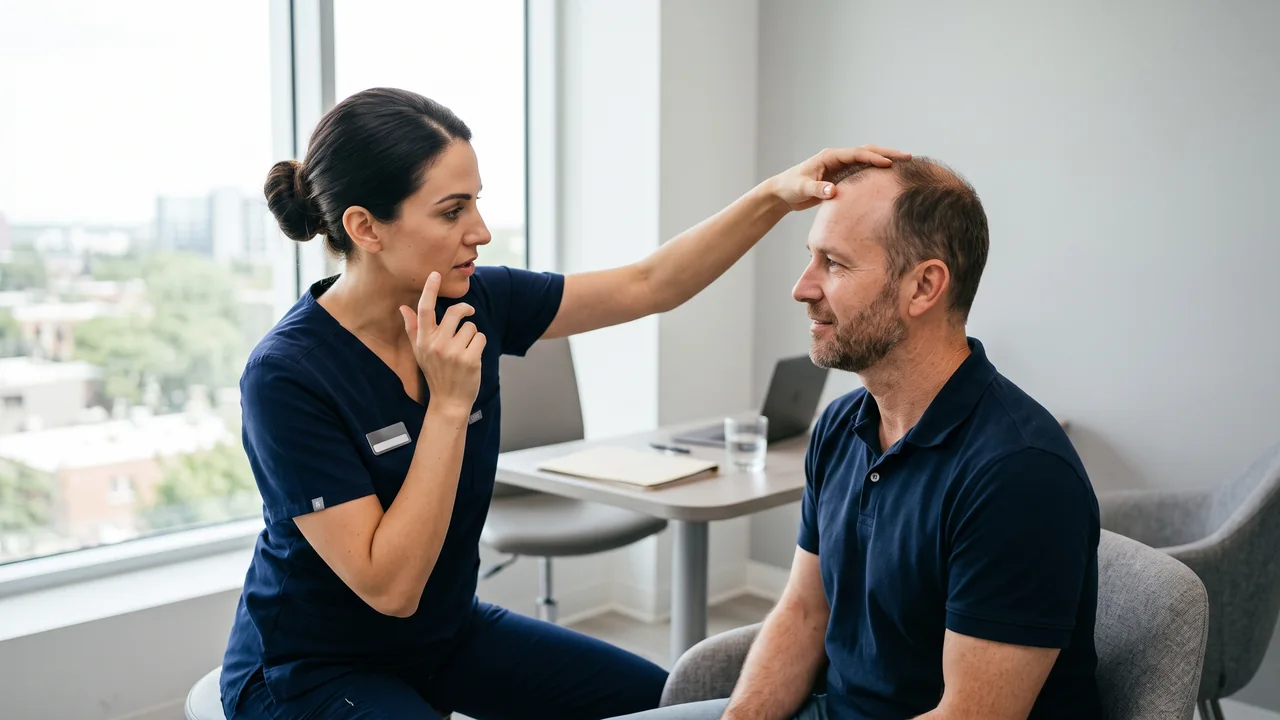
Designing a hairline is an artistic process tailored to each patient's unique anatomy. Our partner surgeons evaluate several factors to create a design that is both aesthetically pleasing and clinically sound. These include:
- Facial Ratios: We apply principles of facial proportion to determine the optimal hairline position, ensuring it balances the upper, middle, and lower thirds of the face.
- Age-Appropriateness: A hairline suitable for a 20-year-old would look unnatural on a 50-year-old. The design must reflect your current age and account for future ageing patterns to ensure long-term naturalness. An excessively low hairline is a common mistake we avoid.
- Forehead Muscles and Expressions: The hairline must be positioned above the frontalis muscle's highest point of contraction. This ensures it looks natural when you make facial expressions, preventing an artificial appearance during movement.
- Existing Hair and Donor Area: The characteristics of your native hair and the capacity of your donor area dictate what is surgically feasible. We design a hairline that integrates smoothly with your existing temporal hair.
- Patient Input and Expectations: A successful outcome requires aligning your aesthetic goals with what is medically achievable. We engage in a detailed discussion to ensure the final design meets your expectations.
We pay specific attention to the frontal temporo-parietal angle (FTPTA), where the frontal hairline meets the temporal points. Recreating this angle correctly is essential for framing the face and avoiding an unnatural, rounded appearance.
The Science of Hairline Design: Follicular Unit Placement and Angulation
While the overall shape is an artistic decision, its execution is a matter of scientific precision. The natural appearance of the final result depends on the meticulous placement, angulation, and distribution of each follicular unit. This technical skill ensures the transplant mimics natural hair growth:
- Irregularity and Micro-Irregularity: Natural hairlines are never perfectly straight. We create subtle undulations and variations in follicle placement to build a soft, irregular edge that avoids a 'pluggy' or 'doll's head' look.
- Single-Hair Grafts for the Leading Edge: The first 1-2 rows of the hairline, known as the transition zone, must be constructed exclusively with single-hair follicular units. These fine hairs create a soft, feathered effect that gradually builds into the denser hair behind it.
- Direction and Angulation: Scalp hair grows at specific angles, not perpendicular to the skin. Our partner surgeons create recipient sites that match the natural forward and downward direction of hairline hair, ensuring the new growth integrates seamlessly.
- Density Gradient: A natural hairline is not uniformly dense. It begins with lower density at the very front and gradually increases over the first centimetre. This gradient is crucial for an undetectable transition from skin to hair.
The surgeon's ability to apply these scientific principles is what transforms the design from a drawing on the scalp into a living, natural-looking hairline.
Achieving Authenticity: Core Principles for a Natural Hairline
Several core principles distinguish a natural-looking hairline from an artificial one. This table summarises the key characteristics our partner surgeons achieve versus the common pitfalls to avoid.
| Characteristic | Natural Hairline (Ideal) | Unnatural Hairline (Avoid) |
|---|---|---|
| Shape | Slightly irregular, soft, subtle undulations | Perfectly straight, unnaturally curved, or too geometric |
| Density | Gradual transition from sparse (single hairs) at the front to denser behind | Abrupt, dense line of hair from the very front |
| Hair Direction | Hairs grow forward and slightly down, fanning out naturally | Hairs grow uniformly perpendicular to the scalp, or in an unnatural direction |
| Graft Type | Predominantly single-hair grafts at the leading edge | Multi-hair grafts placed directly at the front line |
| Symmetry | Subtle, natural asymmetry (no human is perfectly symmetrical) | Perfect, mirror-image symmetry that looks artificial |
| Age-Appropriateness | Designed to suit the patient's age and anticipated future ageing | Too low or too aggressive for the patient's age, creating a 'youthful' but fake look |
| Transition | Soft, feathered appearance where skin meets hair | Sharp, distinct line, like a 'wall' of hair |
The Surgeon's Expertise: Blending Artistic Vision with Medical Precision
The quality of your hairline is determined almost entirely by the surgeon's skill and experience. The procedure requires a clinician who is both an artist and a technician. The artistic component involves visualising an age-appropriate hairline that complements your specific facial structure. The technical component is the ability to execute that vision with surgical precision.
This means placing hundreds or thousands of individual grafts at the correct angle, direction, and density to create a seamless and natural result. This dual capability is not a given; it is developed over years of specialised practice. At Turkey Hair Center, our partner surgeons have dedicated their careers to mastering both the aesthetic and technical aspects of hair restoration. We combine this medical expertise with a collaborative patient approach to achieve consistently natural outcomes.
Your Personalised Hairline Consultation at Turkey Hair Center
Your hairline design is finalised during a detailed consultation, where our medical assessment and your personal goals are combined. During this critical planning stage at our partner hospital, we perform the following steps:
- Detailed Examination: The surgeon assesses your hair loss pattern, donor area capacity, and the texture of your native hair. We also evaluate your facial anatomy, skin quality, and forehead muscle movement.
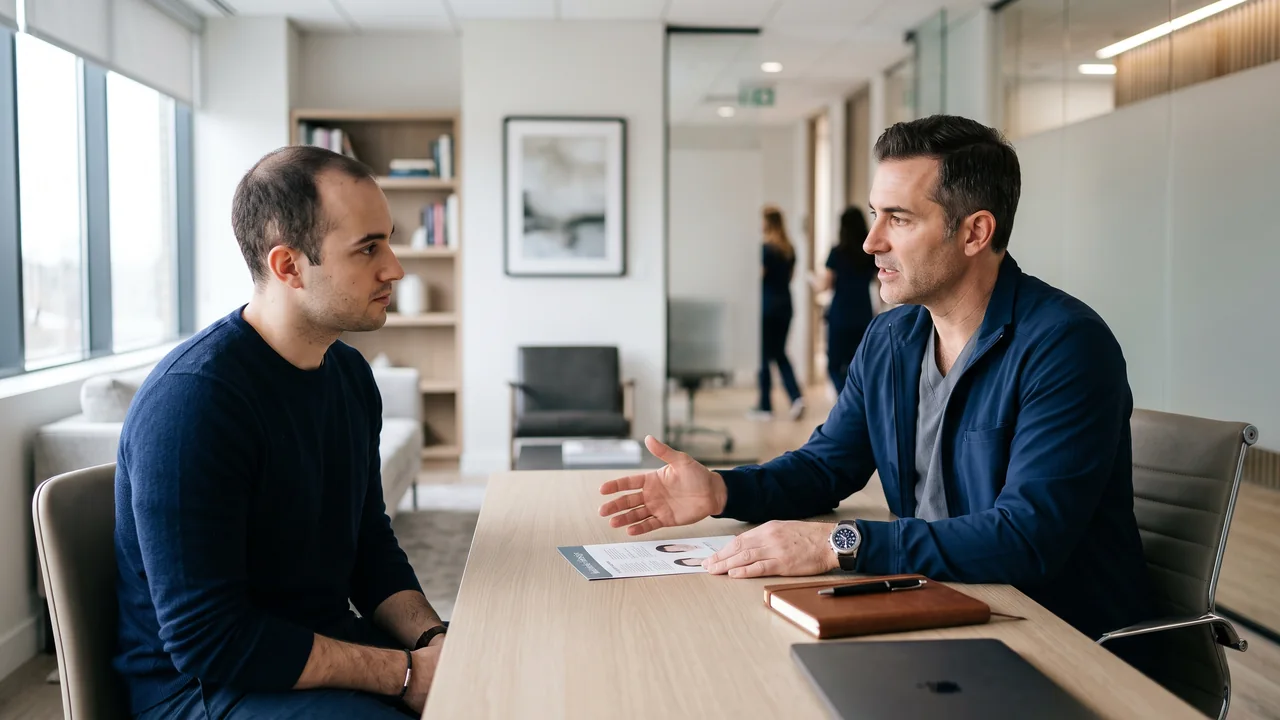
- Discussion of Goals and Expectations: We conduct an open discussion to understand your desired outcome and explain what is realistically achievable based on your individual characteristics.
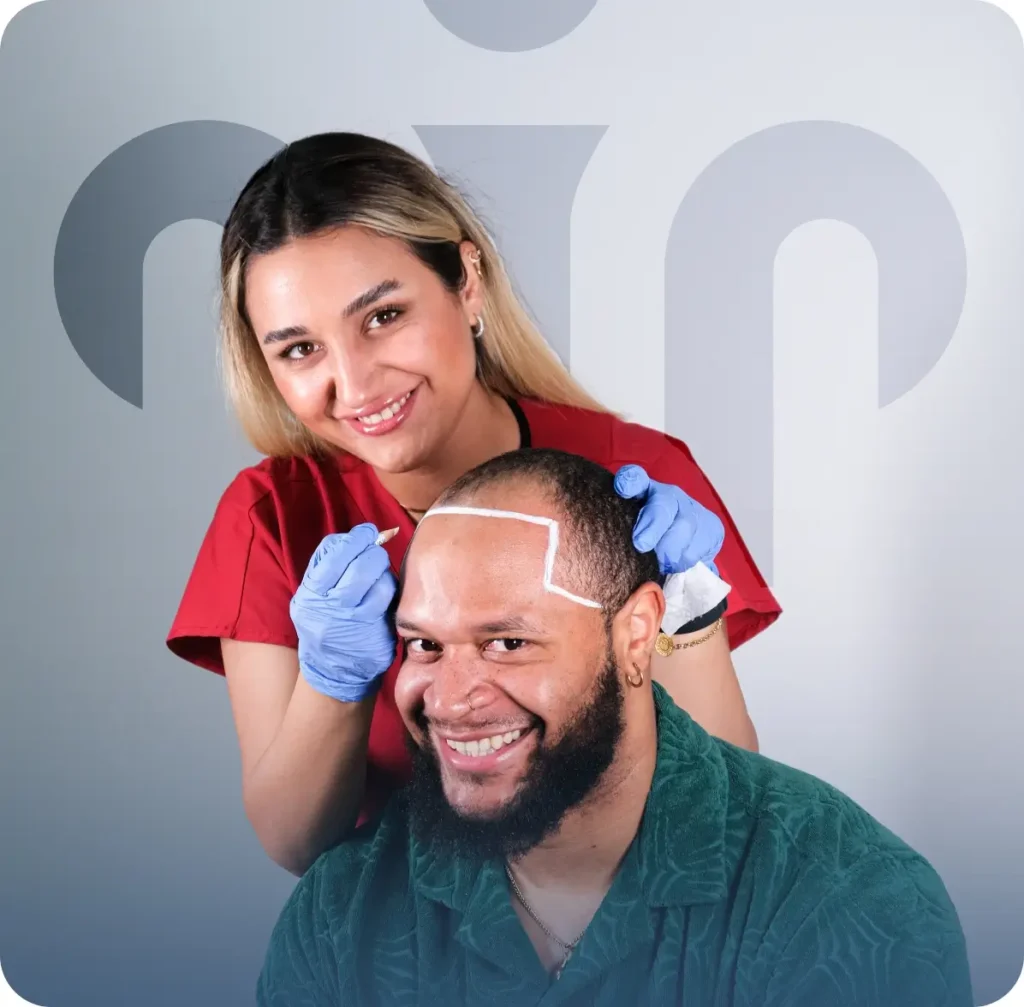
- Hairline Drawing and Refinement: The surgeon will draw the proposed hairline directly on your forehead with a surgical marker. This is an interactive process; you will have a mirror and provide direct feedback as the surgeon adjusts the height, shape, and flow until a final design is mutually agreed upon.
- Photographic Documentation: We take a comprehensive set of clinical photographs to document the agreed-upon design and use it as a precise surgical template.
This meticulous planning ensures that the final design is one you are confident in and that is clinically optimised for a natural, long-lasting result.
From Blueprint to Reality: Executing the Hairline Design
With the design approved, the surgical phase begins. Whether using Follicular Unit Excision (FUE) or Direct Hair Implantation (DHI), executing the hairline requires microscopic precision. After follicular units are extracted from the donor area and prepared, the surgeon begins the implantation phase.
Guided by the design drawn on your scalp, our partner surgeons create recipient sites along the hairline, paying strict attention to four key variables for each individual graft:
- Angle: The site is angled to ensure the hair grows flush with the scalp.
- Direction: The site's orientation follows the natural flow of hair in that specific zone.
- Depth: The graft is placed at the precise depth required for nutrient access and long-term survival.
- Density: The distribution of sites follows the pre-planned density gradient.
The finest single-hair grafts are reserved for the very front to create the soft transition zone. Behind this, follicular units containing 2-3 hairs are used to build natural-looking density. Following the procedure, adherence to our post-operative care instructions is essential for protecting these delicate grafts and ensuring they grow as intended.
Understanding the Investment: Hair Transplant Costs and Value in Turkey
A hair transplant is a significant medical and financial decision. Turkey offers high-quality medical services at costs that are often more accessible than in the UK or Western Europe. For 2026, a hair transplant procedure at a reputable Turkish clinic, including a detailed hairline design, typically costs between £1,800 and £5,500. The final price depends on factors such as:
- Number of Grafts: The primary cost factor is the total number of follicular units required to address your level of hair loss.
- Clinic Reputation and Surgeon's Expertise: Leading clinics with highly experienced surgeons may have higher fees, reflecting a history of successful, high-quality outcomes.
- Included Services: Most reputable clinics provide packages that include the procedure, accommodation, airport transfers, and post-operative medications.
- Technique Used: The specific technique, such as FUE or DHI, can influence the cost, as DHI requires specialised implanter tools and can be more time-intensive.
While cost is an important consideration, the value of a hair transplant is determined by the quality of the result. A low-cost procedure that yields an unnatural hairline is a poor investment. At Turkey Hair Center, we provide a combination of surgical expertise, advanced technology, and comprehensive patient care to deliver results that are both natural and lasting.
Medical disclaimer: This article is for informational purposes only and is not medical advice. Individual results vary from person to person. Always consult a qualified doctor before any hair transplant procedure.
Get a Free Hair Analysis from Our Experts
Use our free online help tool to communicate your hair loss concerns – it only takes a few minutes. We’ll provide you with a personalized, non-binding quote.
Let’s Call You!

Popular Blogs
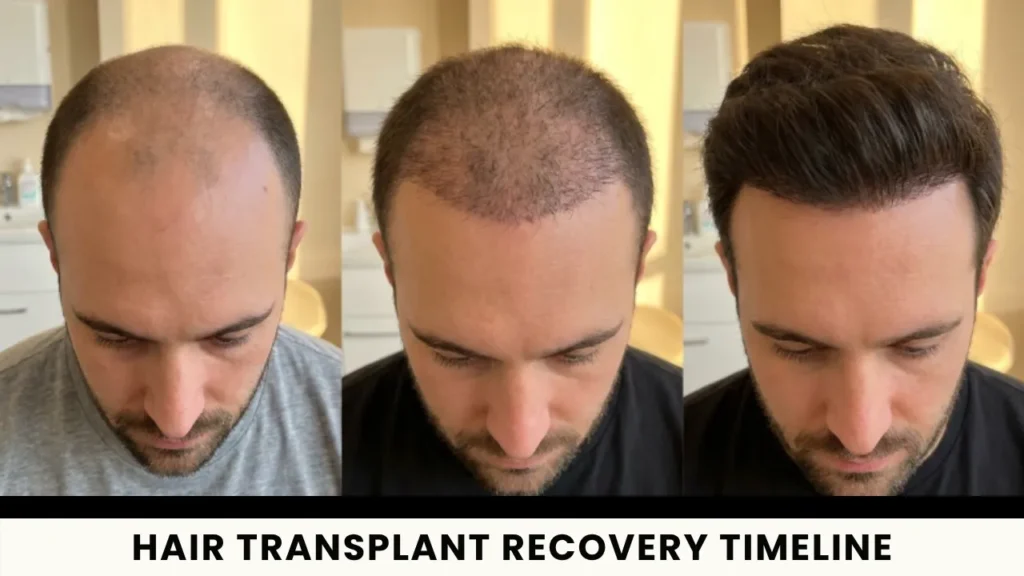
Hair Transplant Recovery Timeline: Day-by-Day, Week-by-Week and Month-by-Month Guide
Hair Transplant Recovery Timeline: Day-by-Day, Week-by-Week and Month-by-Month Guide Free Hair Analysis Homepage Blog Wayne…
Justin Bieber Hair Transplant: Hairline Analysis, Before & After Photos, Rumors & Expert Opinion
Justin Bieber Hair Transplant: Hairline Analysis, Before & After Photos, Rumors & Expert Opinion Free…
Wayne Rooney Hair Transplant: Before & After
Wayne Rooney Hair Transplant: Before & After Free Hair Analysis Homepage Blog Wayne Rooney Hair…
Conor McGregor Hair Transplant: Before & After
Conor McGregor Hair Transplant: Before & After Free Hair Analysis Homepage Blog Conor McGregor Hair…
Turkey Visa Requirements for Hair Transplant in Turkey
Turkey Visa Requirements for Hair Transplant in Turkey Free Hair Analysis Homepage Blog Turkey Visa…
David Silva Hair Transplant: Before & After
David Silva Hair Transplant: Before & After Free Hair Analysis Homepage Blog Discover David Silva…
Ready To
Book Your Appointment?
Reach out to us or complete our simple online form
and we’ll contact you to schedule a time that works perfectly for you.



Frequently Asked Questions