The Role of Artificial Intelligence in Advancing Hair Transplant Precision
Homepage

Blog
The Role of Artificial Intelligence in Advancing Hair Transplant Precision

Medical Reviewed By Dr. Tompi, M.D – Plastic & Aesthetic Surgeon
Written By Nazmi G, Trichologist

Hair transplant surgery, while highly effective, has always relied heavily on the surgeon's skill, experience, and keen eye. However, in 2026, the integration of artificial intelligence (AI) is beginning to redefine the benchmarks of precision, offering unprecedented levels of accuracy and personalisation in hair restoration procedures. This technological leap is not about replacing human expertise, but rather augmenting it, providing surgeons with advanced tools to achieve even more refined and natural-looking outcomes.
At Turkey Hair Center, we continuously evaluate and integrate innovations that enhance patient safety and satisfaction. AI's role in hair transplantation is multifaceted, impacting everything from pre-operative planning and graft analysis to the meticulous creation of recipient sites. By leveraging complex algorithms and machine learning, AI systems can process vast amounts of data, identifying patterns and making predictions that would be challenging or impossible for the human eye alone, thereby elevating the overall quality and consistency of results.
Understanding the Foundation: AI in Medical Imaging and Diagnosis
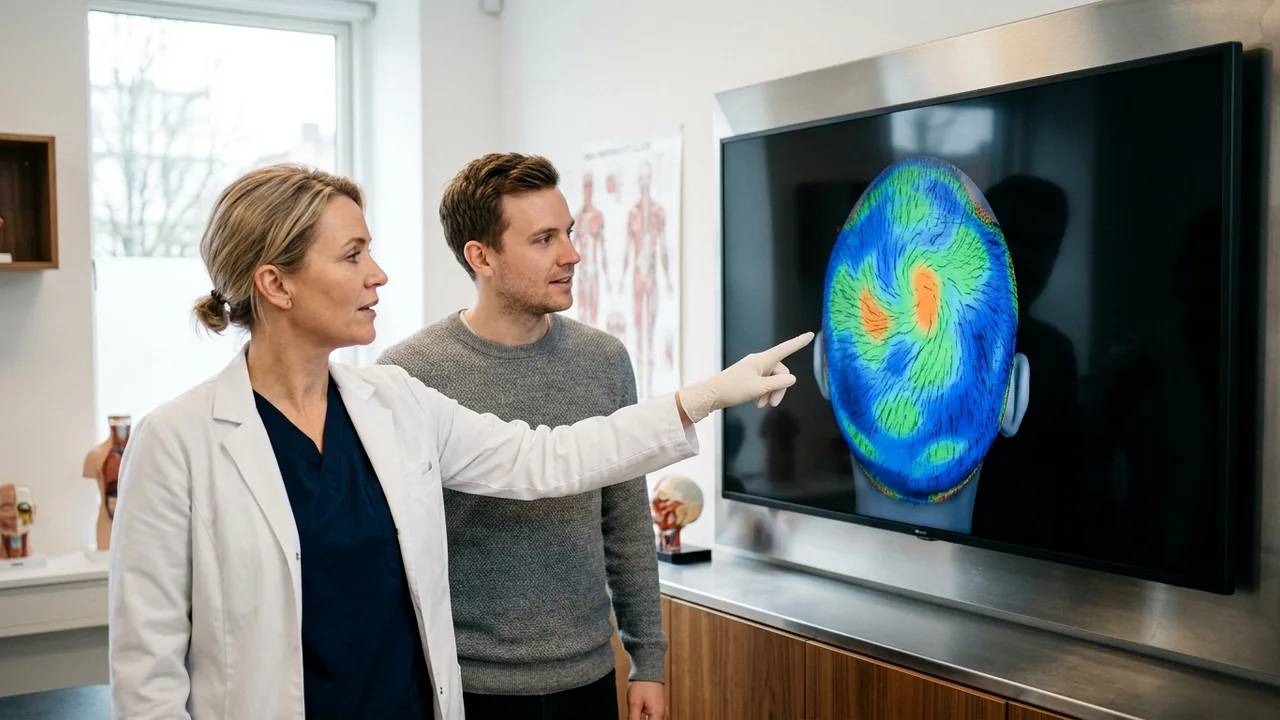
One of the earliest and most impactful applications of AI in medicine, including hair transplantation, is in the analysis of medical images. AI-powered trichoscopy, for instance, allows for a far more detailed and objective assessment of the scalp and hair follicles than traditional methods. High-resolution images of the donor and recipient areas are fed into AI systems, which can then precisely measure hair density, follicle diameter, growth phases, and the presence of miniaturised hairs indicative of future hair loss. This granular data provides a comprehensive map of the patient's hair characteristics, forming the bedrock for highly individualised treatment plans. The system can even identify specific areas that might be prone to further thinning, allowing for proactive planning to ensure long-term stability of the transplanted hair.
Precision in Donor Area Assessment and Graft Selection
The success of any hair transplant hinges significantly on the quality and quantity of grafts harvested from the donor area. Traditionally, surgeons manually estimate the number of grafts and assess their viability. AI algorithms can now analyse the donor area with remarkable precision, calculating the exact number of follicular units available, their distribution, and even predicting the regenerative capacity of the donor site after harvesting. This minimises the risk of overharvesting, which can lead to visible thinning in the donor area. Furthermore, AI can assist in identifying the healthiest, most robust follicular units for extraction, optimising the chances of successful transplantation and growth. For example, some systems can differentiate between single, double, and triple-hair follicular units with greater accuracy than the human eye, ensuring the right graft type is selected for specific areas of the scalp to achieve natural density.
Optimising Recipient Site Design with AI Algorithms
Creating natural-looking recipient sites is an art form, requiring an understanding of hair growth patterns, angles, and density. This is where AI truly shines in enhancing precision. Advanced AI software can generate a personalised 3D model of the patient's scalp, taking into account facial structure, existing hair, and desired hairline. The algorithm then proposes an optimal distribution of grafts, determining the precise angle, direction, and depth for each incision point to mimic natural hair growth. This ensures that the transplanted hair blends seamlessly with existing hair and grows in a direction consistent with the patient's natural pattern. The software can also simulate different hairline designs, allowing patients to visualise potential outcomes before the procedure, providing a clearer expectation and boosting confidence in the planned approach.
Robotic Assistance and AI-Guided Extraction and Implantation
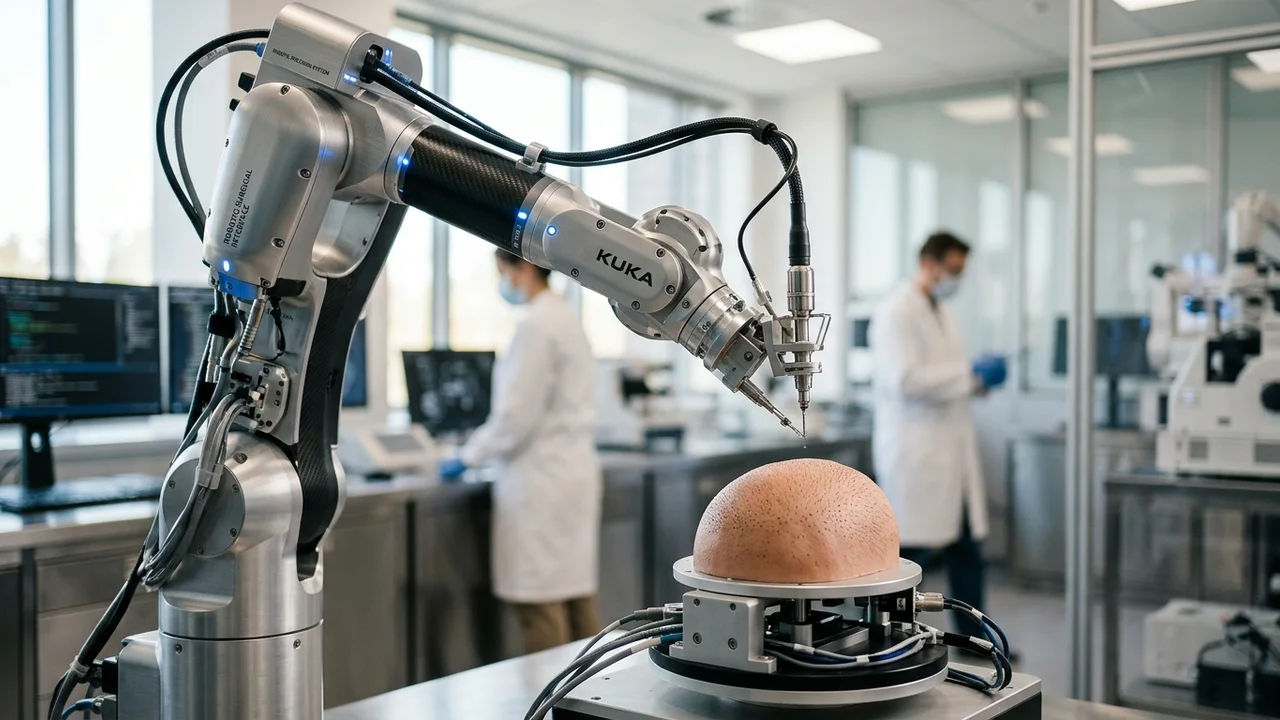
While often conflated, robotic systems are distinct from pure AI but frequently integrate AI for enhanced precision. Robotic hair transplant systems, guided by AI, can perform graft extraction and sometimes even recipient site creation with astonishing accuracy and consistency. For Follicular Unit Extraction (FUE), AI-powered robots can identify and extract follicular units with minimal transection (damage to the graft), leading to higher graft survival rates. The robot's consistent pressure and depth control significantly reduce human error and fatigue, especially during procedures involving thousands of grafts. For implantation, while human surgeons generally retain control for the artistic placement, AI can guide robotic arms or assist manual tools to ensure the precise angle and depth determined during the planning phase are meticulously executed, leading to more uniform and natural density.
Post-Operative Analysis and Predictive Outcomes
AI's utility extends beyond the operating theatre. After the transplant, AI can be used for post-operative analysis, tracking graft survival and growth rates over time with objective measurements. By comparing pre-operative data with periodic post-operative images, AI can assess the success of the transplant, identify any areas that may require further attention, and even predict long-term outcomes more accurately. This continuous monitoring allows for early intervention if needed and provides valuable data for refining techniques. For patients, this means a more data-driven approach to follow-up care and a clearer understanding of their progress. Predictive modelling, powered by AI, can also help patients understand potential future hair loss patterns, enabling them to make informed decisions about preventative treatments.
The Synergy of Human Expertise and AI Technology
It is crucial to understand that AI in hair transplantation is a sophisticated tool, not a replacement for the skilled surgeon. The discerning eye, artistic sensibility, and empathetic judgment of an experienced hair transplant specialist remain paramount. AI provides an unparalleled level of data analysis and precision in execution, but the overarching strategic decisions, the aesthetic vision, and the delicate art of crafting a natural-looking hairline still rest with the human expert. At Turkey Hair Center, our partner surgeons leverage AI to augment their capabilities, ensuring every procedure benefits from both cutting-edge technology and decades of clinical experience. This synergy allows for a level of customisation and precision that was previously unattainable, delivering superior results tailored to each patient's unique needs.
| Aspect of Hair Transplant | Traditional Approach | AI-Assisted Approach |
|---|---|---|
| Donor Area Assessment | Manual estimation, visual inspection | AI-powered trichoscopy, precise density and follicle analysis |
| Graft Selection | Surgeon's visual judgment | AI identifies healthiest, most robust follicular units |
| Recipient Site Design | Surgeon's experience, manual marking | 3D scalp modelling, algorithm-optimised angle/direction/depth |
| Graft Extraction | Manual FUE, potential for human error/fatigue | Robotic FUE with consistent depth/pressure, reduced transection |
| Outcome Prediction | General expectations, surgeon's experience | Data-driven post-op analysis, long-term growth prediction |
The Future of Hair Transplants: Enhanced Precision and Patient Experience
The integration of artificial intelligence is not merely an incremental improvement; it represents a paradigm shift in hair transplant methodology. By bringing a new dimension of precision to every stage of the process, from initial consultation to post-operative care, AI is setting new standards for graft survival, natural aesthetics, and overall patient satisfaction. The ability to precisely map, extract, and implant grafts, guided by intelligent algorithms, reduces variability and elevates the predictability of results. As AI continues to evolve, we anticipate even more sophisticated applications, further enhancing the patient experience and solidifying hair transplantation as a leading solution for hair loss with unparalleled precision.
Medical disclaimer: This article is for informational purposes only and is not medical advice. Individual results vary from person to person. Always consult a qualified doctor before any hair transplant procedure.
Get a Free Hair Analysis from Our Experts
Use our free online help tool to communicate your hair loss concerns – it only takes a few minutes. We’ll provide you with a personalized, non-binding quote.
Let’s Call You!

Popular Blogs
Hair Transplant Recovery Timeline: Day-by-Day, Week-by-Week and Month-by-Month Guide
Hair Transplant Recovery Timeline: Day-by-Day, Week-by-Week and Month-by-Month Guide Free Hair Analysis Homepage Blog Wayne…
Justin Bieber Hair Transplant: Hairline Analysis, Before & After Photos, Rumors & Expert Opinion
Justin Bieber Hair Transplant: Hairline Analysis, Before & After Photos, Rumors & Expert Opinion Free…
Wayne Rooney Hair Transplant: Before & After
Wayne Rooney Hair Transplant: Before & After Free Hair Analysis Homepage Blog Wayne Rooney Hair…

Conor McGregor Hair Transplant: Before & After
Conor McGregor Hair Transplant: Before & After Free Hair Analysis Homepage Blog Conor McGregor Hair…
Turkey Visa Requirements for Hair Transplant in Turkey
Turkey Visa Requirements for Hair Transplant in Turkey Free Hair Analysis Homepage Blog Turkey Visa…
David Silva Hair Transplant: Before & After
David Silva Hair Transplant: Before & After Free Hair Analysis Homepage Blog Discover David Silva…
Ready To
Book Your Appointment?
Reach out to us or complete our simple online form
and we’ll contact you to schedule a time that works perfectly for you.



Frequently Asked Questions