Norwood Scale 3: Where Hair Loss Becomes Visible
Homepage

Blog
Norwood Scale 3: Where Hair Loss Becomes Visible

Medical Reviewed By Dr. Tompi, M.D – Plastic & Aesthetic Surgeon
Written By Nazmi G, Trichologist
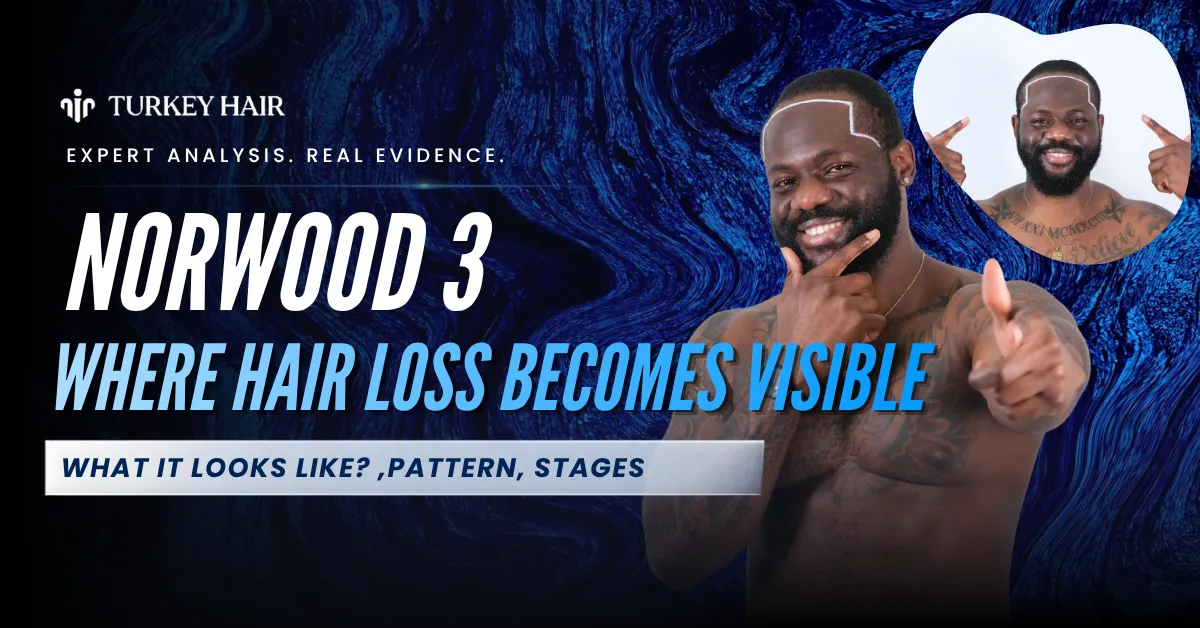

Norwood 3 is the first stage in the Norwood classification described as cosmetically significant baldness . It is characterized by deep, symmetrical recessions at the temples that form a distinct 'M' or 'V' shape on the scalp. While medical treatments are unlikely to restore a fully lost hairline on areas where follicles are no longer producing hair, FDA-approved medications can stop the progression. For those seeking to fully restore the hairline, a hair transplant typically requires between 1,500 and 3,000 grafts depending on the exact size of the balding area.
Norwood 3 Hairline: What It Looks Like
This is the turning point. Up until now, you could hide your receding hairline. A little styling here. A longer fringe there. Not anymore.
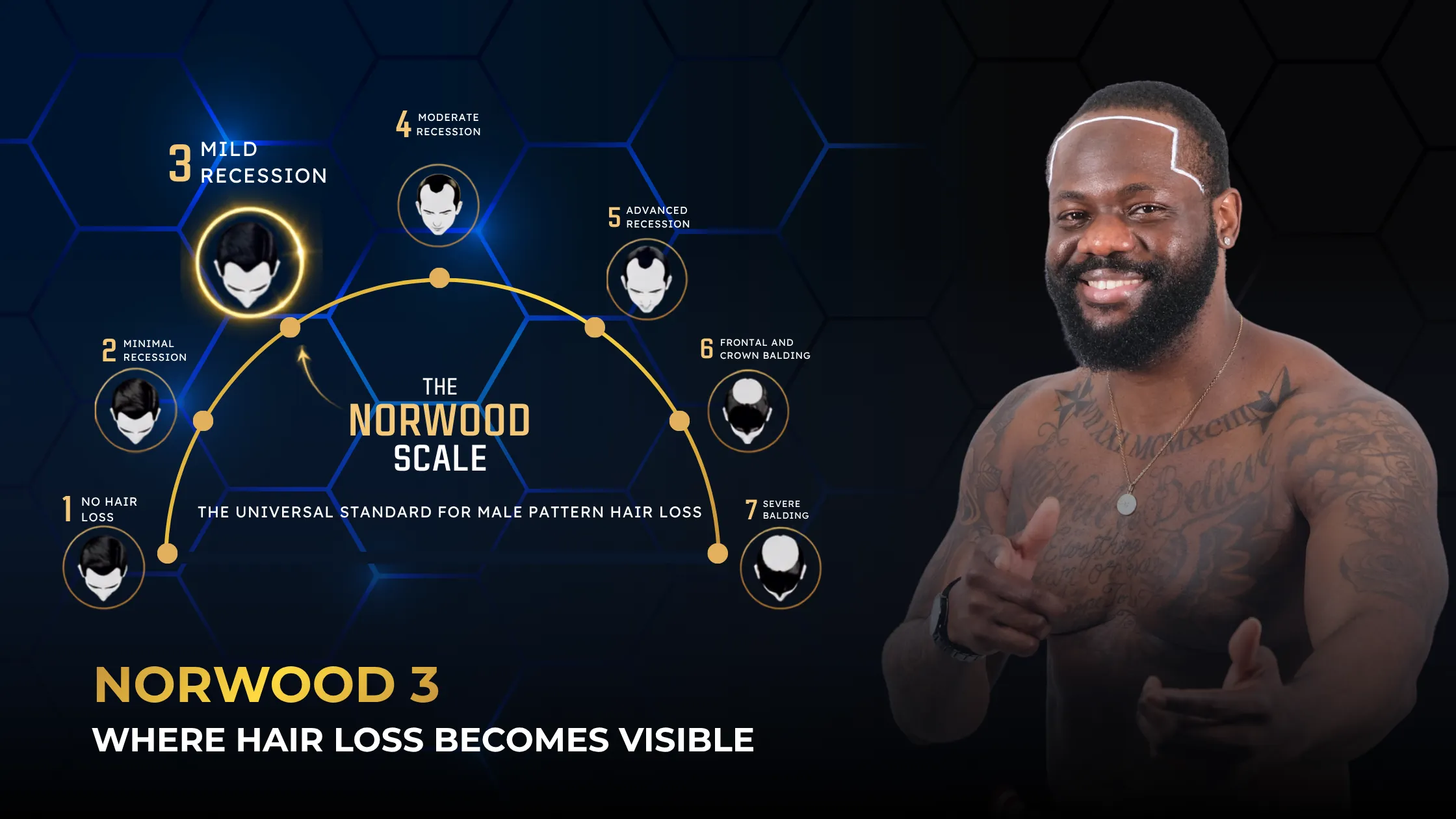
Dr. O'Tar Norwood explicitly defined Stage 3 as the first stage in the Norwood classification described as cosmetically significant baldness [3-https://pubmed.ncbi.nlm.nih.gov/1188424/]. The recession at your temples becomes deep and obvious. The hair on the sides of your head remains thick, but the front pulls back aggressively.
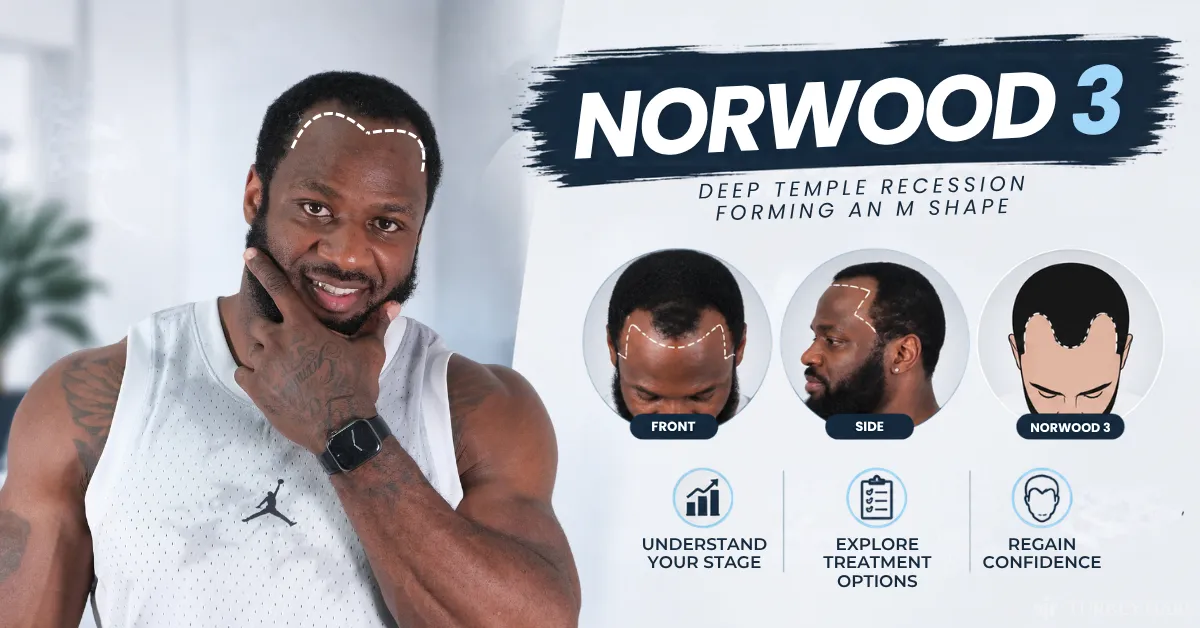
The 'M' Shape Hairline
The frontal temporal zones (your temples) lose their terminal hairs. They shrink. They turn into thin fuzz. Then they disappear entirely. The central patch of hair at the very front of your head usually stays intact, creating that distinct 'M' pattern.
What Do Norwood 3A and 3.5 Mean?
You may also see terms such as Norwood 3A or 3.5 online. These are informal descriptions rather than separate stages in the original Norwood classification. A "3A" usually describes a hairline receding straight back without the isolated 'island' of hair in the front middle. You might also spot mentions of Norwood 3 diffuse thinning, which just means overall lower density across the top, alongside the receding temples.
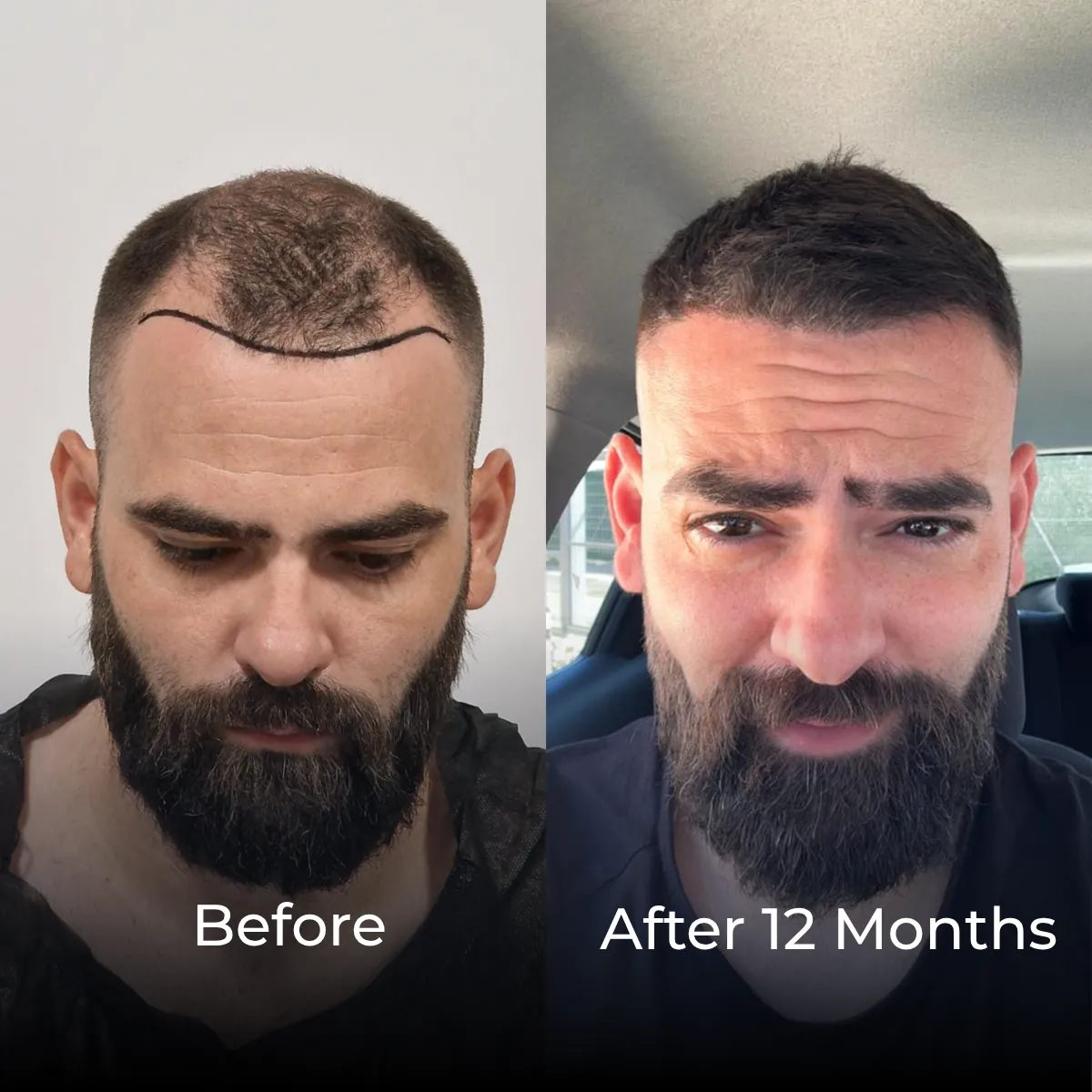
Norwood 3 vs Norwood 3 Vertex Pattern
Not all Norwood 3 patterns are identical. There is a specific sub-stage that completely changes how doctors plan your treatment.
The difference lies at the back of your head. Standard Norwood 3 only affects the frontal hairline. Norwood 3 Vertex (sometimes called 3V) means you have that exact same deep temple recession, but a separate bald spot has also started forming on your crown. Two distinct problem areas.
Why the Vertex Matters
If you have a vertex pattern, you are losing hair in two different zones simultaneously. This requires more aggressive medical protection and completely changes surgical graft calculations.
Norwood 3 vs Norwood 3 Vertex
Feature | Norwood 3 | Norwood 3 Vertex |
Separate bald spot | No visible thinning | Yes, on the crown |
Grafts needed | Lower | Higher (two zones to cover) |
Medical urgency | High | Very High |
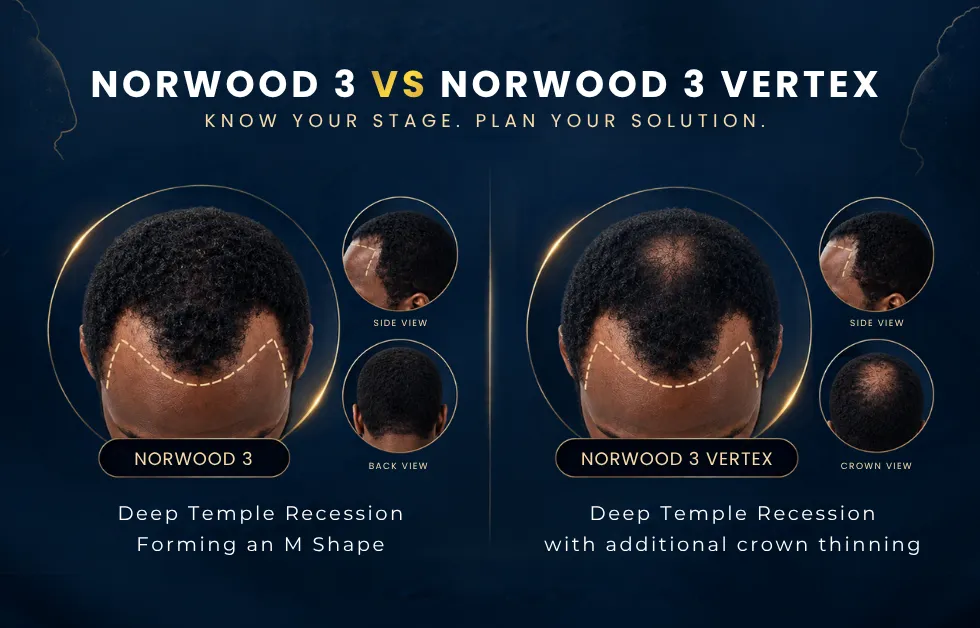
Norwood Scale 3 vs Stages 2 and 4
Figuring out your exact stage is confusing. Hair loss does not happen overnight. It creeps up on you.
Many men spend years wondering if they have a mature hairline or if they are actively going bald. Let's compare the neighboring stages so you know exactly where you stand.
Norwood 2, 3 and 4 Side by Side
Stage | Hairline | Crown | Noticed by others? | Full guide |
Norwood 2 | Slight triangular recession | Untouched | Rarely | Norwood 2 |
Norwood 3 | Deep recession, M-shape | Untouched | Yes, clearly | - |
Norwood 4 | Deep recession, band of hair separating front from crown | Visibly thin | Yes, clearly | Norwood 4 |
Is Norwood 3 Reversible Without Surgery?
We need to be strictly honest here.
Once a follicle is completely lost, medication cannot recreate that follicle. Treatment may still help protect and thicken miniaturized hairs that remain. The hairs bordering your bald spots are currently shrinking. They are weak. Medical treatments like finasteride and minoxidil can force those specific hairs to thicken back up. They stabilize the area. But they are unlikely to restore a fully lost hairline on areas where follicles are no longer producing hair.
VIDEO 1 - Expert trichologist explaining how medical treatments can thicken existing hairs but cannot revive dead follicles at the temples.
Hair Transplant for Norwood 3: How Many Grafts?
Surgery is the physical way to restore hair in areas where sufficient regrowth is no longer expected from medical treatment. But how much hair do you actually need?
Patients constantly ask if 2,000 grafts will be enough. The short answer? Sometimes. A typical Norwood 3 restoration requires between 1,500 and 3,000 grafts. 2,000 grafts can be enough for some standard Norwood 3 cases, particularly when the main goal is restoring the frontal hairline.
The Importance of Temporal Points
Lowering the frontal hairline is only half the job. If a surgeon rebuilds the front but ignores the side triangles—your temporal points—the result looks unnatural. A proper Norwood 3 design connects the new hairline seamlessly into the sides.
Typical Norwood 3 Graft Distribution
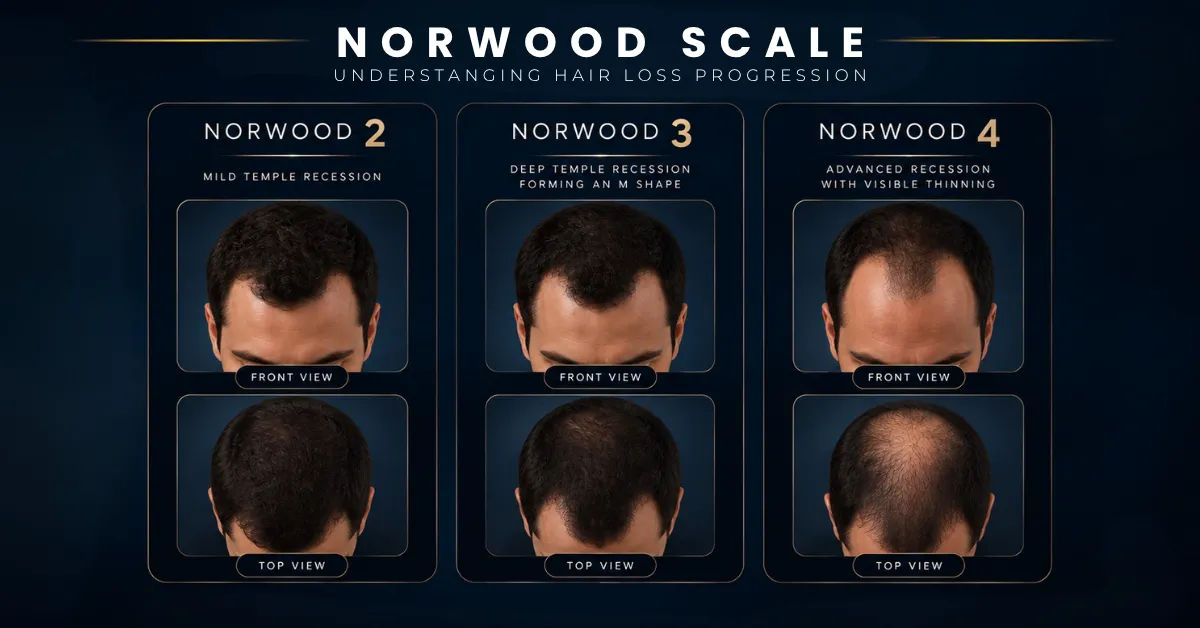
To achieve a completely natural look, surgeons map the scalp into distinct zones. Here is how a standard plan breaks down:
Target Area | Estimated Grafts Required |
Temporal Points (Side triangles) | 400 – 800 |
Frontal Hairline (Corners & front) | 1,200 – 1,800 |
Transition Zone (Blending behind hairline) | 400 – 600 |
Early Vertex Thinning (If 3V applies) | 500 – 1,000 |
The exact number depends on the size of the recipient area, donor density, hair caliber, and desired density. If you have a Norwood 3 Vertex, you will need a higher number to tackle the crown simultaneously.
If you would like a general idea regarding the number of grafts, you can review this guide:
Is Norwood 3 Too Early for a Hair Transplant?
This is a critical question. The answer depends heavily on your age and stability.
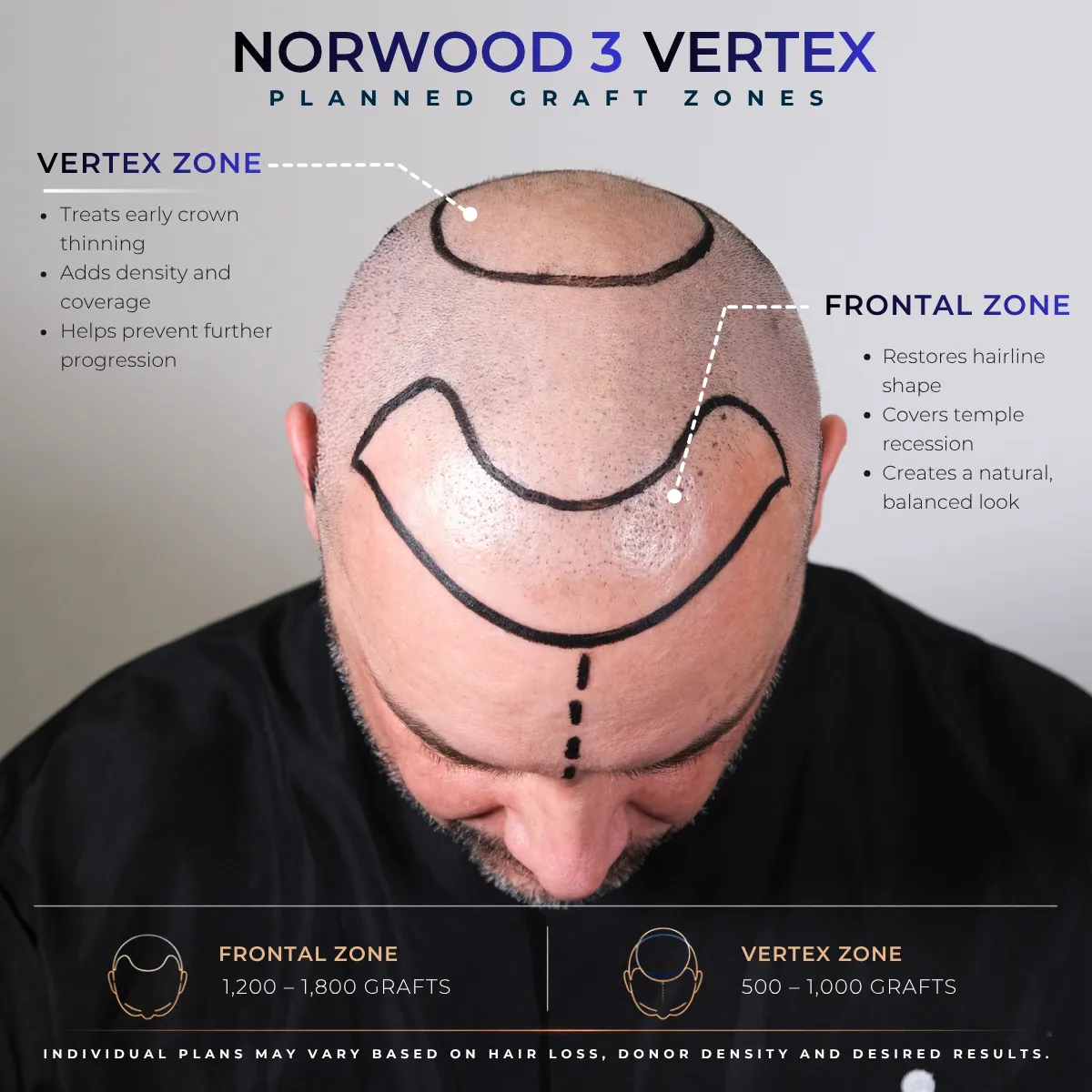
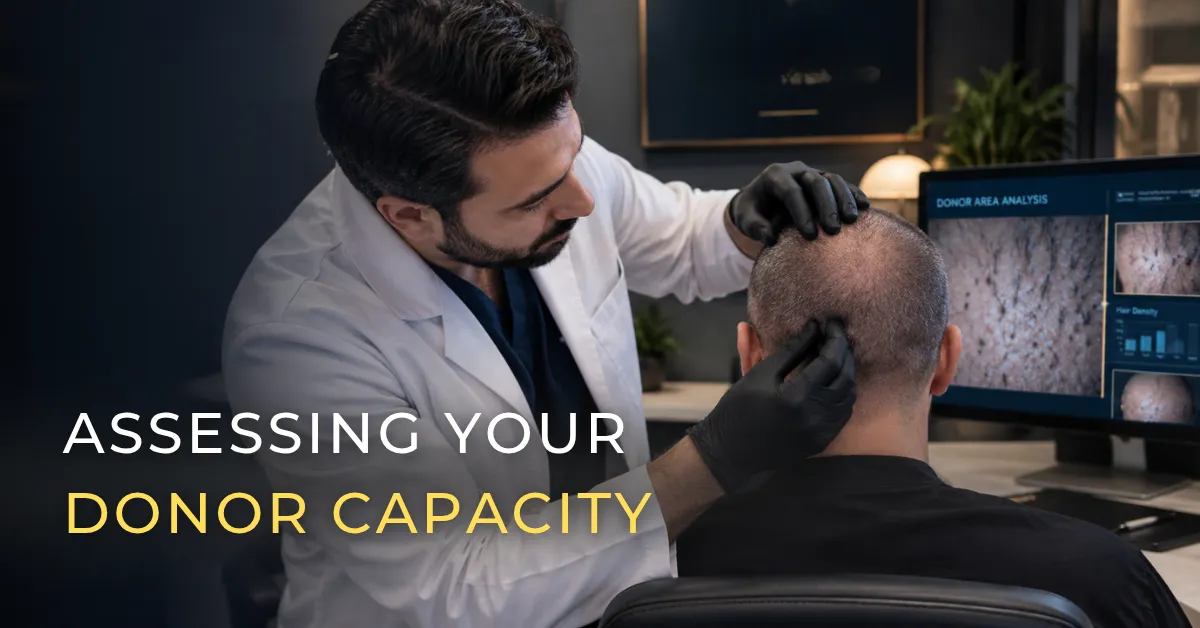
For men in their 30s or 40s, Norwood 3 can be a suitable stage to consider a transplant, provided hair loss and donor capacity have been properly assessed. The loss is visible enough to treat, while many patients may still have sufficient donor hair for restoration.
Reducing Graft Need With Medical Therapy
Leading clinics often advise patients to start finasteride or minoxidil 6 to 12 months before booking a surgery. This is exceptionally important for Norwood 3 Vertex cases. Medications can sometimes thicken miniaturized crown hairs by up to 85%. If the vertex recovers medically, the surgeon only needs to transplant hair into the front temples. This strategy saves thousands of valuable donor follicles for the future.
Surgical Timing for Younger Patients
If you are 22 years old, the approach changes. Getting a transplant under the age of 25 carries unique risks. At 22, however, ongoing hair loss can make long-term planning more difficult. In younger patients, doctors may recommend monitoring hair loss and considering medical treatment before surgery, because continued native hair loss can affect the long-term result. If a surgeon fills in your temples today, you might lose the hair directly behind them tomorrow.
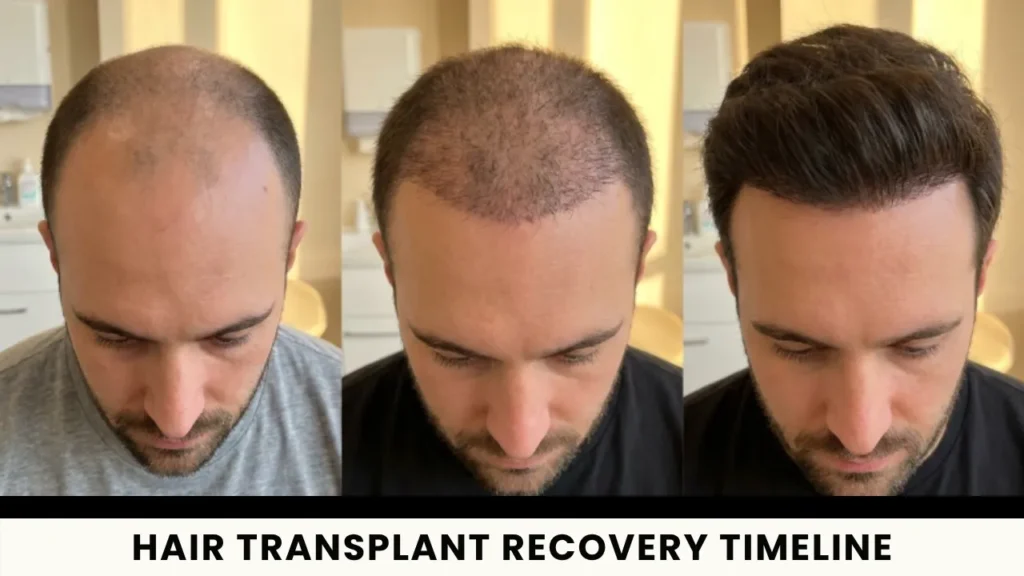
Norwood 3 Hair Transplant Recovery Timeline
Because this stage is often a patient's first hair loss procedure, the recovery process causes a lot of anxiety. Here is exactly what to expect after a temple restoration.
1 to 2 Weeks: Scab shedding and initial healing. The redness in the recipient area begins to fade.
1 to 3 Months: The shock loss phase. The newly transplanted hairs will temporarily fall out. This is a normal biological reaction.
4 to 6 Months: New growth pushes through the scalp. You will start seeing roughly 40% to 50% of the visual change.
12 Months: Final density. The hair shafts mature, thicken, and blend completely with your native hair.
What Norwood 3 Costs to Treat
You have two financial paths here. Maintenance or restoration.
Medical maintenance (like oral finasteride or topical minoxidil) acts as a recurring cost. You pay monthly. Discontinue the medication, and the hair loss process usually resumes [1-https://www.accessdata.fda.gov/drugsatfda_docs/label/2021/020788s028lbl.pdf].
Surgery is a one-time investment. In Turkey, hair transplant pricing is often lower than in the US or UK, but the final cost varies by clinic, graft count, technique, surgeon involvement and what is included in the package. A doctor may also recommend medical treatment to help protect your remaining native hair from future thinning.
You can find detailed information about hair transplant costs in Turkey here:
Hairstyles That Work at Norwood 3
You do not have to shave your head just yet. The right cut hides the recession.
Avoid slicked-back styles. They highlight the 'M' shape instantly. Instead, ask your barber for a textured French crop, a short fringe, or a classic buzz cut with faded sides. Keeping the sides tight reduces the visual contrast between your thick donor hair and your thinning temples.
Want to see exactly what to ask the barber for? Check out our full guide on hairstyles for a receding hairline.

Final Verdict: Your Norwood 3 Action Plan
Do not panic. But do not wait, either.
Norwood 3 is your wake-up call. The days of ignoring your hairline are over. If you are under 25, get to a dermatologist to discuss stabilizing medications. If you are older and tired of hiding your temples, consider a consultation with a qualified hair restoration physician.
A proper assessment can determine whether your donor supply, hair characteristics and long-term hair-loss pattern make you a good candidate. The important part is understanding your pattern before deciding what to do next.
About the Author
Written by Nazmi G., Senior Trichologist & Hair Restoration Consultant. With extensive hands-on clinical experience, Nazmi focuses on patient education around androgenetic alopecia, evaluating miniaturization through dermoscopy, and assessing candidates for medical treatments and hair transplants.
Medical Review Note
Medically reviewed by Dr. Tompi, M.D., Hair Restoration Physician and Plastic Surgeon. This content is for informational purposes only. It does not replace a physical medical diagnosis. Determining your exact hair loss stage and surgical candidacy requires an in-person or direct photo consultation.
Editorial Policy & Trust
We prioritize evidence-based medical reality. We do not promise miracle cures or guarantee specific graft counts without a clinical assessment. Any medical intervention, including DHT blockers or surgery, carries risks and requires formal physician oversight.
References and Medical Sources
Medical disclaimer: This article is for informational purposes only and is not medical advice. Individual results vary from person to person. Always consult a qualified doctor before any hair transplant procedure.
Get a Free Hair Analysis from Our Experts
Use our free online help tool to communicate your hair loss concerns – it only takes a few minutes. We’ll provide you with a personalized, non-binding quote.
Let’s Call You!

Popular Blogs
Hair Transplant Recovery Timeline: Day-by-Day, Week-by-Week and Month-by-Month Guide
Hair Transplant Recovery Timeline: Day-by-Day, Week-by-Week and Month-by-Month Guide Free Hair Analysis Homepage Blog Wayne…
Justin Bieber Hair Transplant: Hairline Analysis, Before & After Photos, Rumors & Expert Opinion
Justin Bieber Hair Transplant: Hairline Analysis, Before & After Photos, Rumors & Expert Opinion Free…
Wayne Rooney Hair Transplant: Before & After
Wayne Rooney Hair Transplant: Before & After Free Hair Analysis Homepage Blog Wayne Rooney Hair…

Conor McGregor Hair Transplant: Before & After
Conor McGregor Hair Transplant: Before & After Free Hair Analysis Homepage Blog Conor McGregor Hair…
Turkey Visa Requirements for Hair Transplant in Turkey
Turkey Visa Requirements for Hair Transplant in Turkey Free Hair Analysis Homepage Blog Turkey Visa…

David Silva Hair Transplant: Before & After
David Silva Hair Transplant: Before & After Free Hair Analysis Homepage Blog Discover David Silva…
Ready To
Book Your Appointment?
Reach out to us or complete our simple online form
and we’ll contact you to schedule a time that works perfectly for you.



Frequently Asked Questions