Sapphire FUE Hair Transplant in Turkey: Cost & Results
How Sapphire FUE differs from classic FUE, what the studies on sapphire slits found, our all-inclusive prices and the recovery month by month, with published sources and a free photo assessment.
Sapphire FUE is an FUE hair transplant in which the channels for the grafts are opened with a sapphire slit instead of a metal one. A Sapphire FUE hair transplant in Turkey with our team takes one day of 6 to 8 hours under local anaesthetic and costs $2,550 to $4,500 as an all-inclusive package. It suits most men and women with stable pattern hair loss and a healthy donor area.
The sapphire slit is one tool in one step. Whether you get a good result depends far more on your donor area, the hairline design and how the grafts are handled, so this guide also covers what the studies on sapphire actually found.
Short answer
Sapphire FUE takes grafts one by one, exactly as classic FUE does, and opens the small channels that receive them with a sapphire slit. All our FUE packages use sapphire slits, so it costs nothing extra: $2,550 to $4,500, all-inclusive. The operation takes 6 to 8 hours, new hair shows from about month 3 or 4, and the final result takes 12 to 18 months.
Sapphire FUE at a glance
Package price
$2,550-$4,500, all-inclusive
What is different
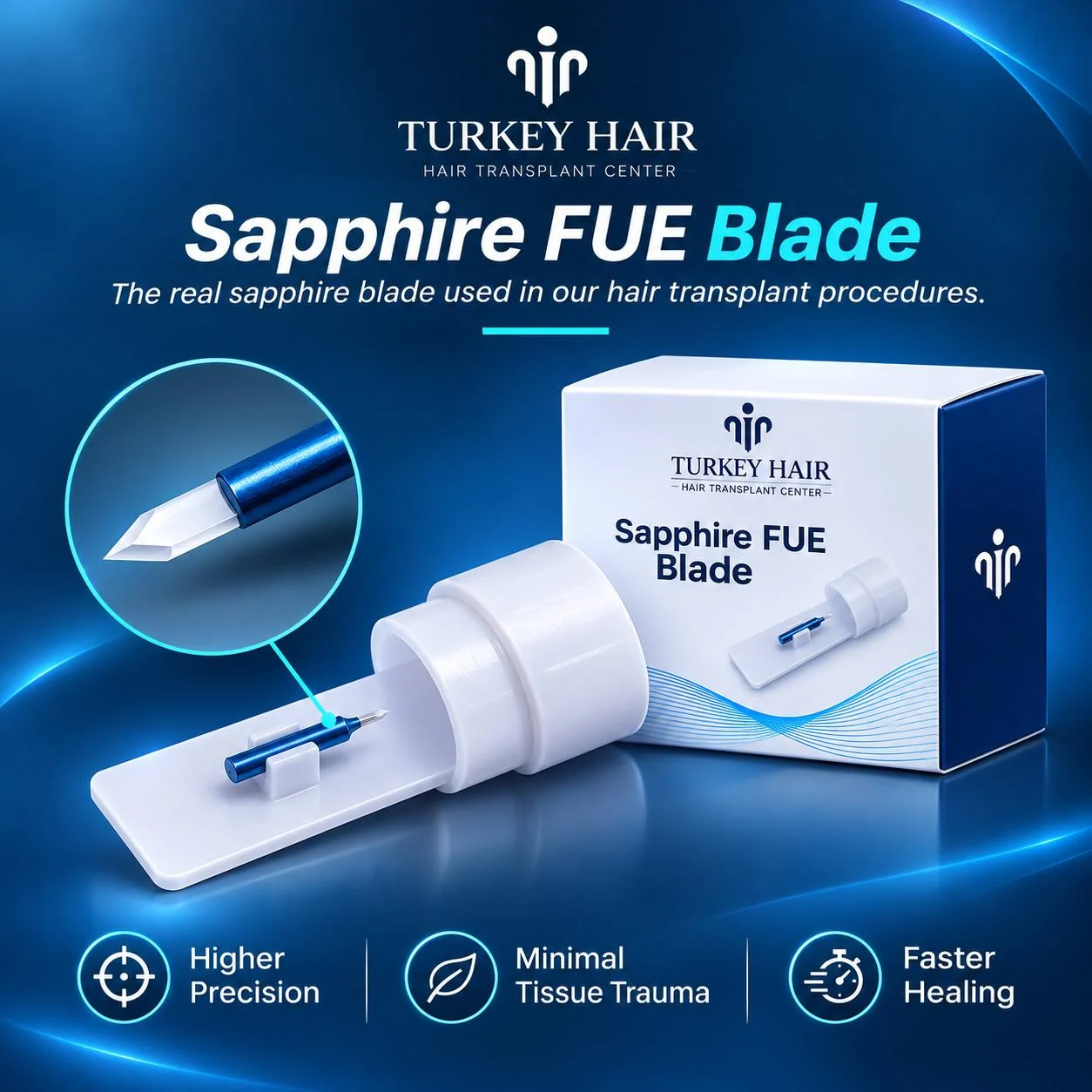
Channels opened with sapphire slits, not metal slits
Extraction
One by one, micromotor device, punches about 0.7-1.2 mm
Operation
One day, about 6-8 hours, local anaesthetic with sedation support
Number of grafts
Set at your assessment, by your hair loss and donor area
Included stay
2 hotel nights, VIP transfers, next-day check-up
Time off work
Plan for 1-2 weeks
Visible growth
From about month 3-4
Final result
Usually 12-18 months
Free self-check
How many grafts would you need?
Find your Norwood stage and graft range. Free, no sign-up.
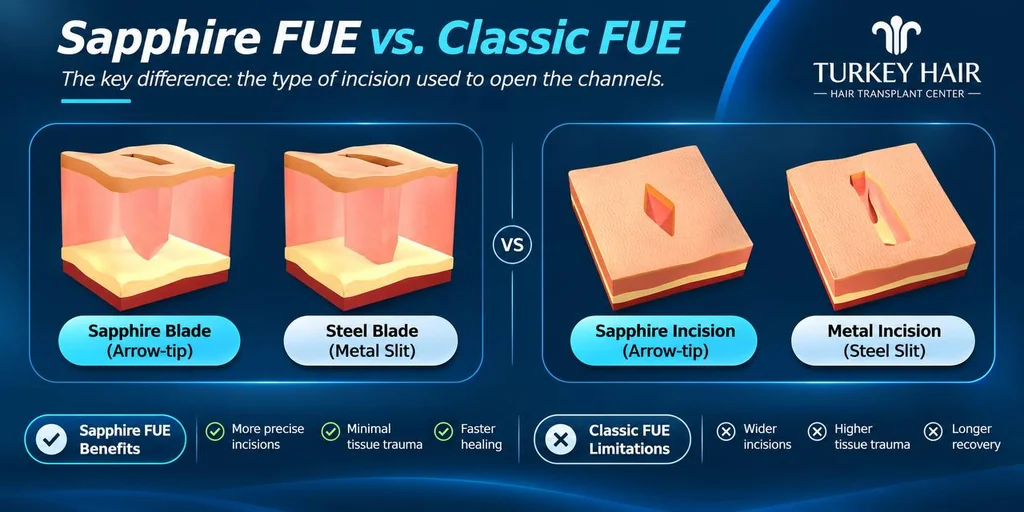
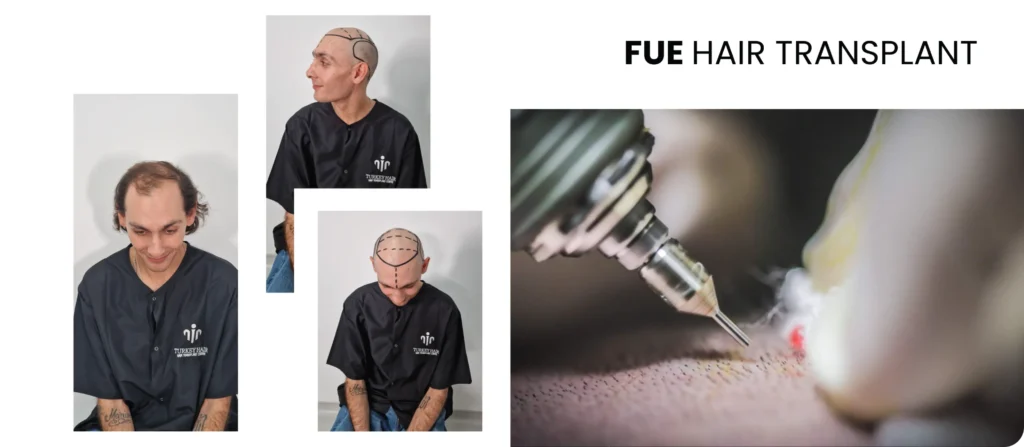
A Sapphire FUE hair transplant is classic FUE with one change: the recipient channels, the tiny incisions that hold each graft, are opened with a sapphire tip. The grafts are taken, sorted and placed as in any FUE, and the moved hair grows the same way.
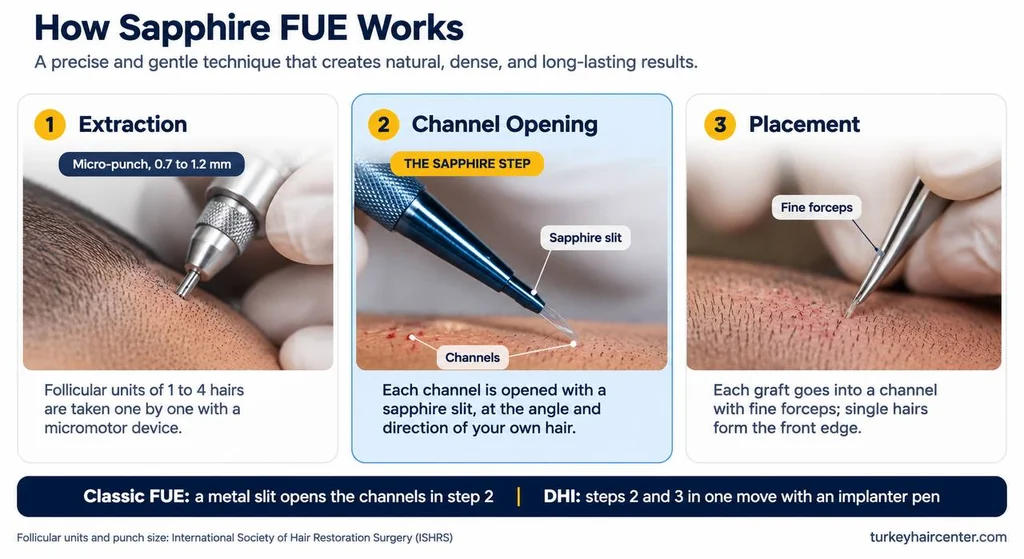
Surgeons either open the recipient sites before the grafts go in or make each one as it is filled.[1] With us, the doctor opens the channels in the thinning area and follows the angle and direction of your own hair.
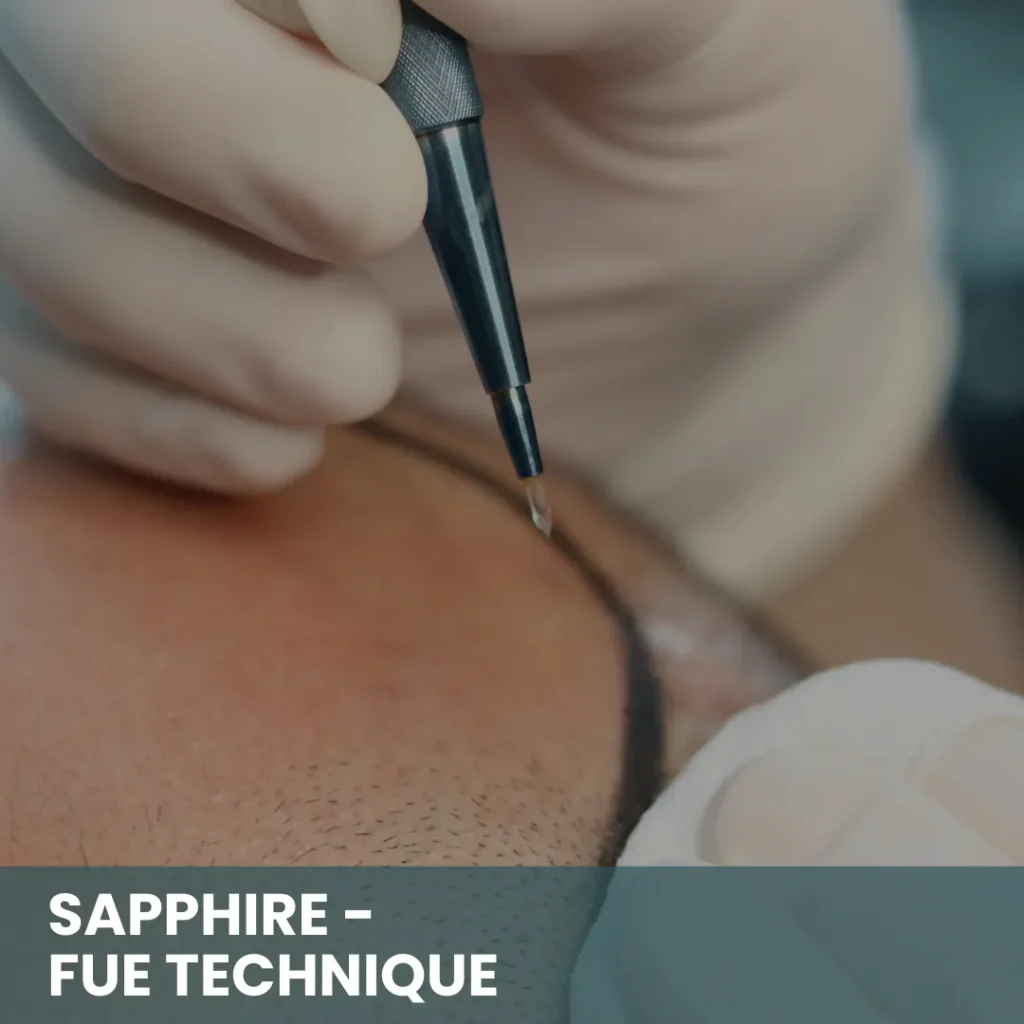
Sapphire FUE: each recipient channel is opened with a sapphire slit.
The Extraction Is the Same as Classic FUE
Nothing changes at the back of your head. Follicular units, natural groups of one to four hairs, are taken one by one with a micromotor device and punches that span about 0.7 to 1.2 mm.[2] The donor area heals with tiny dot scars, as in any FUE hair transplant.
Micro Sapphire FUE and Bio Sapphire: What the Names Mean
These are names for the same idea, not separate operations. Micro Sapphire usually points to a fine sapphire tip, and Bio Sapphire to Sapphire FUE with a supportive treatment such as PRP, which all our packages include.
Sapphire vs Steel Slits: What Three Studies Found
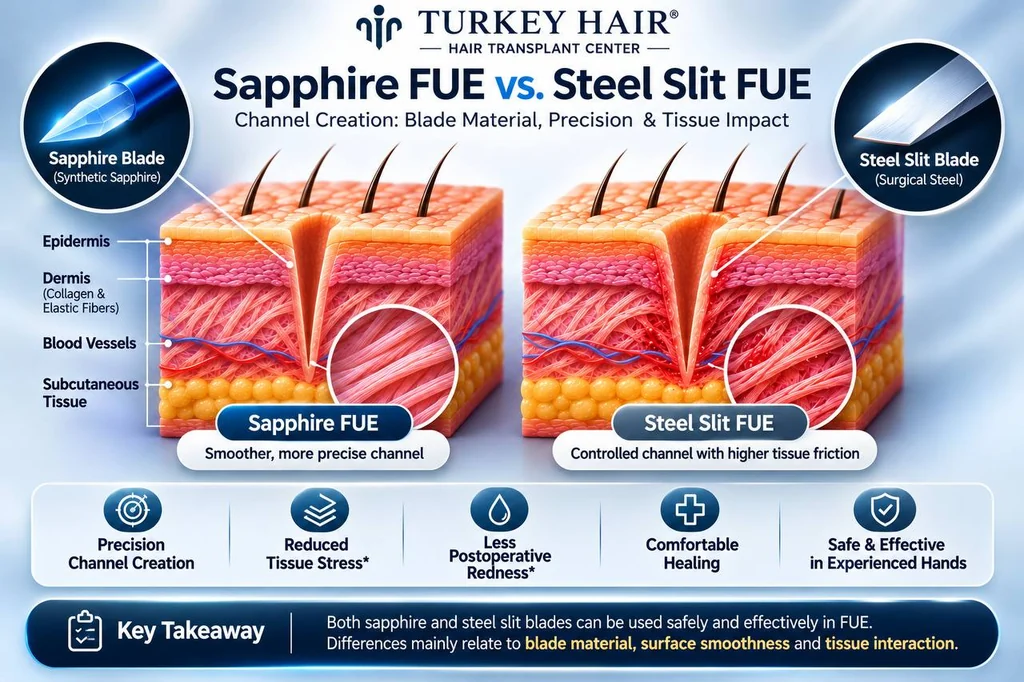
Sapphire slits may cause less damage than steel ones, but the evidence is small and points both ways. We found three studies that compare the two directly, and none of them is a randomised trial:
Study
What was compared
What it found
1,000 patients, India, 2026
What was compared
Sapphire and steel slits in an observational study
What it found
Graft survival of 94.7% with sapphire and 88.9% with steel[3]
12 patients, Turkey, 2023
What was compared
Sapphire on one side of the scalp, handmade razor slits on the other, blood flow measured
What it found
Significantly less tissue damage on the razor-slit side[4]
Mathematical model, 2021
What was compared
Wound surface of five tip shapes at four angles, no patients
What it found
A 30° sapphire tip made the smallest wound, a rectangular tip the largest[5]
Read together, they do not settle the question. The large study favours sapphire, but its groups were not assigned at random, so other differences may explain part of the gap. The small split-scalp study, the only one that measured blood flow, favoured the handmade slits. The model adds that a shallower entry angle cuts less tissue whatever the tip.[5]
Is Sapphire FUE Better Than Classic FUE?
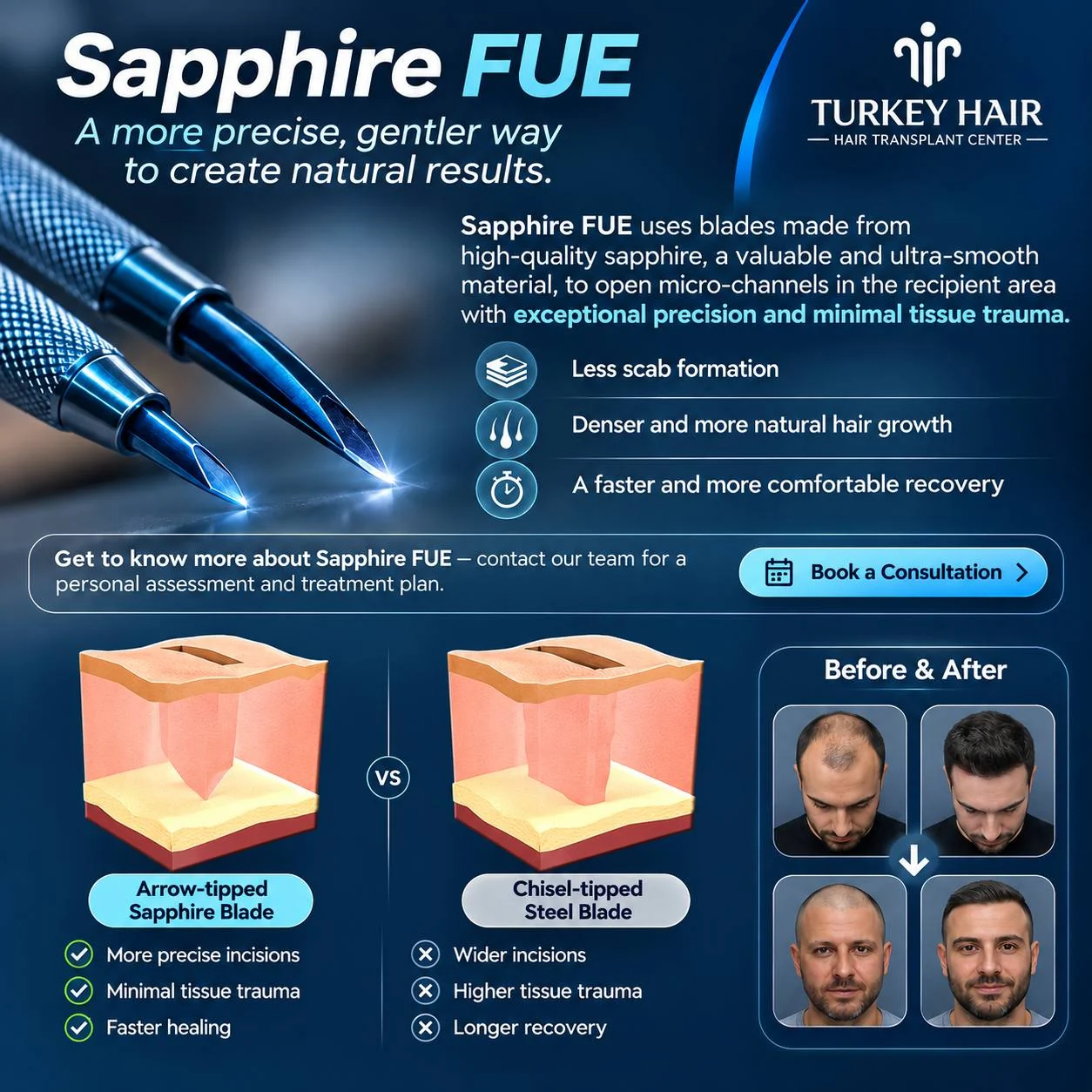
Not in any way that has been proven. A sapphire tip makes small, clean openings, which helps the doctor control angle and spacing, but the gap in results between the two methods has not been confirmed by a randomised trial. What decides a result is the plan, graft handling and your donor area. Our own position is simple: every FUE package we offer already uses sapphire slits, so you do not have to choose or pay more.
Does Sapphire FUE Heal Faster?
Possibly a little, but the faster healing claimed for sapphire has not been measured in a way we could check. In the 1,000-patient study the summary reports graft survival for each slit type, not healing time.[3] Plan for the same recovery as any FUE: small crusts for about 7 to 14 days and 1 to 2 weeks off work.
Who Is a Good Candidate for Sapphire FUE?
You are a good candidate if your pattern hair loss has slowed down and you have enough healthy hair at the back and sides to move. A donor supply and a scalp that can still grow hair matter most.[6] You are usually a good fit if:
Your hair loss runs in your family and follows a pattern.[7]
Your hair loss has slowed, ideally with medical treatment such as finasteride or minoxidil.[2]
Your donor area can supply this session and keep a reserve for later.
Conditions such as diabetes or high blood pressure are under control; the blood tests check them.
You expect natural density, not the hair you had at 18.
What Can Rule You Out?
A transplant is not advised when your donor area is too thin to supply the grafts you need, or when the thinning area can no longer grow hair. Patchy hair loss such as alopecia areata is usually not treated with a transplant,[7] and men in their twenties are often asked to start medication and wait.[6]
Smoking does not rule you out, but it was the most common risk factor in a series of serious healing problems,[8] and a 2026 review advises stopping at least a month before surgery.[9]
Sapphire FUE for Women
Women can have Sapphire FUE when the thinning is stable and the donor area is strong, for example with a high hairline or thin temples. Diffuse thinning over the whole top needs a medical check first; see hair transplants for women.
Sapphire FUE for Curly and Afro-Textured Hair
Sapphire FUE works on curly and Afro-textured hair, with more care at each step. The follicle curves under the skin too, so each graft takes longer to remove whole. Our Afro hair transplant page explains how we plan these cases.
Sapphire FUE Benefits and Limitations
The benefits of Sapphire FUE are real but modest, and they come from the tool, not from a different operation. Where it helps:
A sharp sapphire tip makes small, clean openings, which suits closely spaced work at the hairline.
The doctor controls the angle and direction of each channel, the detail that makes a hairline look natural.
Like all FUE, it leaves tiny dot scars instead of a line, so you can keep your hair short.[7]
With us it carries no extra cost: our lowest-priced package, Sapphire Prime, already uses sapphire slits.
Where it has limits:
No randomised trial has shown better results than with metal slits, and one small study found less tissue damage with handmade slits.[4]
Dense packing is limited by your blood supply, whatever opens the channels; very dense or deep, overlapping slits raise the risk of skin damage.[9]
The donor supply is finite, and the donor area is usually shaved.[2]
It does not stop your own hair from thinning around the grafts.[6]
Is Sapphire FUE Worth It?
Yes, if FUE suits you in the first place; the sapphire slit is a sensible tool, not a reason to choose a provider. Judge the offer by who designs your hairline, how many grafts are planned and from where, and what aftercare you get.
How Sapphire FUE Is Performed, Step by Step
Sapphire FUE is done in one day with no overnight hospital stay, usually in 6 to 8 hours. This is the whole process with our team:
Free photo review. From your photos, the medical team suggests the technique, a graft range and the package.
Arrival and medical check. A driver takes you to the hotel; blood tests and a medical review come first.
Hairline design. The doctor draws your new hairline; you check it in the mirror and agree to it.
Local anaesthetic. The donor and recipient areas are numbed, with sedation support if you want it.
Extraction. Grafts come out one at a time with a micromotor device and are kept cool.
Channels. The doctor opens the channels with sapphire slits, following the angle and direction of your own hair.
Placement. The grafts go in with fine forceps: single hairs at the front edge, larger grafts behind.
Next-day check. The team removes the dressing, checks the grafts and shows you how to wash.
The new hairline is drawn and agreed before any anaesthetic.
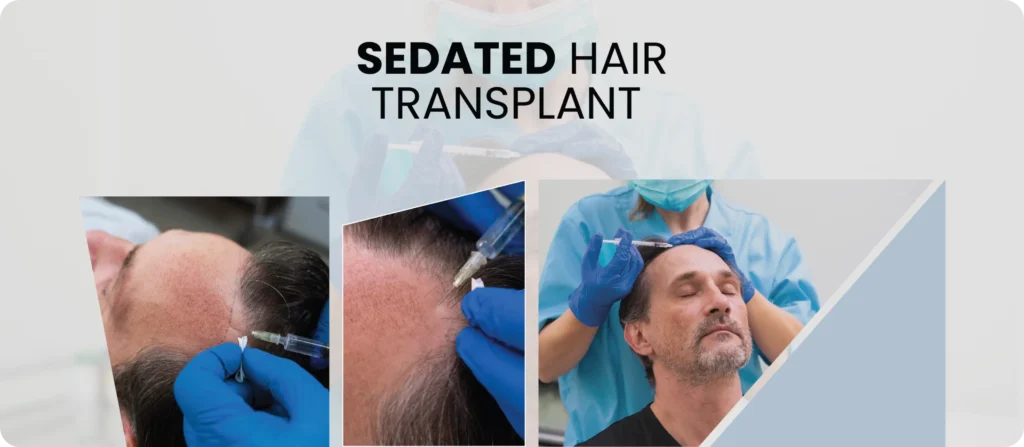
Aftercare does not end at the airport: you send photos at set points, and aftercare consultation continues for 2 years. The diagram below shows the three surgical steps and the one that sapphire changes. Our sedated hair transplant page explains the sedation support in every package.
Only step 2 changes: a sapphire slit instead of a metal one.
How Long Does Sapphire FUE Take?
The operation takes about 6 to 8 hours in one day, with breaks, including one for lunch. Most patients stay two or three nights in total: arrival, the operation day and the next-day check-up. The package covers two hotel nights and the transfers; flights are not included.
Is Sapphire FUE Painful?
Usually only the anaesthetic injections at the start hurt; after that you feel pressure and movement, not pain. A hair transplant is usually done under local anaesthetic and sedation, so you stay awake but should not feel pain.[7] Lying still for hours can stiffen your neck or back, which is what the breaks are for.
You stay awake under local anaesthetic; sedation support is available.
Afterwards a tight, achy and swollen scalp for a few days is expected,[7] mostly at the back, and simple painkillers usually control it. If you are nervous about needles, tell the team before the day.
How Many Grafts Can Sapphire FUE Cover?
There is no standard number of grafts for a Sapphire FUE hair transplant. How many grafts can be harvested depends on your degree of hair loss, the density of your donor area, the quality of your hair follicles and the hair you still have in reserve.
A small area, such as rebuilding the front hairline, may need about 1,000 grafts or fewer. Advanced hair loss at Norwood 5, 6 or 7 needs far more, and in some suitable patients the total reaches 4,000 to 5,000 grafts or more. That does not mean every donor area can give this many, or that all of them can be transplanted in a single session.
Older techniques set a hard limit. In FUT, the follicles came from a strip of skin cut from the donor area, so the number of grafts depended on the size of the strip and its density. In FUE, a micromotor device takes follicles one by one, in a controlled and balanced way, from different points of the donor area. In suitable patients this opens up a wider part of the donor area, but a micromotor does not make the supply unlimited.
When a plan is split into two sessions, they are usually at least 12 months apart, so the first result and the donor area can be judged before the second. Typical numbers by Norwood stage, the 1 to 7 scale of male pattern hair loss:
Norwood stage
Approximate grafts
Usually done in
Norwood 2
Approximate grafts
800-1,500
Usually done in
One session
Norwood 3
Approximate grafts
1,500-2,500
Usually done in
One session
Norwood 3 vertex
Approximate grafts
2,000-3,500
Usually done in
One session
Norwood 4
Approximate grafts
3,000-4,500
Usually done in
One session
Norwood 5
Approximate grafts
4,000-5,500
Usually done in
One session, sometimes two
Norwood 6
Approximate grafts
5,000-6,500+
Usually done in
Often two sessions
Norwood 7
Approximate grafts
Set by the donor area
Usually done in
Planned in stages
The ranges come from our guide to how many grafts you need, and they are the same on our FUE and DHI pages.
How Much Will 3,000 Grafts Cover?
In our ranges, 3,000 grafts covers Norwood 3 with thinning at the crown or the lower end of Norwood 4, and it is more than a hairline alone usually needs. A graft is a follicular unit of one to four hairs, so 3,000 grafts carry well over 3,000 hairs.[2] Our 3,000 grafts guide shows the area in more detail.
Is 4,000 Grafts Overharvesting?
Not in itself; the limit is your donor area, not a fixed number. Overharvesting means taking too many grafts from one place or from outside the safe donor zone, and it leaves a thin, patchy back of the head that is very hard to correct.[2] We set the count only after examining your donor area.
Sapphire FUE vs FUE vs DHI
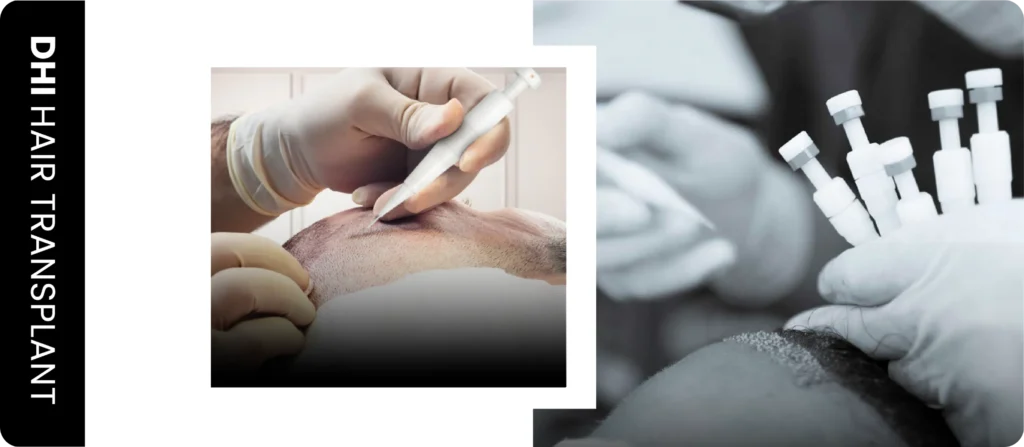
All three take the grafts the same way; they differ in how each graft goes in. Classic FUE and Sapphire FUE open the channels first and place the grafts with forceps, while DHI loads each graft into an implanter pen and places it in one move.
Technique
How grafts are taken
How grafts are placed
Often chosen for
Our price
Classic FUE
How grafts are taken
One by one with a micro-punch
How grafts are placed
Forceps, into channels opened with metal slits
Often chosen for
Most patterns and large sessions
Our price
Not offered; our FUE packages use sapphire slits
Sapphire FUE
How grafts are taken
One by one with a micro-punch
How grafts are placed
Forceps, into channels opened with sapphire slits
Often chosen for
Most patterns; used in all our FUE packages
Our price
$2,550, $3,000 or $4,500
DHI
How grafts are taken
One by one with a micro-punch
How grafts are placed
Implanter pen, without channels made first
Often chosen for
Dense packing between existing hair, smaller areas
Neither is better for everyone. Sapphire FUE opens all the channels before placement, which suits large areas that need even coverage, while DHI gives fine control between existing hair and in smaller zones, but each graft takes longer. In larger cases the team may plan Sapphire FUE for the crown and mid-scalp and DHI for the hairline. Our FUE vs DHI comparison sets the two side by side.
Sapphire FUE Recovery Timeline
Physical healing takes about two weeks, and the hair itself takes 12 to 18 months. This is what you usually see at each stage, and what you can do:
When
What you usually see
What to do
Days 1-3
What you usually see
Tightness, redness, swelling that can reach the forehead
What to do
Rest, sleep with your head raised, take medication on time
Days 4-7
What you usually see
Small crusts and itching
What to do
Wash gently as shown; do not scratch
Days 7-14
What you usually see
Crusts fall away and the donor area calms down
What to do
Back to most daily routines, still no heavy exercise
Small crusts are normal and usually come away within one to two weeks.[2] Thick crusts that are still there after 10 to 14 days can be a sign of slow healing, so send the team a photo.[9] Our hair transplant recovery timeline goes week by week.
When Can You Work and Exercise Again?
Plan for one to two weeks off work. The NHS gives the same range and asks you to be very careful with the grafts for the first 2 weeks.[7]
Short walks: after a few days.
Gym and running: usually from weeks 2 to 4.
Weight lifting, swimming and sauna: around a month.
A tight, sore scalp for a few days is normal; pain that gets worse instead of better is not. Contact the team at once if it increases after day 3, or comes with spreading redness, pus or a fever.
Sapphire FUE Hair Transplant Cost in Turkey
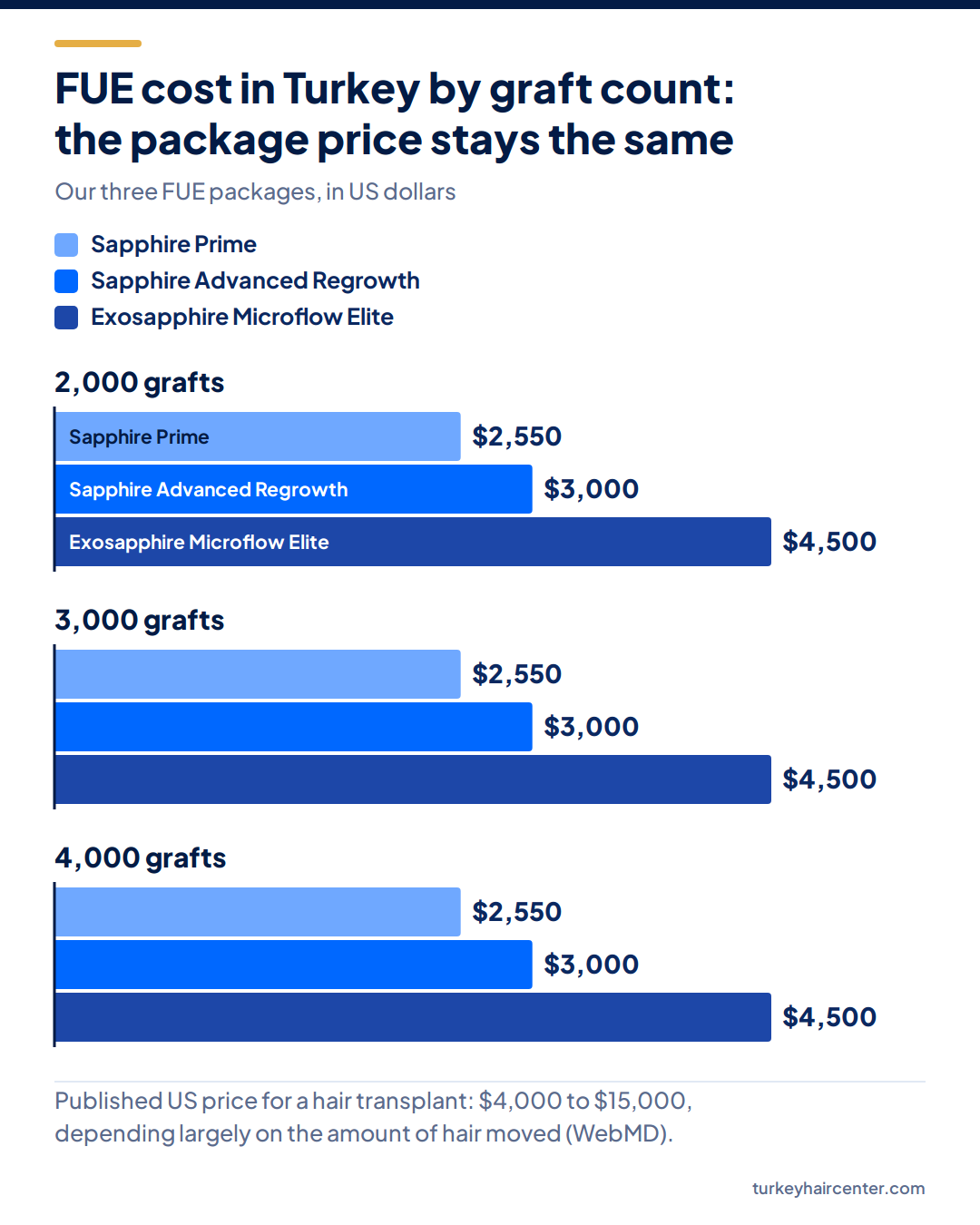
With us, a Sapphire FUE hair transplant in Turkey costs $2,550 to $4,500. The price is set by package, not by graft, so 2,000 and 4,000 grafts cost the same within a package:
Package
Price
What it adds
Sapphire Prime
Price
$2,550
What it adds
The base package, with PRP and a medical hair care kit
Sapphire Advanced Regrowth
Price
$3,000
What it adds
Custom density planning, exosome therapy, advanced aftercare kit
Exosapphire Microflow Elite
Price
$4,500
What it adds
Vascular planning, combined PRP and exosome protocol, one LLLT (low-level laser therapy) session, premium aftercare kit, growth factor serum for home use
Our three FUE packages, all with sapphire slits, cost the same for 2,000, 3,000 or 4,000 grafts.
Every package includes the operation with sedation support and custom hairline design, blood tests and a full medical analysis, PRP, the next-day check-up, 2 hotel nights, VIP airport, hotel and hospital transfers, a personal assistant and interpreter, and 2 years of aftercare consultation. Flights are not included. Our treatments and packages page lists them in full.
Is Sapphire FUE More Expensive Than FUE?
Not with us. All our FUE packages open the channels with sapphire slits, and Sapphire Prime at $2,550 is our lowest price, so there is no cheaper metal-slit option to compare it with. Where a provider charges extra for sapphire, ask what else changes besides the tool.
How Much Do 3,000 or 5,000 Grafts Cost in Turkey?
With us, the same: $2,550 to $4,500 depending on the package, not on the graft count. Providers that charge per graft multiply the count by a rate, so their price rises with every graft. Our hair transplant cost guide compares the two pricing models.
Cost in Turkey vs the USA, UK and Europe
Published prices abroad vary widely, because providers charge per graft and quote different things. Each figure is shown in the currency its source uses:
These figures cover hair transplants in general and do not include travel. Most insurance plans do not cover a hair transplant.[10]
Sapphire FUE Results and Before-and-After Cases
A good result is hair that grows at your natural angle, with a soft front edge and even density, judged at 12 months or later. Results follow the timeline above: shedding first, a slow start, then clear change from about month 6.
5,500 graftsSapphire FUE with exosome therapy · 16 months after5,250 graftsSapphire FUE with exosome therapy · 20 months after4,800 graftsSapphire FUE with exosome therapy · 16 months after4,000 graftsSapphire FUE · 12 months after
Four of our Sapphire FUE patients, photographed 12 to 20 months after surgery. Three of them had FUE with exosome therapy, which is part of our Sapphire Advanced Regrowth and Exosapphire Microflow Elite packages. You can see every case in our before and after gallery.
How Long Do Sapphire FUE Results Last?
The transplanted hair usually lasts for life, because it comes from the back and sides of the head, which keep their hair in pattern hair loss. Your own hair around it can still thin, so medication is often advised.[6] See how long hair transplants last.
What Happens 10 Years After a Hair Transplant?
The transplanted hair is usually still growing, while the native hair around it may have thinned further. That is why we draw a hairline that will still suit you at 45 and keep part of the donor area in reserve.
Do Hair Transplants Look Like Real Hair?
Yes, when the details are right: it is your own hair, growing at your own angle. Results can look so natural that a barber cannot tell.[6] Unnatural results usually trace back to the hairline design or to grafts set at the wrong angle or direction.[9]
What Percentage of FUE Hair Transplants Are Successful?
There is no single success rate, but most grafts survive when they are handled well. In the 1,000-patient study, 94.7% of grafts survived with sapphire slits and 88.9% with steel ones.[3] The NHS lists a small risk that the transplant does not take.[7] Poor growth is linked with rough graft handling, long time outside the body and smoking.[9]
Sapphire FUE Risks and Side Effects
Sapphire FUE is minimally invasive, but it is still surgery, with the same risks as any FUE. Common, temporary effects:
Itching and short-lived numbness, which settle over days to weeks[9]
Shedding of the transplanted hairs between weeks 2 and 8[6]
Tiny dot scars at the back of the head
Less common problems include inflamed follicles, small cysts, pale dots in the donor area and raised scars.[9] The most serious is necrosis, when part of the recipient skin loses its blood supply. It is rare: the largest published series, of 18 patients, found smoking most often, followed by high blood pressure and diabetes.[8] One 2026 case report followed necrosis after FUE in which the recipient sites were made with sapphire, so the tool alone does not prevent it.[12]
Signs That Need a Call to the Team
Infection and necrosis are uncommon, but both need quick care. Contact the team straight away if you notice any of these:
Useful Sapphire FUE reviews show the whole road: the crusts of the first week, the thin third month and the result at a year or more. Independent platforms tell you more than a provider's own website. We do not pay for reviews or reward them.
TrustScore 4.1 out of 5 on Trustpilot, based on 5 reviews (checked 11.10.2026).
★★★★★
Turkey hair center was an amazing experience. They took care of me from the moment I landed all the way until my flight back home. They do top tier work and I would highly recommend them to anyone looking for this service!
★★★★★
I had my hair transplant about a month ago and so far the progress/recovery is going super well and ahead of schedule. The doctor and nurses from the clinic were super friendly and knowledgeable. They made me feel comfortable and confident i made the right decision to go with them. Also the food that they serve me half way through the procedure was amazinggggg.
★★★★★
This experience was great the Doctor and Staff were very professional and the BEST! Highly recommend if you want to goto the best hair transplant center to get your hair transplant! This is me after little before 3 months!
★★★★★
my experience at turkey hair transplant centre was really good and the doctors made me feel vert welcome, i am happy with my results at the moment and would definitely recommend it to others
Sapphire FUE Hair Transplant: Frequently Asked Questions
Does Sapphire FUE leave scars?
Yes, small ones. The donor area heals with tiny dot scars instead of a line, which short hair usually hides; at the front, the channels heal as small crusts that come away within one to two weeks.
Do I need to shave my head for Sapphire FUE?
The donor area is usually shaved, as in most FUE. For smaller sessions, ask about our no-shave hair transplant.
Can Sapphire FUE be combined with DHI?
Yes. For a large area, the team may plan Sapphire FUE for the crown and mid-scalp and DHI for the hairline. The plan is set after your photo review; see Is DHI or Sapphire FUE better?
Is Sapphire FUE safe?
It is surgery with the usual, mostly temporary side effects, and serious complications are rare. Ask any provider who performs each step. With us, our medical team works at partner hospitals and polyclinics in Istanbul, blood tests and a medical review come first, and aftercare consultation lasts 2 years; see common hair transplant concerns.
What is the difference between Sapphire FUE and Exosapphire?
Sapphire FUE is the technique. Exosapphire Microflow Elite is our $4,500 package name: Sapphire FUE with vascular planning, a combined PRP and exosome protocol, one LLLT session, a premium aftercare kit and growth factor serum for home use.
How long do I need to stay in Turkey for Sapphire FUE?
Usually two or three nights: you arrive, have the operation the next day and fly home after the next-day check-up. Every package includes 2 hotel nights and the transfers.
Do you offer payment plans for Sapphire FUE?
No, we do not offer instalment plans. You reserve your date with a $300 deposit, which is deducted from the package price and can be refunded within 7 days of payment; see deposit and payment.
Free Sapphire FUE Assessment
1
Which area do you want to restore?Pick the closest; the photo review confirms it.
Typical graft range800 to 1,500grafts
An estimate from the ranges on this page, not a treatment plan. Your graft count is set after the medical team reviews your photos and donor area.
Every plan with us starts with a free photo review. Send photos of your front, top, sides and back, and the medical team will tell you whether Sapphire FUE suits you, your likely graft range and which package applies. It is free and there is no obligation: get your free hair analysis.
Sources and medical review
The clinical statements on this page draw on the following published literature and professional guidance:
Talk to our hair team on a free video call, in your language. You receive a written plan with your technique, estimated grafts and all-inclusive price. If a hair transplant isn't right for you, we tell you honestly.
Your information is 100% confidential.
Real People Real Support
Send your photos on WhatsApp
Front, top and both sides, reviewed by the medical team.