Elon Musk Hair Transplant: Before and After Hairline Analysis
Homapage

Blog
Elon Musk Hair Transplant Success Story: Before and After
Medical Reviewed By Dr. Tompi, M.D – Plastic & Aesthetic Surgeon
Written By Nazmi G, Trichologist

Elon Musk Hair Transplant: Before and After Hairline Analysis
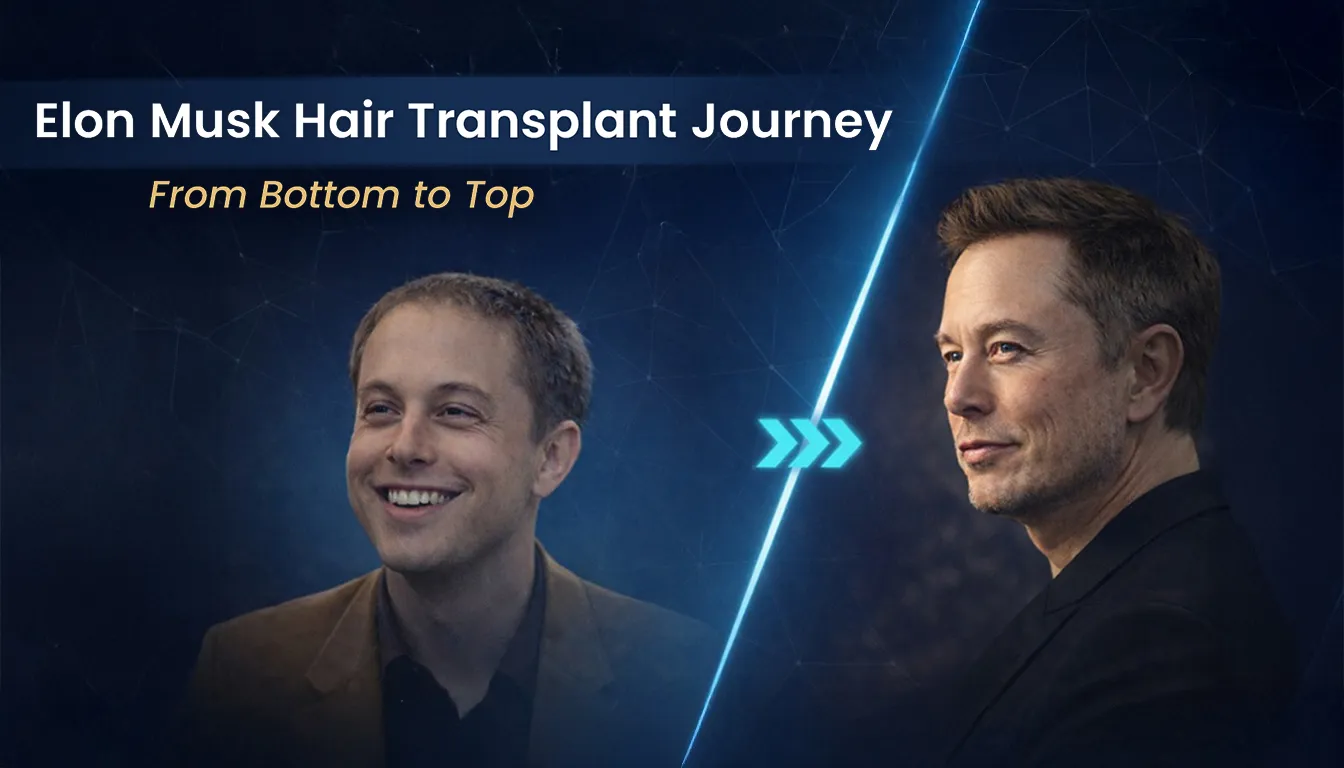
Elon Musk is known for launching rockets, building electric cars, and leading some of the world’s most discussed technology companies. But another detail has also attracted public attention over the years: his hairline.
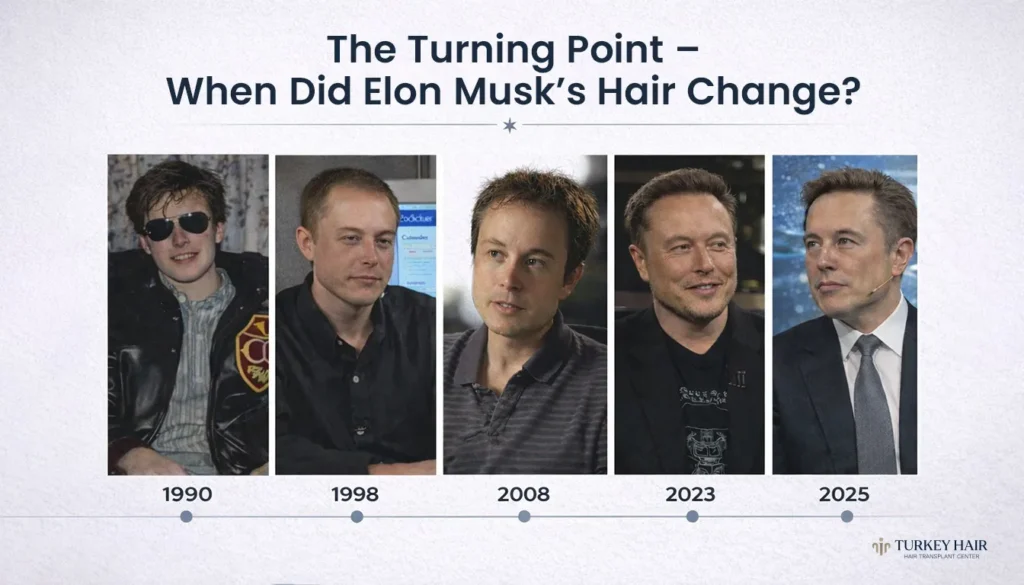
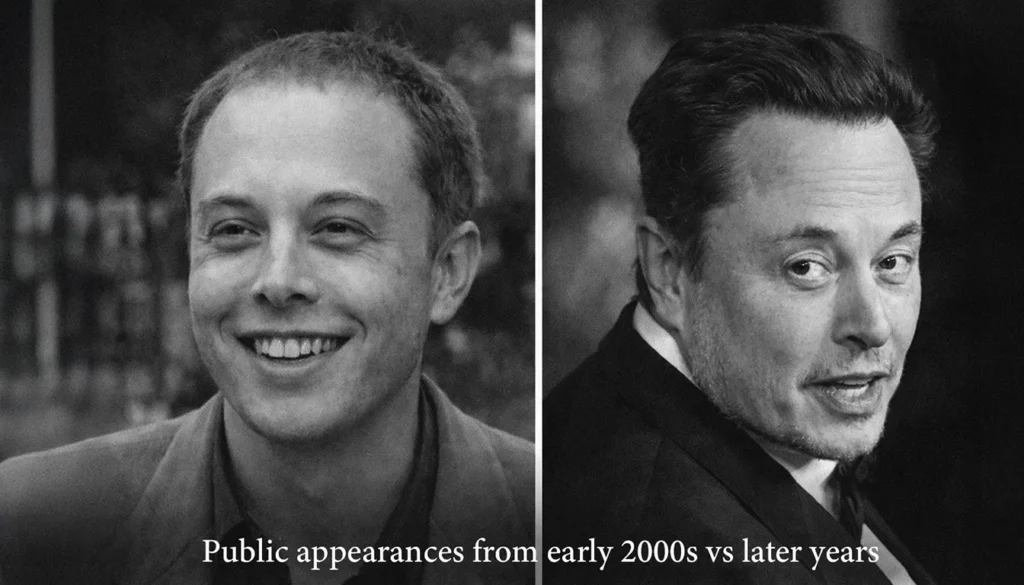
In older public photos, Musk appeared to show visible frontal thinning, temple recession, and a weaker hairline frame. In more recent appearances, his hair looks fuller, denser, and more structured. That visual contrast is the main reason people keep asking whether Elon Musk had a hair transplant.
Important note: Elon Musk has never publicly confirmed having a hair transplant. There is no verified clinic name, no official graft count, no confirmed surgeon, and no public medical record. This article is based only on public photo analysis and general hair restoration principles.
The safest conclusion is this: Elon Musk’s before-and-after photos strongly suggest some form of long-term hair restoration, but the exact method remains unconfirmed.
The Short Answer: Did Elon Musk Get a Hair Transplant?
Elon Musk has never officially confirmed getting a hair transplant. However, photo-based analysis of his hairline evolution from the early PayPal era to his current look suggests possible long-term restoration.
A hair transplant is one of the most discussed explanations because his early photos show visible frontal thinning, while later photos show a stronger and more stable hairline. Still, photos alone cannot confirm the exact technique, clinic, graft count, surgeon, or medical history.
His current hair appearance may involve one or more of the following:
- FUT hair transplant
- FUE hair transplant
- Medical hair loss treatment
- Styling
- Hair fibers
- Density maintenance
- A combined restoration plan
In simple terms, hair restoration is a reasonable explanation for the visible change, but the exact medical details are not publicly confirmed.
What We Can and Cannot Know from Elon Musk’s Photos
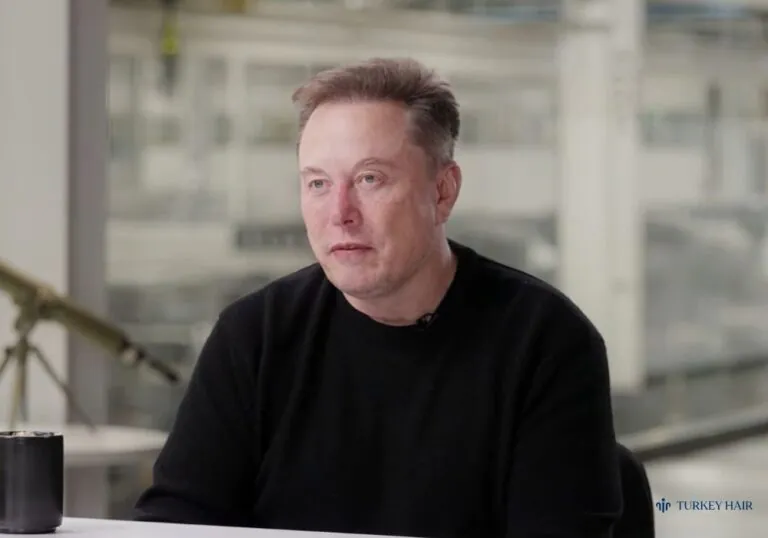
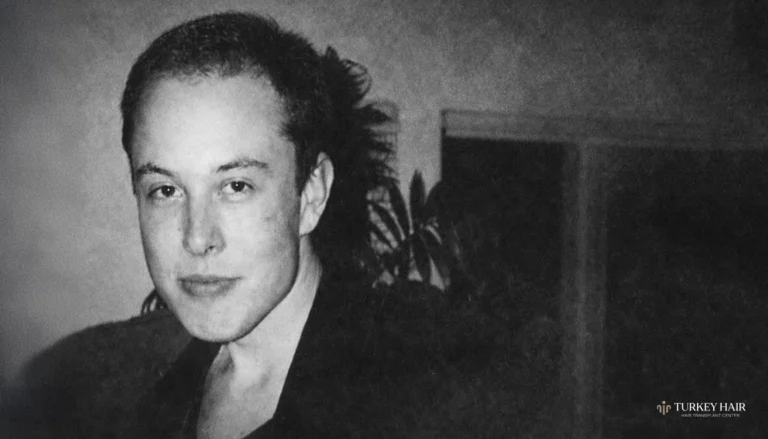
Public photos can show visible changes in Elon Musk’s hairline, but they cannot confirm his private medical history. Earlier images show frontal thinning, temple recession, and weaker density across the front. More recent appearances show a fuller and more structured hairline. This contrast explains why the topic is discussed so often.
However, photos alone cannot prove the exact technique, clinic, surgeon, graft count, number of sessions, or medication use. A visible improvement may be consistent with FUT, FUE, medical treatment, styling, hair fibers, or a combined restoration plan.
This distinction is important for patients. Celebrity hair transformations can be useful for education, but they should not be treated as confirmed medical records. A real diagnosis requires scalp examination, donor density analysis, hair caliber evaluation, miniaturization check, medical history, and long-term hair loss planning.
The safest conclusion is this: Elon Musk’s before-and-after photos strongly suggest a major hair restoration change, but the details remain unconfirmed.
Why Elon Musk’s Hair Transformation Gets So Much Attention
Elon Musk’s hair transformation gets attention because the difference between his early and recent photos is significant.
This is not just a minor styling difference. The contrast between his early frontal thinning and his later, fuller-looking hairline is noticeable. In earlier images, his frontal hairline appeared thinner, more receded, and less defined. In later public appearances, the front of his hair looks fuller, the hairline appears more structured, and the overall frame of his face looks stronger.
That kind of visual change naturally creates discussion. It also makes Musk one of the most searched celebrity examples in hair transplant analysis.
Still, even when the visual change is strong, careful wording is necessary. Photos can explain why people are asking the question, but they cannot confirm a private medical procedure.
Elon Musk Hair Transplant Timeline
Looking at Elon Musk’s hair over time, the transformation can be separated into a few broad phases. This timeline is not a diagnosis. It simply explains why people keep asking whether Elon Musk had a hair transplant.
| Period | Hairline Appearance | Possible Interpretation |
|---|---|---|
| Early PayPal era | Visible frontal thinning and recession | Advanced early hair loss pattern |
| Early Tesla years | Improved frontal density | Possible restoration or long-term treatment |
| Mid-career public appearances | Stronger hairline and better coverage | Possible transplant maturation or maintenance |
| Recent years | Fuller and more stable hairline | Possible combined restoration plan |
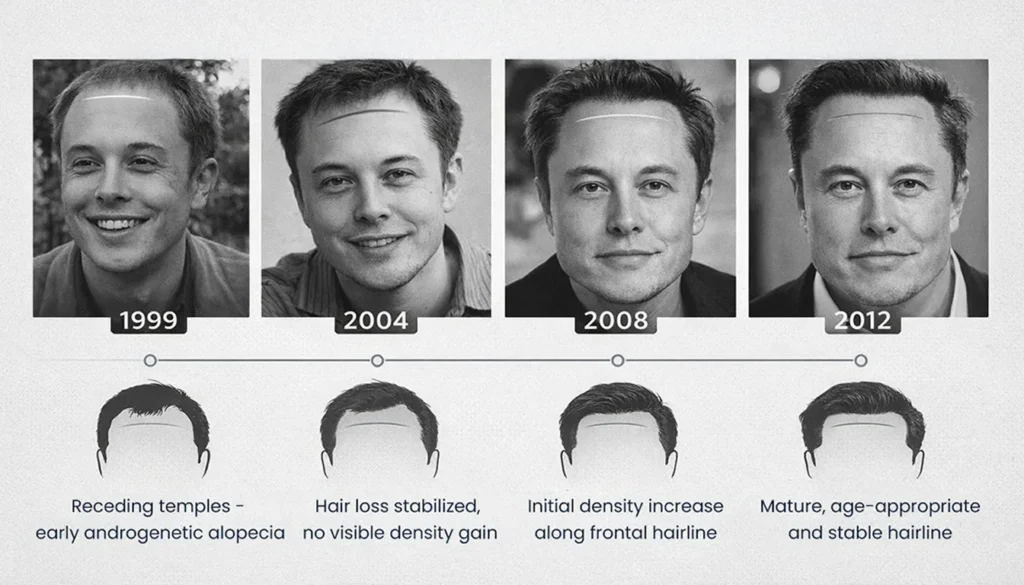
Early PayPal Era: Visible Thinning and Recession
In early public photos, Elon Musk’s hairline looked noticeably thinner. The frontal area appeared weak, the temples looked receded, and the top of the scalp seemed less dense than it does today.
This is the period that fuels most of the hair transplant discussion because the contrast with his later appearance is clear. At that time, Musk did not appear completely bald, but he did show visible frontal thinning. This is often one of the first areas patients want to restore when they begin considering hair transplantation.
Tesla Years: A Stronger Frontal Frame
As Elon Musk became more visible during the Tesla years, his hairline started to look different. The frontal area appeared stronger, the hairline looked more structured, and the face had a better frame.
Can we say with certainty that surgery caused the change? No. But the level of improvement is strong enough for hair restoration to be one of the most discussed explanations.
For patients, this is important because frontal restoration can change the way the whole face looks. A stronger hairline can make the face appear younger, sharper, and more balanced.
Recent Years: Fuller and More Stable Hairline
In recent public appearances, Musk’s hair generally appears fuller than in his early photos. The frontal density looks stronger, the temples look better supported, and the hairline does not appear as weak as it did in older images.
Still, the result does not look like an unnatural teenage hairline. A natural result should not make the patient look artificially young. The goal is to restore facial balance while keeping the hairline mature and believable.
That is one reason the transformation is often discussed as a good example of long-term restoration. If a transplant was involved, the design appears mature rather than overly aggressive.
What Norwood Stage Was Elon Musk Before Restoration?
Based on early public photos, Elon Musk appeared to show more than a mild mature hairline. His frontal area looked thin, the temples appeared recessed, and the density behind the hairline seemed weaker than in later years. For many hair restoration observers, this pattern may look similar to a Norwood 3 or Norwood 4 range.
This is not a diagnosis. The Norwood scale can only be used accurately after a proper examination. Still, it helps explain why Musk’s case attracts so much attention.
A Norwood 2 patient may need only small temple refinement, while a Norwood 3 or 4 pattern usually requires more careful planning across the frontal third and sometimes the mid-scalp.
If Elon Musk had surgical restoration, the visible change suggests more than a small corner correction. The improvement appears to involve rebuilding the frontal frame, strengthening density, and creating a more stable hairline shape.
For patients, the lesson is simple: before asking for a celebrity-style result, first understand your own hair loss stage.
What Do Hair Transplant Specialists Think?
A responsible hair transplant specialist would not diagnose Elon Musk from public photos alone. However, a specialist can explain why his case attracts attention.
The visual pattern includes early frontal thinning, later improvement in density, and a stronger hairline frame over time. These changes can be consistent with hair transplantation, but they can also be supported by medication, styling, or other maintenance methods.
| Visual Clue | What It May Suggest | What It Cannot Confirm |
|---|---|---|
| Early frontal thinning | Male pattern hair loss | Exact diagnosis |
| Fuller hairline later | Possible restoration or treatment | Confirmed surgery |
| Long-term improvement | Possible staged planning | Number of procedures |
| Stronger frontal frame | Hairline reconstruction or density support | Exact technique |
| No public confirmation | Private medical choice | Clinic or surgeon name |
A real consultation would require donor area analysis, scalp examination, hair caliber evaluation, miniaturization check, and long-term hair loss planning.
Photos can support visual analysis, but they cannot replace donor examination, scalp assessment, or confirmed medical history.
Did Elon Musk Have FUT or FUE?
Many online discussions suggest that Elon Musk may have had FUT first and possibly FUE later. This theory exists because his transformation appears large enough to involve significant graft numbers over time.
But this has never been confirmed.
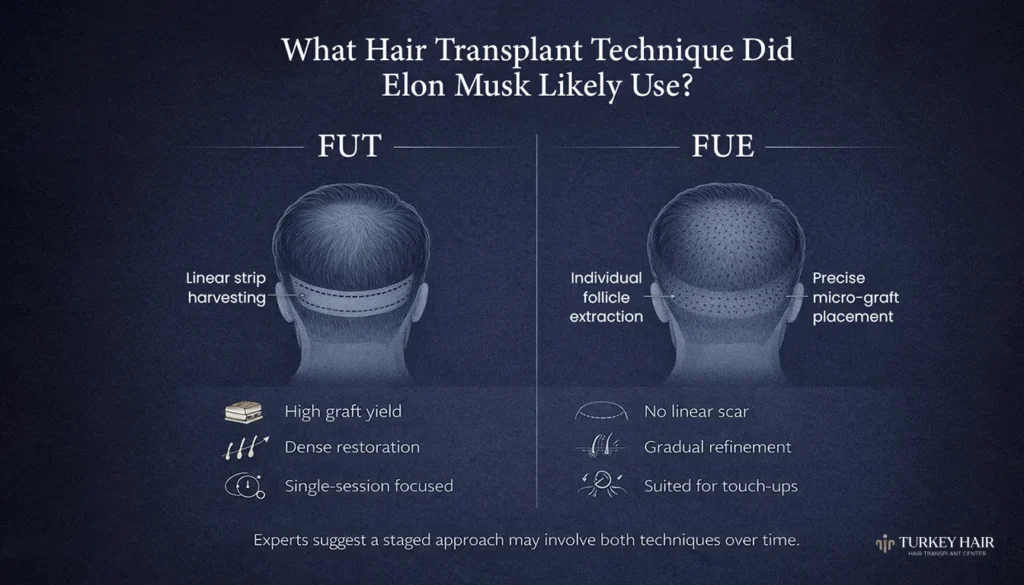
FUT, also called strip surgery, removes a strip of scalp from the donor area and separates it into grafts. This method can move a high number of grafts in one session, but it may leave a linear scar.
FUE, or follicular unit excision, removes individual follicular units one by one from the donor area. It does not create the same long linear strip scar as FUT and is often preferred by patients who want shorter hairstyles.
DHI may also be discussed in modern hair restoration because it uses an implanter pen for graft placement. However, there is no evidence confirming that Musk had DHI.
| Technique | How It Works | Why It Might Be Discussed |
| FUT | Strip of scalp removed from donor area | Can move many grafts in one session |
| FUE | Individual follicles extracted one by one | Avoids a long linear strip scar |
| DHI | Grafts placed with an implanter pen | May support controlled placement |
| Combined approach | Different methods used over time | Possible in larger restorations |
If Musk had surgery, a staged plan would make sense. But no one can confirm the exact technique from photos alone.
Did Elon Musk Have a FUT Scar?
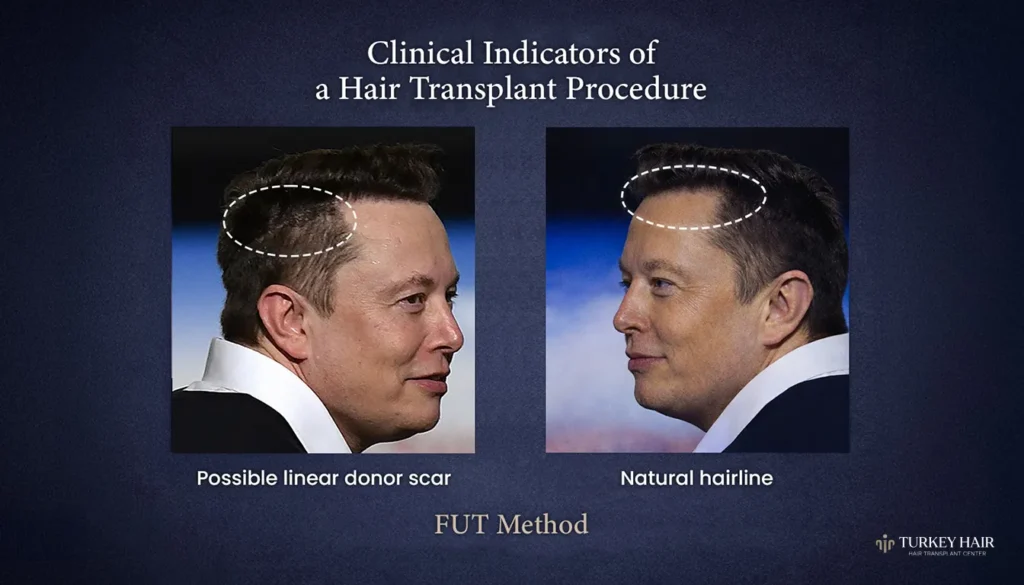
One reason FUT is often discussed in Elon Musk’s case is the possible appearance of a linear donor-area mark in some public photos. Online observers have speculated that this could suggest an earlier FUT procedure, especially because FUT was more common before modern FUE became widely preferred.
FUT, also known as strip surgery, removes a narrow strip of scalp from the donor area. The grafts are then separated and implanted into thinning areas. The benefit of FUT is that it can provide a high number of grafts in one session. The downside is that it may leave a linear scar, especially if the patient later wears the hair very short.
Still, a scar-like line in a photo is not proof. Lighting, haircut length, image angle, and photo quality can all create misleading impressions.
The most accurate wording is this: a possible donor scar is one reason FUT is discussed, but Elon Musk’s actual procedure has never been confirmed.
What Is FUE Hair Transplant?
FUE is a modern hair transplant technique where individual follicular units are removed from the donor area and implanted into thinning or bald areas.
For many patients, FUE is popular because it avoids the long linear scar associated with FUT. It can also be useful for patients who want shorter hairstyles.
But FUE is not automatically better for every case. The right technique depends on donor area quality, graft needs, hair type, scalp condition, surgeon experience, and the patient’s long-term hair loss plan.
For a large transformation like Musk’s rumored case, the most important factor would not be the technique name alone. It would be donor management.
How Did His Donor Area Survive a Large Transformation?
For anyone considering a large hair restoration, the donor area is the biggest long-term concern. The donor area is not unlimited.
If too many grafts are removed too aggressively, the back of the head can start to look thin, patchy, or “moth-eaten.” That is one of the most visible signs of poor planning.
In Elon Musk’s case, if restoration was involved, the donor area appears to have been managed carefully over time. That may suggest staged planning rather than one aggressive session.
A strong donor management plan usually focuses on:
- Using grafts strategically
- Avoiding overharvesting
- Prioritizing the frontal frame first
- Saving grafts for future hair loss
- Balancing density across different zones
- Planning for long-term maintenance
A patient may want a dramatic transformation, but the surgeon has to protect future options. That is what separates a sustainable result from a short-term result.
Risks of Overharvesting in Large Hair Transplant Cases
A large transformation can look impressive from the front, but the donor area decides whether the result is sustainable. This is why overharvesting is one of the biggest risks in large hair transplant cases.
The donor area is not unlimited. If too many grafts are removed too aggressively, the back and sides of the scalp may start to look thin, patchy, or uneven. This problem is especially visible when the patient wears short hair.
A strong frontal result can quickly lose value if the donor area looks damaged.
For a transformation similar to Elon Musk’s rumored case, donor management would be the most important part of the plan. A surgeon would need to decide how many grafts can be used safely, where they should be placed, and how many should be saved for future hair loss.
The real lesson is not “use more grafts.” The real lesson is to use the donor area intelligently.
Is Elon Musk’s Hair Real or a Hair System?
Some people wonder whether Elon Musk’s current hair could be a hair system or a hairpiece. It is an understandable question because his change is visually strong.
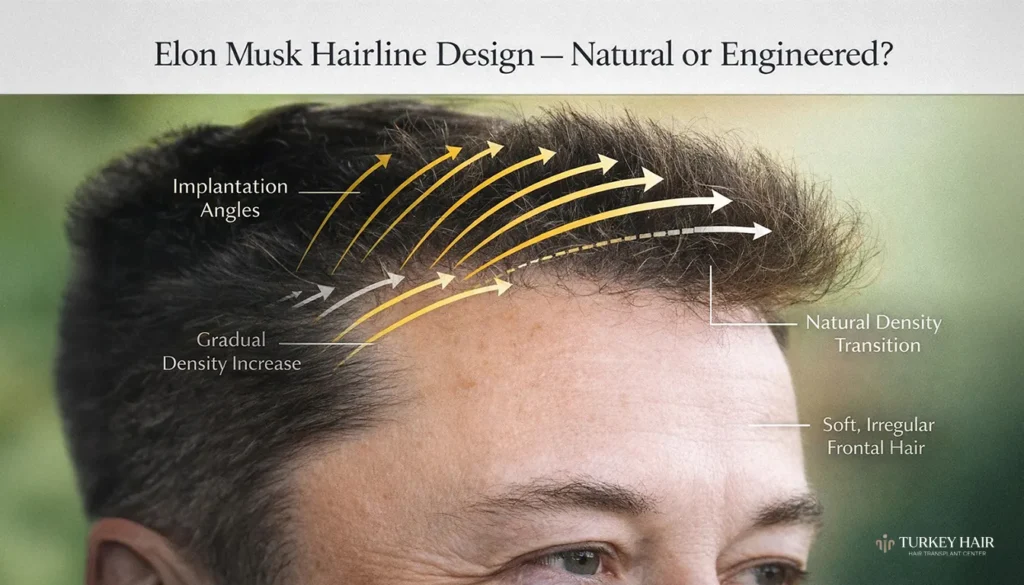
However, his current hair does not look like a typical hairpiece in most public photos. Hair systems often create a very dense and uniform look, especially around the front. Musk’s hairline appears softer and more natural in many photos, which is why many observers lean toward long-term hair restoration rather than a temporary hair system.
Still, no one can confirm this from photos alone.
A natural-looking hairline can be created by combining different methods, including surgery, styling, medication, fibers, or a combination of them all.
The safest answer is this: Musk’s current look appears more consistent with long-term hair restoration than a simple temporary hairpiece, but there is no official confirmation.
How Many Grafts Would Elon Musk Need?
No one knows how many grafts Elon Musk may have had because he has never confirmed a hair transplant.
For a similar transformation, the estimated graft count may fall around 3,500 to 5,500 grafts, depending on the patient’s starting point, donor area quality, hair type, and final density goal.
This is only an estimate for a comparable case.
| Area | Estimated Grafts |
|---|---|
| Frontal hairline | 1,500–2,000 |
| Mid-scalp | 1,000–1,500 |
| Crown support | 1,000–2,000 |
| Total estimate | 3,500–5,500 |
This would be a larger restoration than a simple temple correction. That makes sense because Musk’s early photos showed more than a mild recession. The visible concern appeared to include the frontal area and density behind it.
A higher graft number is not automatically better. In large restorations, the result depends on where those grafts are placed, how the hairline is softened, and whether enough donor hair is preserved for the future.
A natural-looking restoration needs soft hairline design, gradual density, donor protection, and long-term planning.
Medication, Minoxidil, Finasteride, and Long-Term Maintenance
Hair transplant surgery can rebuild lost structure, but maintenance often matters too.
Many men who undergo hair restoration also use medical support to protect native hair. Minoxidil may help improve visible density in suitable patients. Finasteride may help slow DHT-related hair loss for some men.
These treatments are not magic, and they are not right for everyone. But they can be part of a long-term hair loss plan under medical guidance.
For a case like Musk’s rumored transformation, surgery alone may not explain everything. A combined approach involving restoration and maintenance would make sense.
Can Medication Alone Explain Elon Musk’s Hairline?
Medication can play an important role in hair loss management, but it may not fully explain a dramatic hairline restoration. Treatments such as minoxidil and finasteride may help suitable patients slow hair loss, maintain existing hair, or improve visible density. However, they usually do not rebuild a deeply receded frontal hairline in the same way surgical graft placement can.
This is why Elon Musk’s case is often discussed as a possible combined restoration plan. If his transformation involved treatment, it may have included surgery to rebuild the frontal frame and medical support to maintain native hair over time.
For patients, the lesson is practical. A hair transplant can restore structure, but medical maintenance may help protect the surrounding hair. The right plan depends on diagnosis, age, donor area, family history, hair loss speed, and medical suitability.
No patient should start medication only because a celebrity result looks impressive. These treatments should be discussed with a qualified doctor.
Elon Musk vs Wayne Rooney vs Lewis Hamilton Hair Transplants
Celebrity hair stories are not all the same. Some are confirmed, some are rumored, and some are mostly based on visual comparison. That is why it helps to compare Elon Musk with other public figures often discussed in hair transplant content.
| Celebrity | Public Hair Story | Confirmed Hair Transplant? | Main Lesson |
| Elon Musk | Early thinning to fuller-looking hairline | No public confirmation | Large visual change needs careful wording |
| Wayne Rooney | Publicly discussed hair transplant | Yes | Confirmed cases can be discussed more directly |
| Lewis Hamilton | Fuller-looking hairline speculation | No public confirmation | Natural-looking changes may have multiple explanations |
The main difference is confirmation. Wayne Rooney openly discussed his transplant. Musk and Hamilton have not publicly confirmed the same. That is why Musk’s case should be treated as photo-based analysis rather than confirmed medical history.
Hair Loss and Image Pressure in the Tech World
Hair loss is not only discussed in Hollywood or sports anymore. In the tech world, public image also plays a major role. Founders, CEOs, and investors are often seen on stage, in interviews, at product launches, and across social media.
This does not mean every public figure needs hair restoration. But it explains why people pay attention when a high-profile figure’s appearance changes over time.
Elon Musk has spent decades as the public face of companies such as Tesla and SpaceX. Under that level of visibility, even small appearance changes can become part of public conversation. His hairline transformation is one example of how image, confidence, and public perception often overlap.
How Much Would an Elon Musk-Style Hair Transplant Cost Today?
An Elon Musk-style transformation would likely require a larger, multi-area restoration plan. If the goal is to rebuild the frontal hairline, improve mid-scalp density, and support the crown, the estimated graft count may fall around 3,500 to 5,500 grafts.
The final cost depends on several factors, including the country, clinic standards, surgeon involvement, technique, graft count, medical planning, and long-term aftercare.
| Country / Region | Estimated Cost for Similar Case |
| USA | $15,000–$35,000+ |
| UK | £10,000–£25,000+ |
| Western Europe | €8,000–€20,000+ |
| International medical packages | $3,000–$8,000 |
These are general ranges, not fixed prices.
At Turkey Hair Center, a similar case would begin with donor analysis, hairline planning, graft estimation, and technique selection. The goal would not be to copy Elon Musk’s hairline exactly. It would be to design a result that fits the patient’s own face, donor area, hair loss stage, and long-term needs.
For international patients, treatment planning can also include travel guidance, treatment-day support, hotel-style comfort, translation assistance, and post-operative follow-up.
Can You Get a Similar Result?
A similar type of improvement may be possible for some patients, but the plan must be personal.
No patient should ask for Elon Musk’s exact hairline. Your face is different. Your donor area is different. Your hair loss pattern, hair type, age, and scalp condition are different too.
A good candidate for a larger restoration usually has:
- Enough healthy donor hair
- Realistic density expectations
- A clear diagnosis
- A stable or manageable hair loss pattern
- A long-term maintenance plan
- A mature hairline goal
- Strong donor area planning
At Turkey Hair Center, patients often bring celebrity examples like Elon Musk not because they want an identical hairline, but because they want to understand what level of improvement may be realistic for their own donor area, age, and hair loss pattern.
For advanced thinning, the most important question is not “Can we place many grafts?” It is “Can we use the donor area safely and still plan for the future?”
Final Verdict: What Can Patients Learn from Elon Musk’s Hair?
The main lesson from Elon Musk’s rumored hair transformation is planning.
If his change involved hair restoration, it likely required a long-term strategy rather than one simple procedure. A good transformation is not magic. It is hairline design, graft distribution, donor management, timing, maintenance, and realistic expectations.
Patients should not focus only on the celebrity result. They should focus on the principles behind a natural result: mature hairline design, safe donor use, realistic density, and long-term maintenance.
You do not need to be a billionaire to take hair loss seriously. But you do need a plan that fits your own scalp.
Medical Review Note
This article is based on public photo analysis, general hair restoration principles, and medically reviewed hair transplant information. It does not claim access to Elon Musk’s private medical records.
For personal diagnosis, patients should consult a qualified hair transplant doctor or dermatologist.
References & Medical Sources
Get a Free Hair Analysis from Our Experts
Use our free online help tool to communicate your hair loss concerns – it only takes a few minutes. We’ll provide you with a personalized, non-binding quote.
You May Be Interested In
Let’s Call You!

Popular Blogs
Justin Bieber Hair Transplant: Hairline Analysis, Before & After Photos, Rumors & Expert Opinion
Justin Bieber Hair Transplant: Hairline Analysis, Before & After Photos, Rumors & Expert Opinion Free…
Wayne Rooney Hair Transplant: Before & After
Wayne Rooney Hair Transplant: Before & After Free Hair Analysis Homapage Blog Wayne Rooney Hair…
Conor McGregor Hair Transplant: Before & After
Conor McGregor Hair Transplant: Before & After Free Hair Analysis Homapage Blog Conor McGregor Hair…
Turkey Visa Requirements for Hair Transplant in Turkey
Turkey Visa Requirements for Hair Transplant in Turkey Free Hair Analysis Homapage Blog Turkey Visa…
David Silva Hair Transplant: Before & After
David Silva Hair Transplant: Before & After Free Hair Analysis Homapage Blog Discover David Silva…
David Beckham Hair Transplant: Before, After, Rumors & Hair Restoration Analysis (2026)
David Beckham Hair Transplant: Before, After, Rumors & Hair Restoration Analysis (2026) Free Hair Analysis…
Ready To
Book Your Appointment?
Reach out to us or complete our simple online form
and we’ll contact you to schedule a time that works perfectly for you.



Frequently Asked Questions (FAQ) About Elon Musk’s Hair