Performed at authorized partner hospitals Turkey Hair Center is a Ministry of Health authorized health-tourism intermediary, not a clinic.
All-inclusive Afro-textured hair transplant packages at Turkey Hair Center cost £1,920 to £3,390; the package that fits depends on graft count, technique, and the patient's individual treatment plan. Because curly hair roots curve beneath the scalp, precision techniques like Manual FUE hair transplant are often utilized to help reduce the risk of graft damage during extraction.
Short answer
An afro hair transplant moves your own curly or coily follicles from the back of the scalp to thinning areas, with extraction adapted to roots that curve under the skin. With us it is an all-inclusive package from £1,920 to £3,390, usually done in a single 6-8 hour session under local anesthesia.
After the procedure, the patient’s hair must look natural, balanced, and match the patient’s original curl pattern. A successful afro hair transplant result doesn’t look like flattening or changing the texture of native hair.
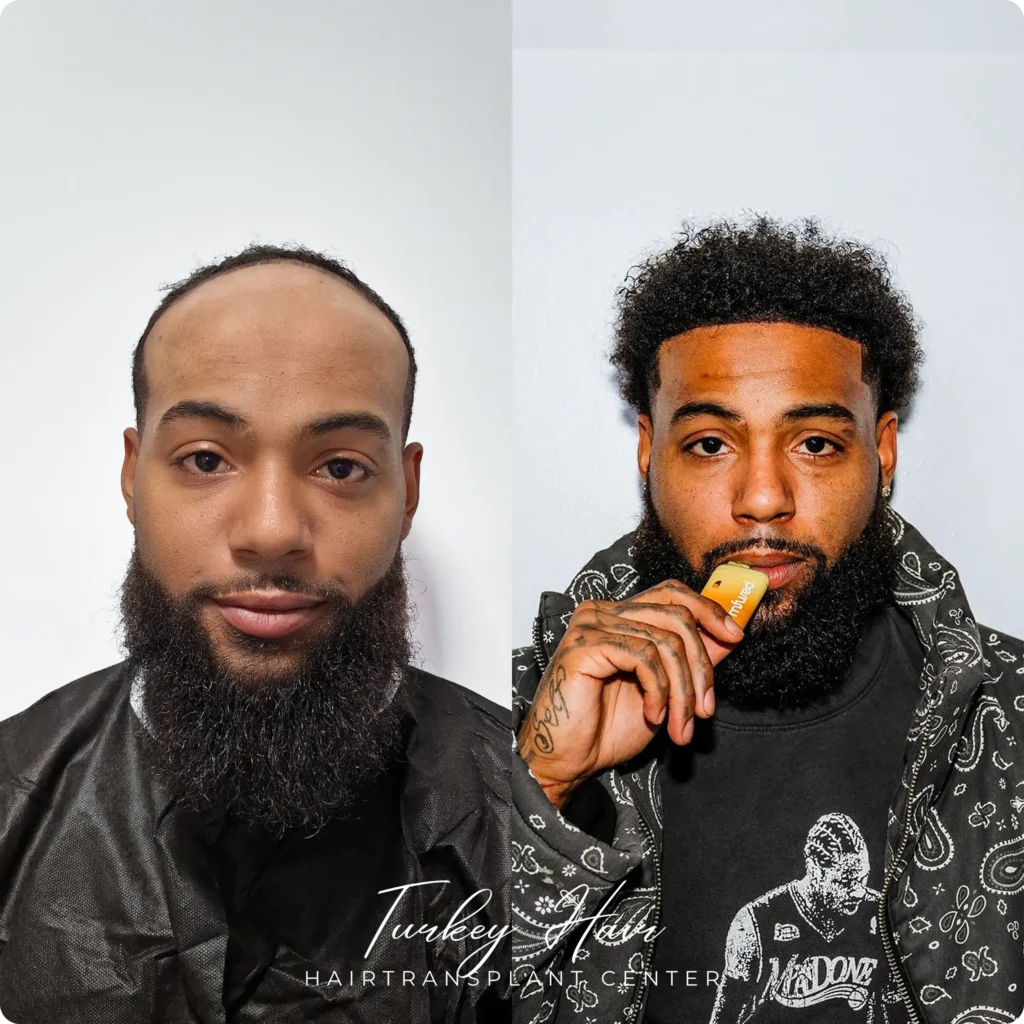
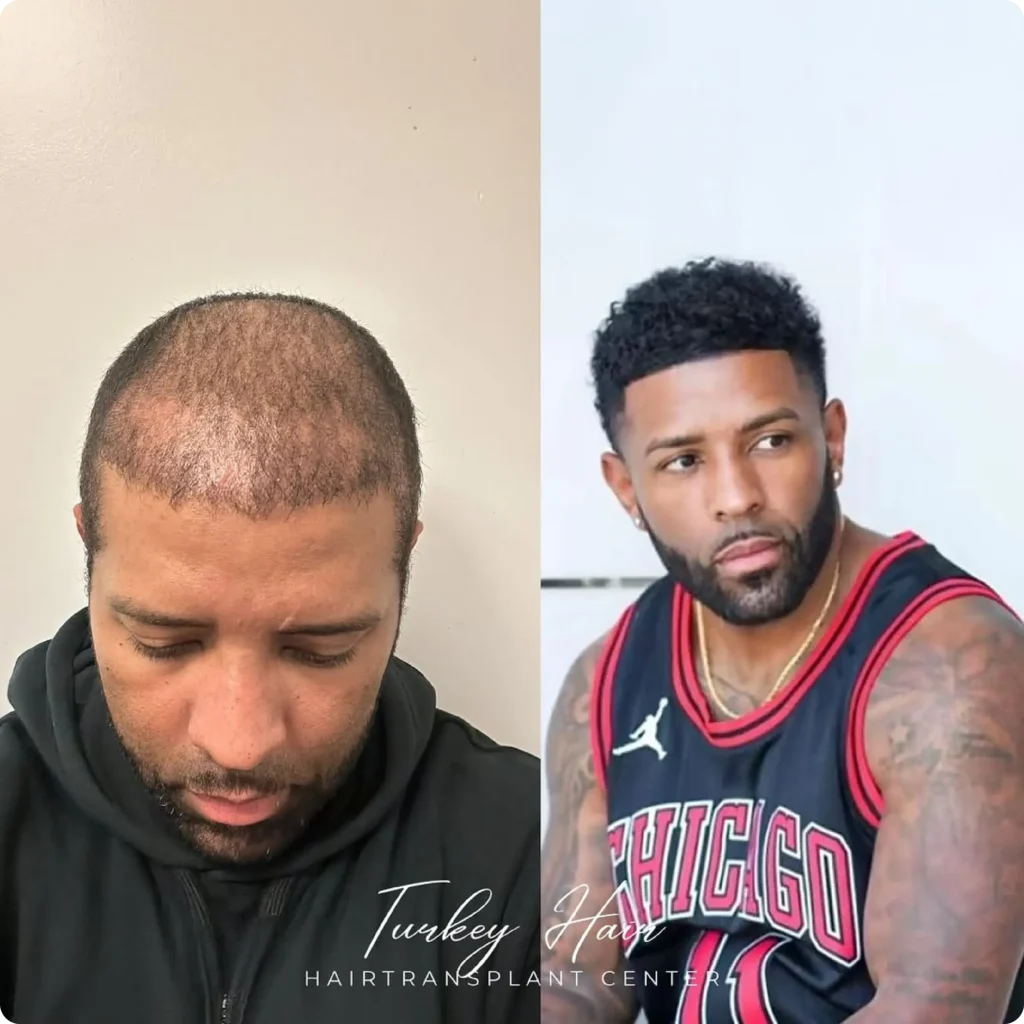
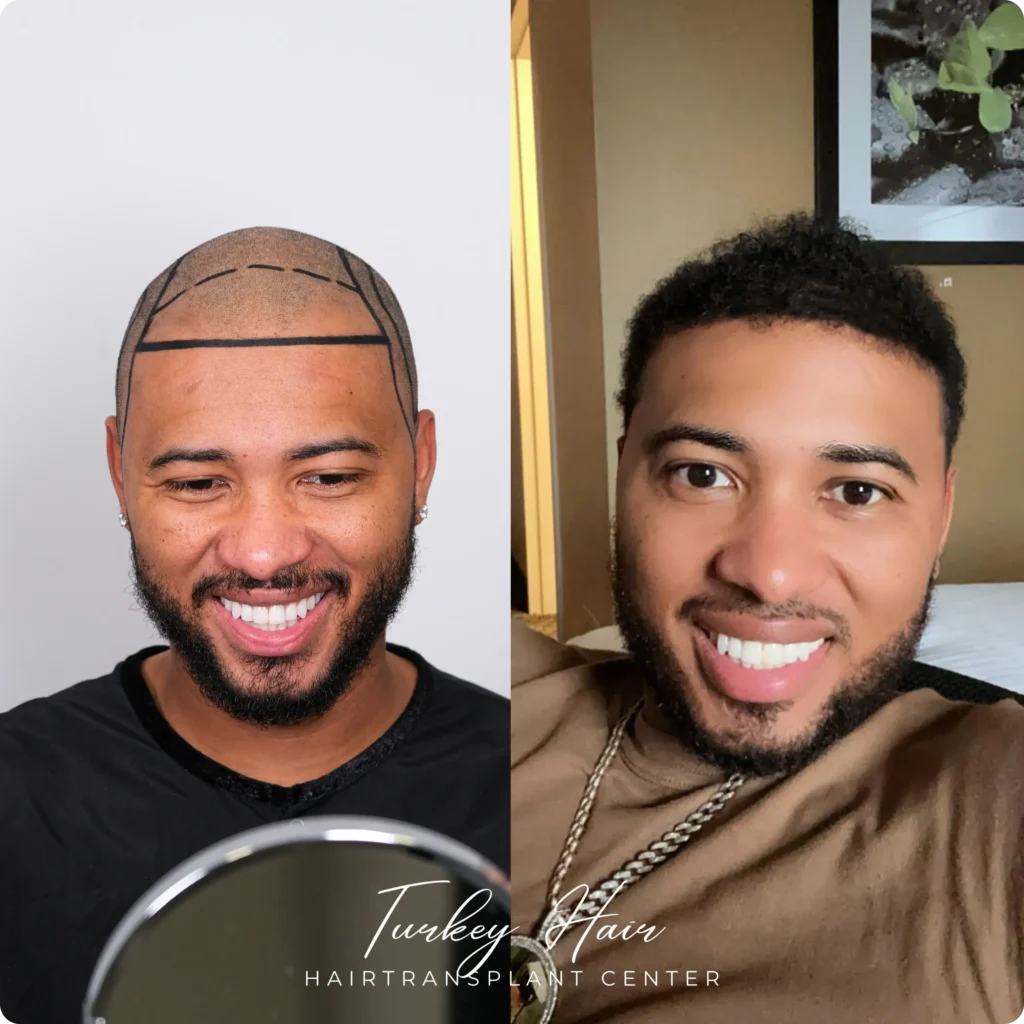
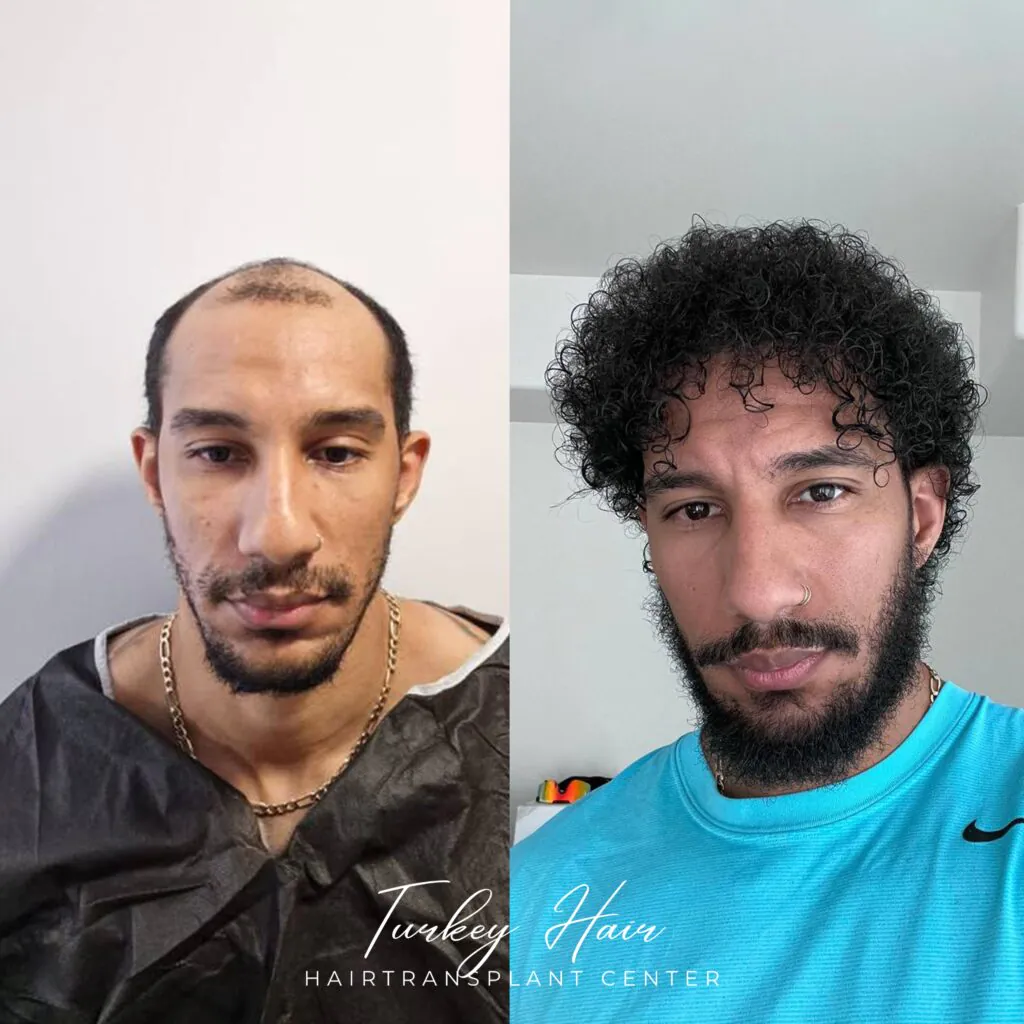
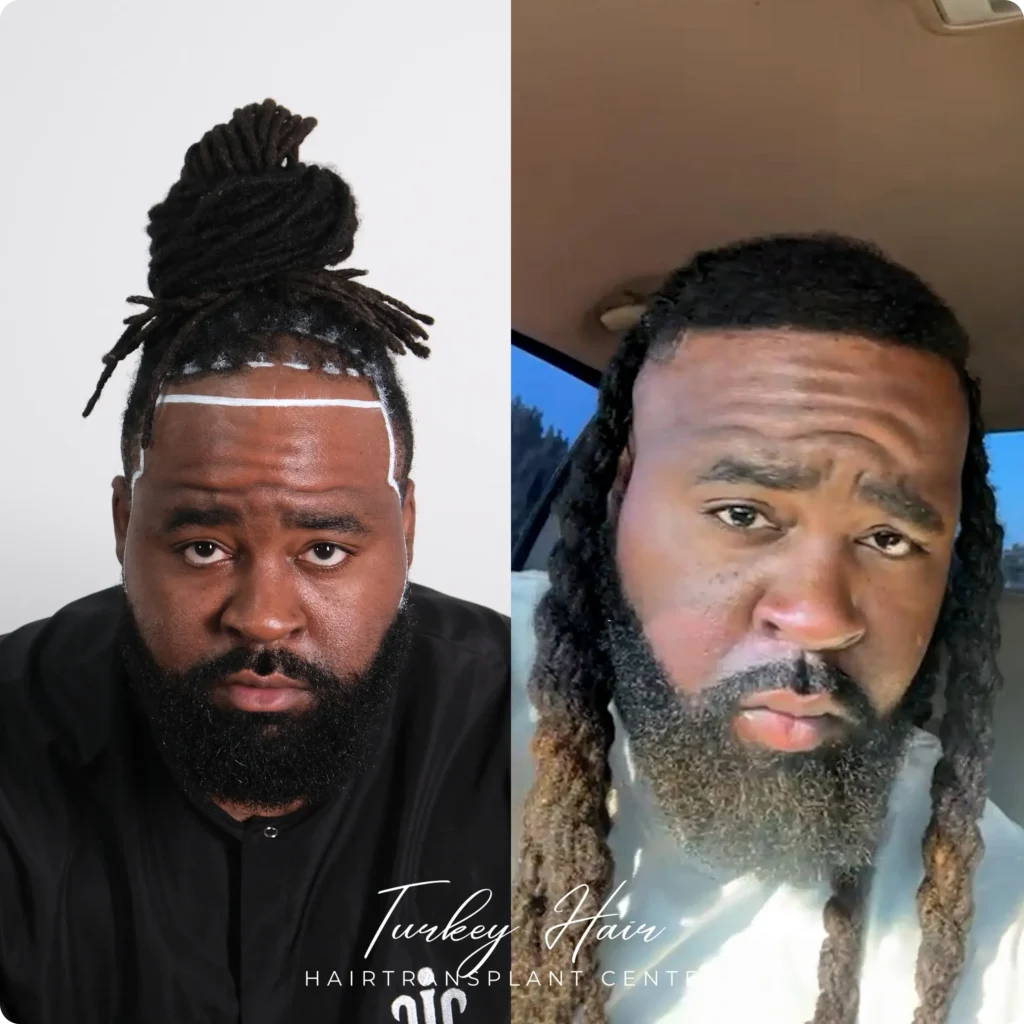
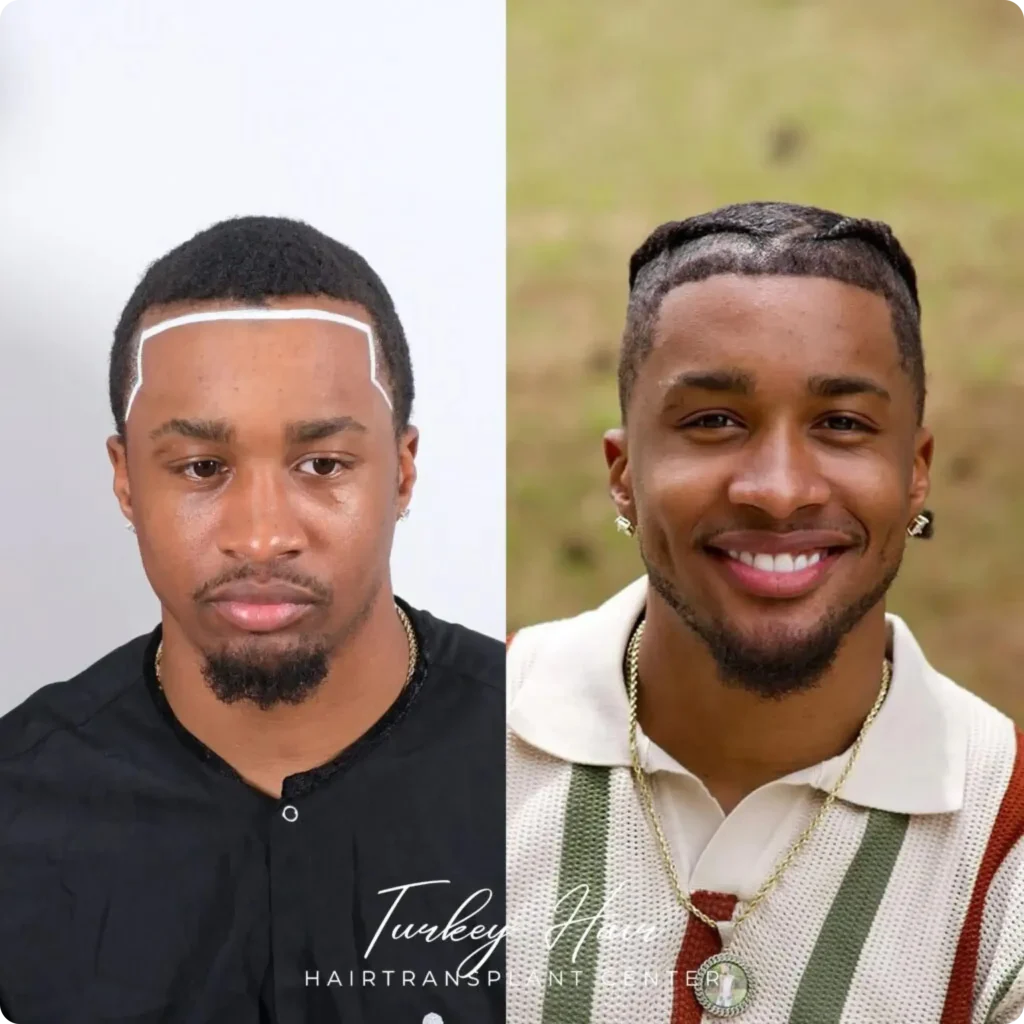
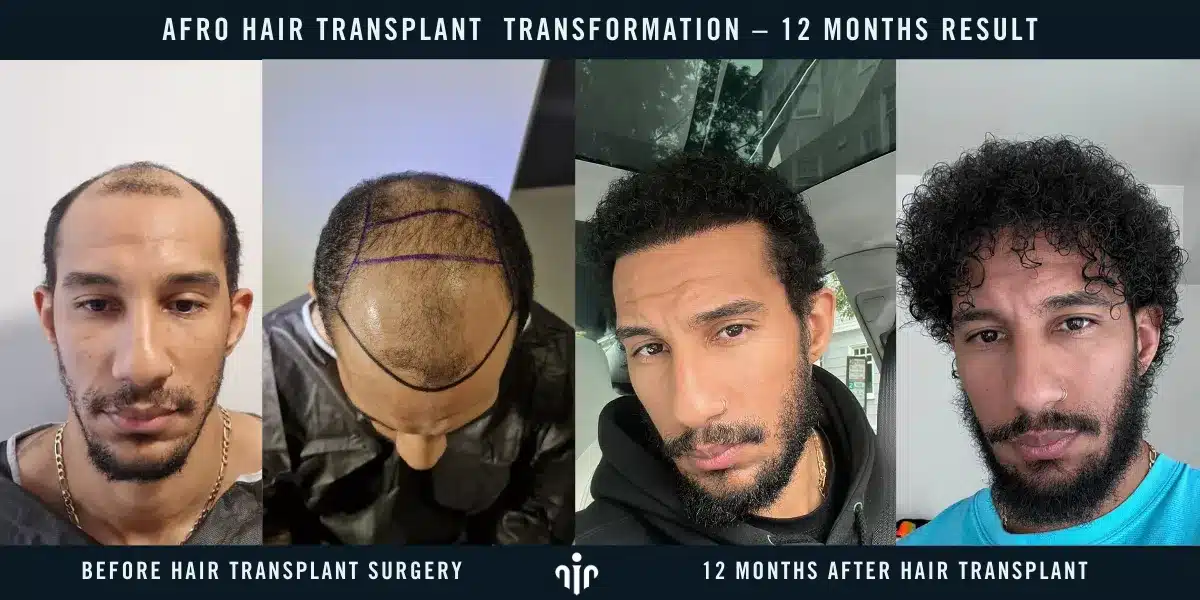
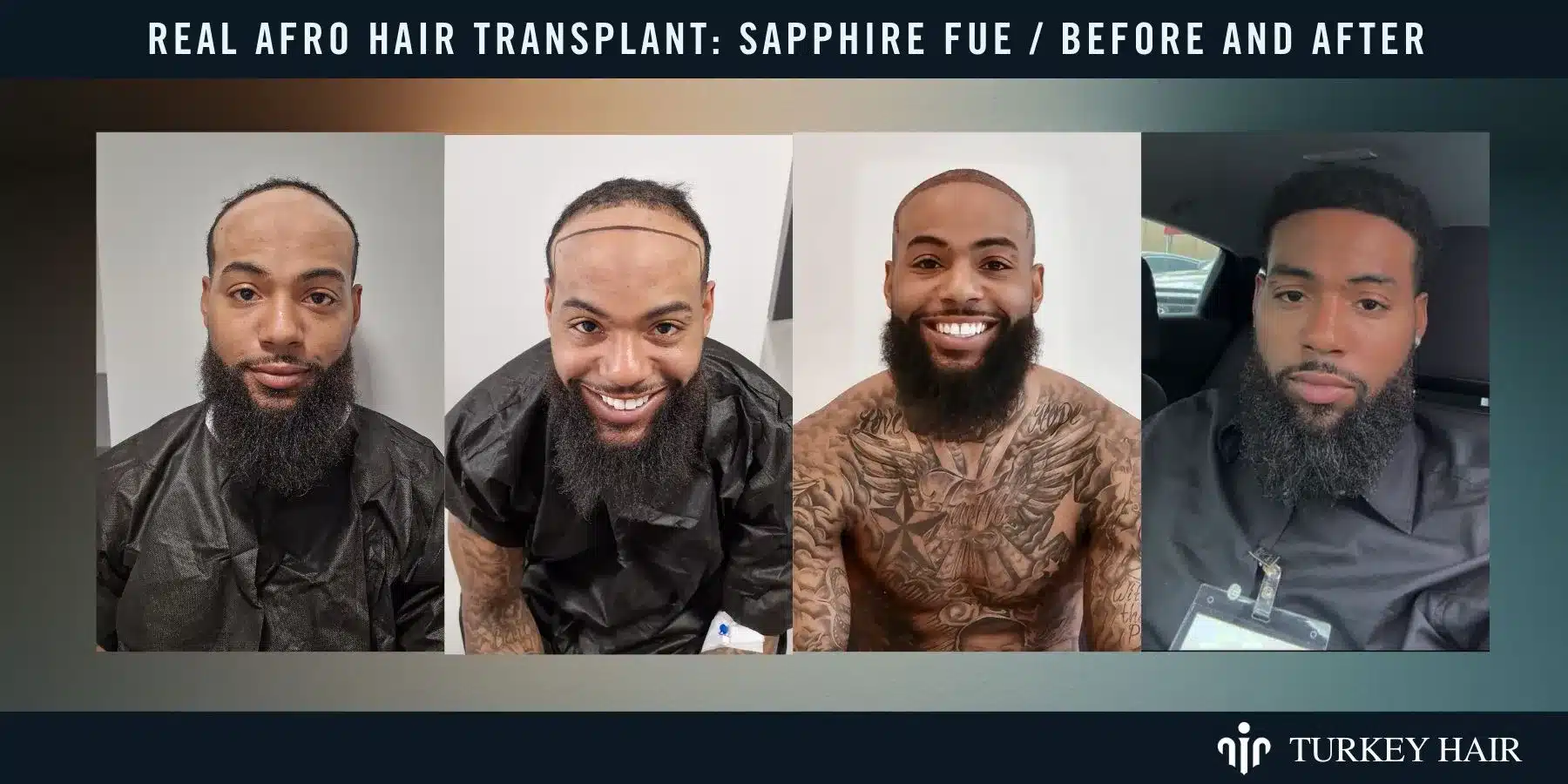
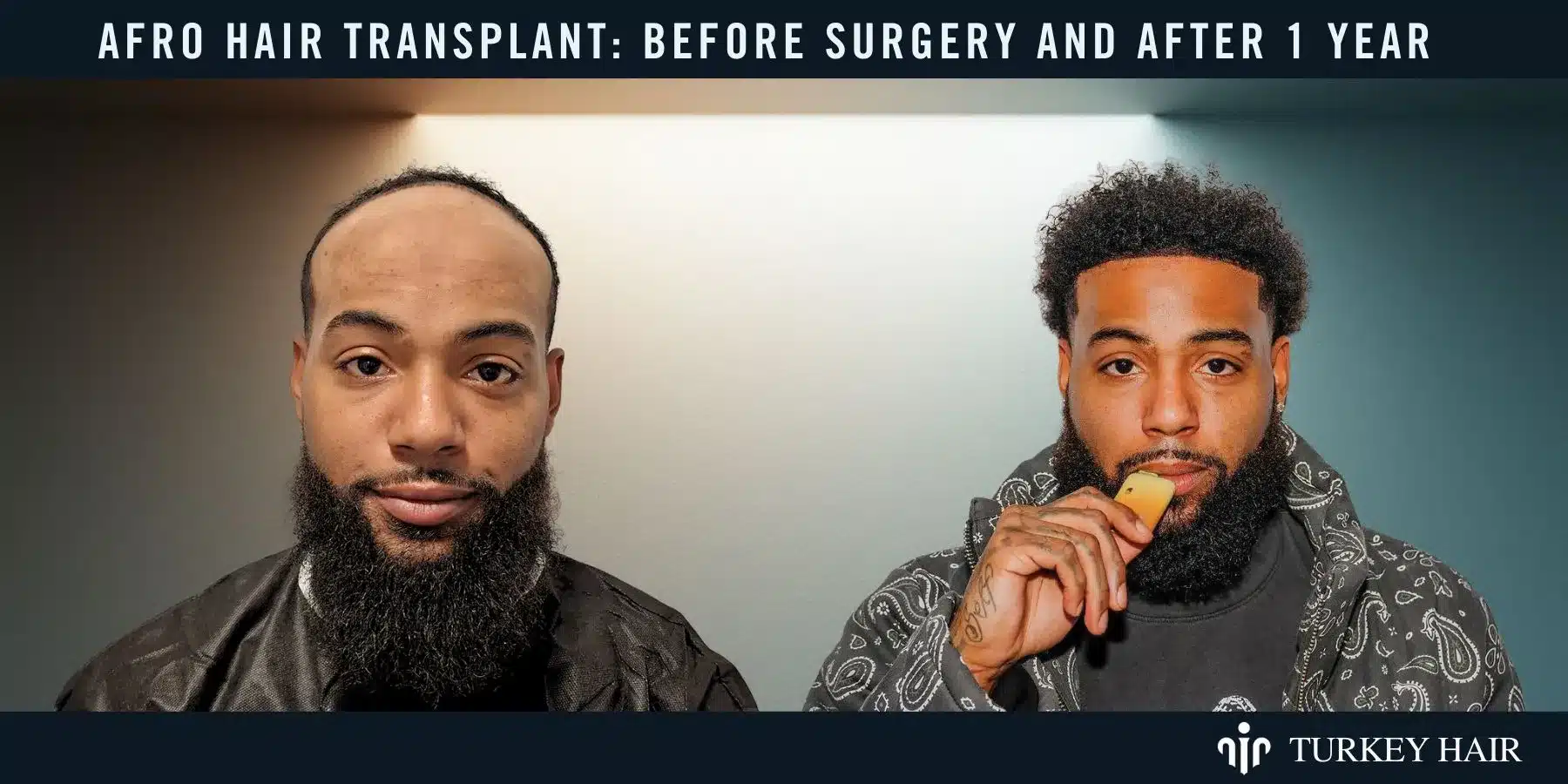
Every afro hair transplant Turkey before and after case here is one of our own patients. Judge afro hair transplant results at around 12 months. More cases are in our afro hair transplant before and after gallery.
Black Hair Transplant Before and After
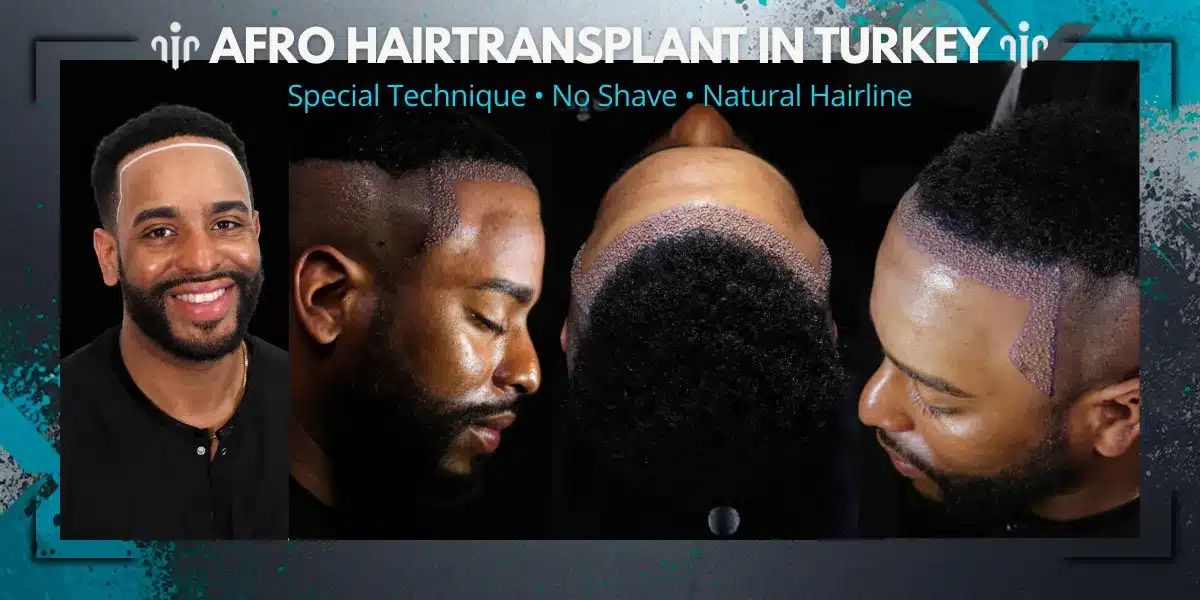
Our black men hair transplant before and after cases mostly show a rebuilt hairline and temples or a fuller crown. In hair transplant before and after black people photos, look for a soft, irregular edge and matching lighting.
Edges: Black Female Hair Transplant Before and After
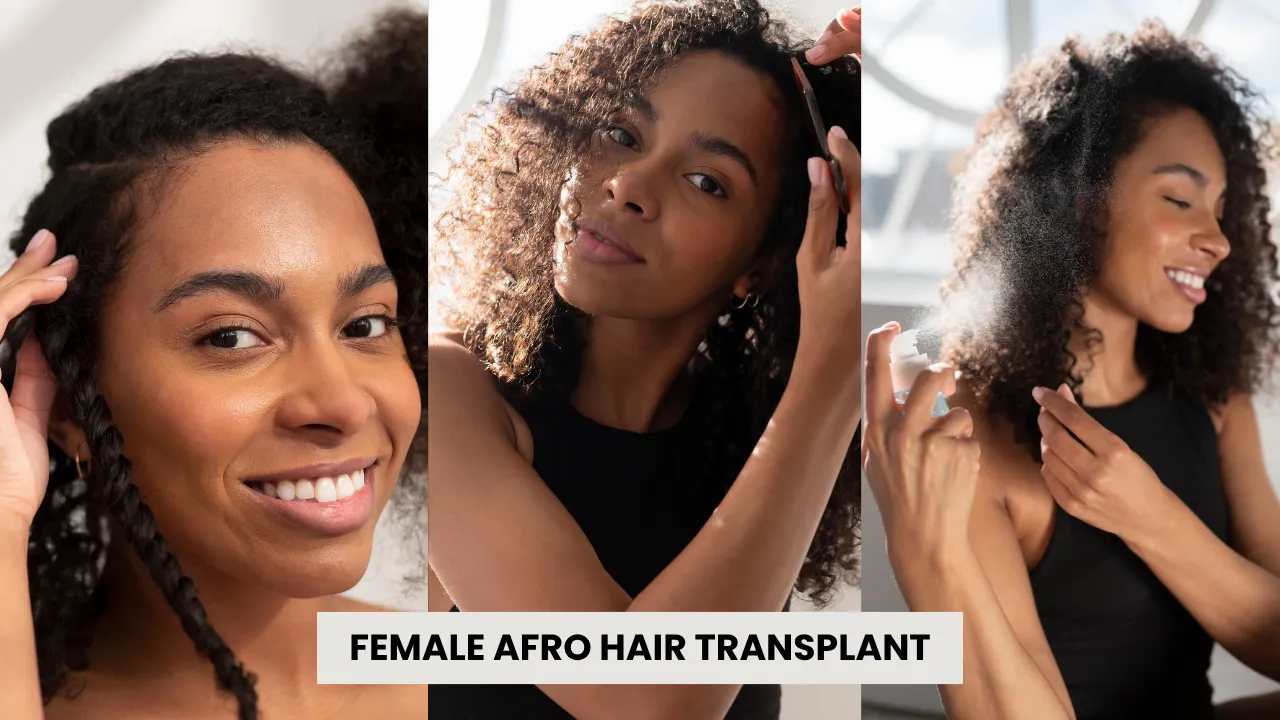
For women, the before photo usually shows edges and temples thinned by braids, weaves or tight ponytails; the after photo, a softer, rounded hairline. See hair transplant for women.
Before and After Afro Hair Transplant: Month by Month
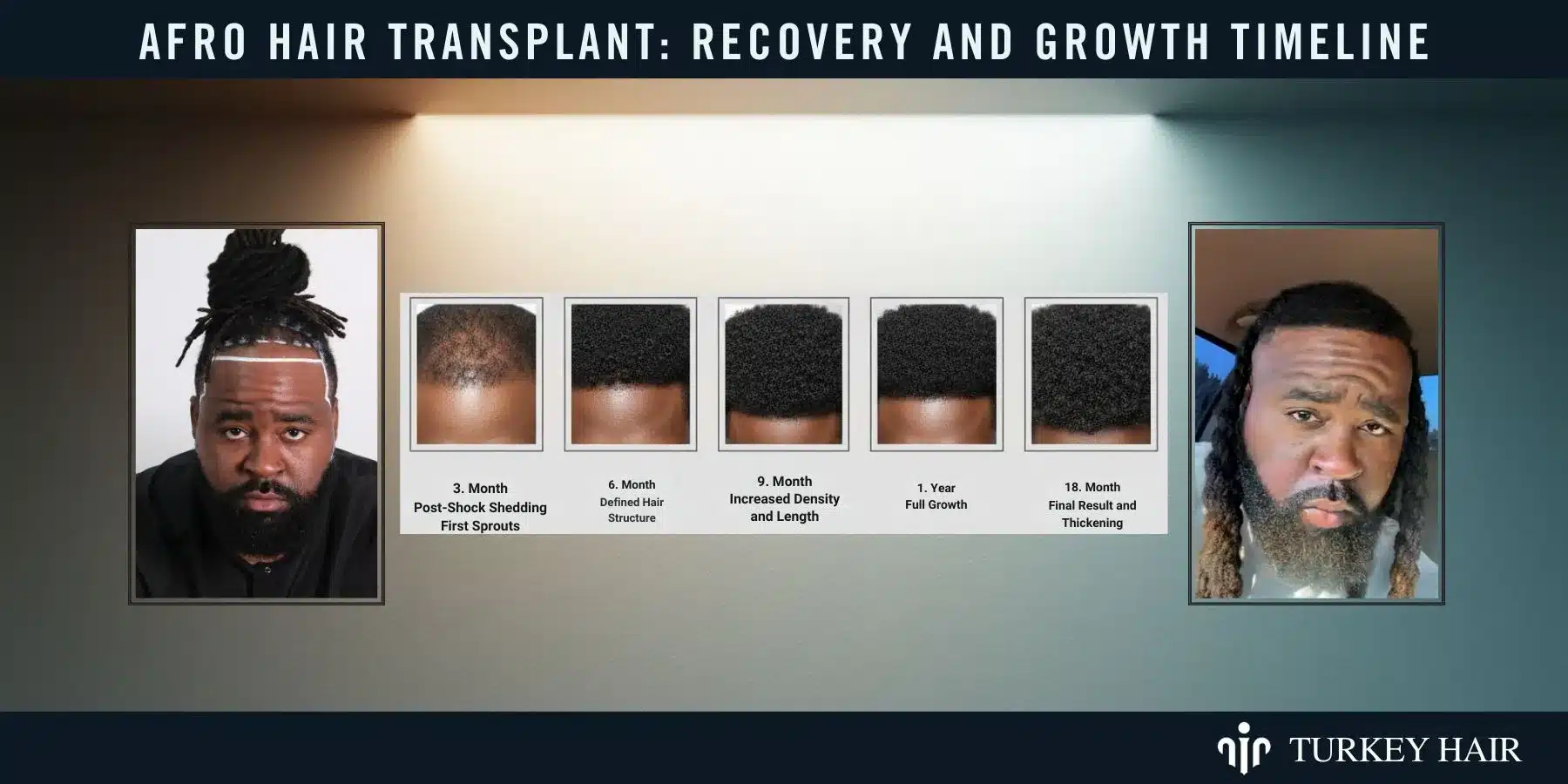
An African hair transplant before and after photo needs a date: month 1 is shedding, early growth shows in months 4-6, visible improvement in months 8-10 and the final evaluation comes at about 12 months.
What Is Afro Hair Transplant?
An Afro hair transplant is a surgical restoration designed to address the specific follicular characteristics associated with tightly curled or coily hair.
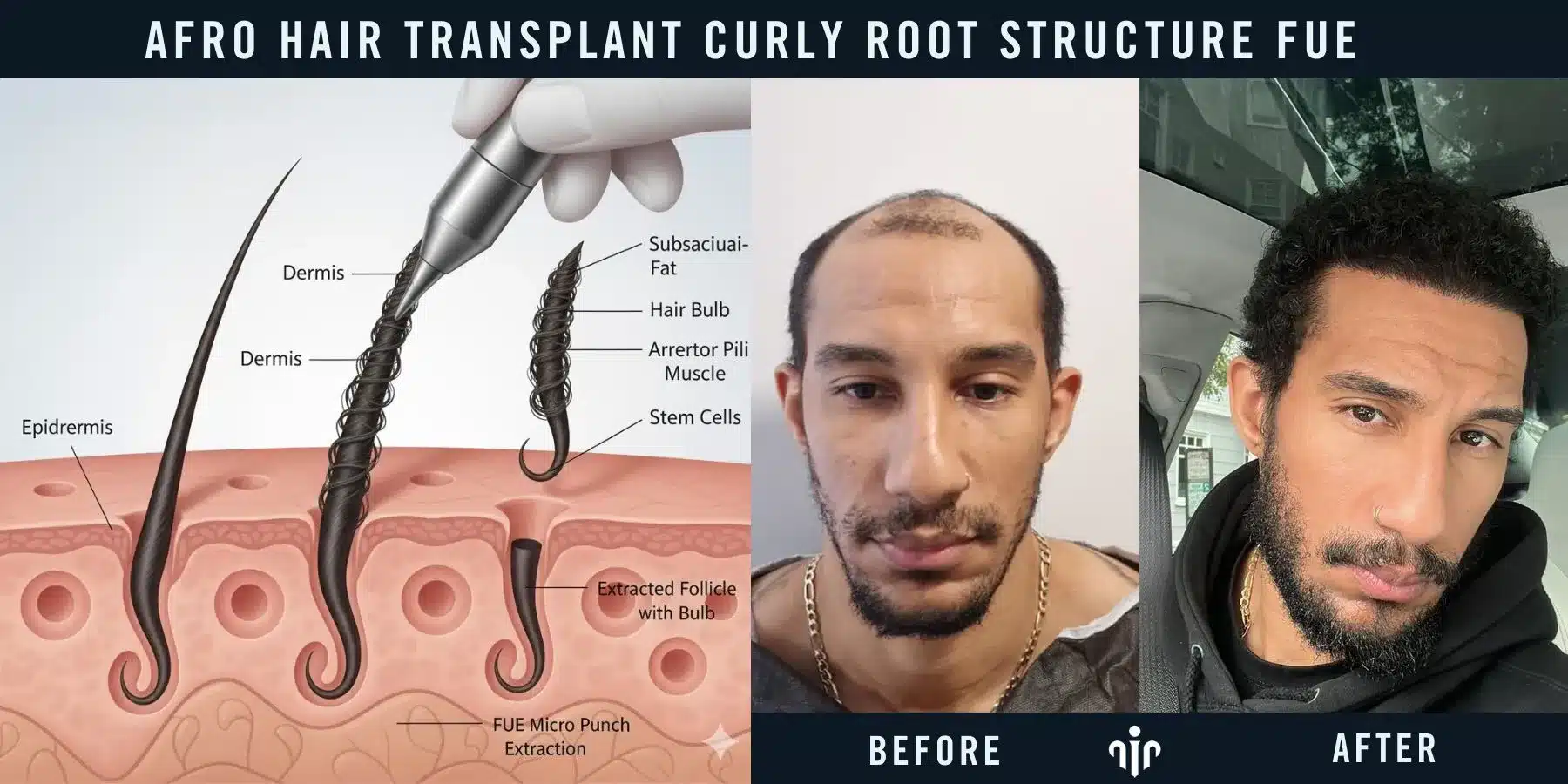
It is not a standard, one-size-fits-all procedure. Type 4A, 4B, and 4C hair follicles frequently possess a distinct curved structure. This curvature isn't just visible on the surface. It continues downward into the dermis. This sub-dermal curve requires highly specialized extraction methods to avoid cutting the root. Managing this curvature during extraction is critical to performing the surgery safely and effectively.
That hidden sub-dermal curve changes the entire extraction approach. If a clinic uses standard, straight extraction punches without modifying their depth or angle, this may increase the risk of follicular transection (cutting the graft). A severely damaged follicle may have reduced viability after transplantation.
Understanding Hair Loss Factors in Afro Textured Hair
Afro hair loss usually comes from traction, genetic DHT-driven loss, scarring alopecia such as CCCA, relaxer and heat damage, or nutritional and hormonal factors. The cause decides whether a transplant can be done now, later or not at all.
Can Afro Hair Get a Hair Transplant?
Yes. Can black people get hair transplants? They can, and an African American hair transplant can be highly effective for appropriately selected patients, as long as extraction and implantation are adapted to roots that curve under the scalp.
Can Afro Hair Be Transplanted?
It can. Can you get a hair transplant with curly hair? Yes: curly hair transplant grafts are your own follicles, so the new hair grows with your own texture, and curls cover more scalp with fewer grafts.
Common Situations Where Transplant Works Well
You may be a good candidate if:
You have stabilized genetic hair loss or inactive traction alopecia.
Your donor area (back of the head) has adequate density.
You are in good general health without active autoimmune conditions.
When We Pause or Decline
Not everyone qualifies for surgery. Medical safety and long-term viability must dictate the treatment plan.
Hair transplantation is generally not recommended when:
You have unrealistic expectations about density or coverage.
We may also advise waiting with uncontrolled keloid scarring, or while a young patient's hair loss is still progressing fast.
Hair Transplant for African American Men
Can black men get hair transplants? Yes. A hair transplant for black males usually targets a receding hairline, thinning temples or the crown. In a hairline transplant, black male patients often need the temples rebuilt with the front line, with soft irregularities rather than a harsh straight edge.
Afro Hair Transplant vs Other Techniques
The most effective techniques depend heavily on scalp laxity, curl type, and the medical team's diagnostic findings.
FUE Hair Transplant Technique for Afro Hair: Manual FUE
Manual extraction can give the surgeon greater control over punch angle and extraction speed. It allows the medical team to adjust in real-time to the specific rotational needs of the coiled follicle. It is slower and labor-intensive, but it helps protect the root integrity.
Sapphire FUE
In Sapphire FUE, sapphire blades may be used to create recipient-site incisions. The choice of blade and incision design depends on the surgeon's technique, the patient's anatomy, and the desired density.
Unshaven FUE
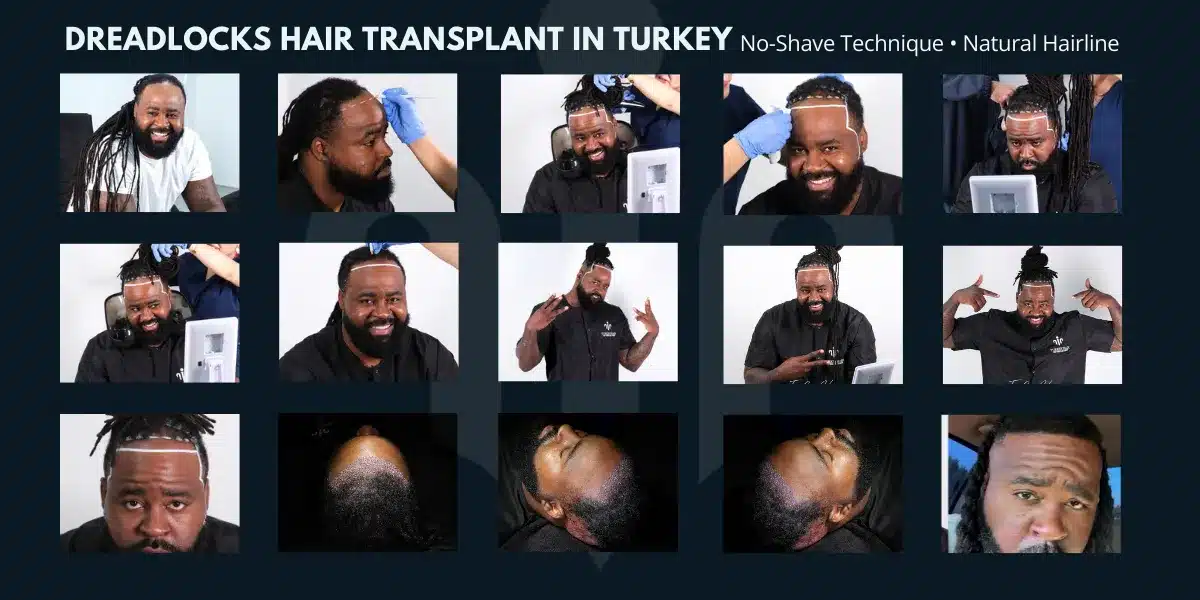
Unshaven FUE allows patients to undergo surgery without fully shaving their head. It preserves existing hair length and offers a more discreet recovery. However, it is technically demanding. Fewer grafts may be practical to extract in a single session, and it is not suitable for every patient profile.
Customized Solutions for Individual Needs: Combining Methods
For patients needing higher graft counts or undergoing a repair surgery, clinics sometimes blend techniques. A combination approach aims to balance extraction across different donor zones, which helps preserve the long-term integrity of the scalp.
DHI and Afro-Textured Hair
DHI may be appropriate in selected patients, but the implanting method should be chosen according to follicular anatomy, graft characteristics, recipient-site requirements, and surgeon experience. Choi implanter pens were historically built for straighter hair. Therefore, loading and implanting a tightly coiled graft requires specific clinical expertise to avoid bending the follicle or traumatizing the bulb.
Using the Right Tools: Tools Made for Curls
Straight punches can cut a curved root below the skin (transection). Surgeons use specialized micro-punches, adjust angle and depth per graft and keep the extraction pace slow.
Customizing Hair Transplantation Techniques for Different Hair Textures
Tools were largely built for straighter hair, so an afro hair transplant for curly hair adapts punch choice, extraction speed, graft loading and placement angle to your curl.
Unique Characteristics of Afro Textured Hair
The root curves beneath the skin, each hair expands outward so fewer grafts look full, and the scalp may scar more easily.
Challenges and Considerations for Afro Hair Transplantation
Keloid history, active CCCA and a donor area that looks denser than it is all need checking first. If you wear locs, see hair transplant with dreadlocks.
Advantages of Afro Hair Transplant
Key Benefits
Your own hair, with your own curl pattern
A fuller look with fewer grafts
A hairline shaped around your temples and face
Edges lost to traction can often be restored
Enhancing Hair Density and Volume for Natural-Looking Results
Coily hair stands away from the scalp and covers more skin per hair, so the plan aims for a natural spread instead of packing grafts tightly and using up the donor area.
Improved Aesthetic Appearance: Restoring Hairline and Facial Harmony
A natural hairline follows your age, forehead height and temple points. In afro hair the temples are usually rebuilt with the front line to frame the face.
Long-Term Solution for Hair Loss: Restoring Growth in Balding Areas
Grafts come from the back and sides of the scalp, an area usually resistant to DHT, so transplanted follicles usually keep growing. Native hair can still thin.
How Afro Hair Transplant Is Performed: Step by Step
The operation is one session of about 6-8 hours under local anesthesia, with sedation support on request; most patients plan three days in Istanbul.
Before Your Surgery Day
Send front, top and back photos in daylight for a free assessment. For 7 days before surgery, stop smoking and alcohol, avoid blood thinners unless your doctor says otherwise and let your hair grow out slightly.
Arrival, Consultation and Hairline Design
Airport pick-up, consultation, blood tests and the hairline drawing you approve.
Day 1
Extraction and Implantation
Grafts are taken one by one at a slow pace, then placed at the angle of your curl with sapphire blades or a DHI pen.
Day 2, 6-8 hours
Next-Day Check-Up
Dressing removed, grafts checked, washing and sleeping explained.
Day 3
Afro Edges and Temples With the Main Hairline
Thinned edges and temples are usually restored in the same session, so the hairline, temple points and edges are designed as one shape.
Beard and Afro Hair Transplant Together
The back of the head is the main donor for scalp and beard (under-chin hair is an alternative), so both share one donor budget. See afro beard transplant.
Eyebrow Transplant for Afro Hair
Brows use fine single-hair grafts from the back of the scalp, placed almost flat to avoid curl misalignment; regrowth starts around weeks 8-12. See eyebrow transplant.
Afro Hair Transplant Donor Area
At Turkey Hair Center, Afro-textured hair cases are assessed individually because follicular curvature, curl pattern, donor density, and previous scalp trauma can vary significantly between patients. Our pre-surgical evaluation includes:
Curl Pattern & Follicular Angle: To determine the correct punch diameter.
Donor Density: To ensure extraction won't cause visible thinning.
Previous Traction or Scarring: To assess blood supply in the recipient area.
CCCA Activity: To rule out active inflammation.
Hairline Design: To match natural facial symmetry.
Graft Requirements: To plan a safe, sustainable extraction limit.
Can black women get hair transplants? Yes, when the cause allows it. Female hair loss is structurally different. Women rarely present with a traditional receding hairline. Instead, they often experience diffuse thinning across the scalp or localized loss at the edges due to traction alopecia.
Restoring female edges requires a softer, rounded hairline design.
Traction Alopecia Repair: The Treatment Path
Restoring hair lost to traction alopecia requires a careful, phased approach. Before any surgery is planned, a doctor must confirm that the mechanical pulling has completely stopped and the hair loss is stable. Rushing into a transplant too early can compromise the final results.
Confirm the medical diagnosis.
Stop all ongoing mechanical traction (braids, tight weaves).
Assess whether the hair loss has completely stabilized.
Evaluate donor density at the back of the head.
Assess scar tissue and blood flow in the recipient area.
Afro Hairline vs European Hairline
European hairlines are often designed with soft, feathered transitions and some temple recession. Many Black men prefer a cleaner, defined line that frames the face; either way, the edge needs slight irregularities.
Density Planning for Afro Curls
Patients naturally want to know how much hair they need before choosing a technique. Many frontal restoration cases fall within a broad range of 2,500 to 3,200 grafts.
Curls can hide a limited follicle count, so we plan grafts conservatively. Estimate your stage with the free Norwood test.
Black Hair Transplant Cost in Turkey
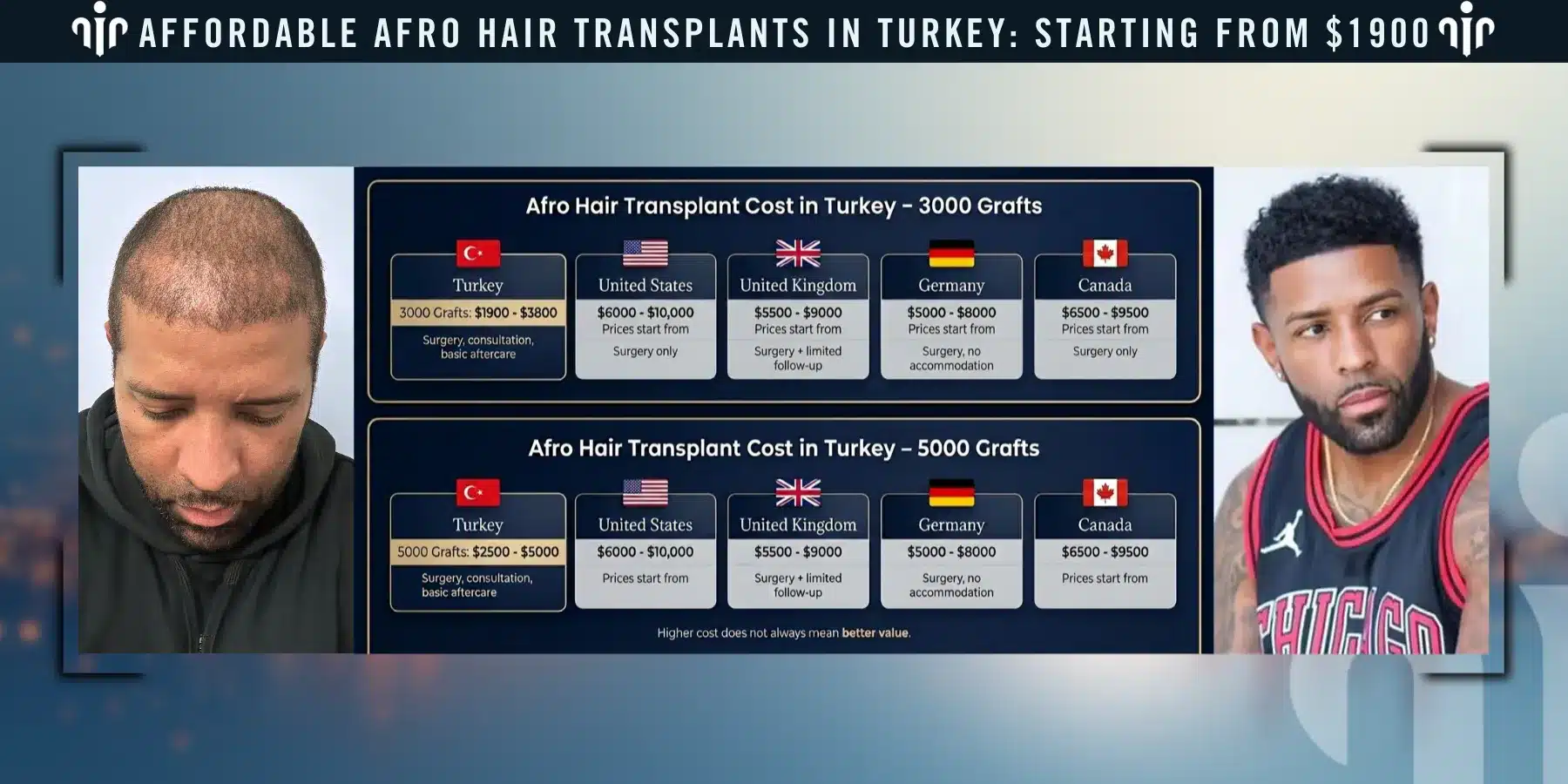
Our all-inclusive Afro hair transplant packages in Turkey cost £1,920 to £3,390; the package that fits depends on the complexity of the case and the number of grafts required.
Across clinics, the price reflects the number of grafts needed, the specific technique applied, the surgeon’s expertise, and the required density. Many clinics in Turkey serving international patients use package-based pricing. Clinics in the US and parts of Western Europe may more commonly price procedures on a strict per-graft basis. Our packages are set by tier and are not billed per graft.
What’s Included in an All-Inclusive Afro Hair Transplant Package in Turkey?
At Turkey Hair Center, international patient packages may include accommodation, transfers, and post-operative aftercare to simplify the travel experience. A typical package usually covers:
VIP airport, hotel, and clinic transfers.
2 nights of hotel accommodation.
A personal medical assistant and interpreter.
Pre-operative blood tests and dermatological analysis.
Post-operative medications, special shampoos, and lotions.
2 years of aftercare consultation.
Cost Comparison: Turkey vs. USA, UK, and Germany
Country
Typical price (3,000-5,000 grafts)
Billing model
Turkey
£1,920 - £3,390
All-inclusive package
United States
£4,520 - £11,290+
Per-graft pricing
United Kingdom
£4,140 - £9,030
Per graft or per session
Germany
£3,760 - £7,530
Per-graft pricing
Typical Afro Hair Transplant Turkey Cost by Package
Our afro hair transplant cost in Turkey is a fixed package price: Sapphire Prime £1,920, Sapphire Advanced Regrowth £2,260, DHI Comfort £2,520 or Exosapphire Microflow Elite £3,390. See what each includes on our treatments page.
Hair Transplant Cost for African American Patients
What does a Turkey hair transplant cost black men or women? The same packages as anyone else. The black male hair transplant cost and the black women hair transplant cost both depend on the area to restore, so your black hair transplant Turkey cost is confirmed in writing before you travel.
What Affects Your Price
Graft count, technique (Sapphire FUE or DHI) and extras such as exosome therapy. A companion may mean an extra hotel charge. More detail in our afro hair transplant cost guide.
Afro Hair Transplant Recovery
Patients receive individualized postoperative instructions based on their specific procedure and clinical assessment. The stages below are a general guide; your own instructions come first.
Afro Hair Transplant Recovery Time
Healing takes about two weeks; growth takes about 12 months.
What You Can Do During Recovery
Days 1-5: driving after 1-3 days, desk work after 2-5 days
First 14 Days: Sleep with your head elevated and avoid direct sun exposure.
Weeks 2-4: gym; weight lifting from week 3-4
Month 1: swimming, sauna and haircuts; hair dye from about month 2
Months 1-6: no chemical relaxers or aggressive scalp treatments until your clinic clears them
Surgery Day
About 6-8 hours under local anesthesia. That night, sleep with your head raised on a travel pillow, don't touch the grafts and avoid smoking and alcohol.
Days 1-3
Mild bleeding, redness and tightness are common; swelling may reach the forehead and eyes on days 2-3 and usually passes. The first wash uses the prescribed foam, without fingernails.
Week 2
Scabs form on days 4-7 and itch; don't pick them. By week 2 most are gone, and after about 10 days accidental graft loss is much less likely.
Weeks 3-4
Shedding may start in week 3. This shock loss is normal: the shafts fall while the follicles stay alive, and dense, coily hair can make it look more dramatic.
Months 2-3
Month 2 is a waiting phase. Around month 3, the first fine hairs appear.
When Will Afro Hair Grow After Transplant?
Expect the first curly hairs around months 3-4 and about half of the result by month 6. Afro hair can keep thickening until months 15-18.
Are Afro Hair Transplant Results Permanent and Natural?
Transplanted follicles come from the back and sides of the scalp, an area usually resistant to pattern hair loss, so they tend to keep growing long term. Your native hair can still thin with age, which is why some patients also use medication.
A natural look depends on design more than density: a hairline with soft irregularities and grafts that follow your curl direction. Afro hair can keep maturing after the first year as the curl pattern settles.
Afro Hair Transplant Risks and Side Effects
Surgery always carries inherent risks.
If a clinic attempts an Afro hair transplant using generic straight-hair protocols, the risk of graft injury, transection, donor scarring, or unnatural growth direction may increase. Patients should verify the surgeon's credentials, experience with tightly curled hair, treatment plan, and aftercare arrangements before choosing a clinic.
Is Afro Hair Transplant in Turkey Safe?
It can be, when the procedure is adapted to curved follicles and you are screened first. Our partner surgeons perform one procedure per day and do not delegate critical steps to technicians.
When Splitting Procedures Is Safer
Taking 4,000-5,000 grafts from afro hair in one day can raise the risk of overharvesting, so large cases may be split into two sessions.
Risk of Scarring?
Patients of African descent may have a higher risk of keloids, raised scars after tissue trauma. A keloid history is not always a reason to refuse surgery, but it needs a dermatological evaluation first.
Risk of Future Hair Loss?
Transplanted follicles usually keep growing, but native hair can keep thinning and leave gaps behind a new hairline. Finasteride or minoxidil may help, though not for everyone.
Contact us without waiting if you notice yellow crusts, discharge, spreading redness or increasing pain. Our guide to hair transplant side effects explains what is normal.
Afro Hair Transplant Turkey Reviews
Afro hair transplant reviews are most useful on independent platforms, ideally with photos taken about 12 months after surgery, when growth is close to final. Our patients review us on Google, Trustpilot, Bookimed and ProvenExpert (links on our review page). We do not pay for reviews, and no discount or gift is attached to leaving one.
Designed for Your Texture. Led by Real Surgeons.
Afro-textured follicles curve below the skin, so punch angle and extraction speed decide how many grafts survive. Our partner surgeons perform only one procedure per day. When you compare black hair transplant doctors, ask who does the extraction and the incisions, and how many afro-textured cases they have treated.
Check Reviews
Read reviews on at least two platforms, including the negative ones, and look for patients with a similar hair type and loss pattern. Then compare them with our own cases in the afro before and after results.
TrustScore 4.1 out of 5 on Trustpilot, based on 5 reviews (checked 11.10.2026).
★★★★★
Turkey hair center was an amazing experience. They took care of me from the moment I landed all the way until my flight back home. They do top tier work and I would highly recommend them to anyone looking for this service!
★★★★★
I had my hair transplant about a month ago and so far the progress/recovery is going super well and ahead of schedule. The doctor and nurses from the clinic were super friendly and knowledgeable. They made me feel comfortable and confident i made the right decision to go with them. Also the food that they serve me half way through the procedure was amazinggggg.
★★★★★
This experience was great the Doctor and Staff were very professional and the BEST! Highly recommend if you want to goto the best hair transplant center to get your hair transplant! This is me after little before 3 months!
★★★★★
my experience at turkey hair transplant centre was really good and the doctors made me feel vert welcome, i am happy with my results at the moment and would definitely recommend it to others
Having Afro Hair Transplant in Turkey: Your Trip
Turkey is a major destination for international hair-transplant patients. However, patients considering treatment should evaluate clinics based on medical credentials, facility standards, communication, and experience with Afro-textured hair rather than destination alone.
When vetting a clinic, consider asking these specific questions:
Has the surgical team treated Afro-textured hair frequently?
Can they explain how they handle follicular curvature?
Are clear, unedited before/after cases available?
Is a medical diagnosis performed before surgery is confirmed?
Who actually performs the extraction and implantation?
What happens if CCCA or an underlying condition is suspected?
What is explicitly included in the financial package?
What kind of digital follow-up is provided once you return home?
There is no single best afro hair transplant Turkey answer. If you are searching for the best afro hair transplant clinic in Turkey, ask every clinic these questions, including us.
How Many Days Does an Afro Hair Transplant Take in Turkey, and How Many Days to Plan?
The operation takes one day. The standard plan is two hotel nights: arrival, consultation and blood tests; the procedure; then the next-morning check-up before your flight. Most patients book three days.
What to Pack
A loose hat you have not worn tight
A travel pillow for sleeping with your head raised
Your regular and prescribed medication
For the flight home: a window seat, bag at your feet
What Types of Hair Loss Can Be Treated?
Afro hair loss is caused by a combination of mechanical, genetic, hormonal, and inflammatory factors. Understanding the underlying cause is the most important step before any surgery is planned.
Afro Hair Transplant For Curly & Coily Hair 18
Impact of Hair Loss on Afro Identity and Self-Esteem
Edges and hairline are part of how many patients style and present themselves, so losing them can weigh on confidence. That is a reason to seek help, not to rush: diagnosis comes first.
Causes of Afro Hair Loss and Hair Loss in African Americans
Traction Alopecia
Decades of wearing tight braids, weaves, or extensions put severe physical tension on the hair root. Over time, this constant pulling can damage the follicle permanently. Traction alopecia is highly prevalent in women of African descent and primarily affects the hairline and temporal edges.
Central Centrifugal Cicatricial Alopecia (CCCA)
CCCA is a scarring condition that usually starts at the crown and spreads outward. Clinical literature links it to genetic predispositions in Black women. Active CCCA causes severe inflammation that destroys hair follicles and replaces them with scar tissue.
Chemical Relaxers & Heat Damage
Harsh chemical straighteners break the disulfide bonds in the hair shaft to alter its structure. Repeated or improper use of chemical relaxers can irritate or injure the scalp. In severe cases, this contributes to local scarring and permanent hair loss.
Androgenetic Alopecia
This is male and female pattern baldness. It is genetic. DHT (dihydrotestosterone) shrinks the hair follicles over time. In Black men, this typically presents as a receding hairline and a thinning crown.
Nutritional & Hormonal Contributors
Deficiencies in vitamin D or ferritin (iron), along with thyroid imbalances, often play a major role in hair shedding.
Type of Hair Loss? What a Transplant Can Treat
Type of hair loss
Is a transplant an option?
Traction alopecia
Often, once pulling has stopped and loss is stable
Androgenetic alopecia
Often, with DHT-resistant donor hair
Relaxer or heat damage
After the scalp is checked for burn scars
CCCA
Generally avoided while active
Nutritional or hormonal
Tests and treatment first
Can Afro Hair Be Transplanted Successfully?
Yes, for appropriately selected patients: success depends on diagnosis, donor area and a technique adapted to curved roots.
Will Transplanted Hair Retain Its Curl Pattern?
Yes. The grafts are your own afro-textured follicles, so they keep your curl. Early hairs can look finer, and the pattern settles as they mature, sometimes beyond the first year.
Maintenance Treatments for Transplanted Afro Hair
Finasteride or minoxidil may protect native hair; minoxidil must reach the scalp, not sit on the curls. PRP is part of our packages. While healing, avoid heavy oils and pomades, which can cause bumps.
Why Is Turkey a Popular Destination for Afro Hair Transplants?
Grammy-winning artist Akon has publicly discussed undergoing a hair transplant in Turkey. His public statements remain a notable example of the country's growing visibility in international medical tourism for Afro-textured hair restoration.
Is Turkey a Leading Destination for Hair Restoration?
It is one of the main destinations for international patients, mostly because of all-inclusive packages instead of US-style per-graft billing (£3-£7.5 or more per graft). Read Akon's hair transplant story.
Key Points About Curly and Afro Hair Transplants
Diagnosis first: active CCCA rules out surgery for now.
Curved roots need adapted punches and slow extraction.
Curls give visual density, so donor plans stay conservative.
Results are judged at about 12 months.
Free Consultation - Afro Hair Transplants
Send front, top and back photos of your scalp in daylight on WhatsApp. The review is free, with a preliminary graft estimate; the plan is confirmed in person when you arrive.
Travelling from the UK
Flights: Turkish Airlines flies non-stop to Istanbul from London, Manchester, Birmingham and Edinburgh, with a flight time of roughly 4 to 4.5 hours.
Entry: British citizens can visit Türkiye without a visa for up to 90 days in any 180-day period. Your passport must be valid for at least 150 days after the date you arrive. Check the latest rules on GOV.UK before you travel.
Time difference: Istanbul is on UTC+3 all year, so it is 2 hours ahead of the UK in summer and 3 hours ahead in winter.
Prices in pounds: Sterling prices on this page are converted from our US dollar price list at the European Central Bank reference rate of 30 September 2026 (1 USD = 0.7526 GBP) and rounded. Exchange rates change, so the sterling amount can move slightly.
Afro Hair Transplant Turkey FAQ
Can Afro Hair Be Transplanted?
Yes. Afro hair is transplanted using your own follicles from the back and sides of the scalp. Because the roots curve under the skin, the team uses adapted punches, a slow extraction pace and places each graft along your curl. Candidacy depends on the cause and your donor area.
Can Black Hair Be Transplanted?
Yes. Black hair is transplanted with the same FUE principle, adapted to curved, coily roots, and grows back with your own texture. Traction alopecia and genetic hair loss are usually treatable; active scarring conditions such as CCCA need treatment before any surgery.
Do Black People Get Hair Transplants?
Yes. Black men and women get hair transplants for a receding hairline, thinning temples or crown, and edges lost to tight styles. The singer Akon has spoken publicly about his transplant in Turkey. What matters is a plan made for curly hair.
Do Black Men Get Hair Transplants?
Yes. Most Black men who contact us have genetic hair loss at the hairline, temples or crown. Donor hair from the back of the scalp is usually resistant to DHT, so transplanted hair usually keeps growing, while native hair may need medication.
Do Black Women Get Hair Transplants?
Yes. The most common reason is traction alopecia at the edges and temples after years of braids or weaves. It can often be restored once the pulling has stopped and the loss is stable. Diffuse thinning or CCCA needs a diagnosis first.
Am I a Good Candidate for a Hair Transplant?
You may be if your hair loss is stable, your donor area at the back of the head has enough density and you are in good general health. Active CCCA, uncontrolled keloids or a depleted donor area usually mean surgery is postponed or not advised.
What Can I Expect During the Recovery Process?
Expect redness and mild swelling in days 1-3, scabs that fall away by day 7-10 and shedding around weeks 3-4. Desk work is usually possible in 2-5 days. The first fine curly hairs appear around months 3-4, and the result is judged at about 12 months.
Are There Non-Surgical Alternatives to African American Hair Transplants?
Yes. Minoxidil and finasteride can help slow hair loss and protect native hair, though they are not suitable for everyone. Scalp micropigmentation (SMP) can create the look of density without surgery. Active CCCA needs dermatological treatment rather than a transplant.
Does the “Shock Loss” phase affect Afro hair differently?
The timing is usually the same as for other hair types: temporary shedding between weeks 2 and 8, with new growth from around month 3. Because afro hair is dense and coily, the shedding can look more noticeable before the new hair grows in. It is a normal part of healing.
Book Your Afro Hair Transplant Consultation
Restoring Afro-textured hair requires more than standard hair transplant protocols. It demands an anatomical understanding of follicle curvature and precise clinical execution.
Take the guesswork out of your planning. Send us clear photos of your scalp. Within 24 hours, our medical team will review your case to provide a preliminary assessment and graft estimate.
Nazmi G. works directly with patients as the Senior Trichologist and Hair Restoration Consultant at Turkey Hair Center. His clinical focus is straightforward: accurate graft planning and natural hairline design.
He spends hours every week consulting with international patients. Figuring out the logistics of traveling abroad for surgery can be stressful. Nazmi steps in to break down the actual medical facts and financial details. His goal is simply to make sure every patient has a clear, evidence-based treatment plan before they ever book a flight.
Medical Review Note
Dr. Tompi, M.D., a board-certified surgeon, evaluated this guide for clinical accuracy. His review specifically verified the medical statements regarding FUE and DHI extraction methods, realistic recovery timelines, and long-term donor preservation.
Medical Disclaimer: This guide is strictly for educational purposes and cannot replace a real medical consultation. You cannot get an exact price, confirm your surgical candidacy, or determine a safe graft count without a direct physical or verified digital evaluation by a licensed physician.
Editorial Policy & Trust
Turkey Hair Center prioritizes medical transparency and patient safety. We actively stand against deceptive marketing and unverified guarantees.
Send three photos: front, top and sides. You get a technique recommendation, a graft range and a straight answer about what is achievable, before anyone talks about price.
Your details are with the team
A patient coordinator will get back to you shortly. If you would like to send your photos now, WhatsApp is the fastest way to do it.
We respond quickly, day or night, in your language.
Multilingual team, no obligation
Data protectedKVKK and GDPR compliant, 100% confidential
Authorized Health Tourism Intermediary
Turkey Hair Center is the hair-restoration brand of Healthy Way Tourism, an authorized international health-tourism intermediary. All medical procedures are performed by licensed medical professionals at authorized healthcare facilities in Turkiye, in accordance with the regulations of the Ministry of Health.