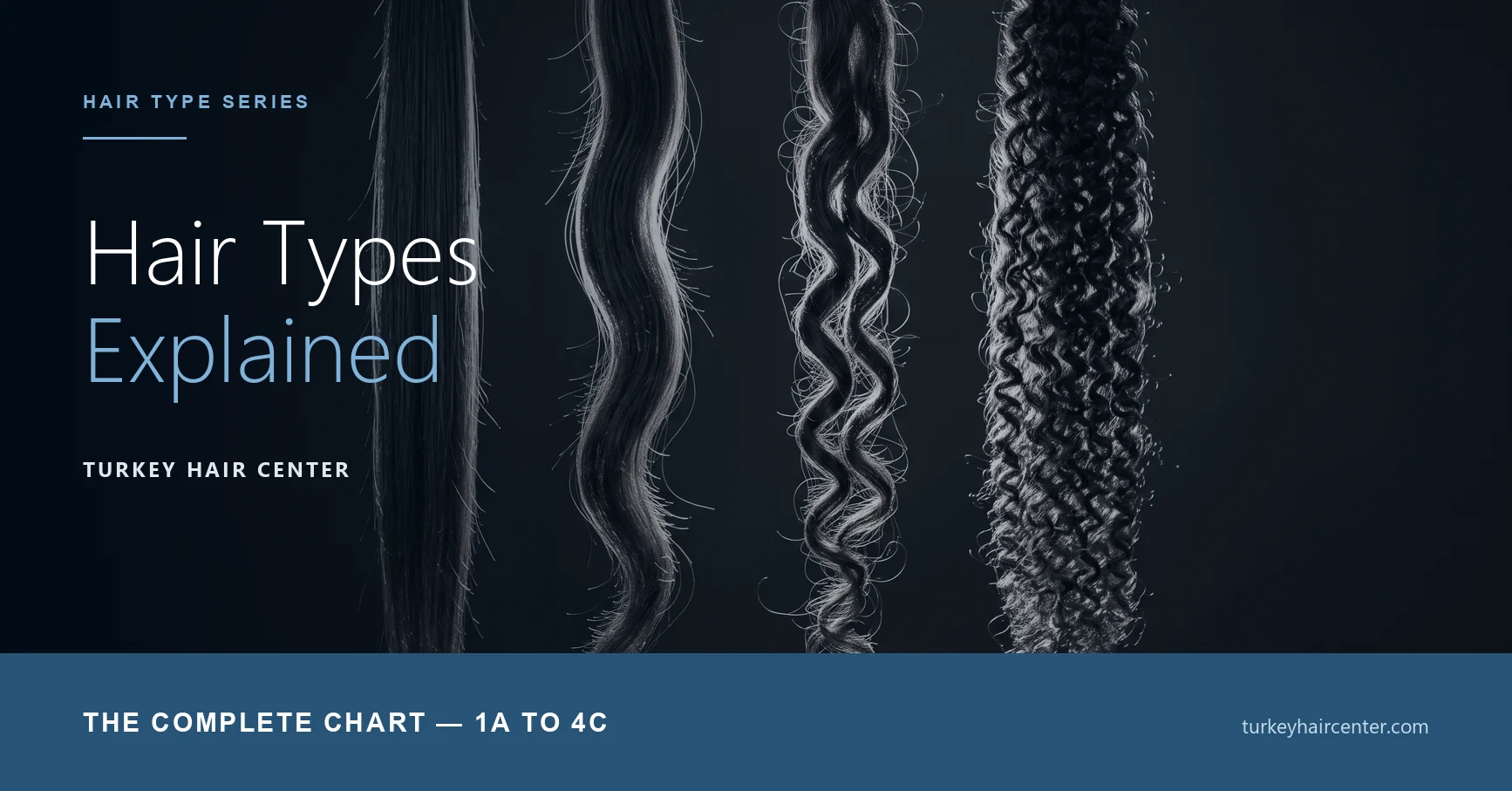
Les cheveux sont classés sur une échelle de 1 à 4 selon leur motif de boucles, 1 est raide, 2 est ondulé, 3 est bouclé et 4 est crépu, et chaque chiffre est divisé en A, B et C selon l'étroitesse du motif. Cela donne douze types au total, du 1A (les cheveux raides les plus fins) au 4C (la spirale en zigzag la plus serrée).
Réalisé dans des hôpitaux partenaires agréés Turkey Hair Center est un intermédiaire de tourisme médical agréé par le Ministère de la Santé, et non une clinique.
Le tableau complet des types de cheveux (1A à 4C)
Votre type est déterminé par la forme du follicule sous le cuir chevelu: les follicules ronds produisent des cheveux raides, les follicules ovales produisent des ondulations, et les follicules de plus en plus aplatis et courbés produisent des boucles et des spirales.
Types de cheveux: Les 12 types de boucles, de 1A à 4C
Types de cheveux: Les 12 types de boucles, de 1A à 4C
Connaître votre type n'est pas une simple coquetterie. Cela détermine quels produits fonctionnent réellement sur vos cheveux, à quelle fréquence vous devez les laver, quelles coupes de cheveux tiennent leur forme, et, si vous envisagez une greffe de cheveux, comment un chirurgien planifie et réalise l'opération. Cette page est le tableau de référence. Chaque famille a également son propre guide détaillé, lié ci-dessous.
Type
Motif
Comment le reconnaître
Plainte la plus courante
Fréquence de lavage
1A
Raide, très fin
Tombe complètement plat; le cuir chevelu est facilement visible; ne tient pas les boucles
Manque de volume, devient gras rapidement
Quotidien à tous les deux jours
1B
Raide, moyen
Raide avec un peu de corps aux pointes
Tombe à plat à midi
Tous les 2 jours
1C
Raide, épais
Mèches épaisses et lourdes; légère courbure près des pointes
Frisottis par temps humide, difficile à coiffer
Tous les 2 à 3 jours
2A
Ondulation en S lâche
Ondulation fine, à peine présente, qui commence sous l'oreille
L'ondulation disparaît en quelques heures
Tous les 2 à 3 jours
2B
Ondulation en S définie
Forme de S claire à partir de la mi-longueur; les racines restent plus plates
Frisottis sur le dessus, racines plates
Tous les 3 jours
2C
Ondulation forte, quelques boucles
Les ondulations commencent à la racine; quelques spirales lâches apparaissent
Frisottis, définition imprévisible
Tous les 3 à 4 jours
3A
Grande boucle lâche
Boucles élastiques d'environ la largeur d'un bouchon de vin
Perd sa définition, s'emmêle
Tous les 4 à 5 jours
3B
Bouclette élastique
Boucles d'environ la largeur d'un marqueur
Sécheresse, rétrécissement
Tous les 5 à 7 jours
3C
Tire-bouchon serré
Tire-bouchons denses d'environ la largeur d'un crayon
Sécheresse, cassure aux pointes
Tous les 5 à 7 jours
4A
Spirale définie
Spirales visibles en forme de S, d'environ la largeur d'une aiguille à crochet
Sécheresse sévère
Hebdomadaire
4B
Courbure en Z
Angles vifs plutôt que boucles rondes; très dense
Rétrécissement important, cassure
Hebdomadaire à bimensuel
4C
Zigzag le plus serré
Motif très serré avec peu de définition visible avant d'être mouillé
Fragilité, dommages dus à la tension
Hebdomadaire à bimensuel
La lettre A/B/C décrit la largeur de la boucle, pas l'épaisseur de la mèche. Ce sont deux propriétés distinctes : voir « Ce que le tableau ne vous dit pas » ci-dessous. La fréquence de lavage est un point de départ, pas une règle ; l'état du cuir chevelu et le climat la modifient.
Comment trouver votre type de cheveux en quatre étapes
Déterminez votre type de cheveux lorsqu'ils sont propres, sans produit et séchés à l'air. Tout le reste, chaleur, gel, un lavage au troisième jour, vous donnera une mauvaise réponse, et une mauvaise classification est la raison la plus courante de l'échec d'une routine « correcte ».
Lavez et ne touchez pas. Lavez, rincez et laissez sécher à l'air sans brosser, froisser, enrouler ou appliquer de produit. Le brossage seul peut faire ressembler un 3A à un 2B.
Observez une seule mèche sur un fond uni. Raide de la racine à la pointe est de type 1. Une forme en S est de type 2. Une boucle ou une spirale est de type 3. Une spirale serrée ou un Z prononcé est de type 4.
Mesurez la largeur du motif. Comparez une boucle à un objet du quotidien: bouchon de vin (3A), marqueur (3B), crayon (3C), aiguille à crochet (4A). C'est l'étape qui sépare les lettres.
Vérifiez plus d'une zone. La plupart des gens n'ont pas un seul type. La nuque et le sommet de la tête sont très souvent un pas complet d'écart, et la ligne des cheveux est généralement plus lâche que le reste.
Les motifs mixtes sont la norme, pas l'exception. Il est tout à fait ordinaire d'être 2C à l'arrière et 3A au sommet. Lorsque vous choisissez des produits ou une coupe de cheveux, travaillez avec votre motif le plus lâche; lorsque vous planifiez l'hydratation, travaillez avec votre motif le plus serré. Déterminez votre type de cheveux en fonction de la section qui vous pose le plus de problèmes.
Type 1, cheveux raides (1A, 1B, 1C)
Follicules ronds, sans courbure naturelle. Parce que la mèche est lisse et de section circulaire, le sébum voyage du cuir chevelu le long de la tige capillaire sans rien pour le ralentir. C'est pourquoi les cheveux de type 1 sont brillants et doux, mais deviennent mous et gras plus rapidement que tout autre type, et pourquoi un après-shampoing lourd est généralement la mauvaise solution pour eux.
Distinguer 1A, 1B et 1C
1A est le type le plus rare en général. Extrêmement fin, parfaitement plat, sans aucune courbure, et il résiste au bouclage même avec de la chaleur. Le cuir chevelu est visible à la raie.
1B a des mèches d'épaisseur moyenne et un peu de corps naturel, en particulier aux pointes. Il tient un brushing pendant quelques heures.
1C a des mèches individuelles épaisses et grossières et une légère courbure près des pointes. C'est le plus susceptible des trois à frisotter par temps humide.
Ce qui fonctionne réellement sur le type 1
Le volume vient de la coupe et de produits légers, une mousse ou un spray pour les racines, jamais d'un après-shampoing lourd ou d'une huile, qui l'aplatissent en une heure.
Conditionnez uniquement de la mi-longueur aux pointes. L'après-shampoing à la racine est l'erreur la plus courante pour le type 1.
Les coupes droites donnent une impression de plénitude plus que les dégradés importants, qui peuvent faire paraître les cheveux raides fins plus clairsemés aux pointes.
Le shampoing sec entre les lavages fonctionne bien ici car le problème est l'huile, pas la perte d'humidité.
Follicules ovales produisant une courbure en forme de S qui est plus proche du plat que de la spirale. Le type 2 se situe à la frontière entre le raide et le bouclé, ce qui en fait la famille la plus souvent mal classée dans les deux sens, les cheveux ondulés brossés à sec semblent raides, et les cheveux ondulés froissés avec du produit semblent bouclés.
Distinguer 2A, 2B et 2C
2A est une ondulation fine, à peine présente, qui ne commence qu'au niveau des oreilles. Elle se lisse sous son propre poids et disparaît rapidement.
2B a un S clairement défini de la mi-longueur vers le bas, avec des racines qui restent nettement plus plates que les pointes.
Les ondulations 2C commencent à la racine, les mèches sont plus épaisses et quelques véritables spirales apparaissent. C'est là que le type 2 commence à se comporter comme le type 3.
Ce qui fonctionne réellement sur le type 2
Le problème caractéristique est une racine plate avec une mi-longueur frisottée. Le décollement des racines au stade du séchage résout plus de problèmes que n'importe quel produit appliqué plus tard.
Les gels légers et les sprays au sel de mer maintiennent l'ondulation; les crèmes et les beurres la font généralement s'effondrer.
Évitez de brosser à sec. Démêlez mouillé, avec de l'après-shampoing, puis laissez tranquille.
Le séchage au diffuseur à basse température préserve le motif en S; le séchage brutal à la serviette le détruit.
Follicules aplatis et courbés produisant de véritables boucles et spirales. Parce que la mèche est elliptique plutôt que ronde, les huiles du cuir chevelu ne peuvent pas la parcourir facilement. Le résultat est la contradiction définissant le type 3: un cuir chevelu gras et des pointes sèches sur la même tête de cheveux.
Distinguer 3A, 3B et 3C
3A forme de grandes boucles lâches et élastiques avec beaucoup de brillance et un mouvement perceptible.
3B forme des bouclettes plus serrées avec plus de volume et visiblement moins de brillance, car la surface réfléchit la lumière dans plus de directions.
3C forme des tire-bouchons denses et serrés. Le rétrécissement devient significatif ici, les cheveux peuvent paraître beaucoup plus courts à sec qu'ils ne le mesurent mouillés.
Ce qui fonctionne réellement sur le type 3
La définition et l'hydratation sont le but du jeu. Appliquez d'abord un leave-in à base d'eau, puis une crème, puis un gel, sur cheveux mouillés.
Appliquez le produit en le pressant plutôt qu'en le peignant, et ne touchez plus les cheveux tant qu'ils ne sont pas complètement secs.
Le co-wash ou un shampoing sans sulfate protège l'huile naturelle dont les pointes ont besoin.
Dormez sur du satin ou de la soie. Les taies d'oreiller en coton soulèvent la cuticule et transforment les boucles définies en frisottis pendant la nuit.
Les follicules les plus plats et les motifs les plus serrés. Chaque courbure de la mèche est un point où la cuticule se soulève légèrement, et chaque point soulevé est une rupture potentielle. Cela rend les cheveux de type 4 structurellement les plus fragiles de tous les types, malgré leur apparence et leur sensation souvent les plus robustes, un décalage qui pousse beaucoup de gens à les manipuler beaucoup plus brutalement qu'ils ne peuvent le supporter.
Distinguer 4A, 4B et 4C
4A forme des spirales définies et visibles en forme de S, d'environ la largeur d'une aiguille à crochet. Le motif est clair même à sec.
4B se plie à des angles vifs plutôt que de se courber, produisant une forme en Z. Les mèches sont densément empaquetées et le motif est moins visible.
4C a le motif le plus serré avec presque aucune définition visible tant que les cheveux ne sont pas mouillés ou qu'un produit n'est pas appliqué.
Ce qui fonctionne réellement sur le type 4
Le rétrécissement de la moitié de la longueur réelle ou plus est normal et n'est pas une perte de cheveux. Mesurez une mèche étirée avant de supposer que quelque chose a été perdu.
Hydrater puis sceller: produit à base d'eau d'abord, puis une huile ou un beurre par-dessus pour retenir l'eau. L'huile seule sur cheveux secs scelle la sécheresse.
Démêlez uniquement lorsque les cheveux sont mouillés et saturés d'après-shampoing, en travaillant des pointes vers le haut par petites sections.
Les coiffures protectrices aident, mais la tension est le danger. Une coiffure qui tire sur la ligne des cheveux est le mécanisme derrière l'alopécie de traction, qui est l'une des rares formes de perte de cheveux véritablement évitables.
Le motif des boucles n'est qu'une des quatre propriétés qui déterminent le comportement de vos cheveux. Deux personnes peuvent toutes deux être de véritables 3B et avoir besoin de routines complètement différentes parce que les trois autres diffèrent. C'est la raison pour laquelle les conseils sur le type de boucles échouent si souvent: c'est un quart de l'image présenté comme l'ensemble.
Porosité, comment la mèche gère l'eau
La porosité décrit la facilité avec laquelle la cuticule laisse entrer l'humidité et la retient. Elle est plus importante que le type de boucles pour la sélection des produits.
Faible porosité: la cuticule est plate et résiste à l'eau. Le produit reste en surface et s'accumule; les cheveux mettent longtemps à être mouillés et longtemps à sécher. Les produits légers et une chaleur douce pendant le conditionnement aident.
Porosité moyenne: absorbe et retient facilement l'humidité. Le moins exigeant en matière de soins.
Haute porosité: la cuticule est soulevée, souvent à cause de dommages, de coloration ou de chaleur. L'eau entre rapidement et repart tout aussi vite, de sorte que les cheveux sont secs quelques heures après le conditionnement. Les scellants plus lourds et les protéines aident.
Le test de flottaison, laisser tomber une mèche propre dans un verre d'eau, est largement répété mais peu fiable, car la tension superficielle et les résidus de produit faussent le résultat. La façon dont vos cheveux se comportent sous la douche est un meilleur indicateur: les cheveux qui mettent des minutes à être mouillés sont de faible porosité.
Densité, largeur de la mèche et élasticité
La densité est le nombre de mèches par centimètre carré de cuir chevelu. C'est ce que les gens entendent généralement lorsqu'ils disent « cheveux épais ». Une faible densité avec un motif de boucles serré semble toujours pleine; une forte densité avec un motif droit peut toujours paraître plate.
La largeur de la mèche est l'épaisseur d'un cheveu individuel, fin, moyen ou épais. Elle est indépendante du type. Un 1A peut être épais et un 4C peut être fin.
L'élasticité est la distance à laquelle une mèche mouillée s'étire avant de se casser. Une faible élasticité est le signe avant-coureur le plus clair de dommages, et cela signifie généralement que les cheveux ont besoin de protéines plutôt que de plus d'humidité.
L'erreur de classification la plus courante: confondre la densité avec le motif des boucles. On dit souvent à quelqu'un qui a beaucoup de cheveux 2A qu'il est de « type 3 » parce que l'ensemble de la chevelure semble plein et volumineux. Classez la mèche individuelle, pas la silhouette.
D'où vient le système, et ses limites
La numérotation 1 à 4 a été popularisée par le styliste Andre Walker dans les années 1990 et les sous-divisions A/B/C ont été ajoutées plus tard par la communauté des cheveux naturels plutôt que par le système original. C'est un raccourci de coiffure, pas une classification clinique, et il présente de réelles faiblesses: il traite les cheveux crépus comme un seul chiffre alors que la gamme au sein du type 4 est plus large que la gamme entre les types 1 et 2, et il ne dit rien sur le cuir chevelu. Utilisez-le comme point de départ pour le choix des produits, pas comme une description médicale de vos cheveux.
Routine de soins par type de cheveux
La plupart des conseils de routine échouent parce qu'ils sont écrits pour un type et lus par un autre. Le tableau ci-dessous compare les quatre familles côte à côte sur les décisions qui diffèrent réellement. Lorsque deux types partagent une ligne, la différence est réellement minime.
Décision
Type 1, raide
Type 2, ondulé
Type 3, bouclé
Type 4, crépu
Nettoyage
Shampoing régulier; clarifier chaque semaine
Shampoing doux; clarifier toutes les deux semaines
Sans sulfate ou co-wash
Co-wash; clarifier chaque mois
Après-shampoing
Mi-longueur aux pointes seulement
Mi-longueur aux pointes, formule légère
Racine aux pointes, généreux
Racine aux pointes, plus un soin profond hebdomadaire
Meilleure texture de produit
Mousse, spray racines
Gel léger, spray salé
Crème puis gel
Crème, beurre, puis huile pour sceller
Démêlage
Sec, brosser librement
Mouillé, peigne à dents larges
Mouillé avec après-shampoing, doigts
Mouillé et saturé, par sections, pointes d'abord
Séchage
Sèche-cheveux ou séchage à l'air
Diffuseur à basse température, ne pas toucher
Diffuseur ou séchage à l'air, pas de frottement à la serviette
Séchage à l'air dans une coiffure étirée
Outils chauffants
Tolérés avec protecteur
Occasionnel, avec protecteur
Avec parcimonie, la chaleur détend le motif
Rarement, risque de relâchement permanent
Nuit
Lâche, n'importe quoi
Tresse lâche, taie d'oreiller en satin
Ananas, satin
Bonnet ou foulard en satin, étiré
Plus grand risque
Accumulation de produit
Frisottis dus au brossage à sec
Perte d'humidité aux pointes
Cassure et dommages dus à la tension
L'erreur la plus fréquente de chaque type
Type 1: appliquer de l'après-shampoing ou de l'huile à la racine, puis blâmer les cheveux de devenir plats et gras. Conditionnez les pointes uniquement.
Type 2: brosser à sec. Cela brise le motif en S en frisottis, et aucun produit appliqué ensuite ne le remettra en place.
Type 3: toucher les cheveux pendant qu'ils sèchent. Chaque contact avant qu'ils ne soient fixés perturbe le film que le gel forme et libère les frisottis.
Type 4: appliquer de l'huile sur cheveux secs. L'huile n'ajoute pas d'humidité, elle scelle ce qui est déjà là, donc huiler les cheveux secs emprisonne la sécheresse.
Les soins du cuir chevelu s'appliquent à tous les types
La classification des cheveux décrit la mèche, mais le follicule est dans le cuir chevelu, et chaque type partage les mêmes exigences en matière de cuir chevelu. Les desquamations persistantes, les démangeaisons, les douleurs ou l'inflammation visible ne sont pas des problèmes de coiffure et ne répondent pas aux solutions de coiffure. Les affections du cuir chevelu telles que la dermatite séborrhéique et la folliculite peuvent contribuer à la chute des cheveux si elles ne sont pas traitées, et elles sont traitées médicalement plutôt que cosmétiquement. Notre guide sur les infections du cuir chevelu et la perte de cheveux couvre celles qui sont le plus souvent confondues avec les pellicules.
Ajustez pour la porosité avant toute autre chose : les cheveux à faible porosité de tout type nécessitent un produit plus léger que ce que suggère ce tableau, les cheveux à forte porosité nécessitent un produit plus lourd.
Pourquoi le type de cheveux est important dans la restauration capillaire
Note sur les informations médicales. Cette page explique la classification des cheveux et les principes généraux de restauration. Ce n'est pas un diagnostic et ce n'est pas une promesse de résultat particulier. La pertinence d'une greffe de cheveux pour vous, et ce qu'elle pourrait réalistement accomplir, ne peut être établie que lors d'une évaluation personnelle avec un médecin qualifié.
Le motif des boucles n'est pas une note de bas de page cosmétique dans une greffe de cheveux, il modifie la chirurgie elle-même. Dans les cheveux bouclés et crépus, le follicule est courbé sous la peau, de sorte que l'angle visible de la mèche à la surface ne révèle pas l'angle de la racine en dessous. Cela a quatre conséquences pratiques.
L' extraction est techniquement plus difficile pour les cheveux de type 3 et de type 4. Le follicule courbé doit être extrait le long de sa courbure ; un punch enfoncé directement risque de le sectionner.
L' évaluation du donneur change. Le nombre de densités et l'apparence de la zone donneuse après la récolte dépendent de la quantité de cuir chevelu que chaque mèche couvre visuellement.
Pourquoi le type de cheveux est important dans la restauration
La couverture par greffon diffère selon le motif. Une spirale couvre une plus grande surface visible du cuir chevelu qu'une mèche droite de même longueur, c'est pourquoi la planification de la couverture n'est pas une formule unique de nombre de greffons appliquée à tous les types.
La conception de la ligne des cheveux change avec le motif. Une ligne des cheveux qui semble naturelle sur des cheveux 1A n'aura pas le même aspect sur des cheveux 4B, car la façon dont le motif tombe, se regroupe et projette des ombres est différente.
C'est pourquoi une clinique expérimentée vous interroge sur votre motif de boucles lors de l'évaluation plutôt que de traiter chaque cuir chevelu de manière identique. Si vos cheveux sont de texture afro, les considérations spécifiques sont exposées dans notre guide de la greffe de cheveux afro, et les différences pour les cheveux d'Asie de l'Est et du Sud sont couvertes dans notre guide sur les considérations relatives à la greffe de cheveux pour les types de cheveux asiatiques.
Le type de cheveux change-t-il jamais?
Oui, et plus souvent que les gens ne s'y attendent. Le motif des boucles est génétiquement déterminé, mais le follicule qui le produit peut être altéré, et lorsque le follicule change de forme, les cheveux qui en poussent changent avec lui.
La puberté et la grossesse modifient couramment un motif d'un pas complet dans une direction ou l'autre par changement hormonal. La chute post-partum peut également rendre un motif temporairement plus lâche.
La chimiothérapie provoque fréquemment une repousse des cheveux avec une texture différente, souvent plus bouclée, et le changement est parfois permanent.
Le vieillissement tend à réduire la largeur de la mèche, de sorte que les cheveux semblent souvent plus lâches, plus fins et moins définis avec le temps.
Les troubles thyroïdiens et les carences nutritionnelles importantes peuvent modifier la texture en même temps que la densité.
Les dommages causés par la chaleur et les produits chimiques peuvent détendre un motif de manière permanente en brisant les liaisons disulfures qui le maintiennent. Il s'agit de dommages, pas d'un véritable changement de type, et cela ne s'inverse pas.
Un changement soudain de texture sans cause évidente, surtout s'il s'accompagne d'une augmentation de la chute des cheveux, mérite d'être examiné plutôt que d'être simplement coiffé. Notre guide sur les analyses sanguines dans le diagnostic de la perte de cheveux explique quels marqueurs sont généralement vérifiés et pourquoi.
Medical disclaimer: Cet article est fourni à titre informatif uniquement et ne constitue pas un avis médical. Les résultats varient d'une personne à l'autre. Consultez toujours un médecin qualifié avant toute greffe de cheveux.
Vous Pourriez Être Intéressé Par
Calendrier de récupération après une greffe de cheveux › Coût et forfaits de greffe de cheveux › La greffe de cheveux FUE expliquée › La greffe de cheveux DHI expliquée › Vrais résultats avant et après › Greffe de cheveux de Justin Bieber ›
Obtenez Analyse Capillaire Gratuite de nos experts
Short answer
Utilisez notre outil d'aide en ligne gratuit pour nous exposer votre problème de chute de cheveux, cela ne prend que a few minutes. Nous vous transmettrons un devis personnalisé et sans engagement.
Articles de Blog Populaires
Calendrier de récupération après une greffe de cheveux: Guide jour par jour, semaine par semaine et mois par mois
Calendrier de récupération après une greffe de cheveux: Guide jour par jour, semaine par semaine et mois par mois
Greffe de cheveux de Justin Bieber : Analyse de la ligne frontale, photos avant et après, rumeurs et avis d'experts
Greffe de cheveux de Justin Bieber : Analyse de la ligne frontale, photos avant et après, rumeurs et avis d'experts
Greffe de cheveux de Wayne Rooney : Avant et après
Greffe de cheveux de Wayne Rooney : Avant et après
Greffe de cheveux de Conor McGregor : Avant et après
Greffe de cheveux de Conor McGregor : Avant et après
Exigences de visa pour la Turquie pour une greffe de cheveux en Turquie
Exigences de visa pour la Turquie pour une greffe de cheveux en Turquie
Greffe de cheveux de David Silva: Avant et après
Greffe de cheveux de David Silva: Avant et après
Prêt à Réserver Votre Rendez-vous?
Short answer
Écrivez-nous ou remplissez notre formulaire en ligne : nous vous recontacterons pour convenir d'un créneau qui vous convient parfaitement.
Types de cheveux : questions fréquentes
Combien y a-t-il de types de cheveux?
Douze. Quatre familles numérotées, 1 raide, 2 ondulé, 3 bouclé, 4 crépu, chacune divisée en trois sous-types A, B et C selon l'étroitesse du motif, donnant de 1A à 4C.
Puis-je avoir deux types de cheveux à la fois?
Oui, et la plupart des gens en ont. Différentes zones du cuir chevelu diffèrent régulièrement d'un pas, le plus souvent entre le sommet et la nuque, et la ligne des cheveux est généralement la section la plus lâche. Classez chaque zone séparément plutôt que d'imposer une seule étiquette à toute la tête.
Quel type de cheveux est le plus fragile?
Le type 4, en particulier 4B et 4C. Chaque courbure prononcée de la mèche est un point faible où la cuticule se soulève, de sorte que les cheveux crépus se cassent plus facilement que les cheveux raides, même s'ils semblent et se sentent plus forts.
Quel type de cheveux est le plus rare?
Le 1A, cheveux complètement plats, très fins, sans aucune courbure, est le moins courant. La plupart des cheveux décrits comme « raides comme des baguettes » sont en fait 1B ou 1C.
Les cheveux 4C sont-ils plus difficiles à transplanter?
C'est plus exigeant techniquement, pas impossible. Le follicule est courbé sous la peau, donc l'extraction doit suivre cette courbure, ce qui nécessite un chirurgien spécifiquement expérimenté dans les cheveux de texture afro. Les résultats dépendent d'une évaluation individuelle.
Quelle est la différence entre le type de cheveux et la porosité des cheveux?
Le type décrit la forme de la mèche; la porosité décrit la facilité avec laquelle elle absorbe et retient l'humidité. Ce sont des propriétés indépendantes. Les cheveux 4C à faible porosité et les cheveux 4C à forte porosité nécessitent des stratégies de produits opposées malgré un type commun.
Le type de cheveux affecte-t-il la vitesse de pousse des cheveux?
Le taux de croissance au niveau du follicule est globalement similaire pour tous les types. Les cheveux crépus semblent pousser plus lentement parce que le rétrécissement cache une grande partie de la longueur et parce que la cassure aux pointes l'élimine aussi vite qu'elle arrive, un problème de rétention de longueur plutôt qu'un problème de croissance.
Puis-je changer mon type de cheveux de façon permanente?
Pas sans dommages. Les défrisants chimiques et les traitements à la kératine modifient le motif en brisant les liaisons à l'intérieur de la mèche, et ces cheveux ne retrouveront pas leur motif original, seule la nouvelle pousse porte le véritable type. Le coiffage peut rendre un motif temporairement plus lâche ou plus serré, mais le follicule décide de ce qui pousse.
Voyager depuis le Sénégal
Vols : Turkish Airlines relie Dakar à Istanbul.
Formalités : vérifiez les conditions d'entrée en Turquie pour votre passeport sur les portails officiels visa.gov.tr et evisa.gov.tr avant de réserver.
Décalage horaire : Istanbul est à UTC+3 toute l'année, soit 3 heures de plus qu'à Dakar.
Sources et revue médicale
Les affirmations cliniques de cette page s'appuient sur la littérature publiée et les recommandations professionnelles suivantes :
Contenu de la page vérifié par l'équipe de coordination médicale de Turkey Hair Center. Dernière vérification : 14.09.2026. Cette page est informative et ne remplace pas une consultation médicale en personne.
Avertissement médical : Cet article est fourni à titre informatif uniquement et ne constitue pas un avis médical. Les résultats varient d'une personne à l'autre. Consultez toujours un médecin qualifié avant toute intervention de greffe de cheveux.
Découvrez nos autres traitements de restauration capillaire
Types de cheveux est une option parmi d'autres. Selon votre schéma de chute, votre réserve donneuse et vos objectifs, une autre technique peut vous convenir davantage.
Envoyez trois photos : de face, du dessus et de côté. Vous recevez une recommandation de technique, une fourchette de greffons et une réponse claire sur ce qui est réalisable, avant toute discussion de prix.
Vos informations sont transmises à l'équipe
Un coordinateur patient vous recontactera sous peu. Si vous souhaitez envoyer vos photos maintenant, WhatsApp est le moyen le plus rapide.
Nous répondons rapidement, jour et nuit, dans votre langue.
Équipe multilingue, sans engagement
Données protégéesConforme au RGPD et à la loi KVKK, 100% confidentiel
Intermédiaire de tourisme médical agréé
Turkey Hair Center est la marque de restauration capillaire de Healthy Way Tourism, intermédiaire international de tourisme de santé agréé. Tous les actes médicaux sont réalisés par des professionnels de santé agréés au sein d'établissements de santé autorisés en Türkiye, conformément à la réglementation du ministère de la Santé.