
Discover how much a 2000-graft hair transplant in Turkey costs, what insurance covers it, and the results. Choose a fair US return date and pricing.
2000 Grafts Hair Transplant Cost in Turkey for USA Patients
As of 2026, the average cost for a 2000-graft hair transplant in Turkey ranges between $2,000 and $3,500 which includes the surgery, hotel accommodation, airport and clinic transfers, and a comprehensive post-operative care kit.
| Location | Average Cost (2000 Grafts) | Pricing Model | What’s Typically Included |
|---|---|---|---|
| Turkey | $2,000 – $3,500 | Package-based | Surgery, consultation, medications, aftercare, hotel, airport transfers |
| United States | $8,000 – $12,000 | Per-graft pricing | Surgery only, limited aftercare |
| Cost Difference | Up to 65–75% savings | — | Travel + treatment often still cheaper |
For patients from the US, a 2,000-graft hair transplant in Turkey offers world-class quality with a cost advantage of up to 70%. Utilizing advanced techniques such as Sapphire FUE and DHI, these treatments eliminate hidden fees through ‘all-inclusive’ packages that cover premium accommodation and VIP transfers. This significant saving is achieved without compromising surgical excellence or medical expertise, driven by Turkey’s high operational volume and competitive pricing strategy.
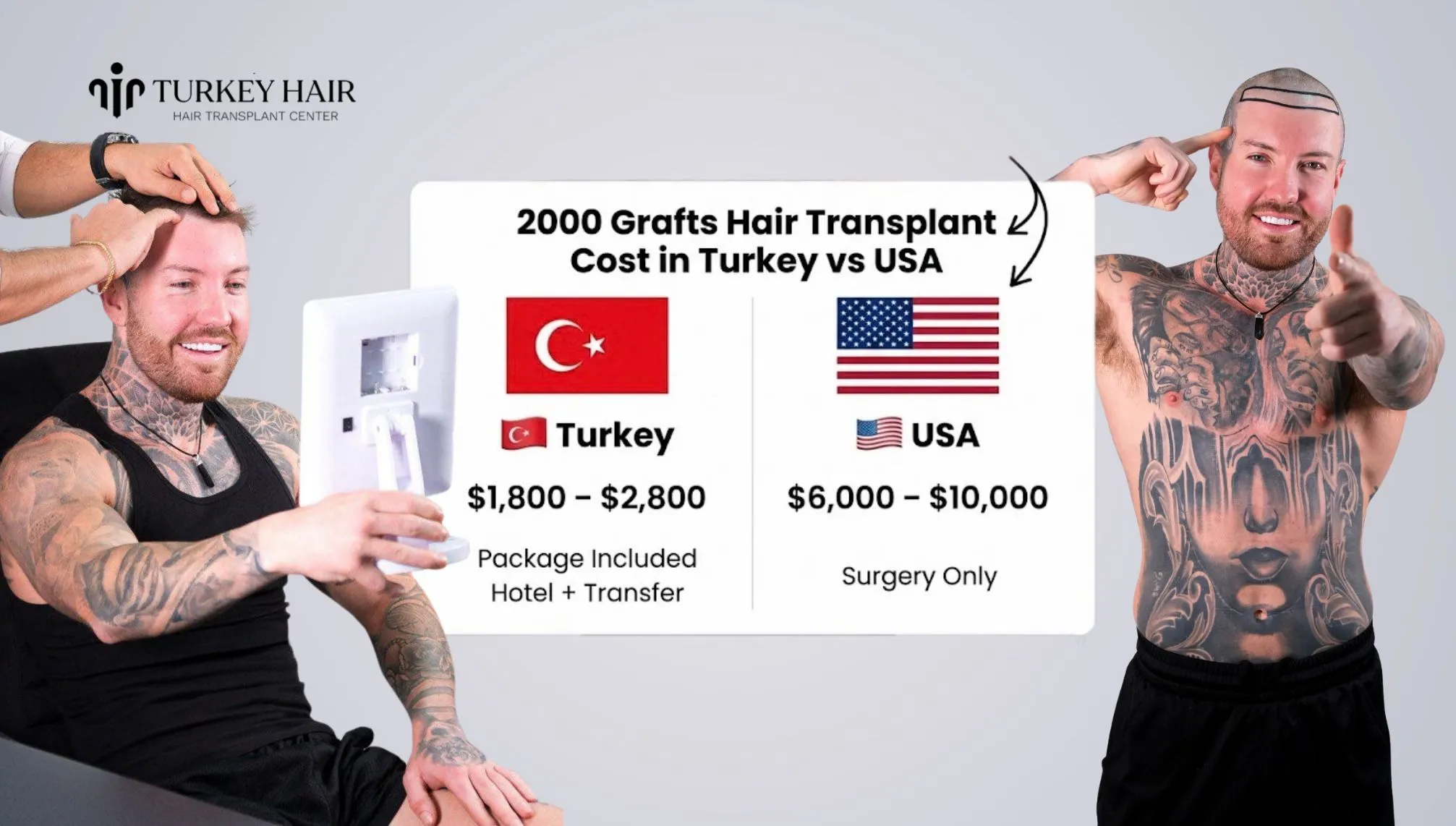
Average Cost of 2000 Grafts Hair Transplant in Turkey vs USA
While a 2,000-graft hair transplant in the United States costs an average of $12,000, the same quality standard treatment in Turkey is offered at approximately $2,800 through all-inclusive packages.
| Cost Factor | Turkey | United States |
|---|---|---|
| Average Total Cost | $2,000 – $3,500 | $8,000 – $12,000 |
| Cost per Graft (Avg.) | $1.00 – $1.75 | $4.00 – $6.00 |
| Typical Pricing Model | Package pricing (all-inclusive) | Per-graft pricing |
| Hotel & Transfer Included | Often included | Not included |
| Aftercare Included | Yes (usually) | Usually limited |
The main reason for the price difference between the two countries is the pricing structure applied by clinics. While clinics in the United States generally charge between $5 and $10 per graft, clinics in Turkey mostly offer fixed-price packages for procedures such as 2,000-graft treatments, covering the entire treatment process. Thanks to this approach, patients are completely protected from the risk of rising costs due to an increase in the number of grafts during the operation and clearly know their total budget from the very beginning.
What Is Included in 2000 Grafts Hair Transplant Packages in Turkey
In Turkey, 2,000-graft hair transplant packages are designed with an ‘all-inclusive’ price concept, meticulously planned for international patients. This comprehensive service covers every detail, from VIP transfers and luxury hotel accommodation to the necessary post-operative medications and specialized care kits.
2000 Grafts Hair Transplant Before and After Results
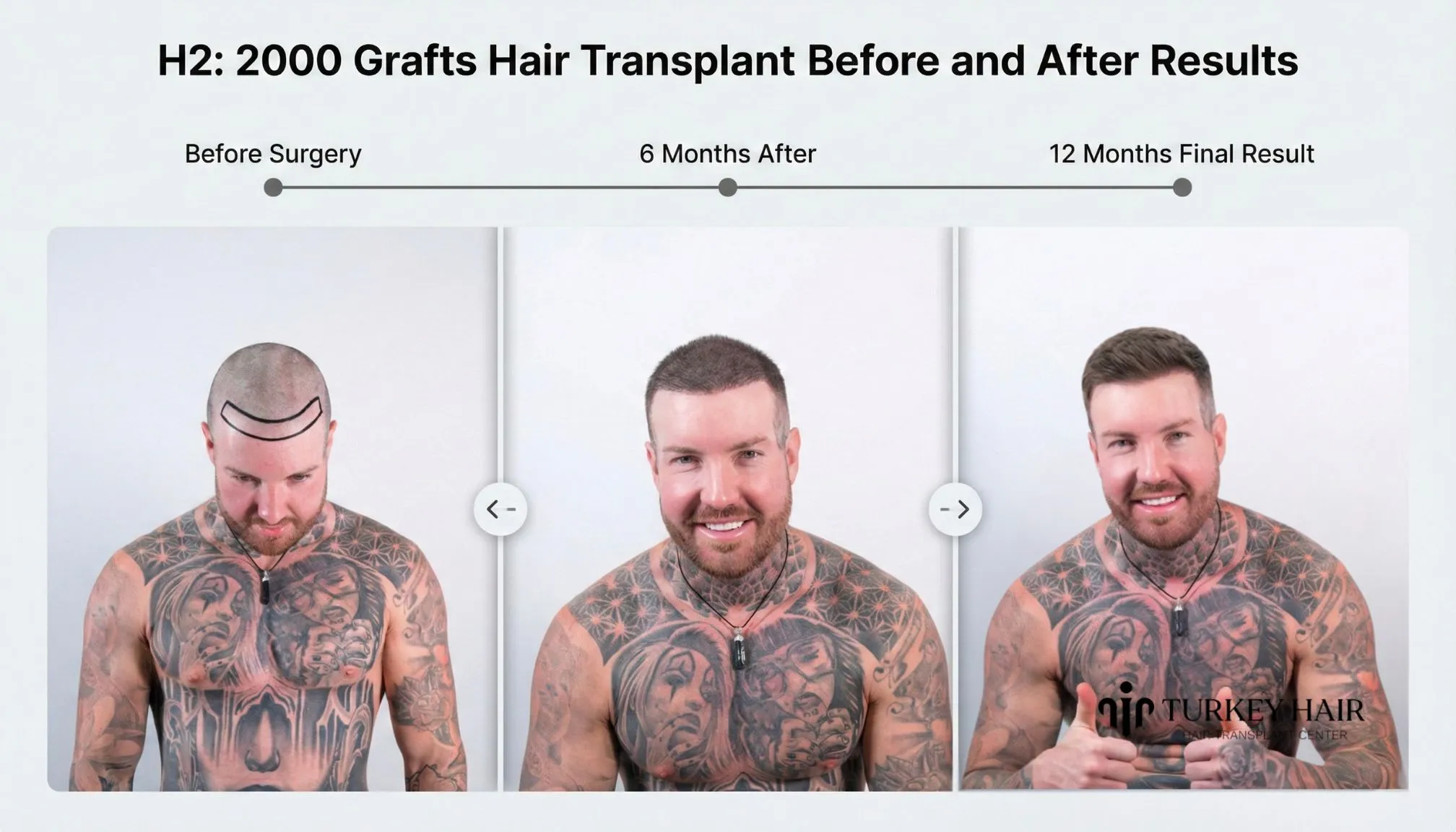
Before and after shots of a hair transplant with 2000 grafts often show clear improvements in certain areas, like the frontal hairline or the line where the frontal hairline meets the mid-scalp. People who have moderate to mild hair loss and want a small boost instead of full coverage usually choose this transplant number. At first, it’s more important that the hairline is even and can cover the head than that it is dense.
It’s not a good idea to look at before and after shots in the first few months; it’s always better to wait longer. When you first look, you might see some shedding, but new hair will appear later. When patients look back at the results later, they may have a better understanding of how smooth, dense, and well-balanced their hair is.
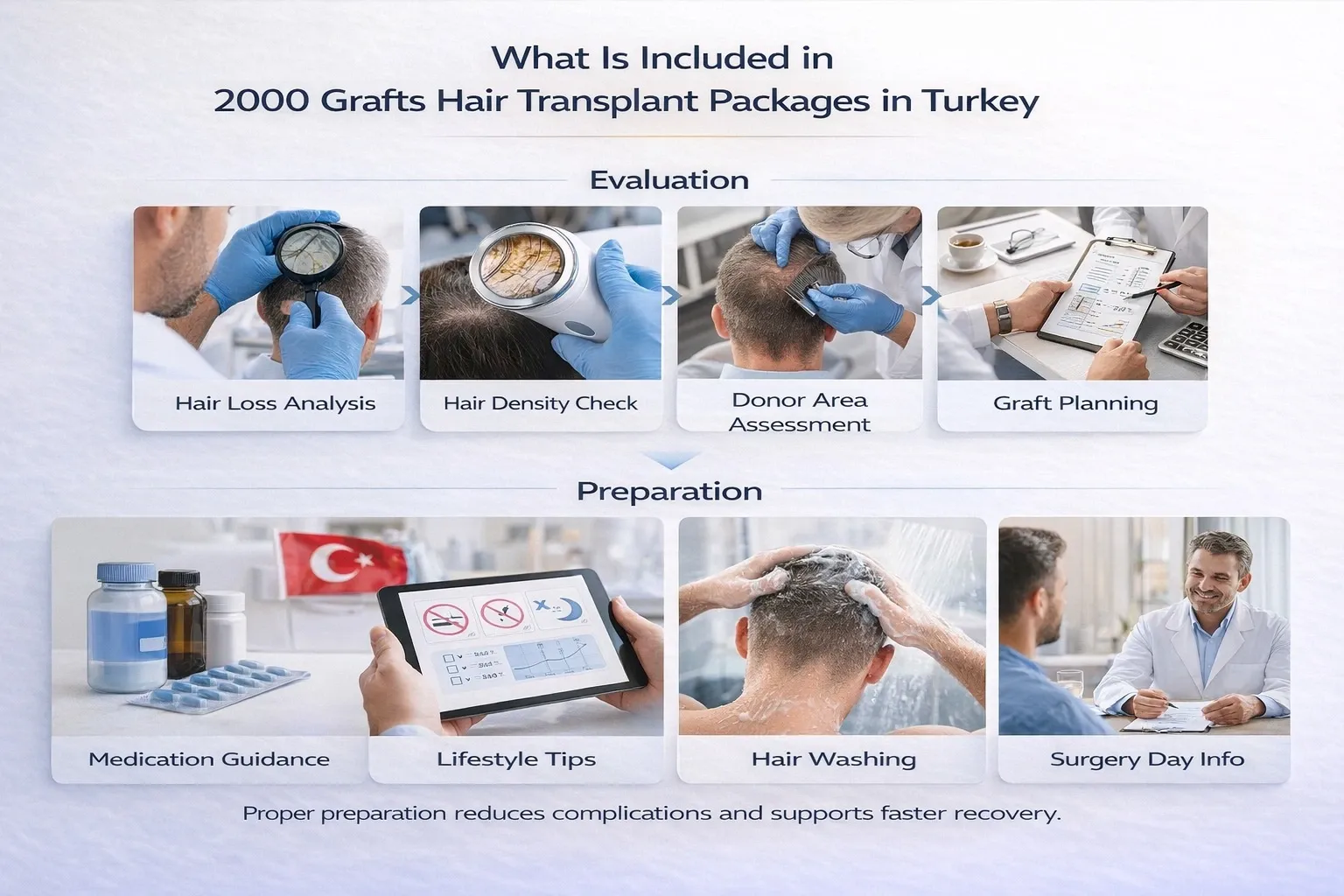
The patient will get detailed directions before the surgery that cover a lot of topics, such as medications and changes to their lifestyle. A patient who is well-prepared for surgery is less likely to have problems and heals faster. Having patients know what to expect during treatment might make their time there more pleasant and stress-free.
What to Expect Before a 2000 Grafts Hair Transplant Procedure
In Turkey, a 2000-graft hair transplant package generally includes surgery, a consultation before the surgery, and medicine after the surgery. For foreign patients, many clinics also offer places to stay, rides to and from the airport, and follow-up care. These add-ons make things easier, make costs clear, and make treatment go more smoothly.
2000 Grafts Hair Transplant After 6 Months vs 12 Months
Six months after a 2000-graft hair transplant, the hair generally starts to grow back, but the results are still not complete. It’s common for hair strands to look thinner, and the general density may look uneven in some places. After the shedding process, the follicles are now actively starting the growth cycle. At this point, patients shouldn’t expect a finished look, but rather gradual growth.
Twelve months after being transplanted, most grafts have fully grown and hit their final thickness. The density evens out, the texture gets stronger, and there are more styling choices. Now is the best time to see how well the transplant worked and how the transplanted area fits in with the rest of the hair.
How Much Area Does 2000 Hair Grafts Cover?
How much area 2000 hair grafts cover relies on hair thickness, curl pattern, contrast in the scalp, and how the surgery is planned. Most of the time, 2000 grafts are enough to fix a drooping frontal hairline or thicken up the frontal–mid-scalp area that is losing hair. Instead of spreading grafts out over a large area, doctors usually focus on the areas that make the most noticeable difference in how you look.
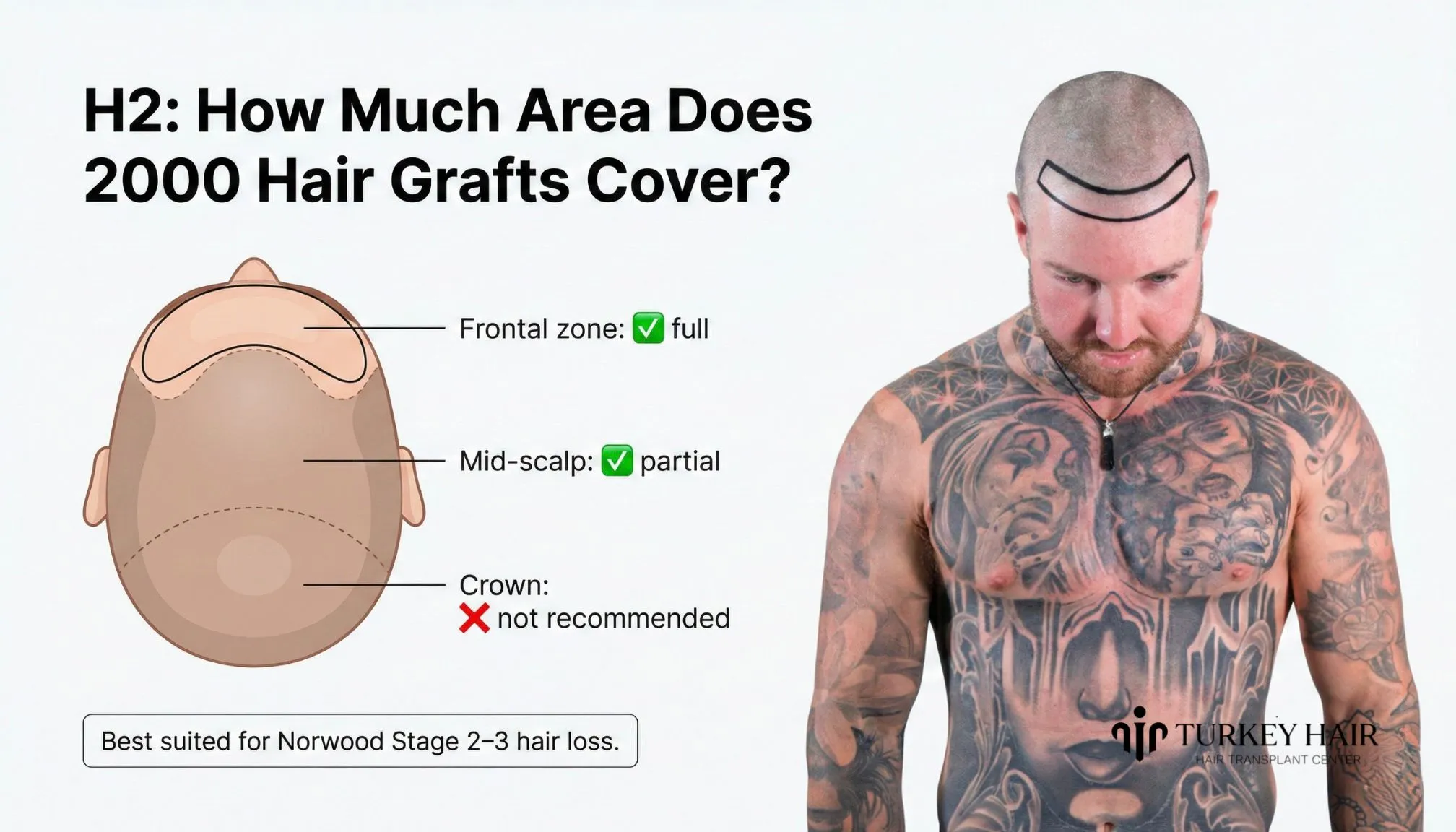
Strategic placement can also change coverage. When grafts are put in with the right angle and distance between them, they can make it look like there is more mass. People whose hair is thicker or wavy may think the area covered is bigger than people whose hair is fine and straight. So, covering shouldn’t just be judged by surface size, but also by how it looks.
Hairline Restoration Coverage with 2000 Grafts
2000 grafts are often used to restore the hairline in people with mild to moderate hair loss. With this number of grafts, surgeons can rebuild the frontal frame while keeping the style natural and right for the patient’s age. Most of the time, the temples and center hairline get the most attention because that’s where density has the most effect on how someone looks.
Coverage is meant to be conservative so that the look doesn’t look fake. Surgeons don’t always try to get the most density at the front. Instead, they often make a soft transition that fits in with the hair that is already there. This method makes the hairline look natural in a range of lighting situations and as the person ages.
Density Expectations from 2000 Grafts Hair Transplant
With 2000 patches, density goals should still be attainable. It is normal to see some improvement, but this many grafts are not meant to make very dense coverage over big areas. The goal is to improve the way you look, not to completely restore your hair to the point where it is not falling.
The way hair looks has a big effect on how dense it seems. With fewer grafts, hair that is thicker, darker, or curly tends to look fuller. 2000 grafts can give you a balanced and natural-looking result if you use the right distribution and implantation method.
What Do 2000 Hair Grafts Look Like Visually?
2000 hair grafts often make a clear difference in how the face looks, especially when they are used for facial hairline work. When the transplanted area has grown all the way out, it usually looks fuller, with less of the head showing and a clearer hairline. The change is generally more subtle and refined than big and sudden, though.
How the final look turns out depends on how the patches grow over time. In the beginning, hair may grow unevenly, but by the end of the growth cycle, most new hairs fit in well with the old ones. The result doesn’t look clearly “transplanted” in everyday situations, which is what most patients notice.
How Many Hairs Are in 2000 Grafts on Average
2000 hair grafts usually have between 4,000 and 5,000 individual hair strands. Depending on the patient’s normal hair follicle structure, each graft may have anywhere from one to four hairs. This difference is a big part of the end visual density.
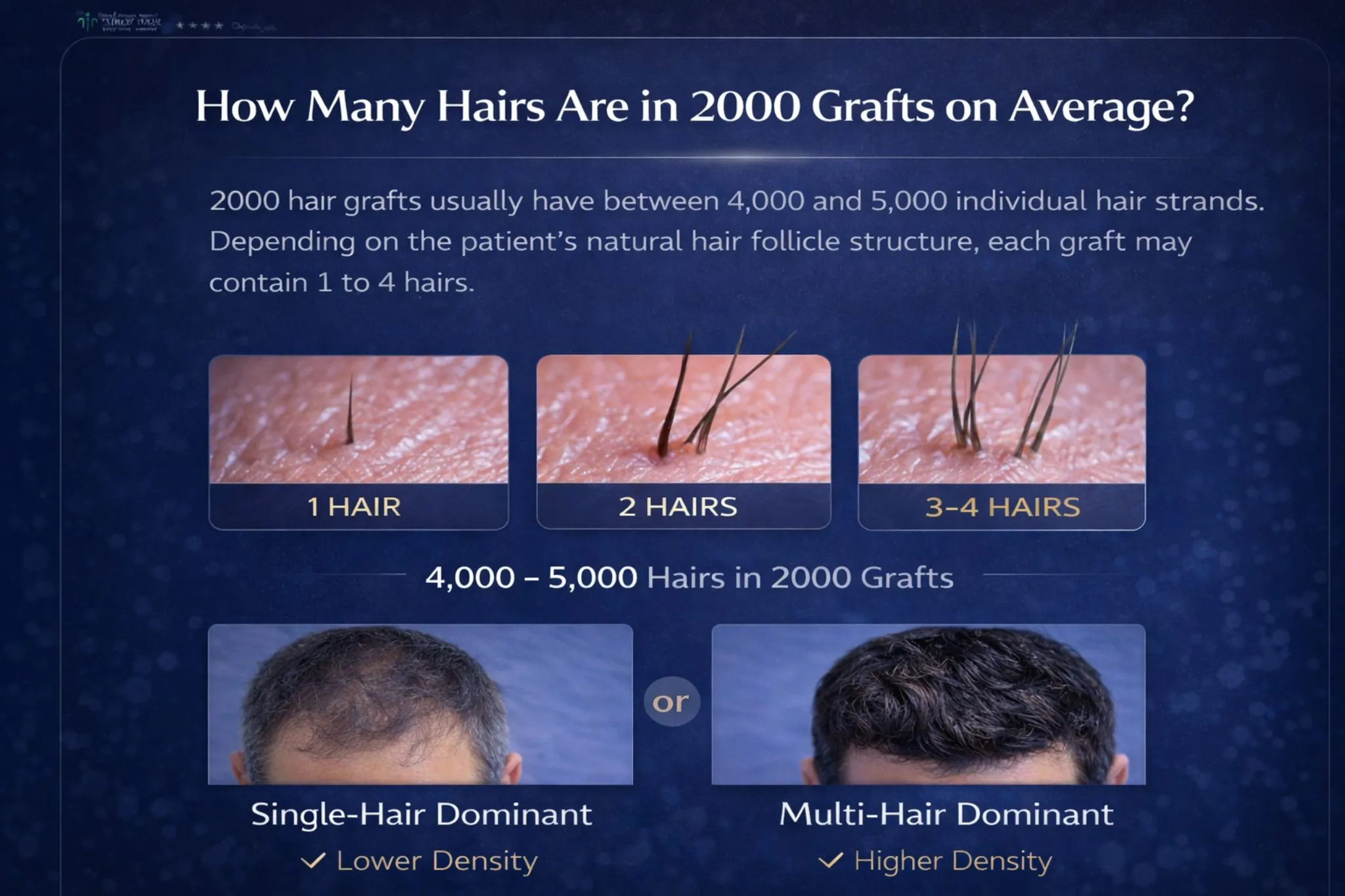
With the same number of grafts, patients who have a higher percentage of multi-hair grafts often get results that look larger. This is why graft number by itself doesn’t tell you everything about the result. During planning, surgeons look at both the quality of the patch and the type of hair that will be used.
Realistic Density Results for 2000 Grafts
In reality, the effects of 2000 grafts on density are best described as moderate but noticeable improvement. Most of the time, the transferred area looks thicker and more structured, especially in the frontal zone. But you shouldn’t expect full coverage of the scalp or very thick packing.
Balance is more important to surgeons than maximum mass. The right spacing saves the health of the scalp and makes sure that grafts will last for a long time. When patients know what they can actually expect from 2000 grafts, they are more likely to be satisfied.
How Long Does a 2000 Graft Hair Transplant Take?
Depending on the technique that is utilized and the level of activity at the clinic, a hair transplant that involves 2000 grafts often takes a few hours to complete. One day is typically required for the procedure, which consists of multiple steps, including the removal of the donor, the preparation of the graft, and the implantation of the graft. Although the operation takes a significant amount of time, it is designed to be manageable for patients by using breaks that are designed to keep them comfortable.
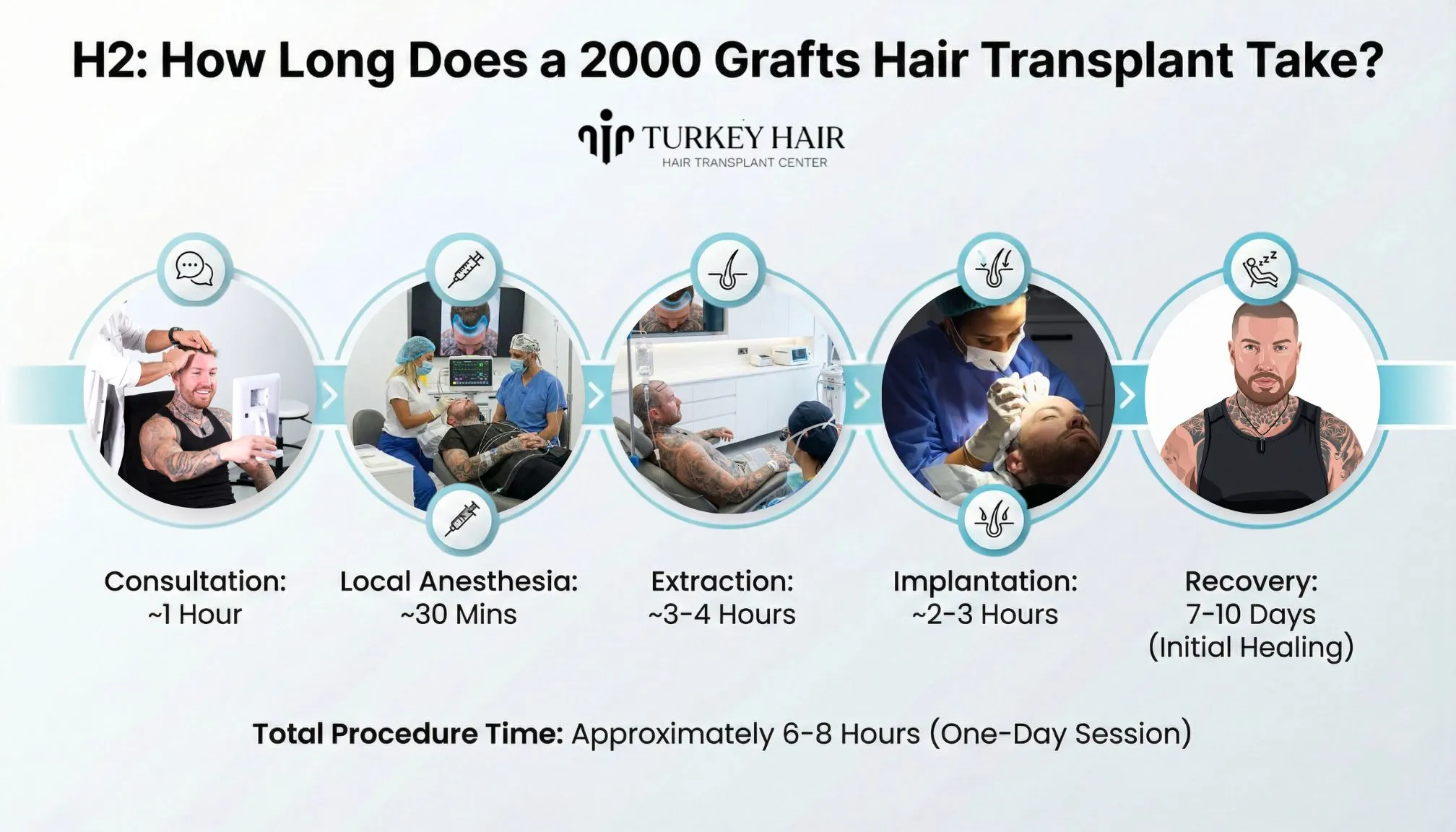
Total time can change depending on the surgeon’s experience, the size of the team, and the way of implantation. Even though speed isn’t the main goal, good planning cuts down on the time the graft has to be exposed to the blood and helps more of them survive. Most of the time, patients can go back to their lodging the same day. They are given post-operative instructions right away after the operation.
Procedure Time for FUE and DHI 2000 Graft Transplants
For a FUE hair transplant with a total of 2000 grafts, the entire procedure typically takes between six and eight hours. This entails removing grafts by hand or with a machine and then placing them in the appropriate location after they have been removed. Due to the fact that FUE performs the extraction and placement in two distinct phases, it typically allows the speed to remain consistent, and there are brief breaks throughout the day on average.
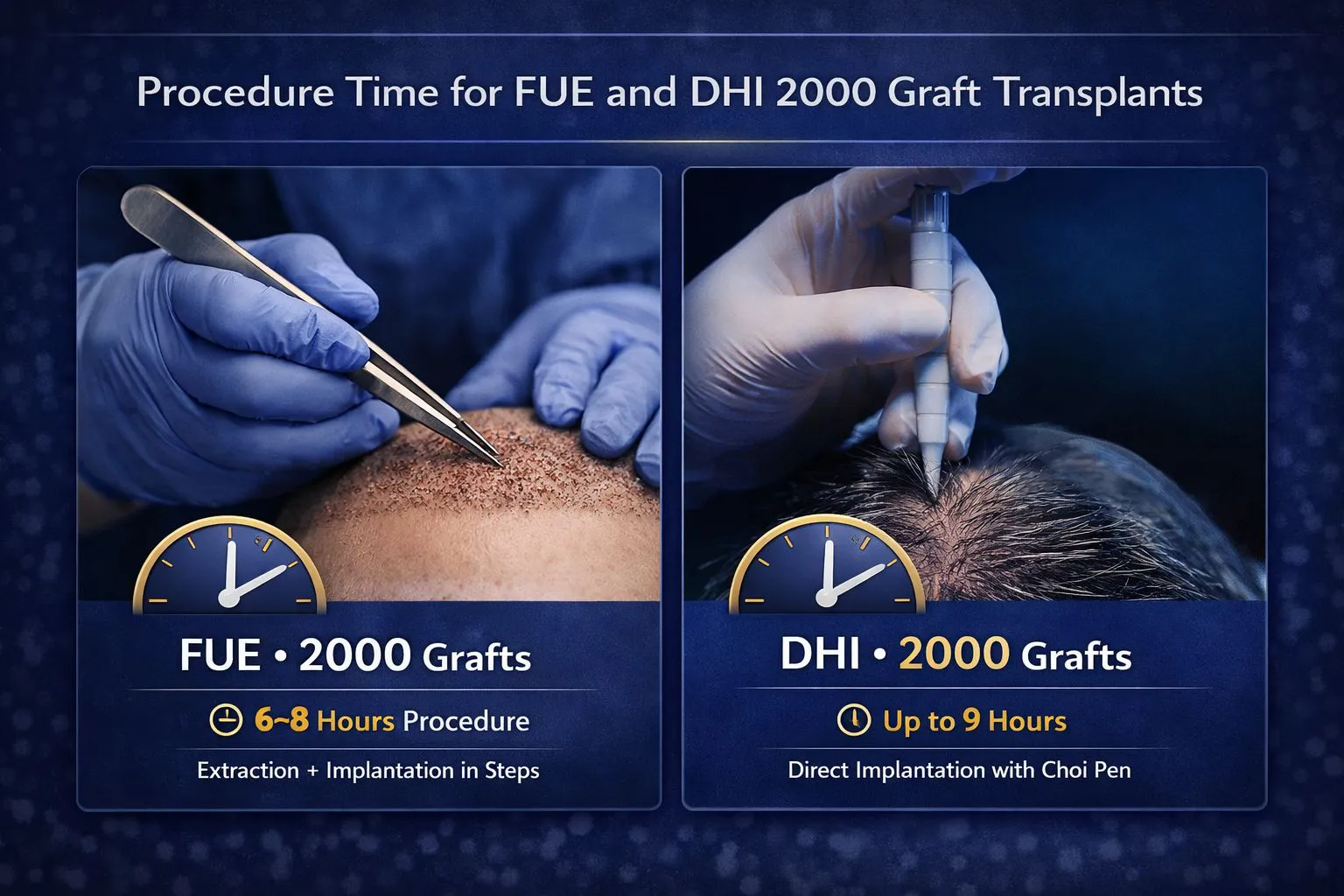
A 2000-graft DHI treatment can take a little longer, and it’s not unusual for it to last up to nine hours. Because grafts are put in directly with special pens, the process needs to be done in an accurate, continuous way. Even though it takes longer, DHI allows for limited implantation, which some patients prefer for certain hairline work.
Recovery Timeline After a 2000 Grafts Hair Transplant
As soon as the 2000-graft hair transplant surgery is over, the person can start to feel better. The first few days may have some mild redness, swelling, and scabs, but they will go away on their own. As long as they carefully follow the aftercare instructions, most people can do light daily chores again in a few days.
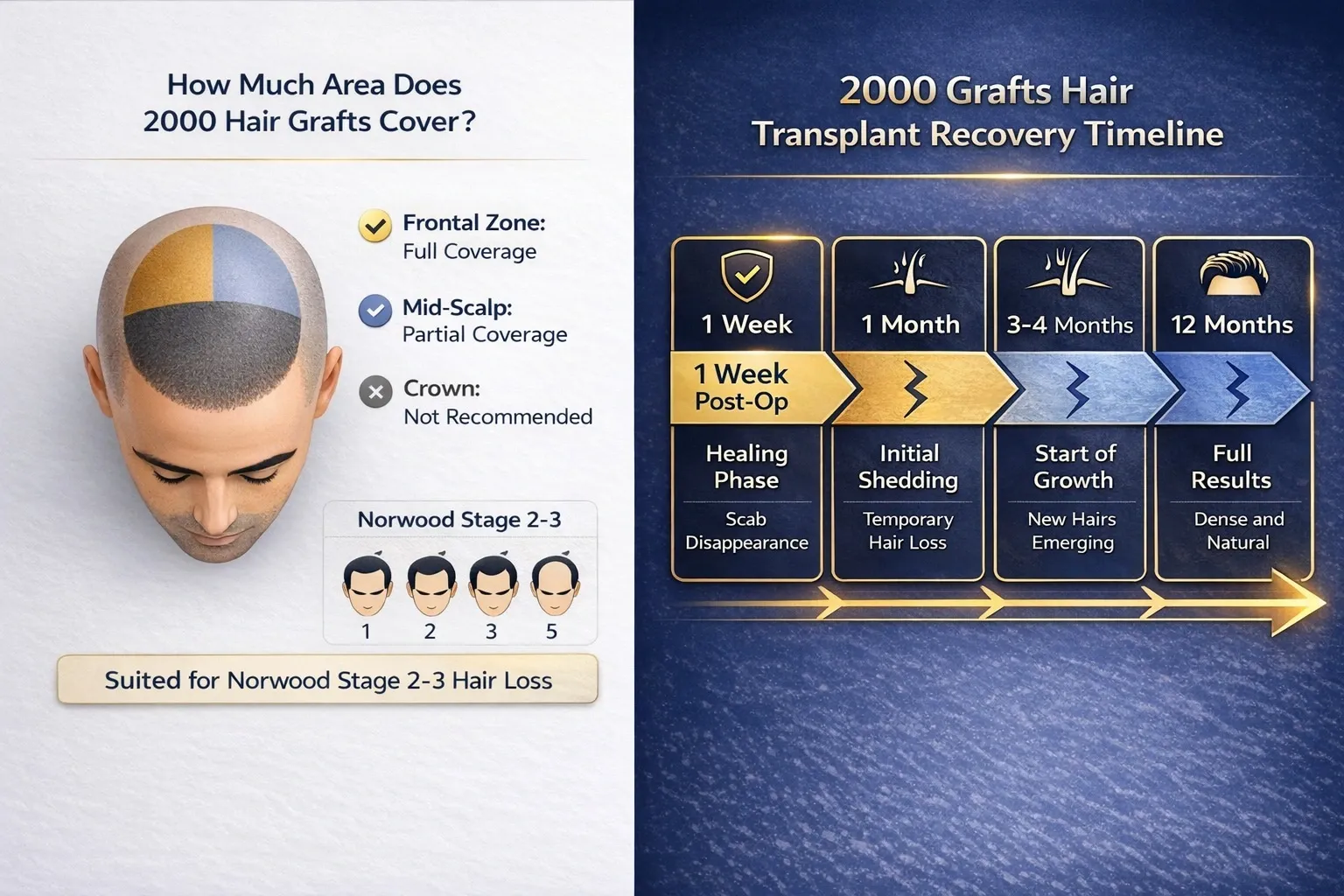
Most scabs fall off by the second or third week, and the transferred hair may shed. This is a normal part of the process. New growth usually starts in three to four months, and you can see progress for up to twelve months. For the best results, you need to be patient during healing.
2000 Grafts Hair Transplant Coverage by Norwood Scale
Depending on the patient’s Norwood scale stage and trend of hair loss, a 2000-graft hair transplant may be enough to cover the bald spots. This graft number is usually thought of as average, and it works best for people who are losing their hair in the early to middle stages. Not only the Norwood stage, but also the width, curl, and quality of the donor area are very important because they directly affect the appearance of density.
Coverage expectations should always be looked at in a practical and personal way. For some Norwood stages, 2000 grafts may be enough to make the patient look better, but for more advanced stages, higher graft numbers or more than one session are usually needed. Patients can have realistic hopes before treatment if they know how the graft distribution fits with each Norwood level.
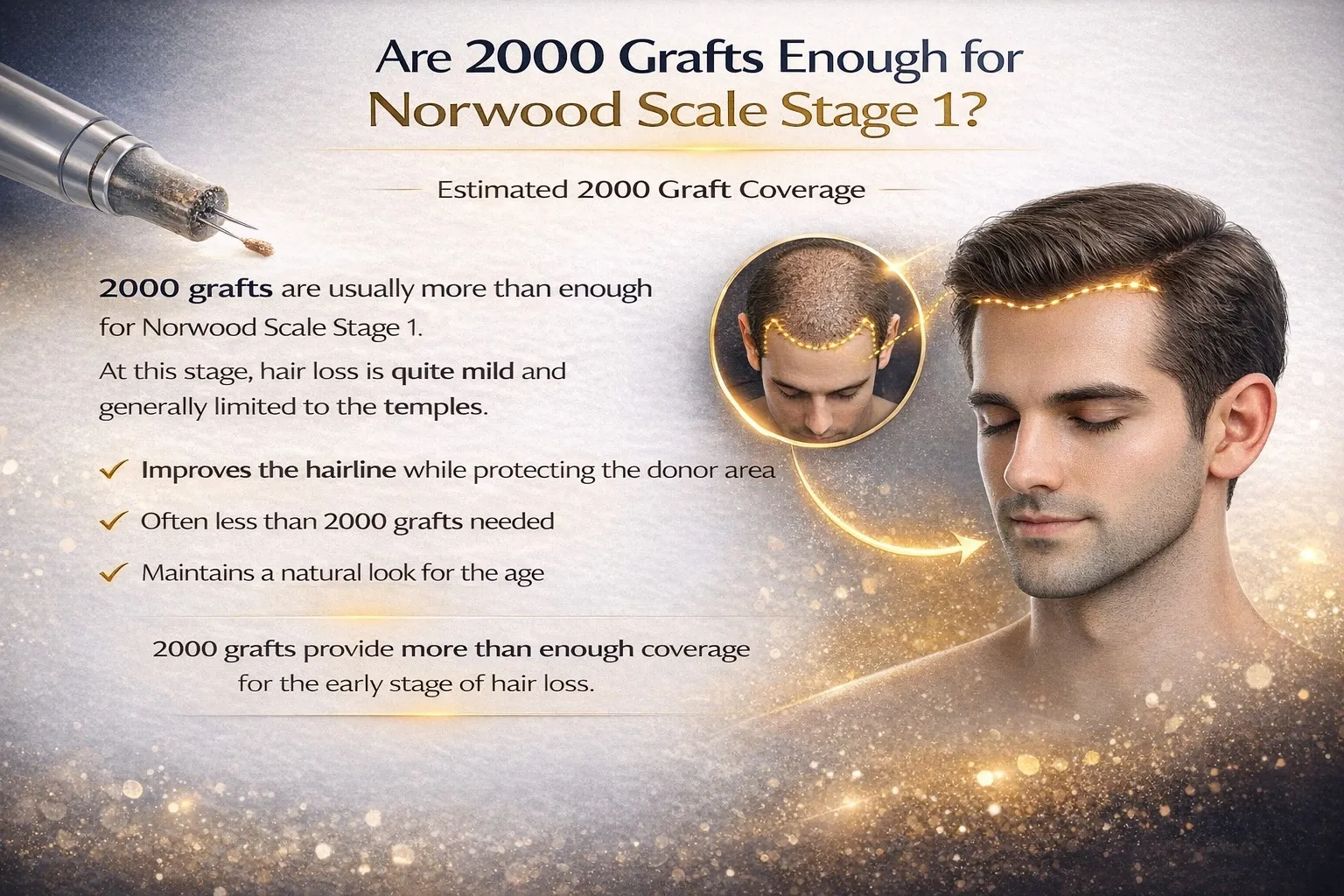
Are 2000 Grafts Enough for Norwood Scale Stage 1?
2000 grafts are usually more than enough for Norwood Scale Stage 1. At this point, hair loss is pretty mild and generally only happens at the temples. A conservative graft distribution can strengthen the natural hairline without making the hair look too thick or fake. At this point, a lot of people might not even need the full graft count.
Surgeons can save the donor area for possible future treatments by using fewer grafts in a smart way. Most of the time, it’s better to do modest reinforcement instead of full reconstruction. When done right, 2000 grafts can protect the hairline from future damage while keeping a natural look that fits the patient’s age.
Are 2000 Grafts Enough for Norwood Scale Stage 2?
At Stage 2 of the Norwood Scale, hair loss is more obvious than the previous one, especially at the corners of the forehead. A 2000-graft hair transplant is often enough to rebuild the hairline in front of the face and fill in receding hairlines in the temples. This graft count gives you even covering while keeping the right density and hairline shape.
At this point, the results are generally very good because the bald spot is still small. When surgeons use fewer grafts in a smart way, they can save the source area for possible future treatments. Most of the time, it’s better to do some minor repairs than to start from scratch. 2000 grafts can keep the hairline from getting damaged in the future and give the person a natural look that fits their age if they are done right.
Are 2000 Grafts Enough for Norwood Scale Stage 3?
Stage 3 of the Norwood Scale is a turning point where hair loss is more advanced and easy to see. 2000 grafts can often restore the forehead hairline well, but they might not be able to fully fix deeper temporal loss. Coverage is possible, but assumptions about density need to be changed.
Most of the time, surgeons focus on the forehead zone to frame the face well. The hairline can be fixed, but the crown or mid-scalp usually doesn’t get worked on. For people who want better coverage past the hairline, they may need more grafts in later sessions.
Are 2000 Grafts Enough for Norwood Scale Stage 4?
2000 grafts are usually not enough to cover the whole Norwood Scale Stage 4 area. Most of the time, hair loss at this stage affects both the front and the crown, making bald spots bigger. Because there are only so many grafts available, doctors can’t always do full coverage. Instead, they have to choose between partial frontal restoration or density enhancement.
In this case, 2000 grafts could be the first step in a plan that includes more than one session. Even though there is still room for improvement, the goal should be strategic improvement rather than total restoration. At this point, long-term planning is very important.
Are 2000 Grafts Enough for Norwood Scale Stage 5?
In Norwood Scale Stage 5, a lot of hair is lost in the front, middle, and top of the head. 2000 grafts are usually not enough to make a difference in total coverage at this level. A small number of grafts won’t be enough to cover the large area of baldness.
2000 grafts can still be useful, though, as part of a staged repair plan. Surgeons can use them to build a basic framework for the frontal lobe, which can then be extended with more sessions. At this point, patients should expect to have more than one treatment to get results that look balanced and natural.
Can You Increase Hair Density After a 2000 Grafts Hair Transplant?
It is possible to get more hair growth after a 2000-graft hair transplant, but you have to plan and time it very carefully. A lot of the hairline or forehead is fixed in the first surgery. Before adding more depth, doctors need to see the whole picture to know if they need to. They can also see how the donor area has responded to the first extraction.
People also judge how dense they are by how thick, curly, and light their hair is compared to the color of their head. There are a lot of happy people who have had 2000 grafts, but some may want more growth. You should take your time with the next treatment. Most clinics will tell you to wait until you have good results before making a choice.
Adding More Grafts After One Year
People say you shouldn’t get another hair transplant for at least twelve months after getting 2000 grafts. The real density is shown after all the attached follicles have had time to fully grow. Now it’s easy for both the patient and the surgery to see any weak spots or holes that need extra support.
Putting in grafts too soon can hurt cells that are already there and slow down the mending process. The head should be stable after a year, and you can check to see if the donor area has healed. This way, any extra grafts are put in in a smart and safe way.
Planning a Second Hair Transplant Session in Turkey
After getting a second hair transplant in Turkey, most people stick to a well-thought-out, long-term plan to heal. Most of the time, clinics look at the scar on the head, the number of volunteers that are available, and the rate of hair loss before giving out more grafts. The goal is to keep donor stocks on hand in case we ever need them again, and at the same time, the population should grow.
In Turkey, clinics are used to seeing people more than once, especially those who come from other countries. In the second meeting, it might not be about rebuilding, but about making the space more crowded. After following this step-by-step plan, you will feel better naturally and for a long time.
Why USA Patients Choose Turkey for a 2000 Grafts Hair Transplant
People from the US like getting 2000-graft hair transplants in Turkey because they work well and don’t cost a lot of money. A lot of people find that they can get full medical care, help with travel, and time to heal for a lot less money than in the US. That way, it’s easy to grow hair back without dropping the bar.
Turkey is cheap, and there are a lot of skilled doctors there who do hair transplants every day. Clinics are used to treating people from other countries and have well-thought-out plans for how to treat them. If you are constant, people will trust you more and be happier with the care you give them.
Cost Advantage Compared to the United States
The big price difference is a big reason why Americans choose to visit Turkey. It is possible to get a 2000-graft hair transplant in Turkey for a lot less than in the US, even when you count the cost of the trip. Transportation, housing, and medical care are often included in package prices. So, prices won’t be a surprise.
This is just to show that business and healthcare systems are not the same when it comes to how much they cost to run. If someone wins this cash prize, they can get improved medical care without going over their budget.
Experience, Technology, and Natural Hairline Design
People also have good feelings about Turkey because it has been in the business for a long time, uses cutting-edge technology, and works hard to make hairlines that look natural. Because they work with a lot of people from other countries, surgeons know how to deal with all sorts of hair types and styles. Now that you know this, it’s easier to guess what will happen.
Every doctor in the world knows how to use the most up-to-date tools and rules. The goal is for hairlines that look normal and right for the person’s age, not too deep. This fair method makes a lot of people from the US trust Turkey for their hair transplant trip.
FAQs
Is a 2000 graft hair transplant considered a small or medium procedure?
A hair transplant with 2000 grafts is usually thought of as a medium-sized operation. A minor touch-up session is smaller than this, but not as small as a full-coverage transplant. This graft count is often used to restore hairlines or treat moderate frontal hair loss because it gives a noticeable difference without being too invasive.
How many sessions are needed for a 2000 graft hair transplant?
It is common for a 2000-graft hair transplant to be done in just one session. As long as the donor area is healthy, the procedure is generally planned to take one day. Extra sessions are only needed if the patient wants more covering or more density in the future.
Is 2000 grafts suitable for both men and women?
Yes, 2000 grafts can work for both men and women, but it depends on how and where the hair loss is happening. Men usually use this graft count for forehead or temporal restoration with balanced results, while women usually use it to add density or smooth out the hairline.
Does hair type affect the results of a 2000 graft transplant?
What kind of hair you have a lot to do with how the 2000 grafts look. It’s easier to hide things under thick, curly, or wavy hair than under thin, straight hair. Even if someone has the same number of grafts, their hair and skin color can make them look bigger than they are.
Will transplanted hair from 2000 grafts fall out over time?
Because the hair from 2000 grafts comes from genetically resistant donor places, it usually stays in place. It’s normal for hair to fall out at first after surgery, but it will grow back. With the right care, transplanted follicles generally keep growing for life after they are fully grown.
Can 2000 grafts be used for crown or vertex hair loss?
Yes, 2000 grafts can be used to cover some hair loss in the crown or vertex. The cap needs more grafts because it is shaped like a circle. People who get 2000 grafts should expect improvement instead of full density, as this is often part of a staged method.
What age is ideal for a 2000 graft hair transplant?
There is no set best age, but most people get a 2000-graft hair transplant between the ages of twenty-five and forty. At this point, the trends of hair loss are more clear, which helps with planning. Younger patients should be carefully assessed to avoid problems with progression in the future.
Are 2000 graft hair transplant results permanent?
Yes, the effects of a 2000-graft hair transplant are thought to last forever because the grafts don’t fall out when you lose hair because of androgens. But the natural hair around the area may continue to thin over time. Long-term results rely on planning ahead and taking care of hair loss over time.
Can beard or body hair be used if 2000 scalp grafts are not enough?
If head grafts aren’t enough, hair from the beard or body can be used as an extra donor source. People usually choose beard hair because it grows quickly and is strong. Most of the time, these grafts are mixed with head hair to make the hair denser rather than to make hairlines.
How soon can you return to work after a 2000 graft hair transplant?
After a 2000-graft hair transplant, most people can go back to desk work in three to five days. Jobs that require a lot of movement may need a longer break. Redness and scabs usually get better within the first week, which makes the social break pretty bearable.
References
American Academy of Dermatology – Androgenetic Alopecia
Mayo Clinic – Hair Transplant Overview
NCBI – Hair Transplantation (Review Article)