A 4000-graft hair transplant is a prevalent option for those experiencing mild to advanced hair loss seeking noticeable, enduring enhancement. This graft count facilitates extensive covering of the hairline, mid-scalp, and occasionally the crown.
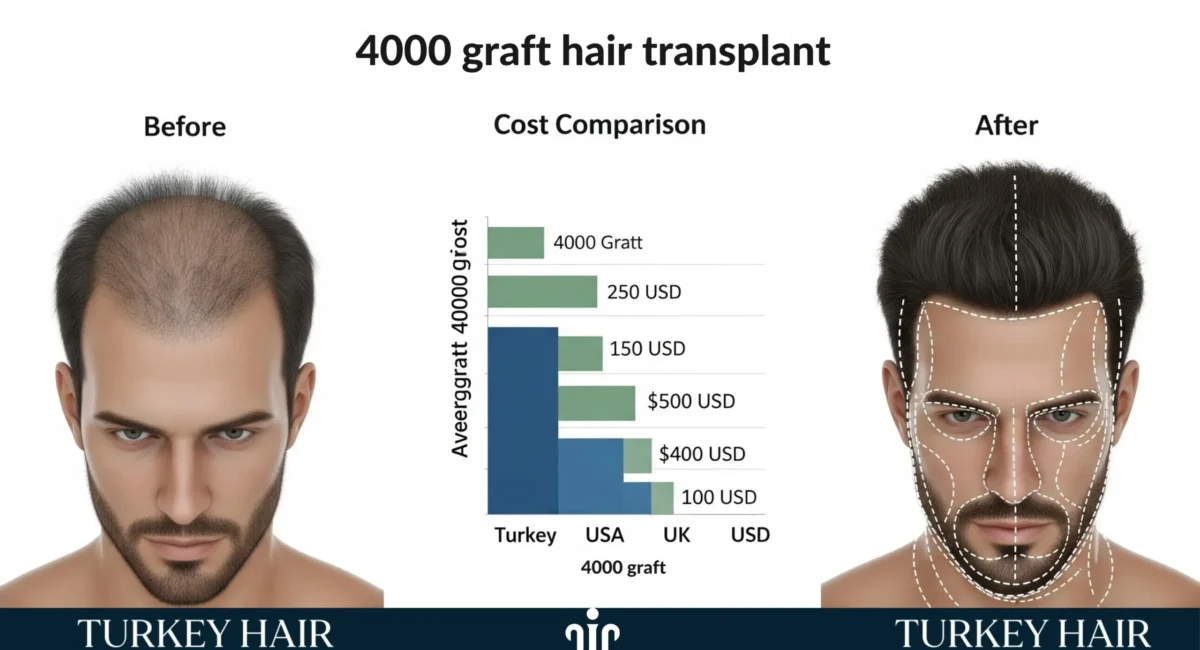
Starting Cost of 4000 Grafts Hair Transplant in Turkey
| Country | Average Cost (4000 Grafts) | Pricing Model | Included Services |
|---|---|---|---|
| Turkey | $2,000 – $3,500 | Fixed Package | Surgery, meds, hotel, transfers |
| USA | $12,000 – $20,000 | Per graft ($4–$6) | Surgery only |
| UK | $8,000 – $14,000 | Per graft | Limited aftercare |
| Europe | $7,000 – $12,000 | Per graft | Rarely all-inclusive |
A hair transplant in Turkey using four thousand grafts can initially cost anything from $2,000 to $3,500. For major treatments, this makes it one of the more budget-friendly locations in the globe. Instead of charging per graft, most Turkish clinics provide fixed-price packages. Patients can have multiple grafts using this procedure without worrying about unexpectedly high prices. Thanks to this pricing method, a far wider audience can afford to experience increased hair regrowth.

The range of services that are included makes this price even more appealing. Usually, the price involves a doctor’s visit, the surgery itself, any medicines, and care afterward. Accommodation and transportation are frequently covered by many centers, so patients can get all of their care within a single, simple budget.
4000 Grafts Transplant Cost Comparison: Turkey vs US
Prices for hair transplants in the United States can range from $12,000 to $20,000 per graft, depending on the scheme used. Costs could quickly mount up due to the usual range of $4 to $6 per graft charged by clinics. Because of this, many people can’t afford the expensive restoration that is necessary.
The amount of grafts may be obtained from Turkey for significantly less money without compromising on the quality of current procedures. Due to its stable cost and excellent treatment efficiency, Turkey is the superior option for patients seeking extensive coverage. Patients from the US are contemplating medical tourism in large numbers due to this pricing disparity.
4000 Grafts Transplant Cost Comparison: Turkey vs Europe
The precise pricing for a 4000-graft transplant in Europe might range from $7,000 to $12,000, depending on the reputation of the facility and the specific area. Larger surgeries cost more than smaller ones since per-graft charging is common, just like in the US. Furthermore, patients may have to wait longer at clinics that are quite popular.
For a fraction of the cost, Turkey provides medical care of comparable quality. Included packages, in conjunction with lower waiting periods, are a big draw for patients from Europe. Time, money, and service scope are the three dimensions that Turkey consistently excels in.
Factors That Affect the Cost of a 4000 Grafts Hair Transplant in Turkey
Turkey hair transplant costs anything from four thousand to six thousand Turkish lirts (around $2,000 USD). Everything from the number of the medical staff to the location of the clinic to the level of personalized care provided all play a role in determining the ultimate price tag. Even with fixed-price models, different clinics may offer different packages.
Planning the course of treatment is also crucial. Reallocation of resources may be necessary to better serve patients who demand more care when it comes to hairline design or crown density. By familiarizing themselves with these features and using them to compare clinics, patients can make better judgments and steer clear of decisions based on headline costs.
Clinic Reputation and Surgeon Experience
Renowned clinics charge a little more than average because of the high demand and proven results. Surgeons who perform many procedures annually have refined their skills and made great strides in the accuracy of their plans. This level of expertise impacts the aesthetics and survival of grafts.
Because they treat so many patients, surgeons in Turkey have a wealth of hands-on experience. International recognition is enhanced when medical facilities welcome patients from various corners of the globe. Choosing an experienced team is more important than going with the cheapest option all the time.
Technique Used: FUE vs DHI
Result and cost of a hair transplant with four thousand grafts depend greatly on the selected method: FUE or DHI. Because FUE can extract and transplant over larger areas, it is often the technique of choice for mega-sessions. Although this technique can still result in more natural looking outcomes, it is often faster and cheaper.
It is important to DHI that the placement is exact and controlled, which is done with specialized implantation tools. Although it might give more accurate results in crowded or frontal areas, this method usually takes longer and costs more. When there are a lot of grafts, clinics usually recommend FUE, unless the pattern or density needs DHI. In that case, FUE is suggested.
Before and After Results of 4000 Grafts Hair Transplant

| Timeline | Visual Changes | What’s Happening Under the Skin |
|---|---|---|
| 0–1 Month | Redness, scabs, shedding | Follicles settle, shock loss |
| 3 Months | Minimal visible growth | New hair cycle begins |
| 6 Months | Noticeable density increase | Active follicle production |
| 12 Months | Final density & natural look | Full maturation |
A 4000 grafts hair transplant may provide a significant distinction between before and after pictures of someone who has mild to serious hair loss. Before they start treatment, many people note hair loss at the hairline, in the middle of the scalp, and sometimes on top of the head. With a 4000-graft treatment, the form and density of the face should be just like it was before.
Things don’t happen right away after the move; they happen over time. At first, not much changes, but as time rolls on, the hair covering gets thicker and more even. If you plan and get good at it, a 4000-graft transplant can make many parts of your head look more genuine and last for a long time.
What to Expect in the First 3 Months
For the first three months after a 4000 grafts hair transplant, most people lose the hair that was moved. This stage, called “shock loss,” happens to a lot of people. It only lasts a short time. It’s possible that the top of your head won’t look the same right away after care.
Under the surface, things are still getting better. Skin turns pink and itchy, but they go away over time, and cells that produce hair rest. Although there isn’t much progress to see right now, things are getting ready for a better future.
6-Month Progress After 4000 Grafts
By the sixth month, most people can start to see a difference in their condition. In the transplanted places, new hairs start to grow, making the hairline and mid-scalp look fuller. The hair may still be thin or uneven, but the coverage looks better overall than it did before the treatment.
Patients often feel better at this time because they can see the results more clearly. The structure of hair keeps getting better, and styling it gets easier. But it’s not quite at full density yet, and more development is likely to happen in the months to come.
12-Month Final Results After 4000 Grafts

After twelve months, most people can see the full effects of a 4000 grafts hair transplant. The density of hair growth is at its highest, and transplanted hairs blend in perfectly with the rest of the hair. The hairline looks clearer, and coverage in the treatment areas is much better overall.
At this point, the hair gets thicker and acts like real hair. Most patients can cut, style, and take care of their hair regularly. If the process is done right, the result will look natural and right for the person’s age, and it will stay that way for a long time.
Who Is an Ideal Candidate for a 4000 Grafts Hair Transplant?
A person with moderate to advanced hair loss in more than one area of the head is a good candidate for a 4000 grafts hair transplant. People with hair loss often have receding hairlines and thinning hair in the middle of the neck or on top of the head. To support such a high graft count, there must be enough source hair density.
It’s also important to be healthy generally and have realistic goals. Candidates should know that results take time to show and depend on the type of hair they have. A professional session can help you figure out if 4000 grafts are enough to cover your hair in a way that looks balanced and natural.
How Many Hairs Are in 4000 Grafts?
A hair graft is not the same as a single hair, but a lot of people think that the number of grafts equals the number of hairs. As a rule, one graft has two or three hair follicles. So, a hair transplant with 4000 grafts should produce between 8,000 and 10,000 individual hairs, based on the shape of the patient’s follicles.
The way these hairs look depends on things other than how many of them there are. Hair thickness, curl pattern, and color difference with the scalp can all change how dense someone thinks they are. This is why the end look of two transplant recipients with the same number of grafts can be so different.
Ideal areas for 4000 Grafts Hair Transplant
For a 4000-graft hair transplant, the best places to put it are in the middle of the head and along the frontage. These places are very important for how you look overall and how your face is framed. Even if the hair loss is further back on the scalp, grafting to the front of the head generally makes the difference more noticeable.
The head may also get grafts from people who are losing a lot of hair. But crown repair needs to be carefully planned because of the higher demand for grafts. The best way to use grafts effectively is to spread them out in a way that keeps the natural structure and promotes long-term balance.
| Norwood Level | Coverage with 4000 Grafts | Expected Outcome |
|---|---|---|
| Norwood 4 | ✅ Very suitable | Hairline + mid-scalp fully restored |
| Norwood 5 | ⚠️ Partially suitable | Frontal focus, crown limited |
| Norwood 6 | ❌ Limited | Hairline only, 2nd session likely |
Are 4000 Grafts Enough for Norwood Scale 4?
For most people with a Norwood Scale 4, 4000 grafts are enough to make a noticeable and significant difference. The crown is still mostly whole at this point in the hair loss process, but the mid-scalp and forehead hairline usually take the most damage. It is possible to strengthen the hairline and center density with 4,000 grafts.
Grafts can be placed in a way that makes transitions smooth and covering even with the right planning. This many transplants rely on the donor’s density and thickness, but many Norwood 4 patients are happy with the results and think the hair will last a long time.
Are 4000 Grafts Enough for Norwood Scale 5?
On the Norwood Scale 5, hair loss is more widespread on the head and facial area, making it harder to cover up. A hairline or the middle part of the scalp can usually gain a lot from 4000 grafts, but the crown may not be fixed. Surgeons often focus on the face and neck to get the best results.
4,000 grafts can make a change, but some Norwood 5 patients would need a second session to get all of their hair back. For a balanced and natural result, the graft needs to be placed strategically, and people need to have realistic expectations.
Are 4000 Grafts Enough for Norwood Scale 6?
People who get a 6 on the Norwood Scale have thin hair that covers a lot of their head. One thousand skin flaps might not be enough to completely fix the problem, but they can still help. A recovered frontal hairline and some mid-scalp filling are common results of treatment.
Crown coverage is either put off or badly limited because of the higher demand for grafts. For many Norwood 6 patients, the full benefits might not be seen until they’ve had more than one session. If you want to get donor hair, you should think about what you want it to look like and how long you want it to last.
How Long Does a 4000 Grafts Hair Transplant Take?
A hair transplant with 4,000 grafts might take anything from a few hours to several days, depending on the technique that is utilized and the number of medical professionals who are involved. In most cases, the procedure is completed in a single day, with breaks used to ensure that the patient is comfortable throughout the process. When there are a large number of grafts, FUE sessions could move forward a little bit more quickly than DHI hair transplant sessions.
It is also possible for time to change depending on the speed with which the graft is removed and the degree of precision with which it is placed. In order to maintain the quality of the grafts, clinics that employ teams of specialists typically carry out procedures in stages. The majority of people are able to manage the procedure successfully with local anesthesia, despite the fact that it takes a very long period.
Recovery Timeline After 4000 Grafts Hair Transplant
| Phase | Duration | Patient Experience |
|---|---|---|
| Immediate Recovery | 1–7 days | Scabs, redness, mild swelling |
| Shock Loss Phase | 2–6 weeks | Temporary shedding |
| Growth Phase | 3–9 months | Gradual thickening |
| Final Result | 12 months | Permanent natural density |
Following a hair transplant consisting of 4000 grafts, there is a predetermined time frame for the healing process, which can take several months. The wound begins to heal within a few weeks, and after some time has passed, there is development that may be observed. Patients who have a thorough understanding of each process are better able to moderate their expectations and assist the achievement of good results.
Receiving the appropriate aftercare, exercising patience, and adhering to the directions provided by your physician are all very crucial during the recovery process. In the beginning, it could appear that things are moving at a snail’s pace; yet, as time passes, steady progress becomes more apparent, which ultimately leads to consistent results over the long term.
First Week After Surgery
During the first week, the scalp is working on mending and making progress toward being stable. The common symptoms include bruising, redness, and minor pain, although they only endure for a brief period of time. During the process of implanting grafts, they are surrounded by little scabs. It is expected that they will disappear after seven to ten days if you follow the washing requirements accurately.
It is recommended to patients that they refrain from putting strain on their bodies and that they avoid hitting their heads. Both the manner in which you sleep and the manner in which you are treated by other people are elements that are significant throughout this period. At the end of the first week, the majority of people make the observation that their skin appears to be more relaxed and at ease.
First Month Healing Phase
The physiological process of shock loss results in the eventual shedding of transplanted hairs within the first month following the procedure. Although this is a common and transient occurrence, it can be quite alarming. There is no harm to the follicles, which are situated just beneath the surface of the epidermis and are preparing to emerge.
The scalp progressively reverts to its normal condition, and the sensitivity diminishes slightly. Patients may still be restricted from participating in activities that demand significant physical exertion; however, they are frequently able to maintain their usual routines. Currently, there is limited growth to observe, and therefore, patience will be required.
Long-Term Care After 4000 Grafts Hair Transplant
The fundamental objectives of long-term maintenance are to encourage the development of healthy hair and to preserve the results they have achieved. Typically, the beginning of new hair growth occurs between the ages of three and four months, and the maturation process goes on for an entire year. The best possible development can be accomplished by routine medical examinations and proper treatment of the scalp.
The ultimate outcomes may be influenced by a variety of characteristics of an individual’s lifestyle, including their habits on nutrition, stress management, and hair care. By following the appropriate maintenance instructions, transplanted hair can become permanent, invisible, and flawlessly integrated with the hair that is already present.
Density Expectations from 4000 Grafts Hair Transplant
The density that can be expected from a 4000 graft hair transplant depends more on the placement approach than on the level of coverage that can be expected. The frontal hairline and mid-scalp are the usual targets for graft density and natural framing. With this technique, you may maximize the crown’s aesthetic potential while minimizing coverage. Hair characteristics, like as thickness and curl, can influence the perceived thickness of the final product.
The process of density development and maturation does not occur suddenly. While the hair shaft appears smaller when it is still in its early phases of growth, it actually thickens as the follicles mature. By the end of the first year, most patients have achieved a natural-looking, well-balanced density that enhances their own hair and guarantees their satisfaction over the long haul.
Donor Area Impact After 4000 Grafts Extraction
The donor location is under extreme demand, thus extensive preparation is required before harvesting 4,000 grafts. If you want to avoid thinning and patchiness, harvesting grafts evenly is the way to go. The success of subsequent treatments and the preservation of a natural appearance following extraction depend on the donor zone’s density and health.
The donor location typically shows minimal to no long-term harm and recovers rapidly when done by an experienced specialist. The hair that grows in naturally around the regions that were extracted will eventually cover them up. A natural hairline on the sides and back of the head can often be preserved after a large-session transplant in patients with a good donor capability.
Choosing the Right Clinic for a 4000 Grafts Hair Transplant in Turkey
To achieve a successful hair transplant of 4000 follicles, it is essential to select an appropriate clinic in Turkey. Comprehensive preparation, experienced medical personnel, and stringent quality assurance protocols are essential for large-scale graft procedures. For consistent and risk-free outcomes, it is advisable to select a facility with extensive experience in performing frequent cosmetic procedures.
Patients should verify the credentials of the surgeon, confirm the accreditation of the facility, and examine patient portfolios showcasing before-and-after photographs of surgical procedures. Equally essential are clearly established communication channels, transparent pricing structures, and comprehensive support provided after the completion of the service. If you visit a reputed facility, they will utilize grafting techniques properly, ensuring results that enhance both your health and appearance.
FAQs About 4000 Grafts Hair Transplant
Those considering multiple sessions of a hair transplant with 4,000 grafts understandably have many practical concerns. Among the most common concerns are the following: shaving needs, visual density, and coverage area. With this information in hand, patients can more confidently plot out their treatment path and establish reasonable expectations.
Feeling better and less worried about what’s to come is another benefit of having all your questions answered. While specifics like hair type and surgical approach determine ultimate results, a few general rules of thumb can help. Here are some frequently asked questions (FAQs) with answers based on what doctors have seen and what patients have reported.
How many square centimeters can 4000 grafts typically cover?
The intended density of coverage determines the typical area that four thousand grafts can cover, which ranges from 120 to 160 square centimeters. Surgeons typically insert 25–35 grafts per square centimeter to achieve natural-looking outcomes. The degree of coverage is conditional on several factors, including hair thickness, scalp health, and the desired area of application (the hairline, the middle of the head, etc.).
Will 4000 grafts make my hair look thick or just natural?
In most cases, a density that mimics normal hair growth rather than extreme thickness is achieved with 4000 grafts. They create the illusion of fullness and great coverage when placed correctly, particularly at the front. If the transplant count isn’t enough to give the impression of fullness, other hair characteristics, like as thickness and curl, can help.
Can 4000 grafts be done without shaving the entire head?
Can a 4000-graft hair transplant be performed without shaving the head entirely? That depends on the procedure and the level of expertise at the clinic. Shaving just a portion of the face, or none, is frequently an option, particularly when using DHI. However, not all patients or hair types may respond well to these techniques, and the process may take longer and cost more overall.
Is shock loss common after a 4000 grafts hair transplant?
When you get 4,000 hair transplants, you should expect temporary shock loss. The follicles are still healthy, thus transplanted hairs fall out early after a few months of safe, natural regrowth.
How many grafts survive on average out of 4000?
Patients benefit from high long-term density and continuous, natural-looking covering after a 4000 graft transplant, which, when performed correctly, usually has a survival rate of 85 to 95 percent.
Can I style my hair normally after a 4000 grafts transplant?
Once they have fully healed, the majority of patients who get a 4000 grafts transplant can resume their regular hair care routine, including trimming, styling, and more. This occurs because, throughout time, the transplanted follicles mimic the behavior of natural hair.
Is a second session needed after a 4000 grafts procedure?
The number of sessions required after a 4000 graft treatment depends on donor availability, the severity of the hair loss, and the patient’s expectations. More grafts may be required for some patients for crown coverage or later phases of development.
Does age affect the success of a 4000 grafts hair transplant?
Hair types and growth trends are different with age, so it can have an indirect effect on the results. Age alone isn’t always the most important thing in 4000 graft transplants. The quality of the donor, the plans, and the method are.
How soon can I return to work after a 4000 grafts transplant?
The majority of patients resume desk-based employment within five to seven days post-4000 graft transplant, contingent upon the reduction of edema and the detachment of scabs, while adhering meticulously to physician directives throughout the initial recovery period.
Are 4000 grafts enough to avoid future hair transplants?
A lot of people can benefit from 4,000 grafts, but some may still need more help in the future. If your hair loss keeps getting worse, you might need more sessions to keep the results even and full over time.
Referances
American Academy of Dermatology – Androgenetic Alopecia & Hair Loss
Mayo Clinic – Hair Transplant Procedure Overview
NCBI – Hair Transplantation Techniques and Outcomes (Review)