Learn about Type 2 hair, what it looks like, how to take care of it, and easy ways to bring out its natural texture. Plus, you’ll learn about the different types of waves (2A, 2B, and 2C).
Understanding Type 2 Hair
| Hair Type | Wave Pattern | Hair Thickness | Volume Level | Frizz Tendency |
|---|---|---|---|---|
| Type 2A | Loose, soft waves | Fine to medium | Low | Low to moderate |
| Type 2B | Defined S-shaped waves | Medium | Medium | Moderate |
| Type 2C | Strong, thick S-waves | Medium to thick | High | High |
Type 2 hair can be styled in a lot of different ways because it naturally has wavy waves that are in the middle of straight, curly, and volumized hair. The way these waves look depends on length, humidity, and style. Usually, they look like loose S-curves. If you know what causes your waves, you might be able to make a practice that makes them stand out more.
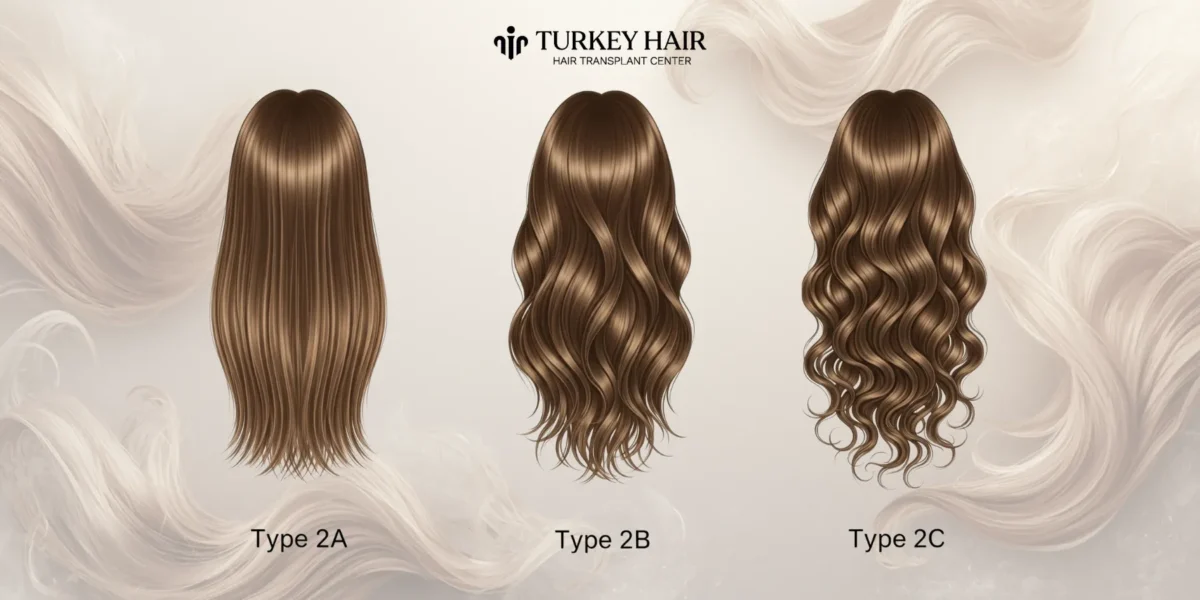
In contrast to other types, Type 2 hair can have a smooth base and wavy ends. The fact that it can be worn or used for two different things might make it hard to figure out. You only need to know what to do to keep your hair’s natural movement, smoothness, and body. This might make it easy to style.
What Defines Wavy Hair
When you have wavy hair, your locks bounce back and forth between being straight and curled up tight. These waves usually look like a “S,” and how clear they are depending on the type. This shape keeps the curls loose without making the hair look or feel too tight.
Being able to change is another trait. If your hair is wavy already, it’s not hard to add waves or straighten it. But if you don’t use the right light styling products and keep the moisture level in check, it starts to flatten and frizz.
Common Characteristics Of Type 2 Hair
Thick, smooth hair that feels good to the touch is what most people with type 2 hair have. Most of the time, it holds styles better than straight hair, but it might lose some of its shine during the day. When hair is very dry or when it’s outside in very hot weather, it can frizz up very quickly.
This hair type often has trouble with product buildup. Anything that is too dry could make hair look dull, and anything that is too sticky could stop waves from forming. If you want waves that are defined and healthy, it’s best to use light products that let your hair move around.
How Type 2 Hair Differs From Straight And Curly Hair
Type 2 hair looks better than straight hair because it is naturally curly and sandy, but it is harder to style. Shiny hair is important for healthy, well-kept locks because straight hair naturally makes hair reflect light.
There is less chance that hair will shrink when it is wavy than when it is curled. These days, it needs a better mix of hold and moisture, and the style should be less tight. So it’s clear that people with type 2 hair need to change how they take care of their hair.
Type 2A Hair Overview
The best hair to work with is Type 2A wavy hair because it is naturally flexible. Few small turns that stand out more near the ends make it look mostly straight. The fine, light texture of this hair makes it stand out.
2A hair has fine waves that make it easy to get tangled. The right way to style hair will show off its natural shape without making it look flat or dirty. You can keep it flexible and help it grow beautiful waves if you take good care of it.
Texture And Wave Pattern Of 2A Hair
A lot of people with type 2A hair have fine to medium hair with very small waves at the roots. It doesn’t make neat S-shapes; instead, it makes lines that aren’t very straight. It’s nice to wear and makes it easy to move around because the clothes are light and airy.
With these waves, it’s easy to do things, but they could go away at any time. One way to keep the natural flow going is to use light items and do as little work as possible. If you style your 2A hair right, it looks smooth and shiny without any work on your part.
Common Challenges With 2A Hair
It’s very bad that 2A hair doesn’t have full roots. Conditioners and creams that are too thick can make fine hair look limp when you style it. Also, grease may show up more quickly than with bigger wave types.
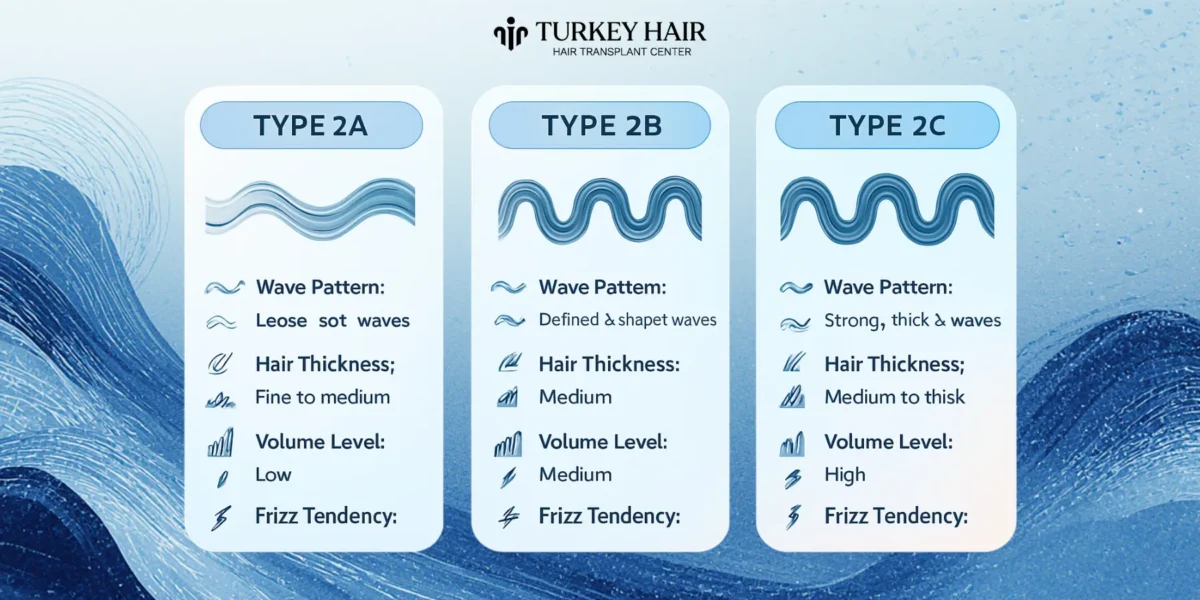
Another issue is that the waves don’t stay the same. There are parts that look straight and parts that look like they are wavy. Some gentle ways to style hair that can help an uneven pattern look more even are scrunching and misting.
Ideal Hair Lengths For 2A Waves
If you have Type 2A hair, the best length for you is somewhere between medium and long. This is because waves grow more easily in hair that is longer. When you cut your hair too short, it hides its structure, making straight hair look even straighter than it is. Layering can also improve motion while giving the impression of fullness.
Longer styles keep the flow going, while gravity can make waves that aren’t as strong. The length of the wave, on the other hand, can be used to slow it down if there is no structure. Extra fat can be cut off with well-balanced trims, which makes the already beautiful 2A waves look even better.
Type 2B Hair Overview
The waves in type 2B hair are more noticeable than those in type 2A hair, and they create more definite S-shaped patterns that begin closer to the mid-lengths of the hair. The consistency is normally medium, which offers the best possible balance between the volume and the fluidity of the substance. Waves stay well-defined and free of distortion throughout the day, even though they are visible. This is because waves require regular maintenance in order to maintain their clarity.
A common appearance of this hair type is that it is more voluminous and that it is better able to retain styles than waves that are looser. Nevertheless, in the lack of sufficient support, it has the potential to rapidly misplace its form. While maintaining structure without causing stiffness or lethargy, a practice that is performed on a daily basis and has an emphasis on hydration and subtle muscular definition is beneficial.
Texture And Wave Pattern Of 2B Hair
2B hair has a wave pattern that is more noticeable and consistent, which results in curls that are well defined and in the shape of an S, and they are flattened toward the crown. In most cases, the fibers have a thickness that is somewhere in the middle, which permits the waves to keep their shape for a considerable amount of time. This results in a style that is organically disheveled and reminiscent of the beach.
There is a positive response from 2B hair to both scrunching and diffusing because of its overall greater consistency. At the same time, it is easily susceptible to being damaged by excessive handling or scrubbing. When it comes to retaining the natural wave pattern, gentle styling methods are most helpful.
Common Challenges With 2B Hair
Type 2B hair is already prone to frizz before it gets worse in wet conditions. A natural lift is produced by the wave pattern, but the likelihood of a cuticle water imbalance is increased. Your waves risk becoming swollen or undetectable if you neglect them.
The product’s equilibrium is another important consideration. Inadequate hold can cause waves to flatten out and heavier products to weigh hair down, making styling more of a chore. For waves that are healthy and easy to manage, it is essential to find stylers that provide volume and shape without weighing hair down and aren’t greasy.
Frizz Control Needs For 2B Hair
2B hair still needs to be allowed to move normally, even though it requires regular tangle maintenance. The most efficient methods for retaining moisture in hair are to use lightweight lotions or gels that also provide protection from dampness. Two advantages of utilizing these products are that they smooth the cuticle and keep the waves soft and controllable.
Fill complete the application precisely as well. You may drastically reduce frizz by using products on wet hair and not handling it too much. Keeping your waves looking natural, shiny, and defined all day long calls for a balanced strategy.
Type 2C Hair Overview
The texture spectrum that type 2C hair straddles between wavy and curly is characterized by waves that are robust and well-defined, as well as high volume as well. As the pattern progresses from the roots to the tips, it becomes more dense and textured. One of the distinguishing features of this hairstyle is the naturally remarkable fullness and boldness of the hair.
Dense hair with a 2C density is able to maintain its style well but requires more careful maintenance. When compared to other types of wavy hairstyles, this particular type is more likely to cause dryness and frizz. In order to keep control of its firm texture, a routine that places equal emphasis on wetness and definition is required.
Texture And Wave Pattern Of 2C Hair
When compared to regular hair, 2C hair is typically thicker and coarser, and it frequently has deep S-shaped waves that can loosely spiral outward. The waves in the hair are obviously evident and ugly, which contributes to the hair’s naturally full appearance. The design provides additional depth and dimension.
Because of the structure of 2C hair, richer style products are preferred for use with this type of hair. Treatments such as creams and gels that increase definition are extremely effective on waves. Using the appropriate form of support, this type of hair has the potential to readily develop a texture that is robust and long-lasting.
Common Challenges With 2C Hair
It is not an easy task to maintain control of the volume of hair that is 2C. In example, waves have the potential to swell and change their shape if they are not adequately regulated in humid environments. Dryness and frizz are also common issues that arise as a result of the thicker cuticle.
Getting tangled up is still another issue. It is possible that the thick wave design will become knotted and broken if it is handled roughly. It is essential to make use of gentle detangling tools and products that are abundant in moisture in order to maintain waves that are healthy and defined without causing any damage to them.
Volume And Definition In 2C Hair
The key to success in 2C hairstyles is striking a balance between fullness and thickness. Fullness, despite the fact that it is a strength, cannot be shapeless due to the absence of form. The best way to shape waves is to utilize styling products that are both hydrating and holding the waves in place.
If they are styled correctly, layers have the ability to add volume without compromising shape. 2C hair has the potential to look sleek and defined if the volume is managed carefully, allowing the texture to be displayed to its full potential.
Hair Styling Tips For Type 2 Hair
| Hair Type | Recommended Styling Products | Best Styling Method | What to Avoid |
|---|---|---|---|
| 2A | Light mousse, fluid gel | Air-drying, gentle scrunching | Heavy creams, oils |
| 2B | Medium-hold gel, wave cream | Diffusing, scrunch & set | Over-brushing after drying |
| 2C | Rich creams, defining gels | Sectioned styling, controlled diffusing | Rough towel drying |
It’s important to bring out the natural waves in type 2 hair when styling it without making it look flat. The weight of the products used and the way they are styled have a big effect on the end result for this middle hair type. The goal is to improve shape while keeping the skin flexible, smooth, and looking natural.
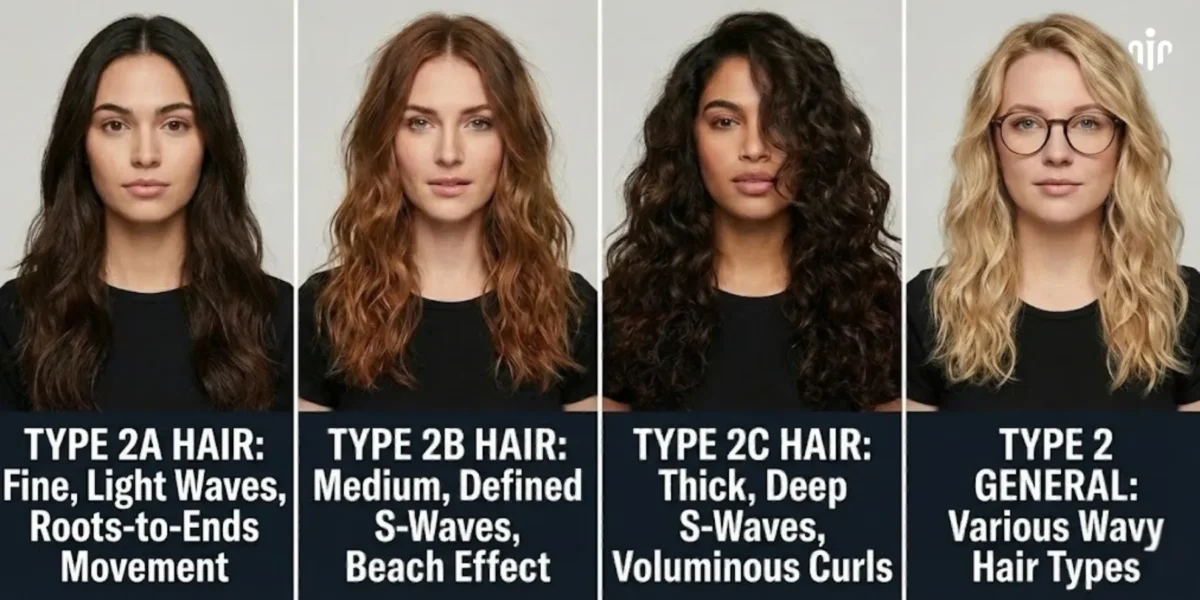
For good style, you need to know a lot about how waves form and how stable they are. When you touch your hair too much, it often gets frizzy or squished. It works better and lasts longer in all type 2 subcategories when you use a clear and deliberate approach.
Styling Tips For 2A Hair
When styling 2A hair, it’s important to carefully add waves without pulling on fine strands. Because waves aren’t always lined up, heavy styling products can often make hair feel heavy. Using lightweight methods makes it easier to improve the texture in subtle ways while keeping the natural movement.
The best way to take care of this subtype is to let it dry naturally or slowly diffuse it at room temperature. Scrunching should be done carefully and with an adult watching. Instead of a tight grip, the main qualities should be softness and flexibility.
Lightweight Styling Approaches
If you have Type 2A hair, lightweight mousses and fluid gels can help give it more volume without making it stiff. The flexibility and feel of the strands are kept while these items make them more visible, which is good for waves. They spread out evenly, and less buildup happens when you put them on wet hair.
Do not use more than one style product at the same time. When too much of a product is used, the amount decreases and the waves disappear. When things are kept simple, the natural design is easier to see and stays the same.
Styling Tips For 2B Hair
Certain styling methods can bring out the S-shaped waves that come naturally in type 2B hair. Even though the waves are stronger than 2A, they still need help to stay in shape all day. Be careful to keep the purity and reduce distortion as much as possible.
The effects of this kind of crushing and spreading are amazing. Products with a medium hold can shape and define hair while keeping its natural structure. Implementing the technology over a long period of time makes the waves more regular.
Enhancing Natural Wave Definition
With more uniform item distribution from center to periphery, wave definition will be improved. This method will help you obtain your desired pattern while minimizing the effect of flat roots. By applying a negligible amount of heat during diffusion, the design can be set up in a natural fashion. Do not brush it after it has dried. If you change how the waves are formed, they become less clear and more unstable. So that you can get the best visual effect, let the waves fall easily.
Styling Tips For 2C Hair
Because 2C hair is thick and has a noticeable wave pattern, it needs to be cared for in a more organized way. There is a lot of information in this class that could be hard to understand if you don’t have the right skills. Stylists should focus on shaping waves instead of smoothing out structure.
Making sure that definitions are clear often needs more substantial products. Sectioning during application makes sure that there is even covering. When dressed right, 2C hair can be both eye-catching and classy.
Managing Thickness And Frizz
In order to maintain the moisture in your hair while controlling the thickness of your hair, you can use a style product or lubricant in conjunction with cream. The purpose of these products is to reduce the amount of frizz in the hair by enhancing the wave pattern and smoothing out the cuticle. When it is used appropriately, volume is controlled in such a way that it serves a purpose and is not excessively loud.
In diffusion processes, controlled wind is utilized in order to maintain the wave pattern in its original state. Careful handling is required in order to preserve the shape and avoid leaving the substance dehydrated. Because of the balance, hair that is colored 2C maintains its structure and flexibility.
Hair Care Tips For Type 2 Hair
| Care Step | Best Practice | Frequency | Benefit |
|---|---|---|---|
| Washing | Sulfate-free shampoo | 2–3 times per week | Reduces dryness & frizz |
| Conditioning | Lightweight conditioner on mid-ends | Every wash | Improves wave definition |
| Detangling | Wide-tooth comb on damp hair | As needed | Prevents breakage |
To take good care of type 2 hair, you need to stay away from extremes and instead aim for balance. It’s important for the waves to have the right amount of moisture to stay smooth, but too much weight quickly makes them less clear. By sticking to a regular schedule of gentle cleaning and small amounts of food, you can train waves to behave in predictable ways. When the products you use to care for your hair are the right ones for its structure, the results of styling are easier to control and more resistant to changes in weather and seasons.
Avoiding severe stripping or excessive buildup is ideal for routines that affect type 2 hair. Instead than trying to force waves into a certain pattern, products should accentuate them. Little changes, like where you put the product or how often you wash it, add up to big results. With proper maintenance, you can avoid dryness and damage to the hair’s structure while also improving the consistency of your waves over time.
Washing And Conditioning Routine
You should wash your type 2 hair often enough to keep it from becoming limp, but not so often that it loses all of its moisture. To keep the wave structure intact, use mild, sulfate-free cleansers. While infrequent cleaning can lead to buildup, overwashing can flatten the texture. Finding your wave’s natural rhythm is the key to keeping it alive and responsive through all the seasons and styles.
To maintain smoothness and manageability in type 2 hair, conditioning is a must. The middle and ends of the hair are the best places to apply lightweight conditioners. Roots won’t get flat or oily because of this. If you want your waves to retain their definition, softness, and pliability then you need to rinse well.
Moisture And Hydration Balance
It’s important to keep a wetness balance for type 2 waves to look healthy. Frizz happens when there isn’t enough moisture, and waves break when there is too much moisture. For this balance to stay in place, use leave-in items that aren’t too heavy. When you moisturize your hair, it better reflects light, keeps its natural shape for longer, and looks better all day without getting greasy or over styled.
Products that are based on water work best on Type 2 hair. They keep the hair moist without adding too much product. If you keep it wet, it will become more flexible and less likely to break. In many regions and daily routines, using products sparingly and evenly helps keep the hair’s moisture level balanced. This makes styling easier and the waves stand out more clearly.
Brushing And Detangling Best Practices
What kind of brushing is used has a big effect on how type 2 waves look and behave. To get the best results detangling, use damp, condition hair. If you want to avoid pain and strain, use your fingers or a wide-tooth comb. Starting with the ends of your hair once a week and working your way up is the best way to keep your wave pattern and keep your hair healthy in general. This will also keep hair from growing.
Type 2 hair can lose its waves and get frizzy when brushed with a dry brush. Once the waves have passed, less influence leads to better results. Carefully detangling keeps the shape and flexibility of the hair. Stick to a pattern for more predictable style results and keep your hair from getting damaged by styling and wearing it every day.
Heat Styling Precautions
Use heat tools to style type 2 hair, but be careful not to damage the waves. If it gets too hot, it dries out, loses some of its shape, and becomes less flexible. If there is heat, you have to wear safety gear at all times. When it comes to health and damage resistance, waves that are made less often and at a lower temperature tend to be better.
Celebrities With Type 2 Hair
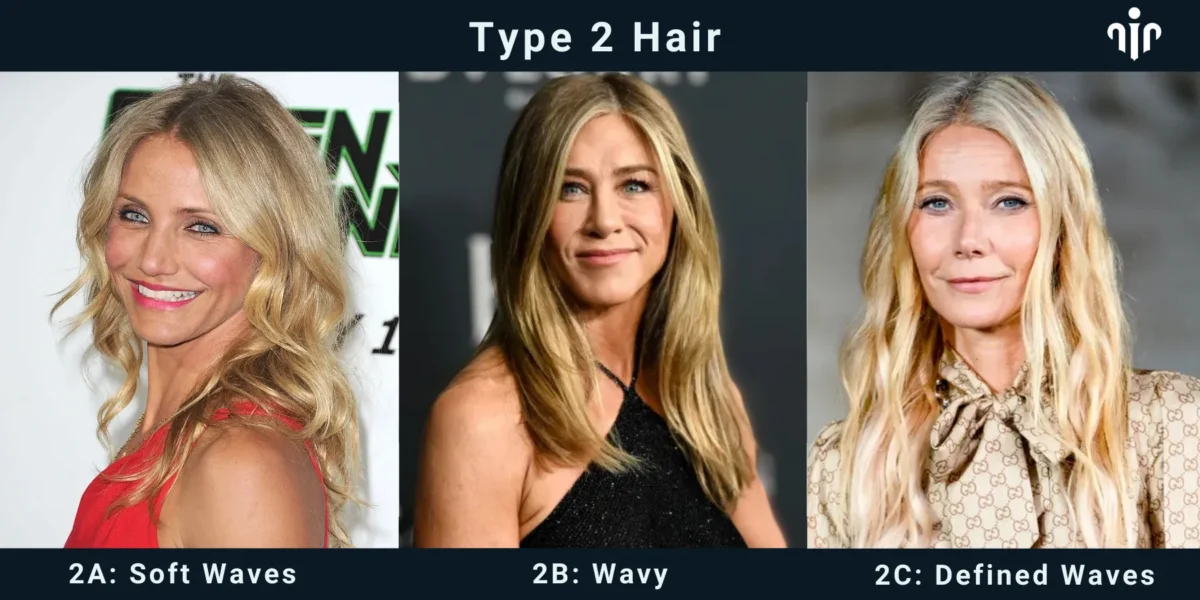
Numerous well-known individuals already have type 2 hair, which demonstrates that wavy hair can seem fashionable even when it is styled in a minimal manner. Their hairstyles demonstrate how waves may be treated in a variety of ways, including varying lengths, trims, and extensions. The addition of volume, softness, and visual harmony is something that type 2 hair will always do, regardless of whether you are trying for a more formal look or a more relaxed, everyday style.
In order to normalize the natural texture of hair and decrease the need to identify hair as straight or curly, these photographs are particularly helpful. It is common for famous people with type 2 hair to embrace their natural wave pattern, which is the exact reverse of what they often do. In addition to providing useful examples of how to style hair types 2A, 2B, and 2C, they also emphasize the small distinctions that exist between these types in real life.
Celebrities With 2A Hair
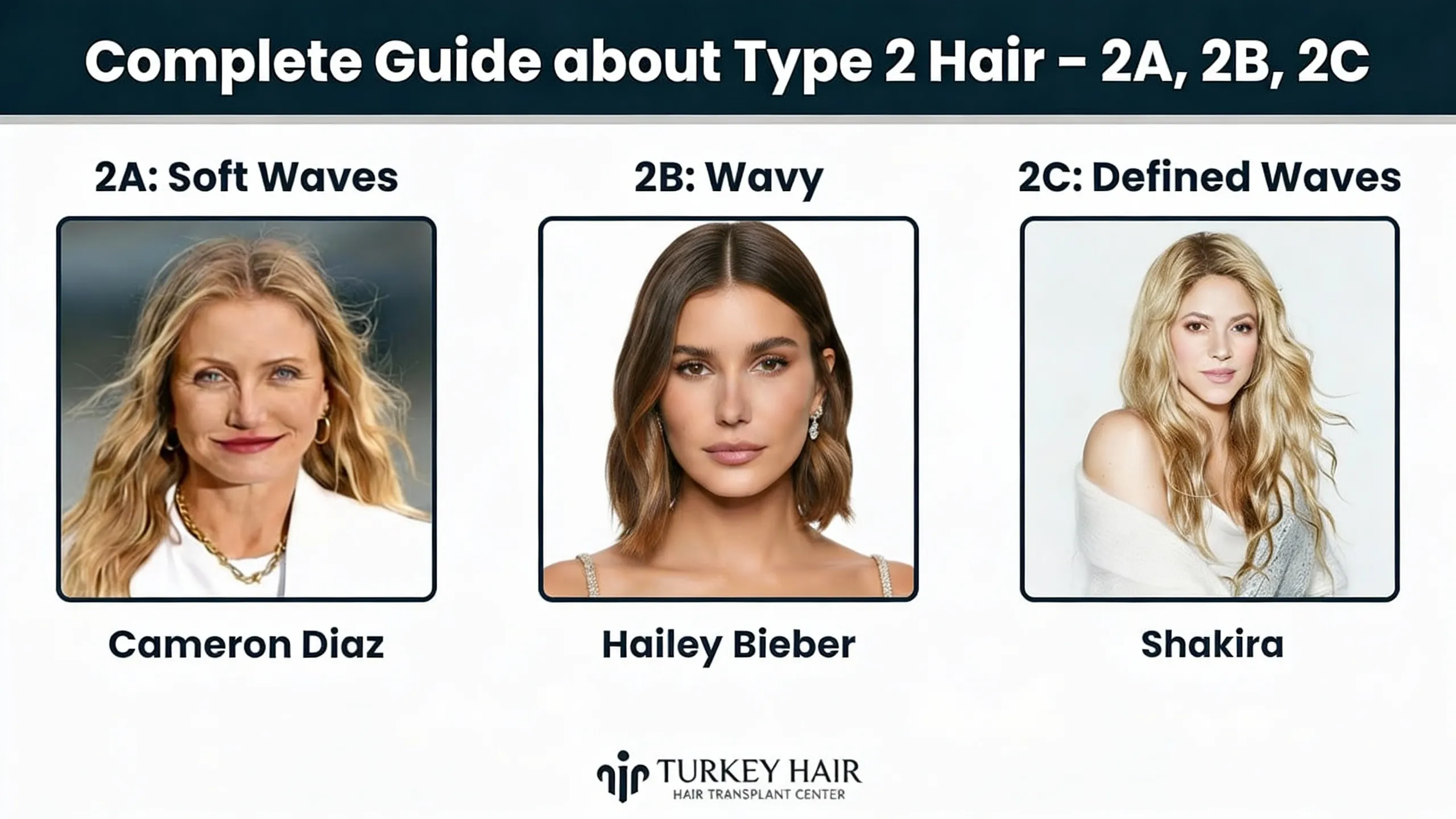
2A hairstyles are common among celebrities and often consist of waves that are soft and cascading and that are positioned close to the crown of the head. A significant portion of the time, Gwyneth Paltrow, Cameron Diaz, and Jennifer Aniston are seen wearing ensembles that are understated and classy. The manner in which they have dressed their hair gives off an appearance of refinement and ease.
Jennifer Lawrence and Kate Hudson are two further instances of celebrities whose waves become more noticeable as their hair becomes longer. The smoothness and glossiness of the hair are emphasized more than the sharpness and definition of the hair. Not only do they demonstrate how modest waves may be highlighted with small style tools, but they also demonstrate how this can bring out the inherent texture of the hair rather than hiding it.
Celebrities With 2B Hair
Famous people often wear their hair in waves that can be seen and have a natural thickness to them when they wear the 2B style. Models like Blake Lively, Hailey Bieber, and Sienna Miller are known to wear beach-themed clothes with frills and waves on them all the time. The waves make a sound that is both soft and clear.
One couple whose hairstyles stress volume and flow is Gisele Bundchen and Bruce Willis. The styles she chooses are like those of other couples. The case of Jessica Alba is just one more proof of this. These different styles show the good things about 2B haircuts, like their light hold and thorough shaping. These pros are shown by the way these hairstyles look. In contrast to other textures, the end product is one that doesn’t have too much styling.
Celebrities With 2C Hair
Famous people who have type 2C hair frequently have waves that are large and thick, giving the impression that they have curly textures. A number of musicians, like Shakira, Zendaya, and Salma Hayek, are known to make regular use of wave patterns that are particularly outstanding. In addition to being thick and full, their hair is naturally defined.
Mila Kunis and Eva Mendes are two additional actresses that have styles that are able to be both full and controlled at the same time. It is clear from these appearances that structure and wetness are extremely important qualities. According to what they display, the key to successfully employing 2C hair is to adjust the volume rather than to reduce it.
Preparation Tips Before Hair Transplant for Type 2 Hair
| Hair Transplant Factor | Type 2 Hair Advantage | What to Consider |
|---|---|---|
| Wave Structure | Creates visual density | Graft direction planning |
| Donor Area | Wavy hair hides scars well | Donor density evaluation |
| Technique Choice | Compatible with FUE & FUT | Hair length preference |
It is imperative that you have a thorough understanding of how hair transplants work with curly hair if you have type 2 hair. It is possible that the manner in which the hair regularly develops will contribute to the thickness of the hair, the clarity of the grafts, and the final appearance of the therapy. There is a possibility that you may be able to achieve both your beauty and health objectives if you plan ahead. Not only will everything go more easily before the transplant, but it will also go more smoothly in the long run.
Because it is robust and full, type 2 hair is an excellent candidate for hair transplantation because it is healthy. If you make preparations in advance, however, you might be able to take advantage of these perks. When deciding on a procedure, it is essential to take into consideration the donor spot as well as the condition of the scalp. Taking care of these things initially may contribute to the body’s ability to mend more quickly and provide you with benefits that appear to be more genuine.
Understanding Hair Transplant Suitability for Type 2 Hair
The wavy pattern of type 2 hair makes it a great choice for hair transplants because it gives the impression of more density. Even better than straight hair, the built-in waves hide the head. A small number of transplants are made possible by this, and the effects are often pleasing to the eye. When you know about this benefit, you can set more realistic goals.
But it’s important to remember that 2A, 2B, and 2C hair all have different wave patterns. Planning for density may need to be done differently for thinner waves than for bigger ones. During the transplantation process, doctors watch how the wave structure moves. You need to give this a lot of thought because the design should work with the hair’s natural nature instead of changing it.
Evaluating Scalp Health and Hair Density
Before you get a hair transplant, make sure your head is healthy. For the graft to survive and for the body to heal properly after surgery, the head must be healthy. It is important to take care not to cause redness, too much oiliness, or dryness. By taking care of these things, the chance of problems happening after surgery goes down.
Also, you should carefully measure how dense the hair is in the source area. Because cell density changes in different ways for each hair type, type 2 hair often looks thicker than it is. To make sure there are enough grafts and to avoid overharvesting, it is best to have a professional look at the situation. In the end, balanced planning makes sure that both the donor and receiver sites are safe.
Choosing the Right Hair Transplant Technique
It is essential to select the appropriate transplantation procedure while engaging with individuals who have type 2 hair. A scar will develop, the length of time it will take to recuperate, and the final esthetic result are all affected by the choice. It is crucial to take into consideration both the type of hair you have and the effects you want to achieve when selecting a technique for wavy hair because of its extraordinary versatility. It is of the utmost importance to engage in a consultation with a knowledgeable specialist.
Depending on the density of the hair and the structure of the scalp, each treatment offers a variety of opportunities for improvement. The peculiarities of the wave pattern, the integrity of the donor site, and the wishes of the patient regarding the treatment are some of the factors that surgeons take into consideration with regard to the patient. Through the selection of appropriate procedures, it is possible to ensure that the post-transplantation development patterns are homogeneous and that they correspond naturally.
FUT vs FUE for Type 2 Hair
The FUT and FUE methods are different when working with type 2 hair. More grafts can be harvested in a single session with FUT, which may appeal to patients seeking maximum density. If you have a linear scar, a wavy hairstyle will help cover it. This means that FUT is an option that some candidates can think about.
Faster healing with reduced scarring is possible with FUE, on the other hand. If you prefer a more subtle modification or a shorter hairdo, this is a perfect choice. When used together, the two techniques have the potential to transform type 2 hair. Before making a final selection, think about your hair goals, medical conditions, and how you normally live your life.
Frequently Asked Questions About Type 2 Hair
Can Type 2 Hair Become Curlier Over Time?
Yes, changes in hormones, getting older, style habits, and the balance of moisture in the hair can all make waves stand out more, which can sometimes make type 2 hair curlier.
Is Type 2 Hair Prone To Dryness Or Oiliness?
Type 2 hair can be dry or oily. Usually, the roots are oilier than the ends, which feels dry over time.
How Often Should Type 2 Hair Be Washed?
If you have type 2 hair, you should wash it two to three times a week, depending on how much oil your head makes.
Can Type 2 Hair Follow The Curly Hair Routine?
To avoid flat waves, type 2 hair should not use heavy creams or oils, but it can still follow a milder curly routine.
What Haircut Works Best For Wavy Hair?
To get the most out of wavy hair, get a cut with soft layers that add movement, thin out the style, and encourage natural wave development.
Does Weather Affect Type 2 Hair Texture?
Humidity makes type 2 hair more prone to frizz, although dry or chilly air can reduce waves.
Can Type 2 Hair Be Chemically Straightened Safely?
Chemical straightening can be done on type 2 hair but doing it too many times may damage the waves and make the hair less healthy generally over time.
How Do I Reduce Frizz Without Losing Waves?
To get rid of frizz, you need to lightly moisturize, style your hair gently, brush it less, and seal in the moisture without using heavy products that weigh down waves for no reason.
Are Sulfate-Free Shampoos Necessary For Type 2 Hair?
Sulfate-free shampoos are beneficial for type 2 hair because they cleanse gently without stripping moisture or disrupting wave definition.
Can Type 2 Hair Change Between 2A, 2B, And 2C?
Yes, type 2 hair can shift between 2A, 2B, and 2C due to hormones, length changes, damage, and styling habits.
Referances
American Academy of Dermatology – Hair Types & Care
Healthline – Understanding Different Hair Types
NCBI – Hair Structure, Texture, and Transplant Considerations