Performed at authorized partner hospitals Turkey Hair Center is a Ministry of Health authorized health-tourism intermediary, not a clinic.
This page covers which procedures suit medical travel, how long each one keeps you in the country, when it is safe to fly home, and how to check a surgeon's credentials before you commit to anything.
Authorized institutionsLicensed hospitals and surgical centres
Board-certified surgeonsProcedures performed by licensed specialists
Coordinated aftercareNamed contact through recovery
The short answer
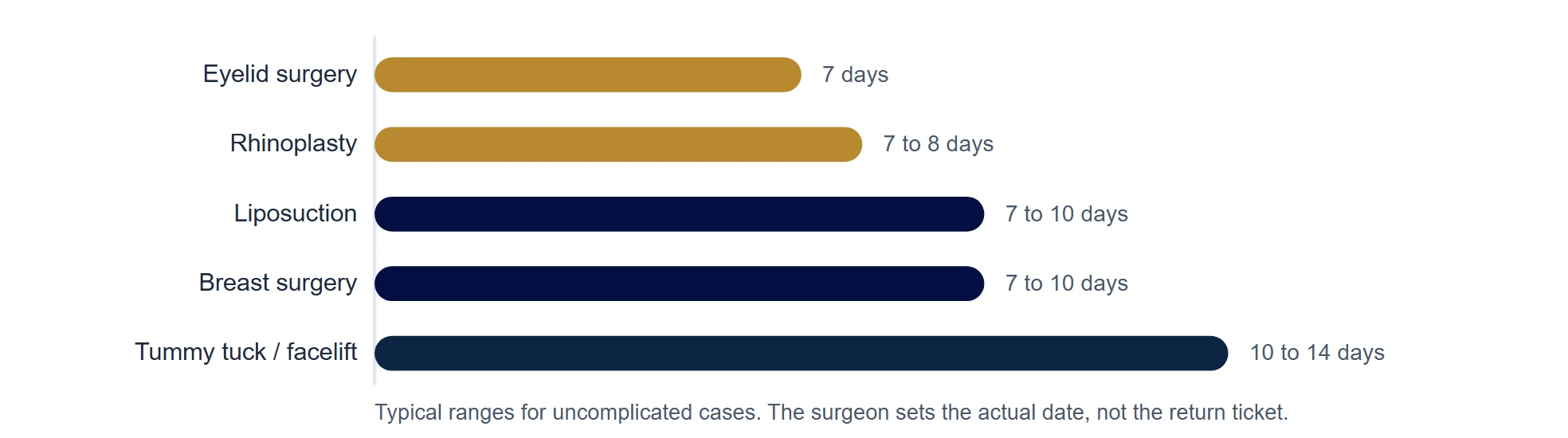
most aesthetic procedures require 7 to 10 days in Türkiye, of which surgery occupies one day and the rest is monitored early recovery. Flying home too early is the single most avoidable risk in medical travel, and the safe day differs by procedure, rhinoplasty and liposuction are not the same decision. Publicly published clinic prices in 2026 place common procedures broadly between 2,500 and 7,500 euros, against considerably higher figures in the United Kingdom and United States. Your figure follows a consultation, not a price list.
Which aesthetic procedures suit medical travel, and which do not
Not every procedure travels well. The question is not whether a surgeon can perform it, but whether the recovery it demands fits inside a trip, and whether complications, if they occur, would occur while you are still within reach of the operating team.
Procedure
Surgery duration
Days in Türkiye
Earliest usual flight home
Back to desk work
Rhinoplasty
2-3 hours
7-8 days
Day 7-8, after splint removal
1-2 weeks
Liposuction / body contouring
1-3 hours
7-10 days
Day 7-10
1-2 weeks
Breast surgery
1-2 hours
7-10 days
Day 7-10
2 weeks
Tummy tuck
2-4 hours
10-14 days
Day 10-14
3-4 weeks
Facelift
3-5 hours
10-14 days
Day 10-14
3-4 weeks
Eyelid surgery
1-2 hours
7 days
Day 7, after suture removal
1 week
Gynecomastia surgery
1-2 hours
7 days
Day 7
1-2 weeks
Timelines are typical ranges for uncomplicated cases. Your surgeon sets the actual date you are cleared to fly, based on your recovery and not on your return ticket.
The flight home is a clinical decision, not a travel decision Long-haul flights after surgery carry a raised risk of venous thromboembolism, and abdominal or lower-body procedures raise it further. Book flexible return tickets. A patient who flies on day four because the ticket says so, against advice, is taking a risk no price saving justifies.
Travelling from Canada for aesthetic surgery
The Government of Canada advises anyone considering medical tourism to discuss their plans with a travel health clinic or their health care provider in Canada first, to use only trusted providers and to research the facility where the procedure will take place. Source: travel.gc.ca.
Questions from patients in Canada
Who regulates doctors who perform hair transplants in Canada?
Physicians in Canada are regulated by medical regulatory authorities in each province and territory; in Ontario, the College of Physicians and Surgeons of Ontario inspects out-of-hospital premises where cosmetic procedures involving the insertion of a patient's own tissue are performed. Sources: cpso.on.ca, fmrac.ca.
What should I do after returning to Canada?
The Government of Canada advises getting copies of all procedure records before departure, reviewing test results, procedure descriptions and medications with a health care provider after returning, and telling any provider consulted in the following 12 months about treatment received abroad; it also notes flying soon after surgery may increase the risk of blood clots. Source: travel.gc.ca.
Does provincial health insurance cover a hair transplant in Turkey?
According to the Government of Canada, provincial or territorial health plans may not cover expenses if complications develop abroad, and most travel insurance policies do not cover planned medical procedures in another country. Source: travel.gc.ca.
Do I need a visa to travel from Canada to Turkey?
Canadian citizens do not need a tourist visa for stays of up to 90 days in a 180-day period. Your passport must be valid for at least 150 days from the date you enter Türkiye. Check the latest rules on travel.gc.ca before you travel.
Planning the trip
Flights: Turkish Airlines flies non-stop to Istanbul from Toronto Pearson and from Vancouver.
Entry: Canadian citizens do not need a tourist visa for stays of up to 90 days in a 180-day period. Your passport must be valid for at least 150 days from the date you enter Türkiye. Check the latest rules on travel.gc.ca before you travel.
Time difference: Istanbul is on UTC+3 all year, so it is 7 hours ahead of Toronto in summer and 8 hours ahead in winter (10 and 11 hours ahead of Vancouver).
Prices in Canadian dollars: CAD prices on this page are converted from our US dollar price list at the European Central Bank reference rate of 1 October 2026 (1 USD = 1.4246 CAD) and rounded. Exchange rates change, so the amount can move slightly.
What aesthetic surgery costs in Türkiye
Published prices vary because packages vary. Some quotes cover the surgeon's fee only; others include anaesthesia, theatre time, the hospital stay, garments, medication, hotel and transfers. Comparing two numbers that describe different things is how patients end up surprised.
Days in Türkiye before the surgeon clears you to fly
Procedure
Türkiye (published 2026 ranges)
United Kingdom
United States
Rhinoplasty
€2,500 - €4,500
£5,000 - £8,000
CA$9,970 - CA$21,370
Liposuction (per area)
€2,000 - €4,000
£3,000 - £6,000
CA$5,700 - CA$11,400
Breast augmentation
€3,000 - €5,000
£5,500 - £8,000
CA$9,970 - CA$17,100
Tummy tuck
€3,500 - €6,000
£6,000 - £10,000
CA$11,400 - CA$21,370
Facelift
€4,500 - €7,600
£9,000 - £15,000
CA$17,100 - CA$35,610
Source: price ranges published by Turkish clinics and international medical travel platforms, August 2026. Indicative market context, not a quotation.
What a complete quote should name
Surgeon's fee, anaesthetist's fee and operating theatre time, itemised rather than bundled into one word
Length of hospital stay included, and the nightly cost if you need longer
Pre-operative blood work and any imaging
Implants, garments, drains and post-operative medication
Number of follow-up examinations before you fly, and who performs them
What happens, and who pays, if a revision becomes necessary
Revision policy is the question most patients forget Aesthetic surgery has a revision rate. It is not a sign of a bad surgeon, it is a property of the field. What separates institutions is whether the revision policy is written down before your first operation or discussed only if something goes wrong. Ask for it in writing at the quotation stage.
How the process runs
Remote consultation
You send photographs and a medical history. A surgeon assesses whether the result you describe is achievable, and says so plainly when it is not.
Plan and quotation
You receive the proposed technique, the expected recovery, the risks specific to your case, and an itemised total.
Pre-operative tests
Blood work and any required imaging are completed. Certain medications, including blood thinners and some supplements, are paused under medical instruction.
Arrival and in-person examination
The surgeon examines you and confirms or revises the plan. Consent is taken with the risks explained in a language you understand.
Surgery and monitored recovery
The procedure is performed at an authorized institution, followed by an observed hospital stay appropriate to the operation.
Clearance and aftercare
Follow-up examinations continue until the surgeon clears you to fly. You leave with written instructions, medication and a named contact.
Verifying a surgeon and an institution
Türkiye has a large and competitive aesthetic surgery sector. That produces both excellent practice and marketing that outpaces it. These checks separate the two, and each produces an answer you can verify rather than a reassurance you have to trust.
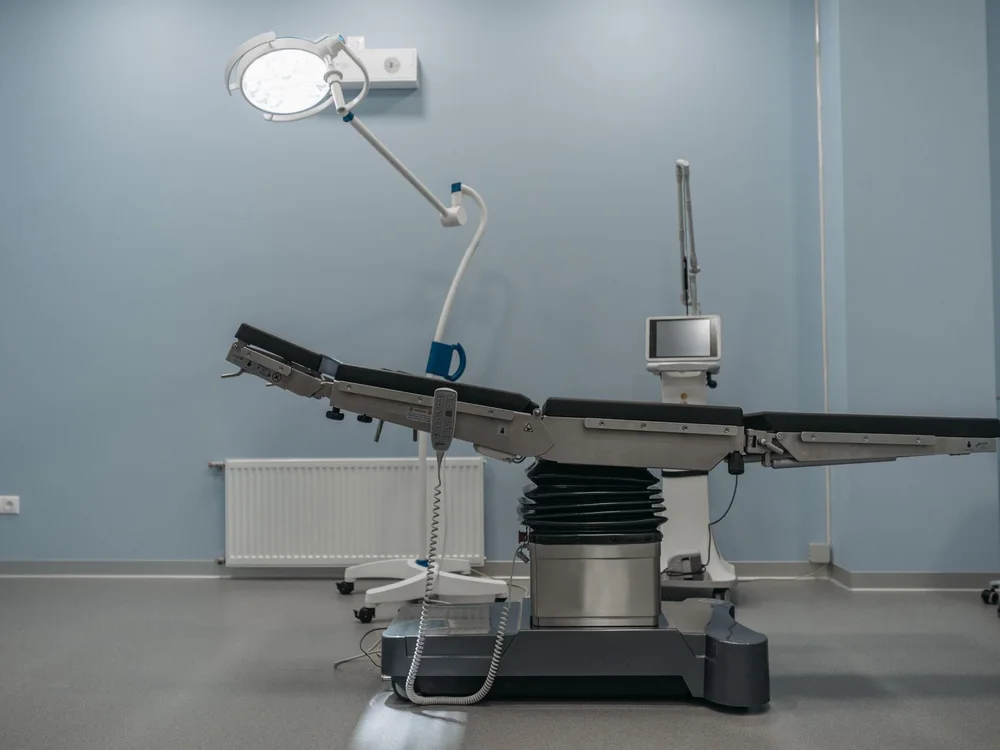
An operating theatre at an authorized healthcare institution in Istanbul. Confirm that your own procedure takes place at the address that holds the facility authorization.
Get the surgeon's full name and specialty registration. Plastic, reconstructive and aesthetic surgery is a distinct specialty with its own training pathway. "Aesthetic doctor" is not the same qualification.
Confirm which hospital or surgical centre holds the authorization, and that your operation takes place there rather than at a separate consultation address. The coordinating company is not the treating institution, and a clear answer about which is which is a reasonable thing to expect.
Ask whether an anaesthetist is present throughout and whether intensive care is available on site if it is ever needed.
Ask who performs your follow-ups. If the operating surgeon does not see you again before you fly, ask why.
Ask for the complication rate for your specific procedure at that institution. A serious answer is a number with context. An evasive answer is information too.
Decline any pressure to decide quickly. Time-limited offers belong to retail, not to surgery.
Combining procedures: what is reasonable and what is not
Combining operations in one session saves a trip and one anaesthetic. It also lengthens time under anaesthesia, which raises risk, and it complicates recovery because two areas heal at once. Surgeons take this decision on total operating time and your physical condition, not on your itinerary. The same question comes up with non-surgical travel too: patients often ask whether a hair transplant can share the trip, and that is assessed on total theatre time in exactly the same way.
Combination
Commonly considered
Main consideration
Rhinoplasty + eyelid surgery
Frequently
Both facial, moderate total operating time
Liposuction + tummy tuck
Frequently
Same region; extends recovery and garment period
Breast surgery + body contouring
Case by case
Total anaesthesia time is the limiting factor
Facelift + major body surgery
Rarely in one session
Combined operating time and blood loss usually make staging safer
Who should postpone
A surgeon who declines to operate is protecting the result as much as the patient. Common reasons to wait:
weight that is still changing significantly, body contouring results shift with it;
smoking, which impairs wound healing and raises the risk of tissue necrosis in several procedures;
an uncontrolled chronic condition, or a medication regimen that has not been reviewed for surgery;
pregnancy, breastfeeding, or plans for pregnancy within the year for abdominal and breast procedures;
expectations that the surgeon has explained are not achievable. Proceeding anyway satisfies nobody;
a trip already committed to a heavier operation. Bariatric surgery takes the full recovery period on its own, while dental treatment is usually the easiest to schedule alongside something else.
A note on photographs you see online Turkish advertising regulation restricts the promotional use of before-and-after imagery for health services, which is why you will not find such galleries here. Assess a surgeon on qualifications, on the clarity of the plan, and on the honesty of the conversation, not on images whose context, lighting and timing you cannot verify.
Recovery, in the order it actually happens
Period
What is normal
What needs attention
Days 1-3
Swelling, bruising, controlled discomfort, drains where used
Fever, one-sided calf pain, breathlessness, bleeding that soaks dressings
Days 4-10
Swelling peaks then begins to settle; sutures or splints removed
Increasing rather than decreasing pain, spreading redness, discharge
Weeks 2-6
Return to desk work, light activity resumed on instruction, garments worn as directed
Asymmetry that worsens, a wound that opens, numbness that spreads
Months 3-12
Residual swelling resolves; the final result becomes apparent, slowest in rhinoplasty
Any change that concerns you, raise it rather than wait for the next check
Final results take months, not days. Judging an outcome at week two is judging swelling, not surgery.
The procedures in detail
General guides describe aesthetic surgery as a category. The decisions that matter are procedure-specific, so this section takes the four most commonly travelled-for operations one at a time.
Rhinoplasty
Nose surgery is the procedure Türkiye is best known for internationally, and it is also the one where expectation management matters most. Two technical approaches dominate: closed rhinoplasty, performed entirely through the nostrils with no external scar, and open rhinoplasty, which uses a small incision across the columella and gives the surgeon direct visibility. Neither is superior in the abstract. Revision cases, complex tip work and significant structural correction usually favour the open approach.
Swelling after rhinoplasty resolves slowly. The splint comes off around day seven, most visible swelling settles within three months, and the definitive shape of the tip can take a full year. A patient judging the result at week three is looking at oedema.
Liposuction and body contouring
Liposuction removes localised fat deposits. It is not a weight-loss operation and it does not treat loose skin. Candidates who are close to a stable weight with good skin elasticity get the results shown in textbooks; candidates hoping to lose substantial weight surgically do not. Compression garments are worn for four to six weeks, and the final contour appears as swelling resolves over three to six months.
Tummy tuck (abdominoplasty)
Abdominoplasty removes excess skin and tightens the abdominal wall, which is why it is a considerably larger operation than liposuction and carries a longer recovery. It leaves a horizontal scar low across the abdomen, placed to sit below underwear where anatomy allows. Patients planning future pregnancy are usually advised to wait, because pregnancy reverses the muscle repair.
Facelift
A facelift repositions deeper tissue rather than simply tightening skin, which is why modern techniques produce a different result from the pulled appearance associated with older methods. Recovery is longer than most patients expect: bruising for two to three weeks, and a settled result at three to six months. Scars follow the hairline and the natural creases around the ear.
A question that reveals a lot Ask the surgeon what result they consider realistic for you, before you describe what you want. A surgeon who answers with your anatomy in mind, skin quality, tissue thickness, underlying structure, is assessing you. A surgeon who simply agrees with whatever you propose is selling.
Anaesthesia, and the questions worth asking about it
Anaesthesia is the part of surgery patients think about least and the part where the safety infrastructure of an institution shows most clearly.
Type
Typically used for
What it involves
General anaesthesia
Rhinoplasty, tummy tuck, facelift, breast surgery
Fully asleep, airway managed, anaesthetist present throughout
Sedation with local
Small-area liposuction, eyelid surgery
Deeply relaxed but breathing independently
Local only
Minor revisions, small excisions
Awake, the area numbed
Is a qualified anaesthetist present for the whole operation, or only at induction?
Is there an intensive care unit in the same building?
What pre-operative tests are required before anaesthesia is approved for me specifically?
Which of my current medications and supplements must stop, and how many days before?
Disclose everything, including the things that feel irrelevant Herbal supplements, weight-loss medication, recreational drug use, sleep apnoea and previous anaesthetic reactions all change anaesthetic planning. Patients frequently omit these out of embarrassment. Anaesthetists are not interested in judgement; they are interested in not being surprised in theatre.
Scars, and how they actually behave
Every incision leaves a scar. Surgeons control placement and closure; biology controls maturation. A scar typically looks worst between weeks four and twelve, then fades over twelve to eighteen months.
keep the scar out of direct sun for at least a year, or use high-factor protection, ultraviolet exposure darkens immature scars permanently;
silicone sheets or gel, used consistently from the point the wound is closed, have the strongest evidence base of the available topical measures;
if you have a history of keloid or hypertrophic scarring, say so before surgery, it changes both technique and expectation;
massage, when the surgeon advises it, begins only after the wound is fully closed.
Türkiye compared with other destinations
Comparison is fair and useful. The following reflects publicly published price levels and the practical trade-offs patients weigh.
Destination
Rhinoplasty, published range
Practical considerations
Türkiye
€2,500 - €4,500
Very high procedure volume, established medical travel infrastructure, direct flights from most of Europe and the Middle East
Poland / Czechia
€3,000 - €5,000
EU regulatory framework, shorter flights from western Europe, fewer all-inclusive structures
Mexico
CA$5,700 - CA$9,970
Convenient for North American patients; quality varies widely between providers
South Korea
CA$7,120 - CA$12,820
Strong technical reputation, higher cost and longer travel for most patients
Publicly published ranges, August 2026. Price is the least reliable basis for choosing a surgeon.
Frequently asked questions
How many days do I need to stay in Türkiye?
Between 7 and 14 days for most procedures. Rhinoplasty and eyelid surgery sit at the shorter end, tummy tuck and facelift at the longer. The stay is not padding, it exists so the surgical team can see you through the period when complications, if any, would appear.
When can I fly home?
Your surgeon decides, based on how you are healing. Typical clearance falls between day 7 and day 14 depending on the procedure. Book a flexible return ticket so a clinical delay does not become a financial decision.
Why is aesthetic surgery less expensive in Türkiye?
Lower staff and facility costs, favourable currency levels, and a high volume of international patients that allows efficient scheduling. The implants, sutures and monitoring equipment come from the same international suppliers used elsewhere.
Is general anaesthesia safe?
General anaesthesia carries risk everywhere, and that risk is managed the same way everywhere: pre-operative assessment, a qualified anaesthetist present throughout, and appropriate monitoring. Confirm that an anaesthetist attends your operation and that critical care is available on site.
Can I combine several procedures in one trip?
Sometimes. The limit is total time under anaesthesia and your overall condition, which is a surgical judgement rather than a scheduling preference. See the combinations table above for how these decisions are usually approached.
What if I need a revision?
Ask for the revision policy in writing before your first operation, what is covered, for how long, and who bears travel costs. Revision rates exist in aesthetic surgery everywhere; a clear written policy is the mark of a serious institution.
Will there be visible scars?
Any procedure involving an incision leaves a scar. Surgeons place incisions in concealed locations where the technique allows. How a scar matures depends on your skin, your genetics and how you care for it, which is why honest surgeons discuss scar placement rather than promising invisibility.
Does Turkey Hair Center perform the surgery?
No. Turkey Hair Center coordinates assessment, planning, scheduling, travel and follow-up communication. Procedures are performed by licensed specialist surgeons at authorized healthcare institutions in Türkiye.
What do I need to arrange before travelling?
Complete the requested blood work, disclose all medications and supplements, stop smoking for the period your surgeon specifies, arrange a companion where the procedure requires one, and buy travel insurance that does not exclude planned medical treatment.
Can I combine a hair transplant with an aesthetic procedure?
Sometimes, and it is a common question because many patients travel for both. It depends on the procedures, the total operating time and your recovery capacity. It is assessed case by case rather than assumed.
What a surgical trip actually looks like, day by day
Day
What happens
Day 1
Arrival, transfer, rest. No procedures.
Day 2
In-person consultation, blood work, anaesthetic assessment, consent taken with risks explained.
Day 3
Surgery, followed by observed recovery in hospital.
Day 4
First dressing change and examination. Mobilisation encouraged.
Days 5-6
Rest at the hotel with scheduled check-ups. Swelling typically peaks around this point.
Day 7-8
Sutures or splint removed where applicable. Surgeon assesses fitness to fly.
Day 8-10
Final review, written aftercare, medication, and departure once cleared.
Insurance rarely covers what patients assume it covers Standard travel insurance normally excludes planned medical treatment and anything arising from it. That means a complication abroad may not be covered by the policy in your pocket. Specialist medical-travel cover exists; read what it excludes before buying, and never assume a card-linked travel policy applies.
Turkey Hair Center coordinates access to aesthetic procedures performed by licensed specialist surgeons at authorized healthcare institutions in Türkiye. This page provides general information about treatment options and does not constitute a diagnosis, a treatment recommendation or a guarantee of outcome. All surgery carries risk. Every plan follows an individual clinical assessment and results vary from person to person. Price ranges shown are publicly published market figures for orientation and are not an offer.
Sources and medical review
The clinical statements on this page are consistent with the public guidance below. Price figures are publicly published market ranges and are labelled as such where they appear.
Send three photos: front, top and sides. You get a technique recommendation, a graft range and a straight answer about what is achievable, before anyone talks about price.
Your details are with the team
A patient coordinator will get back to you shortly. If you would like to send your photos now, WhatsApp is the fastest way to do it.
We respond quickly, day or night, in your language.
Multilingual team, no obligation
Data protectedKVKK and GDPR compliant, 100% confidential
Authorized Health Tourism Intermediary
Turkey Hair Center is the hair-restoration brand of Healthy Way Tourism, an authorized international health-tourism intermediary. All medical procedures are performed by licensed medical professionals at authorized healthcare facilities in Turkiye, in accordance with the regulations of the Ministry of Health.