How Much Is a Hairline Transplant? Cost, Grafts & Price Factors
How Much Is a Hairline Transplant? Cost Guide Medical Reviewed By Dr. Tompi, M.D: Plastic & Aesthetic Surgeon
Written By Nazmi G, Trichologist
How much is a hairline transplant? On average, the cost typically ranges between $3,000 and $18,000. While minor temple corrections requiring around 1,000 grafts typically sit near the lower end ($3,000: $6,000), a full frontal hairline restoration using 2,500 to 3,000 grafts can range from $6,000 to $18,000 depending on the country, clinic, and technique used.
Graft count, technique, clinic location, medical team involvement, and design complexity all shape the final quote. The cost is not fixed. A patient who needs a small temple correction is not paying for the same procedure as someone who needs the whole frontal hairline rebuilt. Same search term. Different surgery.
The better question is not only, “How much is a hairline transplant?”
It is this: How much correction does your hairline actually need?
What Is a Hairline Transplant?
At its core, a hairline transplant is a specialized procedure designed to rebuild, reshape, or lower the front edge of a patient’s hair using their own natural grafts.
It serves as a highly effective solution for common concerns like receding temples, genetic M-shaped hairlines, uneven frontal contours, or progressive thinning directly behind the existing front row.
While the underlying concept sounds incredibly straightforward: extracting healthy hair follicles from a donor zone (typically the back or sides of the scalp) and transplanting them into the empty or thinning areas at the front: the actual execution demands immense clinical skill.
Because the hairline is one of the most prominent features framing your face, there is absolutely no room for error. If a surgeon designs the line too low, draws it unnaturally straight, packs it with excessive density, or misjudges the natural angle of hair growth, the final look will appear artificial almost instantly.
Crafting a successful, long-lasting hairline requires a deeply personalized approach; the medical team must carefully evaluate the patient’s age, forehead height, facial geometry, natural temple points, and hair direction, while also factoring in donor hair strength and the risk of future hair loss.
Ultimately, a premium transplant is never just about adding random density: it is about masterfully restoring the natural frame of your face.
Hairline Transplant vs Hairline Surgery
People often use “hairline transplant” and “hairline surgery” as if they mean the same thing.
A hairline transplant adds grafts to the frontal hairline. It is usually used for recession, thinning, temple loss, or male pattern hair loss.
Hairline lowering surgery, also called forehead reduction, is different. It moves the hairline forward surgically by removing a strip of forehead skin.
Procedure
What It Does
Best For
Hairline transplant
Adds hair grafts to the frontal hairline
Receding hairline, temple recession, thinning front
Hairline lowering surgery
Moves the hairline forward surgically
Naturally high forehead without active hair loss
Combined approach
May involve both methods in selected case
Complex forehead and hairline concerns
If the issue is hair loss, a graft-based transplant is usually the more relevant option.
How Much Is a Hairline Transplant?
A hairline transplant usually costs between $3,000 and $18,000. Minor temple work with around 1,000 grafts is often closer to the lower end. A larger frontal restoration using 2,500-3,000 grafts may move into the higher range, especially in premium clinics.
The biggest cost driver is usually graft count. But not always. A small corner correction takes less time, fewer grafts, and less surgical planning than a full frontal rebuild. Repair cases also cost more because the surgeon may need to work around old grafts, scar tissue, poor angles, or a hairline that was placed too low.
Our partner hospital’s medical team has often observed patients focusing solely on the number. “Can I get 3,000 grafts?” Maybe. But the scalp does not care about impressive numbers. It cares about blood supply, safe extraction, natural spacing, and donor area protection. A smaller, cleaner plan can age better than an aggressive one
Hairline Transplant Cost by Graft Count
Graft count gives patients a starting point.
Graft Count
Best For
Estimated Cost Range
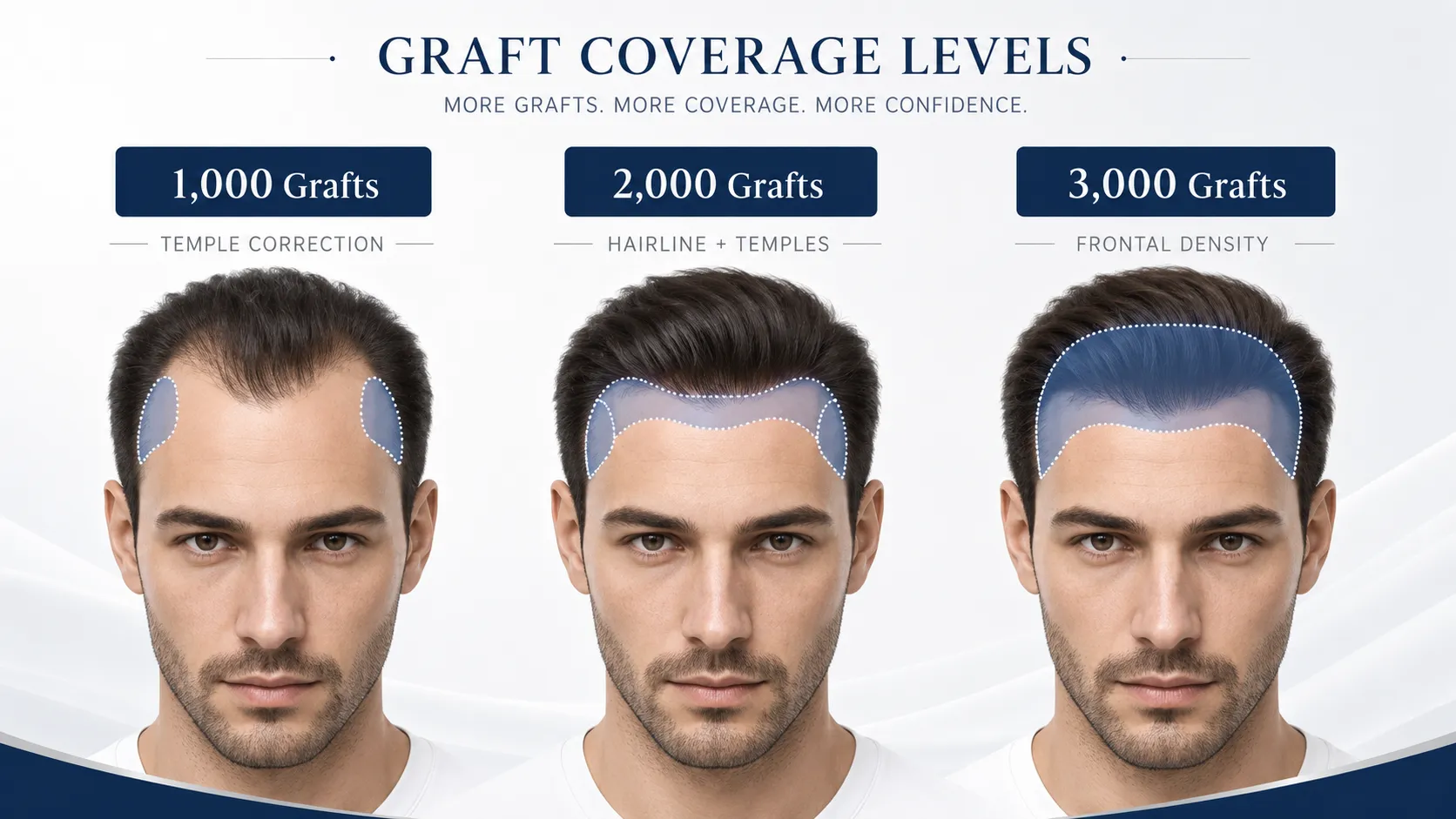
1,000 grafts
Minor temple correction
$3,000: $6,000
1,500 grafts
Mild hairline recession
$4,000: $8,000
2,000 grafts
Hairline and temple restoration
$5,000: $10,000
2,500 grafts
Stronger frontal hairline rebuild
$6,000: $13,000
3,000 grafts
Hairline plus frontal density support
$7,000: $18,000
A 1,000-graft plan is usually a small correction. It may help if the temples have only started to open or one side of the hairline looks weaker.
A 1,500-graft plan can work well for early recession or a light M-shaped hairline.
A 2,000-graft plan often gives enough room to treat the hairline and both temple corners, if the area is not too wide.
A 2,500-graft plan is usually more than a touch-up. It may rebuild the front, support the temples, and add density behind the first row.
A 3,000-graft plan is a bigger decision. It may be useful when the frontal third is thinning, not just the corners.
The number itself is not magic.
A good result should not make people think about grafts. It should simply look like a better hairline.
What Factors Affect Hairline Transplant Cost?
Hairline transplant pricing is not random.
The final quote usually reflects the graft number, technique, design complexity, clinic location, surgeon involvement, donor area quality, aftercare, and whether this is a first-time procedure or a repair case.
The price is not only about moving hair.
It is about moving it carefully.
Number of Grafts Needed
More grafts usually mean more extraction, more placement, and a longer procedure.
Still, more grafts do not automatically mean a better hairline.
A natural hairline needs softness in the first row and stronger density behind it. Thick grafts placed too aggressively at the front can make the result look artificial.
The right number is not the highest number.
It is the number your hairline can use well.
FUE vs DHI Cost Difference
FUE and DHI can both be used for hairline restoration.
FUE removes individual follicular units from the donor area. DHI uses an implanter pen to place grafts directly into the recipient area and may be useful in selected cases where angle, direction, or density control needs extra precision.
DHI may cost more in some clinics because it can take more time.
But higher cost does not automatically mean better technique.
A good clinic chooses the method around the patient’s hairline design, graft quality, donor safety, and density goal.
Technique
Why It May Affect Cost
Best Use
FUE
Individual extraction and placement planning
Flexible hairline and donor planning
DHI
Implanter pen may require more time and control
Precision placement in selected cases
Sapphire FUE
Sapphire blades used for channel opening
Often discussed for refined channel work
Hairline Design Complexity
A straight line is easy to draw.
A natural hairline is not.
The surgeon has to think about forehead height, temple points, facial proportions, hair direction, graft thickness, density transition, and future hair loss.
Cheap hairline work can become expensive later.
A line that is too low, too straight, or too dense may need repair.
Good hairline design is not perfect.
Clinic Location and Medical Standards
New York, London, Los Angeles, and other high-demand cities usually have higher operating costs. International packages may be more affordable because clinic expenses and healthcare pricing structures vary by country.
Price alone does not tell the full story.
A low price is not automatically dangerous. A high price is not automatically excellent.
Patients should compare surgeon involvement, donor protection, medical standards, before-and-after results, follow-up care, and what the quote actually includes.
Repair Hairline Transplant Cost
Repair cases usually cost more than first-time hairline transplants.
The surgeon is not working on a clean canvas.
Old grafts may be too thick. Angles may be wrong. Scar tissue may be present. The hairline may be too low or too straight.
A repair plan may involve graft removal, temple rebuilding, front-row softening, density correction, angle correction, and scar camouflage.
This is why the first design matters.
Hairline Transplant Cost by Country
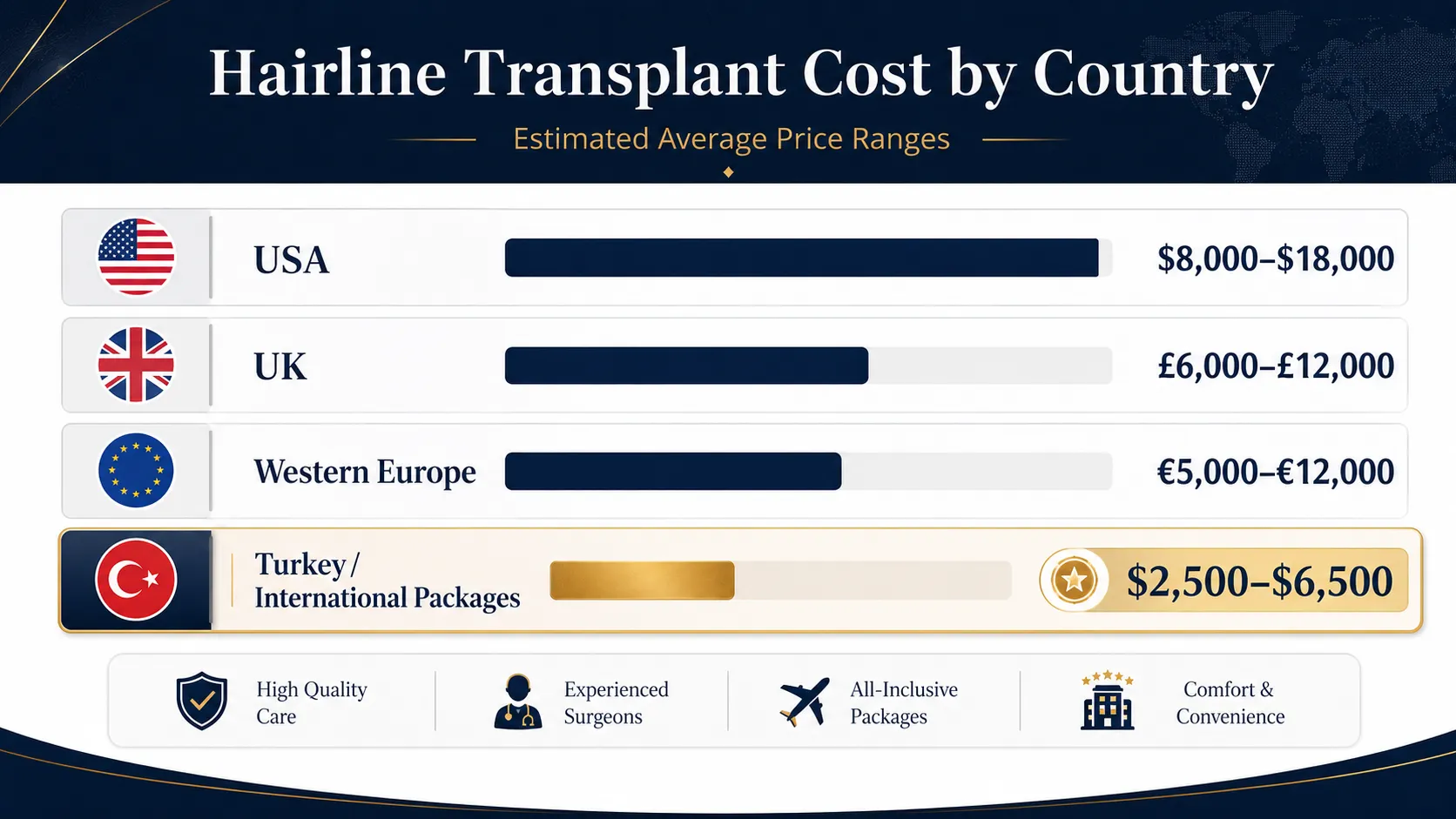
Hairline transplant cost changes a lot from country to country.
Country / Region
Average Hairline Transplant Cost
USA
$8,000: $18,000
UK
£6,000: £12,000
Western Europe
€5,000: €12,000
International medical packages
$2,500: $6,500
In the USA, hairline transplant prices are usually higher, especially in major cities or premium clinics. A full frontal restoration can move into five figures quickly.
In the UK, cost is shaped by graft count, surgeon reputation, clinic location, and technique. London clinics may sit higher because of demand and overhead.
International packages may include more than surgery. Some plans include accommodation, transfers, interpreter support, blood tests, first wash, aftercare products, and follow-up guidance.
At Turkey Hair Center, planning starts with photo review, donor area analysis, graft estimation, and hairline design.
The goal is not to sell a random graft number.
The goal is to build a plan that fits the patient’s face, donor capacity, hair type, and long-term hair loss pattern.
What Is Included in a Hairline Transplant Quote?
Two clinics can give very different prices for what looks like the same case.
Sometimes one clinic is more expensive because it is premium.
Sometimes it is because the quote includes more.
A total quote may include the online consultation, donor analysis, graft estimate, surgery fee, blood tests, medication, PRP or supportive treatments, first wash, aftercare kit, accommodation, airport transfers, interpreter support, and follow-up consultation.
Do not compare only the headline price.
Does Insurance Cover Hairline Transplant?
Most insurance plans do not cover hairline transplant.
It is usually considered cosmetic.
There may be exceptions for burns, trauma, surgical scars, or medically related hair loss. Even then, documentation is required, and the insurance provider makes the final decision.
Ask before planning surgery.
Can You Finance a Hairline Transplant?
Some clinics offer financing, payment plans, or package-based pricing.
But the monthly payment is not the whole story.
Patients should check the total price, deposit, interest, extra fees, refund policy, cancellation rules, included services, and follow-up care.
A payment plan should reduce stress.
Is a Cheap Hairline Transplant Worth the Risk?
Let’s be honest: a lower price tag is always tempting. And nobody wants to spend more than they absolutely have to. However, your hairline isn’t something you can easily cover up or hide under clothes.
If it ends up looking too straight, artificially low, or placed at a strange angle, you have to face that mistake in the mirror every single day. A bad haircut is just a temporary mistake. It can grow out in a few weeks. A poorly executed hairline transplant, unfortunately, is permanent.
This doesn’t mean an affordable procedure is automatically a bad choice; budget-friendly options can still yield safe and excellent results. The real danger lies in poor clinical planning and cut corners, not the price itself.
Before you sign up for the cheapest quote you find, you need to look beyond the discount and get clear answers to a few critical questions:
Who is actually designing your new hairline profile?
Who handles the extraction and places the individual grafts?
How will they protect your limited donor area for the future?
Can they show you real, verified before-and-after results?
What does their medical follow-up care look like?
In the end, those answers matter infinitely more than the quick cash you think you’re saving.
Are Hairline Transplants Worth It?
For the right candidate it is totally. Someone with a stable hair loss pattern, healthy donor hair, and realistic expectations of a hairline transplant is absolutely worth the investment.
Interestingly, the most impactful change isn’t just seeing more hair on your head. The real victory is the restoration of your natural facial balance. Rebuilding a stronger hairline completely redefines how your forehead, eyebrows, and upper face frame each other.
Beyond the aesthetics, it brings immense practical and emotional relief. It changes how you handle that morning mirror check, how you feel about certain photo angles, and how much time you waste on morning styling battles.
With a successful procedure, morning routines become effortless. You can finally ditch the hair fibers, hats, or strategic combing methods you’ve been relying on just to step outside with confidence.
However, it may not be worth it for someone expecting instant growth overnight, unlimited density, or a teenage hairline that simply does not fit their current age.
Hairline Transplant Before and After Results
Hairline transplant before-and-after results should look natural.
The best result usually makes people think, “You look better,” not “You had surgery.”
A natural result comes from a soft front row, correct hair angle, and density that builds gradually behind the line.
If the first row is too thick, the hairline can look harsh. If the line is too straight, it can look drawn on. If the temples are ignored, the front may not match the rest of the face.
Good hairline work is quiet.
It improves the frame without shouting.
How to Get an Accurate Hairline Transplant Quote
You cannot get a real quote from a celebrity photo.
A graft calculator helps, but it is still a rough tool.
The clinic needs to see the hairline, temples, crown, and donor area. It also needs the patient’s age, hair loss history, previous procedure history, hairline goal, donor strength, hair thickness, medical background, and density expectations.
Photos can start the process.
A medical evaluation should finish it.
At Turkey Hair Center, patients can begin with an online hair analysis. After reviewing photos and hair loss history, the team can estimate graft needs and explain which treatment plan may fit best.
Short Recovery Note: How Long Should You Plan?
This is not a full recovery guide, but cost and recovery are connected.
Most patients need around 7-14 days for visible early healing. Scabs usually clear during this period, and many people return to desk work earlier. Full growth takes much longer, often 12 months or more.
Patients traveling for surgery should plan time for consultation, procedure day, first wash, and early healing.
Rushing this stage is not worth it.
Can Turkey Hair Center give me a price from photos?
Turkey Hair Center can usually provide an initial estimate after reviewing clear photos and hair loss history.
The team needs to see the front, temples, crown, and donor area.
The exact plan comes after medical evaluation.
Medical Review Note
This article has been medically reviewed to help ensure the accuracy of information related to hair restoration procedures, treatment considerations, recovery expectations, and patient education. It does not replace a personal consultation or medical diagnosis. For an accurate hairline transplant quote, patients should complete a thorough donor area and hairline evaluation with a qualified hair transplant doctor or clinical medical team.
Let’s disscuse make
Medical disclaimer: This article is for informational purposes only and is not medical advice. Individual results vary from person to person. Always consult a qualified doctor before any hair transplant procedure.
How Much Is a Hairline Transplant? Cost Guide: frequently asked questions
Can Turkey Hair Center give me a price from photos?
Turkey Hair Center can usually provide an initial estimate after reviewing clear photos and hair loss history. The team needs to see the front, temples, crown, and donor area. The exact plan comes after medical evaluation.
How much does a hairline transplant cost?
The price depends mainly on the number of grafts, the clinic and the country. A focused hairline restoration is smaller than a full-scalp procedure, so it usually sits at the lower end of hair transplant pricing, and Turkey is often more affordable than the UK, US or Europe for comparable work.
How many grafts does a hairline transplant need?
A hairline and temple restoration commonly needs around 1,500 to 3,000 grafts. The exact figure depends on how far the hairline has receded and the density you want to achieve.
Why is a hairline transplant cheaper in Turkey?
Lower operating and staffing costs allow experienced clinics in Turkey to offer competitive prices, often as all-inclusive packages covering the procedure, accommodation and transfers, rather than a drop in quality.
What affects the price of a hairline transplant?
The main factors are graft count, the technique used, the surgeon and team, and whether extras like hotel, transfers and aftercare are included in the quoted package.
Is a hairline transplant permanent?
Because the grafts come from donor areas resistant to pattern hair loss, a hairline transplant is generally permanent, though it does not stop future thinning of the untreated native hair.
What is a normal price for a hairline transplant?
Most hairline transplants cost between $3,000 and $18,000. A small temple correction may stay closer to the lower end. A larger frontal rebuild can move much higher. The quote reflects graft count, design difficulty, medical team involvement, location, donor area quality, and aftercare.
Why does one clinic quote $4,000 and another quote $12,000?
Because they may not be quoting the same service. One quote may include only the operation. Another may include consultation, blood tests, medication, first wash, hotel, transfers, follow-up, and doctor involvement. A low price can be fair. A high price can be fair. The question is what sits behind the number.
What does 1,000 grafts really buy me?
A 1,000-graft plan may cost around $3,000-$6,000. It can help with minor temple recession, slight asymmetry, or a cleaner frontal edge. It is not enough for a wide or deep recession pattern. Think refinement. Not reconstruction.
Is 1,500 grafts enough for an M-shaped hairline?
Sometimes. A light M-shaped hairline may improve well with around 1,500 grafts. If the corners are deeper or the frontal band is thin, the patient may need closer to 2,000 grafts or more. The shape matters more than the label.
What can 2,000 grafts do for the front?
A 2,000-graft plan can often treat the hairline and both temple corners. It may also add some density behind the first row. That matters because a hairline should not be only a thin line of grafts. The best 2,000-graft results usually look balanced.
When does 2,500 grafts make sense?
2,500 grafts may make sense when the hairline needs stronger rebuilding and the area behind the front also needs support. This is common in deeper temple recession or visible frontal thinning. At this point, planning becomes more serious.
Is 3,000 grafts too much for just the hairline?
Not always, but it is a big number for the front. It may be reasonable if the frontal third is thinning, not only the corners. It may be too much if the patient only needs a small touch-up. A doctor should check donor strength and future hair loss risk first.
What does a hairline transplant cost in the USA?
In the USA, many hairline transplants fall around $8,000-$18,000. Major cities and premium clinics can cost more. Patients should compare results and planning quality, not only location.
What does a hairline transplant cost in the UK?
In the UK, a hairline transplant may cost around £6,000-£12,000. London clinics may sit higher because of demand, location, and overhead. The key is to compare what is included.
Will insurance pay for any of this?
Usually, no. Hairline transplants are generally cosmetic. Insurance may only review special cases such as burns, trauma, surgery scars, or medically documented hair loss. Ask your provider directly.
Do clinics let patients pay monthly?
Some do. Financing or payment plans may be available, but patients should check the total cost, deposit, interest, extra fees, cancellation rules, and follow-up coverage. A payment plan should reduce stress. Not create more.
Why is DHI sometimes more expensive than FUE?
DHI may cost more because implantation can take more time and control in selected cases. But more expensive does not always mean better. FUE, DHI, and Sapphire FUE can all create natural hairlines when planning is good.
Sources and medical review
The clinical statements on this page draw on the following published literature and professional body guidance:
Epstein GK (2020). Follicular Unit Excision: Current Practice and Future Developments. Facial Plastic Surgery Clinics of North America.
Harris JA (2013). Follicular unit extraction. Facial Plastic Surgery Clinics of North America.
Romera de Blas C (2026). Complications in follicular unit excision hair transplantation: current evidence and practical approaches. Frontiers in Medicine.
Mohmand MH (2020). Transection rate at different areas of scalp during follicular unit extraction/excision (FUE). Journal of Cosmetic Dermatology.
Send three photos: front, top and sides. You get a technique recommendation, a graft range and a straight answer about what is achievable, before anyone talks about price.
Your details are with the team
A patient coordinator will get back to you shortly. If you would like to send your photos now, WhatsApp is the fastest way to do it.
We respond quickly, day or night, in your language.
Multilingual team, no obligation
Data protectedKVKK and GDPR compliant, 100% confidential
Authorized Health Tourism Intermediary
Turkey Hair Center is the hair-restoration brand of Healthy Way Tourism, an authorized international health-tourism intermediary. All medical procedures are performed by licensed medical professionals at authorized healthcare facilities in Turkiye, in accordance with the regulations of the Ministry of Health.