How Much Is a Hair Transplant? Cost, Grafts, Insurance and Procedure Guide Medical Reviewed By Dr. Tompi, M.D: Plastic & Aesthetic Surgeon
Written By Nazmi G, Trichologist
If you are losing your hair, you probably want one simple question answered right away. How much is this going to cost?
You look online hoping to find a clear price tag. Instead, one clinic quotes you $3,000, and another clinic down the street asks for $15,000. It feels like throwing darts blindfolded.
The reality is that hair restoration is not an off-the-shelf product. It is a highly customized surgical procedure. The amount of money leaving your bank account depends on several moving parts: how many grafts you actually need, the specific tools the surgeon uses, the city you live in, and the medical team's experience level. On top of that, clinics in the USA bill completely differently than international hubs like Turkey.
Before you commit to a budget, you need to understand exactly what you are paying for. Let's break down the real costs, the financing options, and the clinical factors you need to know.
Let's cut right to the numbers. In 2026, a standard hair transplant costs anywhere from $2,000 to over $15,000 globally.
Why is that price window so massive? Because you are not buying a manufactured product off a store shelf. The total amount you pay is driven entirely by three core variables: the severity of your hair loss, the country where you undergo surgery, and who is holding the tools inside the operating room. A minor hairline touch-up in an international medical destination sits at the lower end of that price spectrum, whereas a massive session in a major U.S. metropolitan practice sits at the absolute top.
Quick Answer: How Much Does a Hair Transplant Cost?
There isn't a single price tag you can just pull off a shelf.
If you stay in the US or UK, clinics almost always charge by the graft. That means a guy needing a massive restoration pays exponentially more than someone just touching up a receding hairline. Plus, that local fee usually only covers the surgery time and local anesthesia: it rarely includes your long-term aftercare products.
International hubs like Turkey flip this script completely. They bundle the surgery, hotel stays, and VIP transfers into one flat rate, which makes budgeting incredibly predictable. But regardless of which country you choose, a reputable surgeon must physically map out your donor area before locking in a real quote. Until a doctor actually does that math, any number they give you over the phone is just a wild guess.
Average Price Range and What It Usually Covers
When you pay for a procedure locally in the US, that fee normally covers the surgery time, local anesthesia, and the medical staff. It rarely covers your travel or long-term aftercare products.
You can't just call a clinic, say "I'm balding," and expect a precise quote. A reputable doctor needs to see exactly how much hair you have left on the back of your head and map out how much space needs to be covered. Until they do that math, any price they give you over the phone is just a wild guess.
What Is a Hair Transplant?
At its core, a hair transplant works like relocating plants from a dense garden plot to a bare patch. A surgeon harvests permanent, genetically tough hair roots: typically from the back or sides of your head: and carefully implants them into spots where your hairline is pulling back or thinning out.
Who Is a Candidate?
Of course, not every candidate is suitable for this surgical solution. The patient has to have plenty of thick donor hair and a stabilized hair loss pattern. While we often talk about male pattern baldness, women get hair transplants too. This procedure little bit different than men. Because female hair thinning tends to be more spread out rather than receding at the hairline like it often does in men. But the basic surgical principles are the same for both.
Who Is Not a Good Candidate?
If a patient's hair loss is still progressing rapidly or the donor area does not have enough density, a transplant may not be the safest or most effective way to get hair back. A good surgeon will explain when donor supply is insufficient to achieve a natural and sustainable result.
Medical Disclaimer: Surgical candidacy can only be determined with a qualified medical professional.
How Much Is Hair Loss Surgery?
Patients often search for "hair loss surgery" when exploring surgical options beyond topical solutions. Decades ago, this term encompassed more invasive techniques like scalp reduction or tissue flaps.
Today, hair loss surgery almost exclusively refers to extracting individual follicular units via FUE or DHI techniques. Because modern procedures are refined and labor-intensive, costs are closely linked to medical staffing hours. If you are seeking a permanent surgical intervention to restore thinning areas, baseline budgets start around $2,000 internationally and can exceed $10,000 in domestic U.S. clinics.
Hair Transplant Cost by Technique: FUE, FUT, DHI, and NeoGraft
The surgical method your doctor recommends will influence the final bill.
But technique is only one piece of the pricing puzzle. Two clinics can offer the same procedure on paper and still give you very different quotes. The difference may come down to how the grafts are extracted, how they are implanted, how much hands-on work the surgeon performs, and what is included in the treatment package.
That is why it is worth looking at the main techniques separately before comparing prices. The cheapest option is not automatically the best value, especially when you are dealing with a limited donor supply.
FUE Hair Transplant Cost
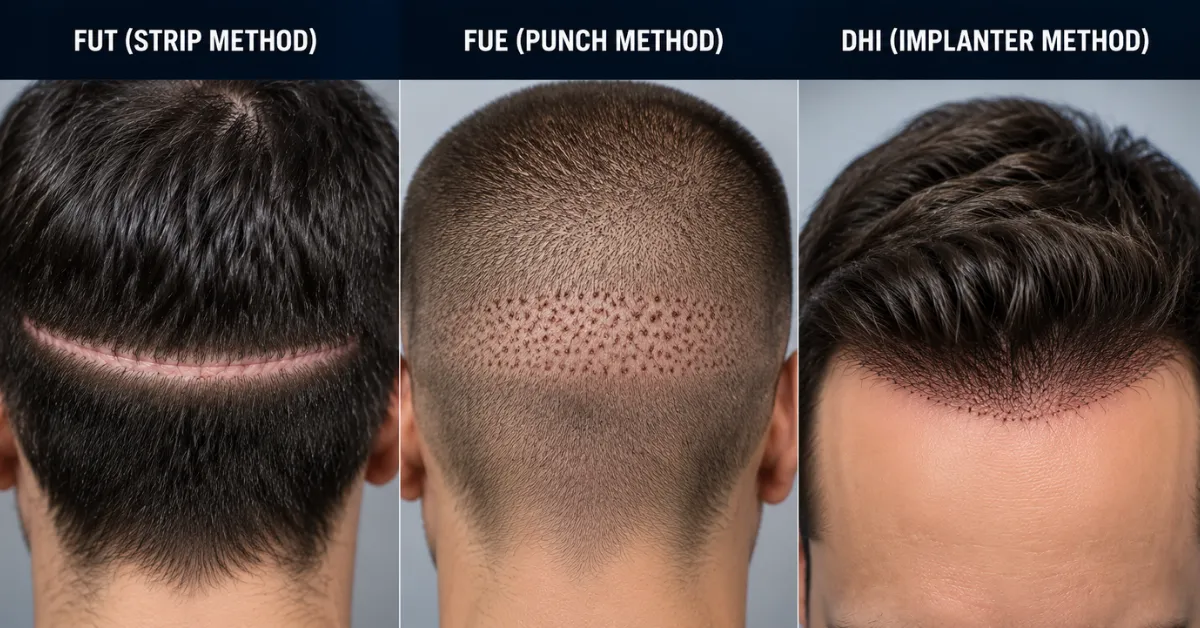
FUE involves extracting grafts one by one using a micro-punch. It leaves tiny dot marks rather than a linear scar. Because it is highly efficient and widely practiced, it often serves as the baseline price for most clinics.
FUT Hair Transplant Cost
FUT is the older "strip" method. The doctor removes a strip of skin from the back of your head, stitches it up, and dissects the hairs under a microscope. It leaves a linear scar. In some cases, it is slightly cheaper than FUE because the extraction phase is faster for the surgeon.
Hair Transplant Cost by Technique: FUE, FUT, DHI, and NeoGraft
DHI and NeoGraft Hair Transplant Cost
DHI typically uses an implanter pen to place extracted grafts into the recipient area, allowing implantation and placement to be performed in a more controlled sequence. Because this requires intense focus and extra time, it almost always costs more.
What about NeoGraft? NeoGraft is an automated, FDA-cleared system that assists surgeons during the FUE extraction process. Some clinics factor the equipment and licensing costs into their final per-graft pricing.
How a clinic decides to bill you changes your entire budget.
Hair Transplant Cost per Graft: How Pricing Is Calculated
Before comparing two hair transplant costs, make sure you know what the number actually means.
In some clinics, the price is the procedure as one complete package. But others may choose the price per graft and calculate the final bill after estimating how many grafts you need.
At first glance, comparing two clinics seems easy. But in practice, it isn't always that simple.
A lower price per graft model does not necessarily mean a lower total cost. Hidden costs after the procedure may surprise you. In a bad way.
On the other hand, a higher price does not automatically mean a better surgical procedure. For the total price, the number of grafts you need, the technique used, the surgeon's involvement, and what the clinic includes are important.
What Is Cost per Graft?
Most US and UK clinics charge by the graft. A single graft contains anywhere from 1 to 4 hairs. If a clinic charges $5 per graft, and you need 2,000 grafts, your surgery costs $10,000. It is simple math, but it gets incredibly expensive if you have severe baldness.
Turkey Hair Center POV: What a Responsible Clinic Should Tell You Before Giving a Price
We see patients constantly chasing the lowest per-graft price without understanding the medical plan. Before you hand over a credit card, a responsible clinic should evaluate your scalp and clearly explain:
Donor Assessment: Do you actually have enough hair to extract safely?
Expected Density: What will the final result look like based on your hair thickness?
Who is Operating: Does the doctor perform the extractions, or do they hand you off to a team?
Package Inclusions: Are hotel nights, meds, and aftercare included?
Don't fall into the trap of thinking a higher graft count is a better deal. Your donor area has a strict limit.
How Much Is Hair Transplant Surgery
When evaluating "hair transplant surgery," remember that you are paying for a certified medical procedure rather than a basic cosmetic treatment.
Calculating the cost of hair transplant surgery involves medical facility overhead, sterilization protocols, local anesthesia, specialized single-use instruments, and professional medical staffing. Clinics operating with ultra-low pricing may compromise on clinical supervision or facility standards. Correcting a compromised donor area or poor graft placement through revision surgery is far more complex and costly than investing in proper care initially.
How Much Do 3,000 and 5,000 Hair Grafts Cost?
The total price of a 3,000- or 5,000-graft procedure depends on several things. Like the clinic, surgeon, technique, location, and whether accommodation is included. But let's look at the prices under the magnifying glass.
How Much Do 3,000 Hair Grafts Cost?
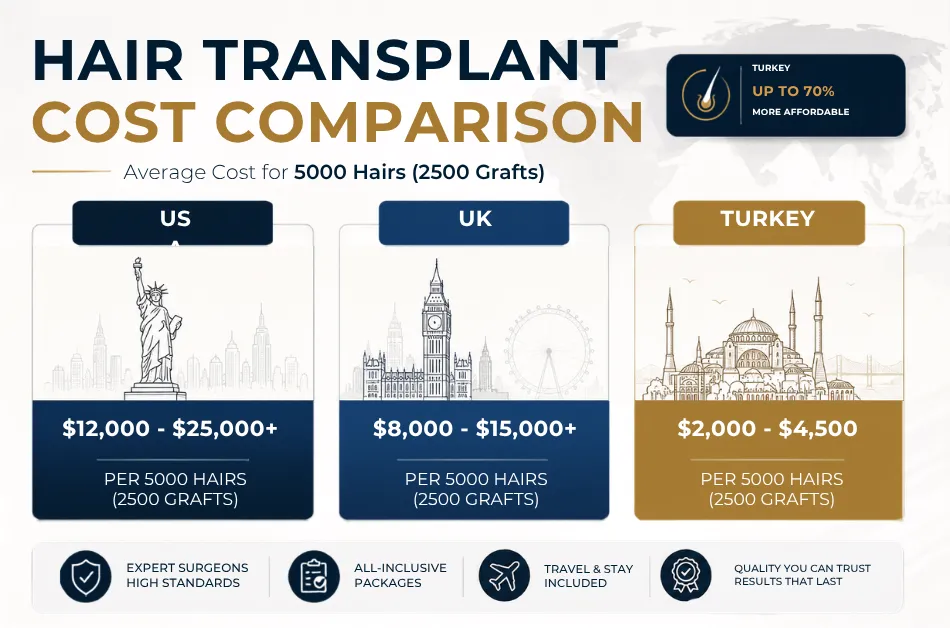
For many US clinics, a 3,000-graft hair transplant can cost around $12,000 - $18,000. But international package pricing may be substantially lower.
This number of grafts is suitable for a lot of patients. 3,000 grafts may be enough to address a receding hairline and areas of mid-scalp thinning. But not in every case. The number may be different depending on donor density and the treatment plan. For many patients, 3,000 grafts can be completed in a single session.
5,000 Grafts Hair Transplant Cost USA
A 5,000-graft procedure is a large session and may require staged treatment depending on the patient's donor supply, surgical plan, and clinical assessment. At $5 a graft in the US, you are looking at $25,000.
More grafts mean more hours in the operating chair, more anesthesia, and a larger team sorting the hair.
How Much Is a Hair Transplant Near Me?
A lot of patients jump on Google and type "hair transplant near me." But location plays a huge role in what you will pay.
Why Location Changes the Price
Renting a massive clinic space in Manhattan or Beverly Hills costs a fortune. The clinics have to cover those massive overhead costs, which means your surgery price goes up.
Average Cost by State or City
You might find a surgeon in Ohio charging $4 a graft, while a celebrity doctor in Los Angeles charges $8 or $10 a graft.
Don't pick a clinic just because it is a twenty-minute drive from your house. Look at their before-and-after portfolios. Read the reviews. Ask who actually performs the surgery.
How Much Is a Hair Transplant in USA vs Turkey?
When local quotes trigger serious sticker shock, looking across the border is usually the next move.
The cost gap is wild. Moving the exact same 3,000 grafts can cost three to four times more in the States than in Istanbul. But stacking a $12,000 US estimate next to a $3,000 Turkish package isn't an apples-to-apples comparison. You have to dissect what's baked into that number: from the surgeon’s actual hands-on time and clinic accreditation down to hotel stays, post-op washings, and airport pickups.
USA Hair Transplant Cost
American practices almost always bill per individual graft. That itemized pricing model makes large sessions painfully expensive fast. The tradeoff? Proximity. Paying top dollar keeps your surgeon close by if you want a face-to-face checkup three weeks in or have a late-night concern during early healing.
Turkey Hair Transplant Cost
Turkey flips the entire business model on its head. Instead of counting individual grafts onto the invoice, clinics bundle the procedure, hotel stay, prescription meds, and drivers into one fixed price. For most men traveling to Istanbul, the entire trip runs roughly $2,500 to $4,500, soup to nuts.
Which Option Offers Better Value?
Don't confuse a low price with good value. Plenty of high-end Turkish clinics offer exceptional medical standards and preserve your donor area responsibly for a fraction of Western costs. Just don't let cheap rates blind you: book based on verified surgeon credentials and long-term results, not flash sales.
Does Insurance Cover a Hair Transplant?
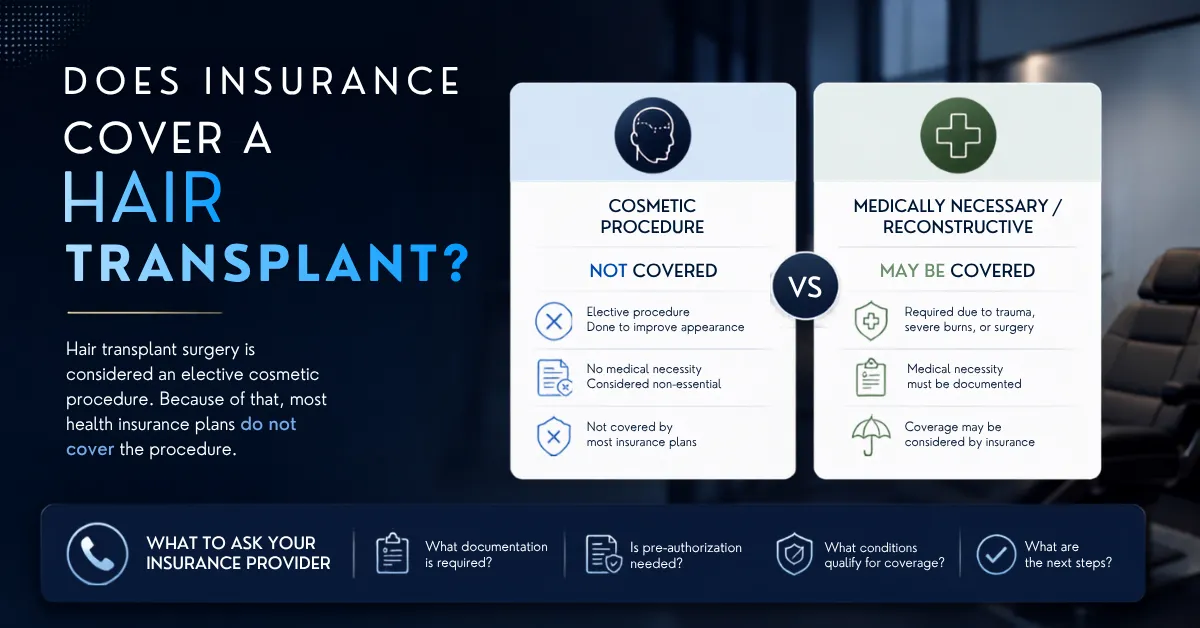
Hair transplant surgery is classified as an elective cosmetic procedure. Because of that, most health insurance plans do not cover the procedure. But if the patient's hair loss is the result of trauma, severe burns, or reconstructive surgery, coverage may be considered.
What to Ask Your Insurance Provider
If you think you have a medical case, get on the phone. Ask your provider what specific documentation they need from your doctor to even consider covering a hair restoration claim. Get everything in writing.
How Can You Pay for a Hair Transplant?
Dropping a massive sum in cash isn't realistic for everyone.
Financing and Monthly Payment Plans
Many clinics partner with financing companies so you can break the amount into manageable monthly payments over a year or two. Services like CareCredit are incredibly popular in the US for this exact reason.
Is the Cheapest Option Ever Worth It?
Honestly? No. Please don’t take out a loan for a botched surgery simply because the monthly installments caught your eye. Hunting for basement-level prices often lands patients in unhygienic clinics, leaving them with nasty scalp infections and permanently scarred hairlines.
Is a Hair Transplant Worth It at 25?
We get this question all the time. Young patients panic when they see their hairline slipping.
Getting surgery at 25 can be risky. If your hair loss hasn't stabilized, building a perfect new hairline today might leave you with an unnatural bald gap a decade later as your native hair continues to thin.
A good surgeon will often tell a 23-year-old to hold off. You need to see exactly what pattern your baldness is taking before you start moving finite donor hair around. Before rushing into the operating room, young patients should look at stabilizing their hair first.
Possible Side Effects and Recovery After a Hair Transplant
Let's not sugarcoat it: this is still surgery, meaning your scalp needs a minute to bounce back. The upside? The downtime isn't nearly as brutal as most guys fear.
Expect your head to look a bit beat up at first with some redness, swelling, and scabbing. You'll likely even deal with temporary shedding (which is terrifying but normal). Just remember that the person staring back at you in the mirror at week two is nowhere near the final result. Healing takes patience.
Common Side Effects
Don't panic if your forehead balloons up for a couple of days: that's just the anesthetic working its way out. You’ll also deal with some annoying itching and maybe weird numbness, but those ugly scabs generally wash away within a week or so.
Recovery Timeline
After around the first month, some of the newly transplanted hair may suddenly fall out. This situation is expected. It's called ''shock loss''. Most patients freak out when it happens. But it's just part of the normal healing process. But if your shedding feels extreme or your scalp looks sore, call your doctor.
The most frequently asked question is: When can I get back to real life? Desk workers usually flip their laptops back open in about three days. But when we talk about the gym, patients need to pause the heavy lifting for at least a full month.
How Long Do Hair Transplants Last for Men?
In a hair transplant procedure, patients' hair follicles are harvested from the donor area, which is the back or sides of the head. The donor area has genetically programmed hair follicles that resist balding. So they usually stick around for the long haul.
What Happens After 1 Year?
After the 12-month mark, patients' new hair usually settles in and matures. It blends with native hair follicles. So you can finally hit the barbershop for whatever fade or cut you've been missing out on.
What Happens 20 Years After a Hair Transplant?
There is a drawback here. Your new transplanted hair follicles are DHT (balding hormone) resistant. But your native hair might still thin or fall out. Over the years, patients can notice new bald patches forming directly behind their transplant. If that happens, you might need minor touch-up surgery.
What Are the Best Alternatives to a Hair Transplant?
If you're not ready to go under a surgical procedure, here's some good news. Surgery isn't the only fix out there, and for some patients, it shouldn't even be step one. Maybe you just want to hit the brakes on your current shedding, or maybe a doctor told you your donor hair is too weak to harvest. Finding the right alternative really boils down to how far your hair loss has progressed and what you're comfortable doing every single day.
Finasteride and Minoxidil
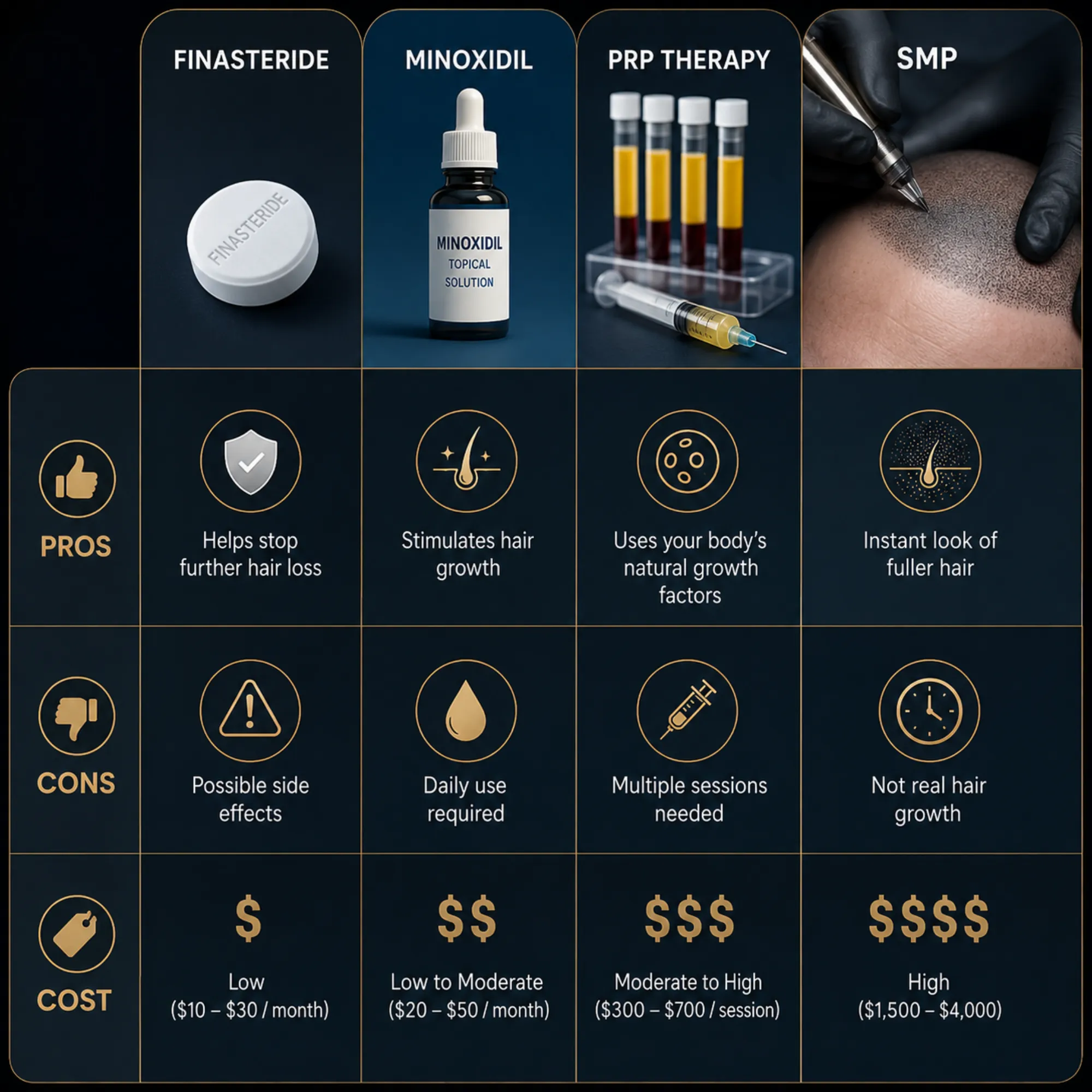
These are the heavy hitters of the hair loss world. Dermatologists heavily lean on Minoxidil and Finasteride to freeze further thinning and protect the hair you still have. Just keep in mind that they only work for as long as you use them.
Medical Disclaimer: Talk to a healthcare pro first, as both drugs come with a list of potential side effects you need to know about.
PRP, Laser Therapy and Scalp Micropigmentation
PRP injects your own growth factors into your scalp to support hair health. Scalp Micropigmentation (SMP) is basically a high-end medical tattoo that mimics the look of a buzzed head.
If your donor area is completely gone, a modern hair system (a high-quality custom wig) can be an effective non-surgical option to get a full head of hair instantly.
Is There a Cure for Genetic Hair Loss? (What to Expect in 2026)
We all want a magic pill. But is it coming?
Right now, the industry is incredibly good at slowing down hair loss and surgically restoring what is gone. But a single-shot "cure" that permanently reverses genetics does not exist on the commercial market in 2026.
Researchers are doing amazing things with stem cells and hair cloning. It is exciting stuff. But realistically, managing hair loss today means relying on the proven medical and surgical treatments we already have.
How to Choose the Right Hair Transplant Clinic for Your Budget
For choosing the right clinic, there are so many important details before the price tag. Before paying any money, here is what you need to verify:
Surgeon Experience: Ask exactly who is performing the surgery. Does the doctor make the incisions? Or do they hand you off to a team and leave the room?
Before-and-After Photos: Are they showing you results from a full year later? Or just photos from the day after the surgery when everything looks dense but hasn't grown yet?
Transparent Pricing: A trustworthy clinic hands you a locked-in quote on paper. And they walk you through their exact policy for botched results or necessary repairs.
Final Verdict: How Much Should You Really Budget for a Hair Transplant?
Stop looking for one magic number, because it just doesn't exist. To recap your options:
USA: Expect to spend between $4,000 and $15,000.
Turkey: A solid all-inclusive package runs about $2,500 to $4,500.
3,000 grafts: Your cost hinges entirely on whether your clinic charges per graft or by the package.
5,000 grafts: This is major territory. It demands expert donor planning and might even take two separate surgeries.
Insurance: You're footing the bill yourself.
At the end of the day, the lowest price tag should never be your deciding factor. What actually matters is figuring out exactly how many grafts you need and finding a surgical team capable of moving them without ruining your scalp. Put your energy into finding an honest clinic that cares about your long-term results, not just getting you into the chair.
About the Author
Nazmi G. has hands-on experience in non-surgical trichological evaluation, structural graft distribution planning, and international patient consultation. His focus centers on donor area management and guiding patients through transparent, evidence-based treatment plans. He regularly contributes to patient education initiatives regarding hair preservation strategies and ethical medical travel.
Medical Review Note
This article was medically reviewed for clinical accuracy by Dr. Tompi, M.D. Dr. Tompi is a board-certified plastic and aesthetic surgeon, specializing in facial reconstruction and advanced FUE/DHI surgical protocols. The clinical review verified the accuracy of graft estimate ranges, donor preservation guidelines, recovery timelines, and patient safety compliance.
Disclaimer: This content is intended for educational purposes and does not replace a formal, in-person medical diagnosis or individualized treatment plan.
Editorial Policy & Trust
Turkey Hair Center believes in total pricing transparency. We do not support deceptive marketing practices, "unlimited graft" guarantees, or hiding fees from patients. The pricing estimates provided in this guide reflect current industry averages and may shift based on individual clinical assessments.
International Society of Hair Restoration Surgery (ISHRS): 2024 Practice Census Results American Academy of Dermatology (AAD): Hair Loss: Diagnosis and Treatment National Center for Biotechnology Information (NCBI) / PubMed: Follicular Unit Extraction Hair Transplant Cleveland Clinic: Hair Transplant: Procedure, Recovery & Results
Medical disclaimer: This article is for informational purposes only and is not medical advice. Individual results vary from person to person. Always consult a qualified doctor before any hair transplant procedure.
Donor Assessment: Do you actually have enough hair to extract safely?
Who is Operating: Does the doctor perform the extractions, or do they hand you off to a team?
Package Inclusions: Are hotel nights, meds, and aftercare included?
Don't fall into the trap of thinking a higher graft count is a better deal. Your donor area has a strict limit.
How Much Is Hair Transplant Surgery
When evaluating "hair transplant surgery," remember that you are paying for a certified medical procedure rather than a basic cosmetic treatment. Calculating the cost of hair transplant surgery involves medical facility overhead, sterilization protocols, local anesthesia, specialized single-use instruments, and professional medical staffing. Clinics operating with ultra-low pricing may compromise on clinical supervision or facility standards. Correcting a compromised donor area or poor graft placement through revision surgery is far more complex and costly than investing in proper care initially.
How Much Do 3,000 and 5,000 Hair Grafts Cost?
The total price of a 3,000- or 5,000-graft procedure depends on several things. Like the clinic, surgeon, technique, location, and whether accommodation is included. But let's look at the prices under the magnifying glass.
Why Location Changes the Price
Renting a massive clinic space in Manhattan or Beverly Hills costs a fortune. The clinics have to cover those massive overhead costs, which means your surgery price goes up.
Average Cost by State or City
You might find a surgeon in Ohio charging $4 a graft, while a celebrity doctor in Los Angeles charges $8 or $10 a graft. Don't pick a clinic just because it is a twenty-minute drive from your house. Look at their before-and-after portfolios. Read the reviews. Ask who actually performs the surgery.
How Much Is a Hair Transplant in USA vs Turkey?
When local quotes trigger serious sticker shock, looking across the border is usually the next move. The cost gap is wild. Moving the exact same 3,000 grafts can cost three to four times more in the States than in Istanbul. But stacking a $12,000 US estimate next to a $3,000 Turkish package isn't an apples-to-apples comparison. You have to dissect what's baked into that number, from the surgeon's actual hands-on time and clinic accreditation down to hotel stays, post-op washings, and airport pickups.
USA Hair Transplant Cost
American practices almost always bill per individual graft. That itemized pricing model makes large sessions painfully expensive fast. The tradeoff? Proximity. Paying top dollar keeps your surgeon close by if you want a face-to-face checkup three weeks in or have a late-night concern during early healing.
Turkey Hair Transplant Cost
Turkey flips the entire business model on its head. Instead of counting individual grafts onto the invoice, clinics bundle the procedure, hotel stay, prescription meds, and drivers into one fixed price. For most men traveling to Istanbul, the entire trip runs roughly $2,500 to $4,500, soup to nuts.
Final Verdict: How Much Should You Really Budget for a Hair Transplant?
Stop looking for one magic number, because it just doesn't exist. To recap your options:
USA: Expect to spend between $4,000 and $15,000.
Turkey: A solid all-inclusive package runs about $2,500 to $4,500.
3,000 grafts: Your cost hinges entirely on whether your clinic charges per graft or by the package.
5,000 grafts: This is major territory. It demands expert donor planning and might even take two separate surgeries.
Insurance: You're footing the bill yourself.
What does recovery look like?
Short answer
Expect your head to look a bit beat up at first with some redness, swelling, and scabbing. You'll likely even deal with temporary shedding (which is terrifying but normal). Just remember that the person staring back at you in the mirror at week two is nowhere near the final result. Healing takes patience.
Let's not sugarcoat it, this is still surgery, meaning your scalp needs a minute to bounce back. The upside? The downtime isn't nearly as brutal as most guys fear.
How Much Is a Hair Transplant? Cost: frequently asked questions
Who Is a Candidate?
Of course, not every candidate is suitable for this surgical solution. The patient has to have plenty of thick donor hair and a stabilized hair loss pattern. While we often talk about male pattern baldness, women get hair transplants too. This procedure little bit different than men. Because female hair thinning tends to be more spread out rather than receding at the hairline like it often does in men. But the basic surgical principles are the same for both.
Who Is Not a Good Candidate?
If a patient's hair loss is still progressing rapidly or the donor area does not have enough density, a transplant may not be the safest or most effective way to get hair back. A good surgeon will explain when donor supply is insufficient to achieve a natural and sustainable result. Medical Disclaimer: Surgical candidacy can only be determined with a qualified medical professional.
What Is Cost per Graft?
Most US and UK clinics charge by the graft. A single graft contains anywhere from 1 to 4 hairs. If a clinic charges $5 per graft, and you need 2,000 grafts, your surgery costs $10,000. It is simple math, but it gets incredibly expensive if you have severe baldness.
How Much Do 3,000 Hair Grafts Cost?
For many US clinics, a 3,000-graft hair transplant can cost around $12,000-$18,000. But international package pricing may be substantially lower. This number of grafts is suitable for a lot of patients. 3,000 grafts may be enough to address a receding hairline and areas of mid-scalp thinning. But not in every case. The number may be different depending on donor density and the treatment plan. For many patients, 3,000 grafts can be completed in a single session. 5,000 Grafts Hair Transplant Cost USA A 5,000-graft procedure is a large session and may require staged treatment depending on the patient's donor supply, surgical plan, and clinical assessment. At $5 a graft in the US, you are looking at $25,000. More grafts mean more hours in the operating chair, more anesthesia, and a larger team sorting the hair. How Much Is a Hair Transplant Near Me? A lot of patients jump on Google and type "hair transplant near me." But location plays a huge role in what you will pay.
Which Option Offers Better Value?
Don't confuse a low price with good value. Plenty of high-end Turkish clinics offer exceptional medical standards and preserve your donor area responsibly for a fraction of Western costs. Just don't let cheap rates blind you, book based on verified surgeon credentials and long-term results, not flash sales.
Is the Cheapest Option Ever Worth It?
Honestly? No. Please don't take out a loan for a botched surgery simply because the monthly installments caught your eye. Hunting for basement-level prices often lands patients in unhygienic clinics, leaving them with nasty scalp infections and permanently scarred hairlines.
What Happens 20 Years After a Hair Transplant?
There is a drawback here. Your new transplanted hair follicles are DHT (balding hormone) resistant. But your native hair might still thin or fall out. Over the years, patients can notice new bald patches forming directly behind their transplant. If that happens, you might need minor touch-up surgery.
How much is a hair transplant?
If you look at the global market, you'll see numbers bouncing anywhere from $2,000 all the way up to $15,000. Why such a massive difference? It mostly comes down to your location and the clinic's billing style. Surgeons in the West generally count and charge you for every single graft they move. Meanwhile, popular overseas destinations tend to offer one flat rate for the entire procedure.
How much does a hair transplant cost in the USA?
For patients staying in the US, expect your total bill to land somewhere between $4,000 and $15,000. American doctors almost always price things by the individual hair follicle, charging roughly $4 to $10 a pop. So, if you only need a quick hairline touch-up, you'll stay on the lower end of that spectrum. But if you have significant thinning to cover? You can easily hit five figures.
How much is a hair transplant in the USA vs Turkey?
Let's look at a standard, middle-of-the-road procedure. In the US, just the surgery itself will often set you back more than $10,000. Take that exact same procedure to Turkey, and the total cost shrinks to between $2,500 and $4,500. The biggest difference here is that the Turkish price tag typically covers your hotel stay and airport transfers, rather than just the time in the chair.
How much do 3,000 hair grafts cost?
If you choose a clinic that charges by the graft (which is the standard approach in the US and the UK), a 3,000-graft surgery will run you roughly $12,000 to $18,000. On the flip side, if you visit an all-inclusive clinic that uses package pricing, that same 3,000-graft session is simply covered under their standard flat fee.
How much does a 5,000-graft hair transplant cost in the USA?
It's an enormous undertaking. In an American clinic, pushing 5,000 grafts can easily blow past $20,000. And this kind of large session usually takes a couple of days to finish safely.
Does insurance cover hair transplant?
Almost never. Unless your hair loss stems from a severe burn or accident, insurance companies write this off as a cosmetic luxury.
How much is a hair transplant near me?
Your zip code dictates your invoice. A flashy clinic paying Beverly Hills rent has to charge way more than a humble setup in Ohio just to keep the lights on.
What is the cheapest hair transplant in the USA?
You'll usually spot bargain-basement prices at massive corporate chain clinics. But honestly? Bargain hunting for surgery is a terrible idea and often ends in a highly visible, unnatural hairline.
How much is a hair transplant for women?
The core pricing model is practically identical to men's. However, since most women refuse to shave their entire head for the procedure, clinics might tack on a slight premium for the tricky extraction process.
Is a hair transplant worth it at 25?
If your hairline is still receding and your hair's constantly falling out, many surgeons will recommend waiting. But if you take the risk and have the surgery now, it might leave an embarrassing gap between your new transplanted hair and your fading native hair in the following years.
How long do hair transplants last for men?
In a hair transplant procedure, surgeons collect follicles from your donor area, which is the back and sides of your head. For this zone, hair follicles are DHT-resistant. So those specific hairs are generally expected to last a very long time.
What happens 20 years after a hair transplant?
The transplanted hairs stay rooted, but your original hair might keep thinning out. It's super common for older men to grab a minor touch-up procedure later in life to keep things looking thick.
What is the best treatment for hair loss in men?
The best treatment is a personal one. Your scalp health and hair loss stage determine your path. Most experienced doctors suggest combining two approaches. To fill the dead zones: hair transplant. For protecting your native hair: medications like Finasteride or Minoxidil.
Sources and medical review
The clinical statements on this page draw on the following published literature and professional body guidance:
Send three photos: front, top and sides. You get a technique recommendation, a graft range and a straight answer about what is achievable, before anyone talks about price.
Your details are with the team
A patient coordinator will get back to you shortly. If you would like to send your photos now, WhatsApp is the fastest way to do it.
We respond quickly, day or night, in your language.
Multilingual team, no obligation
Data protectedKVKK and GDPR compliant, 100% confidential
Authorized Health Tourism Intermediary
Turkey Hair Center is the hair-restoration brand of Healthy Way Tourism, an authorized international health-tourism intermediary. All medical procedures are performed by licensed medical professionals at authorized healthcare facilities in Turkiye, in accordance with the regulations of the Ministry of Health.