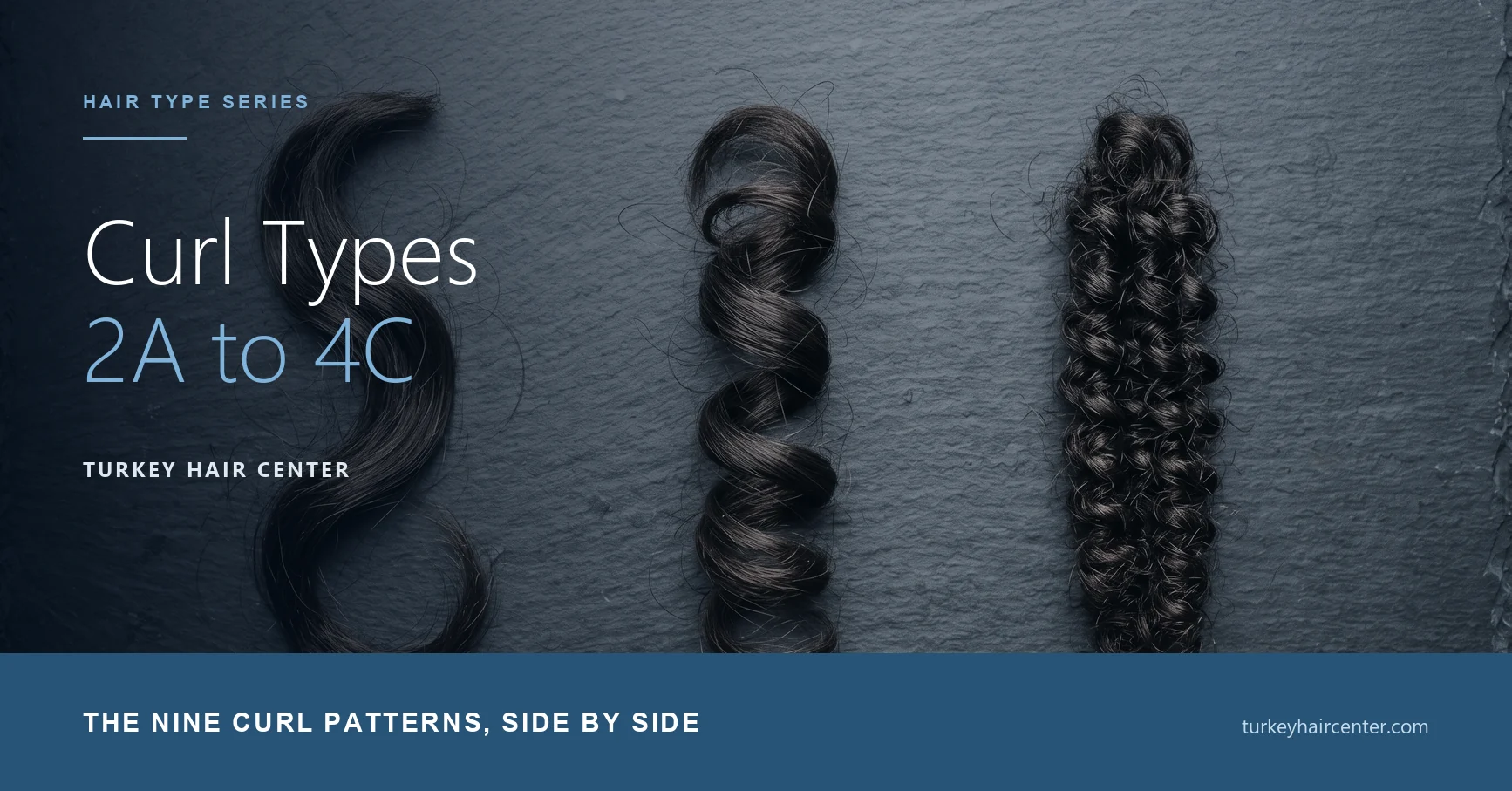
There are nine curl patterns: 2A, 2B and 2C for waves; 3A, 3B and 3C for curls; and 4A, 4B and 4C for coils. The number describes how tight the pattern is and the letter describes how wide each individual curl is, 2A being the loosest S-wave and 4C the tightest zig-zag.
Straight hair (type 1) has no pattern at all and is not part of the curl scale.
Curl Types Explained: The 9 Curl Patterns From 2A to 4C Medical Reviewed By Dr. Tompi, M.D: Plastic & Aesthetic Surgeon
Written By Nazmi G, Trichologist
There are nine curl patterns: 2A, 2B and 2C for waves; 3A, 3B and 3C for curls; and 4A, 4B and 4C for coils. The number describes how tight the pattern is and the letter describes how wide each individual curl is: 2A being the loosest S-wave and 4C the tightest zig-zag. Straight hair (type 1) has no pattern at all and is not part of the curl scale.
Curl is not decided by the strand itself but by the follicle underneath the scalp. A round follicle pushes hair straight out; the more oval and hooked the follicle, the more the strand is forced to bend as it grows. That is why curl pattern is genetic and why it can shift when something changes the follicle: hormones, chemotherapy, age.
Pattern
Shape
Width reference
Shrinkage
Defining problem
2A
Barely-there S, starts below the ear
Wider than a soft-drink can
Almost none
The wave drops out within hours
2B
Clear S from mid-length, flat roots
Soft-drink can
Slight
Frizz through the mid-lengths
2C
Waves from the root, first spirals appear
Wine bottle neck
Noticeable
Unpredictable: half wave, half curl
3A
Large, loose, springy loops
Wine cork
Around a quarter
Loses definition, tangles
3B
Tight ringlets with real volume
Marker pen
Around a third
Dryness through the ends
3C
Dense corkscrews packed together
Pencil
Up to half
Breakage where curls interlock
4A
Defined S-shaped coils
Crochet needle
Half or more
Severe dryness
4B
Sharp Z-shaped bends, not round
Ballpoint pen refill
Half to three quarters
Breaks at the angles
4C
Tightest zig-zag, little visible pattern dry
Thread
Up to three quarters
Fragility and tension damage
This page covers the curly half of the scale. For the full system including straight hair, see the complete hair type chart from 1A to 4C; for the property that decides which products absorb, see hair porosity.
How to identify your curl pattern
Type your hair clean, product-free and air-dried. Brushing, heat or styling product will move you a full step in the wrong direction, and mistyping is the most common reason a “correct” curly routine fails.
Wash and leave it completely alone. No scrunching, no plopping, no brushing, no product. Let it dry untouched.
Isolate one curl. Pull a single curl away from the rest and look at its shape against a plain background: not at the overall head of hair.
Match the width, not the volume. Hold an everyday object beside the curl using the table above. This is what separates 3A from 3B from 3C.
Check three areas. Crown, nape and hairline. Most people differ by a step between them; the hairline is almost always the loosest section.
Volume is not pattern. The single most frequent typing mistake is calling dense 2A hair “type 3” because the head of hair looks big. Density is how many strands you have; pattern is the shape of one strand. Type the strand.
Type 2: the wave family (2A, 2B, 2C)
Waves sit on the border between straight and curly, which makes type 2 the most frequently mistyped family in both directions. Brushed dry it passes for straight; scrunched with product it passes for curly. The follicle is oval rather than flattened, so the bend is gentle and the strand lies closer to the head.
The signature problem is a flat root with a frizzy middle. Fixing it happens at the drying stage, not with product applied afterwards.
Weight is the enemy. Creams and butters collapse a wave. Light gels, mousses and salt sprays hold it.
2C is the crossover point. If genuine spirals appear at the root, treat it as type 3 for moisture and type 2 for weight.
Full type 2 wavy hair guide ›
Type 3: the curl family (3A, 3B, 3C)
Here the follicle is properly flattened and the strand forms closed loops. Because an elliptical strand does not let sebum travel down it, type 3 produces the characteristic contradiction of an oily scalp with dry ends on the same head.
Definition is built while wet and destroyed while drying. Apply product to soaking-wet hair, squish rather than rake, then do not touch it again until it is bone dry.
The cast is the point. Gel dries into a hard shell that protects the curl shape; breaking that cast by scrunching once dry releases soft, defined curls. Skipping the cast produces frizz.
3C is where shrinkage becomes a planning issue. Hair can read four inches shorter dry than it measures wet, which changes how it should be cut.
Full type 3 curly hair guide ›
Type 4: the coil family (4A, 4B, 4C)
The flattest follicles and the tightest patterns. Every bend is a point where the cuticle lifts slightly, and every lifted point is a weak spot: which makes type 4 structurally the most fragile of all patterns despite frequently feeling the most robust. That mismatch is why it is so often handled far more roughly than it can take.
Shrinkage of half to three quarters is normal. Stretch a strand before assuming length has been lost; shrinkage is elasticity, not breakage.
4C is a pattern, not an absence of one. The zig-zag is simply too tight to read dry. It appears clearly when the hair is wet or has product in it.
Detangle only when soaking wet and saturated with conditioner, in small sections, from the ends upwards. Dry detangling is the single biggest cause of length loss.
Tension is the real danger. Protective styles help, but a style that pulls at the hairline is the mechanism behind traction alopecia: one of the few genuinely preventable forms of hair loss.
Full type 4 coily hair guide ›
Why curls lose their pattern
A curl that used to spring and now hangs limp has usually lost the internal structure that held it. The disulphide bonds inside the strand are what set the shape; break enough of them and the curl relaxes permanently.
Heat. Repeated straightening at high temperature causes heat damage that does not reverse. The curl comes back only with new growth.
Chemical services. Relaxers and keratin treatments break those bonds deliberately. Bleach damages them as a side effect.
Protein and moisture imbalance. Too much moisture with no protein gives limp, over-elastic curls; too much protein gives stiff, snapping ones. This kind of loosening is reversible.
Build-up. Silicones and heavy oils weigh curls into looseness. A clarifying wash restores them.
Hormonal change. Puberty, pregnancy and menopause routinely shift patterns by a full step in either direction: genuine change at the follicle, not damage.
Which loosening is permanent? If a clarifying wash and a protein treatment bring the curl back within two or three washes, it was build-up or imbalance. If the pattern stays limp on that length no matter what, the bonds are broken and only new growth will carry the original curl.
Curl pattern and hair transplants
Curl pattern changes the operation itself, which is why an assessment should ask about it rather than treating every scalp identically. In curly and coily hair the follicle curves beneath the skin, so the angle you see on the surface does not tell you the angle of the root below.
Extraction has to follow the curve. A punch driven straight down risks cutting through a curved follicle, which is why type 3 and type 4 hair calls for a surgeon experienced specifically in textured hair.
Coverage per graft differs. A coil shades more visible scalp than a straight strand of the same length, so coverage planning is not one graft-count formula applied across every pattern.
Hairline design changes with pattern. A hairline that reads as natural on straight hair will not read the same way on 4B, because the way the pattern clusters and casts shadow is different.
The specialist considerations for Afro-textured hair are set out in our Afro hair transplant guide, and the differences for East and South Asian hair in our guide to hair transplant considerations for Asian hair types.
Note on medical information. This page explains curl patterns and general hair care. It is not a diagnosis and not a promise of any particular result. Whether a hair transplant suits you can only be established in a personal assessment with a qualified doctor.
Medical disclaimer: This article is for informational purposes only and is not medical advice. Individual results vary from person to person. Always consult a qualified doctor before any hair transplant procedure.
Curl Types Explained: frequently asked questions
How many curl types are there?
Nine: 2A, 2B, 2C for waves, 3A, 3B, 3C for curls and 4A, 4B, 4C for coils. Type 1 is straight hair and has no curl pattern, which is why the curl scale starts at 2.
What is the difference between 3C and 4A?
Width and spring. A 3C corkscrew is roughly the width of a pencil and forms a rounded spiral; a 4A coil is nearer the width of a crochet needle and holds a tighter, more compressed S. 4A also shrinks considerably more.
Can I have more than one curl type?
Almost everyone does. A step of difference between crown, nape and hairline is normal. Work with your loosest pattern when choosing a cut and your tightest when planning moisture.
Why does my curl pattern look different when it is wet?
Water weighs hair down and stretches the pattern out, so wet hair reads looser and longer. Your true pattern is what you see once it has dried untouched, and the difference between the two is your shrinkage.
Is 4C hair the same as having no curl pattern?
No. 4C has the tightest pattern of all, so tight that it is difficult to see when dry. Wet the hair or apply product and the zig-zag becomes clearly visible.
Can straightening permanently ruin my curls?
Repeated high heat can, yes. Once the disulphide bonds are broken the curl does not return to that length, and only new growth will carry the original pattern. Occasional straightening with heat protection and a moderate temperature is far less likely to cause it.
Which curl type is the most fragile?
4B and 4C. Sharp angles concentrate stress at each bend, so coily hair snaps more readily than looser patterns even when it feels thick and strong.
Does curl type affect how fast hair grows?
Growth at the follicle is broadly similar across patterns. Coily hair appears to grow more slowly because shrinkage hides the length and because breakage at the ends removes it as quickly as it arrives, a retention problem rather than a growth problem.
Send three photos: front, top and sides. You get a technique recommendation, a graft range and a straight answer about what is achievable, before anyone talks about price.
Your details are with the team
A patient coordinator will get back to you shortly. If you would like to send your photos now, WhatsApp is the fastest way to do it.
We respond quickly, day or night, in your language.
Multilingual team, no obligation
Data protectedKVKK and GDPR compliant, 100% confidential
Authorized Health Tourism Intermediary
Turkey Hair Center is the hair-restoration brand of Healthy Way Tourism, an authorized international health-tourism intermediary. All medical procedures are performed by licensed medical professionals at authorized healthcare facilities in Turkiye, in accordance with the regulations of the Ministry of Health.