Performed at authorized partner hospitals Turkey Hair Center is a Ministry of Health authorized health-tourism intermediary, not a clinic.
This page sets out the eligibility criteria surgeons actually apply, how the four main procedures differ, what the published cost ranges include, and the lifelong follow-up that determines whether surgery works.
Authorized institutionsLicensed hospitals with intensive care on site
Specialist surgeonsProcedures performed by licensed bariatric surgeons
Structured follow-upDietitian guidance and scheduled reviews
The short answer
bariatric surgery is generally considered from a body mass index of 40, or from 35 when an obesity-related condition such as type 2 diabetes, sleep apnoea or hypertension is present. Most patients stay 7 to 10 days in Türkiye, with 2 to 4 of those in hospital. Publicly published all-inclusive package prices in 2026 range broadly from 3,200 to 6,000 US dollars, against roughly 9,000 to 27,000 in the United States. Surgery is a tool, not a cure, the outcome depends on the dietary and vitamin regimen that follows it for life.
Who qualifies for bariatric surgery
Eligibility is not a formality to be worked around. Surgeons apply criteria because operating on the wrong patient produces harm rather than benefit, and because the procedures are irreversible in the case of sleeve gastrectomy.
Situation
Body mass index
Usual position
Obesity without related conditions
40 and above
Generally eligible for assessment
Obesity with a related condition
35-39.9
Generally eligible where type 2 diabetes, sleep apnoea, hypertension or joint disease is present
Metabolic indication
30-34.9
Considered case by case, usually where diabetes is poorly controlled despite treatment
Below 30
Under 30
Not a surgical candidate
Assessment also covers
documented previous attempts at supervised weight management;
cardiac, respiratory and endoscopic evaluation before anaesthesia is approved;
psychological readiness, including eating patterns such as binge eating that surgery alone does not resolve;
a realistic understanding that vitamin supplementation and follow-up continue permanently.
A clinic that skips the assessment is not saving you time If no one asks about your medical history, your medications, your previous weight-loss attempts or your mental health before offering you a surgery date, that is not efficiency. Pre-operative assessment exists because bariatric surgery has real complication rates and because some patients are safer with a different treatment entirely.
The four procedures, and how they differ
Patients often arrive having decided on a procedure from what they read online. The decision belongs to the surgeon and depends on your body mass index, your existing conditions, prior abdominal surgery and reflux history.
Procedure
What is done
Reversible
Hospital stay
Typically considered for
Sleeve gastrectomy
Around 75-80% of the stomach is removed, leaving a narrow tube
No
2-3 nights
The most commonly performed option across a broad range of cases
Gastric bypass (Roux-en-Y)
A small pouch is created and connected further along the small intestine
Technically reversible, rarely reversed
3-4 nights
Higher body mass index, type 2 diabetes, significant reflux
Mini gastric bypass
A single-anastomosis variant of the bypass
Technically reversible
3-4 nights
Shorter operating time; suitability discussed case by case
Gastric balloon
A balloon placed endoscopically, removed after 6-12 months
Yes, by design
Day case
Lower body mass index, or as a bridge before surgery
Reflux is the detail that changes the plan Sleeve gastrectomy can worsen existing gastro-oesophageal reflux, while bypass often improves it. If you have significant reflux, expect it to influence the recommendation, and be cautious of any plan that ignores it. This is one of the clearest examples of why the endoscopy before surgery is not a formality.
What it costs, and what a package should contain
Published package prices for bariatric surgery in Türkiye in 2026 generally fall between 3,200 and 6,000 US dollars. The figure varies with the procedure, the hospital and what the package covers.
Procedure
Türkiye (published 2026 ranges)
United States
United Kingdom (private)
Sleeve gastrectomy
$3,200 - $4,500
$9,000 - $18,000
£8,000 - £11,000
Gastric bypass
$4,000 - $6,000
$15,000 - $27,000
£10,000 - £15,000
Mini gastric bypass
$3,800 - $5,500
$14,000 - $22,000
£9,000 - £13,000
Gastric balloon
$1,800 - $3,000
$6,000 - $9,000
£4,000 - £6,000
Source: package prices published by Turkish hospitals and international medical travel platforms, August 2026. Indicative context, not a quotation.
A complete package should name
Surgeon, anaesthetist and operating theatre costs
Hospital nights included, and the nightly rate if recovery needs longer
Pre-operative blood work, endoscopy and cardiac clearance
Intensive care availability on site, and whether its use is covered
Hotel nights, airport transfers and interpreter
Dietitian consultation and the written post-operative diet plan
Scheduled remote follow-up after you return, and for how long
Costs that continue after the package ends
lifelong vitamin and mineral supplementation, typically 20 to 60 US dollars a month;
periodic blood tests, usually at 3, 6 and 12 months and annually thereafter;
dietetic support during the first year, which materially affects the result;
possible body-contouring surgery later, which is a separate decision and a separate cost.
The cost most packages do not mention Vitamin deficiency after bariatric surgery is common, preventable and serious when ignored. B12, iron, calcium, vitamin D and folate need monitoring for life. Any presentation of bariatric surgery that treats supplementation as optional is describing a procedure, not a treatment pathway.
The pathway, step by step
Eligibility review
Height, weight, medical history, medications and previous weight-management attempts are reviewed against the criteria above.
Pre-operative tests
Blood work, endoscopy, cardiac and respiratory assessment. Some findings change the recommended procedure; some postpone surgery.
Procedure decision
The surgeon recommends a procedure and explains why that one rather than the alternatives, including what it rules out later.
Pre-operative diet
A liver-shrinking diet for roughly two weeks before surgery. This is not optional; it directly affects how safely the operation can be performed.
Surgery and hospital stay
Laparoscopic surgery at an authorized institution, followed by 2 to 4 monitored nights with mobilisation beginning the first day.
Structured aftercare
A staged diet plan, a supplement regimen, a blood-test schedule and named contacts for the months that follow.
Recovery and the diet stages that follow
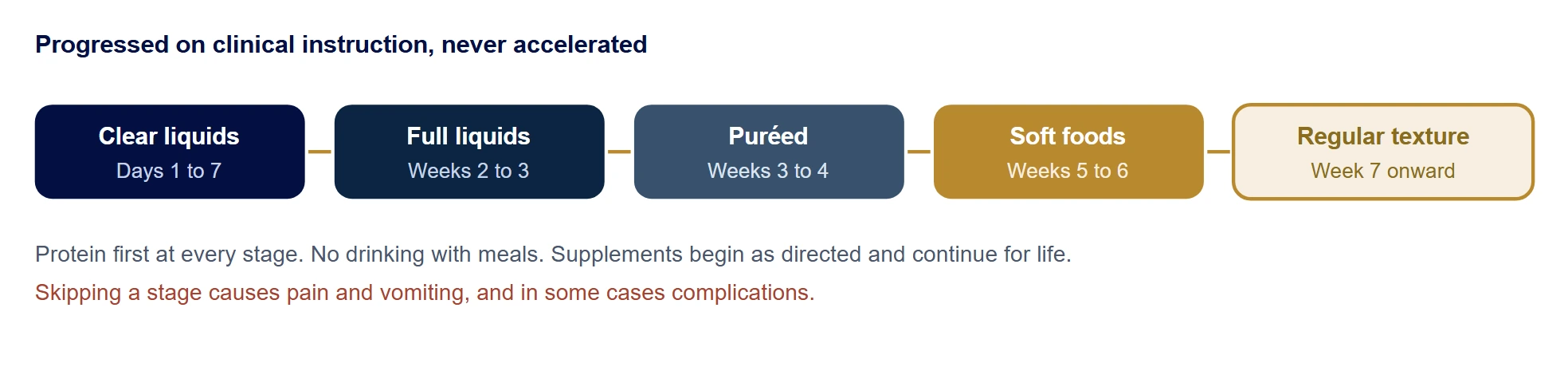
The post-operative diet is progressed in stages so the staple line heals and the stomach adapts. Skipping stages causes pain, vomiting and, in the worst cases, complications.
The post-operative diet, stage by stage
Stage
Period
What you consume
Purpose
Clear liquids
Days 1-7
Water, clear broth, sugar-free fluids in small sips
Protect the healing staple line and maintain hydration
Full liquids
Weeks 2-3
Protein shakes, thin soups, strained yoghurt
Meet protein needs while volume is very limited
Puréed
Weeks 3-4
Smooth, blended foods without lumps
Introduce texture gradually
Soft foods
Weeks 5-6
Soft protein, cooked vegetables, no raw fibrous foods
Rebuild a varied diet slowly
Regular texture
Week 7 onward
Small portions, protein first, no drinking with meals
The long-term eating pattern that maintains the result
Warning signs after you return home
Most recoveries are uneventful. These signs are not, and warrant urgent local medical assessment rather than a message and a wait:
a heart rate persistently above 120 at rest;
fever, or abdominal pain that worsens rather than eases after the first days;
inability to keep fluids down for more than 24 hours;
shortness of breath, chest pain, or one-sided calf pain and swelling;
black stools or vomiting blood.
Tell your own doctor before you travel, not after A GP or family physician who knows the plan in advance is far better placed to manage your follow-up blood tests and prescriptions afterwards. Travelling without informing them is the most common reason patients struggle to arrange local aftercare, and it is entirely avoidable.
What surgery does and does not do
Published clinical data indicates that patients typically lose 60 to 70 percent of excess body weight in the 12 to 18 months after sleeve gastrectomy, and obesity-related conditions such as type 2 diabetes often improve substantially. These are population averages, not promises. Individual results vary considerably, and weight regain occurs in a proportion of patients over the years that follow.
Surgery reduces capacity and alters hormonal signalling. It does not remove the habits, circumstances or emotional patterns that contributed to weight gain. Patients who engage with dietetic support and follow the supplement regimen do measurably better than patients who treat the operation as the finish line. Any presentation that suggests otherwise is selling something. Patients who reach a stable weight often return later for skin-removal work, which is covered on the aesthetic surgery page along with the recovery each procedure needs.
Verifying the hospital and the surgeon
Confirm the surgeon's specialty registration in general or bariatric surgery, by name.
Confirm intensive care is on site, not at a partner hospital across the city. Bariatric complications are time-critical.
Ask how many of your specific procedure the surgeon performs annually. Volume correlates with outcomes in bariatric surgery more clearly than in most fields.
Ask what the complication and leak rates are at that institution, and what the protocol is if a leak occurs while you are still in Türkiye.
Ask what happens if a complication appears after you fly home, who you contact, and what the institution's role is.
Confirm the dietitian is part of the pathway, not an optional add-on offered at checkout.
Know who is coordinating and who is operating. These are separate roles; how that coordination works should be explained to you before you book anything.
The hospital stay, hour by hour
Knowing the shape of the stay removes most of the anxiety patients carry into it, and it also makes it obvious when something is not going to plan.
Bariatric surgery requires a hospital with intensive care on site. Confirm that the institution performing your operation holds the facility authorization and that critical care is in the same building.
Period
What happens
What is expected of you
Day before
Final blood work, anaesthetic review, consent, nothing by mouth from midnight
Ask every remaining question now
Surgery day
Laparoscopic procedure, 1-2 hours, then recovery room and transfer to the ward
Rest; pain relief is given on a schedule, not on request
First night
Observation, intravenous fluids, blood-thinning injection, monitoring of pulse and temperature
Report pain honestly; do not tolerate it silently
Day 1 after
Walking begins, usually within 6 to 12 hours. Leak test in many protocols. Clear fluids started
Walk when asked; it is the single best complication prevention
Day 2 after
Fluids increased, drains removed where used, discharge planning
Practise sipping slowly; large gulps cause pain
Day 3-4
Discharge to hotel with a dietitian briefing and medication
Continue walking hourly while awake
Walking is treatment, not encouragement Early mobilisation lowers the risk of blood clots and chest complications more effectively than anything else available in the first days. Patients who stay in bed because they feel unwell are the patients most likely to develop the complications that make them genuinely unwell.
Medication changes nobody warns you about
Absorption changes after bariatric surgery. This affects existing prescriptions and it is one of the most under-discussed aspects of the entire pathway.
Medication group
What changes
What to do
Diabetes medication
Requirements often fall quickly, sometimes within days
Doses must be reviewed by your own doctor, promptly, not left unchanged
Blood pressure medication
Often reduces as weight falls
Monitor at home and review with your doctor
Oral contraceptives
Absorption can be reduced, particularly after bypass
Discuss non-oral alternatives; pregnancy is advised against for 12-18 months
Anti-inflammatories (ibuprofen and similar)
Raise the risk of ulcers at the surgical site
Generally avoided long term; ask what to use instead
Extended-release tablets
May not dissolve as designed in the altered stomach
Ask your pharmacist about immediate-release or liquid forms
Alcohol behaves differently after surgery Alcohol is absorbed faster and reaches a higher peak concentration after bariatric surgery, particularly after bypass. Published research also identifies a raised risk of developing alcohol use disorder in the years following surgery. This is not a moral caution; it is a physiological change worth knowing before the first drink.
The supplement regimen, in practical terms
This is the part of bariatric surgery that continues for the rest of your life, and the part most likely to be neglected once the initial weight loss feels like success.
Nutrient
Why it matters after surgery
How it is usually monitored
Vitamin B12
Absorption depends on stomach acid and intrinsic factor, both reduced
Blood level at 6 and 12 months, then annually
Iron
Absorption falls; deficiency is common, especially in menstruating women
Full blood count and ferritin, at least annually
Calcium and vitamin D
Bone density can decline without adequate intake
Blood levels annually; bone density scan if indicated
Folate
Deficiency affects blood formation, and matters greatly before any pregnancy
Blood level annually
Protein
Insufficient intake costs muscle mass rather than fat
Dietary review; targets set by your dietitian
Practical signs of a developing deficiency
persistent fatigue that rest does not resolve;
hair thinning beyond the temporary shedding common around months three to six;
tingling or numbness in hands or feet;
breathlessness on mild exertion;
brittle nails, mouth ulcers or unusual bruising.
None of these are reasons to panic, and all of them are reasons to have blood taken rather than to wait and see.
Long-term outcomes, stated honestly
Published follow-up data shows substantial and durable weight loss for most patients, alongside frequent improvement in type 2 diabetes, sleep apnoea, blood pressure and joint pain. It also shows that a proportion of patients regain a meaningful share of the lost weight over five to ten years, and that a smaller group requires revision surgery.
The variables associated with better long-term outcomes are consistent across studies and unremarkable: regular follow-up attendance, dietetic support, protein-first eating, physical activity, and treatment of the emotional patterns around food where those exist. None of them are supplied by the operation itself.
Weight regain is a clinical situation, not a personal failure Patients who regain weight frequently disengage from follow-up precisely when follow-up would help most. Regain has identifiable causes, pouch dilation, grazing patterns, untreated depression, loss of dietetic support, and most of them are addressable. Getting back in touch is the useful response.
Pregnancy after bariatric surgery
Fertility often improves after significant weight loss, sometimes unexpectedly and sometimes quickly. Standard guidance is to avoid pregnancy for 12 to 18 months after surgery, while weight is still changing rapidly and nutritional status is stabilising. When pregnancy does occur, it should be managed as a higher-nutritional-risk pregnancy, with monitoring of B12, iron, folate and vitamin D throughout. Discuss contraception before you travel, particularly if you rely on an oral method.
Türkiye compared with other destinations
Destination
Sleeve gastrectomy, published range
Practical considerations
Türkiye
$3,200 - $4,500
High surgical volume, established medical travel infrastructure, direct flights from most of Europe and the Middle East
Mexico
$4,500 - $6,500
Convenient for North American patients; wide variation between providers
Lithuania / Poland
$5,000 - $7,500
EU regulatory framework; shorter travel from western Europe
India
$4,000 - $6,000
Established medical tourism sector; longer flights for European and American patients
Publicly published ranges, August 2026. With bariatric surgery in particular, the availability of intensive care and the surgeon's annual volume matter more than the price difference.
Frequently asked questions
How long do I stay in Türkiye for bariatric surgery?
Usually 7 to 10 days in total, of which 2 to 4 nights are in hospital and the remainder is monitored recovery before you are cleared to fly. Gastric balloon placement is a day procedure with a shorter stay.
What body mass index do I need?
Generally 40 and above, or 35 and above when an obesity-related condition such as type 2 diabetes, sleep apnoea or hypertension is present. A body mass index between 30 and 35 is considered only in specific metabolic circumstances, case by case.
Which procedure is best?
There is no single best procedure, there is a procedure that suits your body mass index, your reflux history, your existing conditions and any previous abdominal surgery. That is why the recommendation follows the endoscopy and blood work rather than preceding them.
Is sleeve gastrectomy reversible?
No. The removed portion of the stomach cannot be restored. Gastric bypass is technically reversible but rarely reversed. A gastric balloon is removed by design after 6 to 12 months. This difference should weigh heavily in your decision.
How much weight will I lose?
Published data indicates most patients lose 60 to 70 percent of excess body weight within 12 to 18 months after sleeve gastrectomy. That is an average across populations, not a prediction for an individual. Results vary, and long-term outcome depends substantially on diet, activity and follow-up.
Will I need vitamins for the rest of my life?
Yes. B12, iron, calcium, vitamin D and folate require ongoing supplementation and periodic blood monitoring after bariatric surgery. This is a permanent part of the treatment, not a temporary phase.
What if a complication happens after I return home?
Seek local emergency care first, that is always the correct first step. Contact the treating team in parallel so your records and operative details can be shared with the treating doctors. Ask before travelling what the institution's protocol is, and keep your operative report with you.
Can I have surgery if I smoke or have diabetes?
Smoking is usually required to stop for a defined period before and after surgery because it raises complication risk significantly. Diabetes does not exclude you, it is frequently an indication for surgery, but it must be assessed and controlled beforehand.
Does Turkey Hair Center perform the surgery?
No. Turkey Hair Center coordinates assessment, planning, hospital scheduling, travel and follow-up communication. Surgery is performed by licensed specialist surgeons at authorized healthcare institutions in Türkiye.
Will I need surgery for excess skin afterwards?
Some patients do, particularly after large amounts of weight loss. Body-contouring surgery is normally considered only once weight has been stable for around 12 to 18 months. It is a separate procedure, a separate decision and a separate cost.
Practical preparation before you travel
Tell your own doctor. You need their cooperation for follow-up blood tests and medication adjustments afterwards. Informing them beforehand makes that straightforward.
Complete the pre-operative diet exactly. The liver-shrinking diet is not a suggestion; it affects whether the operation can be performed laparoscopically.
Stop smoking for the period specified. Smoking materially raises the risk of leaks and wound complications after bariatric surgery.
Arrange a companion if you can. The first days after discharge are easier with help, and it matters if you feel unwell.
Buy insurance that covers planned treatment abroad, and read what it excludes.
Book flexible flights. A complication that extends your stay by three days should not become a financial crisis.
Arrange your supplements before you fly, so you are not searching for the right formulation in your first week home.
Deal with dental problems first. Reflux and vomiting after surgery are hard on teeth, and treatment is simpler beforehand. The dental treatment page sets out how long each procedure takes.
Turkey Hair Center coordinates access to bariatric surgery performed by licensed specialist surgeons at authorized healthcare institutions in Türkiye. This page provides general information and does not constitute a diagnosis, a treatment recommendation or a guarantee of outcome. Bariatric surgery is major surgery and carries risk, including risks that can be life-threatening. Eligibility is determined by clinical assessment, results vary from person to person, and long-term outcome depends on sustained dietary change, supplementation and follow-up. Price ranges shown are publicly published market figures for orientation and are not an offer.
Sources and medical review
The clinical statements on this page are consistent with the public guidance below. Price figures are publicly published market ranges and are labelled as such where they appear.
Send three photos: front, top and sides. You get a technique recommendation, a graft range and a straight answer about what is achievable, before anyone talks about price.
Your details are with the team
A patient coordinator will get back to you shortly. If you would like to send your photos now, WhatsApp is the fastest way to do it.
We respond quickly, day or night, in your language.
Multilingual team, no obligation
Data protectedKVKK and GDPR compliant, 100% confidential
Authorized Health Tourism Intermediary
Turkey Hair Center is the hair-restoration brand of Healthy Way Tourism, an authorized international health-tourism intermediary. All medical procedures are performed by licensed medical professionals at authorized healthcare facilities in Turkiye, in accordance with the regulations of the Ministry of Health.