Performed at authorized partner hospitals Turkey Hair Center is a Ministry of Health authorized health-tourism intermediary, not a clinic.
This page explains how treatment is planned, what determines the price you are quoted, how many days each treatment needs, and the questions worth asking before you book anything.
Authorized institutionsLicensed dental clinics in Istanbul
Treatment by dentistsPlanning and treatment by licensed practitioners
English-speaking coordinationOne point of contact end to end
The short answer
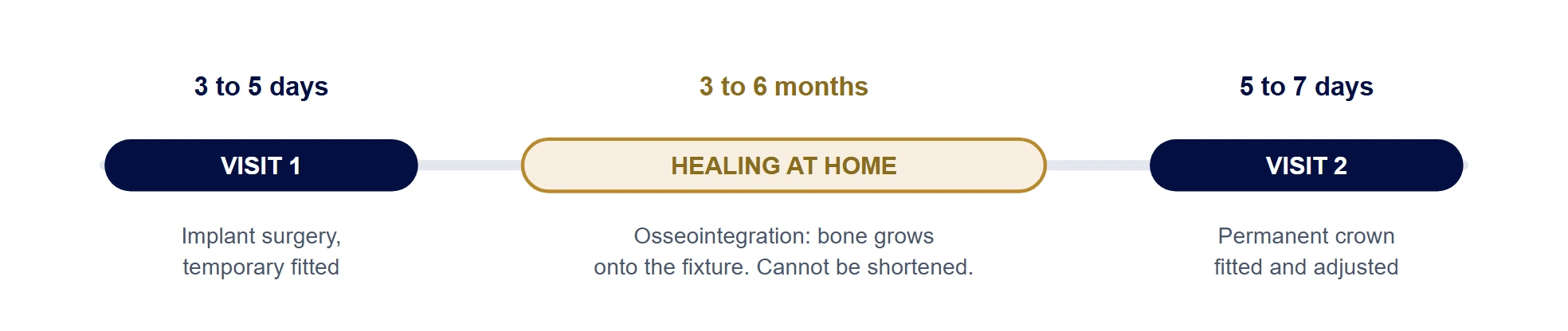
most international patients complete dental implant treatment in Türkiye across two visits, roughly 3 to 5 days for surgery and 5 to 7 days for the final restoration, with a healing gap of about 3 to 6 months in between. Crown and veneer work is usually finished in a single visit of 5 to 7 days. Publicly published clinic prices for a single implant in Türkiye in 2026 sit broadly between 400 and 900 US dollars, against roughly 3,000 to 5,000 dollars in the United States. Your own figure depends on a clinical assessment, not on a list price.
What is actually included in dental treatment in Türkiye
Dental treatment abroad is not a single product. What patients call "getting my teeth done in Turkey" covers several very different clinical pathways, each with its own timeline, risk profile and cost. Being clear about which one applies to you is the first thing that separates a sound plan from an expensive surprise.
Treatment
What it addresses
Days in Türkiye
Number of visits
Single dental implant
One missing tooth, root replaced with a titanium fixture
3-5 days, then 5-7 days
Two, 3-6 months apart
All-on-4 / All-on-6
A full arch supported by four or six implants
5-7 days, then 7 days
Two, 3-6 months apart
Zirconia crowns
Damaged, discoloured or worn teeth
5-7 days
One
Laminate veneers
Front-tooth appearance, minimal tooth reduction
5-7 days
One
Bone graft or sinus lift
Insufficient bone volume for an implant
Adds 3-4 days
Usually merged with implant visit
Root canal, extraction, cleaning
Preparatory work before restoration
1-3 days
Merged with the main visit
Why the two-visit structure matters Implants need osseointegration, the bone grows onto the fixture, before a permanent crown can be loaded. That takes months, not days. A plan that promises implants and final crowns inside a single week is either using immediate-loading in a case that genuinely allows it, or it is cutting a corner. Ask which one it is, and ask why your case qualifies.
What dental treatment in Türkiye costs, and what actually moves the price
Price is the first question almost everyone asks, and it is also the question most likely to be answered badly. Published figures vary widely because they describe different things: some quote the fixture only, some the fixture plus abutment plus crown, some an all-inclusive package with hotel and transfers.
Implant treatment: the two-visit timeline
The table below shows the ranges publicly listed by clinics and medical travel platforms in 2026, alongside commonly cited figures for the United States and United Kingdom. Treat them as market context for orientation, not as a quotation. A real figure comes only after an assessment of your x-rays and clinical situation. The same logic governs every treatment priced this way: the hair transplant cost guide shows how a quote is assembled from clinical findings rather than read off a list.
Treatment
Türkiye (published 2026 ranges)
United States
United Kingdom
Single implant with crown
400-900 USD
3,000-5,000 USD
£2,000 - £2,800
All-on-4, per arch
3,000-7,000 USD
20,000-30,000 USD
£10,000 - £15,000
Zirconia crown
150-300 USD
1,000-1,800 USD
£500 - £900
Laminate veneer
180-350 USD
900-2,500 USD
£500 - £1,000
Source: price ranges published by Turkish clinics and international medical travel platforms, August 2026. Currency values shift; the comparison is indicative.
The four variables that actually change your number
Implant brand and origin. Swiss, German, Korean and Turkish systems differ in price, in the depth of published long-term data, and in how easily a dentist in your own country can service them later. This last point is routinely ignored and it matters more than the brand name.
Restoration material. Monolithic zirconia, layered zirconia, e-max and metal-ceramic behave differently in strength, translucency and cost. A back molar and a front incisor do not need the same material.
Preparatory work. Bone grafts, sinus lifts, extractions and gum treatment are not optional extras invented to raise the bill. If your bone volume is insufficient, an implant placed without grafting is a fixture waiting to fail.
Number of units. Per-unit prices fall as the count rises, which is why a full-arch quote never equals the single-tooth price multiplied out.
The cheapest quote is rarely the cheapest treatment A quote that is far below every other quote usually differs in what it contains, not in what it charges. Ask for the inclusion list in writing: fixture, abutment, crown, temporary, scans, consultation, follow-up. If any of those sit outside the quoted number, the number is not the price.
How the process works, from first message to final crown
The sequence below is how coordinated treatment normally runs. Nothing is booked before a clinical opinion exists.
Assessment
You send a panoramic x-ray, or one is arranged locally, along with photographs and a short medical history. A dentist reviews the case and states what is clinically possible.
Written plan
You receive a treatment plan naming each procedure, the material, the number of visits and the total. Questions are answered before anything is scheduled.
Travel arrangements
Dates, accommodation and airport transfers are arranged around the clinical timetable, not the other way round.
Examination on arrival
A 3D scan and in-person examination confirm the plan. If findings differ from the remote assessment, the plan is revised and re-explained before treatment begins.
Treatment
Surgery or preparation is carried out by the treating dentist at an authorized institution, in stages appropriate to your case.
Follow-up
You leave with written aftercare instructions, records for your own dentist, and a named contact for questions after you get home.
How to check that a dental clinic in Türkiye is what it claims to be
Türkiye regulates dental practice, and legitimate clinics operate under Ministry of Health authorization. How treatment is coordinated with those institutions is set out separately, because the coordinating company and the treating clinic are not the same entity. The difficulty for a patient abroad is not that verification is impossible, it is that most people do not know which questions produce a checkable answer. These do.
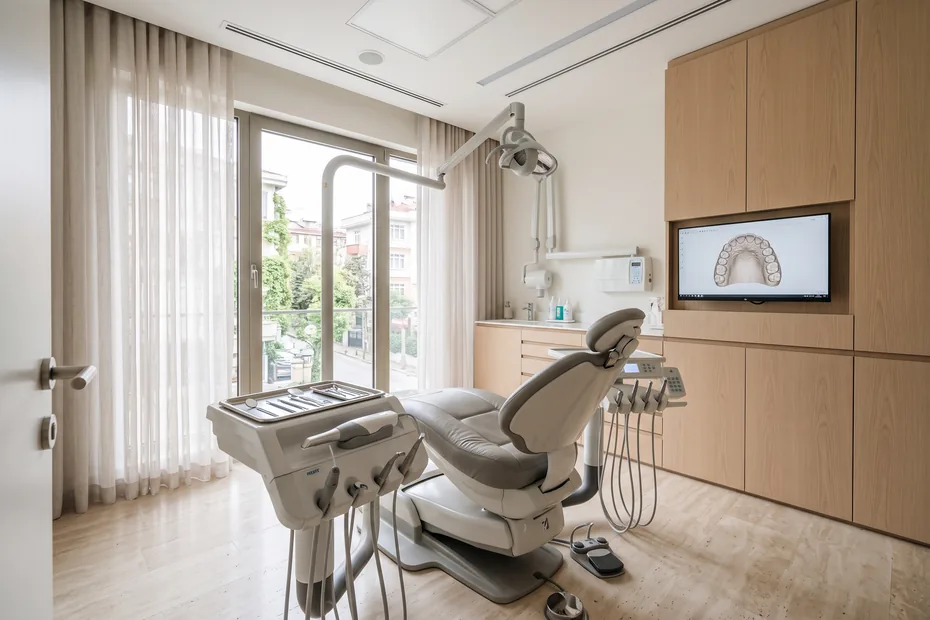
A modern dental operatory: treatment chair, intraoral scanning and a chairside monitor for showing the plan. Illustrative interior. Treatment is carried out by licensed dentists at authorized healthcare institutions in Türkiye.
Ask for the name of the treating dentist, not the clinic. A clinic name tells you nothing about who will hold the handpiece. A named practitioner can be looked up.
Ask which institution holds the health facility authorization and confirm the treatment address matches it.
Ask what happens if a crown chips or an implant fails after you return. A serious answer describes a defined warranty, what it covers, what it excludes, and who pays for the return flight. A vague answer is itself the answer.
Ask for the implant brand and the batch documentation. You should leave with an implant passport. Without it, a dentist at home cannot match components later.
Ask how many days are allocated to your specific treatment. If the schedule is shorter than the clinical norms in the table above, ask what is being compressed.
Ask who you speak to after the flight home. Aftercare that ends at the airport is not aftercare.
Something competitors rarely mention Bring your treatment records to your own dentist before you travel, not after. A local dentist who has seen the plan in advance is far more willing to handle routine follow-up later. Arriving home with an unfamiliar implant system and no paperwork is the single most common reason patients struggle to find local aftercare.
Who is a good candidate, and who should wait
Being honest about this is not a marketing weakness. Patients treated when they should have waited generate the complications that give medical travel its reputation.
Treatment is usually straightforward when
gum health is stable and any active infection has been treated;
bone volume is adequate, or grafting is planned and accepted as part of the timeline;
general health is stable and any chronic condition is under control with a physician's knowledge;
you can commit to two separate trips for implant work, rather than hoping to compress it into one.
Postponing is usually the better decision when
there is untreated periodontal disease, implants placed into inflamed tissue fail more often;
you smoke heavily and are unwilling to stop around the surgical period, which measurably affects healing;
diabetes or another systemic condition is poorly controlled at the time of travel;
you are being asked to decide quickly. Nothing about dental treatment improves under time pressure.
Aftercare, warranties and what happens when you are home
The part of the journey that gets least attention in most guides is the part that lasts longest. Implants and crowns are maintained, not installed and forgotten.
Period
What is normal
What needs attention
First 72 hours
Swelling, mild bruising, discomfort managed with prescribed medication
Heavy bleeding that does not settle, fever, spreading swelling
First 2 weeks
Soft diet, careful cleaning around the site, gradual return to normal routine
Pain that increases rather than decreases after day three
Healing months
Temporary restoration in place, routine hygiene, no unusual sensation
A fixture that feels mobile, or a temporary that repeatedly comes loose
After final restoration
Six-monthly check-ups with your own dentist, professional cleaning
Bleeding gums around an implant, a crown that no longer meets the bite evenly
Warranty terms differ between institutions and are worth reading rather than assuming. In practice a warranty typically covers the restoration itself against defined failure, and typically does not cover travel, accommodation, or damage from neglected hygiene. Neither of those is unusual, but knowing it in advance is the difference between a managed situation and a dispute.
Implant systems: the choice that follows you home
Most guides list implant brands as a price tier and move on. The more useful question is what happens in five years when a component needs replacing and you are sitting in a dentist's chair two thousand miles from Istanbul.
System group
Typical position
Long-term published data
Component availability outside Türkiye
Swiss and Swedish systems
Premium tier
Decades of published follow-up studies
Widely stocked; most dentists can source parts
German systems
Premium to mid tier
Extensive European clinical data
Widely available across Europe and North America
Korean systems
Mid tier
Growing body of data, shorter track record
Available, though not stocked by every practice
Turkish and regional systems
Economy tier
Limited long-term published follow-up
Harder to source abroad; may require ordering
The question to ask, phrased exactly "If I need this abutment replaced in five years, can a dentist in my own country order the part?" A clinic that answers confidently and names the system is giving you something checkable. This single question separates a considered plan from a price list.
Restoration materials, and where each one belongs
Material choice is not cosmetic preference alone. A front incisor and a rear molar are subject to completely different forces and completely different visual scrutiny, and the correct material differs accordingly.
Material
Strength
Appearance
Best suited to
Trade-off
Monolithic zirconia
Very high
Good, less translucent
Molars, bruxism, full-arch work
Less lifelike at the front
Layered zirconia
High
Very good
Front teeth needing strength
Layering can chip under heavy load
E-max (lithium disilicate)
Moderate
Excellent translucency
Single front crowns and veneers
Not first choice for heavy grinders
Metal-ceramic
High
Adequate, can show a grey margin over time
Budget-constrained posterior work
Gum line greying as tissue recedes
Signs a material has been chosen for cost rather than clinical fit
the same material is proposed for every tooth regardless of position or bite;
no one asks whether you grind your teeth at night;
veneers are proposed for teeth that are structurally damaged, where a crown is the correct restoration;
shade is chosen from a photograph rather than a shade guide in daylight.
Veneers versus crowns is a clinical distinction, not a marketing one A veneer covers the front surface and removes minimal tooth structure. A crown covers the whole tooth and removes considerably more. Healthy teeth reduced to stumps to fit crowns cannot be undone. If a plan proposes crowns on teeth you consider healthy, ask precisely why, and get a second opinion before you fly.
What a treatment week actually looks like
Patients often plan around the flights and discover the schedule is tighter than they imagined. This is a realistic single-visit crown or veneer week.
Day
Clinical
Your time
Day 1
Arrival, transfer, rest
Free afternoon
Day 2
Examination, 3D scan, shade selection, plan confirmed
Half day at the clinic
Day 3
Preparation of teeth, digital impressions, temporaries fitted
Most of the day
Day 4
Laboratory production; no appointment
Free day
Day 5
Try-in of the restorations, adjustments to fit and shade
Half day
Day 6
Final cementation, bite check, aftercare briefing
Half day
Day 7
Final review, records and implant passport handed over
Short appointment, then departure
Implant surgery visits follow a different rhythm: surgery on day two or three, then two to three days of monitored healing before the flight home.
Türkiye compared with other dental travel destinations
Türkiye is not the only option, and pretending otherwise helps nobody. The comparison below reflects publicly published price levels and the practical considerations patients weigh.
Destination
Single implant, published range
Practical considerations
Türkiye
$400 - $900
High clinic volume, direct flights from most of Europe, English widely used in international clinics
Hungary
$700 - $1,200
Long-established dental tourism sector within the EU; higher prices, shorter flights from western Europe
Mexico
$750 - $1,500
Convenient for North American patients; quality varies sharply between border clinics and established centres
Poland
$600 - $1,100
EU regulatory framework; fewer all-inclusive packages
Publicly published ranges, August 2026. Price alone is a poor basis for choosing; verification of the clinic and clarity of the plan matter more.
Why treatment abroad goes wrong, when it does
The failures that make headlines rarely come from exotic causes. They come from a short list of avoidable decisions, and every one of them is visible before the flight.
What went wrong
Root cause
How it was avoidable
Implant failed within a year
Placed into untreated gum disease or insufficient bone
Periodontal treatment and grafting completed first
Crowns fitted badly, bite wrong
Schedule too compressed for proper try-in and adjustment
Enough days allocated for a genuine try-in appointment
Healthy teeth crowned unnecessarily
A full-mouth plan sold as a package rather than derived from findings
Second opinion on any plan that treats teeth you consider healthy
No local dentist would take over
Unknown implant system, no records, no implant passport
Records and batch documentation collected before departure
Dispute over a failed restoration
Warranty terms never provided in writing
Written warranty obtained at quotation stage
Traveling from the US
Flights: Turkish Airlines flies non-stop to Istanbul from major US cities, including New York, Washington, D.C., Chicago, Boston, Atlanta, Miami, Houston, Dallas, Los Angeles, San Francisco and Seattle.
Entry: Check the current entry rules for US passport holders on the U.S. Department of State page for Türkiye before you book.
Time difference: Istanbul is on UTC+3 all year, so it is 7 hours ahead of New York in summer and 8 hours ahead in winter.
Prices: All prices on this page are in US dollars.
Frequently asked questions
How many days do I need in Türkiye for dental implants?
Implant treatment is normally two visits. The surgical visit is around 3 to 5 days for a single implant and 5 to 7 days for a full arch. After a healing period of roughly 3 to 6 months you return for 5 to 7 days for the permanent restoration. Crown and veneer work without implants is usually completed in one visit of 5 to 7 days.
Why is dental treatment cheaper in Türkiye than in the United States or United Kingdom?
The difference is structural rather than clinical. Staff costs, clinic overheads, laboratory work and currency levels are all lower, and the volume of international patients allows clinics to operate efficiently. The materials themselves, implant systems, zirconia, scanning equipment, come from the same global manufacturers used everywhere else.
Is it safe to have dental treatment abroad?
The clinical procedures are the same procedures performed worldwide. The variables that affect safety are the authorization status of the institution, the qualifications of the treating dentist, whether the plan matches your actual clinical situation, and whether aftercare is defined before you travel. Those are all checkable in advance, which is why the checklist above matters more than any general reassurance.
What happens if a crown breaks or an implant fails after I go home?
Ask this before treatment, in writing. Institutions typically offer a warranty on the restoration with defined terms. What varies is what is covered, for how long, and who bears travel costs for a revisit. Keeping your implant passport and treatment records makes it far easier for a dentist in your own country to help in the meantime.
Can everything be finished in a single trip?
Crowns and veneers, usually yes. Implants, usually no. Bone integration takes months and cannot be shortened by scheduling. Immediate loading exists and suits some cases, but it is a clinical decision made on your bone quality, not a convenience option to be requested.
Will my treatment records be accepted by my dentist at home?
Normally yes, provided you have them. You should receive your x-rays, the treatment plan, the implant brand and batch details, and the materials used. Give these to your own dentist so routine check-ups continue without interruption.
Do I need to speak Turkish?
No. Coordination and clinical explanation are handled in English, and interpretation is arranged for the consultation and treatment itself.
Does Turkey Hair Center perform the dental treatment?
No. Turkey Hair Center coordinates the process, assessment, planning, scheduling, travel logistics and follow-up communication. Treatment is carried out by licensed dentists at authorized healthcare institutions in Türkiye.
How far in advance should I plan?
Allow two to four weeks between the first assessment and travel for a straightforward case. Full-arch work and cases needing grafting benefit from longer, because the plan usually goes through more than one revision once scans are reviewed.
What should I bring with me?
Any recent dental x-rays, a list of current medications, details of chronic conditions, and your own dentist's contact information. If you take blood thinners, this must be disclosed well before travel, not on arrival.
Practical matters: visas, flights and what to budget beyond treatment
Entry requirements. Many nationalities enter Türkiye visa-free or with an electronic visa obtained online. Check your own passport's requirement before booking flights, not after.
Flights. Istanbul has direct connections from most of Europe, the Middle East, North America and Africa. Book flexible return dates for implant visits, where a healing complication can extend the stay.
Beyond the package. Budget for meals, local transport outside scheduled transfers, and a contingency for an extra two or three nights.
Travel insurance. Standard travel policies commonly exclude planned medical treatment. Read the exclusions; buy a policy that covers what you are actually doing.
Companion. Not required for most dental work, but sedation cases and full-arch surgery are easier with someone present.
More than one treatment. Dental work is often combined with another procedure in the same period. Aesthetic surgery carries its own recovery window before you are cleared to fly, and bariatric surgery demands the whole trip on its own.
One habit that prevents most disputes Keep everything in writing. The plan, the inclusion list, the materials, the warranty, the schedule. Verbal agreements made across a language barrier and a time zone are the origin of nearly every dispute in medical travel, and a written thread costs nothing to maintain.
Turkey Hair Center coordinates access to dental treatment provided by licensed practitioners at authorized healthcare institutions in Türkiye. This page is general information about treatment options and does not constitute a diagnosis, a treatment recommendation or a guarantee of outcome. Every treatment plan follows an individual clinical assessment, and results vary from person to person. Price ranges shown are publicly published market figures for orientation and are not an offer.
Sources and medical review
The clinical statements on this page are consistent with the public guidance below. Price figures are publicly published market ranges and are labelled as such where they appear.
Send three photos: front, top and sides. You get a technique recommendation, a graft range and a straight answer about what is achievable, before anyone talks about price.
Your details are with the team
A patient coordinator will get back to you shortly. If you would like to send your photos now, WhatsApp is the fastest way to do it.
We respond quickly, day or night, in your language.
Multilingual team, no obligation
Data protectedKVKK and GDPR compliant, 100% confidential
Authorized Health Tourism Intermediary
Turkey Hair Center is the hair-restoration brand of Healthy Way Tourism, an authorized international health-tourism intermediary. All medical procedures are performed by licensed medical professionals at authorized healthcare facilities in Turkiye, in accordance with the regulations of the Ministry of Health.