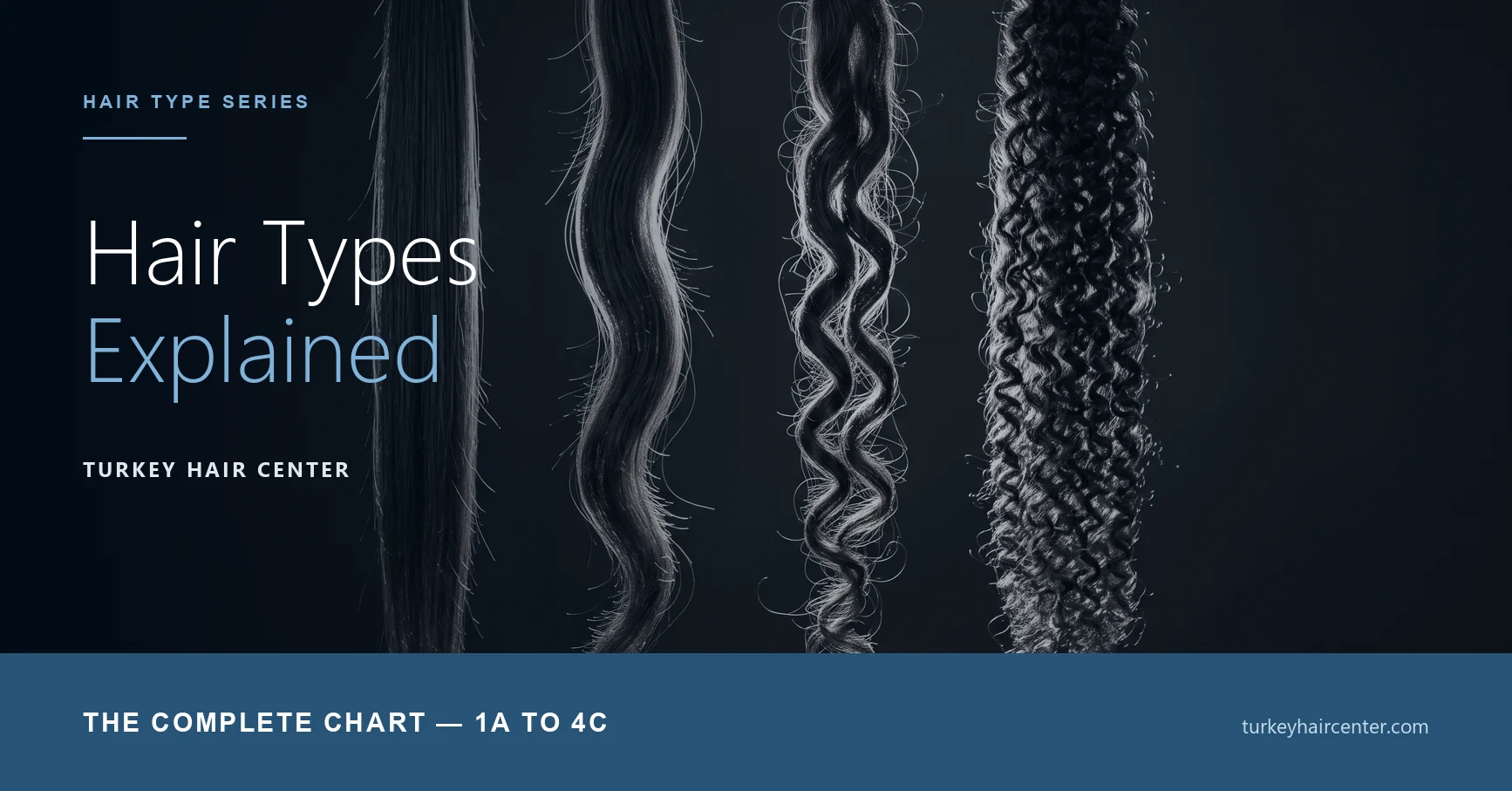
Hair is typed on a 1-4 scale by curl pattern, 1 is straight, 2 is wavy, 3 is curly and 4 is coily, and each number is split into A, B and C by how tight the pattern is. That gives twelve types in all, from 1A (the finest straight hair) to 4C (the tightest zig-zag coil).
Your type is set by the shape of the follicle beneath the scalp: round follicles grow straight hair, oval follicles grow waves, and increasingly flattened, curved follicles grow curls and coils.
Hair Type Chart: All 12 Patterns From 1A to 4C Medical Reviewed By Dr. Tompi, M.D: Plastic & Aesthetic Surgeon
Written By Nazmi G, Trichologist
Hair is typed on a 1-4 scale by curl pattern: 1 is straight, 2 is wavy, 3 is curly and 4 is coily: and each number is split into A, B and C by how tight the pattern is. That gives twelve types in all, from 1A (the finest straight hair) to 4C (the tightest zig-zag coil). Your type is set by the shape of the follicle beneath the scalp: round follicles grow straight hair, oval follicles grow waves, and increasingly flattened, curved follicles grow curls and coils.
Knowing your type is not vanity admin. It decides which products actually work on your hair, how often you should wash it, which haircuts hold their shape: and, if you are considering a hair transplant, how a surgeon plans and performs the operation. This page is the master chart. Each family also has its own in-depth guide, linked in place below.
Type
Pattern
How to recognise it
Most common complaint
Wash frequency
1A
Straight, very fine
Hangs completely flat; shows scalp easily; will not hold a curl
No volume, goes greasy fast
Daily to every other day
1B
Straight, medium
Straight with a little body at the ends
Falls flat by midday
Every 2 days
1C
Straight, coarse
Thick, heavy strands; slight bend near the ends
Frizz in humidity, hard to style
Every 2-3 days
2A
Loose S-wave
Fine, barely-there wave that starts below the ear
Wave drops out within hours
Every 2-3 days
2B
Defined S-wave
Clear S shape from mid-length; roots stay flatter
Frizz on top, flat roots
Every 3 days
2C
Strong wave, some curl
Waves start at the root; a few loose spirals appear
Frizz, unpredictable definition
Every 3-4 days
3A
Large loose curl
Springy loops roughly the width of a wine cork
Loses definition, tangles
Every 4-5 days
3B
Springy ringlet
Curls about the width of a marker pen
Dryness, shrinkage
Every 5-7 days
3C
Tight corkscrew
Dense corkscrews around the width of a pencil
Dryness, breakage at the ends
Every 5-7 days
4A
Defined coil
Visible S-shaped coils, about the width of a crochet needle
Severe dryness
Weekly
4B
Z-shaped bend
Sharp angles rather than round curls; densely packed
Heavy shrinkage, breakage
Weekly to fortnightly
4C
Tightest zig-zag
Very tight pattern with little visible definition until wet
Fragility, tension damage
Weekly to fortnightly
Two properties sit alongside this chart and decide as much as it does. If your hair is wavy, curly or coily, the nine curl patterns from 2A to 4C are covered in their own guide. And whichever type you are, hair porosity: how readily the strand absorbs and holds water: usually decides which products will work on you.
How to find your hair type in four steps
Type your hair clean, product-free and air-dried. Anything else (heat, gel, a day-three wash) will give you the wrong answer, and mistyping is the single most common reason a “correct” routine fails.
Wash and do not touch it. Shampoo, rinse, and let it air-dry without brushing, scrunching, plopping or applying any product. Brushing alone can pull a 3A into looking like a 2B.
Look at a single strand against a plain background. Straight from root to tip is type 1. An S shape is type 2. A loop or spiral is type 3. A tight coil or sharp Z is type 4.
Measure the width of the pattern. Compare one curl to an everyday object: wine cork (3A), marker pen (3B), pencil (3C), crochet needle (4A). This is the step that separates the letters.
Check more than one area. Most people are not one single type. The nape and the crown are very often a full step apart, and the hairline is usually looser than the rest.
Mixed patterns are the norm, not the exception. It is completely ordinary to be 2C at the back and 3A at the crown. When choosing products or a haircut, work with your loosest pattern; when planning moisture, work with your tightest. Type your hair by the section that gives you the most trouble.
Type 1: straight hair (1A, 1B, 1C)
Round follicles, no natural bend. Because the strand is smooth and circular in cross-section, sebum travels from the scalp down the hair shaft with nothing to slow it. That is why type 1 hair looks glossy and feels soft but goes limp and greasy faster than any other type, and why heavy conditioner is usually the wrong answer for it.
Telling 1A, 1B and 1C apart
1A is the rarest type overall. Extremely fine, perfectly flat, no bend anywhere, and it resists curling even with heat. Scalp is visible at the parting.
1B has medium-thickness strands and a little natural body, particularly through the ends. It holds a blow-dry for a few hours.
1C has coarse, thick individual strands and a slight bend near the ends. It is the most likely of the three to frizz in humidity.
What actually works on type 1
Volume comes from the cut and from lightweight product: a mousse or a root spray: never from heavy conditioner or oil, which flattens it within an hour.
Condition mid-length to ends only. Conditioner at the root is the most common type 1 mistake.
Blunt cuts read as fuller than heavy layering, which can make fine straight hair look thinner at the ends.
Dry shampoo between washes works well here because the problem is oil, not moisture loss.
Oval follicles producing an S-shaped bend that lies closer to flat than to spiral. Type 2 sits on the border between straight and curly, which makes it the family most often mistyped in both directions: wavy hair brushed dry looks straight, and wavy hair scrunched with product looks curly.
Telling 2A, 2B and 2C apart
2A is a fine, barely-there wave that only begins below ear level. It straightens under its own weight and drops out quickly.
2B has a clearly defined S from mid-length down, with roots that stay noticeably flatter than the ends.
2C waves start at the root, the strands are thicker, and a few genuine spirals appear. This is where type 2 begins to behave like type 3.
What actually works on type 2
The signature problem is a flat root with a frizzy mid-length. Root-lifting at the drying stage fixes more of it than any product applied later.
Lightweight gels and sea-salt sprays hold the wave; creams and butters usually collapse it.
Avoid brushing when dry. Detangle wet, with conditioner in, then leave it alone.
Diffusing on low heat preserves the S pattern; rough towel drying destroys it.
Read the full type 2 wavy hair guide ›
Type 3: curly hair (3A, 3B, 3C)
Flattened, curved follicles producing true loops and spirals. Because the strand is elliptical rather than round, scalp oils cannot travel down it easily. The result is the defining type 3 contradiction: an oily scalp and dry ends on the same head of hair.
Telling 3A, 3B and 3C apart
3A forms large, loose, springy loops with plenty of shine and noticeable movement.
3B forms tighter ringlets with more volume and visibly less shine, because the surface reflects light in more directions.
3C forms dense corkscrews packed closely together. Shrinkage becomes significant here: hair can look much shorter dry than it measures wet.
What actually works on type 3
Definition and moisture are the whole game. Layer water-based leave-in first, then cream, then gel, on soaking-wet hair.
Squish the product in rather than raking it through, and do not touch the hair again until it is fully dry.
Co-washing or a sulphate-free shampoo protects the natural oil the ends need.
Sleep on satin or silk. Cotton pillowcases lift the cuticle and turn defined curls into frizz overnight.
Read the full type 3 curly hair guide ›
Type 4: coily hair (4A, 4B, 4C)
The flattest follicles and the tightest patterns. Every bend in the strand is a point where the cuticle lifts slightly, and every lifted point is a potential break. This makes type 4 hair structurally the most fragile of all types despite frequently looking and feeling the most robust: a mismatch that leads a lot of people to handle it far more roughly than it can take.
Telling 4A, 4B and 4C apart
4A forms defined, visible S-shaped coils roughly the width of a crochet needle. The pattern is clear even when dry.
4B bends at sharp angles rather than curving, producing a Z shape. Strands are densely packed and the pattern is less visible.
4C has the tightest pattern with almost no definition visible until the hair is wet or product is applied.
What actually works on type 4
Shrinkage of half the actual length or more is normal and is not hair loss. Measure a stretched strand before assuming anything has been lost.
Moisture then seal: water-based product first, then an oil or butter on top to hold the water in. Oil alone on dry hair seals dryness in.
Detangle only when wet and saturated with conditioner, working from the ends upward in small sections.
Protective styles help: but tension is the danger. A style that pulls at the hairline is the mechanism behind traction alopecia, which is one of the few genuinely preventable forms of hair loss.
Read the full type 4 coily hair guide ›
What the chart does not tell you
Curl pattern is only one of four properties that decide how your hair behaves. Two people can both be genuine 3Bs and need completely different routines because the other three differ. This is the reason curl-type advice so often fails: it is a quarter of the picture presented as the whole of it.
Porosity: how the strand handles water
Porosity describes how readily the cuticle lets moisture in and how well it holds it. It matters more than curl type for product selection.
Low porosity: the cuticle lies flat and resists water. Product sits on the surface and builds up; hair takes a long time to get wet and a long time to dry. Lightweight products and gentle heat during conditioning help.
Medium porosity: absorbs and holds moisture readily. The least demanding to care for.
High porosity: the cuticle is raised, often through damage, colour or heat. Water goes in fast and leaves just as fast, so hair feels dry within hours of conditioning. Heavier sealants and protein help.
The float test: dropping a clean strand into a glass of water: is widely repeated but unreliable, because surface tension and residual product both distort the result. How your hair behaves in the shower is a better indicator: hair that takes minutes to wet through is low porosity.
Density, strand width and elasticity
Density is how many strands grow per square centimetre of scalp. This is what people usually mean when they say “thick hair”. Low density with a tight curl pattern still looks full; high density with a straight pattern can still look flat.
Strand width is how thick one individual hair is: fine, medium or coarse. It is independent of type. A 1A can be coarse and a 4C can be fine.
Elasticity is how far a wet strand stretches before it snaps. Low elasticity is the clearest early warning of damage, and it usually means the hair needs protein rather than more moisture.
The most common typing mistake: confusing density with curl pattern. Someone with a great deal of 2A hair is often told they are “type 3” because the overall head of hair looks full and voluminous. Type the individual strand, not the silhouette.
Where the system came from: and its limits
The 1-4 numbering was popularised by stylist Andre Walker in the 1990s and the A/B/C sub-divisions were added later by the natural hair community rather than by the original system. It is a styling shorthand, not a clinical classification, and it has real weaknesses: it treats coily hair as a single number when the range within type 4 is wider than the range between types 1 and 2, and it says nothing about the scalp. Use it as a starting point for product choice, not as a medical description of your hair.
Care routine by hair type
Most routine advice fails because it is written for one type and read by another. The table below sets the four families side by side on the decisions that actually differ. Where two types share a row, the difference genuinely is small.
Decision
Type 1: straight
Type 2: wavy
Type 3: curly
Type 4: coily
Cleansing
Regular shampoo; clarify weekly
Gentle shampoo; clarify fortnightly
Sulphate-free or co-wash
Co-wash; clarify monthly
Conditioner
Mid-length to ends only
Mid-length to ends, light formula
Root to tip, generous
Root to tip, plus weekly deep condition
Best product texture
Mousse, root spray
Light gel, salt spray
Cream then gel
Cream, butter, then oil to seal
Detangling
Dry, brush freely
Wet, wide-tooth comb
Wet with conditioner, fingers
Wet and saturated, in sections, ends first
Drying
Blow-dry or air-dry
Diffuse on low, do not touch
Diffuse or air-dry, no towel rubbing
Air-dry in a stretched style
Heat tools
Tolerated with protectant
Occasional, with protectant
Sparingly: heat relaxes the pattern
Rarely: risk of permanent loosening
Overnight
Loose, anything
Loose plait, satin pillowcase
Pineapple, satin
Bonnet or satin scarf, stretched
Biggest risk
Product build-up
Frizz from dry brushing
Moisture loss at the ends
Breakage and tension damage
The mistake each type makes most often
Type 1: applying conditioner or oil at the root, then blaming the hair for going flat and greasy. Condition the ends only.
Type 2: brushing when dry. It breaks the S pattern into frizz, and no product applied afterwards will put it back.
Type 3: touching the hair while it dries. Every touch before it has set disrupts the cast the gel is forming and releases frizz.
Type 4: applying oil to dry hair. Oil does not add moisture: it seals in whatever is already there, so oiling dry hair locks the dryness in.
Scalp care applies to every type
Hair typing describes the strand, but the follicle is in the scalp, and every type shares the same scalp requirements. Persistent flaking, itching, soreness or visible inflammation are not styling problems and do not respond to styling solutions. Scalp conditions such as seborrhoeic dermatitis and folliculitis can contribute to shedding if they are left untreated, and they are treated medically rather than cosmetically. Our guide to scalp infections and hair loss covers the ones most often mistaken for dandruff.
Why hair type matters in hair restoration
Curl pattern is not a cosmetic footnote in a hair transplant: it changes the surgery itself. In curly and coily hair the follicle is curved beneath the skin, so the visible angle of the strand on the surface does not reveal the angle of the root below it. That has four practical consequences.
Extraction is technically harder in type 3 and type 4 hair. The curved follicle has to be extracted along its curve; a punch driven straight down risks transecting it.
Coverage per graft differs by pattern. A coil covers more visible scalp area than a straight strand of the same length, which is why coverage planning is not a single graft-count formula applied across all types.
Hairline design changes with pattern. A hairline that reads as natural on 1A hair will not read the same way on 4B, because the way the pattern falls, clusters and casts shadow is different.
Donor assessment changes. Density counts and the way the donor area will look after harvesting both depend on how much scalp each strand visually covers.
This is why an experienced clinic asks about your curl pattern during assessment rather than treating every scalp identically. If your hair is Afro-textured, the specialist considerations are set out in our Afro hair transplant guide, and the differences for East and South Asian hair are covered in our guide to hair transplant considerations for Asian hair types.
Note on medical information. This page explains hair typing and general restoration principles. It is not a diagnosis and it is not a promise of any particular result. Whether a hair transplant is appropriate for you, and what it could realistically achieve, can only be established in a personal assessment with a qualified doctor.
Does hair type ever change?
Yes: and more often than people expect. Curl pattern is genetically set, but the follicle producing it can be altered, and when the follicle changes shape the hair growing from it changes with it.
Puberty and pregnancy commonly shift a pattern by a full step in either direction through hormonal change. Post-partum shedding can also make a pattern look looser temporarily.
Chemotherapy frequently causes hair to regrow with a different texture: often curlier: and the change is sometimes permanent.
Ageing tends to reduce strand width, so hair often reads as looser, finer and less defined over time.
Thyroid disorders and significant nutritional deficiency can change texture alongside density.
Heat and chemical damage can permanently relax a pattern by breaking the disulphide bonds that hold it. This is damage, not a genuine type change, and it does not reverse.
A sudden texture change with no obvious cause, particularly when it arrives alongside increased shedding, is worth investigating rather than styling around. Our guide to blood tests in hair loss diagnosis explains which markers are usually checked and why.
Medical disclaimer: This article is for informational purposes only and is not medical advice. Individual results vary from person to person. Always consult a qualified doctor before any hair transplant procedure.
Hair Type Chart: frequently asked questions
How many hair types are there?
Twelve. Four numbered families, 1 straight, 2 wavy, 3 curly, 4 coily, each divided into three sub-types A, B and C by how tight the pattern is, giving 1A through 4C.
Can I have two hair types at once?
Yes, and most people do. Different areas of the scalp routinely differ by one step, most often between the crown and the nape, and the hairline is usually the loosest section. Type each area separately rather than forcing one label on the whole head.
Which hair type is the most fragile?
Type 4, particularly 4B and 4C. Each sharp bend in the strand is a weak point where the cuticle lifts, so coily hair breaks more readily than straight hair even when it looks and feels stronger.
Which hair type is the rarest?
1A, completely flat, very fine hair with no bend at all, is the least common. Most hair described as "poker straight" is in fact 1B or 1C.
Is 4C hair harder to transplant?
It is more technically demanding, not impossible. The follicle curves beneath the skin, so extraction has to follow that curve, which calls for a surgeon experienced specifically in Afro-textured hair. Outcomes depend on individual assessment.
What is the difference between hair type and hair porosity?
Type describes the shape of the strand; porosity describes how readily it absorbs and holds moisture. They are independent properties. Low-porosity 4C hair and high-porosity 4C hair need opposite product strategies despite sharing a type.
Does hair type affect how fast hair grows?
Growth rate at the follicle is broadly similar across types. Coily hair appears to grow more slowly because shrinkage hides much of the length and because breakage at the ends removes it as fast as it arrives, a length-retention problem rather than a growth problem.
Can I change my hair type permanently?
Not without damage. Chemical relaxers and keratin treatments alter the pattern by breaking bonds inside the strand, and that hair will not return to its original pattern, only new growth carries the genuine type. Styling can make a pattern look looser or tighter temporarily, but the follicle decides what grows.
Sources and medical review
The clinical statements on this page draw on the following published literature and professional body guidance:
Send three photos: front, top and sides. You get a technique recommendation, a graft range and a straight answer about what is achievable, before anyone talks about price.
Your details are with the team
A patient coordinator will get back to you shortly. If you would like to send your photos now, WhatsApp is the fastest way to do it.
We respond quickly, day or night, in your language.
Multilingual team, no obligation
Data protectedKVKK and GDPR compliant, 100% confidential
Authorized Health Tourism Intermediary
Turkey Hair Center is the hair-restoration brand of Healthy Way Tourism, an authorized international health-tourism intermediary. All medical procedures are performed by licensed medical professionals at authorized healthcare facilities in Turkiye, in accordance with the regulations of the Ministry of Health.