Performed at authorized partner hospitals Turkey Hair Center is a Ministry of Health authorized health-tourism intermediary, not a clinic.
Hair is commonly described using a curl-pattern system ranging from Type 2 waves to Type 4 coils. Within these groups, 2A-2C, 3A-3C, and 4A-4C describe different wave, curl, and coil patterns. However, curl pattern is only one part of understanding your hair. Texture, density, porosity, and strand thickness can also affect how your hair looks and behaves.
What Are Curly Hair Types?
Trying to manage your hair without understanding its fundamental structure can be incredibly frustrating. The curl typing system can help you understand your hair pattern and choose suitable styling techniques and products. But before buying a dozen new creams, it helps to know how this system actually works.
How the 2A to 4C Curl System Works
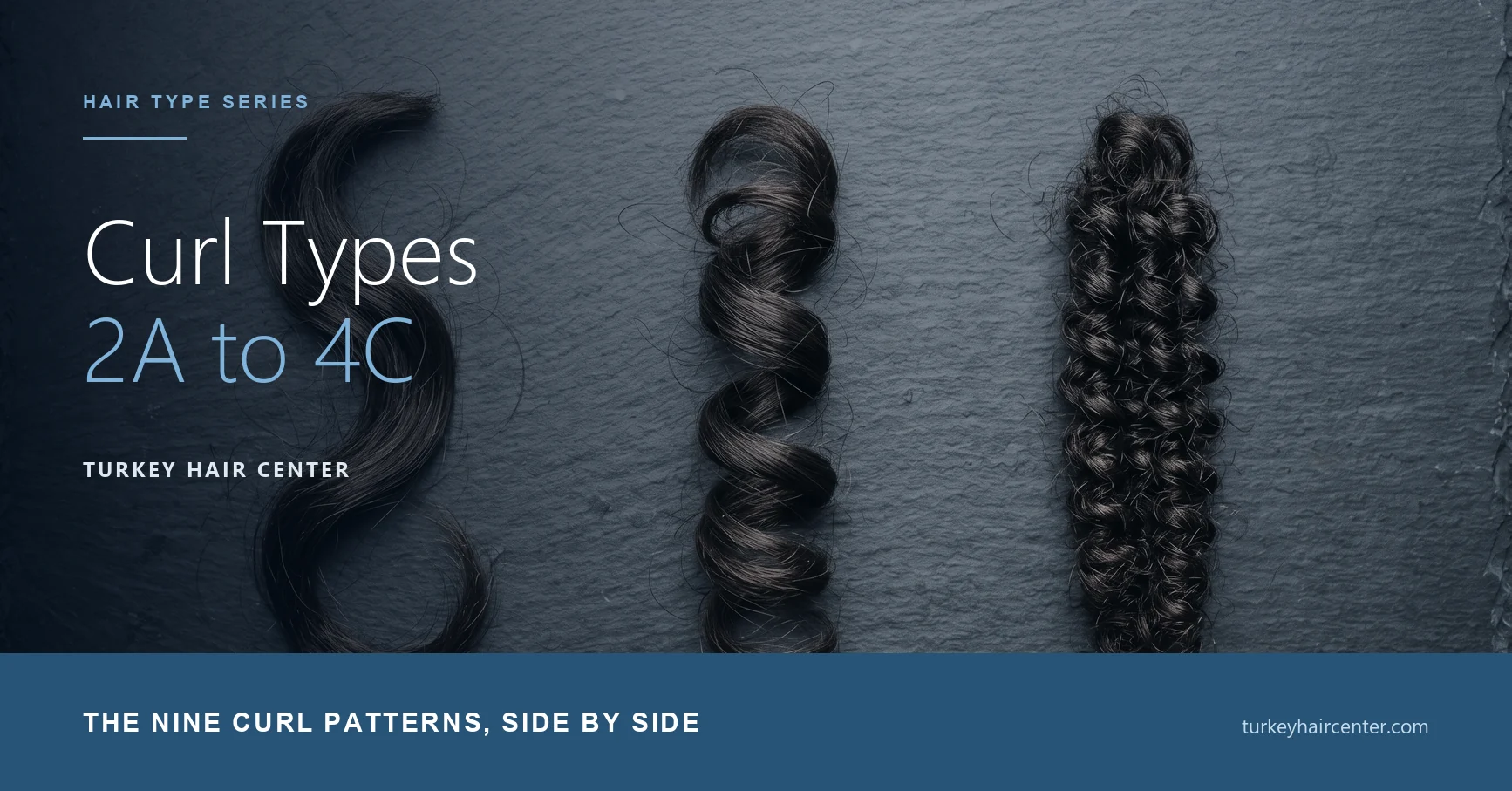
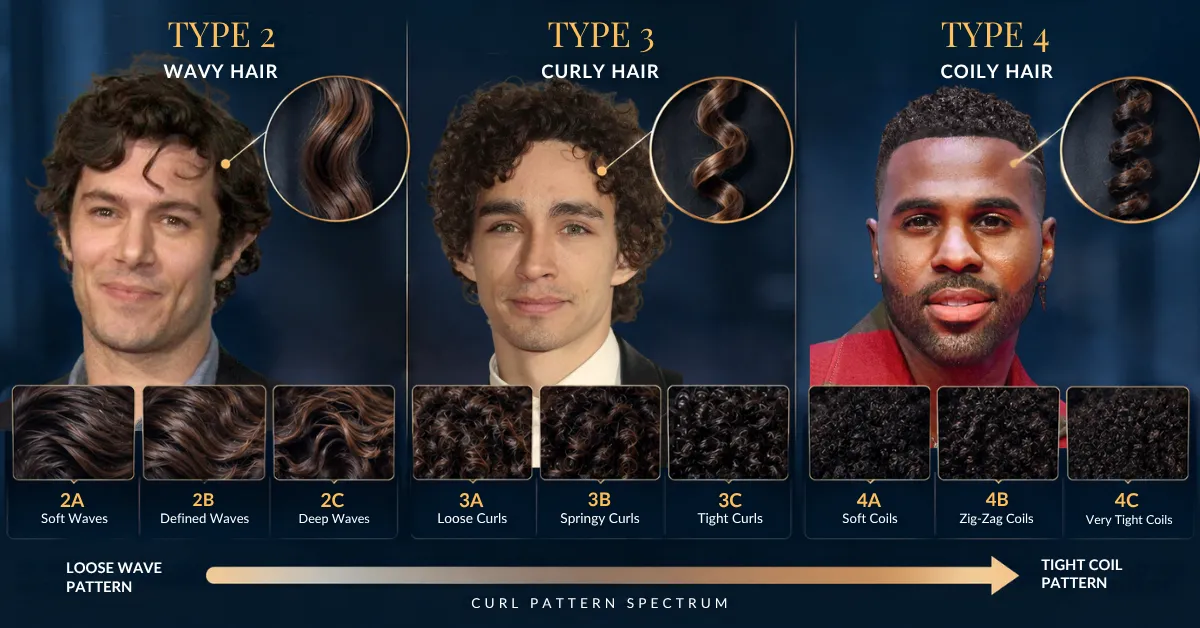
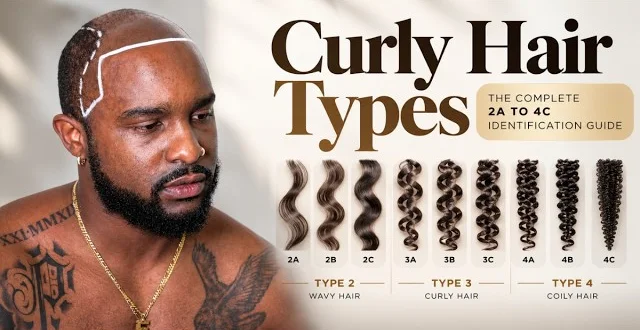
The system categorizes hair into three primary families: Type 2 (wavy), Type 3 (curly), and Type 4 (coily). Each family is then broken down into subcategories-A, B, and C-based on the tightness and definition of the pattern.
Type 2: Wavy Hair
Type 2 hair forms an "S" shape. It is rarely straight, but it usually doesn't form a complete spiral either. It generally lays a bit flatter against the scalp than true curls do.
Type 3: Curly Hair
Type 3 loops around into actual spirals or ringlets. These curls range from large, loose loops to tight corkscrews. They typically hold more volume at the root.
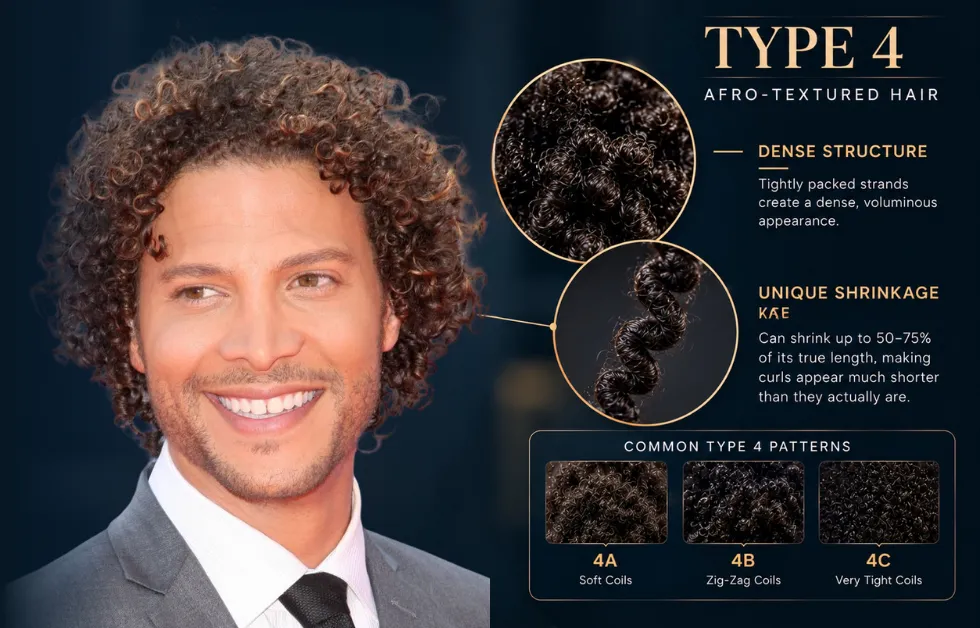
Type 4: Coily Hair
Type 4 features dense, tightly packed coils. It might form a very tight "S" pattern or a sharper "Z" shape. This hair type is known for its beautiful volume and noticeable shrinkage.
Is the 2A to 4C System a Medical Classification?
No. This is purely a consumer hair classification framework. It is not a medical or dermatological diagnosis. It simply exists to help individuals identify styling needs and communicate effectively with stylists.
Curly Hair Types Chart: 2A to 4C at a Glance
Before diving into complex details like porosity and texture, establishing a visual baseline is useful. This chart breaks down the general differences across the entire curl spectrum.
Curl Type
General Pattern
Typical Appearance
2A
Loose waves
Fine, subtle S-waves
2B
Defined waves
More visible S-pattern
2C
Strong waves
Wavy-to-curly
3A
Loose curls
Large spiral curls
3B
Medium curls
Defined springy ringlets
3C
Tight curls
Densely packed corkscrews
4A
Tight coils
Defined S-shaped coils
4B
Z-shaped coils
Less uniform bends
4C
Very tight coils
Very tight, less-defined pattern
What Is My Curl Type? Quick Curl Type Finder
You don't need a microscope to figure this out. Looking closely at a few strands of clean, unstyled hair usually provides enough clues.
Does Your Hair Form Waves or Curls?
Does the strand bend back and forth on a two-dimensional plane, or does it wrap around in a three-dimensional circle? Bends generally mean waves. Spirals mean curls.
Are Your Waves Loose or Defined?
If the wave is barely there and leans toward straight, it often falls into type 2A hair. If the "S" is sharp and starts closer to the root, you might be looking at type 2B hair or type 2C hair.
Are Your Curls Large, Medium, or Tight?
Look at the diameter of the spiral. Large, looping curls point to type 3A hair. Medium-sized, springy ringlets suggest type 3B hair. Tight, densely packed corkscrews usually indicate type 3C hair.
Does Your Hair Form Coils or Z-Shaped Patterns?
If the spirals are microscopic and densely packed, you are likely in the Type 4 family. A clear "S" shape is type 4A hair, while sharp, zig-zag angles mean type 4B hair.
Is Your Curl Pattern Clearly Defined or More Variable?
If your hair looks more like a dense cloud with a very tight, hard-to-see pattern unless it is manipulated, you likely have type 4C hair.
Type 2 Wavy Hair: 2A, 2B and 2C
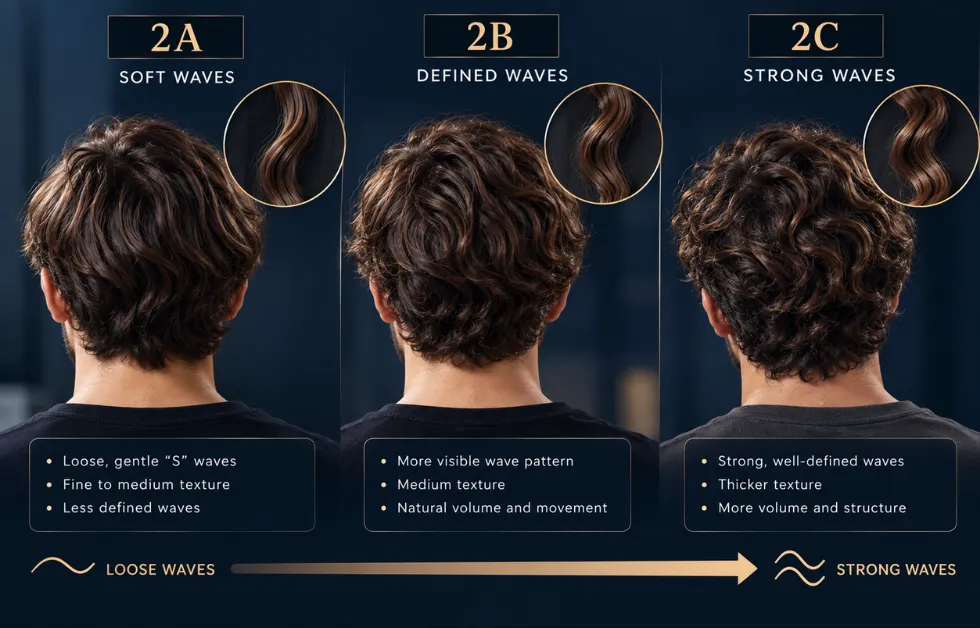
Wavy hair sits right in the middle. It has too much movement to be straight, but not quite enough spiral to be fully curly.
What Is 2A Hair?
Type 2A hair has a very loose wave pattern. The wave often starts around the mid-lengths, leaving the roots relatively flat.
What Is 2B Hair?
With a type 2B curl pattern, the "S" shape becomes much more obvious. The wave starts a bit higher up on the head, offering a classic, beachy look.
What Is 2C Hair?
This is the borderline. Type 2C hair features a strong wave pattern that often starts right at the root, and it can sometimes be more prone to frizz than type 2A or 2B.
2A vs 2B vs 2C: What's the Difference?
It comes down to where the wave starts and how aggressive the bend is. Type 2A hair is subtle. Type 2B hair is defined but loose. Type 2C hair is voluminous and occasionally features actual ringlets mixed in.
Type 3 Curly Hair: 3A, 3B and 3C
Type 3 hair loops completely around itself. This category typically relies on hydration to keep the spirals defined.
What Is 3A Hair?
Type 3A curls are large and loose. They look like big, shiny spirals. Because they are relatively loose, they can easily be weighed down by heavy styling products.
What Is 3B Hair?
Type 3B curls form defined, springy ringlets with a medium circumference. They are typically tighter and more voluminous than Type 3A curls.
What Is 3C Hair?
Type 3C curls are tight corkscrews. The hair is densely packed together, giving it immense natural volume.
3A vs 3B vs 3C: What's the Difference?
The curls become progressively tighter and more densely packed from 3A through 3C. Type 3A hair offers loose curls, type 3B hair delivers medium ringlets, and type 3C hair packs tight corkscrews into a denser frame.
Type 4 Coily Hair: 4A, 4B and 4C
Type 4 hair features tightly coiled or zig-zag patterns and can show significant shrinkage. It grows up and out. However, tightly coiled hair can be more prone to dryness and mechanical breakage, so gentle handling is especially important.
What Is 4A Hair?
Type 4A hair holds a very visible, tight "S" pattern. The coils are dense and springy, often retaining moisture a bit better than type 4B hair or type 4C hair.
What Is 4B Hair?
Type 4B hair bends in sharp angles, creating a "Z" shape rather than a rounded "S." The pattern is less uniform and experiences significant shrinkage.
What Is 4C Hair?
Type 4C hair features extremely tight coils. The pattern is so dense it can be hard to see without stretching the hair out. It benefits from consistent moisture routines to prevent breakage.
4A vs 4B vs 4C: What's the Difference?
The visual definition changes across the spectrum. Type 4A holds a clear coil. Type 4B hair bends sharply like a zig-zag. Type 4C hair is tightly packed with a less visible pattern and can show significant shrinkage.
Curl Pattern vs Hair Texture: What's the Difference?
Many people confuse these two terms. Your curl type describes the shape. Hair texture describes something else entirely.
What Does Hair Texture Mean?
Hair texture generally refers to the thickness or diameter of an individual hair strand.
Fine vs Medium vs Coarse Hair
Fine hair has a smaller strand diameter and may be more easily weighed down by heavy products. Medium hair is the standard middle ground. Coarse hair has a wider strand diameter, while fine hair has a smaller diameter.
Can Fine Hair Be Curly?
Absolutely. You can easily have tight 3C curls on incredibly fine, delicate strands.
Can Coarse Hair Be Wavy?
Yes. A person might have a very loose 2A wave pattern on extremely thick, coarse individual strands.
Why Curl Type Does Not Tell You Everything About Your Hair
Knowing you have 3B curls doesn't automatically dictate your product list. If those 3B curls are fine, heavy creams might ruin them. If they are coarse, richer creams could be exactly what they need.
Curl Pattern vs Hair Density
Density changes the overall visual impact of your curl pattern. So what is hair density? Density is simply how many individual hairs you have on your scalp. It is about the total count.
Low-Density Curly Hair
If you can easily see your scalp when your hair is dry, you likely have lower density. Lightweight products usually work best here to avoid making the hair look sparse.
Medium-Density Curly Hair
Your scalp is somewhat visible when you move the hair around. This is generally the easiest density to manage styling-wise.
High-Density Curly Hair
You have a massive amount of hair, making it very hard to see the scalp. High-density curls often require heavy sectioning to wash and style properly.
How Density Changes the Appearance of Your Curl Type
Two people can both have 3A curls. But if one has low density and the other has high density, their hair will look completely different when styled.
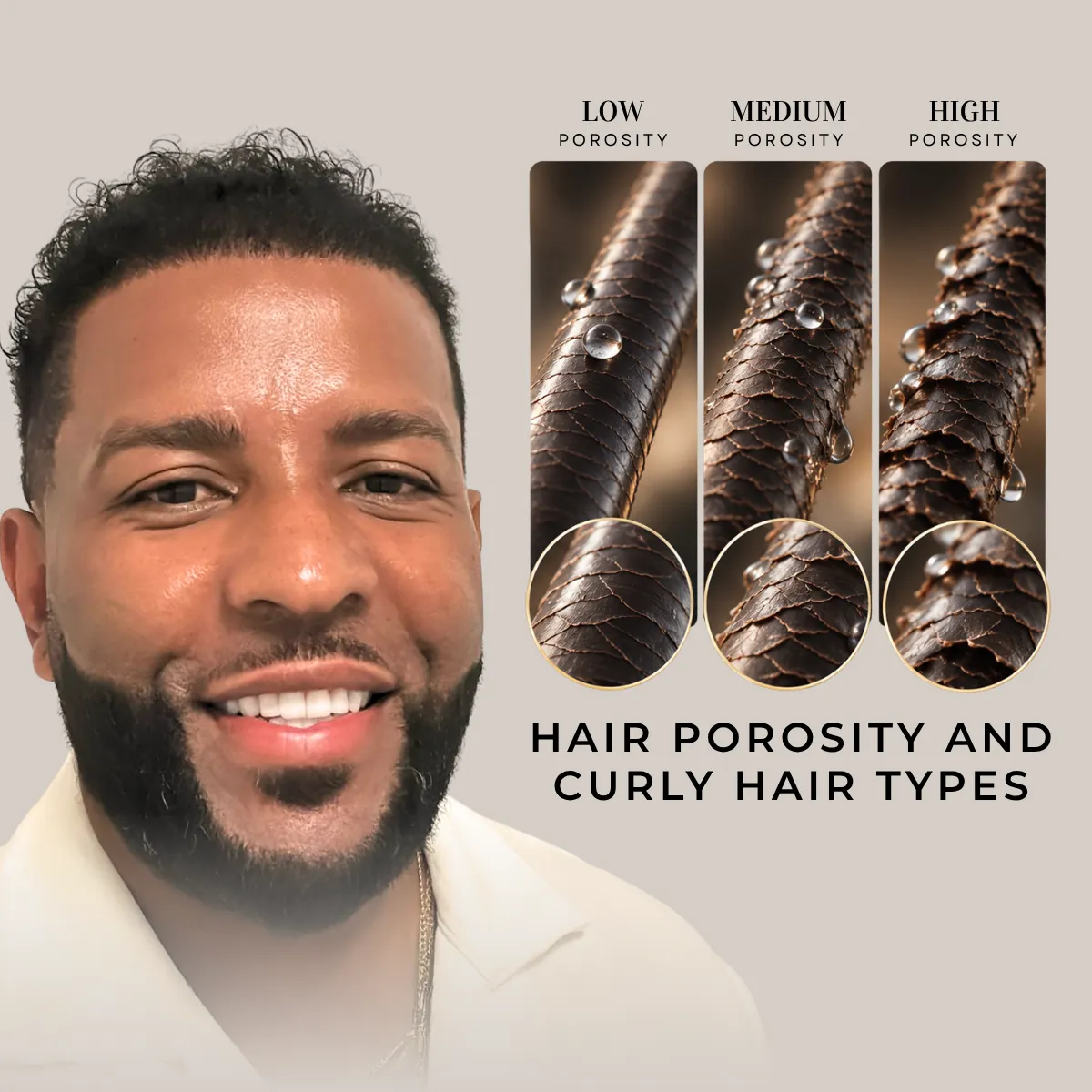
Hair Porosity and Curly Hair Types
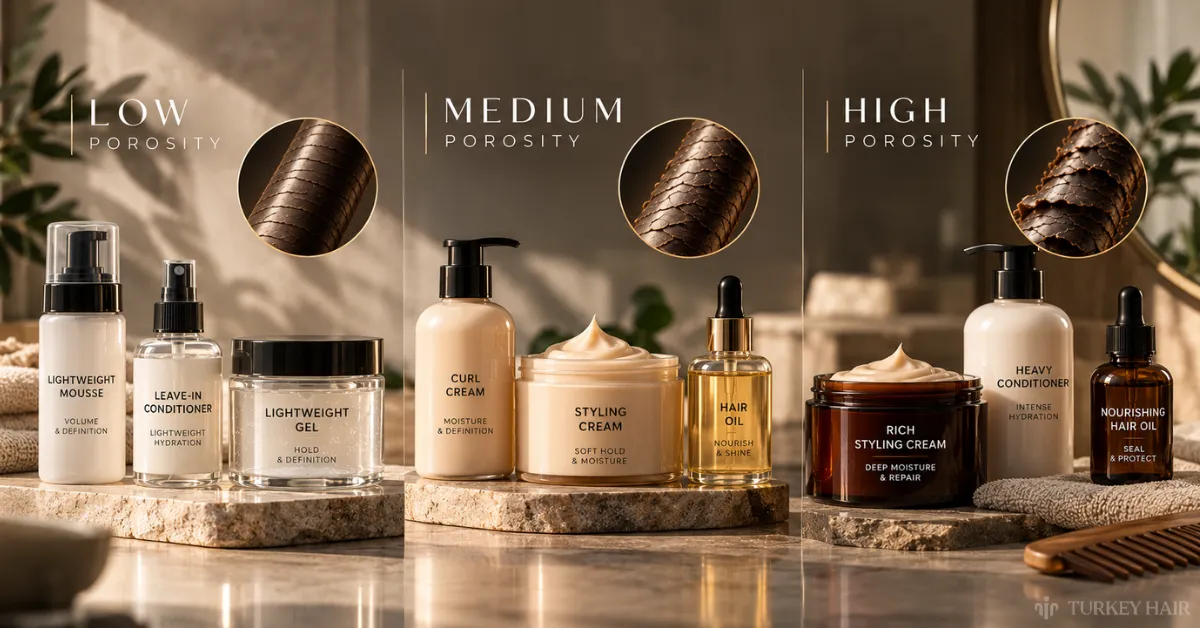
Hair porosity describes how readily hair takes in and retains water and other substances. It can deeply influence how products behave on your hair.
What Is Hair Porosity?
Porosity is determined by the structure of the cuticles-the outer layer of the hair. It describes how easily hair takes in and holds onto moisture.
Low-Porosity Curly Hair
The cuticles lay relatively flat. Water tends to bead up on the hair initially instead of sinking in quickly. Products might sit on top of the hair and cause buildup if they are too heavy.
Medium-Porosity Hair
The cuticles are slightly open. The hair absorbs moisture easily and holds onto it fairly well.
High-Porosity Curly Hair
The cuticles are more raised or open. The hair absorbs water instantly but can also lose that moisture just as fast, which sometimes leads to dryness and frizz.
Curl Type vs Porosity: Why They Are Different
Curl type is your shape. Porosity describes how easily hair takes in and holds onto moisture. Managing one often requires understanding the other.
Does Porosity Determine Your Curl Type?
No. You can have low-porosity 4C coils or high-porosity 2A waves. They are independent traits.
What Is Hair Shrinkage and How Does It Affect Curl Type?
Shrinkage is a completely normal, healthy trait. But it drastically changes how long your hair actually appears.
Why Curly and Coily Hair Shrinks
As hair dries, the spirals and coils retract toward the scalp. The tighter the curl pattern, the more noticeable this shrinkage can be.
Shrinkage in Type 3 Hair
Type 3 curls often shrink noticeably once fully dry, sometimes appearing much shorter than their actual stretched length.
Shrinkage in Type 4 Hair
Type 4 coils can show substantial shrinkage, although the amount varies from person to person. Some tightly coiled hair might appear significantly shorter when fully dry compared to its wet state.
How to Identify Your Curl Pattern Despite Shrinkage
Wet hair can make the natural structural shape easier to see. However, the final comparison should also consider how the pattern behaves once it is completely dry.
How to Identify Your Curl Type at Home
Identifying your pattern is a straightforward process.
Step 1: Wash Your Hair: Start with a clean slate. A clarifying shampoo can help remove product buildup that might weigh the hair down.
Step 2: Avoid Heavy Styling Products: Skip the gels and heavy leave-in conditioners for a moment. You want to see the hair in its raw state.
Step 3: Let Your Hair Air Dry: Avoid the blow dryer. Let it air dry naturally to see how the strands form on their own.
Step 4: Observe Your Natural Pattern : Look at the hair. Does it wave slightly? Does it form a ringlet? Does it zigzag?
Step 5: Look at Multiple Sections: Check the front, the crown, and the nape of your neck. The patterns will likely look a bit different.
Step 6: Compare Your Pattern With the 2A-4C Chart: Match the most dominant shape you see against the standard curl type chart.
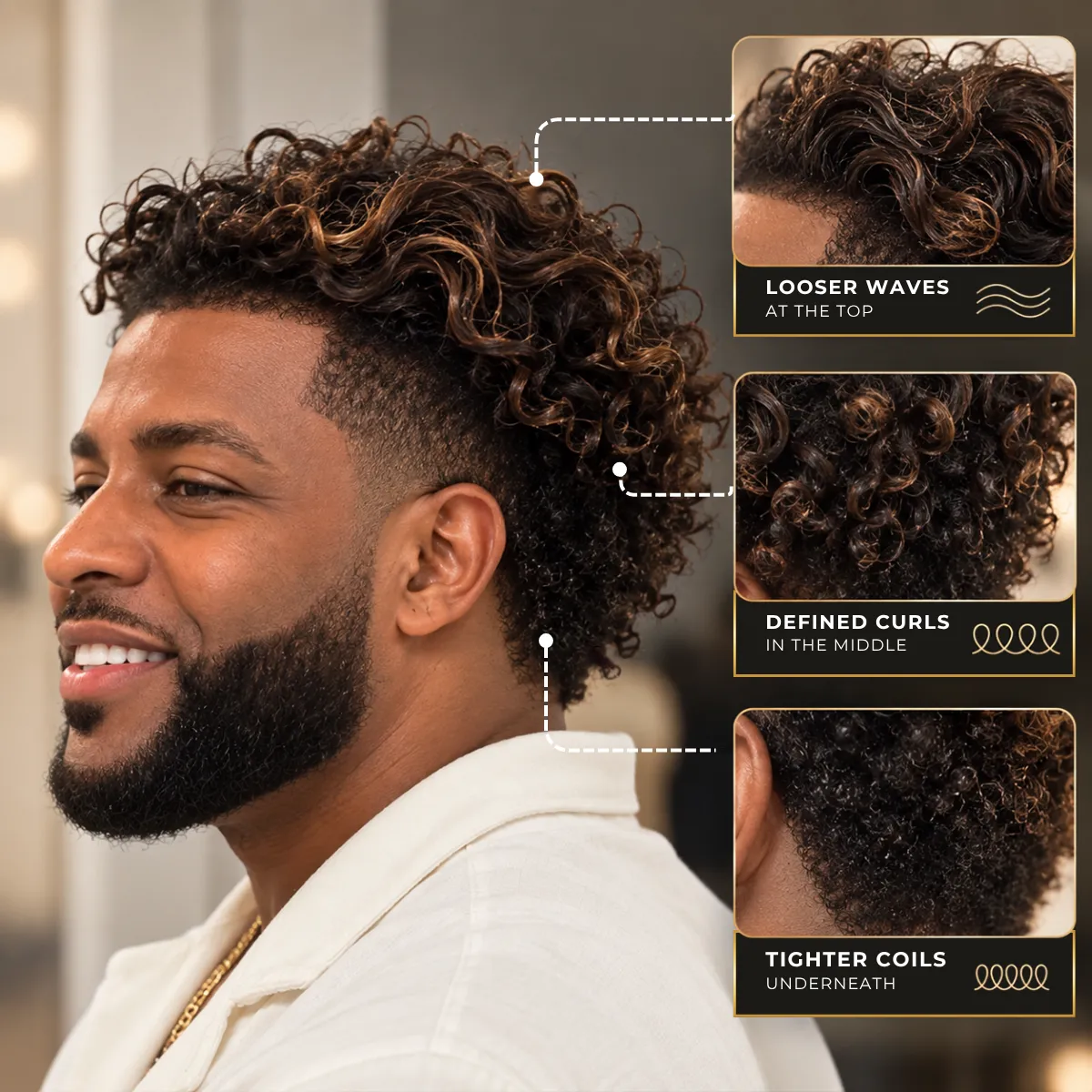
Can You Have More Than One Curl Type?
Yes. It is common for different areas of the same head to show slightly different patterns.
Why Hair Can Have Multiple Curl Patterns
It is common for different areas of the scalp to produce hair with slightly different curl patterns.
Different Curl Types on the Same Head
It is normal to have 3B curls framing your face, while a looser 3A pattern sits underneath near the nape of your neck.
Root Pattern vs Hair Length
Hair sometimes looks looser at the roots because the weight of the strand pulls the curl down. The true pattern is often more visible toward the ends.
How Damage Can Change the Appearance of Your Curl Pattern
Repeated heat styling can damage the hair shaft and may make the curl pattern look less defined. If your ends are straight while your roots remain curly, damage may be one possible explanation rather than a completely different curl type.
How to Care for Multi-Pattern Curly Hair
Many people find it helpful to spot-treat their hair. Applying richer products to the tighter sections and lightweight mousses to the looser waves can balance the final look.
Type 2C Hair vs Type 3A Hair: What's the Difference?
This is one of the most highly debated transitions on the curl chart.
Type 2C Hair Wave Pattern: Type 2C is a strong wave. It forms a deep "S" shape from the root down, but it rarely loops around into a full circle.
Type 3A Curl Pattern: 3A is definitively curly. The hair completes a loop, creating a large spiral.
How to Tell Type 2C and Type 3A Apart
A useful way to compare the two is to pull a strand out. If it springs back into a spiral, it leans toward 3A. If it crinkles back into a heavy wave, it is likely type 2C.
Type 3B Hair vs Type 3C Hair vs Type 4A Hair: What's the Difference?
The transition from curly to coily changes how the hair looks and feels.
Type 3B Curl Pattern: Type 3B curls are tight, springy ringlets with a medium circumference.
Type 3C Curl Pattern: Type 3C curls are tightly packed corkscrews.
Type 4A Coil Pattern: Type 4A is classified within the coily family and has a clearly defined, springy S-shaped pattern.
Key Differences in Shape and Definition
Type 3B hair and type 3C hair hang down as ringlets. 4A tends to grow out and up, forming a dense, structured coil.
Can Your Curl Pattern Change Over Time?
Your pattern isn't always locked in forever. Various factors can alter it.
Hormonal Changes
Puberty, pregnancy, and menopause can sometimes influence follicle structure. Hair might become slightly curlier or straighter during these shifts.
Age and Hair Changes
As we age, hair follicles may produce less oil. This dryness can sometimes make curls lose their bounce or appear frizzier.
Heat and Chemical Damage
Flat irons and chemical relaxers break the bonds that create your curl shape.
Hair Coloring and Bleaching
Bleach strips the cuticle. Severely bleached hair occasionally loses its curl pattern because the structural integrity is compromised.
Haircuts and Growing Your Hair Out
Long hair is heavy. That weight pulls the curl out. Cutting your hair into a bob can instantly make your curl pattern look tighter.
Changes After Hair Treatments
Keratin treatments artificially force the hair straight. The curl usually returns as the treatment washes out over time.
How to Care for Different Curly Hair Types
Since each pattern interacts with moisture differently, adjusting your daily routine can make styling much easier.
Hair Care for Type 2A Hair and 2B Waves
Lightweight shampoos and foams usually work better for looser waves, mainly because heavy styling creams can easily flatten the hair.
Hair Care for Type 2C Hair
Many people find that a light leave-in conditioner paired with a flexible holding gel helps keep this aggressive "S" pattern intact throughout the day.
Hair Care for Type 3A Hair and 3B Curls
Because these ringlets can dry out quickly, working a solid deep conditioning routine into your schedule can help maintain their natural definition.
Hair Care for Type 3C Curls
Tight corkscrews generally respond well to layered products. Applying a leave-in conditioner beneath a styling cream often provides the right balance of moisture and hold.
Hair Care for Type 4A Hair, Type 4B Hair and Type 4C Hair
Keeping delicate coils moisturized is usually the main goal here. The LOC method (Liquid, Oil, Cream) is a popular technique to help seal that necessary hydration into the hair.
How to Choose Products for Your Curl Type
Rather than strictly following the front of the bottle, checking ingredients against your texture and porosity often yields better results.
Lightweight Products for Fine Waves
Mousses, foams, and water-based sprays can provide hold without dragging fine hair down.
Moisturizing Products for Dry Curls
For dry curls, moisturizing formulas may help improve softness and manageability. The right choice still depends on strand thickness, porosity, and how your hair responds to products.
Hold Products for Defined Curls
Gels and custards are great options if you want to extend the life of your styled curls.
Products for Coily Hair
Depending on strand thickness and porosity, some coily hair benefits greatly from richer creams or oils to combat extreme dryness.
When Heavy Products Cause Buildup
If your hair feels sticky or looks dull, your products may be too heavy for your hair type or porosity. Clarifying the hair and switching to lighter formulas usually helps.
Common Curly Hair Type Mistakes
Misunderstanding the framework can make styling harder than it needs to be.
Confusing Hair Texture With Curl Pattern: Shape does not equal thickness. Fine 3C hair needs totally different care than coarse 3C hair.
Classifying Hair While It Is Wet: Water can temporarily weigh the hair down and alter its appearance. Evaluating it when it's clean and air-dried gives a more accurate picture of everyday styling needs.
Using Too Much Styling Product: More cream doesn't always equal more curls. It can sometimes result in flat, greasy hair.
Comparing Your Hair to a Single Photo: Lighting and heavy styling on social media can completely distort what natural curl patterns actually look like.
Ignoring Shrinkage: Fighting shrinkage too aggressively with heat can end up damaging the coils.
Assuming Everyone Has One Curl Type: Multiple patterns are completely normal. Very few people have perfectly uniform hair.
Treating the 2A-4C System as a Medical Diagnosis: It is a styling guide. Don't obsess over the letters too much; the overall health of your scalp is far more important.
When Curly Hair Concerns Need More Than a Routine Change
Sometimes frizz isn't just frizz. Certain changes might prompt a discussion with a healthcare provider.
Sudden Changes in Curl Pattern
If your hair suddenly loses its pattern, it might simply be severe damage. But occasionally, significant, unexplained changes can prompt a discussion with a doctor about hormonal shifts.
Unusual Hair Breakage
Excessive snapping near the root could point to severe structural damage or styling practices that need adjusting.
Sudden Hair Thinning
Sudden or noticeable thinning can have many causes, including excessive shedding, breakage, or medical hair-loss conditions.
Scalp Pain, Scaling or Inflammation
If your scalp burns, itches intensely, or develops thick scales, you might be dealing with a dermatological condition rather than a simple styling issue.
Persistent Hair Loss
If shedding doesn't stabilize after a few months, professional guidance is usually recommended.
When to See a Dermatologist or Hair Specialist
If these changes are sudden, persistent, or accompanied by scalp symptoms, a dermatologist can help determine whether an underlying scalp or hair-loss condition is involved.
Frequently Asked Questions
How many curl types are there?
Nine: 2A, 2B, 2C for waves, 3A, 3B, 3C for curls and 4A, 4B, 4C for coils. Type 1 is straight hair and has no curl pattern, which is why the curl scale starts at 2.
What is the difference between 3C and 4A?
Width and spring. A 3C corkscrew is roughly the width of a pencil and forms a rounded spiral; a 4A coil is nearer the width of a crochet needle and holds a tighter, more compressed S. 4A also shrinks considerably more.
Can I have more than one curl type?
Almost everyone does. A step of difference between crown, nape and hairline is normal. Work with your loosest pattern when choosing a cut and your tightest when planning moisture.
Why does my curl pattern look different when it is wet?
Water weighs hair down and stretches the pattern out, so wet hair reads looser and longer. Your true pattern is what you see once it has dried untouched, and the difference between the two is your shrinkage.
Is 4C hair the same as having no curl pattern?
No. 4C has the tightest pattern of all - so tight that it is difficult to see when dry. Wet the hair or apply product and the zig-zag becomes clearly visible.
Can straightening permanently ruin my curls?
Repeated high heat can, yes. Once the disulphide bonds are broken the curl does not return to that length, and only new growth will carry the original pattern. Occasional straightening with heat protection and a moderate temperature is far less likely to cause it.
Which curl type is the most fragile?
4B and 4C. Sharp angles concentrate stress at each bend, so coily hair snaps more readily than looser patterns even when it feels thick and strong.
Does curl type affect how fast hair grows?
Growth at the follicle is broadly similar across patterns. Coily hair appears to grow more slowly because shrinkage hides the length and because breakage at the ends removes it as quickly as it arrives - a retention problem rather than a growth problem.
Understanding Your Curl Type From 2A to 4C
The 2A to 4C chart can be a useful starting point, but it does not describe every aspect of your hair.
Your actual curl pattern only dictates the shape. To truly understand your hair, you also have to consider your texture, density, porosity, and shrinkage. Once you combine all those factors, finding the right daily routine becomes significantly easier.
About the Author
Written by: Nazmi G., Senior Trichologist & Hair Restoration Consultant. Nazmi focuses on patient education, helping individuals understand their unique hair biology beyond simple consumer marketing terms.
Medical Review Note
Medical Review: Dr. Tompi, M.D., Plastic & Aesthetic Surgeon. The clinical concepts surrounding follicle structure, hair texture, density, and general scalp health were reviewed for accuracy.
Editorial Policy & Trust
Medical information in this article is intended for educational purposes and should not replace an individual dermatological evaluation. We do not endorse the 2A-4C system as a medical diagnostic tool.
References and Medical Sources
American Academy of Dermatology (AAD). Caring for Curly and Coily Hair. (aad.org)
Mayo Clinic. Hair loss: Symptoms, causes, and medication interactions. (mayoclinic.org)
Trüeb RM, Rezende HD, Dias MFRG. A Comment on the Science of Hair Aging. Int J Trichology. 2018 (pubmed.ncbi.nlm.nih.gov)
Send three photos: front, top and sides. You get a technique recommendation, a graft range and a straight answer about what is achievable, before anyone talks about price.
Your details are with the team
A patient coordinator will get back to you shortly. If you would like to send your photos now, WhatsApp is the fastest way to do it.
We respond quickly, day or night, in your language.
Multilingual team, no obligation
Data protectedKVKK and GDPR compliant, 100% confidential
Authorized Health Tourism Intermediary
Turkey Hair Center is the hair-restoration brand of Healthy Way Tourism, an authorized international health-tourism intermediary. All medical procedures are performed by licensed medical professionals at authorized healthcare facilities in Turkiye, in accordance with the regulations of the Ministry of Health.