Performed at authorized partner hospitals Turkey Hair Center is a Ministry of Health authorized health-tourism intermediary, not a clinic.
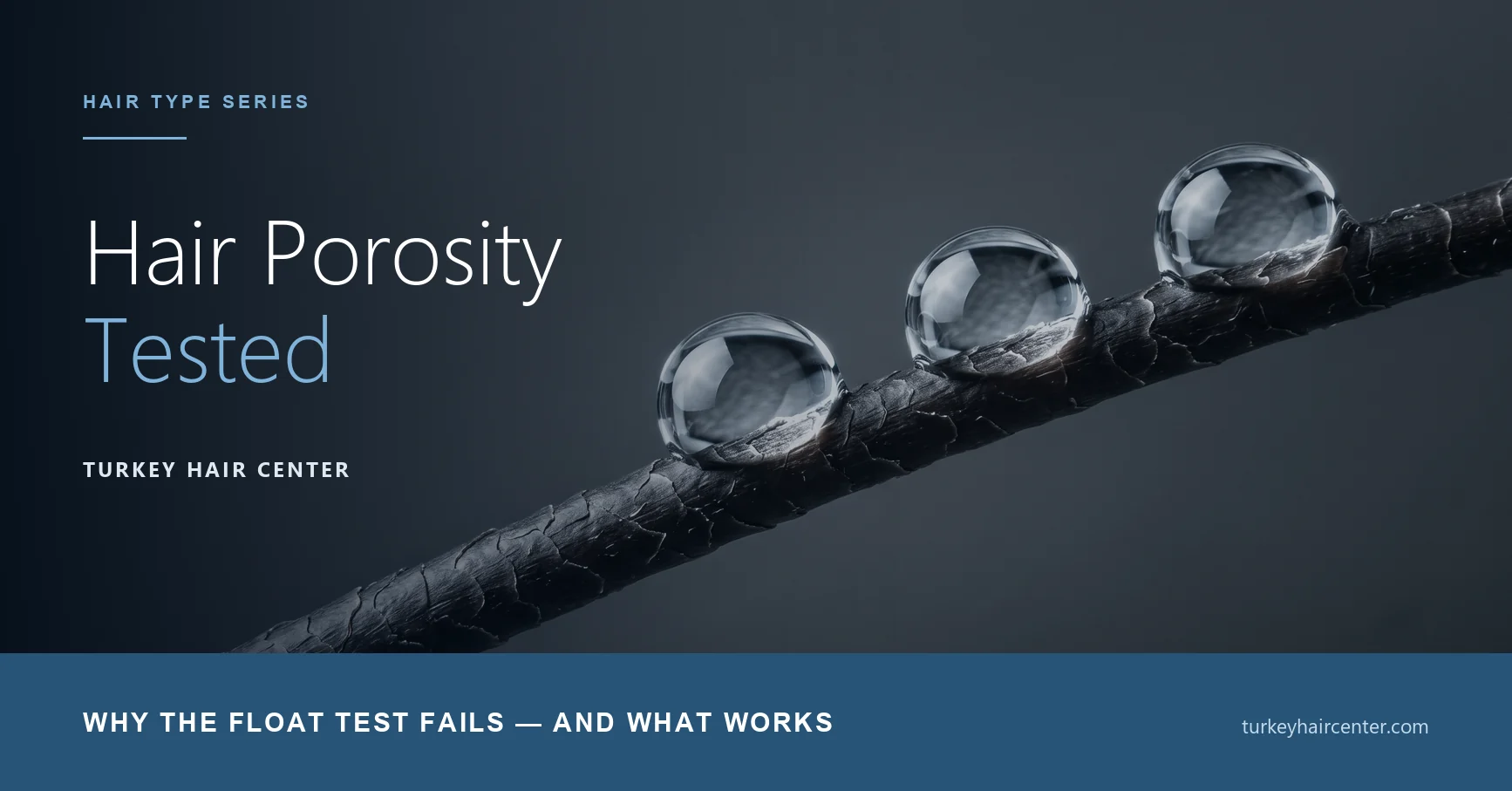
Hair porosity is how readily your hair lets water in and how long it holds on to it: and it is decided by the cuticle, the overlapping outer layer of the strand. When those scales lie flat and tight, water struggles to get in: that is low porosity. When they are raised or damaged, water rushes in and escapes just as fast: that is high porosity. Medium porosity sits between the two and is the least demanding to look after.
Porosity matters more than curl pattern for one specific decision: which products actually work on your hair. Two people can both have 3B curls and need opposite routines, because one has a cuticle that resists moisture and the other has one that cannot hold it. If your hair “does not respond” to products that everyone else swears by, porosity is usually the reason.
Low, medium and high porosity compared
Low porosity
Medium porosity
High porosity
Cuticle
Tightly closed, lies flat
Slightly raised, even
Raised, lifted or broken
Getting wet
Water beads on the surface; takes minutes to soak through
Wets evenly and quickly
Soaks instantly, feels saturated
Drying time
Long: often hours
Moderate
Fast, then feels dry again
Product behaviour
Sits on top, builds up, feels coated
Absorbs well
Disappears; hair feels thirsty within hours
Feel of the strand
Smooth, slippery
Slightly textured
Rough, catches on the finger
Usually caused by
Genetics
Genetics
Genetics, or damage from bleach, heat, chemicals
Needs most
Heat to open the cuticle; light products
Balance; little intervention
Protein and sealing; heavier products
Biggest mistake
Heavy butters and oils
Over-treating
Moisture with no protein
Porosity is independent of curl pattern and of strand thickness. Straight 1A hair can be high porosity; coily 4C hair can be low porosity.
How to test your hair porosity
Why the float test is not reliable
The most repeated test: dropping a strand into a glass of water and seeing whether it sinks: is the one worth ignoring. Surface tension keeps almost any clean, dry strand floating for the first few minutes regardless of porosity, and any residue of oil or silicone makes it float longer still. A strand that has been sitting on a hairbrush is coated in sebum by definition. The test produces a confident-looking answer from a mechanism that has nothing to do with the cuticle.
Use behaviour, not tricks. The most accurate porosity test is how your hair acts in the shower and afterwards: something you observe every week without doing anything special. The three checks below all read that behaviour rather than trying to simulate it.
Three tests that do work
The wetting test. In the shower, note how long your hair takes to feel properly wet through rather than wet on the surface. Under 30 seconds points to high porosity. Two minutes or more, with water visibly beading at first, points to low porosity.
The drying test. Time how long clean, product-free hair takes to air-dry completely. Low porosity hair holds water at the surface and takes markedly longer than hair of the same length and thickness; high porosity hair dries fast and then feels rough.
The slide test. Take one clean strand and run it between finger and thumb from tip towards root, against the direction of growth. Smooth and slippery means the cuticle is lying flat: low porosity. Bumpy, catching, slightly rough means the cuticle is raised: high porosity.
Do all three. If two of them agree, that is your porosity. If they disagree, your hair is probably mixed: commonly low porosity at the root and high porosity at the ends, which is what years of heat or colour does to the oldest part of the strand.
Low porosity hair: what actually works
The defining problem is not dryness. It is that moisture cannot get in, and once product is sitting on the outside of a closed cuticle it stays there, layer on layer, until the hair feels waxy and lifeless. Low porosity hair is far more often over-conditioned than under-conditioned.
Use warmth to open the cuticle. Apply conditioner or a mask to warm, damp hair and cover it: a shower cap, or a warm towel for ten minutes. This single change does more than any product swap.
Go light. Water-based leave-ins, milks and thin creams. Heavy butters, shea, castor oil and thick sealants sit on the surface and suffocate the hair.
Clarify regularly. Every three to four weeks, or whenever the hair stops responding. Build-up is the standing enemy here.
Be cautious with protein. The cuticle is already tight; excess protein makes low porosity hair stiff and brittle rather than strong.
Dilute your products. Mixing leave-in with water in a spray bottle distributes it far better than applying it neat.
High porosity hair: what actually works
Here the strand takes moisture in eagerly and loses it just as fast, because the raised cuticle has no way of holding it. The goal is not to add more water: it is to close the door behind it.
Layer, then seal. Water-based leave-in first, cream second, oil or butter last. The final oily layer is what keeps the water in; oil applied to dry hair only seals dryness in.
Use protein deliberately. High porosity usually means damage, and protein treatments fill the gaps in the cuticle. Every two to four weeks, not every wash: too much protein causes brittleness.
Finish cool. A cold rinse at the end of the shower helps the cuticle lie flatter, at least temporarily.
Cut the cause. Bleach, high heat and chemical straightening are what raised the cuticle in the first place. Products manage the symptom; stopping the damage is the actual fix.
Acidic rinses help. A diluted apple cider vinegar rinse lowers the pH and encourages the cuticle to close.
Medium porosity needs the least. If your hair wets in about a minute, dries in a normal amount of time and holds a style without much fighting, do not go looking for a problem. Medium porosity hair is damaged more often by over-treatment than by neglect.
Porosity and curl pattern are different things
This is where most routines go wrong. Curl pattern describes the shape of the strand and is set by the follicle. Porosity describes the surface of the strand and is set by the cuticle, which damage can change. They are independent, and you need both to choose products sensibly.
If you are…
The practical consequence
Type 1-2, low porosity
The most easily weighed-down combination. Almost everything is too heavy. Lightweight foams and sprays only.
Type 1-2, high porosity
Usually colour or heat damage. Protein first, then a light sealant; heavy oils will still flatten it.
Type 3-4, low porosity
The most misdiagnosed group. Looks dry, is told to use butters, gets build-up instead. Needs heat and light products.
Type 3-4, high porosity
The classic layering routine works exactly as written: leave-in, cream, oil, and protein regularly.
Work out your curl pattern with the hair type chart first, then apply porosity on top of it.
If you have not identified your curl pattern yet, start with the complete hair type chart from 1A to 4C, then come back to this page. The deep guides for each family cover porosity within their own context: type 1 straight, type 2 wavy, type 3 curly and type 4 coily.
Can you change your hair porosity?
Partly, and only in one direction reliably. You cannot make a genetically low-porosity cuticle permanently more open, and you would not want to: a tight cuticle is a healthy one. What you can do is stop porosity from rising.
High porosity from damage can be improved by cutting off the damaged length and preventing new damage. Protein and sealing manage it in the meantime, but they do not repair the cuticle permanently.
Low porosity cannot be “fixed” because it is not a fault. It is managed with warmth and lighter products.
Porosity rises with age and with every chemical service. Bleaching raises it the most, in a single session.
Nothing you apply topically changes the porosity of new growth. The follicle decides what comes out of the scalp.
Frequently Asked Questions
What is hair porosity in simple terms?
How easily water gets into your hair and how well it stays there. It depends on whether the cuticle scales on the outside of each strand lie flat and closed or are raised and open.
Is low porosity hair healthy or unhealthy?
Healthy. A tightly closed cuticle is what undamaged hair looks like. Low porosity is only a problem in the sense that it makes moisturising harder, not because anything is wrong with the hair.
Does the float test actually work?
Not reliably. Surface tension keeps most clean strands floating regardless of porosity, and any oil or product residue keeps them floating longer. Judge by how your hair behaves when it gets wet and how long it takes to dry instead.
Can hair be low porosity at the root and high at the ends?
Yes, and it is very common. The ends are the oldest part of the strand and have taken years of heat, colour and friction, so their cuticle is more raised than that of new growth. Treat the two lengths differently.
Why does my low porosity hair feel greasy after conditioning?
Because the conditioner never went in. It is sitting on a closed cuticle. Use less, use lighter formulas, apply to warm damp hair under a cap, and clarify to remove what has already accumulated.
Do I need protein for low porosity hair?
Rarely, and sparingly. Low porosity hair is usually protein-sensitive: too much makes it stiff and prone to snapping. Protein is mainly a high-porosity tool.
Does porosity change what shampoo I should use?
Yes. Low porosity hair needs regular clarifying because build-up is the main problem. High porosity hair needs gentle, sulphate-free cleansing because it cannot afford to lose the little moisture it holds.
Is high porosity always caused by damage?
No. Some people are genetically high porosity, and very tightly coiled hair tends to have a naturally more raised cuticle at the bends. But a sudden shift to high porosity after bleaching, straightening or heavy heat use is damage.
Does porosity matter for a hair transplant?
Not for the surgery itself. Porosity is a property of the hair shaft above the skin, while a transplant moves the follicle beneath it, so it does not affect how grafts are extracted or placed. Curl pattern does affect the operation: porosity does not.
It matters afterwards, in two practical ways. Transplanted hair keeps the characteristics of the donor area, so if your donor hair is high porosity the new growth will be too, and it will need the same sealing routine. And during the healing period, when the scalp is sensitive and washing is restricted, knowing whether your hair holds moisture or loses it helps you pick post-operative products that will not cause build-up on a healing scalp. Our aftercare guide covers the washing schedule in detail.
Note on medical information. This page explains hair porosity and general hair care. It is not medical advice or a diagnosis. Persistent scalp irritation, unusual shedding or a sudden change in hair texture should be assessed by a doctor rather than managed with products.
Medical disclaimer: This article is for informational purposes only and is not medical advice. Individual results vary from person to person. Always consult a qualified doctor before any hair transplant procedure.
Send three photos: front, top and sides. You get a technique recommendation, a graft range and a straight answer about what is achievable, before anyone talks about price.
Your details are with the team
A patient coordinator will get back to you shortly. If you would like to send your photos now, WhatsApp is the fastest way to do it.
We respond quickly, day or night, in your language.
Multilingual team, no obligation
Data protectedKVKK and GDPR compliant, 100% confidential
Authorized Health Tourism Intermediary
Turkey Hair Center is the hair-restoration brand of Healthy Way Tourism, an authorized international health-tourism intermediary. All medical procedures are performed by licensed medical professionals at authorized healthcare facilities in Turkiye, in accordance with the regulations of the Ministry of Health.