FUE Hair Transplant in Turkey: Cost, Grafts & Recovery
Achieve natural, long-lasting hair restoration with advanced FUE hair transplant procedures in Turkey.
Performed at authorized partner hospitals Turkey Hair Center is a Ministry of Health authorized health-tourism intermediary, not a clinic.
Combining expert surgeons, modern techniques, and affordable all-inclusive packages, Turkey has become one of the most popular destinations for FUE hair transplants.
FUE hair transplants in Turkey combine medical precision with an aesthetic touch, offering a long-lasting option for thinning hair without a linear scar.
Clinics in Turkey stand out by offering high-end medical tourism packages. They cover expert surgical care, luxury accommodation, and detailed post-operative support.
If you’re curious about the healing process or real patient before-and-after results after FUE procedure, you will find answers in this blog!
Short answer
FUE (Follicular Unit Extraction) moves hair follicles one by one from the back and sides of the scalp to thinning areas, without the linear scar of the older strip method. An FUE hair transplant in Turkey is done in a single 6-8 hour session under local anesthesia. Our all-inclusive packages, which open the channels with sapphire blades, cost $2,550 to $4,500.
Single session, about 6-8 hours, local anesthesia with sedation support
Included stay
2 hotel nights, VIP transfers, next-day check-up
Back to desk work
Usually 2-5 days
Visible growth
From about month 3-4
Final result
Usually 12-18 months
Often chosen for
Most patterns, from a receding hairline to the crown
FUE Hair Transplant Results Timeline
FUE Result
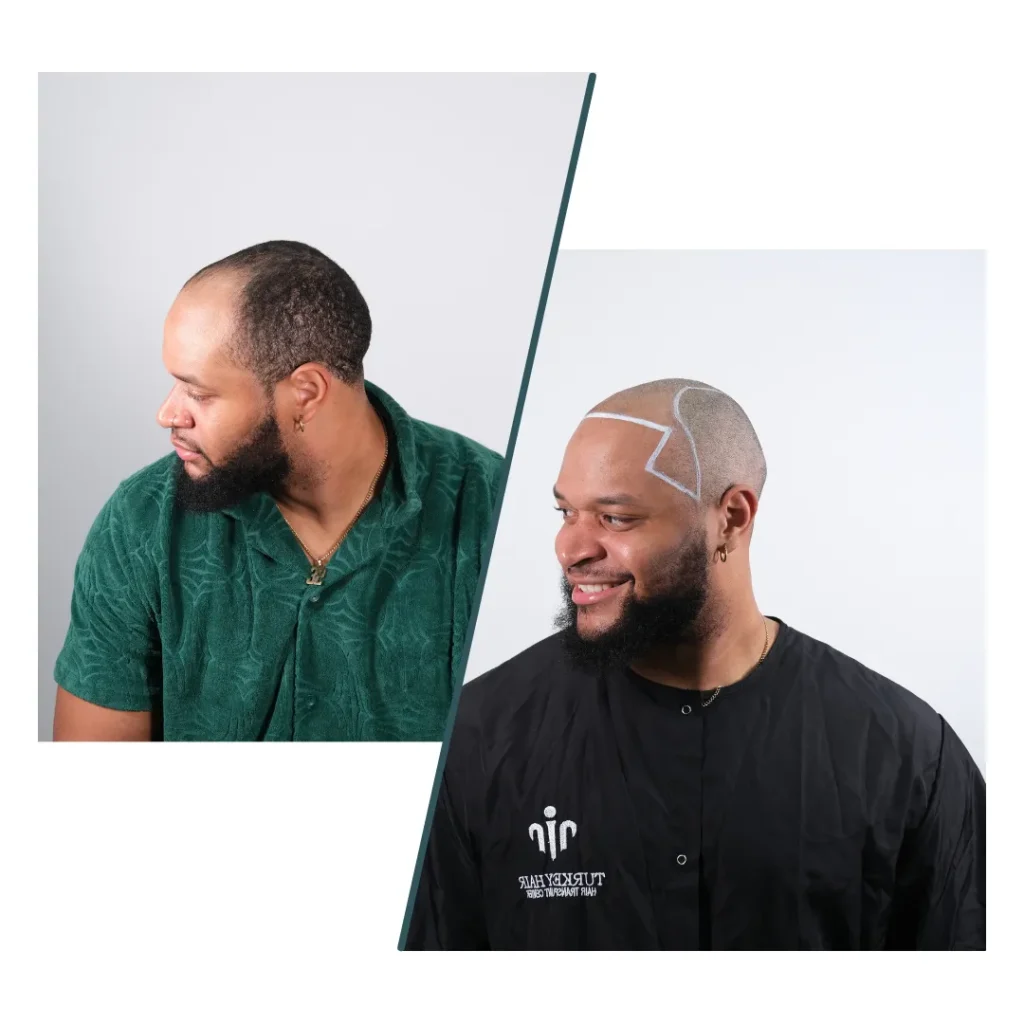
FUE hair transplant results follow the same clock in most patients: shock loss around month 1, new growth from month 3-4, a mature look at about 12 months and crown thickening until month 15-18. So judge before-after FUE hair transplant photos at 12 months: FUE hair transplant before and after pictures from the first weeks show mainly redness and scabs.
DHI vs FUE Results
Long-term growth is generally the same. DHI may look less red at first (about 5-10 days against 7-14 for FUE), but the team's skill matters far more than the technique.
FUE Hair Transplant Results (2000-3500 Grafts)
In most FUE hair transplant before and after male cases, around 2,000 grafts rebuild the frontal hairline; 3,000 can also add mid-scalp density. See cases on our 2000 grafts and 3000 grafts hair transplant pages, and smaller FUE hair transplant 1000 grafts before and after cases.
FUE Hair Transplant Results (3500-5000 Grafts)
Sessions of 3,500-5,000 grafts usually cover the top and crown, with more swelling and a longer crown recovery, up to month 15-18. See our 5000 grafts hair transplant guide.
Get Your Hair Analysis Results
Send photos of your front, top and sides for a free review of your graft range and package; if you prefer not to shave, ask about long hair FUE transplant before and after cases. Get your free hair analysis.
What Is FUE Hair Transplant Surgery?
Fue Hair Transplant In Turkey: Cost
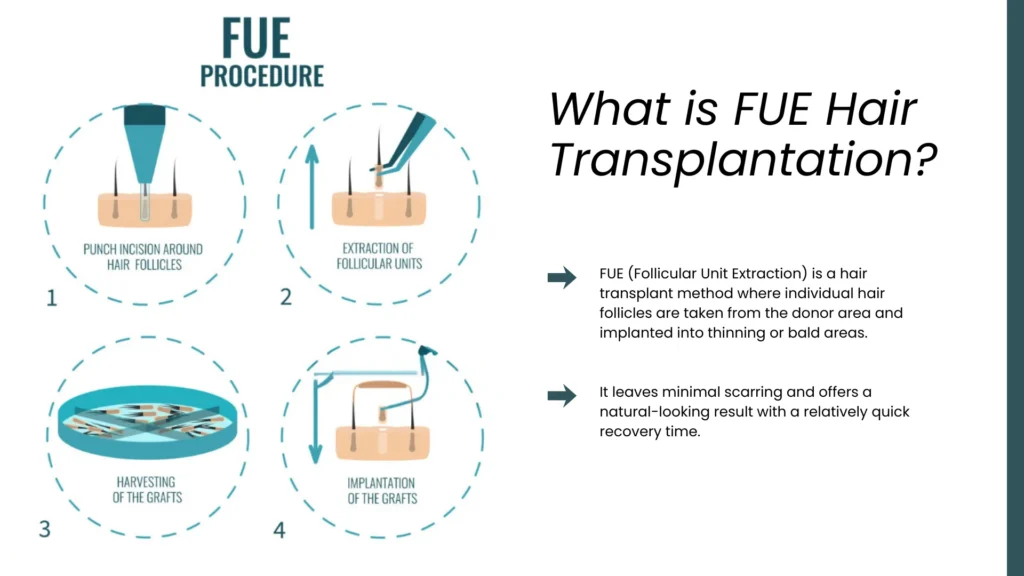
Follicular Unit Extraction (FUE) is a modern and widely preferred method for hair transplantation.
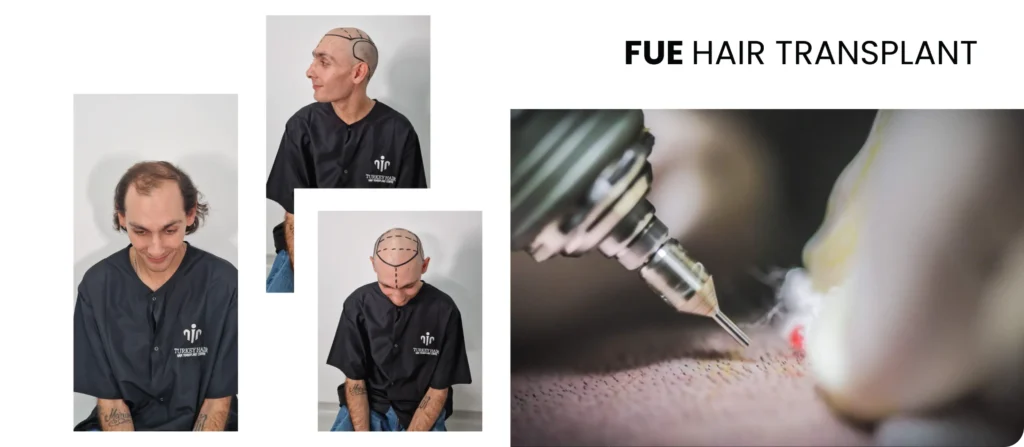
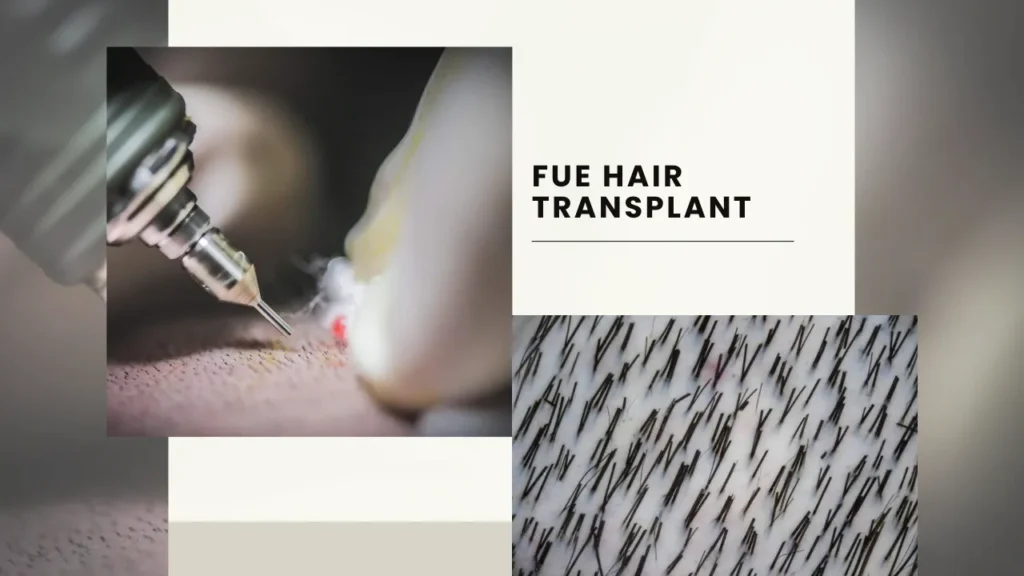
A micromotor is used to extract hair follicles one by one from the donor area at one time. After that, these grafts are gently placed into thinning or bald areas by using microsurgical tools (forceps). Each graft keeps the follicle down to the hair bulb, the part at its base that produces the hair.
In contrast to traditional methods like FUT, the technique FUE doesn’t leave a linear scar in the donor area. This method provides a more natural-looking appearance. Also, the patients feel less discomfort and heal faster thanks to its minimally invasive nature.
What is micro FUE hair transplant? A marketing name rather than a separate technique: "micro" refers to the fine punches (about 0.6-1 mm) and micro-channels every FUE uses. What is bio FUE hair transplant? Usually FUE combined with a supportive treatment such as PRP, which all our packages already include.
Who Is a Good Candidate for FUE Hair Transplant?
Realistic Expectations: A clear understanding of the achievable density and final look is key to patient satisfaction.
Stabilized Hair Loss: Hair loss must be medically controlled or consistent to ensure long-term aesthetic results.
Sufficient Donor Density: A healthy supply of follicles in the donor area (usually the back and sides of the head) is vital for adequate coverage.
Managed Systemic Health: Chronic conditions like diabetes, heart disease, or thyroid issues must be well-managed to prevent complications.
Healthy Scalp Conditions: The scalp must be free of active infections or inflammatory skin diseases.
Fue Hair Transplant In Turkey: Cost
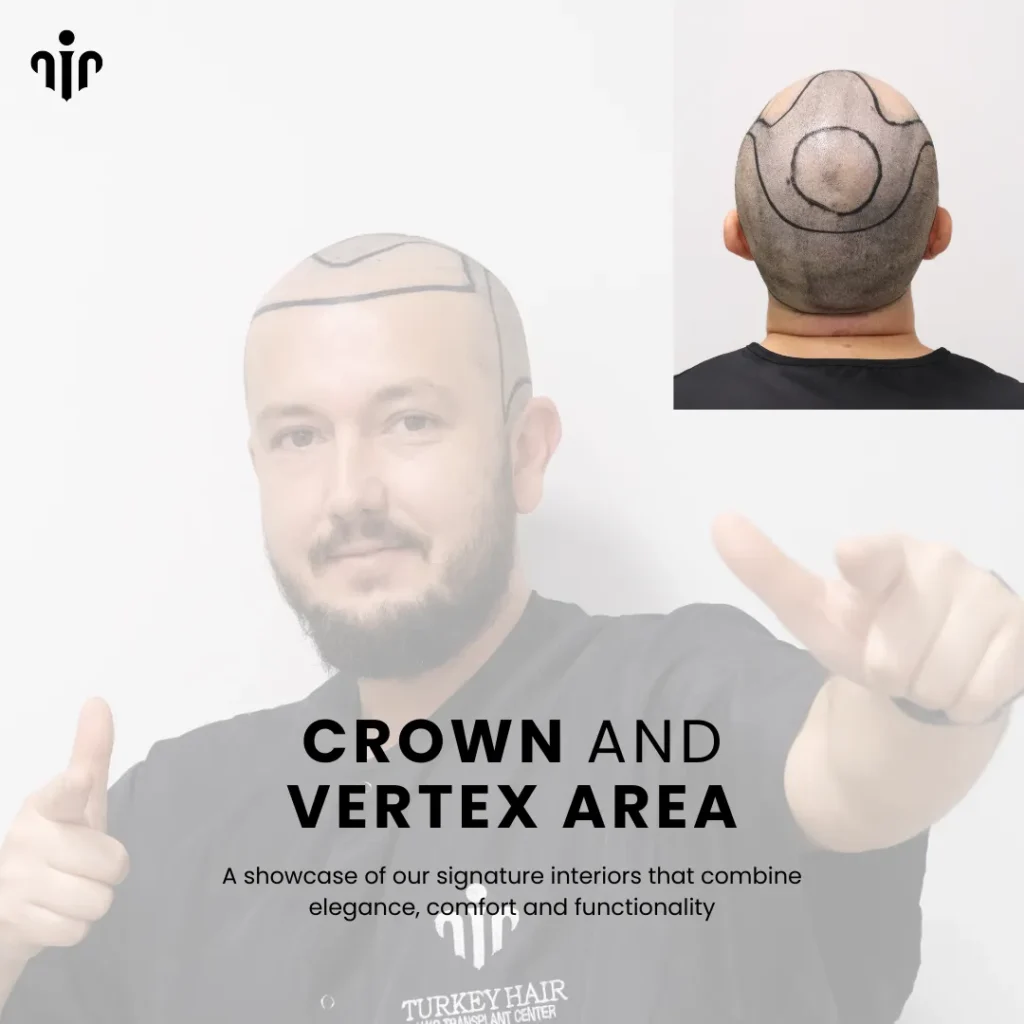
FUE can treat a receding hairline, crown hair transplant FUE cases and diffuse thinning, as long as the donor area can supply enough grafts. Women with stable thinning are assessed the same way; see our hair transplant for women guide, or estimate your stage with the Norwood test.
Does Saw Palmetto Work for Hair Loss?
Saw palmetto is often promoted as a natural DHT blocker. A handful of preliminary studies point to mild benefits, but it cannot match the proven effect of regulated medical treatments. Stabilizing hair loss comes before surgery; read more in our DHT and hair loss guide.
FUT vs FUE
FUE is the umbrella technique: every graft is extracted one by one with a micro-punch. Sapphire FUE changes only the tool that opens the channels, DHI changes how grafts are implanted, and FUT is the older strip method. Our FUE vs DHI comparison sets the two side by side.
FUE extraction, channels opened with sapphire blades
Tiny dot scars
DHI
FUE extraction, implanter pen places each graft without pre-made channels
Tiny dot scars
FUT
A strip of scalp is removed and divided into grafts
Linear scar
Difference Between FUT and FUE
FUT removes a strip of scalp and leaves a linear scar that can stretch; FUE leaves tiny dot scars. That FUE vs FUT scar difference and faster healing are why an FUE hair transplant vs FUT is usually preferred. FUE or FUT, which is better? For most patients who wear short hair, FUE. And FUE hair transplant vs hair transplant? FUE is one way of doing a hair transplant.
FUE vs DHI: Is DHI Better Than FUE?
Not for everyone. DHI is slower and usually costs more (our DHI package is $3,350), while FUE handles larger sessions. Compare both on the same clock: FUE 6 months vs 12 months photos differ a lot.
DHI Hair Transplants: Precision and Natural Results
DHI implants each graft with a Choi pen without pre-made channels, which helps between existing hair and in small areas.
Sapphire FUE vs DHI
Both start with FUE extraction. Sapphire FUE opens channels with sapphire blades; DHI skips the channels and implants with the pen.
Fue Hair Transplant In Turkey: Cost
Sapphire FUE Hair Transplant: Advanced Method for Optimal Outcomes
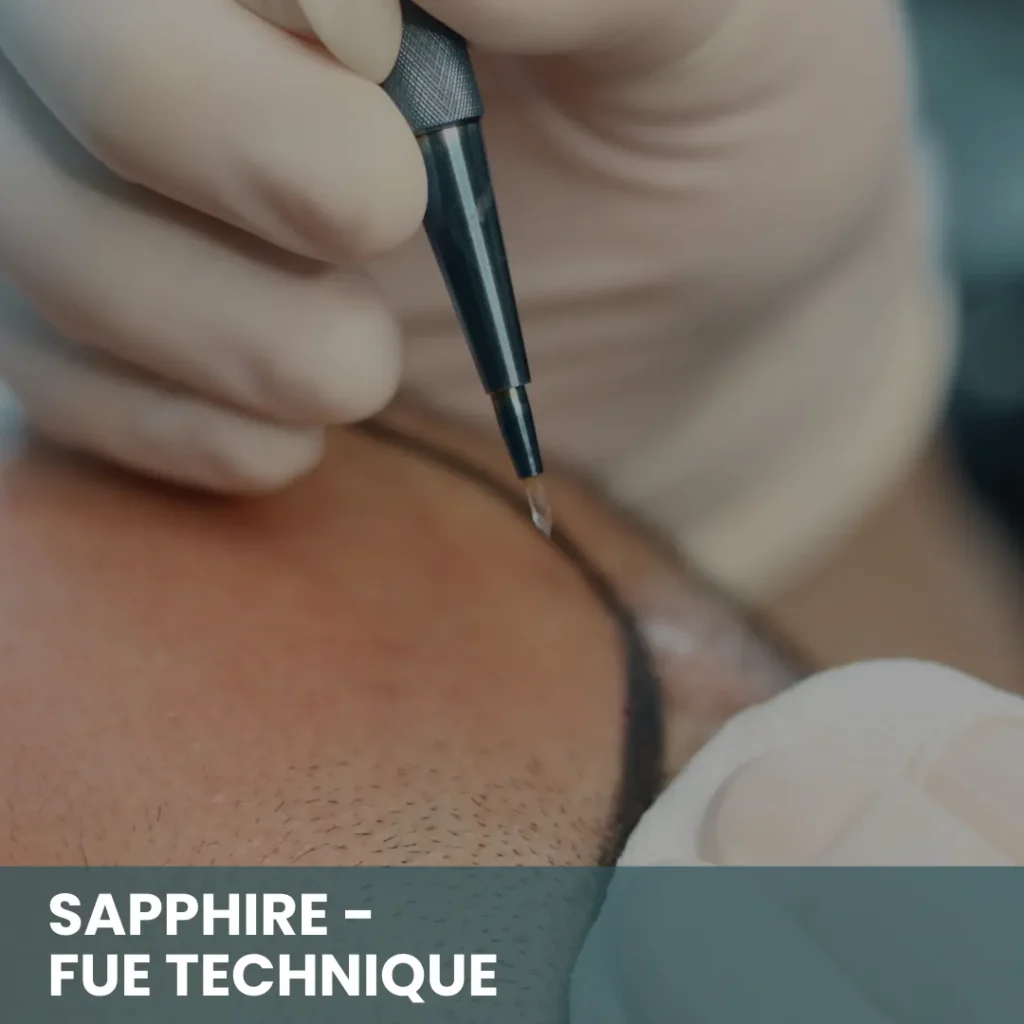
Sapphire FUE is an advanced variation of FUE that uses ultra-sharp sapphire blades to create recipient channels. Thanks to their smooth surface, these blades allow for smaller, more precise incisions, reducing tissue trauma and supporting faster healing.
This precision helps achieve denser, more natural-looking results. However, choosing Sapphire FUE depends on factors like scalp condition, skin elasticity, and desired density: there’s no one-size-fits-all approach.
All our FUE packages use sapphire blades.
FUE Hair Transplant Procedure
FUE hair transplant procedure time is usually 6-8 hours in a single session, so the answer to "FUE hair transplant: how long does it take?" is one day at the hospital.
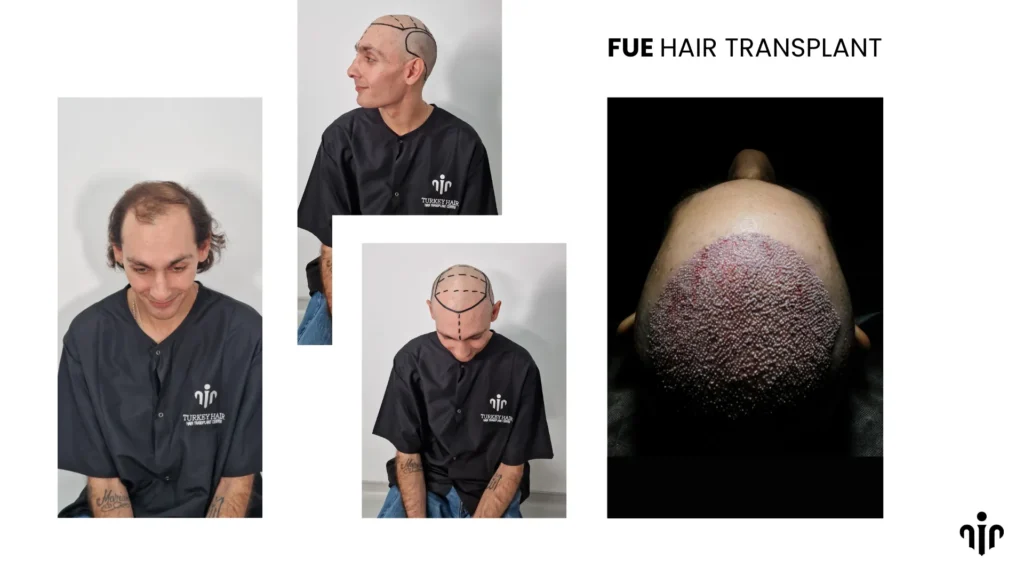
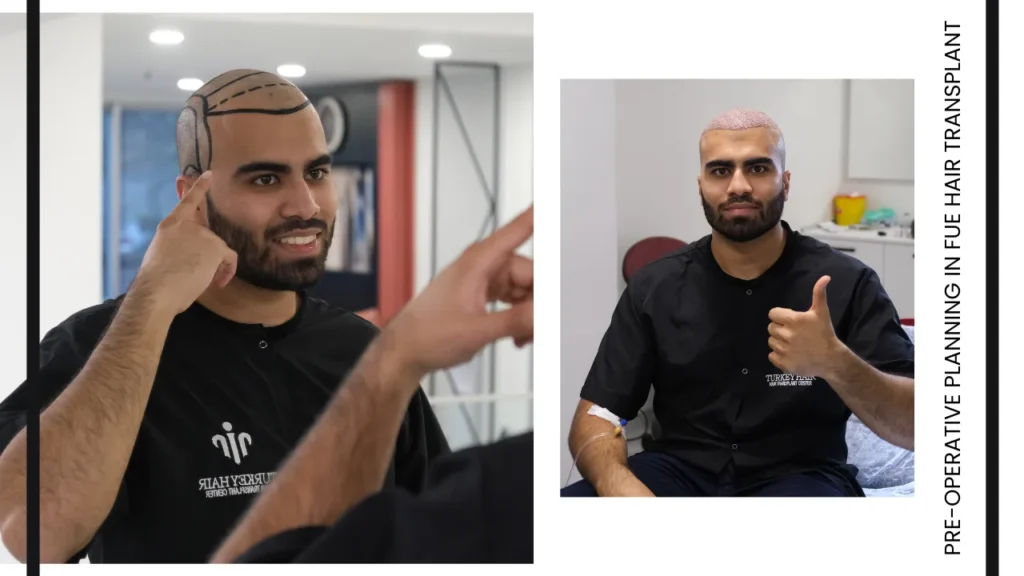
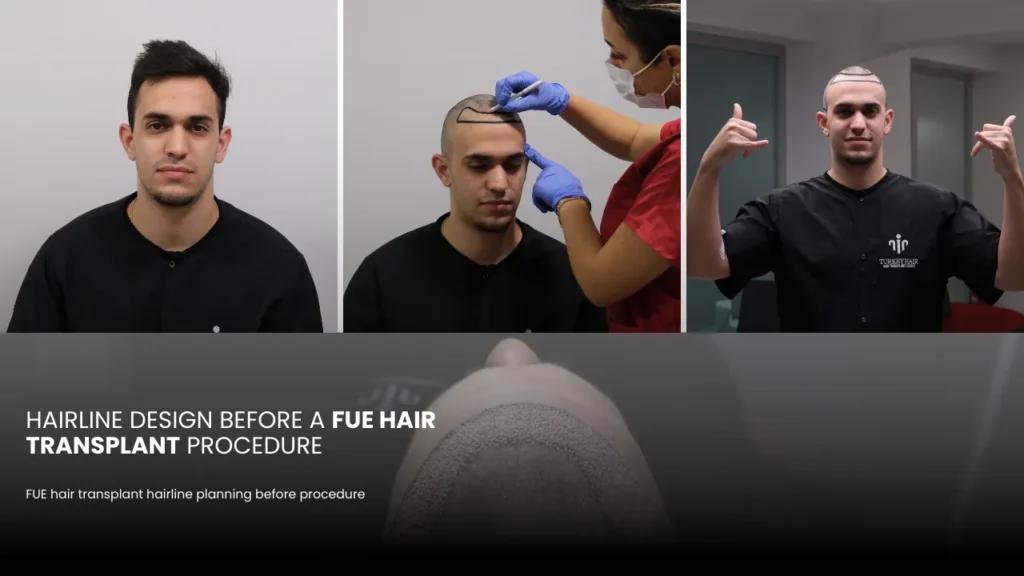
Outlining Donor and Recipient Areas
Fue Hair Transplant In Turkey: Cost
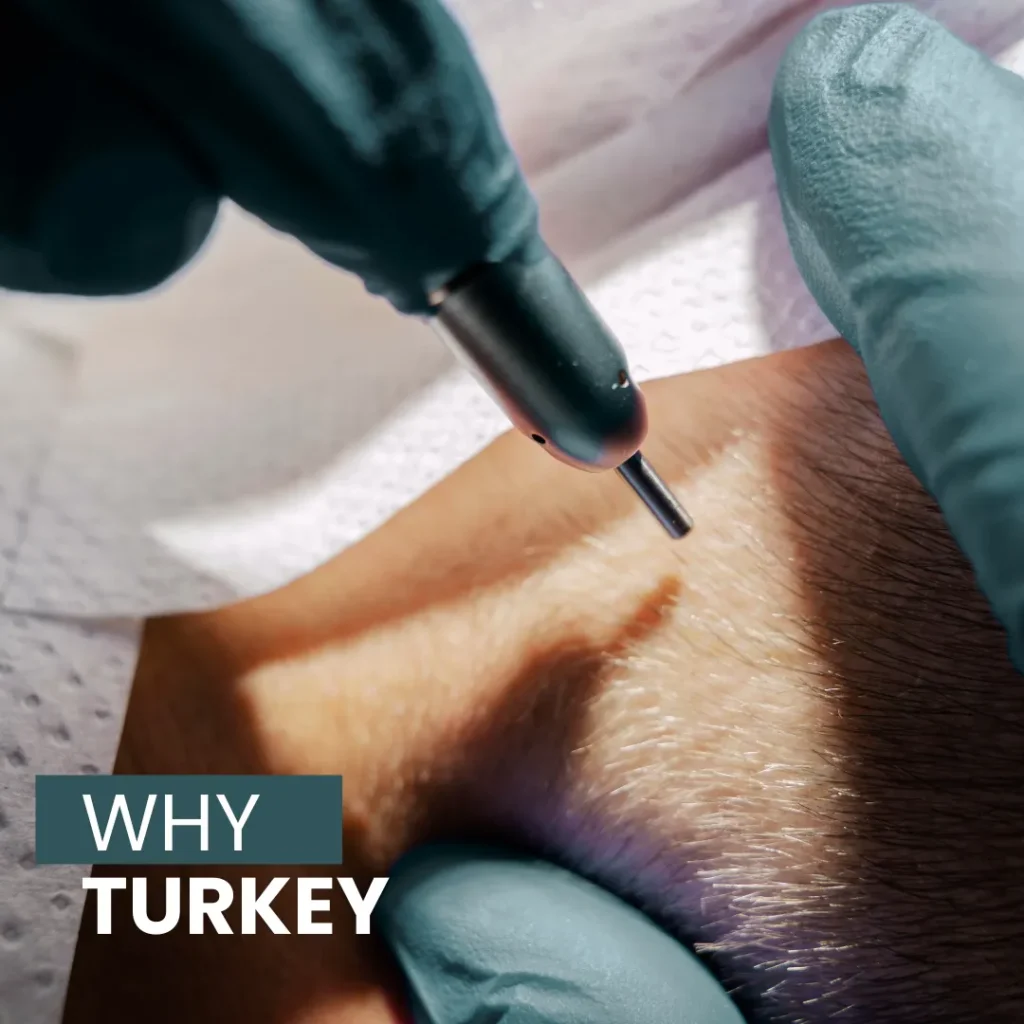
The doctor draws the new hairline to suit your age and face and marks the safe donor zone at the back and sides.
Administering Anesthesia
Local anesthesia numbs both the donor and the recipient areas. Our packages include sedation support for patients who want to feel more relaxed during the long session.
First Step: Extracting the Grafts
Fue Hair Transplant In Turkey: Cost
Grafts are taken one by one from the donor area with a micromotor and fine punches, spread out so the donor area still looks full.
Second Step: Opening the Channels
Micro-channels are opened in the recipient area with sapphire blades, following the natural direction and angle of your hair.
Third Step: Placing the Grafts
The grafts are placed into the channels with fine forceps in the planned pattern, with single-hair grafts in the front row for a soft hairline.
Fourth Step: Dressing and Next-Day Check
What to expect after FUE hair transplant: a dressing on the donor area, tightness and mild swelling. The next day the team removes the dressing, checks the grafts and shows you how to wash; most patients fly home after 2-3 nights.
FUE Donor Area After 1 Month
The FUE donor area is the back and sides of the head, where follicles resist DHT. An extracted follicle does not grow back in that spot, so the team spreads extractions out. How the FUE hair transplant donor area usually looks:
Time
What you usually see
FUE donor area after 1 week
Redness, small scabs and tightness
FUE donor area after 1 month
Calm skin; regrowing hair hides most dots, some native hair may shed for a while
FUE donor area after 3 months
Shedding over; dots hidden once the hair is a little longer
FUE donor area after 1 year
Tiny white dots, usually visible only on a razor-shaved head
A 1 year FUE donor area photo is the fairest test of the extraction: a patchy look means too many grafts were taken.
Donor Depletion FUE
Over-harvesting leaves the back of the head thin and patchy, and a depleted donor area is hard to fix, so a single session is usually capped at about 4,000-4,500 grafts. If the scalp is not enough, beard or body hair can sometimes be used.
2000 Graft FUE
A 2000 graft FUE usually suits Norwood 1-2 or a frontal hairline and takes about 6-8 hours. See what it covers in our 2000 grafts hair transplant guide.
Two-Step or Three-Step Procedure
When a plan needs more grafts than one session can safely take, it is split. A two-step procedure means a second session, usually no earlier than 12 months later, once the first result and the donor area can be judged; any further step follows the same rule.
FUE Hair Transplant Pain
The operation is done under local anesthesia, so the scalp is numb while grafts are taken and placed. Most of the discomfort comes from the first anesthetic injections, and our packages include sedation support if you are anxious.
Pain after FUE hair transplant is usually mild: a tight, slightly sore feeling, mostly at the back of the head, for the first few days. FUE hair transplant pain in donor area tissue is usually managed with basic painkillers. Increasing or severe pain is not normal; contact the team.
Across Turkey, prices vary with the technique and the clinic. Our packages are set by tier, not billed per graft; the right one depends on your medical assessment.
Fue Hair Transplant In Turkey: Cost
Because we do not charge per graft, the FUE hair transplant 3000 grafts cost is the same package price as for fewer grafts; the number of FUE hair grafts you need is estimated from your photos. Is FUE hair transplant expensive? It depends on where you have it. Typical FUE cost: Turkey compared with the USA, the UK and Europe:
Region
Typical FUE cost
Grafts in that range
USA
$8,000 - $15,000
2,000-4,000
United Kingdom
£6,000 - £12,000
2,000-4,000
Europe (EU)
€5,000 - €10,000
2,000-4,000
Turkey (our packages)
$2,550 - $4,500
Fixed package, not per graft
FUE Hair Transplant Turkey Packages
Turkey FUE hair transplant cost with us: Sapphire Prime $2,550, Sapphire Advanced Regrowth $3,000 or Exosapphire Microflow Elite $4,500. Each includes the operation with sedation support, blood tests, PRP, 2 hotel nights, VIP transfers, an interpreter, the next-day check-up and 2 years of aftercare consultation. Compare them on our treatments and packages page.
Is FUE hair transplant covered by insurance? Usually not: most health plans class a transplant for pattern hair loss as an elective cosmetic procedure. Coverage may be considered after trauma, burns or reconstructive surgery, so ask your insurer in writing.
FUE Recovery Timeline
FUE hair transplant how long to heal? Most patients recover physically within 10-14 days; the hair itself takes 12-18 months. Here is the FUE timeline step by step.
Days 1-10
Days 1-3 bring redness, swelling and tightness, days 4-7 small scabs and itching, and by days 7-10 the scabs fall away. Around day 10 the FUE hair transplant donor area recovery is well under way and the donor area looks much calmer.
FUE Face Swelling
Swelling usually peaks around days 2-3 and can move down to the forehead and around the eyes. It looks alarming but is usually temporary and settles within several days.
How to Sleep After FUE?
For the first nights, sleep on your back with your head elevated, ideally on a travel or neck pillow, so nothing touches the grafts. This also helps the swelling settle.
FUE Month by Month
This FUE transplant timeline applies to most patients: shock loss in month 1, a dormant month 2, first growth in months 3-4, noticeable density around month 6, a mature look at month 12 and final thickening until month 15-18.
FUE Hair Transplant After Care
Fue Hair Transplant In Turkey: Cost
Do not touch, scratch or press the grafts, wash only as instructed with the prescribed products, take your medication on schedule, and avoid heavy exercise, sweating, sun and heat in the first weeks.
From Consultation to Aftercare: A Step-by-Step Guide
Fue Hair Transplant In Turkey: Cost
Free photo review, blood tests and a medical check on arrival, the 6-8 hour operation, the next-day dressing and check-up, the flight home after 2-3 nights, then 2 years of aftercare consultation. Every stage is explained in our hair transplant recovery timeline.
Is FUE Hair Transplant Permanent?
How long does FUE hair transplant last? Transplanted follicles come from the back and sides of the head, which resist DHT, the hormone behind pattern hair loss, so they usually keep growing long term. Does FUE hair transplant last forever? No one can promise that: your native hair can still thin, and some patients later need medication or a second session.
Fue Hair Transplant In Turkey: Cost
So, do FUE hair transplants last? In most patients, yes. Does FUE hair transplant look natural? Usually, when single-hair grafts form the front row and the angles follow your own hair; a poorly designed hairline is the main cause of an unnatural look.
FUE Hair Transplant Risks
Is FUE hair transplant safe? It is minimally invasive but still surgery, so FUE hair transplant safe or not depends on screening, planning and aftercare. Blood tests and a medical review come first.
FUE Hair Transplant Side Effects
Swelling toward the forehead in the first days
Redness and small scabs for about 7-14 days
Itching and numbness that settle over weeks or months
Shock loss between weeks 2 and 8
Small pimples as new hairs push through
FUE hair transplant side effects long term, such as lasting numbness or ingrown hairs, are uncommon, and serious FUE hair transplant complications are rare. Can FUE hair transplant fail? Poor graft handling or aftercare mistakes can cause it, so no result is guaranteed.
Scars From FUE Hair Transplant
FUE scars are tiny white dots where each graft was taken. With well-spaced extractions, FUE hair transplant scarring stays hard to see, unlike the linear FUT scar. Tell the doctor if you tend to form keloids.
FUE Scars After 1 Year
At one year, FUE hair transplant scars are usually visible only on a head shaved with a razor; even short hair typically hides them.
Infection After FUE Hair Transplant and Trypophobia
In the first days the grafted area looks like a field of tiny dots and scabs, which can unsettle people with trypophobia; it is a normal stage. Infection is different: yellow-green pus, spreading redness, increasing pain or fever need the team right away. See hair transplant side effects.
FUE Hair Transplant Reviews
When you read FUE hair transplant Turkey reviews, look for full recovery logs that show the red, scabbed first weeks and photos at about 12 months, not just a final picture. Independent platforms such as Trustpilot and Google tell you more than curated clinic feeds.
Wherever you get your FUE hair, Turkey or at home, check licences and who performs each step. We do not pay for reviews or reward them. To judge the best FUE hair transplant plan for you, compare real cases in our before and after gallery.
TrustScore 4.1 out of 5 on Trustpilot, based on 5 reviews (checked 11.10.2026).
★★★★★
Turkey hair center was an amazing experience. They took care of me from the moment I landed all the way until my flight back home. They do top tier work and I would highly recommend them to anyone looking for this service!
★★★★★
I had my hair transplant about a month ago and so far the progress/recovery is going super well and ahead of schedule. The doctor and nurses from the clinic were super friendly and knowledgeable. They made me feel comfortable and confident i made the right decision to go with them. Also the food that they serve me half way through the procedure was amazinggggg.
★★★★★
This experience was great the Doctor and Staff were very professional and the BEST! Highly recommend if you want to goto the best hair transplant center to get your hair transplant! This is me after little before 3 months!
★★★★★
my experience at turkey hair transplant centre was really good and the doctors made me feel vert welcome, i am happy with my results at the moment and would definitely recommend it to others
FUE Hair Transplant: Frequently Asked Questions
When can I wash my hair normally after the procedure?
Use the tips to wash your hair gently after the first two days. After seven to ten days, the grafts should be stable and the scabs should have gone away. At that point, you can clean properly again.
Can I combine FUE hair transplant with PRP therapy?
Yes, combining FUE with PRP therapy is a common practice that uses growth factors to accelerate scalp healing and improve the survival rate of transplanted grafts.
How much is an FUE hair transplant?
In Turkey, our all-inclusive FUE packages cost $2,550, $3,000 or $4,500, set by package rather than by graft count. Each includes the operation, blood tests, PRP, 2 hotel nights, transfers and the next-day check-up. In the USA the same procedure typically costs $8,000-15,000.
Is FUT or FUE better?
For most patients, FUE. It avoids the linear FUT scar, usually heals with less discomfort and lets you wear your hair short. FUT removes a strip of scalp; some surgeons still choose it for specific donor area characteristics and graft needs.
Does FUE hair transplant leave scars?
Yes, but small ones. Instead of a linear scar, FUE leaves tiny white dots where grafts were taken. When extractions are well spaced, they are usually hidden even by short hair and show mainly on a head shaved with a razor.
Is FUE hair transplant dangerous?
Not usually, when screening and planning are done properly. Swelling, scabs and numbness are common and temporary, and serious complications are rare. The main risks are infection and over-harvesting of the donor area, which careful planning and aftercare reduce.
Is FUE hair transplant good?
For most patterns of hair loss, yes: it moves DHT-resistant follicles one by one, avoids a linear scar and suits large sessions. Whether it is good for you depends on your donor density, how stable your hair loss is and realistic expectations.
How long after FUE hair transplant can you wear a hat?
In the first days, only the loose hat the clinic gives you, put on and taken off carefully. A normal loose hat is usually fine after day 7-14, once the grafts have anchored. Avoid tight caps; helmets usually wait until around month 2.
How long after FUE hair transplant can I exercise?
Short walks are fine after a few days. Gym workouts usually wait until weeks 2-4, weight lifting until weeks 3-4, and swimming or sauna until about month 1, because heavy sweating and blood-pressure spikes can harm new grafts. Your surgeon confirms each step.
What does FUE hair transplant stand for?
FUE stands for Follicular Unit Extraction, also called follicular unit excision. A follicular unit is a natural group of one to a few hairs; in FUE each unit is taken individually from the donor area with a micro-punch and implanted where hair is thinning.
Does FUE hair transplant require shaving?
Usually the donor area is shaved, and often the recipient area too, for the best view and graft numbers. Unshaven or long hair FUE is possible but limits how many grafts can be taken in one session. See our no-shave hair transplant page.
Free FUE Hair Transplant Assessment
1
Which area do you want to restore?Pick the closest; the photo review confirms it.
Typical graft rangeAbout 2,000grafts
An estimate from the ranges on this page, not a treatment plan. Your graft count is set after the medical team reviews your photos and donor area.
Every FUE hair transplant Istanbul, Turkey plan with us starts with a free photo review: send your front, top and sides, and you get a technique, a graft range and the package that applies. No obligation: get your free hair analysis or ask us on WhatsApp.
Sources and medical review
The clinical statements on this page draw on the following published literature and professional body guidance:
Send three photos: front, top and sides. You get a technique recommendation, a graft range and a straight answer about what is achievable, before anyone talks about price.
Your details are with the team
A patient coordinator will get back to you shortly. If you would like to send your photos now, WhatsApp is the fastest way to do it.
We respond quickly, day or night, in your language.
Multilingual team, no obligation
Data protectedKVKK and GDPR compliant, 100% confidential
Authorized Health Tourism Intermediary
Turkey Hair Center is the hair-restoration brand of Healthy Way Tourism, an authorized international health-tourism intermediary. All medical procedures are performed by licensed medical professionals at authorized healthcare facilities in Turkiye, in accordance with the regulations of the Ministry of Health.