Hair Bulb Anatomy: Papilla, Follicle and How Hair Grows
Performed at authorized partner hospitals Turkey Hair Center is a Ministry of Health authorized health-tourism intermediary, not a clinic.
The hair bulb is the rounded base of a hair root, deep inside the follicle, where living cells divide to build new hair. At its centre sits the dermal papilla, a cluster of cells that signals the bulb and helps decide how thick, how long and what colour each hair grows.
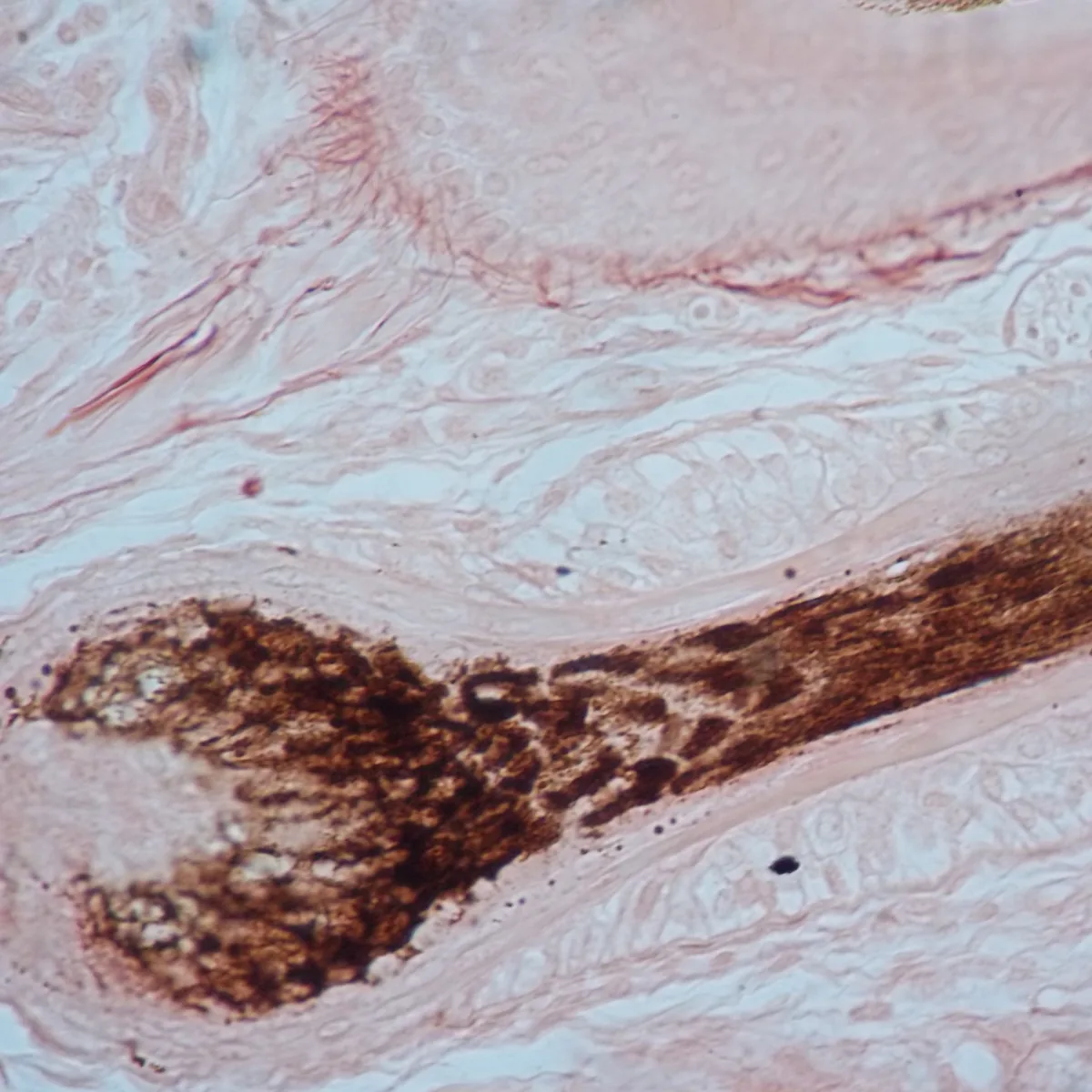
Longitudinal section of a hair follicle from the scalp, stained with fuchsin and resorcinol and seen under a light microscope at 400x. Photo: Ganímedes, CC BY-SA 3.0, via Wikimedia Commons, cropped.
Everything you see above the scalp starts here. The shaft is made in the bulb, pigment is added in the bulb, and when a follicle rests, the bulb is the part that shrinks. This guide covers:
where the hair bulb is and how it is built
what the dermal papilla does
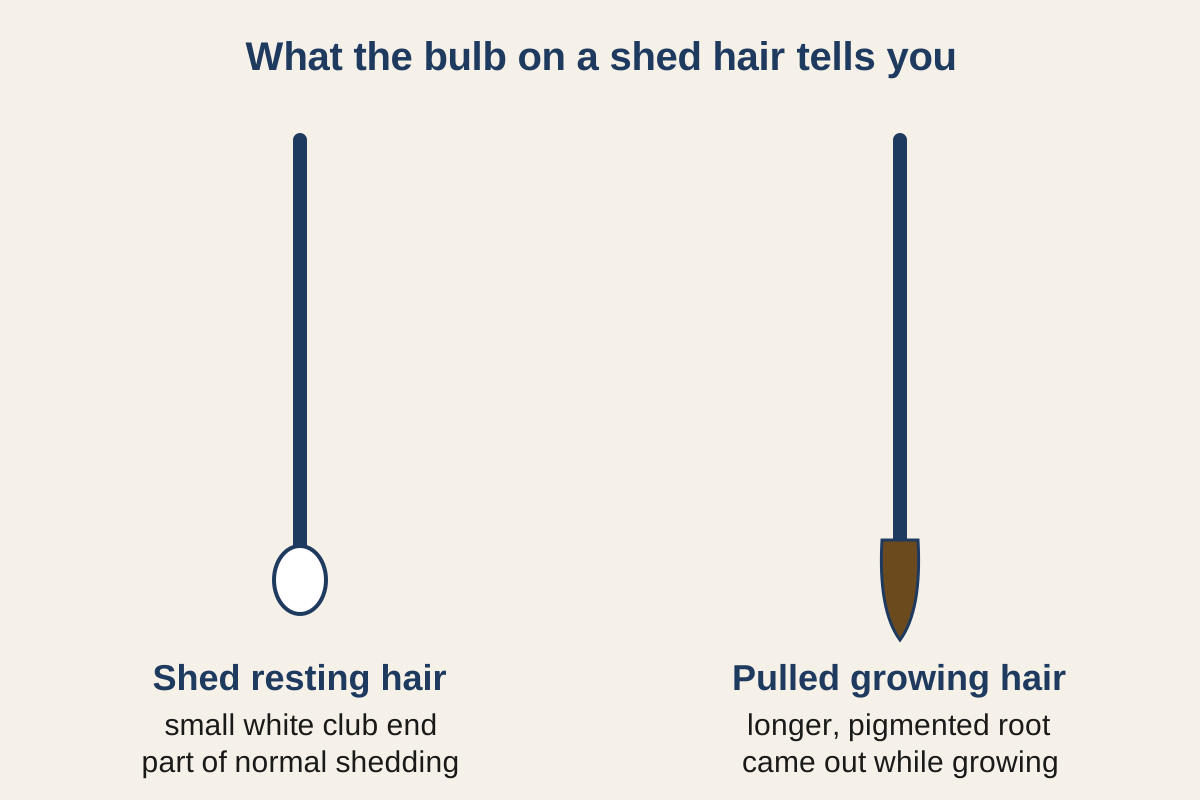
why some fallen hairs have a small white bulb at the end
why the bulb matters in a hair transplant
In this stained section the bulb is the dark, rounded end of the follicle on the left, with the hair running from it to the right. The brown colour is melanin, the pigment that, as explained below, is added to each hair in the bulb.
The Hair Bulb
The bulb is the working end of the follicle. Cleveland Clinic describes the follicle as a tube-like structure in the skin, shaped like a cylinder with a rounded bottom, and the bulb is that rounded bottom. When a hair is pulled out, the small round ball sometimes seen at its end is the root, and in most cases the hair grows back.
Where Is the Hair Bulb Located?
The bulb sits at the deepest point of the follicle. Cleveland Clinic explains that follicles start in the top two skin layers, the epidermis and dermis, and that follicles holding scalp hair can reach into the fat layer underneath. The bulb lies at the lower end of that tube, the part of the hair furthest from the surface.
Hair Bulb Structure
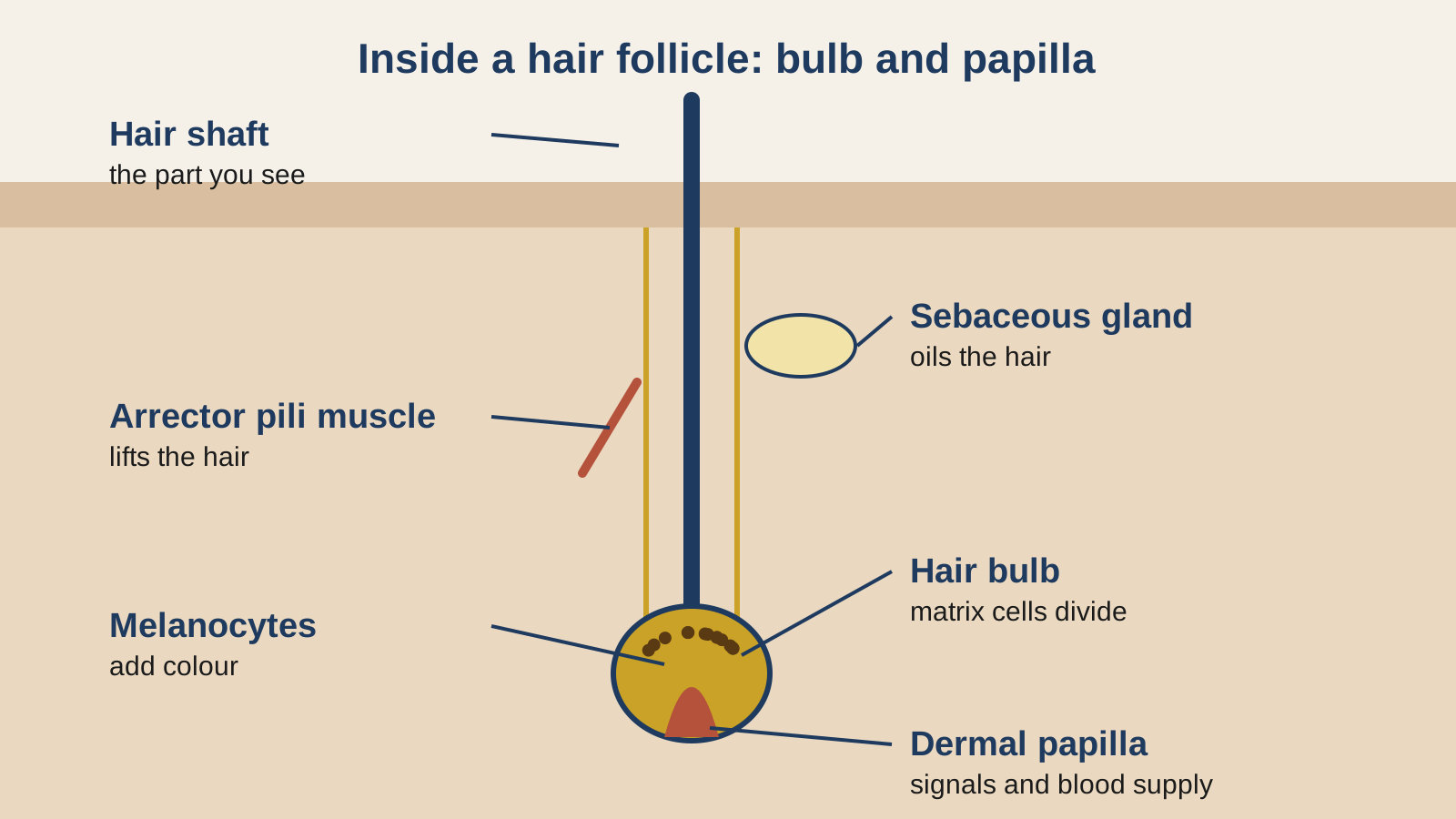
A 2024 review of dermal papilla cells in the journal Biology describes the main parts of the bulb:
Dermal papilla: the cluster of cells at the centre of the bulb.
Matrix cells: fast-dividing cells that surround the papilla and turn into the hair shaft.
Melanocytes: pigment cells that live among the matrix cells.
Root sheaths: the inner and outer layers of the follicle wall that wrap the forming hair.
The matrix is one of the busiest tissues in the body. A review by Tobin in the International Journal of Trichology reports that almost 100% of the keratin-making cells in a growing hair bulb are dividing at any one time, at a rate second only to bone marrow and the lining of the gut.
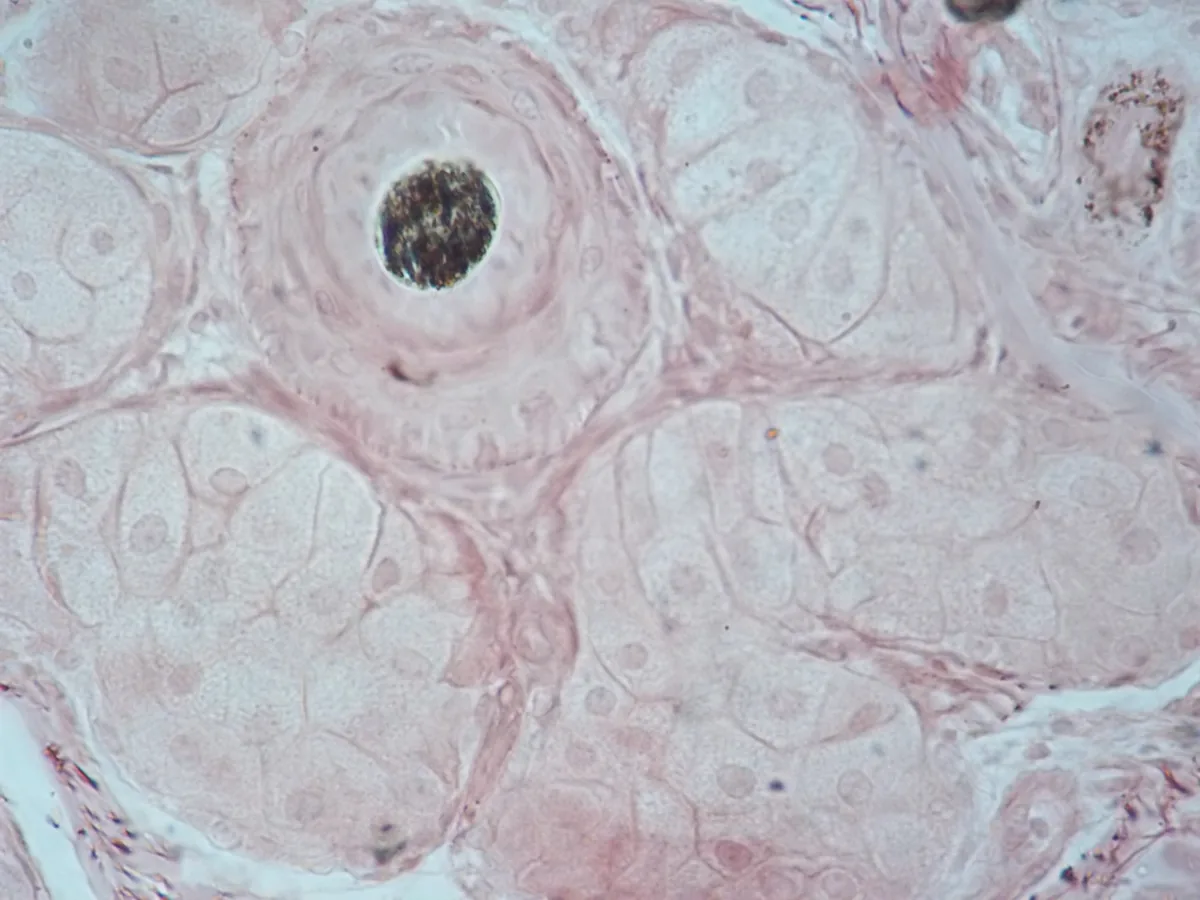
Transverse section of a hair follicle from the scalp under a light microscope at 400x. Photo: Ganímedes, CC BY-SA 3.0, via Wikimedia Commons, cropped.
Cut straight across, a follicle looks like a set of rings. The dark disc in the middle is the pigmented hair, and the pale layers wrapped around it are the follicle wall and root sheaths listed above.
Bulb Hair Follicle
The bulb and the follicle are not two separate things. The follicle is the whole tube in the skin, from the opening on the surface down to its base. The bulb is the thickened base of that tube, where hair is made.
Pigment is added here too. Tobin explains that bulb melanocytes sit above and around the upper dermal papilla and pass melanin granules mainly into the cells of the cortex. Pigment is made only while the hair is growing.
Does Hair Bulb Grow Back?
Yes, in most cases. Cleveland Clinic notes that the follicle is one of the few structures in the body that can stop working and start again. The Biology review describes what happens in each cycle:
Growth (anagen): the matrix divides and the shaft lengthens.
Regression (catagen): division stops and about two thirds of the lower follicle breaks down, while the dermal papilla stays intact and moves upward.
Rest (telogen): the follicle waits, then a new growth phase rebuilds the bulb around the papilla.
So when a resting hair falls out, the follicle is not lost. It forms a new bulb and a new hair. Hair that stops coming back has other causes, and those need a medical assessment rather than a look at the bulb.
The Dermal Papilla
The dermal papilla is the control centre of the bulb. The Biology review states that it controls the growth, shape, size and colour of hair. Cleveland Clinic adds that growth begins at the dermal papilla, which supplies blood and nutrients to the growing hair.
Part
Where it is
What it does
Source
Dermal papilla
Centre of the bulb
Signals growth; linked to hair size, shape and colour
Zhang et al., 2024
Matrix cells
Around the papilla
Divide and become the hair shaft
Zhang et al., 2024
Bulb melanocytes
Above and around the papilla
Make pigment and pass it into the hair
Tobin, 2009
Outer root sheath
Follicle wall
Holds the bulge, with hair and pigment stem cells
Zhang et al., 2024
What Are Hair Papillae?
Hair papillae, or dermal papillae, are small groups of specialised cells, one at the base of each follicle. Their size tracks the size of the hair. A study by Elliott and colleagues in the Journal of Investigative Dermatology found that the papilla volume in large beard follicles was almost 40 times higher than in fine facial hair follicles of women.
The papilla is also where hormones act. The Biology review notes that the androgen receptor is expressed specifically in papilla cells and may be involved in androgenetic alopecia. Our guide to DHT and hair loss explains that link.
What Is the Shape of the Hair Papilla?
The sources we reviewed describe the papilla by its position more than by a fixed shape. It is a compact cluster of cells sitting inside the base of the bulb, wrapped by the matrix cells around it. Its size is not fixed: Elliott and colleagues showed that a larger papilla has both more cells and more surrounding material, and that larger papillae go with thicker hairs.
Frequently Asked Questions
A pale bulb on fallen hairs is normal. What matters is how many hairs you lose and for how long. If shedding is clearly heavier than usual, or you see thinning patches, a dermatologist can examine your scalp and find the cause. Do not try to diagnose it from the bulb alone.
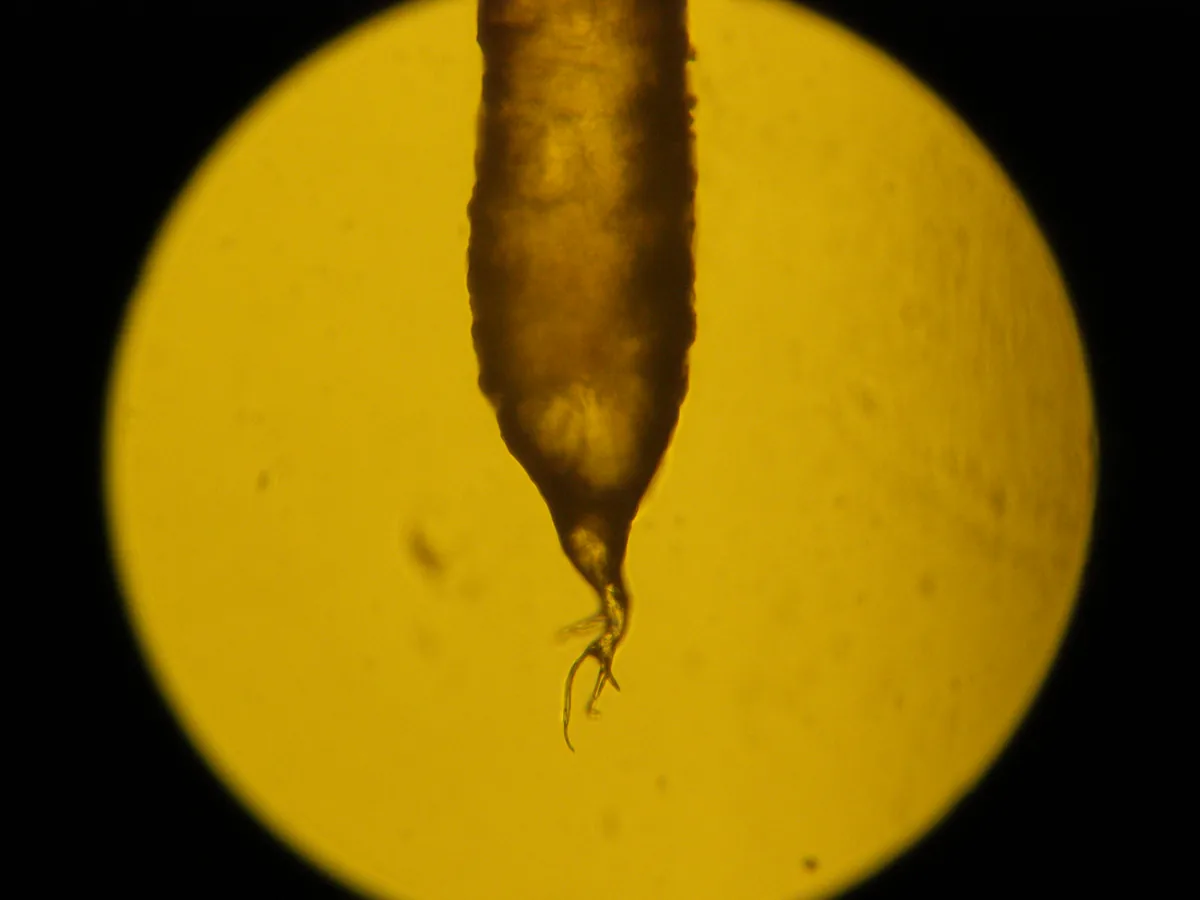
A human black hair root under a light microscope. Photo: Juan de Vojníkov, CC BY-SA 4.0, via Wikimedia Commons, cropped.
Under a microscope the root is simply the lower part of the same hair. In this black hair it stays dark along most of its length and narrows towards its end.
Does the White Bulb on Hair Grow Back?
Yes, usually. A small white bulb at the end of a fallen hair is the tip of a resting hair that has been shed. The follicle stays in the skin and in most cases starts a new hair.
What Is the Bulb at the End of Hair?
It is the base of the hair root. On a shed hair it is usually a small, pale, club-shaped tip. A case report in the International Journal of Trichology describes shed resting hairs as having a depigmented, club-shaped bulb with no root sheath attached.
Is It Normal for the White Bulb to Fall Out?
Yes. The American Academy of Dermatology says shedding 50 to 100 hairs a day is normal. In a 2020 study in the Annals of Dermatology, every hair pulled from the scalps of healthy volunteers was a resting club hair, and 62.7% were the typical club shape.
What Does a White Bulb on Hair Mean?
It means the hair was in its resting phase when it fell. A 2020 study in the Annals of Dermatology explains that protein and pigment production stop in the regression phase, which is why the end of a resting hair has no colour.
What Is the Function of the Hair Bulb?
The bulb makes the hair. Its matrix cells divide and turn into the shaft, its melanocytes add colour, and its dermal papilla sends the signals that start and size each new hair.
What Is the Difference Between the Hair Bulb and the Hair Follicle?
The follicle is the whole tube in the skin that holds the hair. The bulb is only its rounded base, where new hair cells are made.
What Is the Difference Between the Hair Bulb and the Hair Root?
The root is all of the hair below the skin surface. The bulb is the swollen end of the root, at the bottom of the follicle.
Why Is the Hair Bulb Black?
A hair pulled out while it is still growing can carry a dark, pigmented bulb, because pigment is made in the bulb during growth. A hair that has finished growing and been shed has a pale bulb instead.
How Many Hair Follicles Do You Have?
Cleveland Clinic says you are born with more than 5 million hair follicles across the body, and more than one million of them are on the head. Each follicle has its own bulb at its base. The head includes the face as well as the scalp, so this is not a scalp hair count; our guide to how many hairs are on the human head gives the scalp figures.
Do Hair Follicles Heal After an Injury?
Often, yes. Cleveland Clinic says damaged follicles can repair themselves and the hair grows back, although it can take up to four years, depending on how severe the injury was. Repeated injuries can leave scars that make growing hair difficult, and hair that does grow there may be thinner and more fragile. If hair stops growing in an area where it used to grow, see a doctor.
What Conditions Affect the Hair Follicles?
Cleveland Clinic lists alopecia areata, baldness, folliculitis, hidradenitis suppurativa, stress and telogen effluvium among the most common. Typical symptoms are hair loss or thinning, pimples or fluid-filled bumps, swelling and an itchy rash. A pale bulb on a shed hair is not one of these signs, but bumps, a rash or patches of loss should be checked by a dermatologist.
How Do Doctors Check the Health of Hair Follicles?
Cleveland Clinic describes three common tests. A blood test looks for conditions that could explain the symptoms. A biopsy removes a small sample of skin so it can be examined under a microscope. In a pull test, the provider gently tugs a small section of hair to see how many strands come out. Which test is used depends on your symptoms.
Why the Bulb Matters in a Hair Transplant
A transplant moves living follicles, so each graft must keep its lower part, bulb included. A 2026 review in Frontiers in Medicine lists complete follicular unit extraction and avoiding transection, which means cutting through the follicle, as key preventive measures in follicular unit excision. Our FUE hair transplant page explains how grafts are taken.
Before any session, the medical team checks:
donor density at the back and sides of the scalp
hair thickness, which reflects the size of each follicle
the area of thinning today and how it may progress
Medical disclaimer: This article is for informational purposes only and is not medical advice. Individual results and recovery vary from person to person. Always follow the written aftercare plan from your own medical team.
Sources and medical review
Zhang HL, Qiu XX, Liao XH. Dermal Papilla Cells: From Basic Research to Translational Applications. Biology (Basel), 2024;13(10):842
Tobin DJ. Aging of the hair follicle pigmentation system. International Journal of Trichology, 2009;1(2):83-93
Elliott K, Stephenson TJ, Messenger AG. Differences in hair follicle dermal papilla volume are due to extracellular matrix volume and cell number: implications for the control of hair follicle size and androgen responses. Journal of Investigative Dermatology, 1999;113(6):873-877
Chhabra N, Rahim JS. Hair Root Dermoscopy from Shed Hair: A Simple Diagnostic Tool in Telogen Effluvium. International Journal of Trichology, 2024;16(1-6):58-59
Park SH, Seol JE, Kim DH, Kim H. Analysis of Microscopic Examination of Pulled Out Hair in Telogen Effluvium Patients. Annals of Dermatology, 2020;32(2):141-145
Cleveland Clinic. Hair Follicle: Function, Structure and Associated Conditions. Cleveland Clinic health library
Send three photos: front, top and sides. You get a technique recommendation, a graft range and a straight answer about what is achievable, before anyone talks about price.
Your details are with the team
A patient coordinator will get back to you shortly. If you would like to send your photos now, WhatsApp is the fastest way to do it.
We respond quickly, day or night, in your language.
Multilingual team, no obligation
Data protectedKVKK and GDPR compliant, 100% confidential
Authorized Health Tourism Intermediary
Turkey Hair Center is the hair-restoration brand of Healthy Way Tourism, an authorized international health-tourism intermediary. All medical procedures are performed by licensed medical professionals at authorized healthcare facilities in Turkiye, in accordance with the regulations of the Ministry of Health.