Performed at authorized partner hospitals Turkey Hair Center is a Ministry of Health authorized health-tourism intermediary, not a clinic.
Vitiligo can turn hair white when the pigment cells in a hair follicle are destroyed. It may cause a white streak on the scalp, white eyebrows or eyelashes, or white hair growing over a pale skin patch. The sources below describe a change in hair colour, not hair falling out.
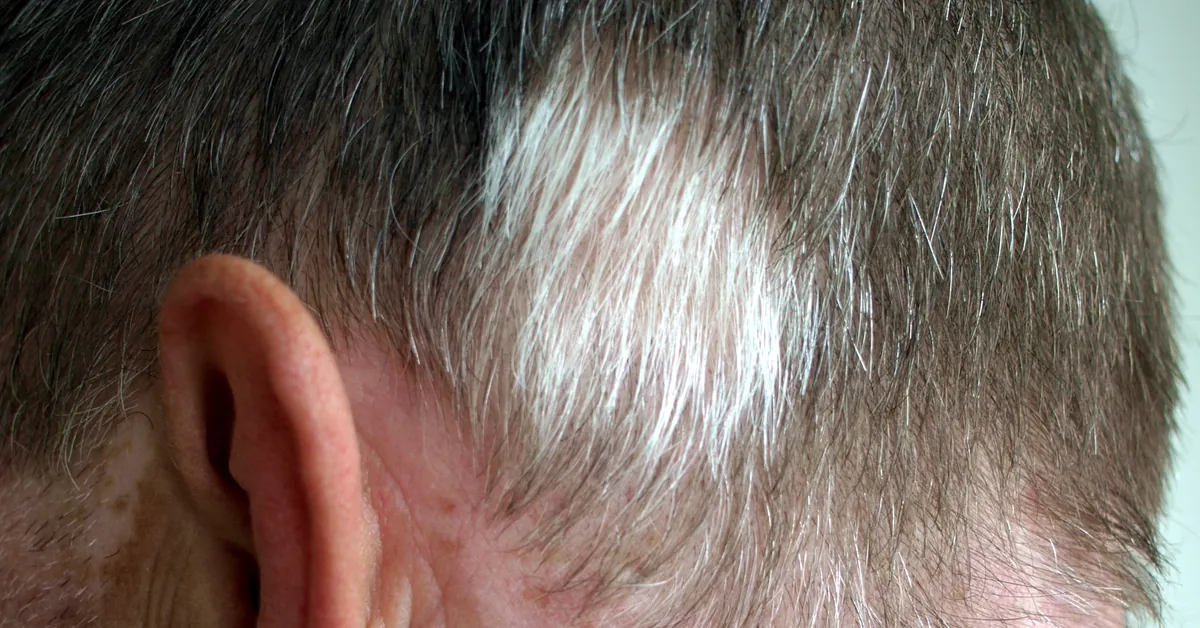
Vitiligo with poliosis: loss of colour in the skin and hair of a 48-year-old man. Photo: Klaus D. Peter, Gummersbach, Germany, CC BY 3.0 de, via Wikimedia Commons, cropped.
Vitiligo hair changes are common: DermNet says loss of hair colour affects the scalp, eyebrows, eyelashes or body hair in 10 to 60% of people with vitiligo. This guide explains what vitiligo in hair looks like, why it happens, how it differs from normal greying, and what dermatologists can offer. It cannot tell you whether you have vitiligo; a dermatologist confirms that by examining the skin.
The photo shows the typical vitiligo pattern in hair: a clearly edged white patch in otherwise brown hair, with pale patches of skin on the neck below it. The white hairs grow from an area where the pigment cells have been lost. Appearance alone is not a diagnosis.
What Is Vitiligo Hair?
Vitiligo is a condition in which the skin loses colour. The AAD explains that the immune system attacks melanocytes, the cells that give skin, hair and eyes their colour. When this happens in skin that has hair roots, the hair growing there can also lose its colour. The NHS notes that vitiligo can develop where there are hair roots, such as on the scalp, and that the hair in the affected area can turn white or grey.
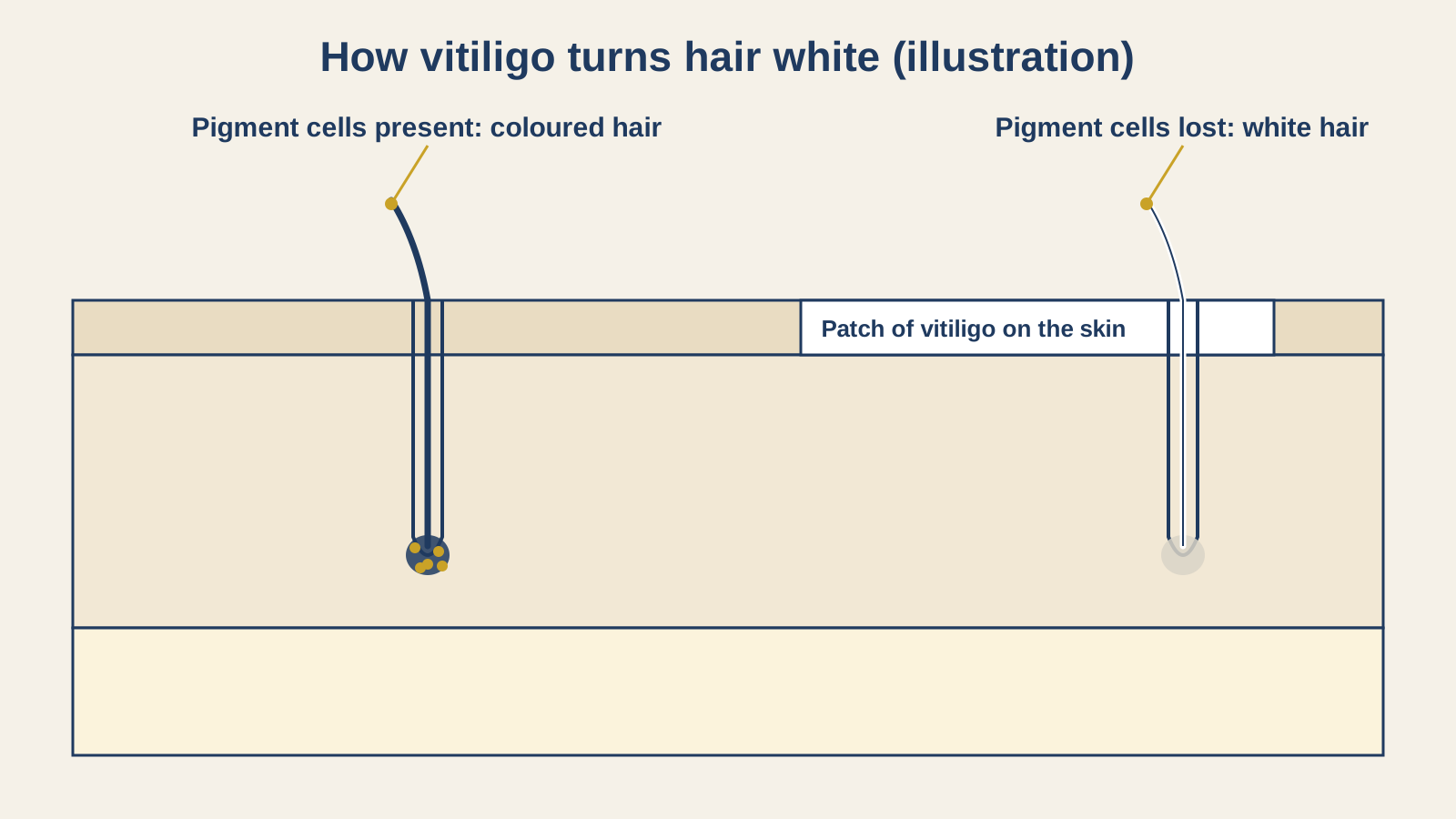
The drawing shows that process at the root. A normal follicle has pigment cells that colour the hair as it grows, while a follicle inside a vitiligo patch has lost them, so the new hair grows out white.
Hair vitiligo is not a separate disease. It is the same vitiligo, showing up in the hair as well as, or occasionally instead of, the skin. DermNet describes a follicular form with prominent white hair and absent or limited skin involvement.
What Is Hair Vitiligo Called?
The medical term is leukotrichia, meaning white hair. A localised patch of white hairs is called poliosis. DermNet says poliosis is a clinical sign rather than a diagnosis, because several conditions besides vitiligo can cause it, including alopecia areata and some inherited conditions.
Does Vitiligo Turn Hair White?
Yes, it can. The AAD says hair on the head may turn grey early or develop a white streak, and part or all of an eyebrow or eyelash can turn white. Hair growing over a patch of vitiligo can also turn white.
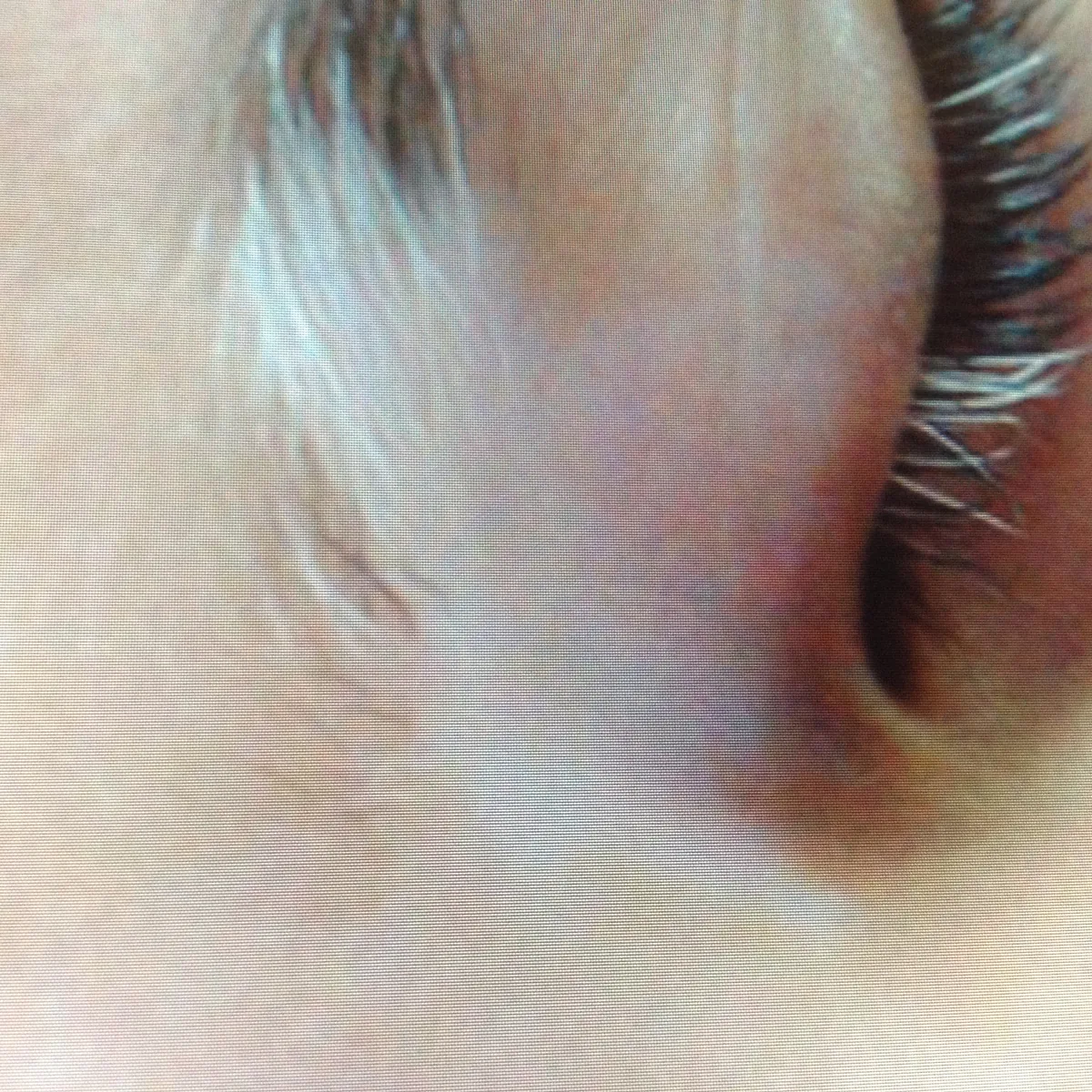
Vitiligo turning eyebrow hairs and eyelashes white. Photo: User:culinary123, CC BY-SA 3.0, via Wikimedia Commons, cropped.
In this close-up both the eyelashes and the eyebrow hairs have turned white, the eyebrow and eyelash change the AAD describes. White lashes or brows can have other causes too, so a dermatologist should confirm whether vitiligo is the reason.
Vitiligo or Gray Hair?
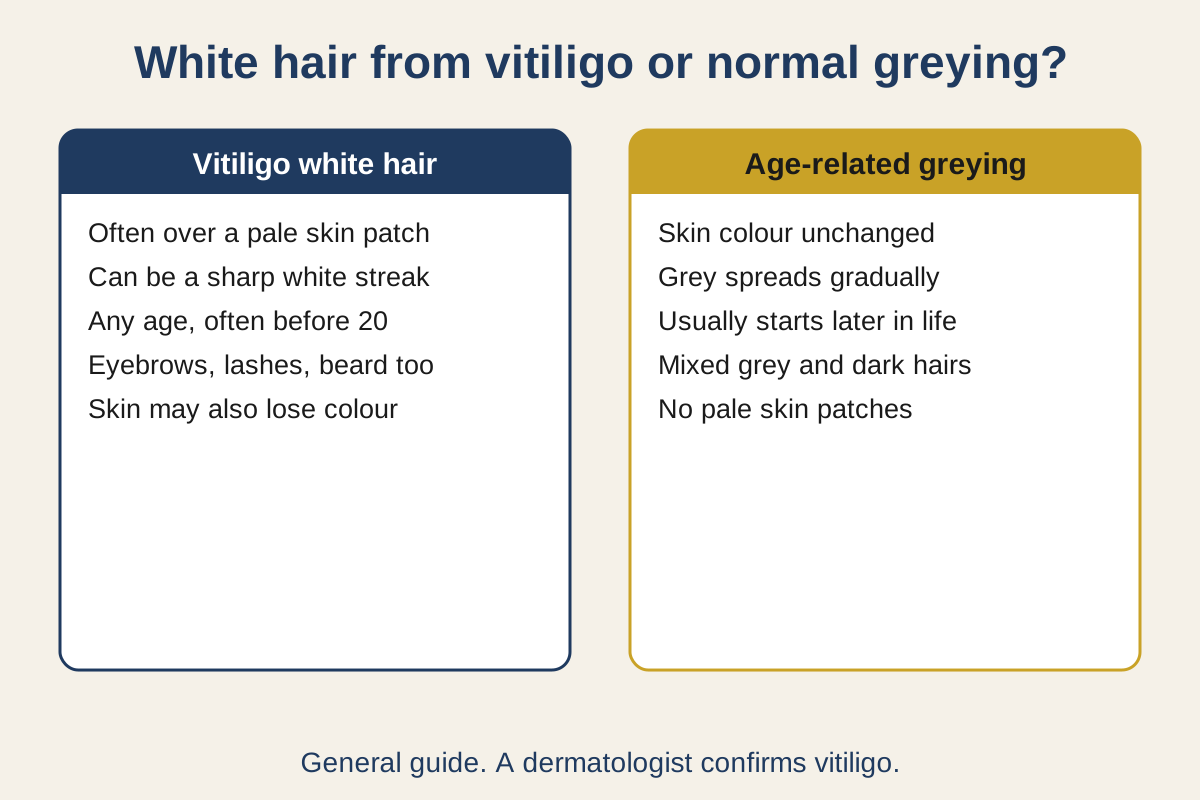
Ordinary greying spreads gradually across the hair and the skin keeps its colour. Vitiligo tends to cause a sharply defined white streak or patch, often over skin that has lost its colour too. A 2025 review in the International Journal of Dermatology lists vitiligo among autoimmune conditions that may promote premature greying, while DermNet says the link with premature greying is still uncertain. Our guide on what causes gray hair covers the usual reasons.
Vitiligo and Hair Loss
None of the sources we checked lists vitiligo itself as a cause of hair falling out; it affects colour. The AAD and DermNet do list alopecia areata, an autoimmune type of hair loss, among conditions linked with vitiligo, so the two can occur in the same person. Our page on reasons for hair loss covers other causes.
What Causes Vitiligo Hair?
Vitiligo hair causes are the same as the causes of vitiligo in skin. According to the AAD, vitiligo is an autoimmune disease in which the immune system mistakes pigment cells for something foreign and destroys them. Inside the hair follicle, the pigment cells sit in the bulb at the base of the hair and colour each new hair as it grows. Once they are gone, the hair grows out white.
The NHS describes two main patterns:
Non-segmental vitiligo is thought to be autoimmune and affects around 9 in 10 people with the condition.
Segmental vitiligo is thought to be caused by chemicals released from nerve endings in the skin and affects one area of the body.
Possible triggers listed by the NHS include stressful events, skin damage such as severe sunburn or cuts, hormonal changes such as puberty, and exposure to certain chemicals. The AAD adds that chemicals in some hair dyes are a known trigger. Vitiligo is not caused by an infection and cannot be caught from someone else.
Genetic Factors in Vitiligo Hair Changes
Genes play a large part. DermNet says genetic factors appear to contribute about 80% of vitiligo risk and environmental factors about 20%, and that 20 to 30% of people with vitiligo report a first or second-degree relative with it. The AAD explains that several genes are involved, so having a relative with vitiligo raises the risk but does not mean you will develop it. A family history of other autoimmune conditions, such as thyroid disease or alopecia areata, also raises the risk of non-segmental vitiligo.
Vitiligo in Hair: Signs and Symptoms
Vitiligo hair symptoms include:
A white streak or patch of white hair on the scalp.
White hairs in an eyebrow, eyelashes or beard.
White hair growing over a pale or white patch of skin.
Hair that turns grey earlier than expected.
On the skin, patches usually start lighter than your natural tone and may turn completely white. Not every pale patch is vitiligo: the AAD notes that tinea versicolor, a yeast infection treated with antifungals such as ketoconazole shampoo, can look similar. The AAD says patches may itch when vitiligo first appears or is spreading, and that pale skin sunburns easily. Vitiligo symptoms with hair loss are not typical; if you also have bald patches, a dermatologist will look for another cause, such as alopecia areata.
Premature Greying Due to Vitiligo
The AAD lists hair that turns grey prematurely as one sign of vitiligo. The evidence on how often this happens is mixed: DermNet calls the association uncertain. Early greying has many other causes, so it is not a sign of vitiligo on its own.
Non-segmental Vitiligo
Non-segmental vitiligo is the most common type. The AAD says patches appear on both sides of the body, such as both hands or both knees, and tend to spread slowly over a lifetime. In segmental vitiligo, colour loss affects one side or part of the body, spreads for about 6 to 12 months and then usually stops. The AAD notes that a bit of scalp hair, eyebrow or eyelash in the area may turn white.
Vitiligo in Hair Treatment Options
There is no cure, but treatment can restore some colour. White hair is harder to treat than pale skin. DermNet says areas with white hair respond poorly, because the pigment cell reservoir in the follicle has been destroyed. The 2025 review in the International Journal of Dermatology calls white hair a poor prognostic sign in vitiligo. These are the options dermatologists use:
Option
What it does
Notes from the sources
Topical corticosteroids
Restore some skin colour
Used for a limited time because of side effects such as thinning skin (AAD)
Tacrolimus or pimecrolimus
Restore colour, especially on the head and neck
Can be used longer than steroids; burning is a common side effect (AAD)
Ruxolitinib cream
Restores colour in a small area
FDA approved for non-segmental vitiligo from age 12 (AAD)
Light therapy
Restores skin colour
Works best on the face and neck; needs several sessions (AAD)
Surgery (grafts)
Moves pigment cells into stable patches
Not usually advised if vitiligo has been active in the past 12 months (AAD)
Camouflage and dyes
Covers patches or white hair
Cosmetic; no effect on the condition
Treatment is chosen by a dermatologist based on your age, health, vitiligo type and whether it is spreading. Vitiligo white hair treatment is the hardest part, which is why the options below are discussed separately.
Topical Steroids for Scalp Vitiligo
For hair vitiligo on scalp treatment, steroid creams or lotions are a common first step. The NHS says steroid creams can restore some pigment but long-term use can cause stretch marks and thinning of the skin. DermNet suggests they can be used on the trunk and limbs for up to 3 months. Your dermatologist sets the strength and how long to use them.
Light Therapy (Phototherapy) for Repigmentation
Light therapy uses a type of ultraviolet light to restore colour. The AAD says it works slowly, needs several treatments and works best on the face and neck. The 2025 review explains that the most common repigmentation pattern starts around hair follicles, as UVB light encourages pigment cells to move from the follicle into the skin. When the hair itself is already white, that reservoir may be gone.
Camouflage Makeup and Hair Dyes for Vitiligo
The AAD says camouflage makeup, self-tanner and skin dyes can even out skin tone straight away. Vitiligo grey hair treatment is often cosmetic: dyeing the white hairs. Because the AAD lists chemicals in some hair dyes as a trigger, ask your dermatologist which products are suitable before dyeing.
Vitiligo in Hair: Side Effects and Safety
Every treatment has trade-offs. The AAD lists thinning skin with long-term steroids, burning or mild itch with tacrolimus or pimecrolimus, acne and itch with ruxolitinib cream, and irritated skin or itch with light therapy. Surgery may not suit people who form raised scars. The NHS adds that treatment may restore colour but the effect does not usually last.
Sun protection matters whether or not you treat vitiligo. Skin that has lost its colour sunburns easily, and DermNet notes that sunburn may cause vitiligo to spread. Cover pale patches on the scalp with a hat if your hair is thin.
See a dermatologist if you notice new pale skin patches or a white streak of hair, if patches are spreading quickly, or if white hair comes with bald patches. Tell your doctor about tiredness, thirst or changes in hearing or vision: the NHS and AAD say vitiligo is linked with thyroid disease and other autoimmune conditions, eye inflammation and some hearing loss.
Does Vitiligo Affect Hair?
Yes, vitiligo can affect hair anywhere on the body: the scalp, eyebrows, eyelashes, beard and body hair. DermNet puts the share of people with some hair colour loss at 10 to 60%. White hair does not track disease activity, so a white streak can stay after the skin has settled.
Hair matters in vitiligo for another reason. DermNet explains that the hair follicle is the main source of new pigment cells when the skin regains colour. Hairy skin therefore tends to respond better than hairless areas such as fingertips. The AAD notes that the face responds well and the fingertips poorly.
When can vitiligo affect hair in a way that changes treatment? If the hairs in a patch are still dark, the follicle reservoir is likely intact. If they have turned white, the dermatologist may suggest stronger or combined treatment, as the 2025 review notes.
Does Vitiligo Change Hair Color?
It can change hair colour from its natural shade to white or grey in the affected area. Can vitiligo change hair color back? Once hair is white, medical treatment rarely restores it: DermNet says areas with white hair respond poorly. In the skin, DermNet notes that some colour may return from the hair follicles without treatment, while the AAD says complete return of lost skin colour is rare.
Surgery is one route studied for white hair. In a 2015 study in the Journal of Cutaneous and Aesthetic Surgery, Thakur and colleagues transplanted follicular unit grafts into 63 patches of stable vitiligo in 50 patients. White hairs regained colour in 11 of the 46 patients who had them, and 39 of the 63 patches showed a good to excellent response. Follicle grafting for vitiligo is a dermatological procedure for stable vitiligo, not a cosmetic hair transplant.
Frequently Asked Questions
Does Vitiligo Affect Hair Color?
Yes. When the pigment cells in a follicle are destroyed, the hair grows out white or grey. This can affect the scalp, eyebrows, eyelashes and beard. The AAD lists a white streak and premature greying among the signs.
Can Vitiligo Hair Be Dyed?
Many people cover white hair with dye. The AAD lists chemicals used in some hair dyes as a known trigger for vitiligo, so ask your dermatologist which product suits you, and stop if the scalp becomes irritated.
Can Vitiligo Hair Repigment?
It can happen, but not often. A 2015 study found white hairs regained colour in 11 of 46 patients after follicle grafting. DermNet says areas with white hair generally respond poorly to medical treatment.
Can Vitiligo Change Hair Texture?
We did not find a reliable source showing that vitiligo changes hair texture. The sources we checked describe changes in colour, not thickness or curl. If texture is changing, a dermatologist can look for another cause.
Can Vitiligo Affect Hair Texture?
The AAD, NHS and DermNet pages describe colour loss in hair but do not list texture change as a symptom. A change in texture with white hair is a reason to see a dermatologist rather than assume it is vitiligo.
Is Hair Vitiligo a Thing?
Yes. Vitiligo can affect hair as well as skin, and DermNet describes a follicular form in which white hair is the main sign with little or no skin involvement. The medical terms are leukotrichia and poliosis.
Is Vitiligo Associated with Hair Loss?
Vitiligo affects colour rather than hair growth. The AAD and DermNet link vitiligo with alopecia areata, an autoimmune hair loss, so the two can occur together. New bald patches need a separate check by a dermatologist.
Is Grey Hair Vitiligo?
Usually not. Grey hair is most often part of normal ageing or runs in families. A sharp white streak, white hair over a pale skin patch or white eyebrows or eyelashes are more suggestive, and a dermatologist can tell the difference.
Where Does Vitiligo Appear on the Body?
Vitiligo can develop anywhere on the skin. The AAD says that when it begins, patches usually appear on the face, arms, hands or feet, and that in time they can grow and appear in other areas. It can also affect the inside of the mouth and nose, the genitals, the inner ear and the hair in affected areas.
Will Vitiligo Return If You Stop Treatment?
It can. The AAD estimates that about 40% of patients see some colour loss within a year of ending treatment, and the NHS says that treatment may restore colour but the effect does not usually last. Keep follow-up appointments so your dermatologist can spot new colour loss early and decide whether further treatment makes sense.
Do Vitamins Help Vitiligo?
There is no proof that they do. The AAD says researchers are studying diet and supplements, but more research is needed to know whether any diet or supplement can effectively treat vitiligo. If you think you have a deficiency, a blood test and a doctor's advice are more useful than taking supplements on your own.
Hair, Pigment and Hair Restoration
Vitiligo needs a dermatologist's assessment, and hair restoration is a separate question. If you are also losing hair, send clear photos for a free hair analysis. Turkey Hair Center is a Ministry of Health authorized health-tourism intermediary working with authorized partner hospitals. For eyebrow concerns, see our page on eyebrow transplant, or use the contact page.
Medical disclaimer: This article is for informational purposes only and is not medical advice. Individual results and recovery vary from person to person. Always follow the written aftercare plan from your own medical team.
Send three photos: front, top and sides. You get a technique recommendation, a graft range and a straight answer about what is achievable, before anyone talks about price.
Your details are with the team
A patient coordinator will get back to you shortly. If you would like to send your photos now, WhatsApp is the fastest way to do it.
We respond quickly, day or night, in your language.
Multilingual team, no obligation
Data protectedKVKK and GDPR compliant, 100% confidential
Authorized Health Tourism Intermediary
Turkey Hair Center is the hair-restoration brand of Healthy Way Tourism, an authorized international health-tourism intermediary. All medical procedures are performed by licensed medical professionals at authorized healthcare facilities in Turkiye, in accordance with the regulations of the Ministry of Health.