Performed at authorized partner hospitals Turkey Hair Center is a Ministry of Health authorized health-tourism intermediary, not a clinic.
Folliculitis is inflammation of hair follicles, seen as small red bumps or pus-filled spots centred on hairs, often itchy or tender. It can come from bacteria, yeast, viruses, shaving or blocked follicles, and most mild cases settle with simple care, while deep, spreading or recurring spots need a doctor.
Folliculitis on the lower leg. Photo: Da pacem Domine, CC0, via Wikimedia Commons, cropped.
People often search for folliculitis pictures to compare a rash with what they see online. This guide combines real clinical photos with drawings. Photos vary with skin tone, body site and stage, so each one is paired with the typical pattern described by DermNet, the NHS and MedlinePlus. It does not diagnose your skin; a swab or an examination is the only way to confirm the type.
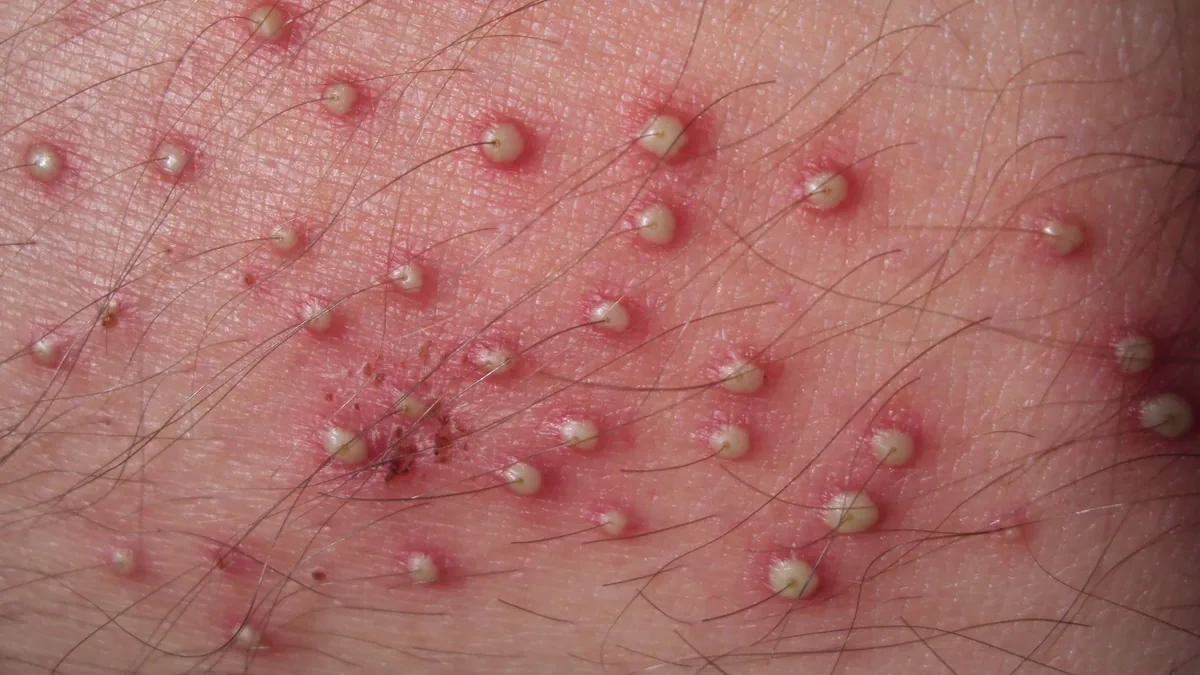
This photo shows the classic look: dozens of small pustules with white or yellow heads, and a hair coming out of the centre of many of them. That hair at the centre is the clue that the follicle is involved. Appearance alone is not a diagnosis, because the cause can only be confirmed by examination or a swab.
What Are Folliculitis Bumps?
DermNet defines folliculitis as an inflamed hair follicle due to any cause, with the result being a tender red spot, often with a surface pustule. Each bump sits around a hair, which is the detail that separates it from many other rashes. A blocked hair follicle that becomes inflamed is the simplest version.
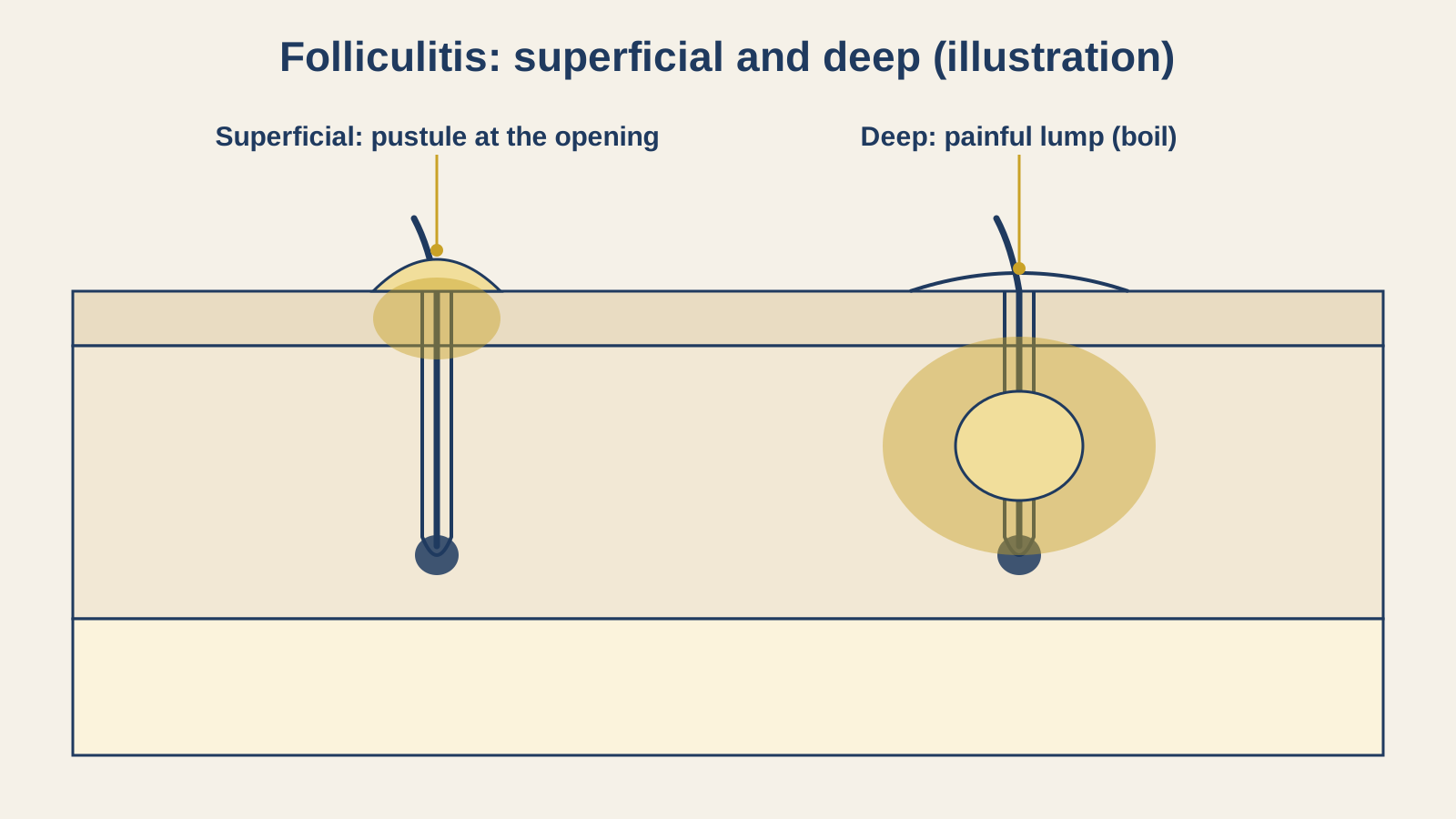
Folliculitis can be superficial or deep. Superficial folliculitis affects the top of the follicle and looks like a crop of small pimples. Deep folliculitis reaches the lower follicle; DermNet says deep bacterial infection results in a painful boil.
The drawing compares the two depths. A superficial spot stays at the opening of the follicle and usually heals without a mark, while a deep infection forms a larger, painful lump that may need a doctor.
It can appear anywhere hair grows: scalp, beard, chest, back, buttocks, arms and legs. MedlinePlus lists rash, itching and pimples or pustules near a hair follicle, often in the neck, groin or genital area, and notes that the pimples may crust over.
On brown and black skin, redness can be hard to see. DermNet notes that dark marks after inflammation (postinflammatory hyperpigmentation) are common in darker skin types after spa pool folliculitis, and the same pattern applies to razor bumps.
Types of Folliculitis
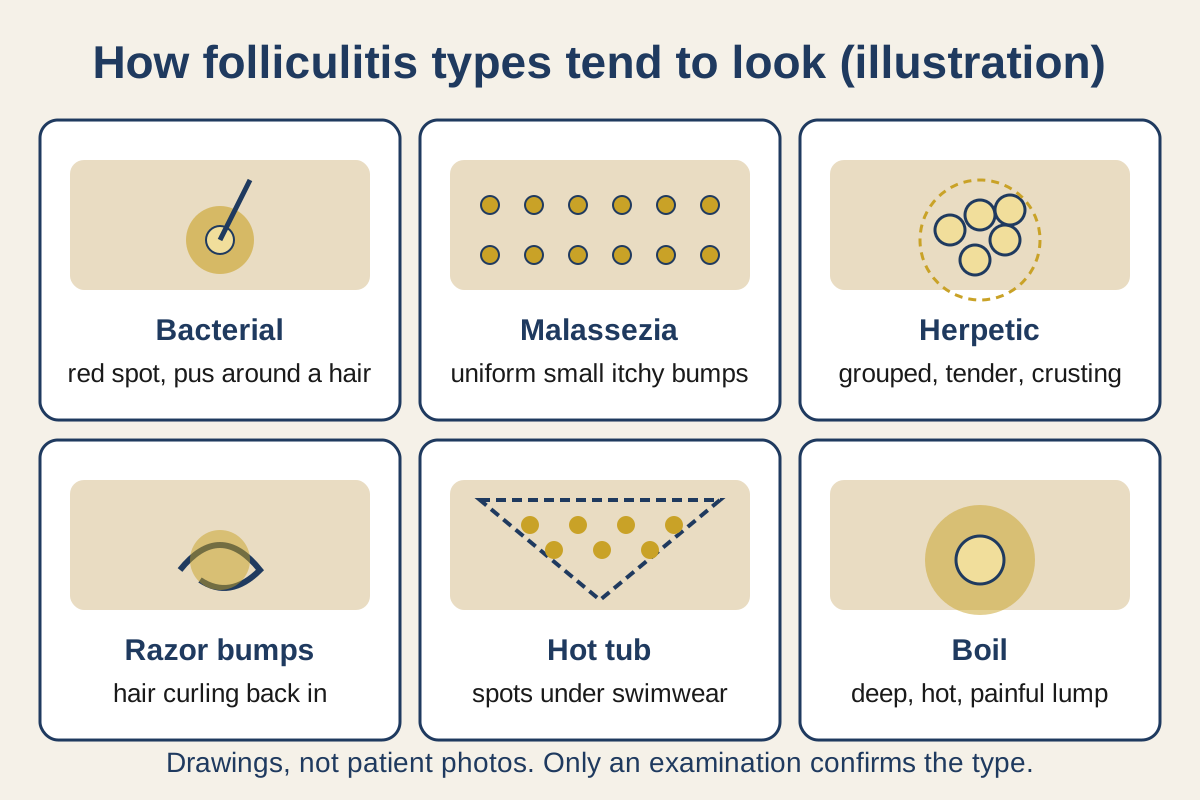
The types of folliculitis pictures you find online usually group the condition by cause. DermNet lists infection, occlusion (blockage), irritation and a range of skin diseases. The drawing below shows how six common types tend to look; it is a guide to patterns, not a way to identify your own rash.
Type
Usual cause
Typical look (illustration)
Where
Bacterial
Staphylococcus aureus
Red spot with pus around a hair
Anywhere with hair
Malassezia
Yeast
Uniform small itchy bumps
Upper trunk, hairline
Herpetic
Herpes simplex virus
Tender grouped spots that crust
Often the face
Hot tub
Pseudomonas aeruginosa
Spots under swimwear
Skin under swimwear
Razor bumps
Hair curling back into skin
Ingrown hairs, small bumps
Beard, legs, groin
Boil
Deep staph infection
Hot, painful lump with pus
Anywhere with hair
Early Stage Herpetic Folliculitis Pictures
Early herpetic folliculitis can be mistaken for other spots. DermNet describes herpes simplex folliculitis as tender, and recurrent herpes blisters as small and closely grouped, usually returning to roughly the same site. Grouped spots that sting or tingle before they appear are worth showing to a doctor.
Bacterial Folliculitis (Staph)
DermNet says bacterial folliculitis is commonly due to Staphylococcus aureus. MedlinePlus adds that damaged follicles most often become infected with staph. Treatment ranges from careful hygiene and antiseptic wash to antibiotic ointment or tablets.
Fungal Folliculitis (Malassezia)
Malassezia folliculitis presents as small, uniform, itchy papules and pustules, particularly on the upper back and chest, and sometimes the forehead and hairline, according to DermNet. Comedones are not seen, which helps separate it from acne. See our guide to scalp yeast infection for scalp yeast problems.
Viral Folliculitis (Herpes Simplex)
Folliculitis caused by herpes simplex tends to be tender and resolves without treatment in around ten days, according to DermNet. Severe recurrent attacks may be treated with aciclovir or other antivirals, which a doctor prescribes.
Hot Tub Folliculitis (Pseudomonas)
DermNet describes spa pool folliculitis as an infection with Pseudomonas aeruginosa picked up from warm water in spa pools, hot tubs, warm swimming pools and even wet suits. The bacteria can survive in adequately chlorinated water by forming a film on surfaces and pipes. Red spots turn into papules and pustules, mostly on skin covered by swimwear, with itch, pain or burning. Some people feel unwell, with headache, low fever or tender lymph glands. To lower the risk, DermNet advises removing swimwear and showering after getting out, and washing swimwear after each use.
Razor Bumps (Pseudofolliculitis Barbae)
Razor bumps are an inflammatory reaction to cut hairs that curl back into the skin, not an infection at first. DermNet says they mostly affect men of African ancestry, at about 45 to 80%, and are more common with blade razors than electric shavers. Bumps sit on the face and neck, especially under the jawline, and may bleed when shaved. The most definitive fix is to stop shaving; inflammation can take several weeks to settle as hairs grow out.
Shaving can also cause true folliculitis, where the follicle itself becomes inflamed or infected rather than a hair curling back into the skin.
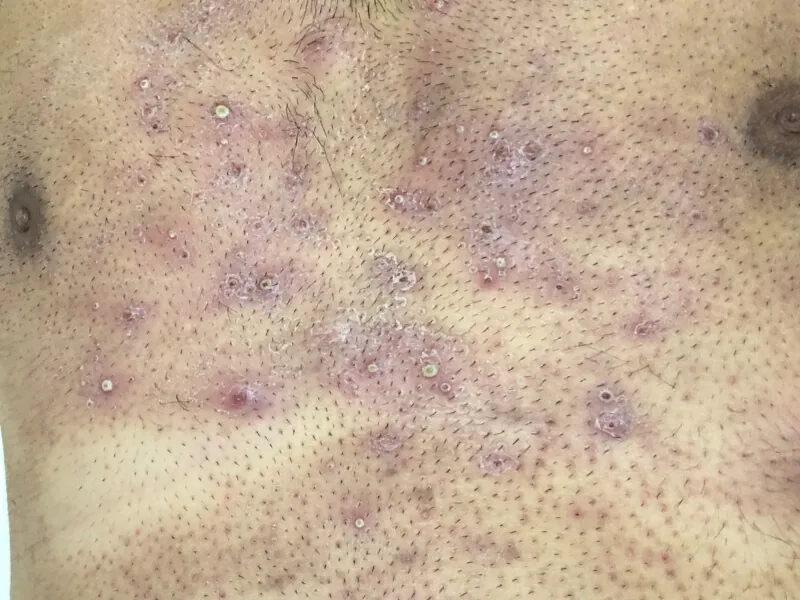
Folliculitis after shaving, on the chest. Photo: Dr. Shyam Verma, MBBS, DVD, FRCP, FAAD, CC BY 4.0, via Wikimedia Commons, cropped.
Here the spots are spread across the shaved area as small red bumps, several with a white head and some with a darker ring on brown skin. Razor bumps and folliculitis can look alike, so a doctor decides which one it is.
What Virus Causes Folliculitis?
DermNet names three viruses that can involve hair follicles:
Herpes simplex virus: tender folliculitis that clears in around ten days.
Herpes zoster (shingles): painful pustules and crusted spots in one band of skin supplied by a single nerve, treated with high-dose aciclovir.
Molluscum contagiosum: common in young children, with small dimpled bumps around the follicles, usually near body folds.
Most folliculitis is not viral. Bacteria, yeast and irritation from regrowing hairs are more common causes in the folliculitis treatment and causes literature.
What Causes Folliculitis Outbreaks?
Outbreaks often follow a trigger: shaving or waxing, a hot tub, tight clothing, heavy creams or a course of medicine. DermNet lists paraffin-based ointments, moisturisers and adhesive plasters as causes of sterile folliculitis, and corticosteroids, androgens and lithium among drugs that can cause it.
Why Does Folliculitis Keep Coming Back?
MedlinePlus says folliculitis often responds well to treatment but may come back. Recurrence is common when the trigger stays: shaving the same area, ongoing sweat and friction, or yeast that is part of normal skin. DermNet notes Malassezia folliculitis tends to recur, even after successful treatment.
Acne Vs. Folliculitis
Acne is a form of folliculitis in DermNet's grouping, but the two look different. Acne usually includes blackheads and whiteheads (comedones); Malassezia folliculitis does not. Bacterial folliculitis is centred on single hairs and often follows shaving or friction. Our guide to pimples on the scalp covers acne under the hair.
What Does Folliculitis on Scalp Look Like?
DermNet describes scalp folliculitis as small, very itchy pustules on the scalp, often most troublesome at the frontal hairline. There may be only a few spots or many. They are hard to leave alone because of the itch, and they often become sore and crusted.
The cause is not fully understood. DermNet considers it an inflammatory reaction to microorganisms in the follicle, including Cutibacterium acnes, Staphylococcus aureus in severe cases, Malassezia yeast and Demodex mites.
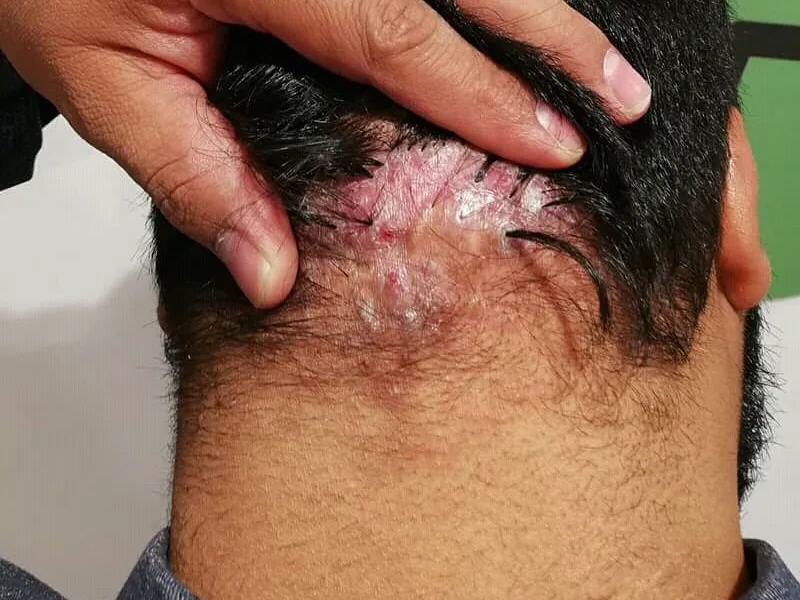
A more severe form, acne necrotica, leaves blackened crusts and pox-like scars. Folliculitis decalvans, usually around the crown, causes scarring hair loss with pustules at the edge of the patches and tufts of several hairs from one opening.
DermNet says folliculitis decalvans usually starts in a person's 40s or 50s, affects men more often, and does not affect children. It is thought to be an abnormal immune response to Staphylococcus aureus, although this is not proven. Treatment is led by a dermatologist and can include steroid creams or injections, because the aim is to stop further scarring.
In this photo the affected area has red, crusted skin with hair missing in the middle, which is the scarring pattern DermNet describes. Only a dermatologist, sometimes with a biopsy, can confirm folliculitis decalvans; appearance alone is not a diagnosis.
Eosinophilic folliculitis is another specific type. DermNet links it to a weakened immune system, for example in people with HIV or cancer, so spots that keep appearing in that setting should always be reported to the treating team.
Photos of Scalp Folliculitis
Scalp folliculitis photos online often show the hairline because that is where spots are easiest to see. The folliculitis decalvans photo above shows a scarring scalp form, and in our illustration the bacterial and Malassezia panels show the two patterns most linked to the scalp. Folliculitis symptoms pictures cannot show itch or tenderness, which matter as much as the look of the spots.
What Are Treatments for Folliculitis?
Treatment depends on the cause, which is why a swab can matter. DermNet says swabs should be taken from pustules for cytology and culture when infection is suspected. MedlinePlus says warm, moist compresses may help drain the follicles, and that treatment may include antibiotics on the skin or by mouth, or an antifungal.
How Is Folliculitis Treated?
These are the usual approaches by type, as described by DermNet:
Bacterial: careful hygiene, antiseptic cleanser or cream, antibiotic ointment, or oral antibiotics.
Malassezia: avoiding heavy moisturisers, stopping antibiotics where possible, and antifungal treatment for several weeks; weekly use may help prevent recurrence.
Scalp folliculitis: mild shampoo as often as desired, antidandruff shampoos with ketoconazole or ciclopirox, and prescription options such as topical antibiotics or mild steroid lotions.
Irritant folliculitis from shaving: stop hair removal and do not start again for about three months after it settles.
Herpetic: antivirals for severe recurrent attacks.
Chronic folliculitis treatment and folliculitis treatment long term are decisions for a dermatologist, especially when the scalp is involved or hair is thinning. Folliculitis treatment and hair loss go together in scarring forms such as folliculitis decalvans, which DermNet says can cause permanent progressive hair loss.
Is folliculitis treatment contagious? Treatment itself is not, but some infections are. Spa pool folliculitis, for example, is acquired from contaminated warm water in hot tubs and pools.
Home and Natural Remedies for Folliculitis
Simple home care helps mild folliculitis settle. MedlinePlus and the NHS suggest these steps:
Hold a clean cloth soaked in warm water against painful spots; the NHS suggests 10 minutes, 4 times a day for boils.
Keep the area clean and avoid tight clothing that rubs.
Avoid shaving the area if possible; otherwise use a clean new blade or an electric razor.
Do not share towels, and wash bedding and towels regularly.
Do not pick, squeeze or pierce spots.
MedlinePlus advises contacting a health professional if symptoms come back often, get worse, or last longer than 2 or 3 days despite home care.
Zinc and Tea Tree Oil
We found no clinical trial of zinc or tea tree oil specifically for folliculitis in the sources we checked. The NHS lists zinc tablets among supplements a pharmacist may suggest for acne, which is a related follicle condition.
Tea tree oil has trial data for dandruff: a 5% tea tree oil shampoo improved dandruff in 41% of people after 4 weeks, against 11% with placebo, in a study of 126 people in the Journal of the American Academy of Dermatology. A review in Clinical Microbiology Reviews notes that tea tree oil can cause irritation and allergic reactions and is toxic if swallowed. If you try it, use a ready-made product, test a small area first and stop if the skin reacts.
Folliculitis: Side Effects and Safety
Most folliculitis heals without marks, but complications are possible. DermNet lists postinflammatory hyperpigmentation, scarring and cellulitis among the complications of spa pool folliculitis, and abscess and keloid scarring for razor bumps. Deep infections can become boils; a group of boils is a carbuncle.
Treatments carry their own risks. Antibiotics should be used only when prescribed, and the NHS advises not to pick, squeeze or pierce a boil. Steroid creams used too long can themselves cause folliculitis, according to DermNet. Ask a pharmacist before combining products on the same area.
How Long Do Folliculitis Bumps Last?
How long folliculitis lasts depends on the type. Herpetic folliculitis resolves in around ten days, according to DermNet. MedlinePlus advises seeing a provider if it lasts longer than 2 or 3 days despite home treatment.
Folliculitis treatment how long does it take is a common question. For Malassezia folliculitis, DermNet says antifungal treatment usually runs for several weeks. For razor bumps, DermNet says it may take several weeks for inflammation to calm after shaving stops, as hairs grow out.
How Long Does It Take for Folliculitis to Appear?
Timing helps link a rash to its trigger. DermNet says spa pool folliculitis usually appears between 8 hours and 5 days after exposure. After a hair transplant, a 2026 review in Frontiers in Medicine reported folliculitis in 12.1% of FUE patients in one series, with onset usually 1 to 4 weeks after surgery.
Herpetic Folliculitis Pictures
Herpetic folliculitis pictures show grouped, tender spots that may blister and crust. DermNet describes recurrent herpes blisters as smaller and more closely grouped than the first attack, and they usually return to the same site. DermNet notes that recurrent Type 1 herpes most often affects the face.
Because the virus stays in the body, attacks can recur. DermNet says topical aciclovir or penciclovir may shorten recurrent attacks of herpes simplex if started early, and oral antivirals may be used for severe recurrent folliculitis. A doctor should confirm the diagnosis before you start antiviral treatment.
Pictures of Hair Follicle Infection
Pictures of hair follicle infection usually show bacterial folliculitis: a red spot with a white or yellow head around a single hair. Hair follicle pictures in anatomy guides show the follicle as a small tube in the skin; folliculitis is inflammation in that tube.
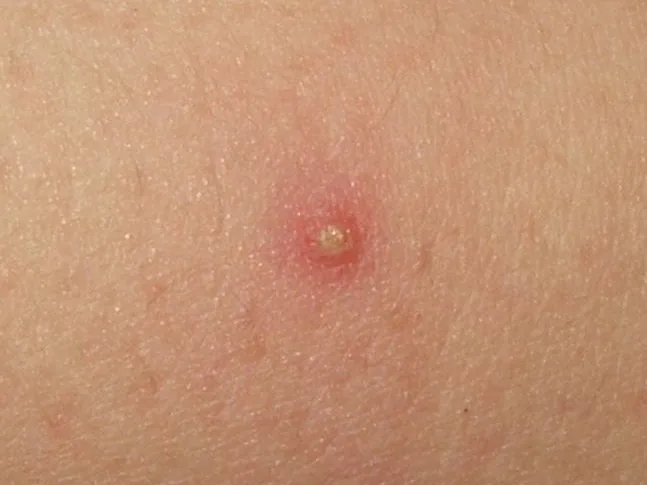
One spot on its own looks like this: a yellow head of pus in the middle and a small red ring around it. A single spot like this often settles with simple care, but a doctor should see it if it grows, hardens or keeps coming back.
If the infection reaches deeper, it becomes a boil: a hard, painful lump that fills with pus. The NHS says most boils go away on their own, but you should see a GP if you keep getting them or have one for 2 weeks without improvement.
Picture of Folliculitis in Pubic Area
A picture of folliculitis in pubic area skin often shows small red bumps after shaving or waxing. MedlinePlus lists the groin and genital area among common sites. DermNet notes that razor bumps can occur wherever hair is shaved or plucked, including the pubic area, and that women commonly get them in the groin.
Folliculitis pictures pubic area treatment usually means pausing hair removal, wearing loose underwear and using warm compresses. Spots in the genital area that blister or recur should be checked by a doctor, because herpes simplex can look similar.
Infected Hair Follicle Pictures
Infected hair follicle pictures on scalp skin show pustules at the hairline or crown. Severe cases of scalp folliculitis can involve Staphylococcus aureus, according to DermNet. Spots that spread, leave scars or sit in patches of hair loss need a dermatologist, because scarring forms of folliculitis can destroy follicles.
If you have recently had a hair transplant, spots in the grafted area are a known complication of healing. Follow your aftercare guideline and send photos to your medical team rather than treating them on your own. Our page on hair transplant side effects explains what is common after surgery.
Folliculitis on Legs Pictures
Folliculitis on legs pictures often show a shaving rash: small, very itchy bumps on the lower legs. DermNet describes irritant folliculitis on women's lower legs and recommends stopping hair removal and not restarting for about three months after the folliculitis settles. The photo at the top of this page shows folliculitis on a lower leg.
To prevent it from coming back, DermNet suggests a gentle hair removal method such as an electric razor; if you use a blade, avoid soap and apply plenty of shaving gel.
See a doctor or dermatologist if folliculitis: - lasts longer than 2 or 3 days despite home care, or keeps coming back - forms deep, hot, painful lumps or a group of boils - comes with fever, chills or spreading redness - sits in patches of hair loss, scarring or tufted hairs on the scalp - appears on the face or genitals with blisters - affects someone with diabetes or a weakened immune system
Frequently Asked Questions
Can You Catch Folliculitis From Someone Else?
Some types can pass on. The NHS advises not sharing towels while a boil is present and staying away from pools and gyms until it heals. Hot tub folliculitis comes from contaminated water, and herpes simplex spreads by contact. Irritant folliculitis from shaving is not infectious.
Can Folliculitis Spread?
Yes. MedlinePlus notes it may return or spread to other body areas. Scratching and shaving over spots can carry bacteria to nearby follicles, so keep nails short and avoid shaving the area until it clears.
Can You Have Folliculitis for Months?
Yes, when the trigger continues. Malassezia folliculitis often recurs, and irritant folliculitis from shaving can last until hair removal stops. Any folliculitis that keeps going for weeks should be seen by a doctor, who may take a swab.
Can You Have Folliculitis for Years?
Some forms are long-lasting. DermNet describes folliculitis decalvans as chronic and chronic buttock folliculitis as very persistent. These need a dermatologist, who may suggest long courses of treatment or permanent hair reduction by laser.
Does Folliculitis Cause Permanent Hair Loss?
Some types can. DermNet lists folliculitis decalvans, lichen planus, discoid lupus and folliculitis keloidalis as causes of deep sterile folliculitis with permanent hair loss. Early treatment by a dermatologist is the best way to limit damage.
Does Scalp Folliculitis Go Away on Its Own?
Mild folliculitis often does. The AAD says the breakouts tend to go away on their own if you have a healthy immune system and stop doing what caused them, such as shaving or wearing tight clothing or equipment. Scalp folliculitis can be more stubborn, and DermNet lists antifungal shampoos, antibiotic lotions and tablets for it. See a doctor if spots last, spread or leave bald patches.
How Do You Tell If Scalp Folliculitis Is Fungal or Bacterial?
You usually cannot tell reliably by looking. DermNet describes Malassezia (yeast) folliculitis as small, uniform, itchy bumps without blackheads, while bacterial folliculitis is typically a red spot with pus around a hair. To confirm the cause, a doctor can take a swab or skin scraping for testing, which DermNet recommends when infection is suspected.
Can I Keep Washing My Hair With Scalp Folliculitis?
Yes. DermNet says a mild, normal shampoo can be used as often as you like for scalp folliculitis. Washing removes sweat, oil and product build-up around the follicles. Be gentle: do not scratch or pick at spots with your nails, rinse well, and do not share towels or combs while you have spots.
What Shampoo Helps Scalp Folliculitis?
DermNet says antidandruff shampoos containing antifungal ingredients such as ketoconazole or ciclopirox are sometimes helpful, alongside a mild everyday shampoo. These target Malassezia yeast, so they suit some types better than others. If spots continue, a doctor may prescribe an antibiotic lotion, a mild steroid lotion or tablets, according to DermNet. Follow the label for how long to leave the shampoo on.
Are Pictures Enough to Diagnose Folliculitis?
No. Pictures help you describe the pattern, but folliculitis can look like acne and other rashes. The AAD notes it can be helpful to see a dermatologist to make sure you have folliculitis, and DermNet says swabs can be taken from pustules when infection is suspected. Clear photos of your spots are still useful to show your doctor.
Worried About Spots and Hair?
Folliculitis that leaves scarring or bald patches needs a dermatologist first. If the scalp is settled and hair loss remains, send clear photos for a free hair analysis. Turkey Hair Center is a Ministry of Health authorized health-tourism intermediary, and procedures take place at authorized partner hospitals. You can also use the contact page.
Medical disclaimer: This article is for informational purposes only and is not medical advice. Individual results and recovery vary from person to person. Always follow the written aftercare plan from your own medical team.
Carson CF, Hammer KA, Riley TV. Melaleuca alternifolia (tea tree) oil: a review of antimicrobial and other medicinal properties. Clinical Microbiology Reviews, 2006;19(1):50-62
Send three photos: front, top and sides. You get a technique recommendation, a graft range and a straight answer about what is achievable, before anyone talks about price.
Your details are with the team
A patient coordinator will get back to you shortly. If you would like to send your photos now, WhatsApp is the fastest way to do it.
We respond quickly, day or night, in your language.
Multilingual team, no obligation
Data protectedKVKK and GDPR compliant, 100% confidential
Authorized Health Tourism Intermediary
Turkey Hair Center is the hair-restoration brand of Healthy Way Tourism, an authorized international health-tourism intermediary. All medical procedures are performed by licensed medical professionals at authorized healthcare facilities in Turkiye, in accordance with the regulations of the Ministry of Health.