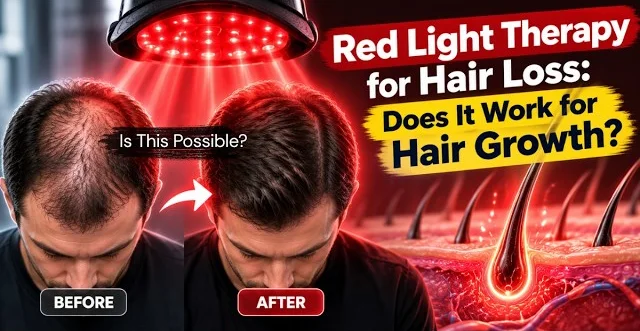
Red Light Therapy for Hair Loss: Does It Work for Hair Growth?
Does red light therapy work for hair loss? Review the evidence, who may benefit, how LLLT is used, expected results, safety, devices and alternatives.
Performed at authorized partner hospitals Turkey Hair Center is a Ministry of Health authorized health-tourism intermediary, not a clinic.
Does red light therapy work for hair loss?
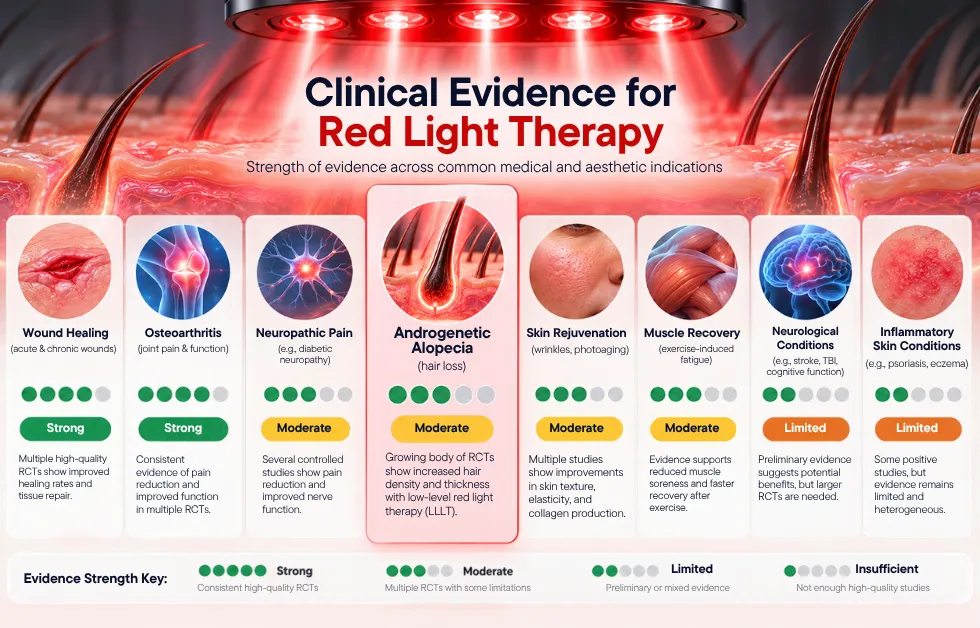
Red light therapy actually shows potential for improving hair density, especially if you have male or female pattern hair loss. Clinical studies do suggest that low-level light therapy (LLLT) supports hair growth. Just remember that results vary wildly depending on the person and the device. You won't see changes overnight; most studies evaluate results after several months. Plus, evidence for other types of hair loss remains pretty limited.
Does Red Light Therapy Work for Hair Loss?
Evaluating light-based treatments requires looking past product marketing to see what clinical trials actually measure.
Does red light therapy help hair grow?
It may support hair growth by stimulating the biological processes inside your existing hair follicles. The strongest clinical evidence points directly to androgenetic alopecia (pattern hair loss). It cannot, however, magically restore hair in areas where the follicles are permanently lost.
What Does the Latest Research Say?
We got a much clearer picture from a major systematic review published in 2025. Researchers looked at 38 different studies covering 3,098 patients with various types of alopecia. They did find that hair density improved when compared to a sham placebo device. Typically, these trials tracked changes over a 16 to 24-week period by measuring hair count per square centimeter.
There is an important limitation to keep in mind, however. Out of all those people, 2,930 specifically had androgenetic alopecia. The actual findings varied considerably across the different studies. For other types of hair loss, there simply wasn't enough solid data to run a proper meta-analysis.
Which Types of Hair Loss Have the Best Evidence?
Currently, the clinical evidence is strongest for androgenetic alopecia. So if you are dealing with hereditary thinning, research offers a starting point. But if stress, a nutritional deficiency, or an autoimmune condition is causing your hair to fall out, the clinical proof drops off significantly.
Potential Benefits of Red Light Therapy for Hair Growth
Studies of androgenetic alopecia have found improvements in hair density, and some have also reported thicker hair shafts. Plus, it is completely non-invasive. No needles and no downtime. A lot of people prefer that conservative approach. Just keep in mind that a treatment being non-invasive doesn't guarantee it will regrow your hair.
What Is Red Light Therapy for Hair Growth and How Does It Work?
The whole process comes down to specific wavelengths of light interacting with the cells inside your scalp.
Red Light Therapy, LLLT and Photobiomodulation: What's the Difference?
People throw these terms around constantly. Low-Level Laser Therapy (LLLT) and red light hair therapy both fit under the umbrella of "photobiomodulation" or PBM for short. Just remember that not all PBM devices use the exact same light source or follow the same clinical rules.
LED vs Low-Level Laser Therapy for Hair Loss
Light sources are not all created equal. Lasers give off a focused, coherent beam of light. LEDs scatter it. Because of this, device-specific evidence is a big deal when evaluating low-level laser therapy for hair loss. You can't just buy a cheap LED cap and expect the exact same scalp penetration or clinical results you would get from a laser helmet tested in actual medical trials.
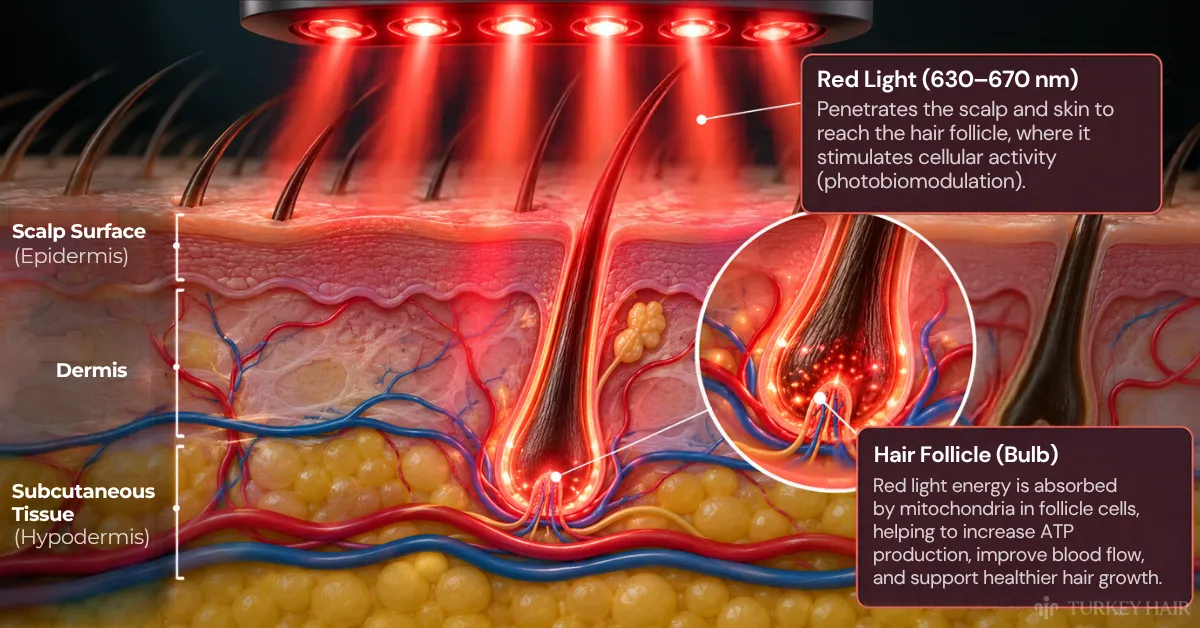
How Red Light May Affect Hair Follicles
The leading theory involves mitochondrial signaling. Photons get past the scalp tissue and cells absorb them. This interaction might kickstart cellular metabolism and keep the hair in its growth phase (anagen) longer. But it doesn't perform miracles. If a follicle is dead and permanently gone, shining a light on it won't bring it back.
Who Is Red Light Therapy for Hair Loss Most Likely to Help?
Your underlying diagnosis dictates whether this therapy even makes sense for you.
Male and Female Pattern Hair Loss
This is where the clinical backing is strongest. The American Academy of Dermatology points out that repeated red-light sessions can trigger hair regrowth for people with hereditary pattern hair loss. Even then, they make it clear that results vary from person to person. It is a valid, non-invasive option for female pattern hair loss too. Nobody can guarantee the outcome, though.
Thinning Hair and Early-Stage Hair Loss
Catching it early is your best bet. The therapy targets weakened, miniaturized follicles to try and bulk them up. If your hair loss is advanced and the follicles are already extensively lost, the chance of seeing noticeable regrowth drops drastically.
Can Red Light Therapy Regrow Hair on a Bald Scalp?
It can help improve the growth of weakened, existing hair follicles. But it is highly unlikely to restore hair in totally bald areas where the follicles are permanently gone. If you have advanced baldness, you might need to look into other treatment options, including a hair transplant.
What About Alopecia Areata, Telogen Effluvium and Other Hair Loss?
The evidence here is just not nearly as established. The recent meta-analysis made it pretty obvious. There isn't enough robust statistical proof right now to back this up as a widespread treatment for hair loss outside of the standard androgenetic pattern.
How to Use Red Light Therapy for Hair Growth
You have to follow the instructions for your specific device. Clinical testing protocols are incredibly varied.
How Often Should You Use Red Light Therapy for Hair Loss?
Don't look for a universal schedule because one doesn't exist. Clinical trials test all kinds of setups. Recent meta-analyses looked at studies where people used devices anywhere from every single day to just two or three times a week. You have to stick to the specific protocol your device was modeled after.
How Long Should Each Session Be?
Session lengths are all over the board too. In clinical studies, treatments lasted anywhere from a couple of minutes to a full half-hour. The timing relies entirely on the device's power output and the intended medical dose.
Typical Clinical Study Parameters for LLLT
To give you an idea of what researchers actually test, here is a general breakdown of verified study protocols:
Parameter
Common Clinical Standard
Wavelength
600 - 650 nm
Treatment Duration
16 to 24 weeks minimum
Assessment Metric
Hair density per cm²
Does Dose and Device Type Matter?
Definitely. Wavelength is just one part of the equation. Irradiance, scalp coverage, how long the session lasts, and whether you actually stick to the routine-that is what makes up the real medical dose you get.
How Long Does Red Light Therapy Take to Work for Hair Loss?
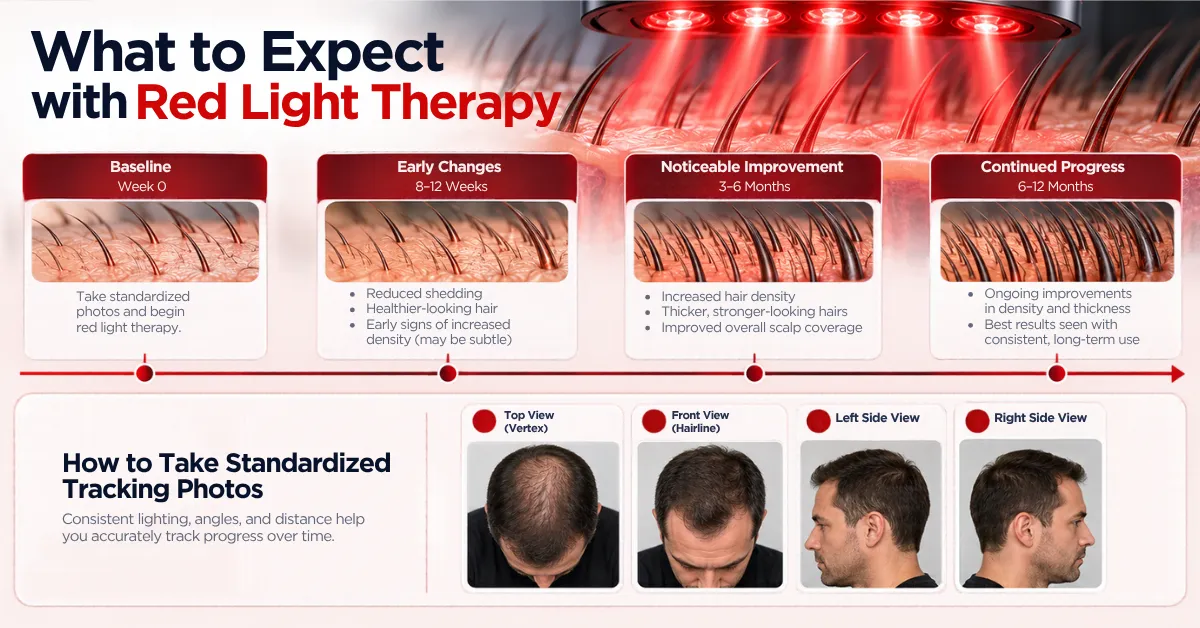
You usually need several months of consistent use before you can meaningfully assess the results. In fact, many clinical studies wait three to six months before evaluating any changes in hair density. Individual results ultimately depend on your device, the treatment protocol, and what actually caused your hair loss in the first place.
Period
Clinical Assessment
First weeks
Visible change is usually minimal. Early regrowth is not expected.
1-3 months
Some early shifts in hair quality may appear, heavily depending on the protocol.
3-6 months
This is the primary assessment window used in most clinical trials to evaluate density.
6+ months
Long-term response is evaluated. Maintenance is typically necessary to preserve results.
How Should You Track Hair Growth Results?
You can't just trust the bathroom mirror. It tricks you. When assessing red light therapy hair growth results, use standardized photos instead. Take a picture of yourself every single month. To get accurate red light therapy before and after comparisons, make sure the lighting, the angle, the distance, and even if your hair is wet or dry stays exactly the same. Researchers in a clinical setting measure actual hair counts and shaft thickness. They definitely aren't just eyeballing it.
What Happens If You Stop Red Light Therapy?
You will likely have to keep using the device to keep your results. If you stop, those supported follicles just slowly go back to their natural thinning state over time. We do still need more long-term data on what happens when you stop, though.
Is Red Light Therapy for Hair Loss Safe?
An international expert consensus labeled photobiomodulation a safe treatment modality for adults. But there are always a few exceptions.
Possible Side Effects
Short-term side effects rarely cause any big problems. Some users say they get a temporarily red scalp or maybe some mild irritation. Sometimes it's just a warm feeling while using the device.
Who Should Be Cautious or Avoid Red Light Therapy?
If you take photosensitizing meds, get medical clearance first. The AAD also warns people with darker skin tones to be extra careful. Being sensitive to visible light can actually increase the risk of hyperpigmentation for them.
Can Red Light Therapy Damage Hair or the Scalp?
The current short-term safety data shows a very low risk of scalp damage as long as you use the device correctly. We are still studying what decades of daily exposure might do, however.
FDA-Cleared vs FDA-Approved: What's the Difference?
You need to know the difference here. When the FDA "clears" a device, it essentially means they permit it for marketing because it is substantially equivalent to something already legally on the market. FDA "approval" is a completely different, much stricter review of safety and efficacy. A clearance badge does not guarantee the device will magically regrow your hair.
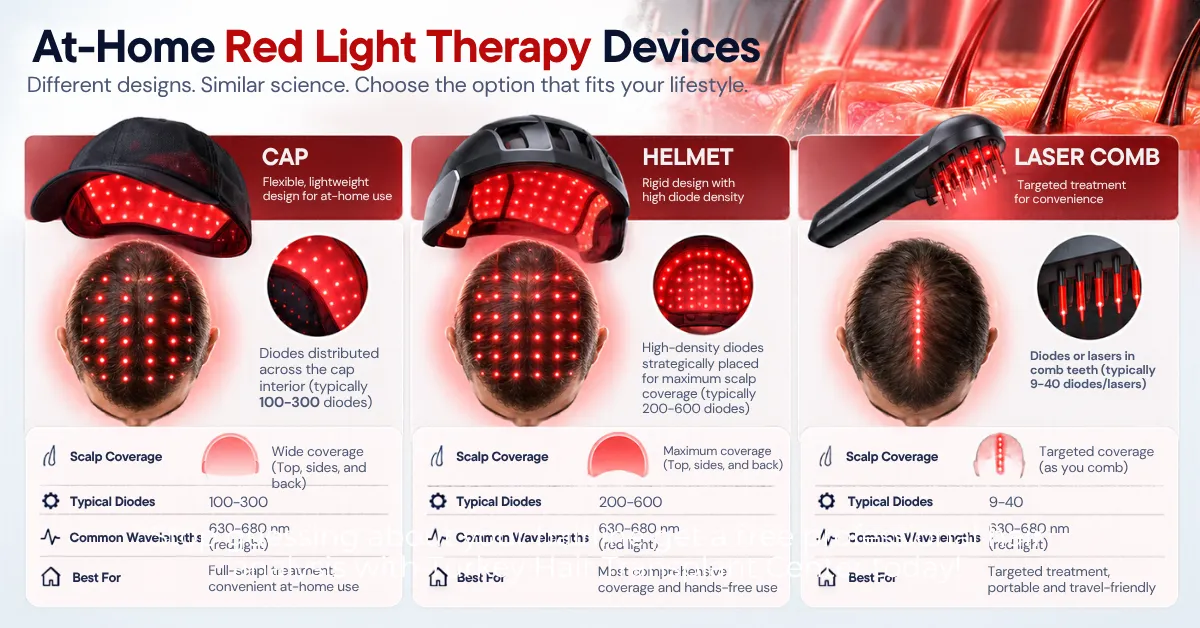
At-Home Red Light Therapy for Hair Loss: Caps, Helmets or Combs?
Laser caps, helmets, and combs vary wildly. The design, the settings, and the actual scientific evidence behind them are all over the place.
What Should You Look for in a Hair-Growth Device?
You really need to check a few things. Wavelength, scalp coverage, and treatment times all matter. Brands love to use FDA clearance to build trust. But an FDA clearance badge just isn't enough on its own. A device that has its very own peer-reviewed studies is vastly more reliable than one just piggybacking on general light therapy research.
Are At-Home Devices as Powerful as Professional Treatments?
Professional and at-home devices can differ in power output and scalp coverage. More power doesn't automatically mean better results. Before you make your decision, you have to focus on the clinical evidence for the specific device. That is much more reliable than just making assumptions about whole product categories.
Red Light Therapy vs Minoxidil, Finasteride and Other Hair Loss Treatments
Figuring out how light therapy compares to standard medical treatments is a great way to set realistic expectations.
Treatment
Main Purpose
Evidence Framing
Invasive?
Ongoing?
RLT/LLLT
Light-based management
Promising for androgenetic alopecia
No
Often
Minoxidil
Hair-growth medication
Established for indicated use
No
Generally
Finasteride
DHT-targeting medication
Established for indicated populations
No
Generally
PRP
Injection-based treatment
Protocols and evidence vary
Minimally
Multiple sessions
Hair Transplant
Redistributes donor follicles
Established surgical restoration
Yes
Different objective
Is Red Light Therapy Better Than Minoxidil?
They actually work through completely different mechanisms. Minoxidil is an established medication for certain types of hair loss, while red light therapy is a non-invasive option supported by clinical evidence for pattern hair loss. Current research simply doesn't prove that red light therapy is consistently more effective than minoxidil.
Can Red Light Therapy Be Combined With Minoxidil or Other Treatments?
Combining therapies happens a lot, but the clinical data isn't straightforward. One 2025 meta-analysis looked at adding LLLT to minoxidil and found no significant added advantage. On the flip side, another recent review of seven randomized controlled trials saw greater density and diameter from the combination. It might help, but compounding results are never a sure thing.
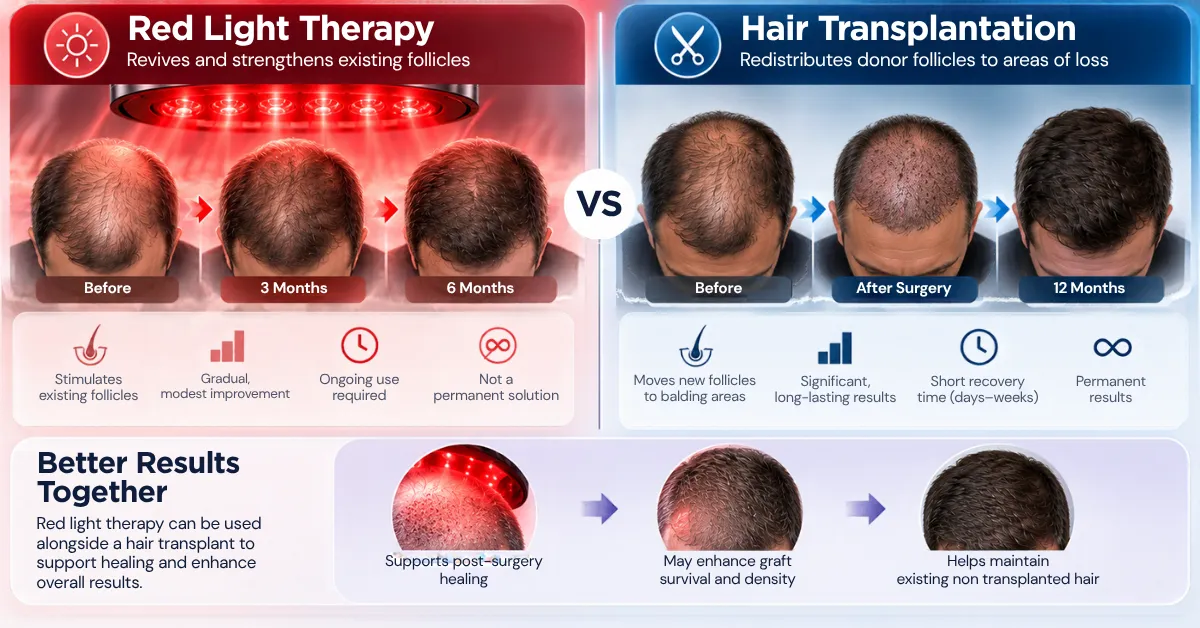
Can Red Light Therapy Replace a Hair Transplant?
Light therapy's job is to improve the growth coming out of your existing follicles. A hair transplant is a surgical procedure that physically moves healthy follicles into balding areas. They do entirely different things. If an area of your scalp has completely lost its follicle structures, shining a light on it won't replace the need for surgery.
Can You Use Red Light Therapy After a Hair Transplant?
People often wonder if light therapy can speed up their recovery or protect the new grafts.
The truth is, we lack robust clinical trials that verify accelerated healing or better graft survival rates specifically from post-op light therapy. Because the medical literature doesn't have universal standards for this yet, your operating surgeon has to be the one to explicitly direct any adjunctive therapy you use.
Conclusion: Is Red Light Therapy Worth Considering for Hair Loss?
Red light therapy stands as a promising, non-invasive option if you have androgenetic alopecia. Clinical studies do suggest it may improve hair density. Still, results vary and the treatment absolutely requires consistency. It is not a guaranteed fix for every type of hair loss, and identifying your underlying cause is essential before you choose a treatment.
Considering Your Next Steps?
Every single hair loss journey is different. Getting a proper medical assessment clarifies exactly what you need and sets up realistic treatment options based on the actual health of your follicles. Reach out to find out what your scalp really requires. [CTA]
Editorial Policy and Trust
We strictly adhere to an evidence-first medical approach. All claims regarding photobiomodulation and alopecia are cross-referenced with systematic reviews, randomized controlled trials, and official guidelines from dermatological authorities to ensure clinical accuracy.
References and Medical Sources
Perez SM, Vattigunta M, Kelly C, Eber A. Low-Level Laser and LED Therapy in Alopecia: A Systematic Review and Meta-Analysis. Dermatologic Surgery. 2025. (pubmed.ncbi.nlm.nih.gov)
American Academy of Dermatology (AAD). "Is red light therapy right for your skin?" (aad.org)
Alosaimi A et al. Comparative efficacy of minoxidil alone versus minoxidil combined with low-level laser therapy in androgenic alopecia: systematic review and meta-analysis. (pubmed.ncbi.nlm.nih.gov)
Mawu FO et al. Comparative efficacy and safety of LLLT + topical minoxidil vs topical minoxidil monotherapy in AGA: systematic review/meta-analysis of RCTs. (pubmed.ncbi.nlm.nih.gov)
Maghfour J et al. Evidence-based consensus on the clinical application of photobiomodulation. Journal of the American Academy of Dermatology. 2025. (pubmed.ncbi.nlm.nih.gov)
Send three photos: front, top and sides. You get a technique recommendation, a graft range and a straight answer about what is achievable, before anyone talks about price.
Your details are with the team
A patient coordinator will get back to you shortly. If you would like to send your photos now, WhatsApp is the fastest way to do it.
Real People Real Support
Send your photos on WhatsApp
Front, top and both sides, reviewed by the medical team.
We respond quickly, day or night, in your language.
Multilingual team, no obligation
Data protectedKVKK and GDPR compliant, 100% confidential
Authorized Health Tourism Intermediary
Turkey Hair Center is the hair-restoration brand of Healthy Way Tourism, an authorized international health-tourism intermediary. All medical procedures are performed by licensed medical professionals at authorized healthcare facilities in Turkiye, in accordance with the regulations of the Ministry of Health.