Performed at authorized partner hospitals Turkey Hair Center is a Ministry of Health authorized health-tourism intermediary, not a clinic.
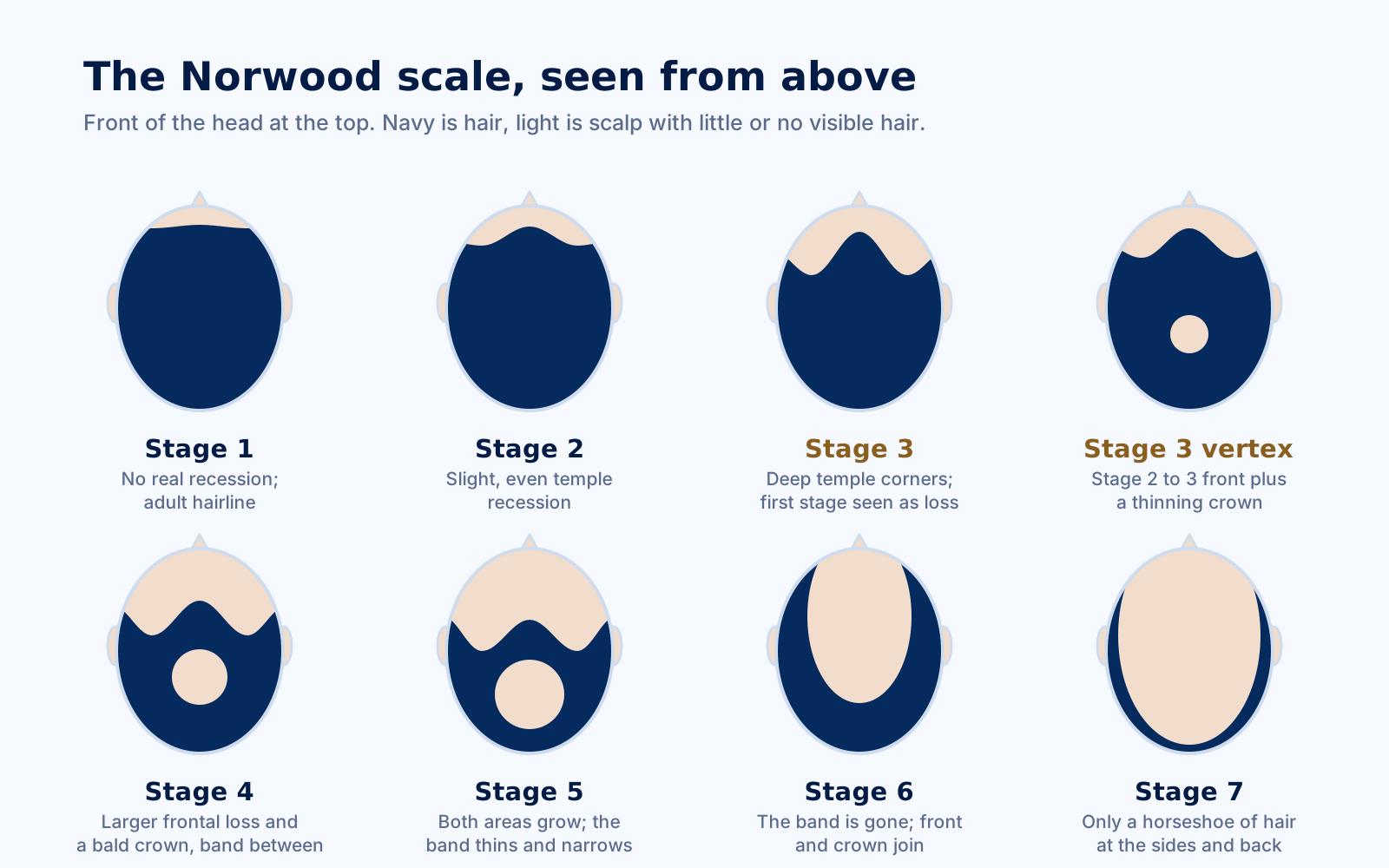
The Norwood scale sorts male pattern hair loss into seven stages, from an adult hairline with little or no recession (Norwood 1) to a horseshoe of hair at the sides and back (Norwood 7). Stage 3 is the first stage counted as clinical hair loss, and a separate "vertex" type covers men who lose hair at the crown first.
Doctors use the scale to describe how far hair loss has gone, to follow it over time and to plan treatment, including how many grafts a transplant would need. Below you will find every stage as its own section, the in-between "Norwood 1.5" that people ask about, and what each stage usually means for treatment. If you would rather place your own pattern first, our Norwood stage test walks you through it.
What Is a Norwood Hairline?
A "Norwood hairline" is simply a hairline described by its stage on this scale. The system has two authors, which is why it is also called the Hamilton-Norwood scale. James Hamilton published the first version in 1951. In 1975 O'Tar Norwood revised it after examining 1,000 adult men, added the stage 3 vertex and the "type A" variants, and gave surgeons a shared vocabulary for planning.
Fifty years on, it is still the reference most clinics, studies and online tools use. It is not the only system: the BASP classification, published in 2007, scores the hairline shape and the density on top separately and works for women as well. For a quick, common language between you and a doctor, though, Norwood is the one to know.
Norwood 1
At Norwood 1 there is minimal or no recession of the hairline. The front sits low and fairly straight, close to where it was in your late teens. A Norwood 1 hairline example is the hairline most boys have before their twenties: no temple corners worth measuring and no thinning at the crown. A V-shaped point at the centre, a widow's peak, is a natural hairline shape, not a stage.
Norwood 1 vs 2 comes down to the temples. At stage 2 small, usually symmetrical triangles appear where the hairline meets the temples. At stage 1 they are absent or barely there. Norwood 1 examples in photos can mislead, because a fringe or a forward style hides the temples completely. The rumours about Justin Bieber's hairline also began with close-up photos.
Is Norwood Scale 1 Normal?
Yes. Stage 1 means no pattern hair loss. Many men do not stay at stage 1 for life, because a mild move to stage 2 is the normal change from a teenage to an adult hairline.
So What Do You Actually Do About Norwood 1?
Nothing needs treating. Norwood 1 treatment questions usually come from men with a strong family history. The practical step is to take dated photos once or twice a year, so that any change is measured rather than guessed.
Norwood 1.5
Norwood 1.5 is not a stage in Norwood's 1975 paper. It is an informal label for a hairline that has started to soften at the temples but has not formed the clear triangles of stage 2. A Norwood 1.5 hairline often shows as a slightly higher corner on one side, or a temple that looks thinner in harsh light than in daylight.
People also write "Norwood 1.5 to 2" for the same in-between look. Treat these half stages as rough. In one reliability study, dermatologists and dermatology residents rating photos of 43 men agreed only moderately on the whole stages, and when a second group rated 56 photos again three months later their repeat scores were poor. Half stages are even harder to agree on.
What the label is good for: noticing that the hairline is starting to move. Compare a photo from a few years ago taken at the same angle and in similar light.
Norwood 2
At Norwood 2 there are triangular, usually symmetrical areas of recession at the frontotemporal hairline. In Hamilton's original description these corners reach no farther back than a point 3 cm in front of a line drawn across the head between the ear canals. For many men, Norwood scale 2 is the mature adult hairline and it may stay that way.
A Norwood 2 hairline example looks like a slightly higher forehead with soft corners, and the front edge stays dense. Lists of "Norwood 2 celebrities" online are guesses made from styled photos, not assessments, so they say little about any one hairline. Our LeBron James hairline analysis shows the limits of judging from photographs.
Norwood 2 vs 3
The difference is depth and density. Stage 3 temple recessions are deep and bare or only sparsely covered. Stage 2 corners are shallow and still have hair.
How Long Does Norwood 2 Last?
There is no fixed time. No study gives a duration for each stage. Some men stay at stage 2 for decades, while others move on within a few years, often those whose loss started early.
How Long Does It Take to Go From Norwood 2 to 3?
Nobody can give you a number. In five years of placebo data from men with mostly crown loss, 75% were rated visibly worse, which also means a quarter were not. Family history and the age loss started are better personal guides.
Norwood 3
Norwood 3 is the minimal extent of hair loss that Norwood counted as baldness. The temple recessions are deep and symmetrical, and they are bare or only sparsely covered by hair. Norwood 3 hair often still looks full from the front when it is styled forward, which is why this is the stage many men first notice in a photo. For cuts that suit it, see hairstyles for a receding or balding hairline.
A Norwood 3 hairline forms a clear M or V shape. A transplant at this stage usually rebuilds the hairline and the temple corners. Our page on Norwood 3 hair transplant covers graft numbers and timing.
Can Balding Stop at Norwood 3?
It can slow or stay put for years, but nothing predicts that in advance. Untreated pattern loss tends to progress: over five years men on placebo lost 239 hairs in the measured area, a 26.3% fall in density. In two five-year trials with 1,553 men, finasteride 1 mg cut the likelihood of further visible loss by 93% compared with placebo. Finasteride is a prescription medicine with possible side effects, so it should be started and followed by a doctor.
Norwood 4
At Norwood 4 the frontal recession is deeper than at stage 3, and the crown has sparse hair or none. The two areas are still separated by a band of moderately dense hair that runs across the top and connects with the sides. As long as that band is there, the head still reads as having hair from the front.
Planning now covers two areas. Adding the usual starting ranges our medical team uses for the hairline and the crown gives roughly 2,700 to 5,000 grafts, depending on donor density and how much of the crown is treated.
Norwood 5
At Norwood 5 the crown and the front are still separated, but less clearly. The band across the top has become narrower and sparser, and both bald areas are larger. From most angles the top of the head now looks bald.
At Norwood 5, plans start to be shaped as much by the donor area as by the bald area. The hairline usually comes first, and the crown is covered as far as the donor supply allows.
Norwood 6
At Norwood 6 the bridge of hair across the top has gone, leaving only sparse hairs. The frontal and crown areas have joined into one bald zone, and hair remains on the sides and the back.
Restoring all of Norwood 6 in one session is often not possible. Plans usually frame the face first, then add density to the top and crown over one or two sessions if the donor area allows.
Norwood 7
Norwood 7 is the most advanced stage. Only a narrow horseshoe of hair remains on the sides and back, and that band can itself be thinner and lower than at stage 6. Some men keep a shaved head instead, as many famous bald men have.
Questions about Norwood 7 hair transplant results come up often. The honest answer is that the gap between what is needed and what the donor area can give is at its widest here. A plan normally aims for a natural frame around the face and accepts a lighter crown. The medical team judges this from photos of the donor area.
Hair Loss Stages According to the Norwood Scale
The table puts the Norwood classification of male pattern baldness on one page. The graft column shows where our medical team starts planning, not a quote. For a sense of scale, see how many hairs are on the human head.
Stage
What you see
Planning range our medical team starts from
1 to 2
Little or mild, even temple recession
Usually none; 600 to 1,200 grafts for temple refinement
3
Deep temple corners, clear M or V
1,500 to 3,000 grafts
3 vertex
Stage 2 or 3 front plus a thinning crown
Hairline 1,500 to 2,500; crown 1,200 to 2,500
4 to 5
Front and crown, band between them
Often two areas added together
6 to 7
One large area, horseshoe at the sides and back
3,500 to 6,000 grafts for a full head, often over two sessions
The final number depends on the density and width of your donor area, the thickness of your hair, your age and how much loss is still likely to come. Our pages on 2,000 grafts and 4,000 grafts show what each size usually covers. Turkey Hair Center is a Ministry of Health authorized health-tourism intermediary, and procedures take place at authorized partner hospitals in all-inclusive packages from $2,550 to $4,500.
Stage 3 Vertex and Type A
Two patterns sit beside the main line:
Stage 3 vertex: the loss is mainly at the crown, and the front recession goes no further than stage 3. Men often find out from a photo taken from above. Our crown balding guide covers this pattern.
Type A: the hairline moves back across the whole front without the M shape, and there is no separate crown patch. In a community study of men aged 18 to 49, 12% had this predominantly frontal pattern.
How Common Each Stage Is by Age
The same 1998 community study rated healthy men rather than clinic patients:
16% of men aged 18 to 29 were at stage 3 or higher.
53% of men aged 40 to 49 were at stage 3 or higher.
42% of all men aged 18 to 49 were at stage 3 or higher.
These figures describe how many men reach a stage, not how fast one man will move.
Treatment by Stage
At stages 2 to 4, medicine has the most to work with, because the follicles are still there even where the hair has become thin. Not every serum contains a tested medicine; see whether hair growth serums work.
Finasteride 1 mg: reduced further visible loss in the five-year trials above; prescription only. Telehealth services also prescribe it; see does Hims work for hair loss.
Minoxidil 5%: in a 48-week trial with 393 men, it produced 45% more regrowth than the 2% strength. Our guide to DHT and hair loss explains what these medicines target.
Transplant: moves follicles from the back and sides to the bald areas. It does not stop loss in the hair you still have, so many plans combine surgery with medicine.
If you are under about 25 and at stage 2 or 3, ask whether medicine first makes sense before surgery. A hairline placed too low too early can look out of place if loss continues behind it.
Checking Your Own Stage
Stages are harder to judge than diagrams suggest. A few habits make a self-check more reliable:
Use daylight and a dry, unstyled head. Wet hair and bathroom spotlights both make loss look worse.
Take four photos: front, both temples and the top from above.
Compare with a photo from a few years ago taken at a similar angle.
Pull the hair back at the temples, because a fringe hides stage 3 well.
The scale is built for men. Women usually lose density on top while the front hairline stays in place, which the Ludwig scale describes instead. Our page on hair transplant for women explains how that assessment differs.
Frequently Asked Questions
How Long Does the Norwood Procedure Take?
There is no procedure called Norwood. Placing someone on the scale is a visual check that takes a few minutes in person or from good photos. A transplant planned around your stage takes longer, and its length depends on the number of grafts, so the medical team gives you a written schedule.
What Is Norwood 1 2?
People write "Norwood 1 2" or "1.5" for a hairline between the first two stages: the temples have started to soften but have not formed the clear triangles of stage 2. It is not an official stage. Dated photos taken a year apart show whether it is moving.
What Is a Norwood 1 Hairline?
A Norwood 1 hairline has minimal or no recession. It sits low and fairly straight, without temple corners and without thinning at the crown. It is the hairline most men have in their late teens, and many move from it to a mature stage 2 hairline in adulthood.
Can Norwood 1 Be Reversed?
There is nothing to reverse. Norwood 1 means no pattern hair loss. If the hairline starts to move, the question becomes whether to treat early loss, and that decision belongs with a doctor who can examine your scalp and review your family history.
Is Norwood 1 Reversible?
It does not need to be. Stage 1 is the starting point of the scale, not a problem. Medicines such as finasteride and minoxidil are used once real pattern loss appears, usually from stage 2 or 3, and only after a medical assessment.
Is Norwood 1 No Hair Loss?
Yes. Norwood described stage 1 as minimal or no recession of the hairline, and Norwood counted only stage 3 and above as baldness. Normal daily shedding still happens at stage 1, because every follicle cycles through growth and rest.
Is Norwood 1 Bad?
No. It is the least advanced point on the scale. If you are worried because relatives lost their hair early, keep dated photos. A change you can measure is far more useful than one you fear.
How Do I Know If I Am Norwood 1 or Norwood 2?
Pull your hair back in daylight and look at the temple corners. Shallow, even triangles mean stage 2; a near straight line means stage 1. Even experts disagree on borderline cases, so a photo review by the medical team is the quickest way to settle it.
Find Your Stage
Your stage is a starting point; your donor area, age and the speed of loss decide the plan. Take the Norwood stage test for a quick self-check, or send photos of the front, top and sides for a free hair analysis. The medical team will tell you your stage, the likely graft range and the options that fit. Package details are on our hair transplant cost page.
Medical disclaimer: This article is for informational purposes only and is not medical advice. Individual results and recovery vary from person to person. Always follow the written aftercare plan from your own medical team.
Sources and medical review
Hamilton JB. Patterned loss of hair in man; types and incidence. Annals of the New York Academy of Sciences, 1951;53(3):708-728
Norwood OT. Male pattern baldness: classification and incidence. Southern Medical Journal, 1975;68(11):1359-1365
Gupta M, Mysore V. Classifications of patterned hair loss: a review. Journal of Cutaneous and Aesthetic Surgery, 2016;9(1):3-12
Kaufman KD, Girman CJ, Round EM, et al. Progression of hair loss in men with androgenetic alopecia (male pattern hair loss): long-term (5-year) controlled observational data in placebo-treated patients. European Journal of Dermatology, 2008;18(4):407-411
Kaufman KD, Rotonda J, Shah AK, Meehan AG. Long-term treatment with finasteride 1 mg decreases the likelihood of developing further visible hair loss in men with androgenetic alopecia (male pattern hair loss). European Journal of Dermatology, 2008;18(4):400-406
Olsen EA, Dunlap FE, Funicella T, et al. A randomized clinical trial of 5% topical minoxidil versus 2% topical minoxidil and placebo in the treatment of androgenetic alopecia in men. Journal of the American Academy of Dermatology, 2002;47(3):377-385
Lee WS, Ro BI, Hong SP, et al. A new classification of pattern hair loss that is universal for men and women: basic and specific (BASP) classification. Journal of the American Academy of Dermatology, 2007;57(1):37-46
Send three photos: front, top and sides. You get a technique recommendation, a graft range and a straight answer about what is achievable, before anyone talks about price.
Your details are with the team
A patient coordinator will get back to you shortly. If you would like to send your photos now, WhatsApp is the fastest way to do it.
We respond quickly, day or night, in your language.
Multilingual team, no obligation
Data protectedKVKK and GDPR compliant, 100% confidential
Authorized Health Tourism Intermediary
Turkey Hair Center is the hair-restoration brand of Healthy Way Tourism, an authorized international health-tourism intermediary. All medical procedures are performed by licensed medical professionals at authorized healthcare facilities in Turkiye, in accordance with the regulations of the Ministry of Health.