Am I Balding? Norwood Scale Test and Graft Calculator
You are balding by the Norwood scale's own measure if the picture closest to the top of your head is stage 3 or higher, while stages 1 and 2 are not yet counted as baldness. Pick your picture below and our free test shows your likely stage and the graft range our medical team starts planning from.
What Norwood Am I? Pick the Closest Picture
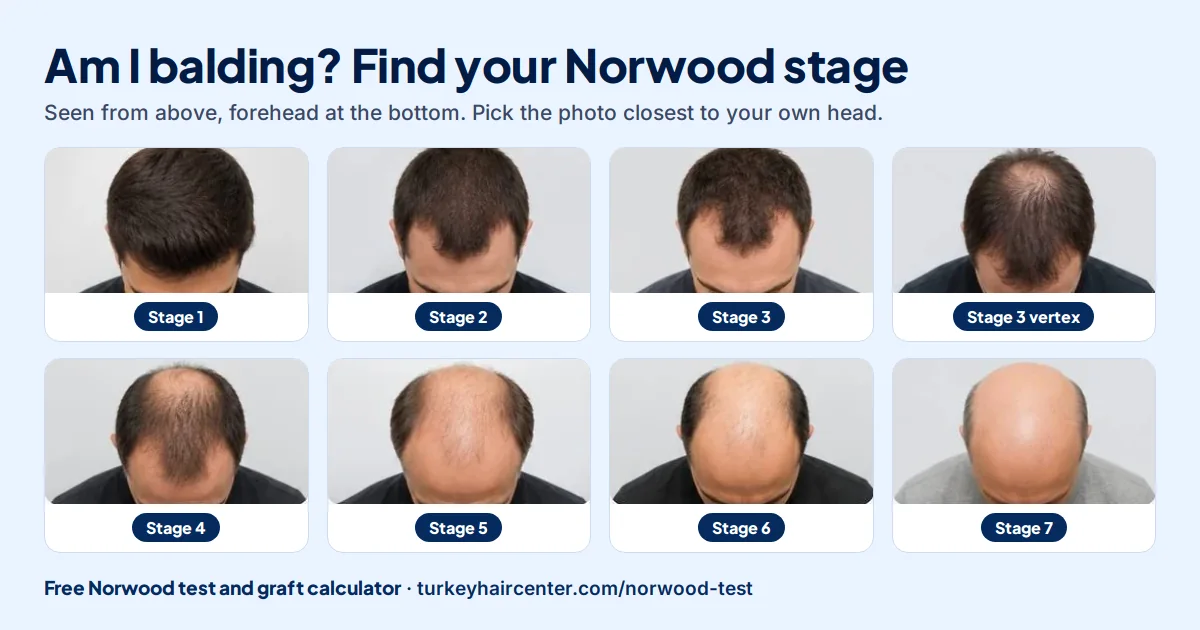
Your Norwood stage is the card whose bare areas look most like the top of your head. The cards follow the stages Dr. O'Tar Norwood described after classifying the hair loss of 1,000 adult men in a study published in 1975.
Look at the top of your head. A photo taken from above in daylight, with dry hair, shows far more than a mirror; our guide to checking your own stage explains how to take one.
Tap the closest card. Match where the scalp shows: at the temples, at the crown or in both places. If two cards look equally close, note both.
Read your result. You see your likely stage, its starting graft range and a button that sends both to us on WhatsApp.
How to Read the Cards
Each card is a real photo of a man's head seen from above, with the forehead at the bottom and the crown at the top. Dark areas are hair and pale areas are scalp.
Cards 1 to 3 change only at the front, where the temple corners move back until they form a clear M or V. Card 3 vertex keeps that front and adds a thinning crown. From card 4 the front and the crown both grow, the band of hair between them is gone by card 6, and card 7 leaves a horseshoe of hair at the sides and back.
The eight cards of our Norwood test: real heads photographed from above, with the forehead at the bottom.
If none of the pictures looks like your head, your hair loss may follow another pattern: round or oval bald patches are typical of alopecia areata, and heavy shedding all over the scalp months after an illness, a birth or another shock points to telogen effluvium.
The card you picked answers the question: cards 1 and 2 mean you are not balding by the Norwood scale's measure, cards 3 and 3 vertex mean balding has started, and cards 4 to 7 mean it has spread across the top of the head. The line sits at stage 3 because Norwood treated stage 3 as the least hair loss that counts as baldness, as a review of hair loss classifications sets out.
Cards 1 and 2: not balding yet. Temples that have moved back slightly and evenly are often just a mature hairline.
Cards 3 and 3 vertex: balding has started at the temple corners, the crown or both, and the test shows a graft range for the first time.
Cards 4 to 7: balding at both the front and the crown, which join from card 6 onward, in the pattern our guide to male pattern baldness explains.
Not necessarily: bright light from above, wet hair and a short cut let almost anyone's scalp show through, and dark hair on pale skin makes it stand out even more. What counts is where the scalp shows and whether that matches one of the cards.
If scalp shows at the temple corners, or as a thin circle at the crown, in dry hair and daylight, that looks like card 3 or 3 vertex. Scalp that shows only through a parting, under a spotlight or after a shower means little on its own. A swirl of hair at the crown can look thin too, and our crown balding guide shows how to tell a natural whorl from a balding crown.
What Your Test Result Shows
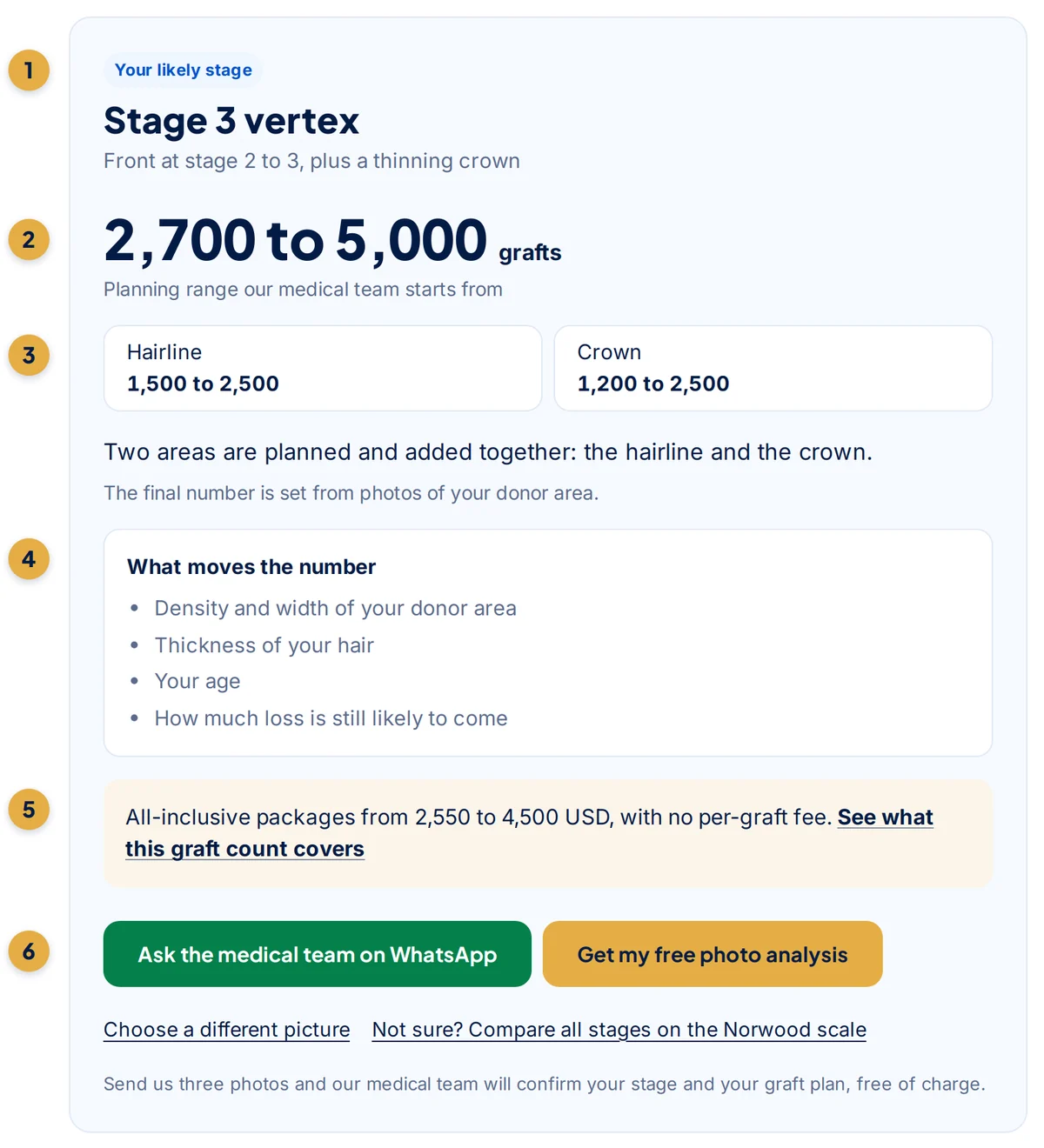
Your result shows your likely Norwood stage, the graft range our medical team starts planning from and what moves that number. Below is the result for card 3 vertex as the test shows it, part by part.
The result for card 3 vertex as the test shows it. Numbers 1 to 6 match the list below.
Your likely stage. The card you picked, named and described in one line.
Planning range. 2,700 to 5,000 grafts in this example. At stages 1 and 2 the result reads "usually no transplant", with 600 to 1,200 grafts only if the temples are refined.
Hairline and crown. Only stage 3 vertex splits the range: 1,500 to 2,500 grafts for the hairline and 1,200 to 2,500 for the crown, planned and added together.
Your exact number is set from photos of your donor area. The package you choose sets the price, and the graft count does not change it: Sapphire Prime $2,550, Sapphire Advanced Regrowth $3,000, DHI Comfort $3,350 and Exosapphire Microflow Elite $4,500, each with the hotel, transfers and aftercare included. See what each package includes.
What Happens After You Get Your Result
Send your result to our medical team: the WhatsApp button opens a message that already names your stage and range. Add photos of the front, top and sides, and one of the back of your head, the donor area the grafts come from.
From those photos the team confirms your stage, checks your donor area and tells you the technique and graft range that fit, free and with no obligation; see how the exact number is confirmed.
When a transplant is not the right step for you yet, the team tells you honestly. When it is, our own team performs the procedure at partner hospitals and polyclinics in Istanbul. Turkey Hair Center is a UK-headquartered global hair restoration company.
How Our Graft Calculator Works
Our graft calculator does not measure your scalp: it turns the picture you pick into a Norwood stage, and the stage into the graft range our medical team starts planning from. Each stage stands for a typical size of bald area, so one tap gives a starting range.
Step 1Picture to stage
The card you tap sets your likely stage: 1 to 7, or 3 vertex.
Step 2Stage to range
Each stage has one planning range, kept in one place on our server, so this page and every website that embeds the test show the same numbers.
Step 3Photos to exact number
Our medical team sets the exact number from your photos, above all those of the donor area.
Online balding tests answer different questions: a picture test like ours shows the stage you have reached today, while a will I go bald calculator estimates your chance of losing hair in the future. The comparison below sets out the main types and where each one stops.
Test type
What you give
What you get
What it leaves out
Next step
Picture test (this page)Ours
What you giveOne tap on the closest picture
What you getYour likely stage and starting graft range
What it leaves outDensity, donor area and the cause of the loss
Next stepSend photos for a free analysis
Symptom quiz
What you giveAnswers about shedding and recent changes
What you getA summary of the signs you report
What it leaves outWhat your scalp looks like today
Next stepCompare your answers with a picture
Risk calculator ("will I go bald")
What you giveAge, family history and lifestyle
What you getAn estimate of your future risk
What it leaves outWhether hair loss has already started
Next stepTake a picture test
Photo or AI scan
What you giveScalp photos you upload
What you getAn automated stage or density estimate
What it leaves outYour donor area and the history of the loss
Next stepHave a person review the photos
Photo review by our teamOurs
What you giveFront, top and side photos
What you getYour confirmed stage, technique, graft range and price
What it leaves outBlood tests or a biopsy
Next stepYour plan, or an honest answer that you do not need one
Examination by a dermatologist
What you giveQuestions, a close look at the scalp and a gentle pull test
What you getThe cause, with blood tests or a biopsy when another cause is suspected
Use the picture test to see where you stand today and a will I go bald calculator for a rough sense of what may come. A risk calculator scores your answers about age, family and lifestyle and never sees your scalp, so if scalp already shows at your temples or crown, start with the picture.
The two work well together: family history shapes your odds, as our page on whether baldness is genetic explains, while the picture test, taken again over time, shows whether your own head has changed.
Frequently Asked Questions
Is There a Free Balding Test?
Yes, this Norwood test is free: tap the picture closest to your head and it shows your likely stage and starting graft range, with no sign-up and no photo upload. If you want a person to look at your hair as well, send your photos to our medical team on WhatsApp or through the form below; the analysis is free and there is no obligation.
How Accurate Is an Online Balding Test?
An online picture test is reliable for the broad answer, whether balding has started and how far it has spread, and less exact about the precise stage. When 7 dermatologists and 16 residents graded the same 43 photos of men's heads, a study of the Hamilton-Norwood scale rated their agreement unsatisfactory. If you sit between two cards, note both: our medical team confirms your stage from your photos.
Can I Check If I'm Balding From a Photo?
Yes: a clear photo shows where your scalp is visible, which is exactly what the cards compare, and this test needs no upload. Take the hairline with your hair pushed back, both temples, the top and the crown, in daylight with dry hair, then repeat them at the same angle every few months. A change between two sets of photos tells you more than any single picture.
Add This Norwood Test to Your Website
Bloggers, barbers, hair-loss forums and health writers can show this test to their readers for free. Paste the code into any page that accepts HTML. The test loads from our server, so stage descriptions and graft ranges stay current when our medical team updates them. It sets no cookies and asks readers for no personal details.
Paste the code where the test should appear, in an HTML or custom code block.
Keep the credit line under the test; it tells readers where the graft ranges come from.
Need it in French? Change data-lang="en" to data-lang="fr".
Use the Norwood Scale Diagram
Our diagram of all seven stages, seen from above, is free to use on your site with a credit link. It is a vector file, so it stays sharp at any size.
Sources and medical review
The health statements on this page draw on the following sources:
Talk to our hair team on a free video call, in your language. You receive a written plan with your technique, estimated grafts and all-inclusive price. If a hair transplant isn't right for you, we tell you honestly.