Performed at authorized partner hospitals Turkey Hair Center is a Ministry of Health authorized health-tourism intermediary, not a clinic.
A mature hairline is the slightly higher, more shaped hairline most men develop as they move from their teens into adulthood. It is normal: the front edge rises a little, the temples form a small and even dip, and then the line settles instead of moving back year after year.
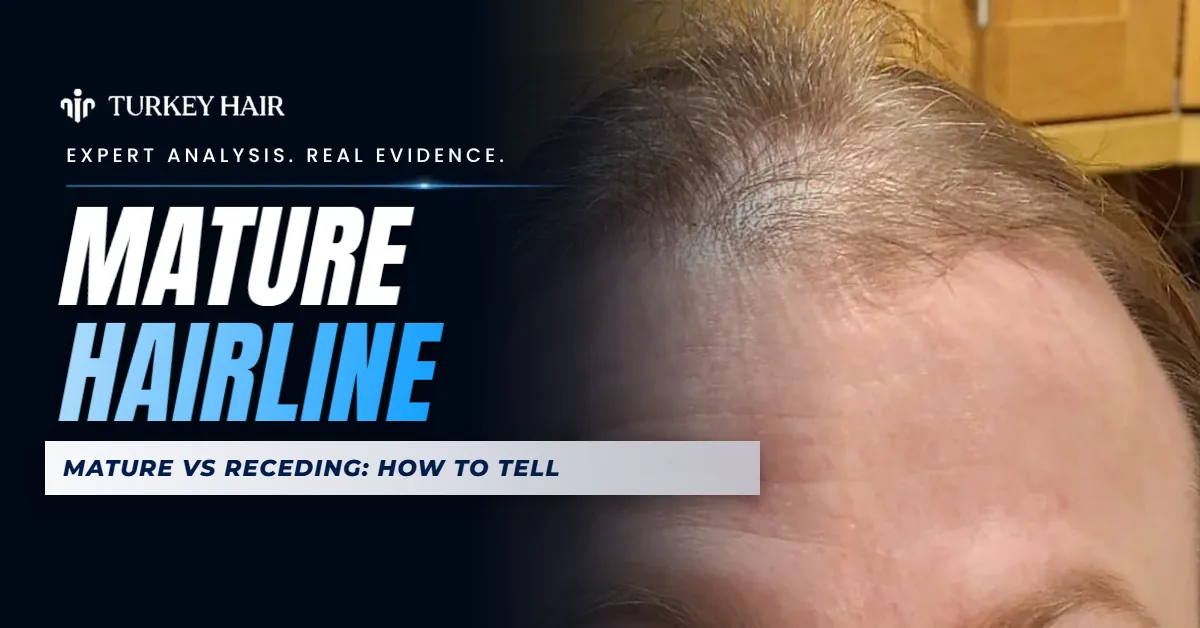
Cover built on a front view of a forehead with recession at both temples. Photo: Sister of necronwarrior, uploaded by necronwarrior, CC BY-SA 4.0, via Wikimedia Commons, cropped, text and logo added.
A receding hairline keeps moving. The temples deepen into an M, the hairs along the edge become finer, and the change shows in photos taken months apart. On the scale doctors use, a mature hairline sits at stage 2, and stage 3 is the first stage counted as balding. This guide explains how the two differ, how to compare them at home and when it is worth seeing a doctor.
This photo does not show a mature hairline. Both temples have moved far behind the middle of the hairline, and the hair at the front has thinned enough for the scalp to show through. That goes well past the small, even dip of a mature hairline, and it shows where a receding hairline can end up.
What Is a Mature Hairline?
A mature hairline is the adult shape of the front hairline. In childhood the hairline usually sits low and runs in a fairly straight or rounded line across the forehead. As the face grows into its adult proportions, the hairline changes with it. A review of normal hairline maturation describes hairlines as changing shape with age from birth, moving from a childlike look to a more mature look as a child grows into adulthood (Rassman and colleagues, 2013).
In practice, most men notice three things when the hairline matures:
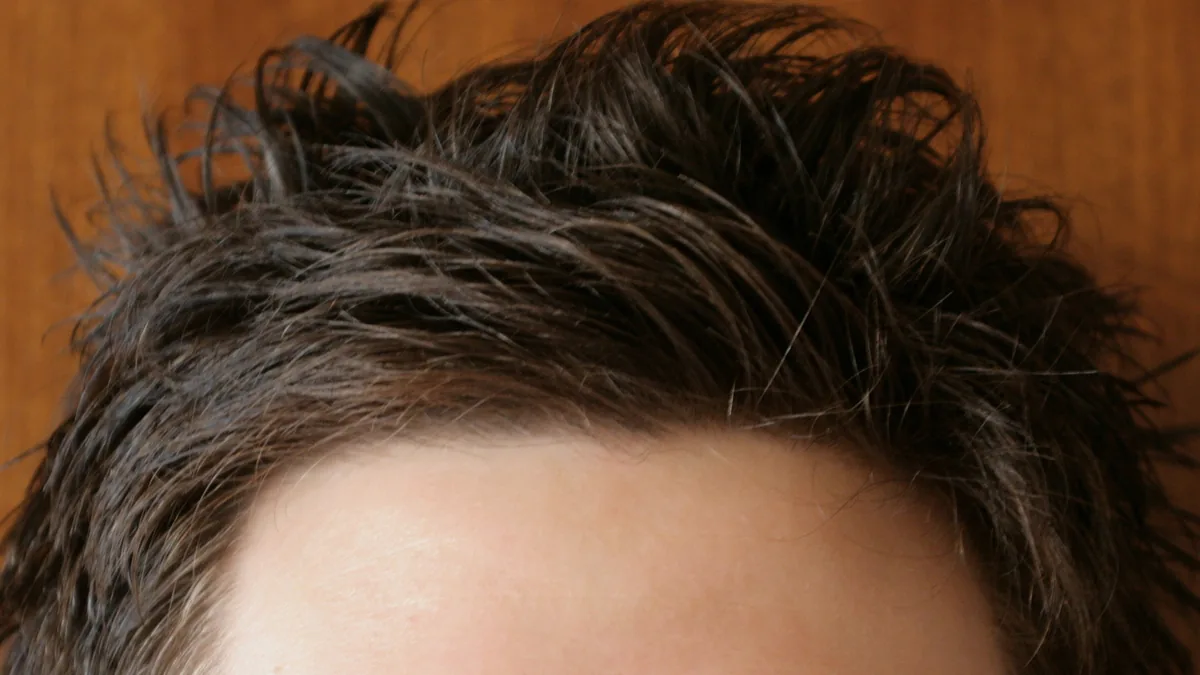
the front edge sits a little higher on the forehead than it did at 15;
the corners at the temples dip back slightly and about evenly on both sides;
the middle of the hairline stays where it was, or very close to it.
The hairs along the edge keep the same thickness as the rest of your hair. That detail tells you more than the shape does, and we come back to it below.
The front hairline of a man, seen from above the eyebrows with the hair brushed back. Photo: Frank Vincentz, CC BY-SA 3.0, via Wikimedia Commons, cropped.
Mature Hairline Meaning in Plain Terms
When people look up the mature hairline meaning, they usually want an answer to one question: is this hair loss? A mature hairline is a change in shape, not a loss of density. The hairline moves into its adult position and stays there. Many men call it a maturing hairline while the change is still happening, and a mature hairline once it has settled.
Is a Mature Hairline Normal?
Yes. A small, even rise at the temples is common enough that the main classification systems treat it as an early stage that does not count as baldness. In the Norwood classification, type 2 means triangular, usually symmetrical areas of recession at the temples, while type 3 is the minimal hair loss sufficient to be considered baldness (Gupta and Mysore, 2016).
A normal hairline is not perfectly symmetrical either. A study of 125 East Asian men at Norwood stage 2 or lower found that hair growth direction at the hairline leaned to the right by 22.2 degrees on average, and only 8.8% of the men leaned the other way (Kim and colleagues, 2025). That study measured the direction the hairs grow, not the height of the hairline. It still shows that small differences between the left and right side of a healthy hairline are expected.
Normal does not mean fixed for life. The American Academy of Dermatology (AAD) notes that with age most people notice some hair loss because hair growth slows. A mature hairline can stay stable for many years, but it does not protect anyone from pattern hair loss later.
When Does a Hairline Mature?
There is no fixed age for it. The published reviews describe a gradual change through adolescence into adulthood, and none of the sources we checked gives one age range for when the hairline finishes maturing. Many men first notice it in their late teens or twenties, often because that is when they start comparing photos of themselves.
The age question matters because pattern hair loss can begin in the same years. The AAD says male pattern hair loss sometimes starts in the late teens or early twenties, although it usually appears later. MedlinePlus, the US National Library of Medicine's health site, states that androgenetic alopecia can start as early as the teens and that the risk increases with age.
Survey data shows how common early recession is:
Age group
Men at Norwood 3 or higher
Source
18 to 29
16%
Rhodes and colleagues, 1998
40 to 49
53%
Rhodes and colleagues, 1998
All men 18 to 49
42%
Rhodes and colleagues, 1998
By age 50
More than half of white men show a visible sign
AAD
A hairline that changes at 19 can be maturing, and it can also be early pattern loss. Age alone does not separate the two. The way the hairline changes over the following months does.
Mature Hairline on the Norwood Scale
The Norwood scale is the classification most doctors use for male pattern hair loss. Norwood published it in 1975 after classifying 1,000 white adult men, and his report pointed out the continued effect of time on hair loss, even in later years. For this question only the first three stages matter.
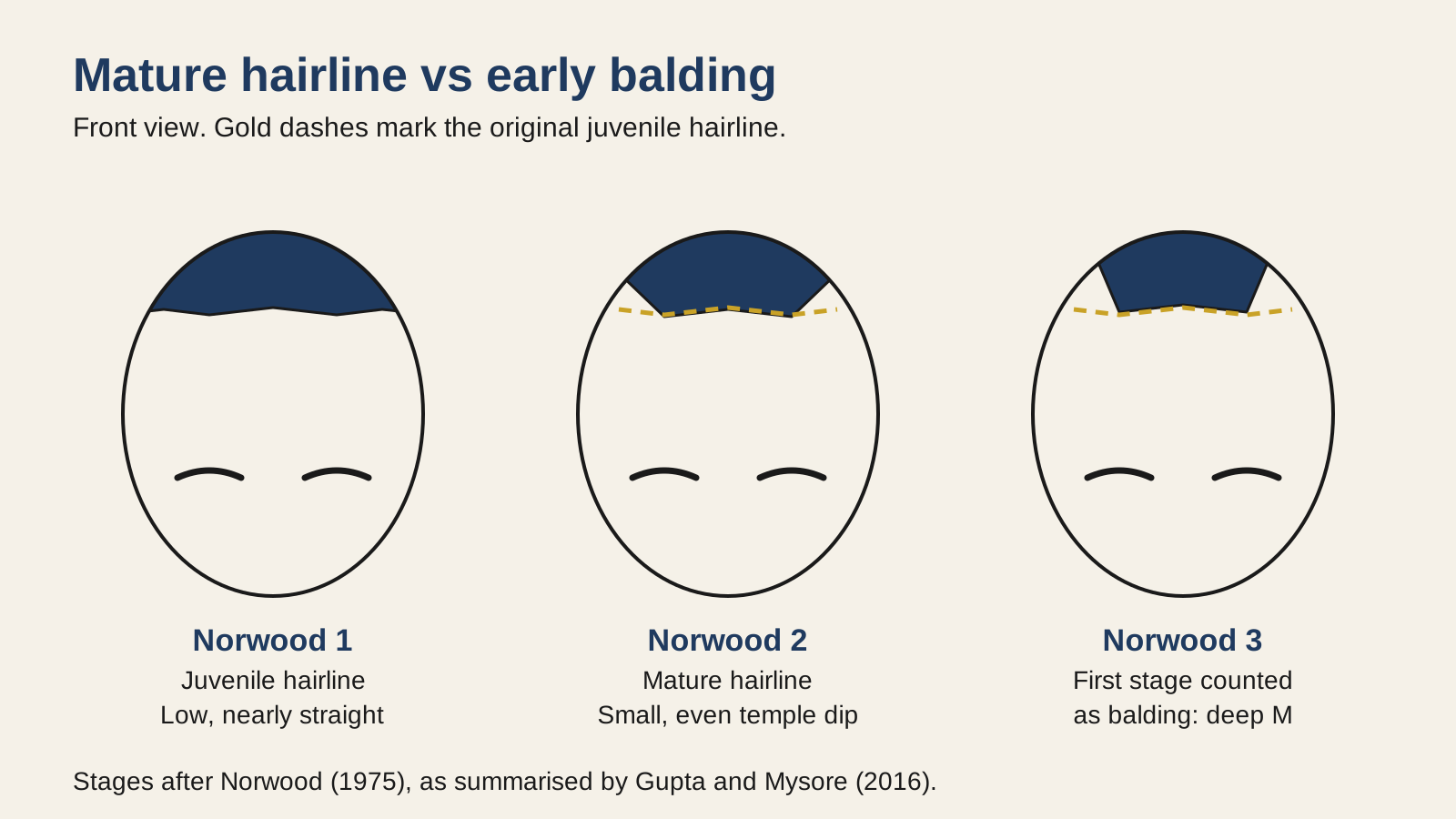
The stage definitions, as summarised in a 2016 review of hair loss classifications:
Norwood 1: minimal or no recession of the hairline. This is the juvenile hairline, low and nearly straight.
Norwood 2: triangular, usually symmetrical recession at the temples. This is where a mature hairline sits.
Norwood 3: deep, symmetrical recession at the temples, which are bare or only sparsely covered. This is the first stage counted as balding.
There is also a Norwood 3 vertex type, where the front stays at stage 3 and the crown starts to thin; our guide to crown balding covers it. If you are unsure which drawing matches your own hairline, the Norwood test takes you through the stages one by one.
Hamilton's original system, which Norwood built on, gives a rough limit for type 2. The recession at the temples reaches no farther back than a point 3 cm in front of a line drawn over the top of the head between the two ear canals. It is a clinical measurement and hard to take in a mirror, but it shows how modest a stage 2 dip is.
Mature Hairline vs Receding Hairline
The difference between a mature and a receding hairline is change. A mature hairline moves a short distance and stops. A receding hairline keeps moving back, and the hairs at its edge become finer as it goes. MedlinePlus describes the male pattern as hair lost above both temples first, with the hairline receding over time into a characteristic M shape.
Feature
Mature hairline
Receding hairline
Norwood stage
2
3 and beyond
Temple shape
Small, even dip
Deep M
Middle of the hairline
Stays close to where it was
Can thin or move back as well
Hairs along the edge
Same thickness as the rest
Finer, shorter hairs
Change over months
Little or none
Visible in repeated photos
What it means
Normal adult change
Pattern hair loss, which usually runs in the family
Signs of a Receding Hairline
The AAD names a receding hairline as one of the first signs of hereditary hair loss in men. In repeated photos, watch for:
the temples sitting further back than in the photo from a few months before;
short, fine hairs along the front edge that look thinner than the hair behind them;
the middle of the hairline thinning as well, not only the corners;
the M shape getting deeper on both sides.
One of these on a single day proves little. Two or more that keep progressing over several months are a good reason to book an examination.
Mature Hairline vs Balding
Balding, as doctors grade it, starts at Norwood 3. That is the dividing line between the two. A mature hairline is a stage 2 change in shape, while balding means the temples have lost enough hair to be bare or only thinly covered.
Male pattern hair loss runs in families. The AAD explains that it comes from inherited genes that make the hair follicles shrink and eventually stop growing hair; our guide to DHT hair loss covers the hormone side. Because the shrinking is gradual, the earliest stage of balding and a mature hairline can look alike for a while.
Over time, two things separate them:
Direction. A mature hairline settles, while pattern hair loss tends to continue. In a five year study, men with male pattern hair loss who took a placebo kept losing hair, and 75% of them were rated as worse on photographs after five years (Kaufman and colleagues, 2008).
Spread. Pattern loss often reaches the crown as well as the front. MedlinePlus notes that hair also thins at the top of the head. A mature hairline only involves the front edge.
Does a Mature Hairline Mean You Will Go Bald?
Not on its own. Norwood 2 is where a mature hairline sits, and it is also a stage that early pattern loss passes through, so a single photo cannot predict which way yours will go. The trend over the next months is what answers the question.
How to Tell If Your Hairline Is Maturing or Receding
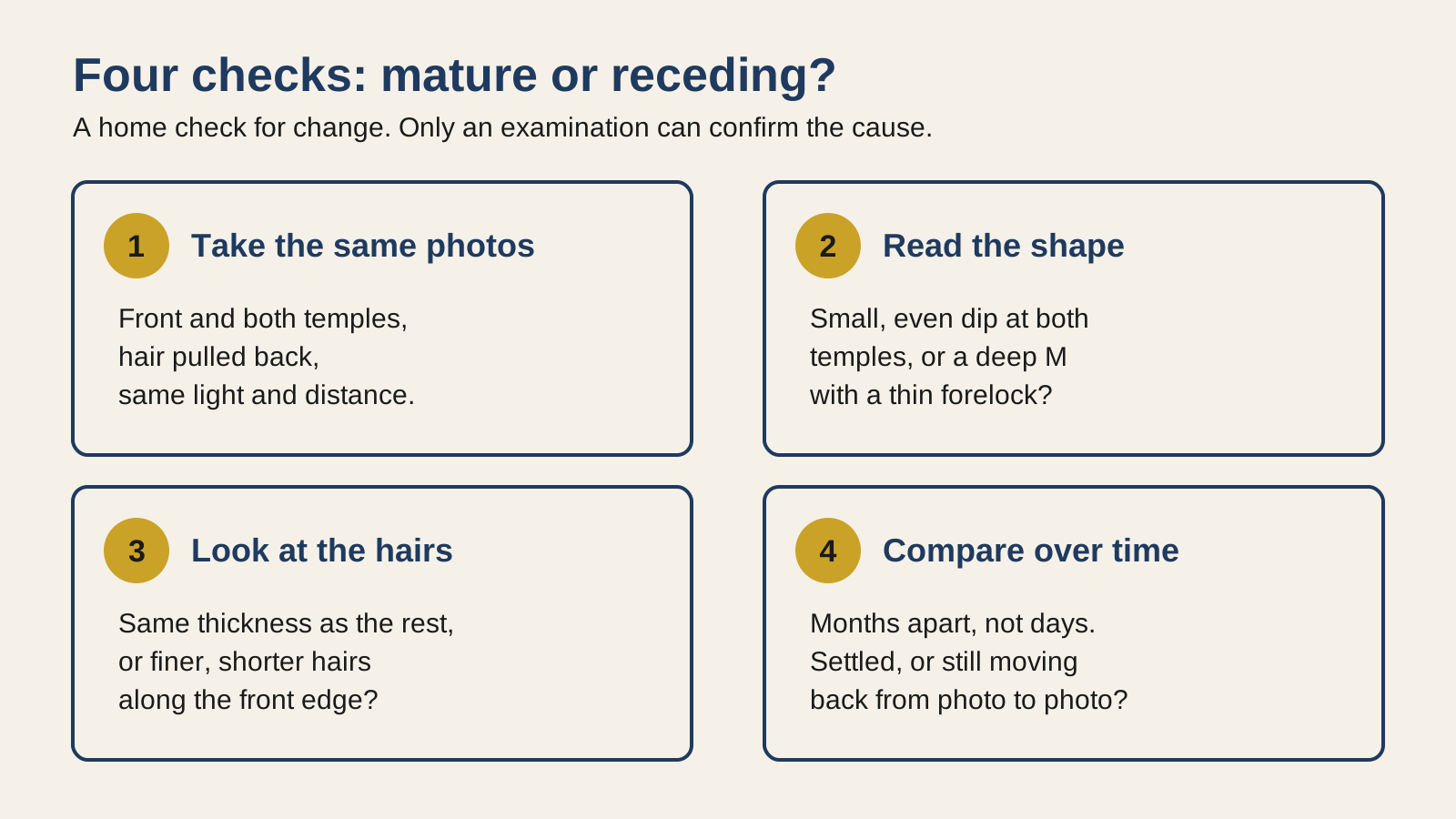
Nobody can diagnose their own hairline, but you can collect evidence that makes an examination much more useful. These four checks take a few minutes each and cost nothing.
Take the same photos. Photograph the front and both temples with the hair pulled back, in the same light and from the same distance. Daylight from a window shows the edge better than overhead bathroom lights.
Read the shape. A small, even dip at both temples fits a mature hairline. A deep M with a thinner middle fits recession.
Look at the hairs. Check the very edge in good light. Hairs as thick as the rest point to a mature hairline, while fine, short hairs can point to miniaturization.
Compare over time. Repeat the photos every few months. A few days or weeks is too short to show a real change.
The Finger Test
Many websites suggest measuring the distance from the eyebrows to the hairline in finger widths. It is a common rule of thumb, not a diagnostic criterion, and it does not appear in the classification systems above. Foreheads and fingers vary in size, so treat the result as a rough note at most.
Baby Hairs or Miniaturized Hairs?
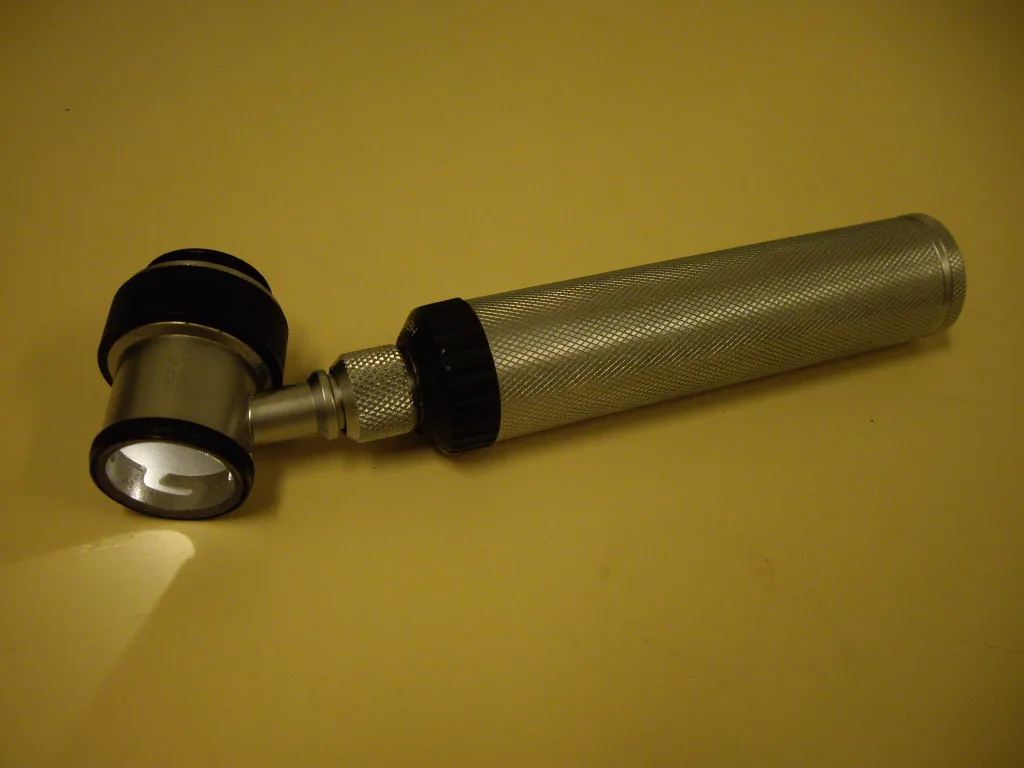
Short, soft hairs along the edge are common, and on their own they do not prove hair loss. The concern is when the hairs at the edge become steadily thinner and shorter than they used to be. A study of trichoscopy, a magnified examination of the scalp, found that variation in hair thickness was the most common finding in pattern hair loss, and that the examination can show early changes in follicle size well before the loss is visible (Ummiti and colleagues, 2019). This is the check that settles most borderline cases.
A handheld dermatoscope, the lit magnifier used to examine the scalp and the hairs along the hairline. Photo: Frank33, CC BY-SA 3.0, via Wikimedia Commons.
Conditions That Can Look Like a Receding Hairline
Not every rising hairline is maturation or pattern hair loss. A few other conditions can change the front edge:
Frontal fibrosing alopecia (FFA). The AAD says it often looks like a receding hairline along the front and sides of the head, starting as a thin band of balding skin. Many people with FFA also lose some or all of their eyebrows. It is usually diagnosed in women after menopause, men have been diagnosed with it too, and follicles that scar over can no longer grow hair, so early diagnosis matters.
Traction alopecia. Hairstyles that pull hard on the hair can cause hair loss, and the AAD says the hairline is one of the first places it shows. Some types of hair loss, traction alopecia among them, can become permanent the longer they go untreated.
Excessive shedding. Losing 50 to 100 hairs a day is normal, according to the NHS and the AAD. Shedding far more than that after illness or a stressful event is called telogen effluvium, and it often stops on its own.
Our reasons for hair loss guide lists the other common causes and what each one looks like.
Mature Hairline in Women
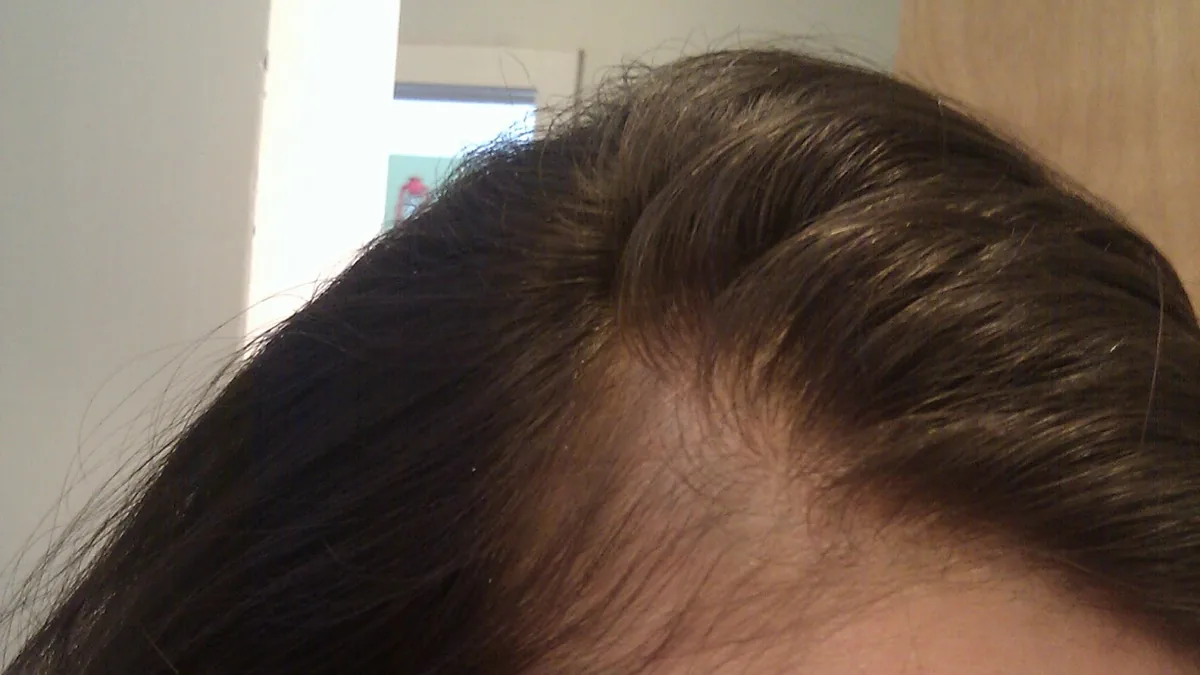
Women's hairlines change too. The AAD notes that a woman's hairline naturally starts to recede with age, and that female pattern hair loss can make the hair near the temples recede. In women the more typical sign is a widening part and overall thinning, not an M shape. Female pattern hair loss usually begins in a woman's 40s, 50s or 60s, although it can start earlier.
Thinner hair at the front hairline and temple of a woman, cropped above the eyes. Photo: Mvolz, CC0, via Wikimedia Commons, cropped.
A part that gets wider over several months is a reason to see a dermatologist. Treatment for women differs from treatment for men, and our page on hair transplant for women explains when surgery is considered.
Widow's Peak or Receding Hairline?
A widow's peak describes a shape: a V-shaped point in the middle of the hairline. A receding hairline describes a change: the hairline moving back over time. A hairline can have a widow's peak and be mature, or have one and be receding. The same four checks apply, and our guide to the widow's peak covers the shape in more detail.
When to Consider Treatment or a Transplant
A mature hairline does not need treatment. The question changes when your photos show the hairline still moving, or when a doctor finds miniaturization along the edge. The NHS advises seeing a GP if you are worried about hair loss, and the AAD says effective treatment begins with finding the cause.
What an examination can include, according to the AAD:
a look at the scalp with a dermatoscope, a lit magnifier;
questions about how long the hair loss has lasted and whether it came on quickly;
a gentle pull on the hair, which shows how it is growing and whether it breaks easily;
a blood test or scalp biopsy if the doctor suspects a disease, deficiency, hormone problem or infection.
If pattern hair loss is confirmed, time matters. The AAD says that men tend to get better results when they start treatment soon after noticing hair loss, and that finasteride slows further hair loss in about 80% to 90% of men who take it. Medicines such as finasteride and minoxidil are chosen and followed by a doctor, because both have possible side effects.
A transplant comes later in the sequence. The AAD says a man in his 20s with hair loss may be asked to wait and start a hair loss medicine first, and that a fuller head of hair, rather than a full one, is the realistic goal. Once recession reaches stage 3, our guide to Norwood 3 hair transplant explains how a hairline is planned, and the hairline transplant cost page covers the graft numbers.
A stable mature hairline is part of an adult face. Rassman and colleagues describe the move from a childlike to a mature hairline as a normal part of growing into adulthood, so pulling it back down to its teenage position is a cosmetic choice, not a treatment for hair loss. Discuss it with the doctor who examines you, with photos in hand.
Turkey Hair Center is a Ministry of Health authorized health-tourism intermediary; procedures are carried out by its own medical team in contracted hospitals in Istanbul. All-inclusive packages range from $2,550 to $4,500, and our hair transplant cost page explains what each includes.
Frequently Asked Questions
What Does a Mature Hairline Look Like?
It sits slightly higher than a teenage hairline, with a small and about even dip at both temples. The middle stays close to where it was, and the hairs along the edge are as thick as the rest of the hair. On the Norwood scale it is stage 2.
At What Age Does a Hairline Mature?
No source we checked gives a fixed age. Reviews describe a gradual change through adolescence into adulthood, and many men notice it in their late teens or twenties. Because pattern hair loss can also start in those years, the trend over several months matters more than age.
Is a Mature Hairline at 20 Normal?
It can be. A hairline that has risen a little and then stopped is consistent with maturation at any adult age. At 20 it is still worth taking regular photos, because the AAD says male pattern hair loss sometimes starts in the late teens or early twenties.
How Do I Know If My Hairline Is Mature or Receding?
Compare photos taken months apart in the same light. A mature hairline stays put and keeps hairs of normal thickness at the edge. A receding hairline keeps moving back, forms a deeper M and shows finer hairs along the front. A dermatologist can confirm it with a magnified scalp examination.
Can a Mature Hairline Turn Into a Receding Hairline?
Yes, it can. A mature hairline is not protection against male pattern hair loss, which can begin at different ages and, as Norwood noted, keeps being influenced by time even in later years. If a hairline that was stable for years starts moving again, have it checked.
Is Norwood 2 Balding?
No. In the Norwood classification, stage 3 is the minimal hair loss counted as baldness. Stage 2 is the small, symmetrical temple recession of a mature hairline. Norwood 2 can still progress, so stable photos over time are the reassuring sign.
Is a Widow's Peak the Same as a Receding Hairline?
No. A widow's peak is a V-shaped point in the middle of the hairline, which is a shape. A receding hairline is a change over time. Someone with a widow's peak can have a stable hairline or a receding one, and the photo checks tell them apart.
Can Stress Make Your Hairline Recede?
Stress can trigger excessive shedding, which the AAD calls telogen effluvium and which often stops on its own. Pattern recession at the temples is a different process driven by inherited follicle sensitivity. If shedding comes with a hairline that keeps moving back, a doctor can check for both.
Can a Receding Hairline Grow Back?
Sometimes, in part. For male pattern hair loss the AAD says treatment can reduce further hair loss and some men regrow a bit of their hair, with the best results in men who start soon after noticing the loss. Full regrowth is unlikely, which is where a transplant comes in.
Should I Get a Hair Transplant for a Mature Hairline?
Usually not. A mature hairline is normal and stable, so there is no hair loss to treat. A transplant is considered when recession progresses, typically from Norwood 3 onwards, and the AAD says men in their 20s may be asked to try medicine first.
Do Women Get a Mature Hairline?
Women's hairlines also change with age, and the AAD notes that a woman's hairline naturally starts to recede. Female pattern hair loss more often shows as a widening part and overall thinning, though the hair near the temples can recede too.
Check Your Hairline
Front and temple photos taken in daylight with your hair pulled back usually show whether a hairline is mature, still moving or clearly receding. Send them for a free hair analysis, and the medical team will tell you the Norwood stage, whether the photos suggest a mature or a receding hairline and the options worth discussing with your doctor.
Medical disclaimer: This article is for informational purposes only and is not medical advice. Individual results and recovery vary from person to person. Always follow the written aftercare plan from your own medical team.
Sources and medical review
Gupta M, Mysore V. Classifications of patterned hair loss: a review. Journal of Cutaneous and Aesthetic Surgery, 2016;9(1):3-12
Norwood OT. Male pattern baldness: classification and incidence. Southern Medical Journal, 1975;68(11):1359-1365
Rassman WR, Pak JP, Kim J. Phenotype of normal hairline maturation. Facial Plastic Surgery Clinics of North America, 2013;21(3):317-324
Kim J, Wan J, Jang T, Yi KH. Natural asymmetry in hair growth direction: implications for hairline design in male patients. Journal of Craniofacial Surgery, 2025
Kaufman KD, Girman CJ, Round EM, et al. Progression of hair loss in men with androgenetic alopecia (male pattern hair loss): long-term (5-year) controlled observational data in placebo-treated patients. European Journal of Dermatology, 2008;18(4):407-411
Ummiti A, Priya PS, Chandravathi PL, Kumar CS. Correlation of trichoscopic findings in androgenetic alopecia and the disease severity. International Journal of Trichology, 2019;11(3):118-122
Send three photos: front, top and sides. You get a technique recommendation, a graft range and a straight answer about what is achievable, before anyone talks about price.
Your details are with the team
A patient coordinator will get back to you shortly. If you would like to send your photos now, WhatsApp is the fastest way to do it.
We respond quickly, day or night, in your language.
Multilingual team, no obligation
Data protectedKVKK and GDPR compliant, 100% confidential
Authorized Health Tourism Intermediary
Turkey Hair Center is the hair-restoration brand of Healthy Way Tourism, an authorized international health-tourism intermediary. All medical procedures are performed by licensed medical professionals at authorized healthcare facilities in Turkiye, in accordance with the regulations of the Ministry of Health.