Spironolactone for Hair Loss: Does It Work & Is It Safe
Performed at authorized partner hospitals Turkey Hair Center is a Ministry of Health authorized health-tourism intermediary, not a clinic.
Spironolactone for hair loss is an off-label use of a prescription water tablet that dermatologists give to women with female pattern hair loss, because it blocks the effect of androgen hormones on the hair follicle. Studies suggest it helps about 4 in 10 women by slowing further loss or thickening hair, but most of the evidence comes from small trials, results take 6 to 12 months to judge, and it must not be taken in pregnancy.
Cover built on a photo of a pile of round white tablets. Photo: Mx. Granger, CC0, via Wikimedia Commons, cropped, text and logo added.
So, does spironolactone work for hair loss? For many women it stops thinning from getting worse, and some see real regrowth. Men rarely take it because of its hormonal side effects. This guide explains how it works, what each study found, how long results take, which side effects and blood tests matter, and when a hair transplant becomes worth discussing.
Spironolactone is available only on prescription. The NHS describes it as a diuretic, one of the medicines sometimes called water tablets because they make you pee more. Its approved uses on the US label are heart failure, high blood pressure, fluid build-up (edema) and a hormone condition called primary hyperaldosteronism. Hair loss is not on that list.
How Does Spironolactone Work for Hair Loss?
Spironolactone works for hair loss by reducing the action of androgens, the male-type hormones that women also make. The US prescribing label describes it as an aldosterone antagonist that also binds to the androgen receptor, the docking point androgens use to act on cells, and it notes antiandrogenic effects in animal studies.
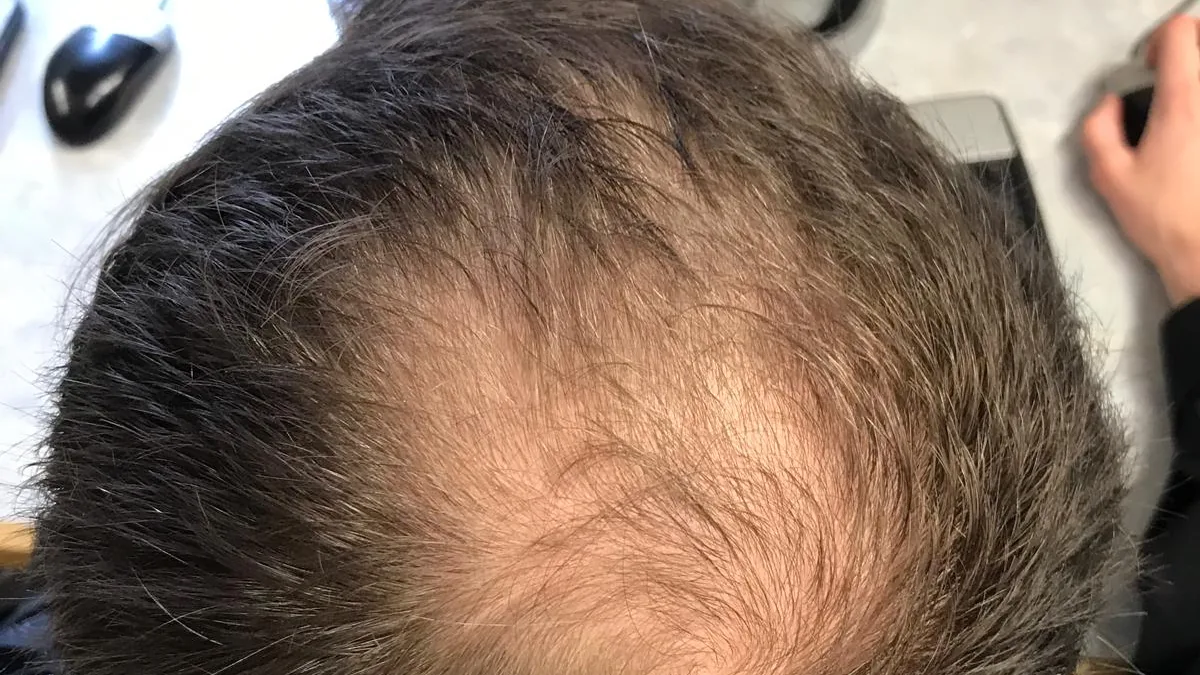
In female pattern hair loss, follicles on the top of the scalp react to androgens and slowly shrink. Each new hair grows back thinner and shorter, so the parting widens and the scalp shows through. Our guide to DHT and hair loss explains this shrinking process step by step. By lowering androgen activity at the follicle, spironolactone aims to stop that shrinking. In some women, follicles then produce thicker hairs again.
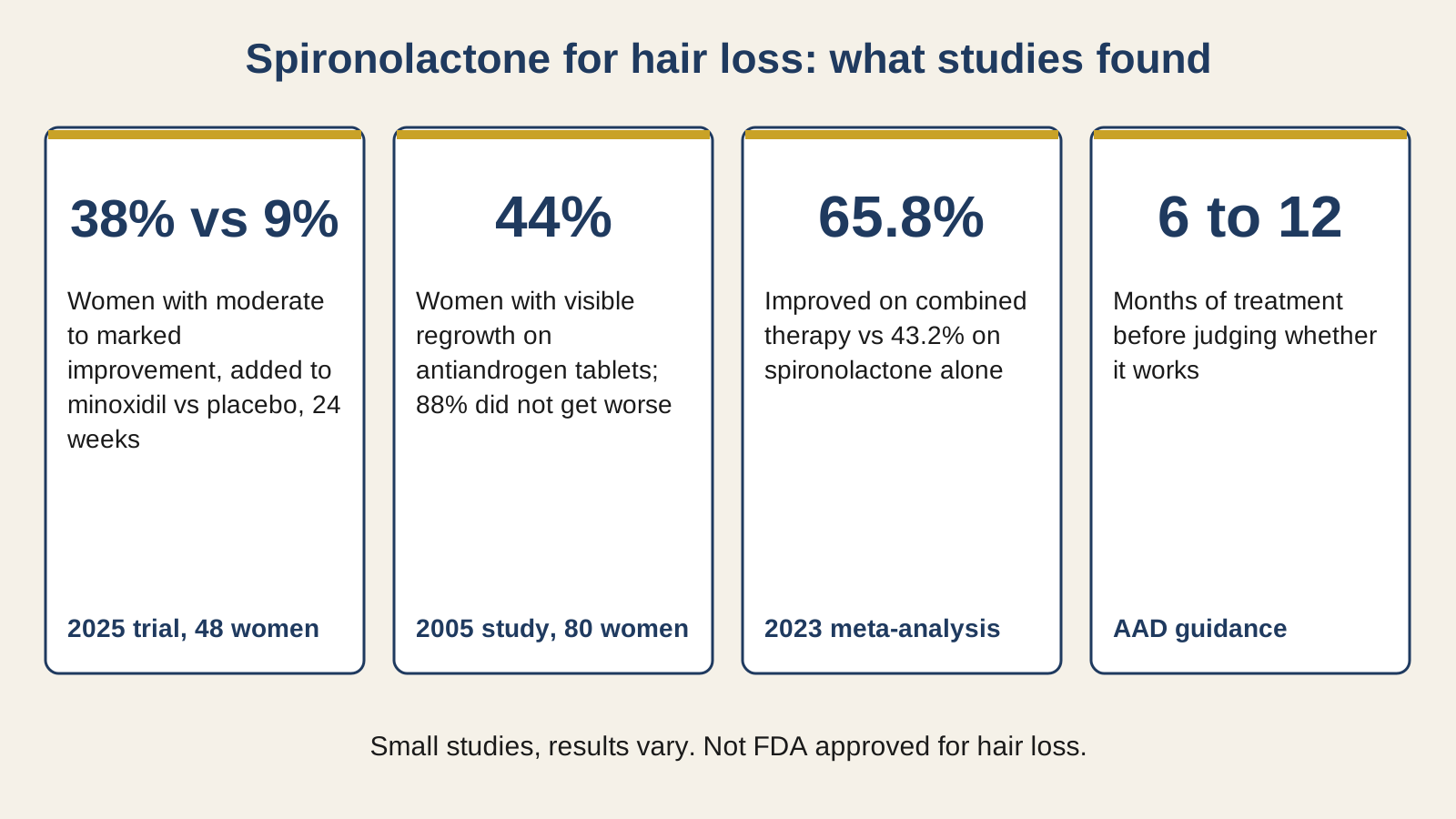
The figure above sums up the main numbers from the studies discussed below. None of these results is large, and none comes from a big, long, placebo-controlled trial. They are the best evidence available today, and they point in the same direction.
Why Do Dermatologists Use Spironolactone for Women?
The American Academy of Dermatology (AAD) says spironolactone has been prescribed for decades to treat hair loss, and that for women with female pattern hair loss it may be an option. According to the AAD, it can stop further hair loss and increase hair thickness, and the studies it cites found it effective in about 40% of women with female pattern hair loss.
Is Spironolactone FDA Approved for Hair Loss?
No. The current US label, revised in November 2025, does not list hair loss among its uses. Prescribing it for hair loss is off-label: your doctor uses an approved medicine for a different purpose based on published studies and clinical experience. This also means the dose, the blood tests and the follow-up plan come from your doctor rather than from the label.
Who Is Spironolactone for Hair Loss For?
Spironolactone is mainly a treatment for women with female pattern hair loss. Before prescribing it, a dermatologist looks at the pattern of thinning, your health and your plans for pregnancy. The groups below show who is usually considered and who needs extra caution:
Women with female pattern hair loss: thinning on the top of the head with a widening part, the group the AAD describes it for.
Women already using minoxidil: several trials added spironolactone to minoxidil, and the combination did better than either option alone in most of them.
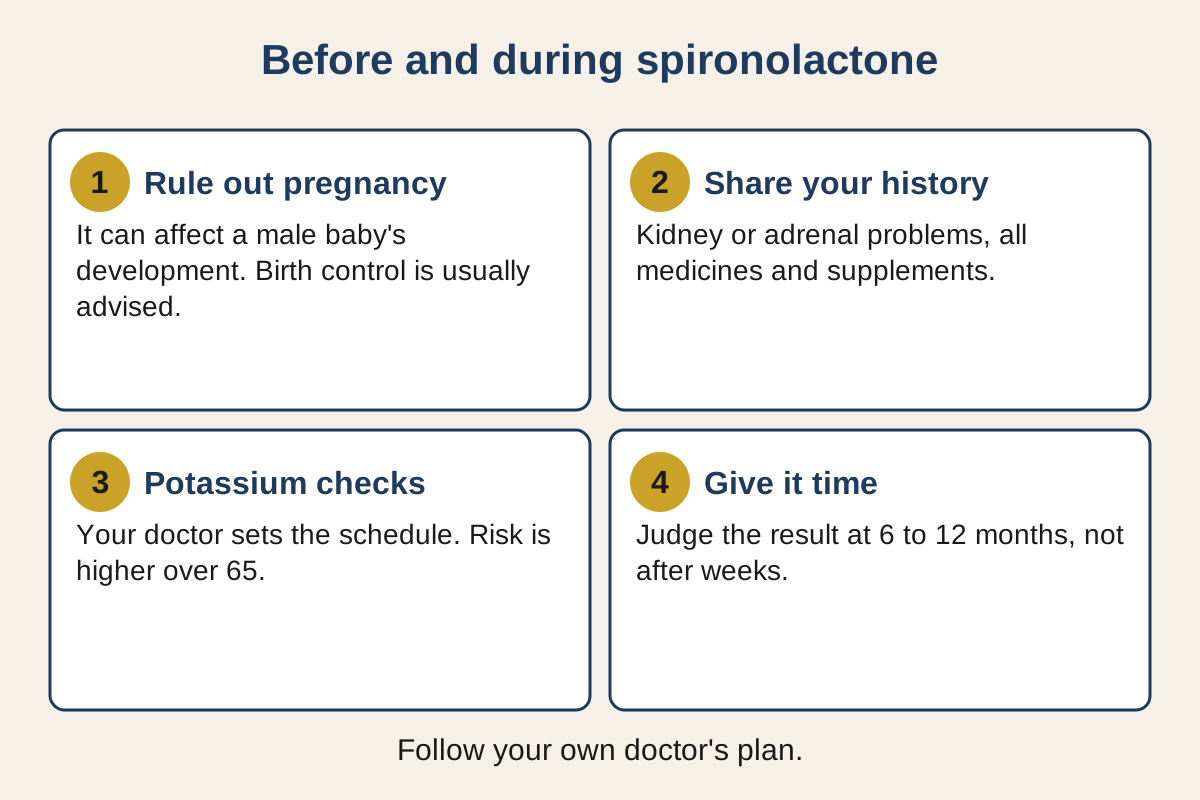
Women who are not planning a pregnancy: the AAD recommends that all pre-menopausal women use birth control while taking prescription hair loss medicines.
People with kidney or adrenal problems: the AAD asks you to tell your dermatologist about these conditions first, and the NHS lists severe kidney problems, Addison's disease and a history of high potassium as reasons it may not suit you.
Men: rarely, because of breast enlargement and other hormonal effects, covered in the section on men below.
Not all thinning in women is pattern hair loss. Heavy shedding a few months after childbirth, for example, follows a different course and usually settles on its own; our postpartum hair loss guide explains the timeline. Our guide to the reasons for hair loss lists other common causes. A dermatologist confirms the diagnosis before an antiandrogen makes sense.
Spironolactone and Birth Control
Because spironolactone can harm a developing baby, it is often prescribed together with birth control. Some pills can affect hair on their own, either for better or worse, depending on the progestin they contain. Our guide on whether birth control can cause hair loss explains which types matter and where antiandrogen pills fit in.
Does Spironolactone Work for Hair Loss?
The evidence is encouraging but limited. Most studies are small, several have no placebo group, and they used different doses and different ways of measuring hair. Here is what the main studies found:
Study
Who took part
Treatment used in the study
Result
Sinclair 2005
80 women aged 12 to 79, no placebo group
Spironolactone or cyproterone acetate tablets
44% regrowth, 44% no change, 12% continued loss
Liang 2022
120 women before menopause, 24 weeks
5% minoxidil alone, or plus oral spironolactone 80 to 100 mg a day, or plus microneedling
Spironolactone plus minoxidil beat minoxidil alone; microneedling plus minoxidil did best
Wang 2023
Review of 7 studies, 618 patients
Oral doses of 25 to 200 mg a day, or topical gel or solution
Helped hair loss; combination with minoxidil worked better than spironolactone alone
Aleissa 2023
Meta-analysis of published studies in women
Spironolactone alone or combined with other treatment
Improvement in 56.6% overall: 65.8% on combined therapy vs 43.2% alone
Werachattawatchai 2025
48 women aged 21 to 45, 24 weeks
100 mg a day or placebo, all with 3% minoxidil
Moderate to marked improvement in 38% vs 9% on placebo
Jha 2026
204 women aged 18 to 50, 24 weeks
100 mg a day vs bicalutamide 50 mg a day
Hair count rose more with bicalutamide; clinical scores did not differ
The doses in this table are the ones used in the studies, not a recommendation. Ask your doctor which dose, if any, suits you.
The AAD also cites a study of 166 women taking spironolactone in which 42% reported mild improvement and 31% reported thicker hair. In the 2005 study, 88% of women either improved or did not get worse. That second number matters, because in pattern hair loss, stopping further loss is already a result.
Is Spironolactone Better Than Other Antiandrogens?
Few trials compare antiandrogens head to head. In the 2005 study, spironolactone and cyproterone acetate gave results that were not significantly different, so the authors combined them. In a 2026 double-blind trial of 204 women, the hair count at the front of the scalp rose by 5.05 hairs per square centimetre with bicalutamide and by 3.13 with spironolactone. The clinical scores, which include photographs and shedding, showed no significant difference between the 2 groups. The authors noted the short follow-up and single-centre design.
What Do the Studies Not Tell Us?
The 2005 study authors wrote that a placebo-controlled study was needed to compare their results with how the condition progresses without treatment. The 2023 review called for more randomised trials, and the 2023 meta-analysis found wide differences between studies. In short, spironolactone is a reasonable option with modest proof, and it does not work for everyone.
How Long Does Spironolactone Take to Work for Hair Loss?
Plan on 6 to 12 months before you can judge it. The AAD says you need to take a prescription hair loss medicine for 6 to 12 months before you will know whether it works, and that no hair growth within 12 months means the medication will not work for you.
The trials match that slow timeline. Most ran for 24 weeks, about 6 months. In the 2018 combination study, the hair loss severity score kept improving after month 6: it fell by 0.85 points at 6 months and by 1.3 points at 12 months. Shedding scores fell faster, by 2.3 points at 6 months and 2.6 at 12 months.
A simple way to follow your own progress:
Take photos of your parting and crown before you start, in the same light and from the same angle.
Repeat the photos every 2 to 3 months instead of checking the mirror daily.
Note whether shedding in the shower or on your brush is less than before.
Review the photos with your doctor at about 6 months.
Decide with your doctor at 12 months whether to continue, combine or change treatment.
What Happens If You Stop Spironolactone?
The hair gained on treatment does not stay without it. According to the AAD, once you stop taking a prescription hair loss medicine, you lose the hair that grew, and this happens in about 3 to 4 months. Stopping is your doctor's decision to make with you, especially if you also take other blood pressure medicines.
Spironolactone and Minoxidil Together
Combining spironolactone with minoxidil is common, and the studies support it more than spironolactone alone. In the 2022 trial of 120 women, adding oral spironolactone to 5% minoxidil gave better results than minoxidil alone. That same combination group also had the most side effects. The 2023 meta-analysis found improvement in 65.8% of women on combined therapy against 43.2% on spironolactone alone.
Low-dose oral minoxidil is now often paired with spironolactone. Two studies looked at this:
The 2018 pilot study: 100 women took a once-daily capsule with low doses of both medicines for 12 months. Side effects appeared in 8 women and were generally mild; 2 women stopped because of hives, and no one developed high potassium.
The 2026 safety study: in 432 women on the combination, 37.7% had at least 1 side effect. The most common were extra hair growth on the face or body (12.3%) and dizziness or light-headedness, often when standing up (12.0%).
Other blood pressure medicines: taking at least 1 more medicine that changes blood pressure raised the odds of these standing-up symptoms about 3.3 times.
Starting both at once: starting the two medicines at the same time lowered the risk of extra hair growth.
Most problems were manageable: in 46.0% of cases the treatment did not need to be changed at all.
Neither study had a control group, so they describe safety rather than prove how well the combination works. If you are comparing options, our guide on whether Hims works for hair loss covers what is inside common minoxidil products.
Spironolactone Side Effects for Hair Loss
Most side effects in the hair loss studies were mild, but some lead women to stop. The 2023 meta-analysis reported itching or scaling of the scalp in 18.9% of patients, menstrual changes in 11.9% and extra facial hair in 6.9%. Only 2.8% stopped treatment because of side effects. In the 2025 placebo trial, 37.5% of women taking spironolactone had irregular periods.
The US label and the NHS describe other effects to know about:
Low blood pressure and dizziness: the label warns about low blood pressure and changes in kidney function.
High potassium (hyperkalaemia): the NHS lists muscle weakness, tiredness, numbness and an irregular heartbeat as signs.
Breast changes: the label lists breast enlargement, which is far more studied in men.
Medicine interactions: the NHS names potassium supplements, some heart and blood pressure medicines, and painkillers such as ibuprofen, aspirin and diclofenac.
Foods: the NHS says bananas, avocados and potassium-based salt substitutes can raise potassium levels further.
Do You Need Potassium Blood Tests?
That depends on your age and health. For its approved uses, the US label advises checking potassium within 1 week of starting and regularly after that. For young, healthy women the picture is different: a 2015 study of 974 women taking spironolactone for acne found abnormal potassium in 13 of 1,802 tests (0.72%), close to the 0.76% rate expected in the general population, and concluded that routine checks were of little use in this group.
Age changes that. A 2026 study of 398 women aged 45 and over found high potassium in 10.1%. The rate was 22.4% in women aged 65 or older against 7.9% at ages 45 to 64, and 28.1% in women 65 or older with at least 1 condition that raises the risk. It was lowest, 6.3%, in healthy women aged 45 to 64. In 97.5% of cases the rise was mild. Your doctor sets your blood test plan; follow it even if you feel well.
Do not take spironolactone if you are pregnant or could become pregnant without talking to your doctor first. In animal studies it caused feminisation of male foetuses, the US label advises against using it in pregnancy, and the AAD says prescription hair loss medicines can cause birth defects, so birth control is advised. If you are breastfeeding, the NHS says to check with a doctor before taking it.
Spironolactone for Hair Loss in Men
Spironolactone is rarely used for hair loss in men. Because it blocks androgen receptors, it can cause breast enlargement, called gynecomastia. The US label says gynecomastia is the most common side effect in men: in a large heart failure trial, it appeared in about 9% of men even at low doses. The risk rises with dose, it can start anywhere from 1 to 2 months to more than a year after starting, and it usually goes away after stopping.
A 2023 review of 7 studies included 65 men among 618 patients. The same review noted that topical spironolactone, applied to the scalp as a gel or solution, had fewer side effects and could suit any gender. Topical forms are less studied than tablets, so the evidence for men remains thin. Men with pattern hair loss usually discuss other medicines with their doctor first, and a hair transplant for a receding hairline or crown when the donor area allows it.
When Is a Hair Transplant an Option?
A hair transplant becomes worth discussing when medicine has had its full trial and specific areas stay thin. The AAD says a hair transplant may be an option for some women with female pattern hair loss, and that most transplants today look natural. It also warns that not everyone is a good candidate: if the hair on your scalp is sparse all over, you may not have enough healthy hair to move.
These are the questions the medical team looks at before talking about surgery:
Has medical treatment had at least 12 months? Earlier than that, it is too soon to say it failed.
Is the thinning in one area or everywhere? Thinning limited to the part or the front is easier to treat than diffuse loss.
How dense is the donor area? The back of the scalp must have enough strong hair to spare.
Has the loss slowed down? Stable hair loss makes planning more predictable.
Will you continue treatment afterwards? A transplant moves hair; it does not stop the rest of your hair from thinning.
Our guide to hair transplant for women explains who it suits, how the procedure works and what it costs. At Turkey Hair Center, a Ministry of Health authorized health-tourism intermediary, procedures are carried out by our own team at partner hospitals and polyclinics in Istanbul, and packages range from $2,550 to $4,500.
Frequently Asked Questions
Can Spironolactone Regrow Hair?
In some women, yes. In the 2005 study, 44% of women on oral antiandrogens had regrowth. More often, spironolactone stops hair loss from getting worse; regrowth, when it happens, is usually modest.
How Much Spironolactone for Hair Loss?
We cannot recommend a dose. The doses used in studies are shown in the table above, and they varied widely. Your doctor chooses a dose based on your blood pressure, kidney function, other medicines and how you respond.
How Long Does Spironolactone Take to Work for Hair Loss?
Usually 6 to 12 months. The AAD says that no hair growth within 12 months means the medicine will not work for you.
Can Men Use Spironolactone for Hair Loss?
Rarely. Breast enlargement is the most common side effect in men according to the US label. Topical forms may cause fewer side effects, but they have less evidence.
Is Spironolactone Safe Long Term?
Spironolactone has been used for decades for heart and blood pressure conditions, and the AAD says it has been prescribed for decades for hair loss. The hair loss studies lasted 6 to 12 months, so long-term data for this use are limited. Regular review with your doctor is part of safe use.
Will My Hair Fall Out If I Stop Spironolactone?
Yes, the hair that grew on treatment is usually lost again. The AAD says this happens in about 3 to 4 months after stopping.
Can You Take Spironolactone While Pregnant or Breastfeeding?
Not in pregnancy without your doctor's advice: the US label advises against it and the AAD says these medicines can cause birth defects. In breastfeeding, the NHS says to check with a doctor first.
What Foods Should You Avoid on Spironolactone?
The NHS warns that bananas, avocados and potassium-based salt substitutes can raise potassium further. Potassium supplements and some painkillers can also interact.
Does Topical Spironolactone Work for Hair Loss?
A 2023 review found that topical gels and solutions helped in the studies it included, with fewer side effects than tablets. There are fewer trials of topical forms, and they are not widely available.
Is Spironolactone Better Than Minoxidil?
Studies suggest the 2 work better together than apart. In the 2023 meta-analysis, improvement was 65.8% with combined therapy and 43.2% with spironolactone alone. Our birth control and hair loss guide also covers how these options compare for women with hormone-related thinning.
Is Your Hair Still Thinning on Spironolactone?
If you have taken spironolactone for a year and your part or crown is still thinning, the pattern of loss and your donor area tell more than another change of dose. Send clear photos for a free hair analysis, and the medical team will tell you what they see. You can also read about hair transplant for women and who is a candidate.
Medical disclaimer: This article is for informational purposes only and is not medical advice. Individual results and recovery vary from person to person. Always follow the written aftercare plan from your own medical team.
Sinclair R, Wewerinke M, Jolley D. Treatment of female pattern hair loss with oral antiandrogens. British Journal of Dermatology, 2005;152(3):466-473
Liang X, Chang Y, Wu H, Liu Y, Zhao J, Wang L, Zhuo F. Efficacy and safety of 5% minoxidil alone, minoxidil plus oral spironolactone, and minoxidil plus microneedling on female pattern hair loss: a prospective, single-center, parallel-group, evaluator blinded, randomized trial. Frontiers in Medicine, 2022;9:905140
Wang C, Du Y, Bi L, Lin X, Zhao M, Fan W. The efficacy and safety of oral and topical spironolactone in androgenetic alopecia treatment: a systematic review. Clinical, Cosmetic and Investigational Dermatology, 2023;16:603-612
Aleissa M. The efficacy and safety of oral spironolactone in the treatment of female pattern hair loss: a systematic review and meta-analysis. Cureus, 2023;15(8):e43559
Werachattawatchai P, Khunkhet S, Harnchoowong S, Lertphanichkul C. Efficacy and safety of oral spironolactone for female pattern hair loss in premenopausal women: a randomized, double-blind, placebo-controlled, parallel-group pilot study. International Journal of Women's Dermatology, 2025;11(3):e227
Jha AK, Zeeshan M, Singh A, Ankad BS. Spironolactone vs. bicalutamide in female pattern hair loss: a randomized clinical trial. Clinical and Experimental Dermatology, 2026;51(8):1406-1411
Sinclair RD. Female pattern hair loss: a pilot study investigating combination therapy with low-dose oral minoxidil and spironolactone. International Journal of Dermatology, 2018;57(1):104-109
Dewey E, Salloum L, Gregoire S, McIntosh BA, Zhao V, Mostaghimi A. Safety and tolerability of combination oral spironolactone and low-dose oral minoxidil for hair loss in adult females: a retrospective cohort study. Journal of the American Academy of Dermatology, 2026;94(6):1679-1685
Plovanich M, Weng QY, Mostaghimi A. Low usefulness of potassium monitoring among healthy young women taking spironolactone for acne. JAMA Dermatology, 2015;151(9):941-944
Gregoire S, Dewey E, Sanchez K, et al. Hyperkalemia incidence in females over 45 years old on spironolactone for dermatologic conditions: a retrospective cohort study. Journal of the American Academy of Dermatology, 2026;94(6):1671-1678
James JF, Jamerson TA, Aguh C. Efficacy and safety profile of oral spironolactone use for androgenic alopecia: a systematic review. Journal of the American Academy of Dermatology, 2022;86(2):425-429
Mx. Granger Spironolactone for veterinary use (cover image: cropped, text and logo added), CC0 Wikimedia Commons
Happi Raphael Prélèvement sérologie au Laboratoire Hopital Douala Cameroun 10 (cropped), CC BY-SA 4.0 Wikimedia Commons
BlaiserPascal Male-pattern hair loss (cropped), CC BY-SA 4.0 Wikimedia Commons
Send three photos: front, top and sides. You get a technique recommendation, a graft range and a straight answer about what is achievable, before anyone talks about price.
Your details are with the team
A patient coordinator will get back to you shortly. If you would like to send your photos now, WhatsApp is the fastest way to do it.
We respond quickly, day or night, in your language.
Multilingual team, no obligation
Data protectedKVKK and GDPR compliant, 100% confidential
Authorized Health Tourism Intermediary
Turkey Hair Center is the hair-restoration brand of Healthy Way Tourism, an authorized international health-tourism intermediary. All medical procedures are performed by licensed medical professionals at authorized healthcare facilities in Turkiye, in accordance with the regulations of the Ministry of Health.