Performed at authorized partner hospitals Turkey Hair Center is a Ministry of Health authorized health-tourism intermediary, not a clinic.
Yes, thyroid disease can cause hair loss: both an underactive and an overactive thyroid can make hair shed and thin evenly across the scalp. In most people the hair grows back once thyroid hormone levels are brought back into range, although regrowth takes several months and is not always complete.
Cover built on a photo of blood being drawn from an arm vein for lab tests. Photo: Richardelainechambers, public domain, via Wikimedia Commons, cropped, text and logo added.
Thyroid hair loss is usually a slow, even thinning rather than a bald spot, and it rarely comes on its own. Tiredness, weight change, feeling unusually cold or hot and a change in heartbeat tend to come with it. This guide covers why it happens, the link with alopecia areata, shedding on thyroid medicines, which blood tests to ask about and when a hair transplant makes sense.
A blood test shows whether the thyroid is behind the shedding. One sample can cover TSH and, if needed, free T4, thyroid antibodies and ferritin (see the tests section below).
Does Thyroid Cause Hair Loss?
Thyroid disease is a recognised cause of hair loss. The American Academy of Dermatology lists it among the common causes and notes that treating the thyroid disease can reverse the hair loss. Cleveland Clinic gives the same message: once hormone levels are back to normal, the loss usually reverses.
How severe the thyroid problem is matters. The British Thyroid Foundation explains that hair loss follows severe and long-lasting thyroid disease, while mild, subclinical or short-lived thyroid problems are unlikely to cause it. It also points out that thyroid-related hair loss with no other symptoms at all is unusual.
The reverse is also true: most people who lose hair do not have a thyroid problem. In a 2026 study of 1,411 patients seen for non-scarring hair loss, most TSH results were in the normal range and 8.5% had thyroid dysfunction. Thyroid problems were found most often in the group with telogen effluvium, the diffuse shedding described below. For the full list of other causes, see our guide to the common reasons for hair loss.
Why Thyroid Problems Make Hair Fall Out
Thyroid hormones act directly on the hair follicle. In a 2008 laboratory study on human scalp follicles, thyroid hormone lengthened the growth phase of the hair and increased the activity of the cells that make the strand and its colour. When hormone levels stay too low or too high for a long time, that support is disturbed and more hairs end up shedding at once.
Doctors describe this as diffuse non-scarring hair loss. The follicles are not destroyed, which is why regrowth is possible. A 2026 primary care review lists hypothyroidism, alongside nutritional deficiencies, among the causes of this kind of loss, and lists antithyroid drugs among the triggers of telogen effluvium.
How this kind of shedding behaves:
Losing 50 to 100 hairs a day is normal, according to the NHS.
Shedding usually begins 2 to 3 months after the trigger, so the start of hair loss often lags behind the start of the thyroid problem or a medicine change.
The hair comes out from all over the scalp, so the first sign is often a thinner ponytail or more scalp showing under bright light.
Telogen effluvium is usually self-limiting once the trigger is removed. The AAD says fullness typically returns in 6 to 9 months.
Because of this delay, regrowth also starts slowly. Our guide on how fast hair grows back explains the hair cycle behind these timings.
Hypothyroidism vs Hyperthyroidism: How Hair Changes
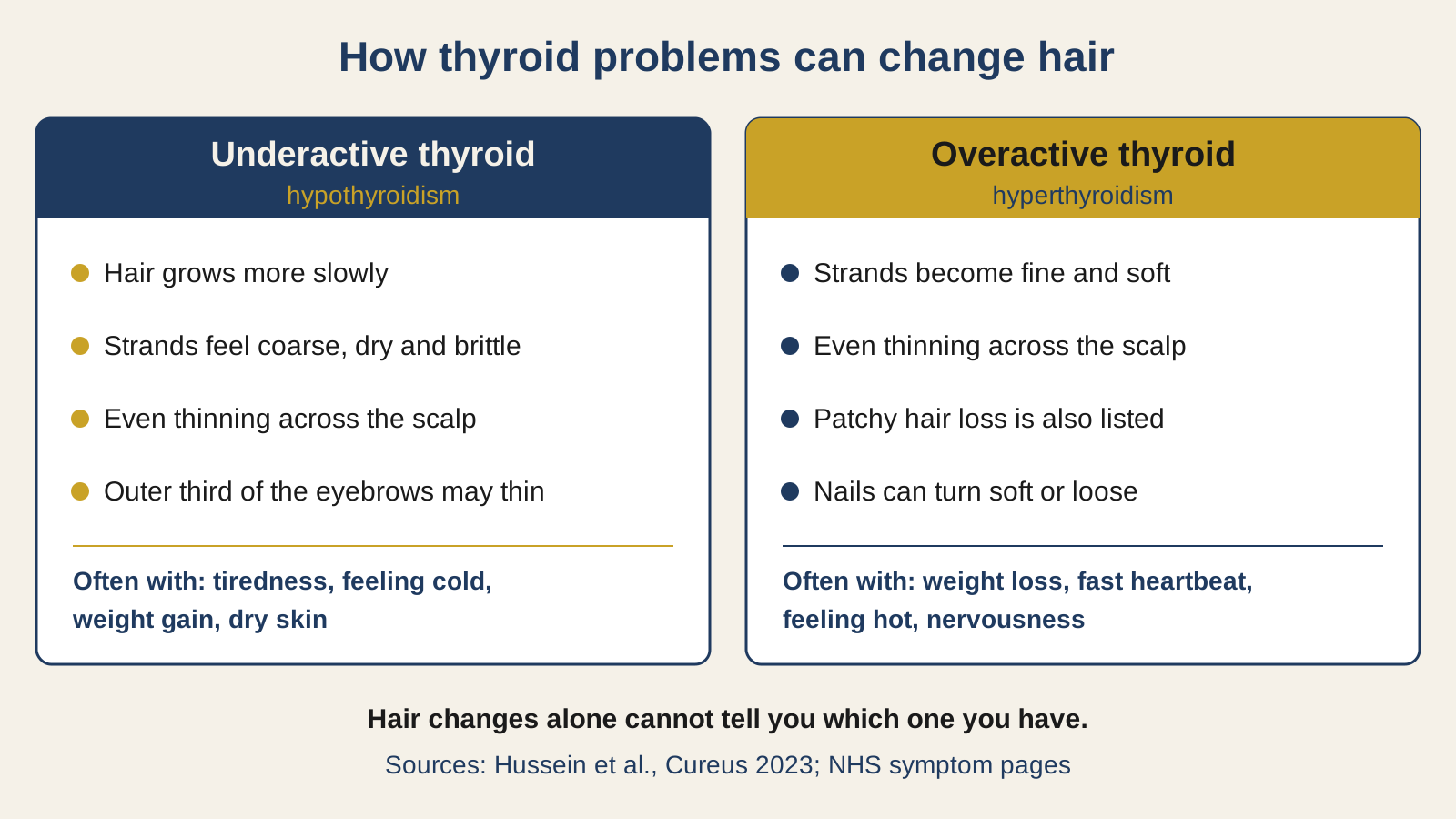
Both conditions can thin the hair evenly across the scalp, but the hair itself tends to feel different. A 2023 review in Cureus describes hair in hypothyroidism as slow growing, coarse, dry and brittle, and hair in an overactive thyroid as fine and soft.
The NHS symptom lists show what usually comes with the hair changes:
Sign
Underactive thyroid (hypothyroidism)
Overactive thyroid (hyperthyroidism)
Hair texture
Coarse, dry, brittle, slow growing
Fine and soft
Hair loss pattern
Even thinning; outer eyebrow may thin
Even thinning or patchy hair loss
Other common symptoms
Tiredness, feeling cold, weight gain, constipation, low mood, dry skin
Nervousness, feeling hot, weight loss, fast or irregular heartbeat, a swelling in the neck
Hair changes alone cannot tell you which problem you have, or whether you have a thyroid problem at all. That needs a blood test.
Thyroid and Eyebrow Hair Loss
Thinning of the outer third of the eyebrows is a classic sign of an underactive thyroid in medical texts, described in the same 2023 review. Cleveland Clinic adds that thyroid disease can also affect the eyelashes and body hair. Eyebrow thinning on its own has other causes too, including alopecia areata, so it is a reason to ask about a blood test, not a diagnosis.
Hashimoto's, Graves' Disease and Alopecia Areata
The American Thyroid Association lists autoimmune disease, such as Hashimoto's thyroiditis, among the causes of an underactive thyroid, and names Graves' disease as the most common cause of an overactive one. In both, the immune system targets the thyroid by mistake.
Alopecia areata is also autoimmune, and the two often occur together:
A 2020 meta-analysis of 17 studies, with 2,850 people with alopecia areata and 4,667 controls, found thyroid disease about 3.7 times as often in the alopecia areata group (odds ratio 3.66).
A 2019 meta-analysis of 50 studies found higher odds of abnormal thyroid tests, thyroid antibodies and autoimmune thyroid disease in people with alopecia areata.
The British Thyroid Foundation notes that alopecia areata occurs in people with autoimmune thyroid disease more often than would be expected by chance.
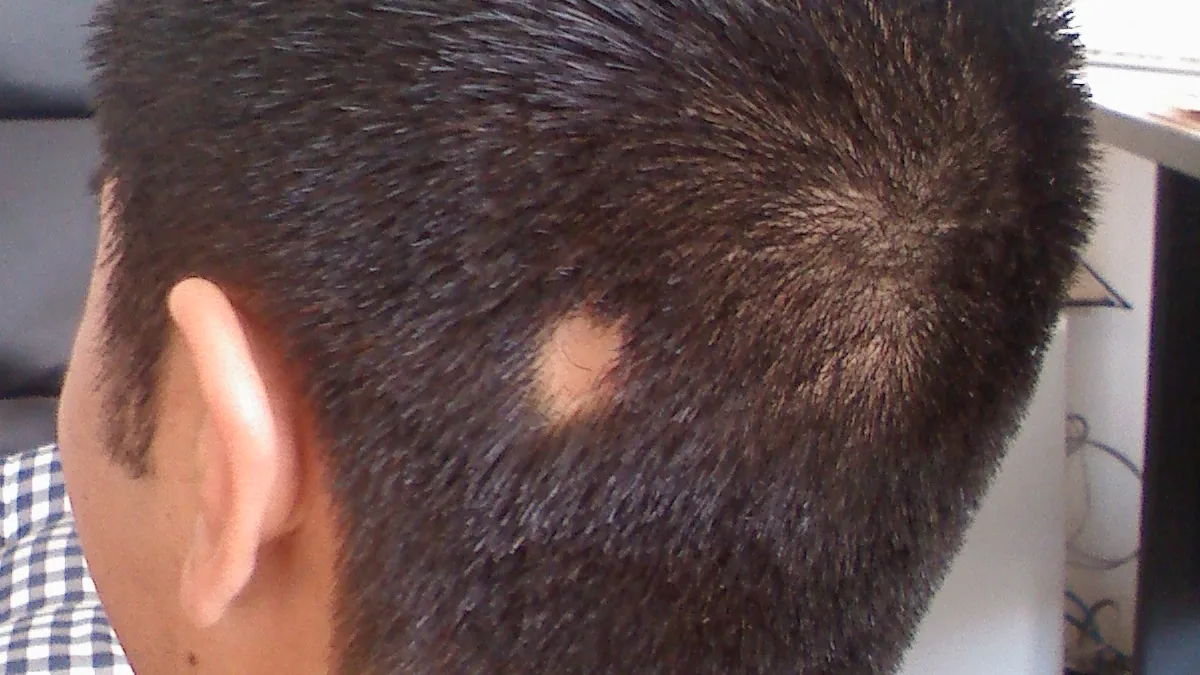
Alopecia areata looks different from thyroid shedding. It usually causes smooth, round bald patches, rather than even thinning. Having Hashimoto's or Graves' does not mean you will develop it. If patches appear, a dermatologist should see them. In most cases alopecia areata settles by itself, with hair returning within a year, according to the 2026 primary care review.
A single smooth, round bald patch on the back of the scalp, the typical look of alopecia areata. Photo: Kevlaraz, CC0 1.0, via Wikimedia Commons, cropped.
Levothyroxine Hair Loss
Levothyroxine is the usual treatment for an underactive thyroid. The US prescribing label for Synthroid states that partial hair loss may occur rarely during the first few months of treatment in adults and that it is usually temporary.
The British Thyroid Foundation explains the confusion: shedding from the thyroid problem itself shows up months later, often just as treatment starts. The tablet gets blamed, people stop it, and stopping can make the hair loss worse.
What to do if your hair sheds after starting levothyroxine:
Do not stop the medicine or change the dose yourself.
Tell the doctor who prescribes it when the shedding started and how much hair you are losing.
Ask whether your thyroid blood tests are due, since the dose is set by those results.
Ask your doctor or pharmacist how to time calcium supplements; the British Thyroid Foundation advises taking them about 4 hours apart from levothyroxine.
Avoid kelp and iodine products unless your doctor recommends them, as the British Thyroid Foundation advises.
Thyroid medicines are not the only ones linked to shedding. Our guide to Wellbutrin hair loss covers another commonly asked about medicine and how to tell drug-related shedding from other causes.
Antithyroid Medicines and Hair Loss
Medicines that slow down an overactive thyroid can also cause hair loss, although the labels and reviews describe it as uncommon. This table sums up what each source says:
Medicine
Used for
What the source says about hair
Source
Levothyroxine (Synthroid)
Underactive thyroid
Partial hair loss may occur rarely in the first few months; usually temporary
US prescribing label (DailyMed)
Methimazole
Overactive thyroid
Abnormal loss of hair listed among side effects
US prescribing label (DailyMed)
Propylthiouracil (PTU)
Overactive thyroid
Loss of hair listed among side effects
US prescribing label (DailyMed)
Carbimazole
Overactive thyroid
Rarely causes diffuse hair loss
British Thyroid Foundation
Antithyroid drugs as a group
Overactive thyroid
Listed among drugs that can trigger telogen effluvium
2026 primary care review
A side effect on a label does not mean most people get it. If you suspect a thyroid medicine, talk to your doctor rather than stopping it; an untreated overactive thyroid can itself keep the hair shedding.
Will Thyroid Hair Loss Grow Back?
In most cases, yes. The British Thyroid Foundation says regrowth is usual once the thyroid is treated, but it takes several months and may be incomplete. The new hair can also differ in texture or colour from before.
A realistic way to think about recovery:
Get the thyroid treated and the blood tests back into the range your doctor is aiming for.
Expect shedding to continue for a while, because hairs that were already in the resting phase still have to fall out.
Look for short new hairs along the parting and hairline over the following months.
Judge the result at around 6 to 9 months, the timescale the AAD gives for telogen effluvium.
If your thyroid has been in range for many months and the hair is still thinning, ask your doctor to look for a second cause. In men, thinning at the temples and crown often follows the pattern shown on the Norwood scale of male pattern baldness, which thyroid treatment does not reverse.
Which Tests Should You Ask Your Doctor About?
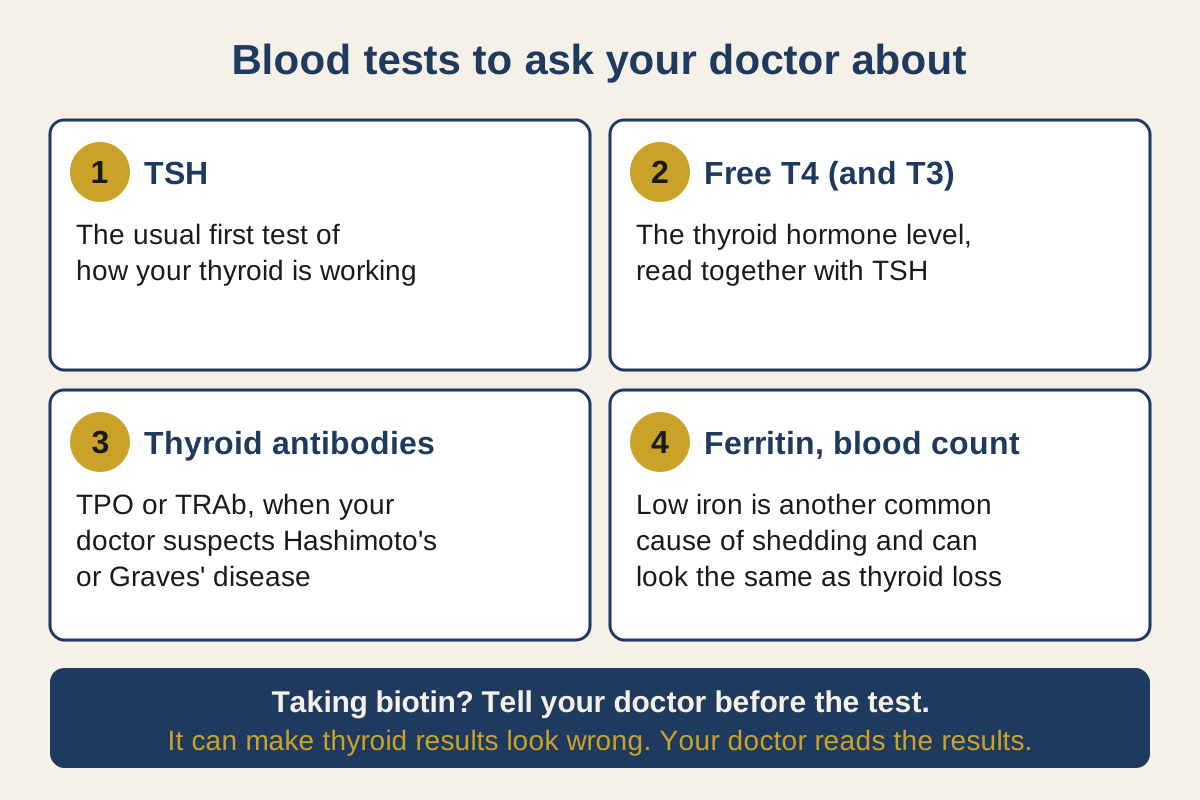
If you have hair loss along with other symptoms of a thyroid problem, it is reasonable to ask about blood tests. The American Thyroid Association describes a TSH blood test as the best way to start checking thyroid function, with free T4 read alongside it.
Tests your doctor may consider:
TSH: the usual first check of thyroid function.
Free T4, and sometimes T3: the hormone level itself.
Thyroid antibodies: TPO antibodies when Hashimoto's is suspected, or TSH receptor antibodies when Graves' disease is suspected.
Ferritin, iron and a full blood count: low iron can cause shedding that looks the same as thyroid hair loss.
Vitamin B12, folate, vitamin D and zinc: listed in the 2026 primary care review among tests that may be done for hair loss.
One practical point matters before any of these tests. Biotin, found in many hair supplements, can make thyroid results look wrong, so tell your doctor if you take it. Our guide to the vitamins and minerals linked to hair loss covers when those levels are worth checking. Your doctor interprets the results against the laboratory's own ranges; this guide does not.
Warning Signs That Need a Doctor
Some signs should be checked rather than waited out:
Smooth, round bald patches, or hair loss in the eyebrows or beard.
A swelling at the front of the neck, which doctors examine for as part of a hair loss assessment.
A fast or irregular heartbeat, trembling or unexplained weight loss.
Tiredness, feeling cold, weight gain and low mood that have built up over months.
Heavy shedding that started 2 to 3 months after a new medicine, an illness or a dose change.
A sore, red or scaly scalp, which needs a dermatologist rather than a blood test.
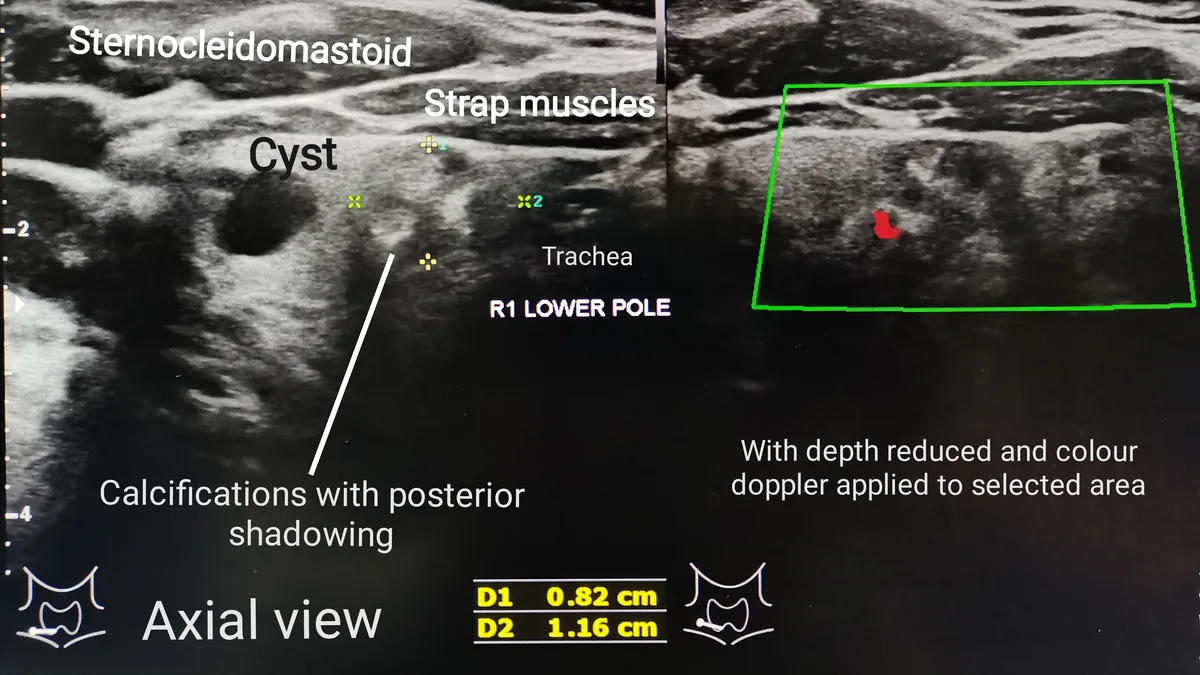
A thyroid ultrasound scan, with the cyst, a calcified nodule, the trachea and neck muscles labelled. Photo: Cerevisae, CC BY-SA 4.0, via Wikimedia Commons, cropped.
Hair loss after childbirth is a separate common cause of shedding, covered in our postpartum hair loss guide.
Thyroid and Hair Transplant: Why Timing Matters
A hair transplant moves follicles to thinning areas; it does not treat the cause of shedding. A 2021 review of hair transplant indications and contraindications lists telogen effluvium among the conditions that weigh against surgery. It adds that acute telogen effluvium usually resolves once the cause is removed, while chronic telogen effluvium can be harder to treat.
In practice, that means:
Get the thyroid diagnosed and treated first.
Give the shedding time to settle and the regrowth time to show.
If thinning remains in a clear pattern after that, it may be pattern hair loss rather than thyroid loss, and a transplant can then be discussed.
The medical team asks about thyroid treatment and recent shedding and reviews photos before any treatment is discussed. Women with ongoing thinning can read our hair transplant for women guide.
This guide is general information and not a diagnosis. Do not stop or change a thyroid medicine without speaking to the doctor who prescribed it. See a doctor promptly if hair loss comes with a fast or irregular heartbeat, a swelling in the neck, unexplained weight change or patchy bald areas.
Frequently Asked Questions
Does Hair Loss Mean I Have a Thyroid Problem?
Not necessarily. In a 2026 study of 1,411 people with non-scarring hair loss, 8.5% had thyroid dysfunction, and the British Thyroid Foundation notes that thyroid hair loss with no other symptoms is unusual. A blood test answers the question.
Does Levothyroxine Cause Hair Loss?
It can, rarely. The Synthroid prescribing label says partial hair loss may occur in the first few months of treatment and is usually temporary. Shedding at this stage is often from the thyroid problem itself rather than the tablet.
Will My Hair Grow Back After Thyroid Treatment?
Usually, yes. The British Thyroid Foundation says regrowth is the rule once the thyroid is treated, but it takes several months, may be incomplete and the new hair can have a different texture or colour.
Can Hashimoto's Cause Hair Loss?
Yes. Hashimoto's thyroiditis is an autoimmune cause of an underactive thyroid, which can thin the hair. It is also linked with alopecia areata, which causes patchy loss.
Can Graves' Disease Cause Hair Loss?
Yes. Graves' disease is the most common cause of an overactive thyroid, and the NHS lists patchy hair loss or thinning among its symptoms. Antithyroid medicines used to treat it can occasionally cause shedding too.
Should I Stop My Thyroid Medicine If My Hair Is Falling Out?
No. The British Thyroid Foundation warns that stopping treatment because of hair loss can make the hair loss worse. Speak to the doctor who prescribed it.
Can I Have a Hair Transplant With a Thyroid Condition?
A transplant is considered once the thyroid is treated and shedding has settled. Active telogen effluvium weighs against surgery, so the timing is discussed after the thyroid is under control.
Is Your Hair Still Thinning?
If your thyroid has been treated for months and your hairline or crown still looks thinner, the pattern of loss can show whether something else is going on. Send clear photos for a free hair analysis, and the medical team will tell you what they see.
Medical disclaimer: This article is for informational purposes only and is not medical advice. Individual results and recovery vary from person to person. Always follow the written aftercare plan from your own medical team.
Sources and medical review
Xin C, Sun X, Lu L, Yang R, Shan L, Wang Y. Increased incidence of thyroid disease in patients with alopecia areata: a systematic review and meta-analysis. Dermatology, 2020;236(3):251-254
Lee S, Lee YB, Kim BJ, Lee WS. Screening of thyroid function and autoantibodies in patients with alopecia areata: a systematic review and meta-analysis. Journal of the American Academy of Dermatology, 2019;80(5):1410-1413.e4
van Beek N, Bodó E, Kromminga A, et al. Thyroid hormones directly alter human hair follicle functions: anagen prolongation and stimulation of both hair matrix keratinocyte proliferation and hair pigmentation. Journal of Clinical Endocrinology and Metabolism, 2008;93(11):4381-4388
Alomary SA, et al. An analysis of thyrotropin levels in patients with nonscarring alopecia: a single-center retrospective comparative study. Journal of Clinical and Aesthetic Dermatology, 2026;19(4):35-37
Send three photos: front, top and sides. You get a technique recommendation, a graft range and a straight answer about what is achievable, before anyone talks about price.
Your details are with the team
A patient coordinator will get back to you shortly. If you would like to send your photos now, WhatsApp is the fastest way to do it.
We respond quickly, day or night, in your language.
Multilingual team, no obligation
Data protectedKVKK and GDPR compliant, 100% confidential
Authorized Health Tourism Intermediary
Turkey Hair Center is the hair-restoration brand of Healthy Way Tourism, an authorized international health-tourism intermediary. All medical procedures are performed by licensed medical professionals at authorized healthcare facilities in Turkiye, in accordance with the regulations of the Ministry of Health.