Performed at authorized partner hospitals Turkey Hair Center is a Ministry of Health authorized health-tourism intermediary, not a clinic.
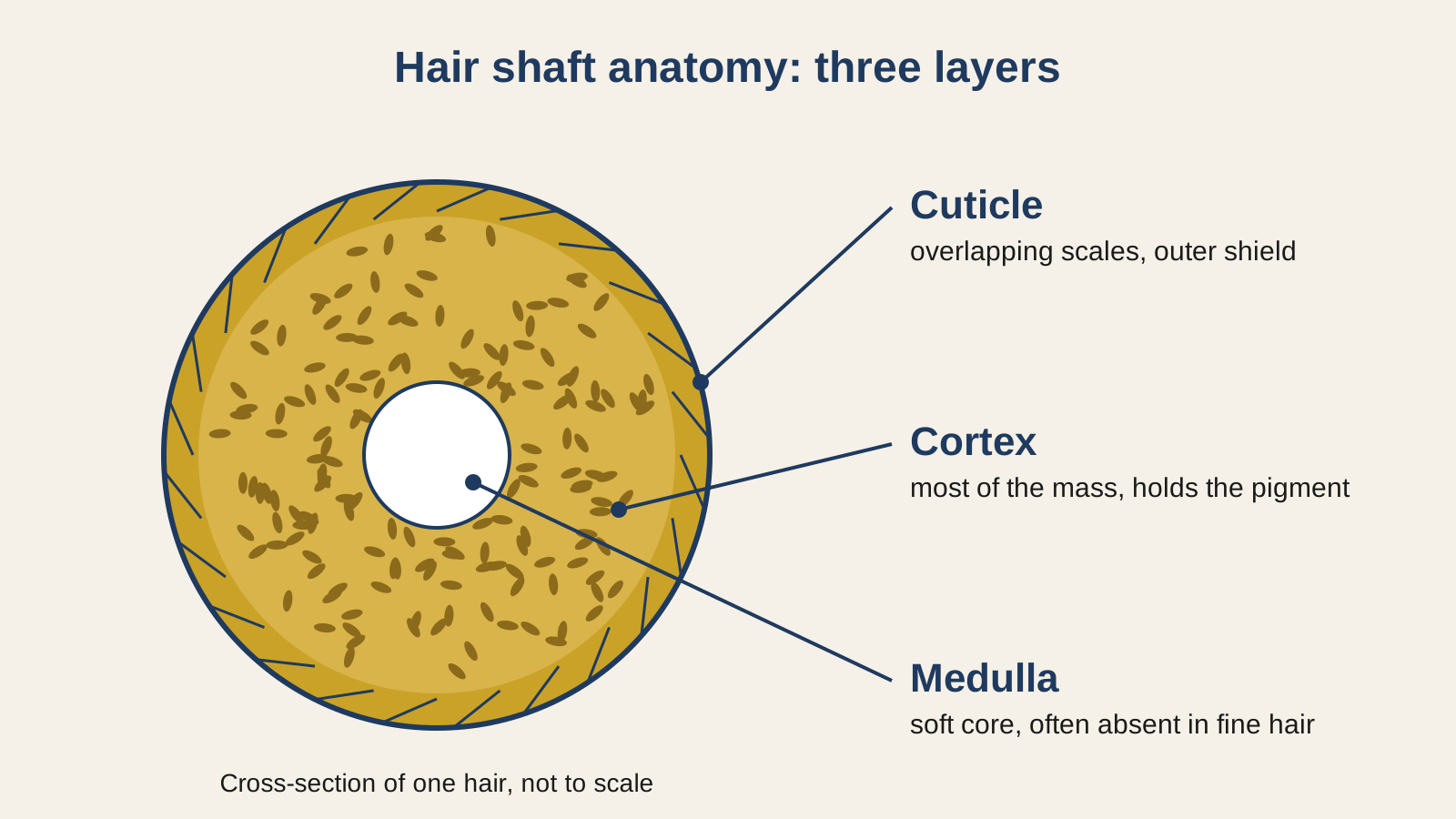
The hair shaft is the visible part of a hair above the skin, made of keratin in three layers: the cuticle outside, the cortex in the middle and, in thicker hairs, a central medulla. It forms in the follicle and cannot repair itself after it leaves the scalp.
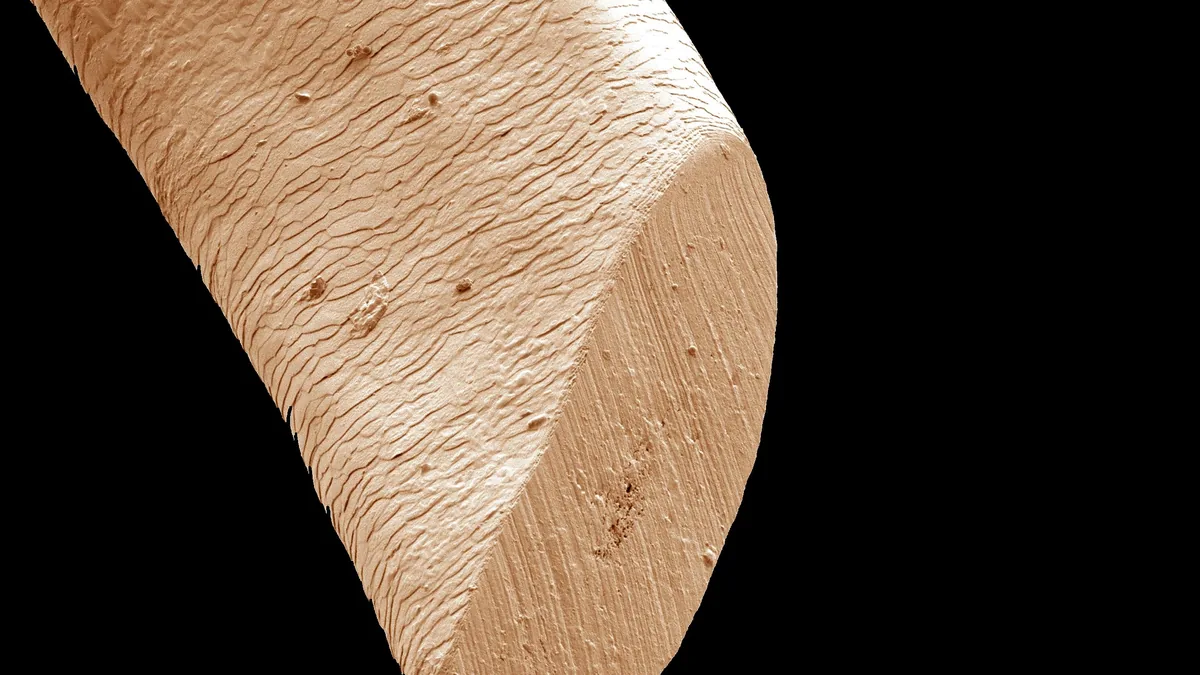
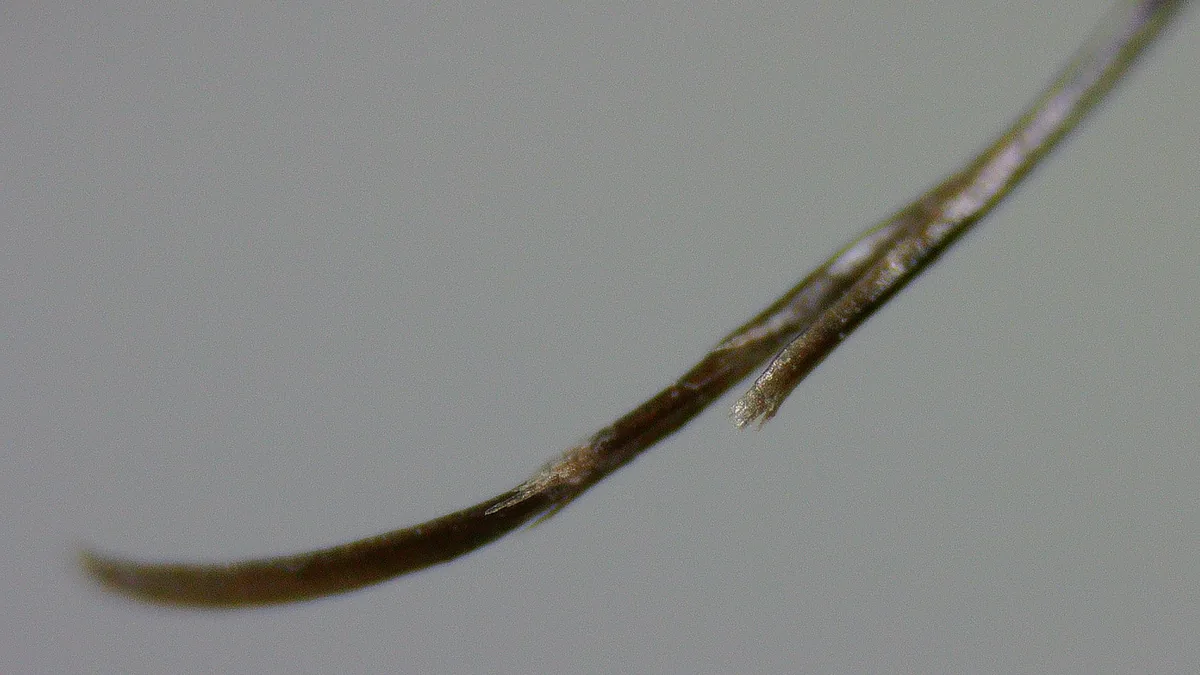
A human hair after shaving, shown at high magnification. Photo: Pr.zs.i, CC BY-SA 4.0, via Wikimedia Commons, cropped.
That last point explains most of what people notice about their hair. Split ends, frizz and colour that fades all happen in the shaft, while growth, thickness and new hair come from the follicle below the skin. This guide walks through:
what the hair shaft is and where it sits
the medulla, cortex and cuticle, one layer at a time
what damages the shaft and what breakage looks like
how the shaft differs from the hair root
The wavy lines across the surface are the edges of overlapping cuticle scales, and the smooth oval face is where the razor cut straight through the shaft. Nothing in it is alive, so the cut end stays as it is until the hair grows out.
What Is the Hair Shaft?
The hair shaft is the long fibre that grows out of the skin. A 2014 study in PeerJ describes adult scalp hair as about 20 to 180 micrometres wide, built from the cuticle, the cortex and the medulla, with the layers held together by a material called the cell membrane complex. For scale, a study of Arab adults measured a mean scalp hair diameter of 87 micrometres.
The shaft is made mostly of keratin, a tough structural protein. The outer cuticle is described in the same study as a layer of dead, overlapping cells. Unlike skin, the shaft cannot heal itself, so damage along its length stays there until that part of the hair is cut off or grows out.
The shaft also carries the features you see and touch:
Colour: melanin made in the follicle is packed into the shaft as it forms.
Thickness: set by the follicle, and in particular by the size of its dermal papilla.
Texture: how the shaft feels depends heavily on the state of the cuticle.
Shape: straight, wavy or coiled, as our curl types guide explains.
What Is Hair Follicle Anatomy?
The follicle is the living part of the hair, and the shaft is its product. Cleveland Clinic describes the follicle as a tube-like structure that surrounds the root and strand of a hair. It sits in the top two layers of the skin, the epidermis and dermis, and follicles that hold scalp hair can reach into the fat layer beneath.
A 2024 review in Biology sets out the main parts of the follicle:
Outer root sheath: the outer wall of the follicle, which contains the bulge, a store of hair follicle stem cells and melanocyte stem cells.
Inner root sheath: a layer that wraps around the hair shaft while it forms.
Matrix cells: fast-dividing cells in the hair bulb that surround the dermal papilla and turn into the hair shaft.
Dermal papilla: a cluster of cells at the base that signals the matrix and controls the growth, size, shape and colour of the hair.
Pigment is added in the bulb. A review by Tobin in the International Journal of Trichology explains that melanocytes there pass melanin granules into the cells of the cortex, less often into the medulla and very rarely into the cuticle. This happens only during the growing phase, which is why hair colour lives mainly in the cortex.
Medulla
The medulla is the soft core that runs down the centre of some hairs. The PeerJ study describes it as a loosely packed, disordered region near the centre of the hair. It is the least understood of the three layers, and not every hair has one.
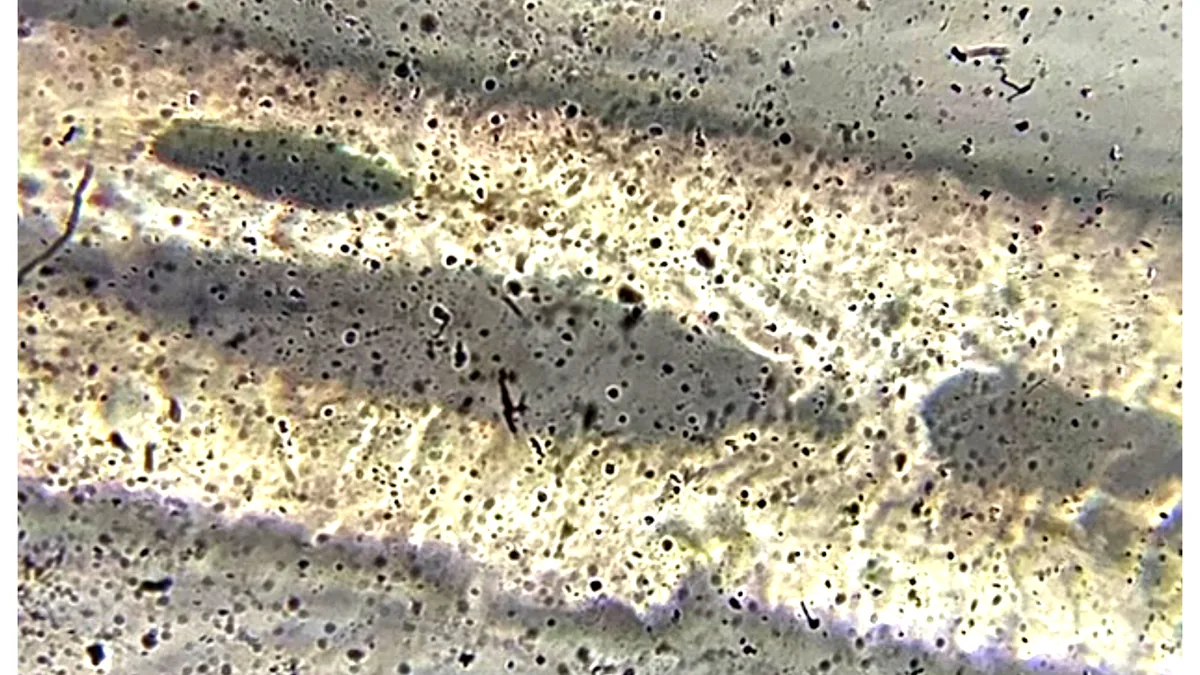
A grey human hair under a brightfield microscope at 400x; the photographer notes a dark medulla running through it and a very light cortex. Photo: ConformationXII, CC BY-SA 4.0, via Wikimedia Commons, cropped.
Grey hair is one of the coarser hair types in which the review below says a medulla is present. With so little pigment in the surrounding cortex, the medulla shows up here as the darker band down the middle.
According to a review of hair shaft structure by Gavazzoni Dias in the International Journal of Trichology, the medulla is:
present in coarser hair, such as grey hair, thick hair and beard hair
absent in the fine hair of children
more common in the coarser hair of Asian people than Caucasian people
a possible weak point, giving cracks a path to travel along the length of the fibre
So a hair medulla definition is simple: the central zone of a thick hair shaft, made of loosely arranged cells, that may be missing entirely in fine hair. Its exact job in human hair is not settled in the sources we reviewed, so we do not claim one. What matters in practice is that its presence tends to go with thicker, coarser strands.
Cortex
The cortex is the thick middle layer and makes up most of the hair. The PeerJ study says it contains the major part of the fibre mass, mainly keratin proteins and structural lipids. Its cells are long and spindle shaped, roughly 1 to 6 micrometres across and 50 to 100 micrometres long, and they lie parallel along the length of the hair.
Gavazzoni Dias describes what sits inside each cortex cell. There are long fibrous bundles called macrofibrils, each made of smaller, highly organised microfibrils set in a protein matrix rich in cystine. The cortex also holds the melanin granules that give hair its natural colour.
Those details explain three everyday facts:
Colour sits in the cortex, so dyes and bleach have to reach it to change the shade.
Strength depends on the cortex, which holds most of the fibre mass and its long keratin fibres.
Moisture changes the cortex, since hair is porous and water makes the shaft swell.
What Are the 3 Parts of the Hair Shaft?
The three parts of the hair shaft are the cuticle, the cortex and the medulla. The table below sets them side by side, with the cuticle as the outer layer, the cortex beneath it and the medulla at the centre when it is present.
Layer
Position
What it is made of
Main role
Present in every hair?
Cuticle
Outer surface
Flat, overlapping dead cells in several layers
Protects the cortex and controls friction
Yes
Cortex
Middle, most of the mass
Long spindle cells with keratin fibres and melanin
Strength, elasticity and colour
Yes
Medulla
Centre
Loosely packed, disordered cells
Not settled; may be a path for splitting
No, often absent in fine hair
Structure of Hair
Seen from the side, a hair has two parts: the shaft above the skin and the root inside the follicle. Seen in cross-section, the shaft shows its three rings. The cell membrane complex acts as cement between cuticle cells, between cortex cells and between the two layers, according to Gavazzoni Dias.
The same review notes that this cement and the inner part of the cuticle are the most vulnerable regions to bleaching, dyeing, straightening and perms. Everyday shampooing and friction can disrupt it too. Cracks in this cement may appear before a hair actually snaps.
Layers of the Hair
The cuticle is the layer you touch. Gavazzoni Dias compares its overlapping scales to shingles on a roof, and the PeerJ study gives their size: each cell is about 0.5 micrometres thick and 45 to 60 micrometres long. The number of stacked scales differs between people:
about 6 to 8 scales thick in Asian hair
slightly fewer in Caucasian hair
fewer again in African hair, which the review links to a higher tendency to break
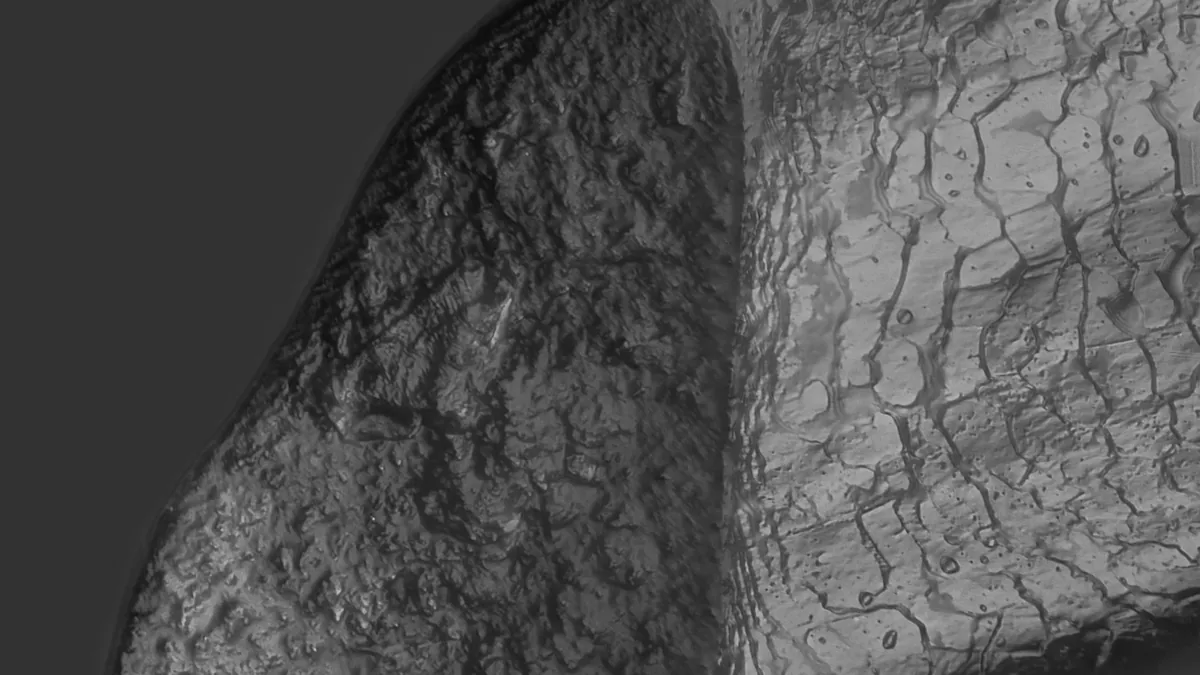
A cut human hair under differential interference contrast microscopy, 50x lens. Photo: Alexander Klepnev, CC BY 4.0, via Wikimedia Commons, cropped.
On the right of this image, the fine, irregular lines are the free edges of the cuticle scales, each one lying over the next like the shingles described above. The rougher area on the left is where the hair was cut.
The cuticle has its own fine layers. On the outside is the epicuticle, covered in a fatty layer that includes a lipid called 18-MEA. This lipid is what makes healthy hair repel water. Repeated rough washing, unprotected drying, friction, sunlight and alkaline chemical treatments strip it, and the surface becomes more water loving and more prone to tangling. How quickly hair takes up water is often called porosity, and our hair porosity guide covers how it changes in daily care.
The Cortex: The Workhorse
If the cuticle is the shield, the cortex does the heavy lifting. Its parallel keratin fibres let a hair stretch and spring back. Gavazzoni Dias reports that wet, untreated hair can be stretched by 30% of its length without damage, that stretching between 30% and 70% causes changes that do not reverse, and that stretching to 80% breaks it.
Chemical treatments work by reaching the cortex. The same review explains that bleaching reduces the cross links inside the fibre, so bleached hair is penetrated faster by conditioners, dyes and straightening products. It also notes that bleached and chemically treated hair is more porous than untreated hair.
Products sold as "repairing" can coat the surface, reduce friction and make hair feel smoother. The review by Gavazzoni Dias states that amino acids in these products do not replace or restore the damaged keratin structure. Once the cortex inside a hair is broken down, that length of hair stays weaker until it is cut off or grows out.
Hair Shaft Breakage
Breakage is the end result of damage that builds up over time. Gavazzoni Dias calls this weathering: a slow wearing down of the shaft from the root to the tip, which daily grooming causes in everyone to some degree. In heavily weathered or chemically treated hair, the cuticle scales lift, the 18-MEA layer is lost and the cuticle cracks.
When the cuticle wears away, the cortex is exposed and further damage can make the fibre snap. The American Academy of Dermatology notes that damaged hair is fragile, tends to break and can look frizzy. It adds that ongoing damage can lead to thinning hair or even bald spots.
Breakage and shedding are not the same thing, and the review points out that patients often cannot tell them apart. A broken hair snaps somewhere along the shaft and has no root at its end. A shed hair falls out whole from the follicle, usually with a small bulb at its tip, and is part of the normal growth cycle.
A split end on the photographer's own hair, which they say broke after a lack of moisture, heat and mechanical stress. Photo: RealGatba, CC0, via Wikimedia Commons, cropped.
Here the shaft has split lengthwise near its end into two strands. This is damage to the shaft, not shedding, and like any damage along the shaft it stays until that length is cut off or grows out.
Common Causes of Hair Shaft Damage
Most shaft damage comes from how hair is washed, dried and styled. The American Academy of Dermatology lists ten common hair care habits that can damage hair:
rubbing shampoo into the length of the hair instead of the scalp
skipping conditioner
rubbing hair dry with a towel
brushing hair while it is wet
using a blow dryer, hot comb or curling iron
using styling products with long-lasting hold
pulling hair back tightly in a ponytail, bun or cornrows
wearing a weave or hair extensions
colouring, perming or relaxing hair
brushing 100 strokes a day or tugging on hair to style it
For chemical work, the academy advises having only one service at a time, such as colour, relaxer or perm, and leaving two weeks between a perm or relaxer and colouring. Its colouring guidance warns that going more than three shades lighter needs stronger peroxide and causes more damage, so it suggests staying within three shades of your natural colour.
Its tips for daily care are practical:
massage shampoo into the scalp and let it rinse through the length
use conditioner after every shampoo
wrap hair in a towel and let it air dry where possible
use the lowest heat setting and limit hot tools to about once a week or less
comb gently with a wide-tooth comb
If you see hair on your pillow or in the shower, check the ends. Short pieces with no bulb point to breakage in the shaft. Whole hairs with a small bulb point to shedding from the follicle. The academy advises seeing a dermatologist if changing your hair care does not help, especially if you are concerned about thinning.
Hair Shaft vs Hair Root
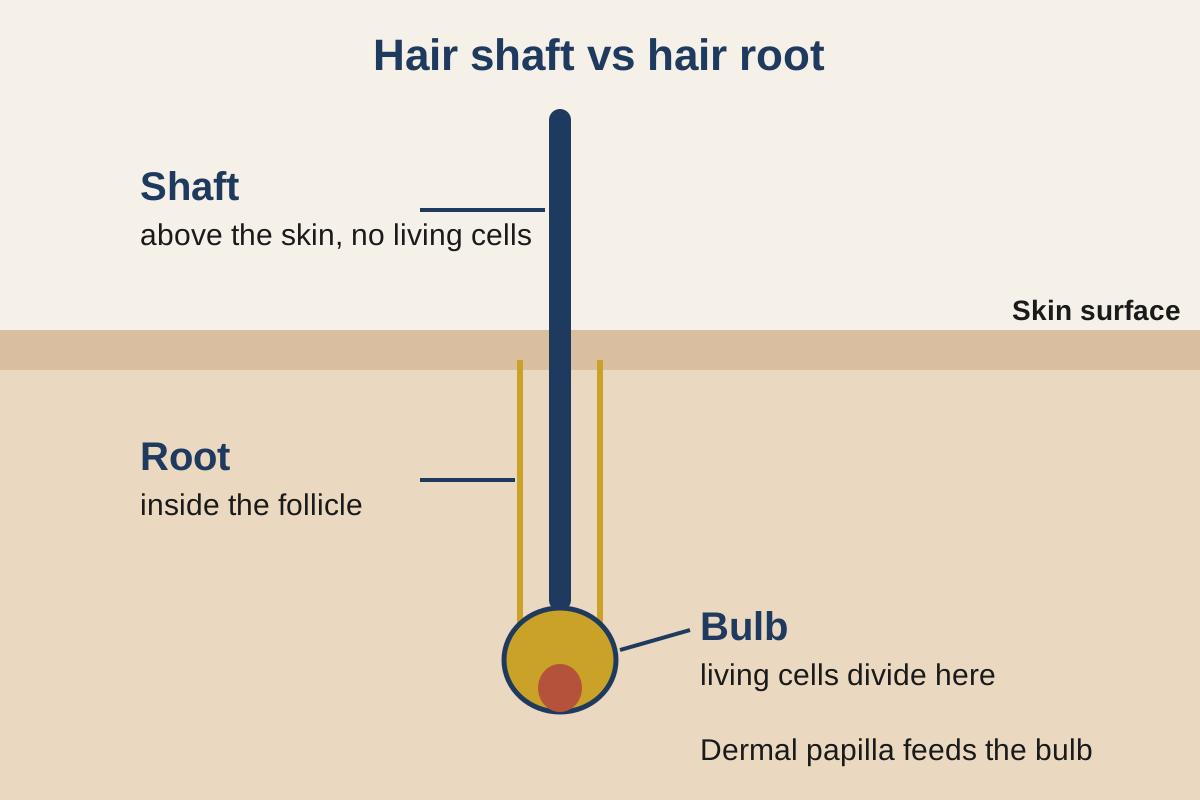
The shaft and the root are the same hair at two different places. The shaft is the part above the skin. The root is the part below the skin, sitting inside the follicle and ending in the hair bulb, where living cells divide and build new hair.
Feature
Hair shaft
Hair root
Where it is
Above the skin surface
Inside the follicle, below the skin
Living cells
No, made of dead keratinised cells
Yes, in the bulb at its base
What happens there
Wear, weathering and breakage
Growth, pigment and the start of a new hair
Effect of cutting or styling
Changes length and look only
Not affected
Can it recover?
No, damage stays until it grows out
A follicle can stop and restart growth
The difference between the hair shaft and the hair follicle matters when people talk about hair loss. Cleveland Clinic notes that the follicle is one of the few structures in the body that can stop working and start again. It also explains that pulling a hair out does not remove the follicle, and in most cases the hair grows back.
The same split explains what a transplant can and cannot do. A hair transplant moves follicles, not shafts, so what grows in the new area comes from the moved follicle. Our page on whether a hair transplant can change hair texture looks at this in more detail.
Hair Shaft Definition
In plain terms, the hair shaft is the non-living keratin fibre that a hair follicle produces and pushes out above the skin. It is what people mean when they talk about "their hair": the part that can be cut, coloured, curled and brushed.
A short glossary of the terms used on this page:
Hair shaft: the visible, non-living part of a hair above the skin.
Cuticle: the outer layer of overlapping protective scales.
Cortex: the middle layer that holds most of the mass, strength and colour.
Medulla: the loose central core found in many thick hairs.
Cell membrane complex: the cement between the cells of the shaft.
Follicle: the living tube in the skin that makes the hair.
The meaning of hair shaft in medical writing is the same. Dermatologists separate problems of the shaft, such as breakage from styling, from problems of the follicle, such as pattern hair loss, because they have different causes and need different care.
Where Is the Shaft of the Hair?
The shaft starts at the skin surface and runs to the tip of the hair. Below the surface the same hair continues as the root, inside the follicle. On the scalp, every visible strand is a shaft, and a healthy adult scalp carries around 80,000 to 120,000 of them, as we explain in our guide to how many hairs are on the human head.
Each shaft grows from its base, not its tip. A review in Deutsches Ärzteblatt International gives a growth rate of about 0.3 mm a day, roughly 1 cm a month. So the part closest to the scalp is the newest, and the ends are the oldest and most weathered part of the hair.
That is why long hair often looks healthy at the roots and dry at the ends. At 1 cm a month, a hair 30 cm long has been growing for about two and a half years, and its ends have been through all of that washing, brushing and sunlight. Hair shape and density vary widely between people too, which our hair types guide explains.
Frequently Asked Questions
Where Is the Hair Shaft Located?
The hair shaft is located above the surface of the skin. It is the part of each hair you can see and touch, from where it leaves the scalp to the tip. The part below the skin is the root, held inside the follicle.
What Is the Meaning of Hair Shaft?
The hair shaft means the visible strand of hair. It is a fibre of keratin made by the follicle, with three layers: cuticle, cortex and, in thicker hairs, medulla. It contains no living cells.
What Are the Three Layers of Hair?
The three layers of hair are the cuticle on the outside, the cortex in the middle and the medulla at the centre. The cuticle protects, the cortex gives strength and colour, and the medulla is often absent in fine hair.
Is the Hair Shaft Alive?
No. The shaft is made of keratinised cells that are no longer living, and the cuticle is described as a layer of dead cells. Only the cells at the base of the follicle, in the hair bulb, are alive and dividing.
Can a Damaged Hair Shaft Be Repaired?
Not fully. Conditioners and oils can reduce friction, smooth lifted scales and improve shine. They cannot rebuild damaged keratin, so the lasting fix is to cut off the damaged length and protect the new growth.
What Is the Difference Between the Hair Shaft and the Hair Follicle?
The follicle is the living structure in the skin that makes hair. The shaft is the non-living fibre it produces. Shaft damage affects how hair looks; follicle problems affect whether hair grows.
Where Is the Hair Follicle Located?
The follicle sits in the skin beneath each hair shaft. Cleveland Clinic explains that follicles start in the top two layers of the skin, the epidermis and dermis, and that follicles holding scalp hair can reach into the fat layer underneath. The shaft leaves the follicle at the skin surface, and everything below that point is the root.
What Is the Hair Shaft Made Of?
Mostly keratin, a tough structural protein. The 2014 PeerJ study says the cortex holds the major part of the fibre mass, mainly keratin proteins and structural lipids, while the cuticle is a layer of flat, overlapping dead cells. A material called the cell membrane complex holds the cells and the layers together.
Which Part of the Hair Shaft Gives Hair Its Colour?
The cortex. Tobin's review explains that pigment cells in the hair bulb pass melanin granules mainly into the cells of the cortex, less often into the medulla and very rarely into the cuticle. Pigment is added only while the hair is growing, which is why dyes and bleach have to reach the cortex to change the shade.
What Is Trichorrhexis Nodosa?
It is a common hair shaft problem in which thickened or weak points, called nodes, form along the shaft and make the hair break off easily, according to MedlinePlus. It can be inherited or triggered by blow-drying, ironing, over-brushing, perming or heavy chemical use, and sometimes reflects a condition such as hypothyroidism or iron deficiency. Gentler grooming usually helps; see a doctor if it does not.
Questions About Your Own Hair?
Hair that breaks is a shaft problem and often improves with gentler care. Hair that thins from the root is a follicle problem, and that is where a proper assessment helps. For a photo review, send:
the front hairline, hair pushed back
the top of the head, from above
the back and sides, where donor hair sits
Then ask for a free hair analysis. If a transplant turns out to be suitable, our hair transplant cost page lists the all-inclusive packages from $2,550 to $4,500.
Medical disclaimer: This article is for informational purposes only and is not medical advice. Individual results and recovery vary from person to person. Always follow the written aftercare plan from your own medical team.
Gavazzoni Dias MF. Hair cosmetics: an overview. International Journal of Trichology, 2015;7(1):2-15
Tobin DJ. Aging of the hair follicle pigmentation system. International Journal of Trichology, 2009;1(2):83-93
Zhang HL, Qiu XX, Liao XH. Dermal Papilla Cells: From Basic Research to Translational Applications. Biology (Basel), 2024;13(10):842
Elliott K, Stephenson TJ, Messenger AG. Differences in hair follicle dermal papilla volume are due to extracellular matrix volume and cell number: implications for the control of hair follicle size and androgen responses. Journal of Investigative Dermatology, 1999;113(6):873-877
Alsharif SH, AlGhamdi KM. Evaluation of Scalp Hair Density and Diameter in the Arab Population: Clinical Office-Based Phototrichogram Analysis. Clinical, Cosmetic and Investigational Dermatology, 2022;15:2737-2743
Wolff H, Fischer TW, Blume-Peytavi U. The Diagnosis and Treatment of Hair and Scalp Diseases. Deutsches Ärzteblatt International, 2016;113(21):377-386
Cleveland Clinic. Hair Follicle: Function, Structure and Associated Conditions. Cleveland Clinic health library
Send three photos: front, top and sides. You get a technique recommendation, a graft range and a straight answer about what is achievable, before anyone talks about price.
Your details are with the team
A patient coordinator will get back to you shortly. If you would like to send your photos now, WhatsApp is the fastest way to do it.
We respond quickly, day or night, in your language.
Multilingual team, no obligation
Data protectedKVKK and GDPR compliant, 100% confidential
Authorized Health Tourism Intermediary
Turkey Hair Center is the hair-restoration brand of Healthy Way Tourism, an authorized international health-tourism intermediary. All medical procedures are performed by licensed medical professionals at authorized healthcare facilities in Turkiye, in accordance with the regulations of the Ministry of Health.