Hair Breakage or Hair Loss? Causes, Signs and How to Stop It
Why hair snaps instead of shedding, how to tell a broken hair from a shed one, what heat, bleach and brushing do to the shaft, and when breakage points to hair loss.
12sources
10in PubMed
14min read
Written by Nazmi Güldeş, Certified Trichologist · Medically reviewed by Dr. Teuku Adifitrian, Sp.BP-RE (Dr. Tompi), Plastic, Reconstructive and Aesthetic Surgeon · Last reviewed 31 October 2026
Reading level
Hair breakage means strands snap partway along their length, so you find short, uneven pieces with no root on your brush, pillow or clothes. The root stays in the scalp and keeps growing, which makes breakage a problem of hair care rather than hair growth. Heat, bleach, relaxers, rough grooming and tight styles all cause it.
Before you change your routine, check what you are actually finding. Most hair that falls out is shed whole from the root, and that needs a different answer.
1Quick answerThe short answer, in a few sentences
What Is Hair Breakage?
Hair breakage is a fracture of the hair shaft: the strand snaps somewhere along its length and leaves a short piece with no root, while the root keeps growing. It builds up from heat, chemical treatments, rough brushing and tension. Shedding is different, because the whole hair leaves the scalp with its club-shaped root end.[1][2]
2Complete guideFrom the root check to repair, hair loss and transplants
Hair Breakage vs Shedding: How to Tell Them Apart
Three different things make hair look thinner, and you can tell them apart at home. The last row is our own summary.
Sign
Hair breakage
Shedding (telogen effluvium)
Pattern hair loss
The hair you find
Short pieces with no root
Whole hairs with a club-shaped root end
Whole hairs, many of them finer
Where it shows
Often the ends
More whole hairs than usual on your pillow and brush
Front, mid-scalp and crown
What is going on
The shaft fails; the root keeps working
Heavy shedding a few months after a trigger
Follicles shrink step by step
What helps
Gentler care and a trim
Dealing with the trigger
Medical treatment or a transplant
Check the End of the Hair
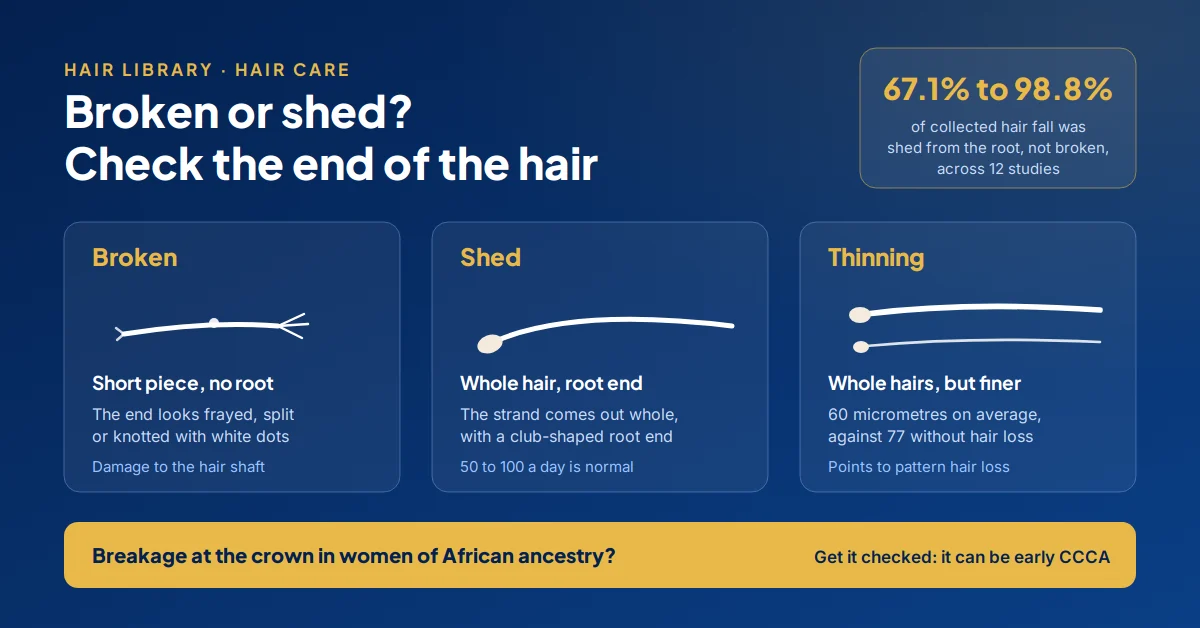
Look at both ends of a few hairs from your brush or pillow. A shed hair comes out whole, with a club-shaped root end. A broken hair is shorter, has no root, and its tip may look frayed, split or knotted with tiny white dots.
Expect most of what you find to be whole hairs. In nine older studies, hairs shed from the root made up 67.1% to 97.7% of the hair collected, and in three recent ones the averages ran from 72.2% to 98.8%.[2]
How Much Hair Loss Is Normal?
Shedding 50 to 100 hairs a day is normal, according to the American Academy of Dermatology.[3] A single wash is easier to count than a whole day.
In one wash test, people without hair loss lost about 28 hairs per shampoo, people with pattern hair loss about 52 and people with shedding about 126. Hairs lost in pattern hair loss were also thinner, 60 micrometres across against 77.[4] The worse the pattern hair loss, the more hairs fell and the thinner they were. Shed hairs that keep getting finer point to shrinking follicles, not to the shaft.
Hair Breakage or New Growth?
Short hairs are not always broken ones. After a bout of shedding, hair tends to regain its normal fullness within six to nine months, and that regrowth starts out short.
So look at the tip. A broken hair often ends frayed, split or knotted with white dots, the signs of a damaged shaft.
Where Your Hair Breaks and What It Can Mean
Find the row closest to what you see. The last two columns are our own summary.
Where it breaks
What it often means
Your first move
What to expect
The ends, with splits or white dots
Weathering, split ends or trichorrhexis nodosa
Trim, then handle hair gently
Regrowth can stay healthy once the cause is removed
Where a style pulls tight
Tight styles
Loosen the style now
Can lead to thinning and bald spots
Wherever hot tools meet wet hair
Heat damage, sometimes bubble hair
Use a heat protector and the lowest heat
Heat damage can hide until the next wash
Crown, in women of African ancestry
Possible early central centrifugal cicatricial alopecia (CCCA), a scarring loss
See a dermatologist; a biopsy may be needed
Treatment aims to stop the loss
Broken hairs where you pull or twist them
Hair pulling (trichotillomania)
See a doctor
A dermatoscope helps tell it apart
Front and crown, with finer hairs
Pattern hair loss, not breakage
A hair loss assessment
Often keeps going without treatment
Do not wait on the crown row. In biopsies from 8 people with crown breakage, 5 showed typical CCCA and 2 more showed a sign of early CCCA, which treatment can halt but rarely reverses.[5]
Every hair wears a little from root to tip with daily grooming, a process called weathering. Heat, chemicals and friction speed it up: they strip the protective cuticleGlossaryThe cuticle is the overlapping outer layer of the hair strand, the layer you touch. It decides hair porosity: when its scales lie flat and tight, water struggles to get in. Open in the glossary →, expose the cortex underneath and, in the end, the shaft can fracture.[1] Our hair shaft anatomy guide explains the layers that wear away.
That is why the ends are the most worn part of a hair. They are the oldest part and have been through every wash and salon visit since they grew.
Heat: Blow Dryers, Flat Irons and Bubble Hair
Blow-drying is less clear-cut than you might expect. A dryer causes more surface damage than air drying, yet a lab study found that a dryer held 15 cm away and kept moving did less damage overall than drying naturally.[1] The American Academy of Dermatology still advises air drying when possible and the lowest heat setting.
If you use a dryer, hold it about 15 cm away, keep it moving and use the lowest heat. Hot tools on wet hair carry their own risk: the water in the hair can boil and form bubbles inside the shaft, known as bubble hair. A silicone heat protector, which spreads the heat along the hair surface, helps prevent it.
Bleach, Relaxers and Other Chemical Treatments
Bleach, permanent dye and straighteners weaken hair from the inside, and chemically treated hair is prone to breakage. Bleached hair also turns more porous, so later dyes and straighteners soak in faster; our hair porosity guide explains what that means.
Relaxers straighten hair for good by breaking and re-forming its inner bonds. Applied badly, they burn the scalp and break hair, most often where new growth meets relaxed hair. They do not mix with bleached hair, and the academy suggests one service at a time: perm or relax first, and colour two weeks later.
Brushing, Combing and Wet Hair
Breaks tend to happen where the comb meets a tangle. Combing dry hair tends to snap off short pieces near the ends, while combing wet hair causes longer breaks further up.
Highly coiled hair combs more easily wet, and straight hair more easily dry. The academy's advice matches: comb textured hair damp, let straight hair dry a little first, and forget 100 strokes a day, which it calls a myth.
Tight Hairstyles
Tight ponytails, buns, cornrows and heavy weaves pull on your hair all day. The damage first shows as breakage, and if the pulling goes on, it can lead to thinning and bald spots. Our traction alopecia entry explains how to spot it early.
Split Ends and Trichorrhexis Nodosa
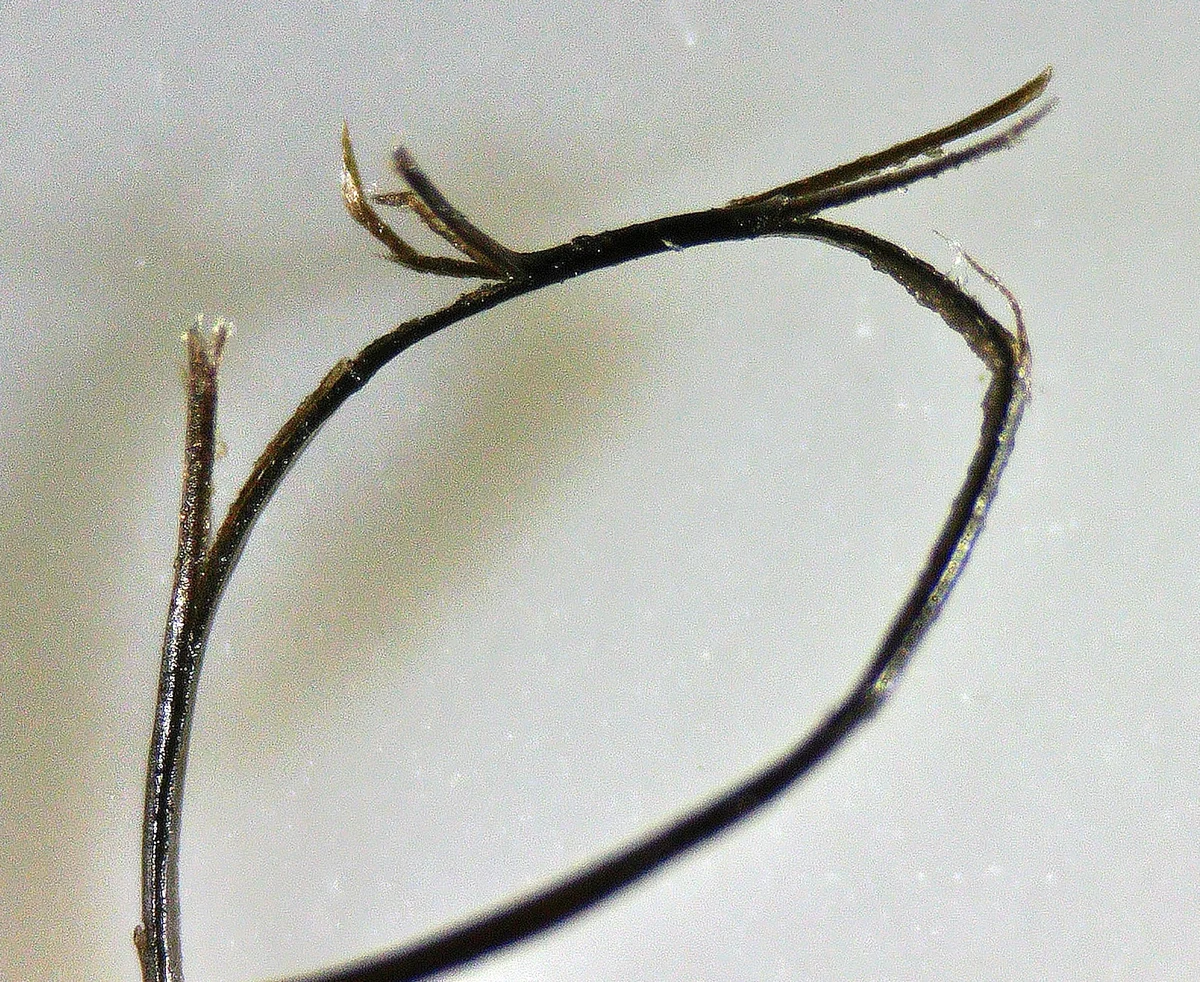
A split end, or trichoptilosis, is the shaft splitting lengthwise. It starts once the cuticle has worn away, when too few layers are left to hold the end together and a crack runs up the cortex.
A hair with several split ends (trichoptilosis). Photo: RealGatba, CC0, via Wikimedia Commons, cropped.
In trichorrhexis nodosaGlossaryTrichorrhexis nodosa is a common hair shaft problem in which thickened or weak points, called nodes, form along the shaft and make the hair break off easily. It can be inherited or triggered by blow-drying, ironing, over-brushing, perming or heavy chemical use. Open in the glossary →, weak points form along the shaft as tiny white knots. The hair looks dull, frays at the ends and will not grow long, and under magnification each break looks like two paintbrushes pushed together. The acquired form, linked to hair care routines and chemicals, is the common one.[6] In one reported case, a shaved head and a gentle, sulfate-free shampoo for the regrown hair kept it from returning over six months.
Diet, Thyroid, Hormones and Stress
Some health problems change the shaft itself. An underactive thyroid goes with dry skin and brittle hair[7], as our thyroid hair loss guide explains.
Diet can matter through shedding. Losing 20 pounds or more is a common trigger, as are childbirth, high fever, surgery and a lot of stress.[3] That is telogen effluviumGlossaryTelogen effluvium is sudden diffuse shedding that follows illness, childbirth or stress. Shedding usually starts two to three months after the trigger, and it is usually self-limiting once the trigger is removed. Open in the glossary →. Our telogen effluvium entry explains the timeline.
In every reported case where biotin helped, there was an underlying problem, and there is not enough evidence for it in healthy people.[8] Our guide to vitamins for hair loss compares the others.
How to Stop Hair Breakage
Can Damaged Hair Be Repaired?
Partly. Conditioners and some oils smooth a lifted cuticle and cut the friction that makes hair snap, and coconut oil also helps hair keep its protein. Our guide to oils for hair compares the rest.
Split ends are harder. A chemical straightener tested on 30 women repaired the cuticle but left split ends unchanged.[9] So stop new damage, and let a trim remove what is already broken.
Daily Habits That Reduce Breakage
The swaps are the American Academy of Dermatology's advice.[10] The middle column is our summary of why each habit hurts.
Habit
What it does
Gentler swap
Rubbing shampoo into the lengths
Friction and tangles
Massage it into the scalp; let the rinse run through
Skipping conditioner
More friction for the comb
Conditioner after every wash and after swimming
Rubbing hair dry with a towel
Friction on wet hair
Wrap it in a towel instead
Brushing hard or often
Snaps hair at tangles
A wide-tooth comb, only to style
Daily hot tools
Heat damage to the shaft
The lowest heat, once a week or less
Tight styles and heavy weaves
Constant pull
Loose styles; weaves for two or three months at most
How long the damaged length takes to grow out depends on how fast hair grows.
Myths About Hair Breakage
"100 brush strokes a day make hair healthier." The academy calls this a myth.
"The right product can repair split ends." Products can smooth the cuticle, but in a test of a straightener, split ends stayed split. A trim removes them.
"Biotin stops breakage." There is no good evidence that it helps healthy people.
"Air drying is always gentler." A dryer kept moving at a distance did less damage overall in the lab.
Hair Breakage in Men
When a man's hair thins at the front, mid-scalp and crown, think of pattern hair loss before breakage: those are the follicles that shrink in androgenetic alopeciaGlossaryAndrogenetic alopecia, or pattern baldness, is the pattern hair loss behind most male and female thinning. It is primarily driven by genetic predisposition and sensitivity to androgen hormones. Open in the glossary →.
If you keep your hair short and still find more hair than usual, look at the root ends: whole, finer hairs point to pattern loss rather than breakage.
Afro-Textured Hair
Very curly hair breaks more easily when it is combed and handled. Each strand is elliptical, thinner at every twist, and the scalp's oil does not travel down it well, so hair and scalp tend to be dry.[1]
It is also often straightened with heat or relaxers, one reason curly hair often breaks before it reaches full length. Our type 4 hair guide covers daily care for coily hair.
Can a Hair Transplant Fix Hair Breakage?
No, and it is the wrong answer when breakage is the whole problem. A transplant moves follicles from the back of the scalp, while breakage happens in the shaft above a working root.
It becomes relevant when breakage hides pattern hair loss, where transplantation is an effective treatment alongside finasteride and minoxidil.[11] Our page on how many grafts you need explains how coverage is planned. Crown breakage that could be CCCA needs a diagnosis before surgery is even discussed.
Frequently Asked Questions
Does hair breakage grow back?
Usually, yes. A broken hair leaves its root in the scalp, so the same follicle keeps growing and the length returns with time. The exception is crown breakage that turns out to be CCCA, a scarring alopecia.
How do you repair damaged hair?
Mostly by stopping new damage while healthy hair grows in. Conditioner and oils smooth the surface, but split ends stayed split even when a treatment repaired the cuticle, so cut them off or let them grow out. Trim the worst, condition after every wash and keep heat low.
How do you get rid of split ends?
Trim them off. Products have not been shown to join a split end back together: in one test, a straightener repaired the cuticle but left split ends unchanged. Then go easy on bleach and heat, and detangle gently.
Does keratin treatment damage hair?
It can. In Brazilian keratin treatment, a flat iron passes over the same spot 15 to 20 times, which a review calls very aggressive to the hair's proteins. The ingredients used today release formaldehyde when heated, and products labelled formaldehyde-free have still produced formaldehyde at or above workplace limits.[1]
Can stress cause hair breakage?
Stress is known for shedding rather than breakage: it triggers shedding from the root a few months later. Hair pulling (trichotillomania) is the exception: broken hairs and black dots are the most common things a dermatoscope finds in it.[12]
Why is my hair breaking on top of my head?
Rule out heat if you dry or iron your hair while it is wet, because that can form bubble hair. In women of African ancestry, crown breakage can be early CCCA, and in men, thinning on top points to pattern hair loss.
Can hair breakage be hormonal?
In some conditions. An underactive thyroid brings brittle hair, and after the menopause, the front, mid-scalp and crown become prone to pattern hair loss. Hair loss after pregnancy is shedding: it peaks about four months after birth, and hair tends to regain its fullness within six to nine months. See our postpartum hair loss guide.
Who Can Fix Breakage at Home, and Who Needs a Hair Check
Start at home if the hair you find is mostly short pieces with no root, the damage sits in the ends, and you can link it to heat, colour, a relaxer or a tight style.
Get a hair check if breakage clusters at the crown, comes in patches, or the hairs you find are whole and getting finer. The same goes if a gentler routine and a trim have not helped after a few months.
A transplant treats pattern hair loss, not breakage. If you are unsure which one you have, send three photos for a free hair analysis, and the medical team will tell you whether it looks like breakage, shedding or pattern loss. You can also message us on WhatsApp.
About the Author
Written by: Nazmi Güldeş, Certified Trichologist. Nazmi Güldeş focuses on patient education around androgenetic alopecia, evaluating miniaturization through dermoscopy, and assessing candidates for medical treatments and hair transplants.
Editorial Policy & Trust
This entry was drafted with the help of AI writing tools and edited by our team, then medically reviewed by Dr. Teuku Adifitrian, Sp.BP-RE (Dr. Tompi) on 31 October 2026. AI is never used as a source: every study cited here was checked against PubMed on 31 October 2026. Key figures are marked with their source, and every source is listed at the end of this entry. Read how we work in our editorial policy.
3 questions
Test yourself
Check what you remember from this entry. Each answer links back to the section that explains it.
Across 12 studies of hair fall, what made up most of the hair people collected?
Hairs shed from the root, with a club-shaped root end, outnumbered broken hairs in every study: 67.1% to 97.7% in nine older studies and 72.2% to 98.8% on average in three recent ones. Read the section
In a lab study of blow-drying, which drying method did the authors find least damaging?
Held 15 cm away and kept moving, a dryer did less damage overall than natural drying. The American Academy of Dermatology still advises air drying when possible. Read the section
Can a hair transplant fix hair breakage?
A transplant moves follicles. It fits pattern hair loss that breakage may hide, not breakage itself. Read the section
3Scientific evidenceStudy types, references and how to cite this entry
12sources
Evidence behind this entry: 10 publications indexed in PubMed (2012 to 2026): 4 reviews, 3 clinical studies, 1 case report, 1 clinical trial and 1 systematic review. Plus 2 patient guidance pages from the American Academy of Dermatology. 6 sources have free full text.
Randomized trialpeople assigned to treatments by chance
Reviewsummarises many studies
Clinical studya study in people without random groups
Guideline or labela professional body, or the official drug label
Gavazzoni Dias MF. Hair cosmetics: an overview. International Journal of Trichology. 2015;7(1):2-15.ReviewPubMedDOIFree full text
Li Y, Lin S, Paterson S, et al. New insights from data analysis of 12 global clinical studies on hair shedding. International Journal of Cosmetic Science. 2026.Clinical studyPubMedDOI
American Academy of Dermatology. Do you have hair loss or hair shedding? AAD public information.GuidelineSource page
Li X, Wang X, Wang C, et al. Hair Shedding Evaluation for Alopecia: A Refined Wash Test. Clinical, Cosmetic and Investigational Dermatology. 2022;15:117-126.Clinical studyPubMedDOIFree full text
Callender VD, Wright DR, Davis EC, et al. Hair breakage as a presenting sign of early or occult central centrifugal cicatricial alopecia: clinicopathologic findings in 9 patients. Archives of Dermatology. 2012;148(9):1047-1052.Clinical studyPubMedDOI
S A, R G S, C R V N, et al. Hair Shaft Fracture in a Young Athlete: A Rare Case Report of Acquired Trichorrhexis Nodosa. Cureus. 2024;16(8):e67341.Case reportPubMedDOIFree full text
Lause M, Kamboj A, Fernandez Faith E. Dermatologic manifestations of endocrine disorders. Translational Pediatrics. 2017;6(4):300-312.ReviewPubMedDOIFree full text
Patel DP, Swink SM, Castelo-Soccio L. A Review of the Use of Biotin for Hair Loss. Skin Appendage Disorders. 2017;3(3):166-169.ReviewPubMedDOIFree full text
Sanad EM, El-Esawy FM, Mustafa AI, et al. Structural changes of hair shaft after application of chemical hair straighteners: Clinical and histopathological study. Journal of Cosmetic Dermatology. 2019;18(3):929-935.Clinical trialPubMedDOI
American Academy of Dermatology. How to stop damaging your hair. AAD public information.GuidelineSource page
Liu Y, Tosti A, Wang ECE, et al. Androgenetic alopecia. Nature Reviews Disease Primers. 2025;11(1):73.ReviewPubMedDOI
Kaczorowska A, Rudnicka L, Stefanato CM, et al. Diagnostic Accuracy of Trichoscopy in Trichotillomania: A Systematic Review. Acta Dermato-Venereologica. 2021;101(10):adv00565.Systematic reviewPubMedDOIFree full text
Güldeş, N. (2026, October 31). Hair breakage: Causes, signs and how to tell it from shedding. Turkey Hair Center Hair Library. https://turkeyhaircenter.com/hair-breakage/
@misc{guldes2026hairbreakage,
  author       = {Güldeş, Nazmi},
  title        = {Hair breakage: Causes, signs and how to tell it from shedding},
  howpublished = {Turkey Hair Center Hair Library},
  year         = {2026},
  month        = oct,
  url          = {https://turkeyhaircenter.com/hair-breakage/},
  note         = {Last updated 31 October 2026}
}
TY  - ELEC
AU  - Güldeş, Nazmi
TI  - Hair breakage: Causes, signs and how to tell it from shedding
T2  - Turkey Hair Center Hair Library
PY  - 2026
DA  - 2026/10/31
UR  - https://turkeyhaircenter.com/hair-breakage/
N1  - Last updated 31 October 2026
ER  -
Send three photos: front, top and sides. You get a technique recommendation, a graft range and a straight answer about what is achievable, before anyone talks about price.
Your details are with the team
A patient coordinator will get back to you shortly. If you would like to send your photos now, WhatsApp is the fastest way to do it.