How Many Hairs Are on the Human Head: Hairs, Follicles and Differences by Gender
Performed at authorized partner hospitals Turkey Hair Center is a Ministry of Health authorized health-tourism intermediary, not a clinic.
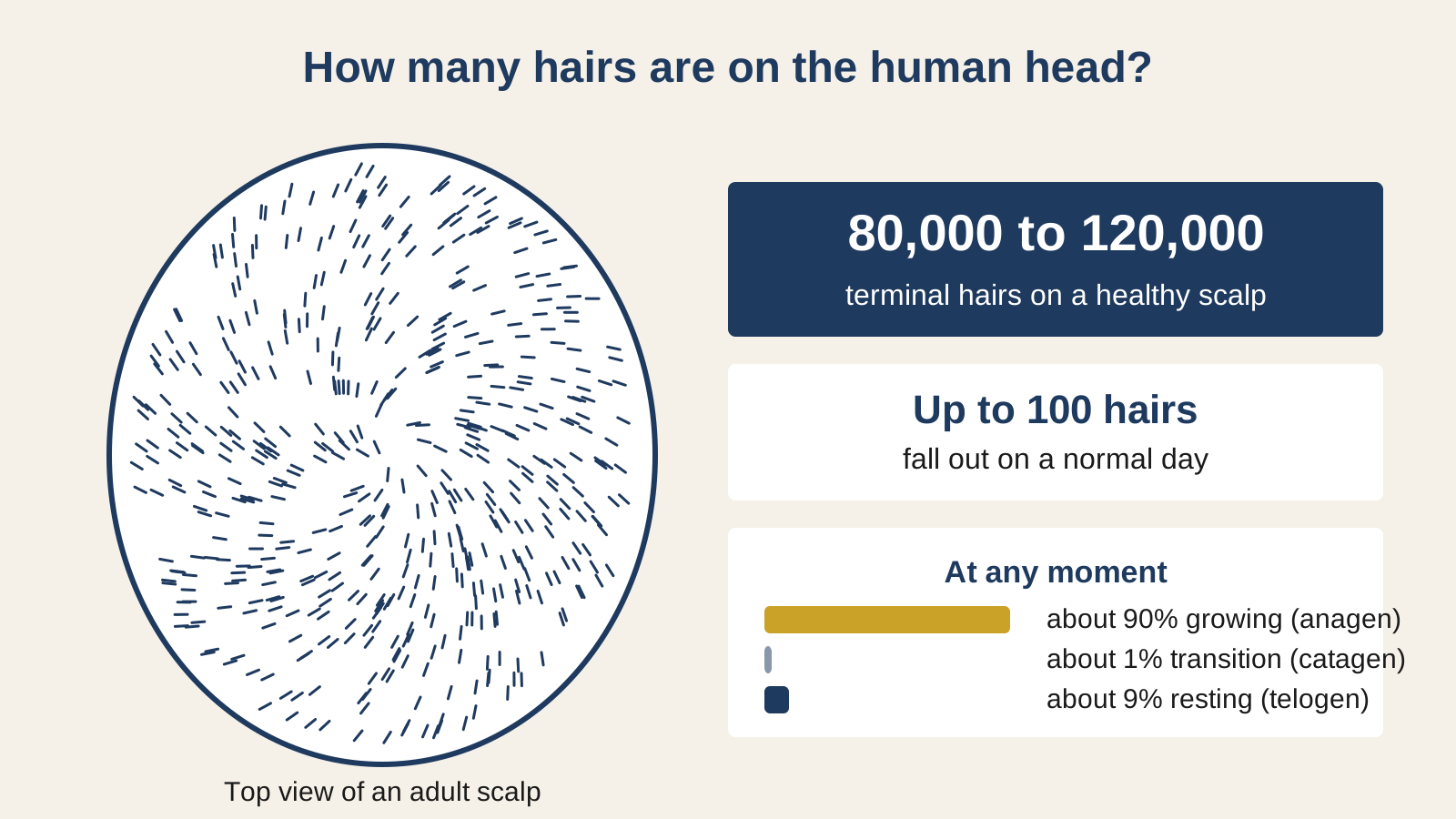
A healthy adult scalp carries roughly 80,000 to 120,000 terminal hairs, the thick pigmented hairs you can see and count. The exact number of hairs on the human head depends on hair density per square centimetre, scalp size and ancestry, and it falls slowly with age and pattern hair loss.
People ask the question in many forms: how many hairs on the human head, how many hair in human head, or how many hairs in a human head. The answer is the same, and the useful part is what sits behind it. This guide covers:
the measured density figures behind the total
the difference between men and women
how many hairs fall out each day
why the count matters when a surgeon plans grafts
Hair Follicle Count by Gender: Male vs Female
A review in Deutsches Ärzteblatt International gives the working range most dermatologists use: healthy men and women generally have 80,000 to 120,000 vital terminal hairs on the scalp. The same range applies to both sexes. Across the whole body, Cleveland Clinic puts the figure at more than 5 million hair follicles.
Researchers rarely count a whole head. They count hairs in a small area, then report density as hairs per square centimetre. Figures differ between studies for three plain reasons:
Method: a phototrichogram counts hairs on shaved, photographed skin, while a biopsy counts follicles in a 4 mm plug of tissue.
Site: the crown, temples and back of the head carry different densities.
People: age, ancestry and any hair loss in the sample all move the average.
What the Density Studies Found
Group studied
Mean density
Method
Source
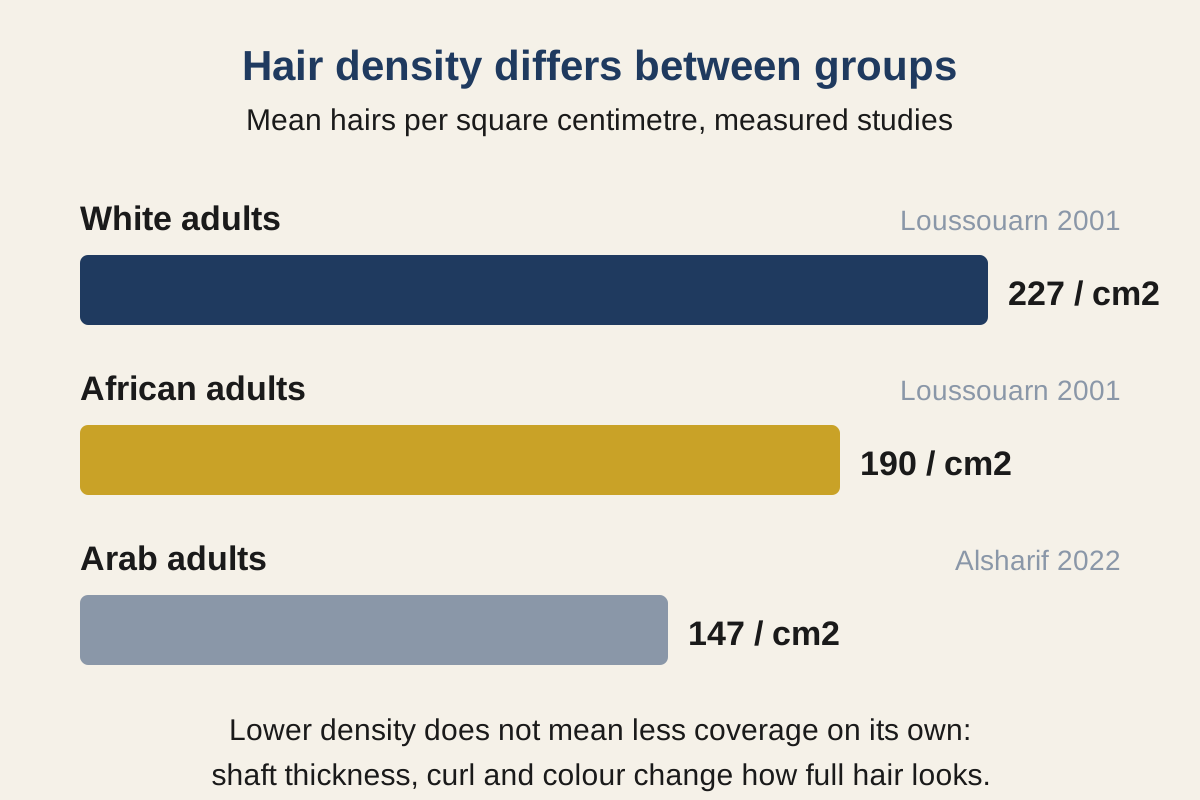
White adults
227 hairs per cm²
Phototrichogram
Loussouarn, 2001
African adults
190 hairs per cm²
Phototrichogram
Loussouarn, 2001
Arab adults
147 hairs per cm²
Phototrichogram
Alsharif and AlGhamdi, 2022
African American adults
Lower than white adults
Scalp biopsy counts
Sperling, 1999
Korean adults
Lower than white or Black adults
Scalp biopsy counts
Lee et al., 2002
Lower density does not always mean thinner looking hair. The Arab study found a mean hair diameter of 87 micrometres, which the authors describe as thicker than other groups, with lower density. Curl and colour change coverage too, as our hair types guide explains.
Do Men and Women Have a Different Number of Hairs?
The measured differences between the sexes are small:
In the African volunteer study, density showed no significant difference between men and women.
In the Arab study, women had higher density than men at the back of the head only.
The Korean biopsy study reported a slight difference between the sexes.
The bigger difference is how hair is lost. The American Academy of Dermatology notes that men with hereditary hair loss often see a receding hairline or a bald spot on top, while women more often notice overall thinning or a widening part. The Norwood scale shows how the male pattern usually moves.
Why the Count Matters for a Hair Transplant
A transplant does not add hairs. It moves follicles from the back and sides of the scalp, where hair is more stable, to thinning areas. A 2026 review of follicular unit excision describes over-harvesting of that donor area as a real complication and lists limiting extraction to 10% to 20% per session as one way to prevent it.
You may read that blondes have about 140,000 hairs and redheads about 90,000. We could not trace these figures to a measured study, so we do not repeat them as fact. Your own density, measured on your scalp, is what decides how many grafts can be taken safely.
This is why graft numbers are planned per person. The medical team looks at:
donor density at the back and sides, counted on the scalp
How Many Hair Follicles on the Human Head Per Square Inch?
One square inch is about 6.45 square centimetres. Using the study means above, that works out to roughly 1,460 hairs per square inch in white adults, 1,230 in African adults and 950 in Arab adults. Individual scalps vary well above and below these averages.
How Many Hair Follicles on the Human Head Thick Hair?
Thick hair usually means each strand has a wide diameter, not that there are more follicles. The Arab study found thicker hair alongside lower density than other groups. Two people with the same follicle count can look very different if one has coarse hair and the other fine hair.
How Many Hairs Grow on the Human Head a Day?
Each growing hair lengthens by about 0.3 mm a day, according to the Deutsches Ärzteblatt review. Because follicles cycle on their own schedules, a stable scalp starts new hairs at roughly the rate it sheds old ones, so the total stays level.
How Many Hairs on Human Body and Head?
Cleveland Clinic reports more than 5 million hair follicles across the body. Only a small share of them, about 80,000 to 120,000 terminal hairs, sit on the scalp. The rest are spread over the face and body.
How Many Hairs on the Top of a Human Head?
There is no single published count for the crown alone. In the African volunteer study, density was highest on the vertex. The top is also where male pattern loss often starts, so the count there changes more with age than at the back.
How Many Hairs on the Average Human Head Fall Out a Day?
The American Academy of Dermatology says shedding 50 to 100 hairs a day is normal. At any time about 9% of scalp follicles are resting, according to a 2024 review in Biology, and those resting hairs are the ones that fall out.
How Many Hairs on the Average Adult Human Head?
For an adult with no hair loss, 80,000 to 120,000 terminal hairs is the accepted range. The number falls when follicles shrink in pattern hair loss, so two adults of the same age can sit at very different points in that range.
Want to Know Your Own Numbers?
A photo review is the quickest way to estimate density and donor capacity. Take these in daylight with dry hair:
the front hairline, hair pushed back
the top of the head, from above
the back and sides, where donor hair sits
Then send them for a free hair analysis. If a transplant is a fit, our hair transplant cost page lists the all-inclusive packages from $2,550 to $4,500.
Medical disclaimer: This article is for informational purposes only and is not medical advice. Individual results and recovery vary from person to person. Always follow the written aftercare plan from your own medical team.
Sources and medical review
Wolff H, Fischer TW, Blume-Peytavi U. The Diagnosis and Treatment of Hair and Scalp Diseases. Deutsches Ärzteblatt International, 2016;113(21):377-386
Cleveland Clinic. Hair Follicle: Function, Structure and Associated Conditions. Cleveland Clinic health library
Loussouarn G. African hair growth parameters. British Journal of Dermatology, 2001;145(2):294-297
Alsharif SH, AlGhamdi KM. Evaluation of Scalp Hair Density and Diameter in the Arab Population: Clinical Office-Based Phototrichogram Analysis. Clinical, Cosmetic and Investigational Dermatology, 2022;15:2737-2743
Sperling LC. Hair density in African Americans. Archives of Dermatology, 1999;135(6):656-658
Send three photos: front, top and sides. You get a technique recommendation, a graft range and a straight answer about what is achievable, before anyone talks about price.
Your details are with the team
A patient coordinator will get back to you shortly. If you would like to send your photos now, WhatsApp is the fastest way to do it.
We respond quickly, day or night, in your language.
Multilingual team, no obligation
Data protectedKVKK and GDPR compliant, 100% confidential
Authorized Health Tourism Intermediary
Turkey Hair Center is the hair-restoration brand of Healthy Way Tourism, an authorized international health-tourism intermediary. All medical procedures are performed by licensed medical professionals at authorized healthcare facilities in Turkiye, in accordance with the regulations of the Ministry of Health.