Bradley Cooper Hair Transplant: Did He Really Get One?
Did Bradley Cooper have a hair transplant? We examine his hairline, before-and-after photos, the 2008-2009 change and the graft estimates found online.
Performed at authorized partner hospitals Turkey Hair Center is a Ministry of Health authorized health-tourism intermediary, not a clinic.
No specific public confirmation of a Bradley Cooper hair transplant has been identified in the reviewed sources. His hairline appeared to change visibly around the late 2000s, which prompted widespread speculation, but public photographs alone cannot establish that surgery occurred. Claims about his exact procedures, graft counts or hair-loss treatments remain unverified.
Did Bradley Cooper Have a Hair Transplant?
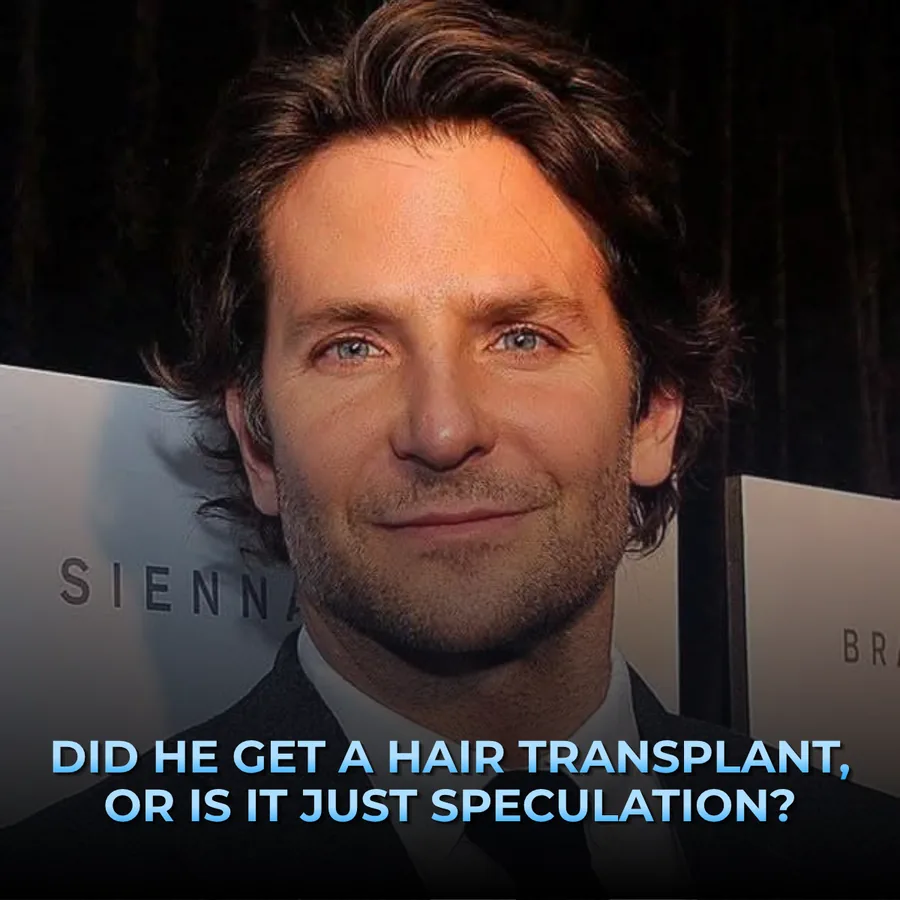
There is no public confirmation that Bradley Cooper had a hair transplant, and we found nothing in the reviewed evidence that proves it. At first glance, his comparison photos show a hairline that looks noticeably different at various stages of his career. Visual changes alone, however, do not establish a surgical procedure.
Rumours that Cooper had undergone a hair transplant gained traction in the late 2000s, particularly in the period leading up to his role in "The Hangover". His frontal density appeared to shift sharply, and that prompted widespread online curiosity.
In this review, we analyse what can be observed, examine comments from third parties, and separate verified facts from rumours found online. We cannot state that surgery definitely occurred or definitely did not occur, but we can clarify what the evidence actually supports.
What Did Bradley Cooper Say About Cosmetic Surgery in 2026?
On the 5 January 2026 episode of the SmartLess podcast, Will Arnett addressed recurring internet rumours that Bradley Cooper had undergone plastic surgery. Arnett said Cooper had not had plastic surgery, and Jason Bateman echoed him. Cooper himself mentioned that people had recently approached him to comment on his appearance; he did not explicitly confirm or deny the rumours himself.
The exchange concerned broader plastic-surgery speculation, not hair transplantation. Because of that context, the podcast conversation does not establish whether Cooper has had a hair restoration procedure, and treating it as a hair-transplant-specific denial would misrepresent what was said.
Question
Evidence status
Has Cooper specifically confirmed a hair transplant?
No specific public confirmation identified in the reviewed sources
Did his hairline appear different over time?
Public photographs show differences in appearance
Is 2008-2009 the most discussed period?
Several third-party analyses focus on this period; one Reddit commenter quoted by The List places it between 2012 and 2014 instead
Was it definitely FUE?
Unknown
Is the exact graft count known?
No verified count identified
What graft estimates appear online?
About 1,000 grafts (Longevita) to 1,500-2,000 (Matt Dominance); neither estimate is verified
Is a Norwood estimate confirmed?
No; third-party interpretations are not clinical confirmation
Is a hairpiece or hair system documented?
No source in our review documents one
Has his hair looked thinner recently?
A June 2025 report on a New York street outing described it as thinner than usual; a photo observation, not a diagnosis
Bradley Cooper Hair Transplant Before and After
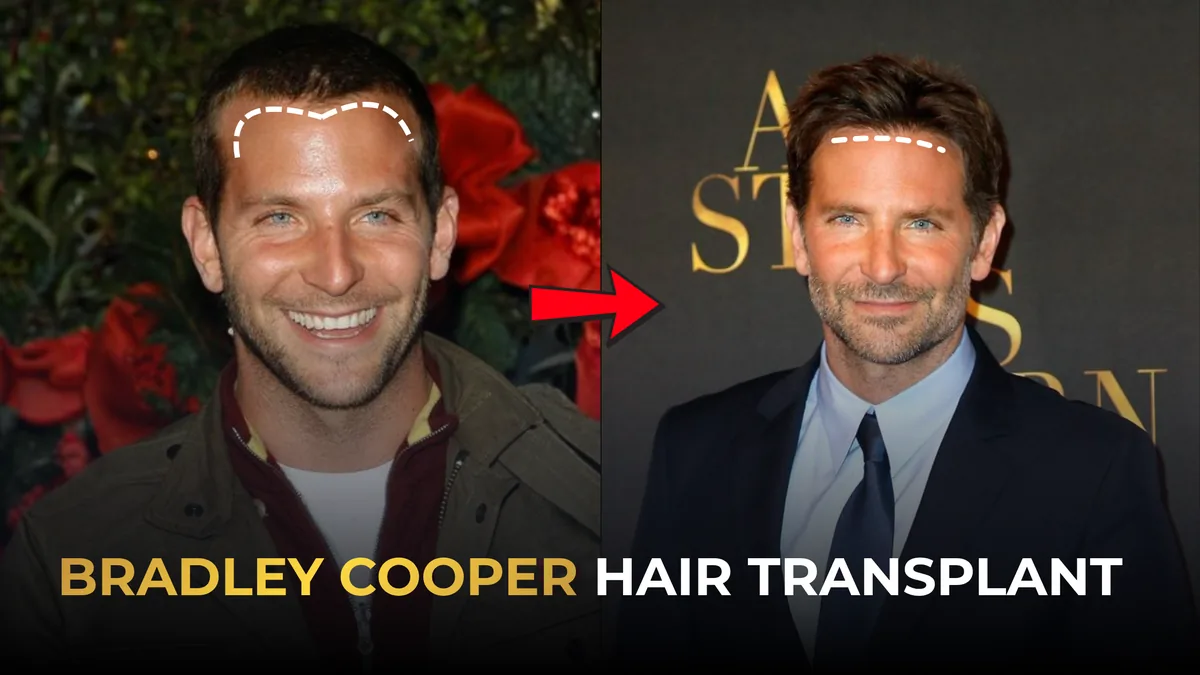
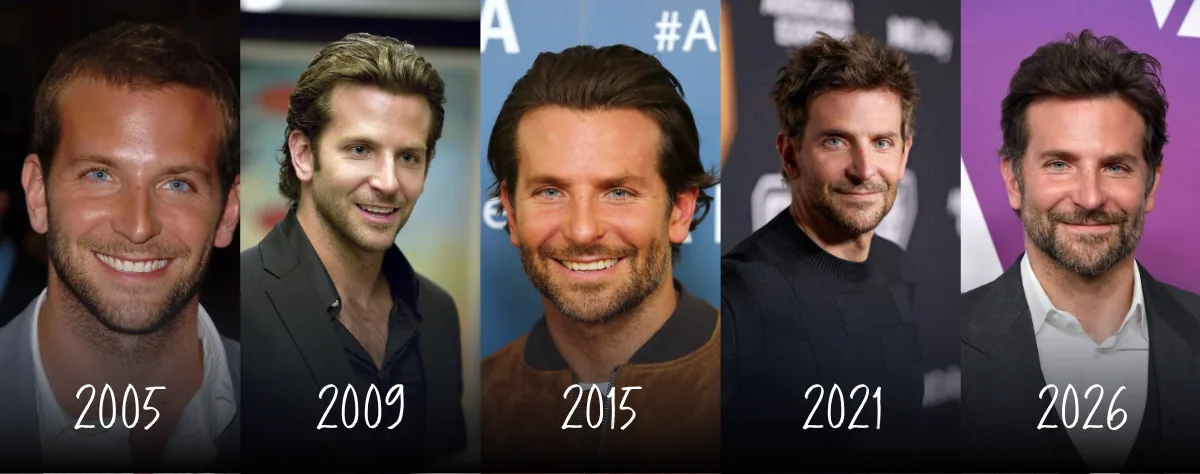
Tracking Bradley Cooper's hairline means comparing public photographs from different eras of his acting career. The pairing below shows the comparison most often shared online: a mid-2000s hairline with deeper temple corners next to a recent red-carpet appearance with a straighter frontal line.
2005-2007: Wedding Crashers and Early Hairline Changes
In 2005, public photographs from Wedding Crashers and subsequent television roles show visible temporal recession. His frontal corners appeared deeper and his hairline sat slightly further back. Observers often note that the front of his hair looks slightly thinner in this era. We cannot diagnose clinical hair loss from these images, but receding temples were prominent on camera.
2008-2009: The Most Discussed Hairline Change
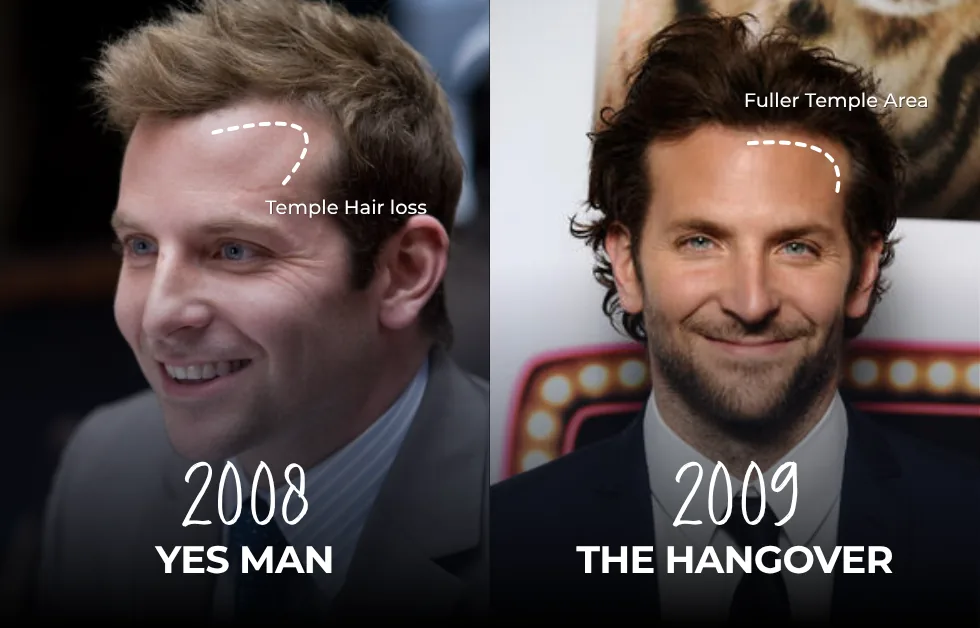
The period between Yes Man (2008) and The Hangover (2009) features prominently in third-party transplant speculation. Dated photographs from this era appear to show a fuller frontal boundary and a straighter hairline than in 2005.
This visual shift is the main reason the "Bradley Cooper hair transplant 2008" theory exists. An observation of increased density in public photos, however, is not the same as a verified medical procedure. This era explains why the theory began; it does not prove that a transplant happened.
Not every online theory agrees on the date. The List quoted a Reddit commenter who believed the procedure happened "somewhere between 2012 and 2014", pointing to a slight widow's peak in He's Just Not That Into You and All About Steve. Two incompatible timelines circulating at once is itself a sign that neither rests on documented evidence.
2010s-Today: Did the Hairline Stay Consistent?
From the 2010s to the present, Cooper's frontal appearance looks generally consistent in public photographs, with a strong, defined hairline shape. Hairstyle, hair length, lighting, camera angles and professional photography all shape how that consistency is perceived.
The most recent observation runs the other way. On 5 June 2025, The List reported that during a New York street outing Cooper's hair "seemed to be a bit thinner than usual", with the front and some side portions looking "somewhat faded" in bright sunlight, while his hairline remained "intact to some degree". Sunlight and an unstyled look are exactly the conditions that make hair appear thinner, so this is a photo observation, not evidence of hair loss or of a failed procedure.
What Changed in Bradley Cooper's Hairline?
Across the visual chronology, the most notable changes centre on the frontal corners and temple contours. Early in his career, the temporal recession appeared deeper, creating a more pronounced "V" or "M" shape. In later photographs those corners look filled in, giving a straighter, lower hairline and greater apparent density at the front of the scalp.
These observations establish that his hairline looks different over time; they do not establish the cause. A shift in apparent density can result from surgery, but it can also come from changing hairstyles, professional styling and hair length. Observers can confidently say his hairline looks different now than in 2005. Nobody can diagnose a condition or confirm a procedure from selected celebrity photos.
Hair Transplant, Hair-Loss Treatment or Just Styling?
Because no procedure has been verified, several possibilities could explain his changing appearance.
Could It Have Been a Hair Transplant?
Some commentators consider subtle frontal or temporal restoration one possible explanation. No medical records or personal statements verify that surgery took place.
Could Medication Have Played a Role?
A 2014 RadarOnline report claimed that Cooper used the hair-loss medication Propecia. The claim relies entirely on an anonymous source; it is not a statement made by Cooper. According to the American Academy of Dermatology, finasteride (sold as Propecia) is an FDA-approved prescription medication shown to slow further hair loss in about 80% to 90% of men taking it, and topical minoxidil is the other FDA-approved option, available without a prescription. Medication is a standard first-line approach, but the 2014 claim remains unverified speculation about Cooper's private medical history.
Could It Be a Hairpiece or Hair System?
Some online comparisons ask whether a hairpiece explains the fuller front. No source in our review documents Cooper wearing a hairpiece or hair system, and his hair is regularly photographed wet, windswept and in close-up, conditions in which a system is difficult to hide. The same applies to thickening shampoos and similar products often named in online answers: none is documented as part of his routine.
Could Hair Length and Styling Explain the Difference?
Hair length, styling direction and products can change how the temples and front look to a significant extent, and Cooper has spoken about this himself. In a 2009 Allure interview he mentioned using hair products to maintain a longer, textured style. In later roles, such as A Star Is Born (2018), he wore his hair noticeably longer, and longer hair falling forward covers the temple corners. A skilled stylist can also use texture, products and blow-drying to conceal thinning and maximise volume. Styling is therefore a significant variable behind the difference between his "before" and "after" photos.
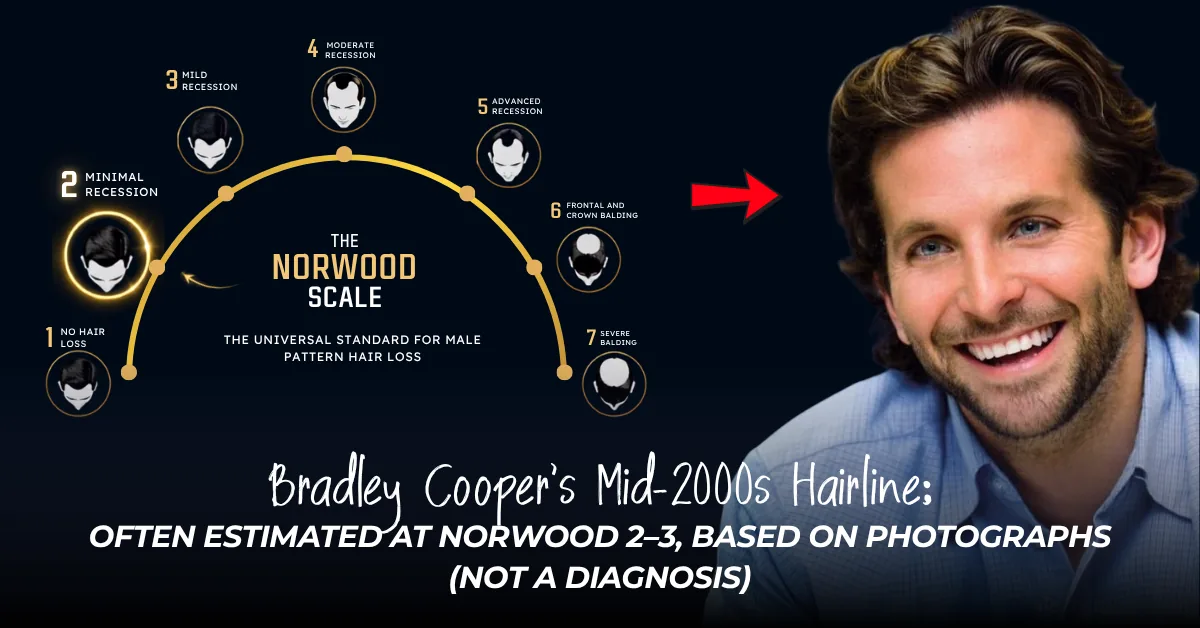
What Norwood Stage Was Bradley Cooper?
Third-party commentators offer differing visual interpretations. Many clinic blogs suggest he was at Norwood 2 or early Norwood 3 in the mid-2000s because of his temporal recession, but these are estimates made from photographs.
The Norwood scale is a classification system for male pattern hair loss, and a person's stage can only be assessed in an in-person examination. We therefore cannot state Cooper's Norwood stage.
How Many Grafts Would a Bradley Cooper-Style Hairline Need?
Bradley Cooper's graft count has not been publicly verified, because no procedure has been confirmed.
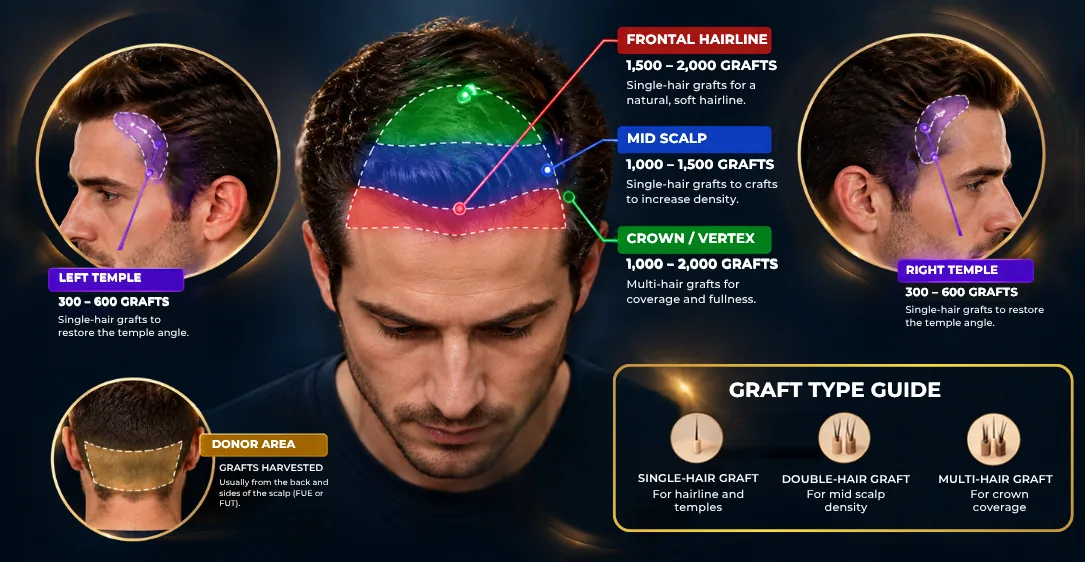
Online estimates vary. Longevita suggests roughly 1,000 grafts might have been used to fill his temporal corners, while Matt Dominance estimates 1,500 to 2,000. These figures are third-party estimates, not Cooper's known treatment details.
For a real patient with a similar frontal or temporal pattern, the graft requirement depends on several physical factors. A surgeon evaluates the size of the recipient area, existing native density, hair calibre and total donor capacity. Patient goals and the likelihood of future hair-loss progression also shape the plan. A real person's graft requirement cannot be calculated from photographs alone.
FUE or FUT: Can Bradley Cooper's Technique Be Identified?
No verified evidence establishes a hair-transplant procedure or technique for Bradley Cooper.
Follicular Unit Extraction (FUE) and Follicular Unit Transplantation (FUT) are the two main harvesting methods in modern hair restoration. FUT removes a strip of tissue from the donor area, while FUE extracts individual follicular units one by one. Neither technique has been confirmed for him.
Photographs, especially of someone who usually wears the back of the hair long enough to cover the donor zone, cannot reliably show the harvesting method. Nobody can look at a frontal hairline and tell whether the grafts came from FUE or FUT.
Why Bradley Cooper's Hair Can Look Different Between Photos
Cooper's changing appearance cannot be explained by surgery alone. Several variables outside surgery can dramatically alter how his hair looks:
Hair length and styling direction: sweeping hair forward or changing the parting is very effective at masking receding temples.
Wet versus dry hair: wet hair clumps together and exposes the scalp, so it looks thinner; dry, blown-out hair maximises volume.
Hair products: volumising powders and thickening sprays create the illusion of denser hair.
Lighting and camera angle: direct, harsh light passes through the hair and shows more scalp, while soft light preserves visual density.
Film and professional styling: on-set stylists sometimes use cosmetic concealers to keep a character consistent.
Hair colour and contrast: hair colour, greying and skin tone all affect how thinning is perceived.
These factors show the limits of before-and-after comparisons. No single factor definitively explains Cooper's appearance, but together they show why photos are not medical evidence.
What Makes Bradley Cooper's Hairline Look Natural?
Whether it comes from genetics, styling or subtle restoration, the frontal appearance in Cooper's recent films looks natural, and understanding why is useful general hair-restoration education.
An age-appropriate hairline relies on subtle irregularity; a perfectly straight boundary looks artificial. Surgeons typically place single-hair follicular units at the very front to mimic the soft transition found in nature. Keeping slight temporal recession also matters, because completely flattening the corners on a mature man can upset facial proportions. Preserving the donor area and planning for the long term help a result age well with the patient.
These are general clinical principles; we do not suggest they were used in Cooper's case.
Frequently Asked Questions About Bradley Cooper's Hair
Did Bradley Cooper get a hair transplant?
There is no specific public confirmation that Bradley Cooper had a hair transplant. Some observers note a fuller hairline in photographs from around the late 2000s, but visual changes alone are not proof of a surgical procedure.
When did Bradley Cooper supposedly get a hair transplant?
Most third-party speculation centres on the late 2000s, particularly around 2008, while at least one online commenter places it between 2012 and 2014. No verified procedure date exists.
How many grafts might a similar hairline require?
Online estimates suggest roughly 1,000 to 2,000 grafts to fill similar temporal corners, but Cooper's actual graft count is unknown. A real graft count requires an in-person medical assessment.
Was Bradley Cooper Norwood 2 or Norwood 3?
Estimates vary and often place his early-career appearance around Norwood 2 or early Norwood 3. The Norwood scale is a clinical classification, however, and cannot be assigned from photographs.
Did Bradley Cooper have FUE?
No hair transplant has been verified for Cooper, so there is no information confirming FUE (Follicular Unit Extraction). Photographs cannot determine a surgical method either.
Does Bradley Cooper use finasteride?
In 2014 a tabloid report citing an anonymous source claimed Cooper used the hair-loss medication Propecia (finasteride). Cooper has not confirmed it, so it remains an unverified claim.
Is Bradley Cooper's hair thinning now?
A June 2025 report described his hair as looking thinner than usual during a sunny New York street outing, with the hairline still largely intact. Lighting and an unstyled look strongly affect how dense hair appears, so a single outing does not show progressive hair loss.
Could You Get a Hairline Similar to Bradley Cooper's?
Many patients ask for a specific celebrity's hairline, but hair restoration is individual. An achievable result depends on face shape, donor density, hair calibre and existing native hair. Before any procedure, a specialist needs to build an individual plan around the patient's age, the degree of temple recession, scalp characteristics and likely future loss.
When choosing where to be treated, treat any promise of an identical hairline or a celebrity-like outcome as a warning sign. The goal is a restoration that suits your own facial structure naturally.
Editorial Policy & Trust
Bradley Cooper is not a patient of Turkey Hair Center. This article is an independent educational analysis based on publicly available information and general educational material. Turkey Hair Center has no access to Bradley Cooper's private medical history. This article does not establish a diagnosis, confirm a procedure or guarantee treatment outcomes.
References and Medical Sources
People. "Bradley Cooper Addresses Rumors About Whether or Not He's Had Plastic Surgery" (SmartLess podcast, 5 January 2026). (people.com)
Allure (2009). Bradley Cooper interview on grooming and styling. (allure.com)
RadarOnline (2014). Report citing an unnamed source about hair-loss medication. (radaronline.com)
The List. "Bradley Cooper Exposes His Thinning Hair In Jarring NYC Street Outing" (5 June 2025). (thelist.com)
American Academy of Dermatology. "Male pattern hair loss: Diagnosis and treatment." (aad.org)
Matt Dominance. "Bradley Cooper Hair Transplant Analysis." (mattdominance.com)
Send three photos: front, top and sides. You get a technique recommendation, a graft range and a straight answer about what is achievable, before anyone talks about price.
Your details are with the team
A patient coordinator will get back to you shortly. If you would like to send your photos now, WhatsApp is the fastest way to do it.
Real People Real Support
Send your photos on WhatsApp
Front, top and both sides, reviewed by the medical team.
We respond quickly, day or night, in your language.
Multilingual team, no obligation
Data protectedKVKK and GDPR compliant, 100% confidential
Authorized Health Tourism Intermediary
Turkey Hair Center is the hair-restoration brand of Healthy Way Tourism, an authorized international health-tourism intermediary. All medical procedures are performed by licensed medical professionals at authorized healthcare facilities in Turkiye, in accordance with the regulations of the Ministry of Health.