Performed at authorized partner hospitals Turkey Hair Center is a Ministry of Health authorized health-tourism intermediary, not a clinic.
A cowlick is a section of hair that grows in a different direction from the hair around it, so it stands up, parts on its own or lies at an odd angle. It is set by the angle of the follicles in the skin, which is why brushing it flat rarely lasts.
Most people have at least one, usually at the crown, the front hairline or the nape. Cowlick hair is not damaged hair and it is not hair loss. You may also see it written as cowlicks hair, cows lick hair or callac hair; all of them describe the same growth pattern. This guide covers where cowlicks come from, how to tell one apart from a thinning spot, and what can and cannot change it.
What Is a Cowlick?
The Cambridge Dictionary gives a simple cowlick definition: a piece of hair that always sticks out on someone's head and will not lie flat. In medical writing the same feature is described as part of the scalp hair pattern, and the spiral point where hair turns around a centre is called a whorl.
The cowlick meaning in everyday speech is the visible result: the tuft that lifts, the gap that opens or the section that flips the wrong way. The name is a plain description, because the hair looks as if a cow had licked it into place. In some American regions the word is said closer to "callick", which explains spellings such as callac hair.
There is no slang meaning with a medical side. When people talk about cowlick meaning hair that "has a mind of its own", they are describing direction, not texture or health.
Types of Cowlick
Cowlicks are easiest to sort by where they sit and how the hair turns. A review in the Journal of Investigative Dermatology summarised whorl patterns found in an earlier survey: a single clockwise whorl in about 75% of people, a single anti-clockwise whorl in about 11%, two whorls in a small minority, and no clear spiral in roughly 10%.
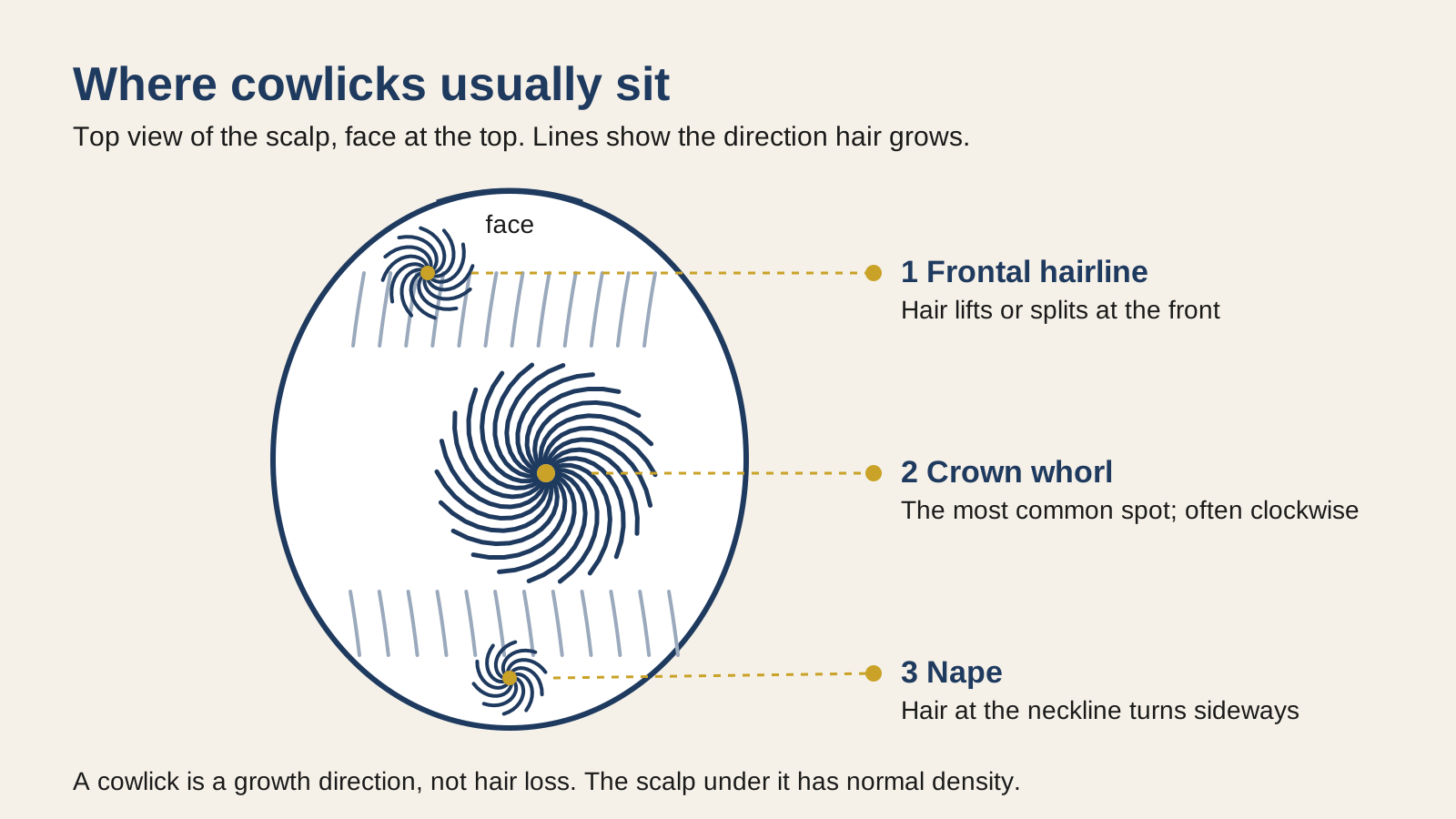
Crown whorl: the classic spiral at the top of the head. Hair fans out from one point.
Frontal cowlick: a lift or split at the front hairline, often on one side of the forehead.
Nape cowlick: hair at the neckline that grows sideways or upwards instead of down.
Double whorl: two spirals on the crown, which can make a parting hard to place.
What Causes Cowlicks?
Cowlick causes sit in the follicle, not in the hair shaft. Each follicle leaves the skin at an angle, and neighbouring follicles share a direction. Where two directions meet, or where they turn around a point, the hair has nowhere neat to lie, and a cowlick appears.
Hair direction is laid down before birth, while the scalp follicles form. A review of newborn scalp hair by Furdon and Clark in Advances in Neonatal Care notes that scalp hair patterning develops alongside the fetal brain, and the authors recommend looking at hair direction and whorls in every newborn examination. A single cowlick on its own is a normal finding.
Genetics plays a part but does not explain everything. Klar proposed a single-gene model for whorl direction, yet his later study of Japanese adults found the direction to be random in that population. The same review in the Journal of Investigative Dermatology described identical twins with different whorl patterns.
What Causes Cowlick in Back of Head?
A cowlick at the back of the head is usually the crown whorl itself or a second spiral below it. Hair has to turn through a full circle there, so some of it always runs against the way you comb it.
Common Cowlick Locations
The crown, the front hairline (often just off centre) and the nape are the usual spots. Some people also notice a turn in the beard or the eyebrow, where hair growth direction changes over a small area. A V-shaped point at the centre of the hairline is a widow's peak, not a cowlick.
Cowlick Formation Process
The formation process is simple: the follicle angle is fixed, the hair grows out along it, and longer or heavier hair then bends under its own weight. That is why one cowlick can look worse at a short length and better at a longer one.
What Do Cowlicks Look Like?
A cowlick looks like hair that refuses the direction of the rest. At the crown it forms a spiral with a small point at the centre. At the front it shows as a lift, a natural parting or a tuft that flips up after drying. At the nape it looks like a sideways sweep along the neckline.
Wet hair shows the pattern best. When hair is damp and combed straight back, the strands around a cowlick separate along the growth line, and you can often see the skin at the centre point. That visible skin worries a lot of people, so the next two sections deal with it directly.
Is Cowlick a Sign of Balding?
No. A cowlick is a direction, and the hair around it is normal in thickness. The American Academy of Dermatology notes that the first signs of hereditary hair loss in men are often a receding hairline or a bald spot at the top of the head, and in women overall thinning or a widening part.
Cowlick Identification Checklist
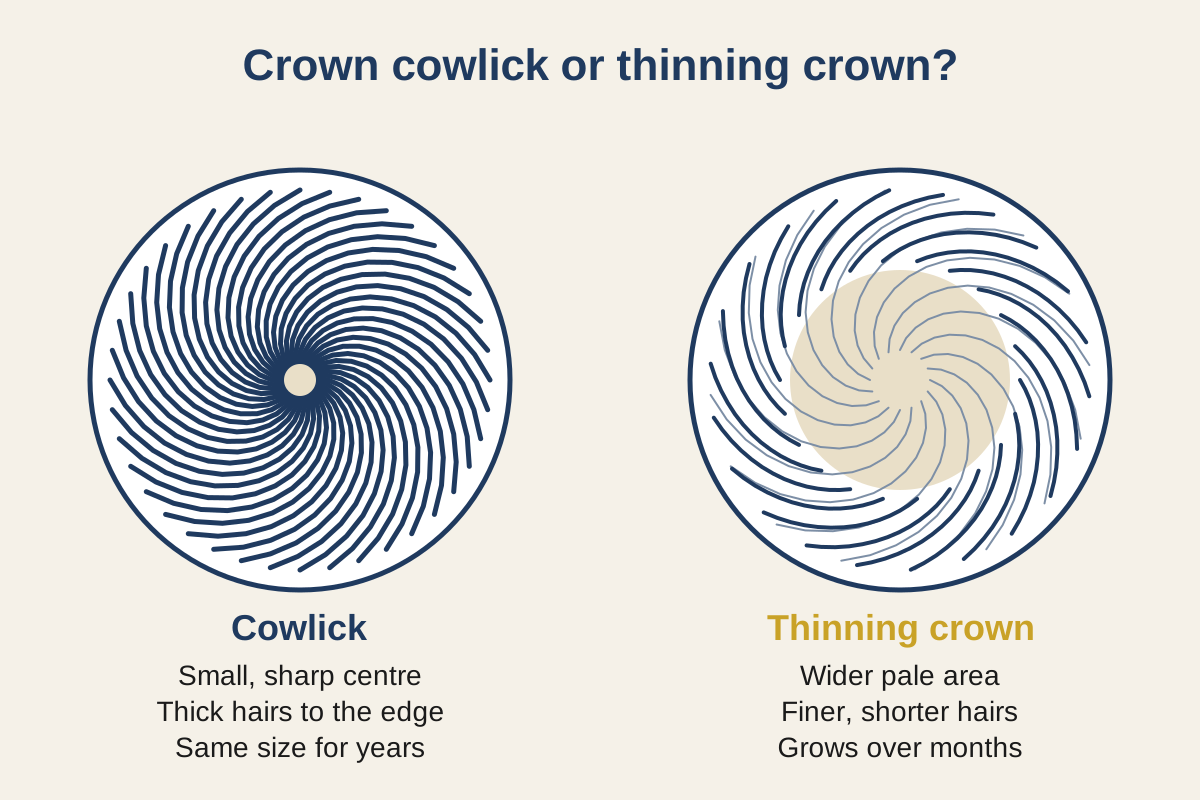
The centre point is small and stays the same size over the years.
The hairs right up to the centre are as thick as the rest of your hair.
The pattern is the same when you look at childhood photos.
The skin shows only when hair parts along the spiral, not through it.
Can You Permanently Fix a Cowlick?
No method changes the angle of the follicles, so a cowlick cannot be removed for good. What changes is how much it shows. The most reliable cowlick treatment is the haircut: leaving enough length for the weight of the hair to hold it down, or cutting short enough that there is little to lift.
Styling: blow-dry the area against its growth while damp, then finish in the direction you want it to lie.
Products: a paste or pomade holds a flattened cowlick better than a light spray.
Keratin treatment cowlick results: smoothing treatments change the hair shaft, not the follicle, so new growth comes in with the original direction.
Beard and eyebrow treatment: trim with the growth and set with a little wax or brow gel.
A hair transplant does not remove a cowlick. When grafts are placed at a hairline with a cowlick, the surgeon has to decide whether to follow the existing direction or the cowlick direction. That is a planning question for the medical team, not a cosmetic fix you can request.
Cowlick: How It Compares
People often search cowlick vs balding, or cowlick vs bald spot, because a crown spiral can look thin under bright light. The table compares the patterns that get mixed up most often.
Pattern
What it is
Changes over time?
When to get it checked
Cowlick
Hair growing in a different direction
No, it stays the same
Only if the skin is sore or scaly
Hair whorl
The spiral centre of a cowlick
No
Rarely, unless a doctor flags it
Balding crown
Miniaturised, finer hairs over a growing area
Yes, slowly widens
When the pale area grows over months
Widow's peak
A V-shaped point in the hairline
Usually not
If the temples recede beside it
Ahoge
A single strand that sticks up (anime term)
No
Not a medical finding
The cowlick vs hair whorl question is mostly a matter of words: the whorl is the centre point, and the cowlick is the hair that misbehaves around it. Cowlick vs widows peak is a different comparison, because a widow's peak is a hairline shape, not a growth direction.
For a cowlick vs balding crown, look at the hairs at the centre. With a cowlick they are full thickness. With pattern hair loss they become shorter and finer, and the area widens. If you are unsure where you stand, our Norwood scale guide shows how male pattern loss usually progresses.
Cowlick Hairline
A cowlick hairline is the most visible version, because it sits on the frame of the face. Cow licks at the hairline usually show as a lift on one side of the forehead or a gap that will not close. Many people style around it with a side part that follows the growth.
Frontal patterns vary, and a cowlick can appear anywhere along the front cow lick hair line. This matters most when hairline work is being planned. A surgeon designing a new hairline maps the existing growth direction first, because grafts placed against it can look unnatural.
If you are thinking about hairline restoration, our page on how much a hairline transplant costs explains graft ranges and packages. At Turkey Hair Center, a Ministry of Health authorized health-tourism intermediary, all-inclusive packages range from $2,550 to $4,500, and procedures take place at authorized partner hospitals.
Cowlick Hair Female
Cowlick hair in women is just as common, but it often gets more attention because of longer styles and fringes. A cowlick hairline female pattern usually shows as a fringe that splits or flips at one point.
The best evidence on surgery comes from a 2024 study in Aesthetic Plastic Surgery of 80 women having hairline correction. 77 had a single cowlick and 3 had a double one. Touch-up procedures for density were needed in 7 of 12 women whose grafts followed the original hair direction, compared with 7 of 68 whose grafts followed the cowlick direction.
The authors concluded that the choice depends on the location, shape and pattern of the cowlick, the face shape and the patient's preference. For cowlick hair women considering surgery, the hair transplant for women guide explains who is usually a candidate.
Frequently Asked Questions
Why Do I Suddenly Have a Cowlick?
The pattern was there from birth, but a new haircut, a change in length or thinning around it can make it show. If the area also looks thinner, or the skin is more visible than before, have the hair density checked rather than assume it is only a cowlick.
Why Does My Cowlick Hurt?
A cowlick is a direction pattern, not a change in the skin, so soreness at the spot usually comes from the scalp itself: tight styles pulling against the growth direction, irritation from products, or a skin problem. Pain with redness, scaling, bumps or hair shedding should be seen by a dermatologist.
Can a Cowlick Be Corrected?
It can be managed but not corrected. The follicle angle does not change with styling, chemical treatment or growth products. A haircut chosen around the direction, and styling while the hair is damp, give the most control in daily life.
How to Control a Hair Cowlick?
Wet the area, blow-dry it against its natural direction, then dry it into the direction you want with a flat brush. Finish with a paste or pomade. Avoid cutting the cowlick very short at the centre, because short hair there tends to stand straight up.
Can You Create a Cowlick?
Not a real one. Sleeping on one side or wearing a cap can bend hair for a day, but the direction returns once the hair is wet and dried again, because the follicle angle stays the same.
Why Is My Cowlick Getting Worse?
Shorter hair, a new parting or a change in texture can make it stand out more. If the centre is getting wider and the hairs around it look finer, that points to thinning rather than a cowlick, and it is worth a proper assessment.
How Do Cowlicks Form?
They form before birth, when the scalp follicles develop and take their angle. Where groups of follicles meet or turn around a point, the hair grows out in conflicting directions and creates a cowlick or a whorl.
Can Cowlicks Go Away?
They do not go away, but they often look calmer with age and longer hair, because heavier hair lies flatter. If one seems to disappear while the area gets thinner, the change is in density, not direction.
Not Sure If It Is a Cowlick?
A photo usually settles it. Send clear pictures of the area, dry and combed back, and the medical team will tell you whether you are looking at a normal growth pattern or early thinning. Start with a free hair analysis, or use the contact page if you prefer.
Medical disclaimer: This article is for informational purposes only and is not medical advice. Individual results and recovery vary from person to person. Always follow the written aftercare plan from your own medical team.
Plikus M, Chuong CM. Making waves with hairs. Journal of Investigative Dermatology, 2004;122(4):vii-ix
Furdon SA, Clark DA. Scalp hair characteristics in the newborn infant. Advances in Neonatal Care, 2003;3(6):286-296
Klar AJ. A 1927 study supports a current genetic model for inheritance of human scalp hair-whorl orientation and hand-use preference traits. Genetics, 2005;170(4):2027-2030
Klar AJ. Scalp hair-whorl orientation of Japanese individuals is random; hence, the trait's distribution is not genetically determined. Seminars in Cell and Developmental Biology, 2009;20(4):510-513
Send three photos: front, top and sides. You get a technique recommendation, a graft range and a straight answer about what is achievable, before anyone talks about price.
Your details are with the team
A patient coordinator will get back to you shortly. If you would like to send your photos now, WhatsApp is the fastest way to do it.
We respond quickly, day or night, in your language.
Multilingual team, no obligation
Data protectedKVKK and GDPR compliant, 100% confidential
Authorized Health Tourism Intermediary
Turkey Hair Center is the hair-restoration brand of Healthy Way Tourism, an authorized international health-tourism intermediary. All medical procedures are performed by licensed medical professionals at authorized healthcare facilities in Turkiye, in accordance with the regulations of the Ministry of Health.