Performed at authorized partner hospitals Turkey Hair Center is a Ministry of Health authorized health-tourism intermediary, not a clinic.
A crown hair transplant moves hair follicles from the back and sides of the head into the thinning area at the top back of the scalp, called the crown or vertex. It is planned differently from a hairline because the crown grows in a spiral, usually needs more grafts for the same visual density, and tends to keep losing hair if the underlying pattern loss is not managed.
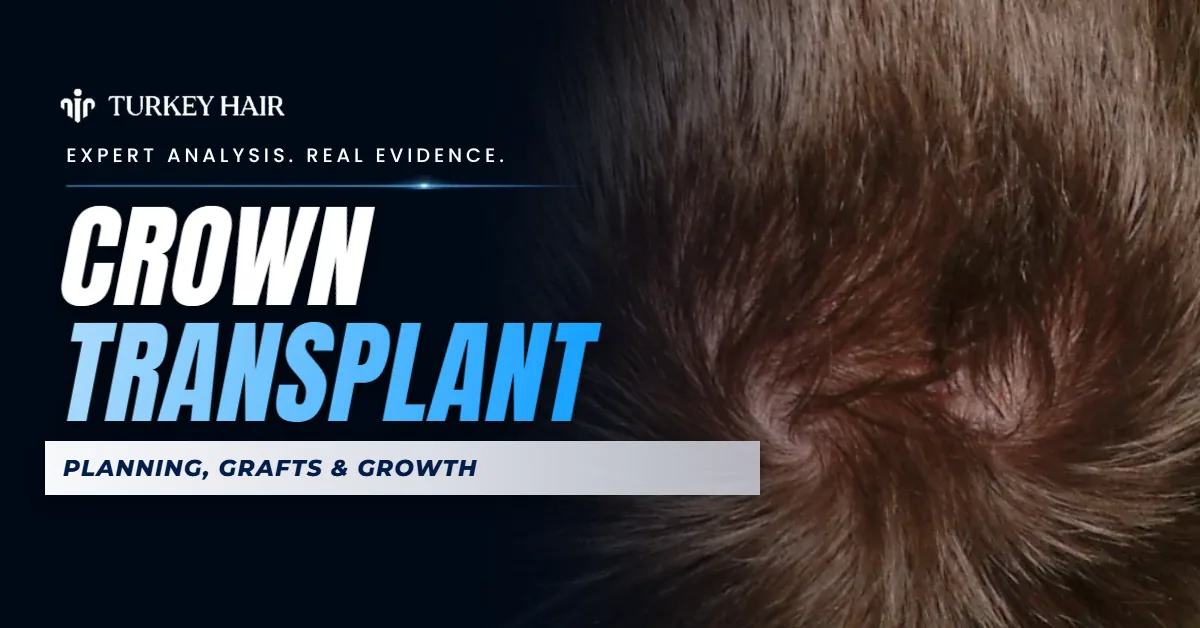
Cover built on a close view of hair growing out of a double crown whorl. Photo: HorsePunchKid, CC BY-SA 3.0, via Wikimedia Commons, cropped, text and logo added.
If you are asking whether it can work for you, these are the short answers:
Can the crown be restored? Often it can be made denser, but a transplant does not stop the hair around it from thinning.
How many grafts? It depends on the size of the bare area, the existing hair and donor density, so the medical team plans it from your photos.
When do I see it? New hair usually starts at about 4 months, and the full result takes 10 to 18 months.
What decides the result? Hair direction, density planning, donor supply and keeping up medical treatment afterwards.
This guide covers the procedure itself. If you first want to know whether your crown is thinning and why, read our guide to crown balding.
The head in this photo has a full crown and no hair loss. It is here for the pattern: two spirals sit side by side, and the hair around each one leaves the scalp in a different direction. Hair at the crown does not grow straight out of the scalp, and every graft placed there has to follow that swirl.
What Is a Crown Hair Transplant?
It is a surgical procedure in which follicular units, the natural groups of one to a few hairs, are taken from the donor area and placed in tiny recipient sites across the crown. The donor area sits at the back and sides of the head, where hair resists the hormone that shrinks hair in pattern loss. Because of that, transplanted hairs keep the traits of the donor hair, including their thickness, according to the StatPearls review of hair transplantation.
What Is the Crown or Vertex Area?
The crown, also called the vertex, is the highest point at the back of the head, where the skull begins to curve down towards the neck. The marker is the whorl, the point that hair spirals out from. Loss here is separate from a receding hairline, and many men have both at once.
Why Is the Crown Different From the Hairline?
Three things set it apart:
The spiral. Hairs at a whorl point in different directions, and each side of the centre needs its own angle.
The area. A round bare patch covers more scalp than it looks from the front.
The view. Nobody sees their own crown in a mirror, but everyone else sees it from above and behind, often under bright light.
The 2021 hair transplant practice guidelines call the vertex a "black hole" for grafts, because it consumes more of them than the front of the scalp does. Our team adds a plain-language version: the crown can swallow a lot of donor hair and still look thin if the plan is rushed.
Can a Hair Transplant Restore the Crown?
Yes, a transplant can add visible density to a thinning or bare crown, provided the donor area is healthy and the cause of the loss has been identified. What it cannot do is switch off pattern hair loss. The same review stresses that androgenetic alopecia is continuous and progressive, so hair that is already there can keep thinning around the grafted patch.
Why Does the Crown Lose Hair?
In men the usual cause is male pattern hair loss, an inherited sensitivity of the follicles at the top of the scalp. Our crown balding guide covers the stages and the other causes in detail, such as shedding after illness or stress. For planning a transplant, the point that matters is the pace: loss at the crown often keeps spreading, so the surgeon needs to know how fast yours has moved.
Can Crown Hair Loss Continue After a Transplant?
It can. The transplanted hairs usually stay, because they come from a donor area that resists the hormone, but the original hairs around them can still thin. The 2021 guideline warns that early surgery in a young person leads to later loss that undoes the result, and prefers waiting until at least 23 to 25 years of age.
That is why a good plan leaves room for the future. If the pattern keeps expanding, a graft patch with a bare ring around it can look worse than the original thinning. StatPearls names this the doughnut look, and says grafting the vertex alone should generally be avoided because it can use up donor grafts early.
Who Is a Good Candidate for Crown Restoration?
StatPearls lists the traits of an ideal candidate: a clear and stable pattern of loss, a healthy scalp, donor hair of good quality and quantity, good general health and realistic expectations. These points matter most:
The cause is known. Pattern hair loss, not a scarring or patchy condition that a transplant cannot fix.
The loss has settled or is controlled. A pattern that is still moving fast is harder to plan around.
The donor area is enough. The safe donor zone holds about 65 to 85 follicular units per square centimetre. Above 80 is excellent, and below 40 is less suitable.
The hair is suited to coverage. Thick hair and low contrast between hair and skin give a fuller look from fewer grafts.
You will keep up treatment. More on that in the aftercare section.
A doctor makes this call from photos and an examination, not from a mirror. Our medical team gives a first opinion from your pictures, free of charge, and the final decision belongs to the surgeon who will operate.
Who Should Wait Before a Crown Transplant?
Age is the clearest signal. The 2021 guideline states that vertex reconstruction is better avoided in young individuals, because their loss pattern has not shown its final shape. Others who may be advised to wait or try medicine first:
men whose crown is thinning quickly and has not been treated with medicine yet
anyone whose hair loss cause has not been confirmed by a doctor
people with a small donor area who still need hairline work first
anyone with an active scalp condition, until it is treated
How Is the Crown Designed?
Planning the crown is a set of decisions made before the first graft is placed. Four of them decide how natural it looks.
Which Comes First, the Hairline or the Crown?
When both the front and the crown are thin, the hairline is usually treated first, because it frames the face and is what people notice. StatPearls also stresses a conservative hairline, so the donor hair is not spread too thin. The crown then gets what the donor supply allows.
Can the Crown and Hairline Be Done in the Same Session?
Sometimes, but the donor area decides, not the wish list. Rose writes in a 2015 review that a lack of donor hair is a major barrier to good results, and that when loss is marked, the crown is often the area left untreated for exactly that reason. Doing both at once means splitting one harvest between two large zones.
Time is the second limit. A 2010 review of follicular unit extraction by Dua and Dua describes the number of grafts taken in a day as limited, with large cases spread over several days. The 2021 guideline adds that when donor hair is short, surgeons may combine methods or harvest beard and body hair, which means longer operating hours and a higher anaesthetic dose.
Situation
What usually happens
Strong donor area, modest front and crown loss
Both may fit in one session
Front needs many grafts, crown is wide
Front first, crown later if donor hair allows
Limited donor area
The most visible zone is treated; the crown may stay as it is
How Is the Natural Whorl Rebuilt?
The surgeon maps the centre of the spiral and works outwards, placing grafts so that they follow the direction of the surrounding hair. Magnification helps the surgeon match each site to the angle that the hair naturally leaves the scalp, as the 2021 guideline notes for follicular unit extraction. A crown with the wrong direction looks like a patch even when it is dense.
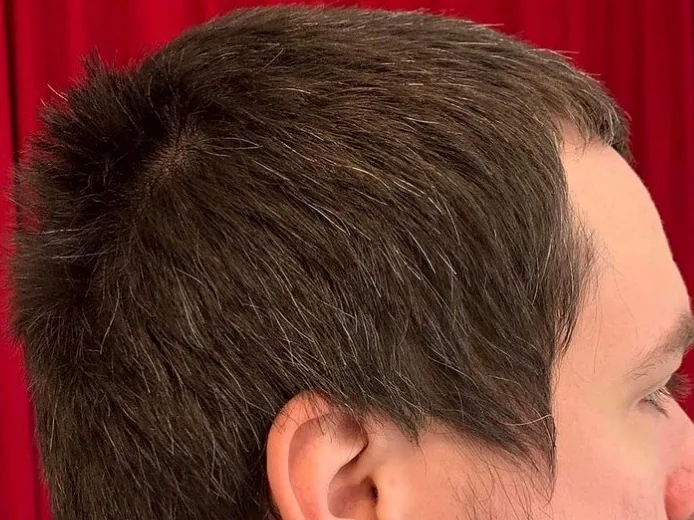
A crown whorl seen from the side, with short hair standing up where the spiral turns. Photo: LakusLiele, CC BY-SA 4.0, via Wikimedia Commons, cropped.
This photo is not one of our patients and not a transplant result, and the man in it shows no hair loss. It shows why direction matters: at the whorl, short hairs point upwards and outwards instead of lying flat, so grafts placed at one fixed angle would sit against that flow.
What If You Have a Double Crown?
A double crown means two whorls instead of one, like the head pictured at the top of this guide. It is not rare: in a 2020 study of scalp whorls, 12.4% of the control group had two whorls and 85.4% had one. The same paper notes that in white populations a single whorl usually sits just off the midline, more often to the right.
For a transplant, two whorls mean two centres to map. Hair between them meets from opposite directions, so the surgeon follows each spiral separately and blends the line where they meet. Tell the team if you know you have a double crown, and send a clear picture from above with short, dry hair so both centres show.
How Is Density Set?
Density is a trade-off with the donor supply. StatPearls notes that thicker hair covers more surface, and that light skin with light hair shows less contrast, so coverage looks fuller from fewer grafts. The goal is a look that holds from above and from behind, in changing light, without using up donor hair that later treatment may need.
How Is Existing Hair Protected?
The plan has to work around the hair you still have. Grafts are meant to blend with it, not replace it. Shedding of existing hairs near the grafts after surgery, called shock loss, is possible, and the surgeon should explain it to you beforehand.
Which Technique Is Used for the Crown?
Three methods are in use, and the choice depends on your donor area, your hair and the surgeon's approach.
A strip of scalp is removed and divided under a microscope
Thin linear scar
A strip revision should wait 9 to 12 months
The American Academy of Dermatology notes that most surgeons now transplant hairs a few at a time. For the crown specifically, no technique is automatically better. The result depends far more on the direction and the plan than on the name of the method. The 2021 guideline gives a safe FUE harvest of 10 to 15 excisions per square centimetre where the donor hair measures 65 to 75 follicles per square centimetre, which keeps the donor area from looking thinned.
How Many Grafts Does a Crown Need?
There is no honest single number. In the medical team's planning ranges, a crown-only plan for a Norwood 3 vertex pattern usually falls between about 2,000 and 3,500 grafts; a small, early patch can need fewer, and a wide bare crown joined to front loss needs more. Our guide to how many grafts you need shows the range for every Norwood stage. What decides it:
the width of the bare area and how much hair remains in it
donor density and how many grafts can be taken safely
hair thickness, curl or wave, which change how well it covers
the density you want, and what the donor can support
how far the loss is likely to spread
A figure such as 1,000 grafts therefore means different things on different heads. For a wider look at graft numbers, our guide to a 2,000 graft hair transplant shows what that count covers.
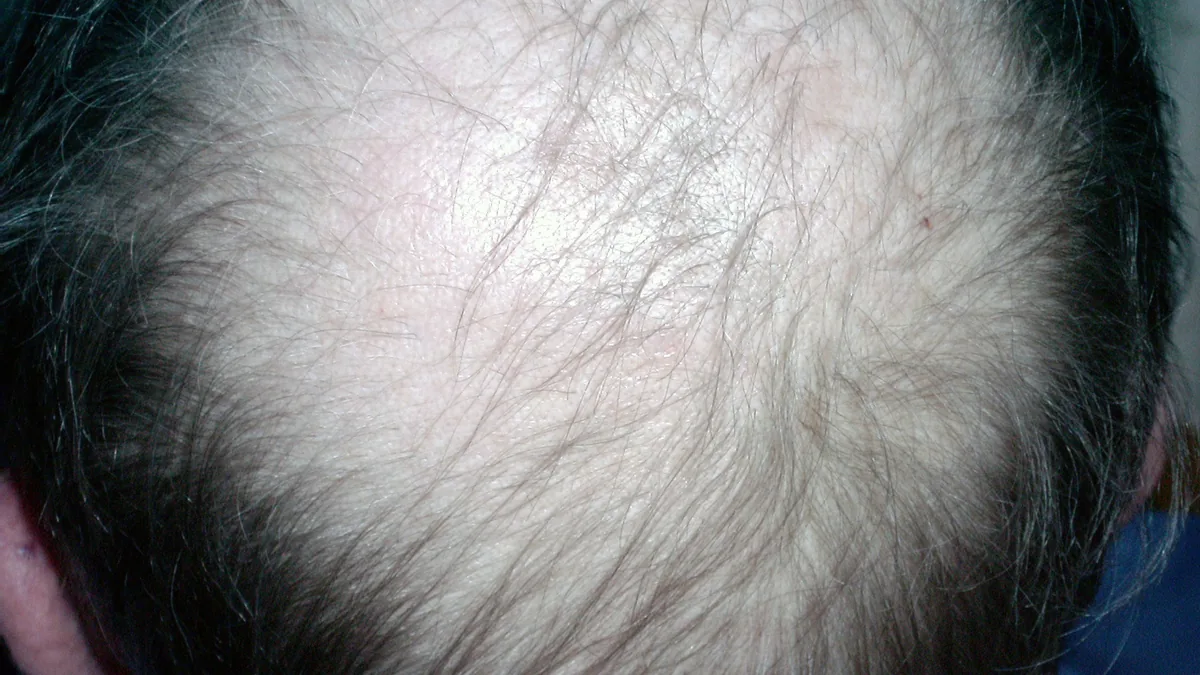
This photo is not one of our patients and not a transplant result. It shows the kind of crown that needs careful counting: the bare area is wide, fine hairs still cross it, and the scalp shows through under direct light. A plan for a crown like this has to cover the whole round area and protect the hairs that remain.
When Is a Second Crown Session Needed?
A second session is considered when the first one could not give enough grafts for the density wanted, or when loss has spread around the grafted area. It is a smaller harvest than the first. Mohmand and Ahmad advised taking under 35% of donor density in a first session and only 10 to 20% in a second, and noted that a donor area left with 20 to 30% of its original density looks odd.
The studies we read give no fixed gap between sessions. The first result has to be judged first, and that takes at least 12 months for the crown. The surgeon then checks the donor area and decides whether more can be taken safely.
How Much Does a Crown Transplant Cost?
The cost depends on the number of grafts, the technique, the hospital and what the package includes. Nothing here is quoted, because the price is set after your photos are reviewed. Our hair transplant cost page lists the packages and what each one covers.
What Is Recovery Like, and When Does Crown Hair Grow?
Swelling and redness are common early on (see the risks below). Your surgeon's written aftercare instructions come first, and our recovery timeline guide covers the stages week by week.
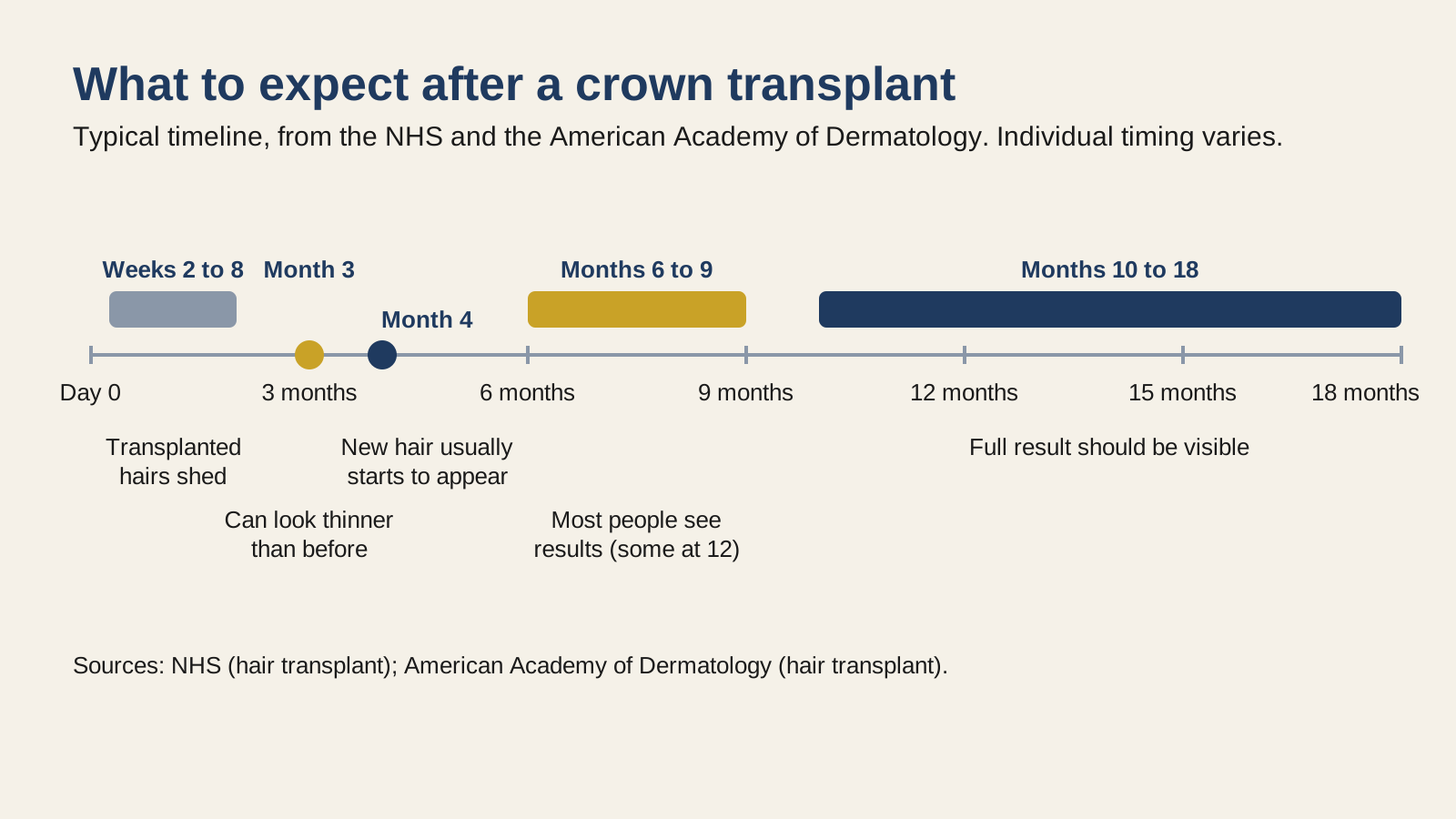
Growth follows a slow, fixed pattern. The NHS says transplanted hair often falls out after a few weeks, with new hair usually appearing after 4 months and the full result visible after 10 to 18 months.
Typical growth timeline after a hair transplant, from NHS and American Academy of Dermatology information.
Stage
When
What happens
Shedding
Weeks 2 to 8
Transplanted hairs fall out; the follicles stay
Thin phase
Around month 3
The area can look thinner than before surgery
First new hair
About month 4
Fine new hairs start to show
Visible results
Months 6 to 9
Most people see results; some need up to 12 months
Full result
Months 10 to 18
The final density can be judged
The figures come from the NHS (new hair after 4 months, full results at 10 to 18 months) and the American Academy of Dermatology (shedding at 2 to 8 weeks, results at 6 to 9 months, sometimes 12).
Does crown hair grow slower than hairline hair? No source we reviewed gives a different growth rate for the crown. The common impression comes from the fact that the crown is large and low in density, so it takes longer to look filled in. Judge it at 12 months or later, not at 3.
How Do You Read Crown Results?
The crown looks different from the hairline in a photo, so the same graft count can look strong in one picture and thin in another. When you look at before and after pictures, check these things:
Lighting. Overhead light shows the scalp; soft light hides it.
Angle. The same view from above and from behind, not one side.
Time. The date of the picture after surgery. A photo at 4 months is not a result.
Hair length and wetness. Wet or very short hair exposes the scalp.
Context. The technique used and whether the patient also uses medicine.
Individual results vary with donor hair, hair type and how the pattern loss moves afterwards. Our team shares comparable pictures during the free review so you can judge them with these checks.
How Do You Care for the Crown and Keep the Result?
Follow the written instructions from your surgeon on washing, sun protection, sleeping position and returning to exercise. They differ between surgeons and between techniques, so the surgeon's version applies.
For the longer term, the 2021 guideline says patients should be taught to keep up medical management after surgery, naming topical minoxidil 2 to 5% and oral finasteride 1 mg per day as the approved treatments. The American Academy of Dermatology likewise says a dermatologist may recommend hair loss medicine to help the transplant work and to keep the results. Neither is started without a doctor's advice.
Hair transplant surgery is generally safe when done by a trained surgeon, but problems exist, and some matter more at the crown. The reviews we read list these:
Swelling, redness and itching. Common and usually short.
Shock loss. Temporary loss of existing hair near the grafts; donor-area shock loss usually resolves in 3 to 4 months.
Folliculitis. In a series of 2,896 patients, sterile folliculitis occurred in 203 and lasted 3 weeks to 3 months; infection occurred in 2 patients, both diabetic.
Numbness. Reported in 18 patients in the same series.
Poor density or an unnatural look. Usually a planning problem; direction and density matter.
Overharvesting. Taking too much from the donor area leaves it thin.
Tell the team about diabetes, blood thinners, smoking or any scalp condition before surgery. Contact the hospital if you have fever, spreading redness, pus or severe pain.
Crown Transplant or Another Option?
A transplant is not the only choice, and often not the first one.
Option
What it does
Limit
Medicine (minoxidil, finasteride)
Slows loss and can thicken hair
Needs to be continued; results take months
Transplant
Adds hair where it has gone
Does not stop original hair thinning
Both together
Adds hair and protects what is left
Needs a doctor's advice
Medicine acts on the hair you still have, and a transplant adds hair where it has gone. A crown that has been bare for years rarely grows back with medicine alone. A doctor decides which one, or both, suits you.
Should You Start Medicine Before a Crown Transplant?
Ask your doctor. Rose calls finasteride the most effective drug for reducing male pattern loss, and puts sexual side effects at about 2 to 5%, which a lower dose can often overcome. None of the sources we read set a fixed time to start it before surgery. What they agree on is that treatment should continue after the transplant, because the original hair around the crown keeps its own course.
Can Women Have a Crown Transplant?
Sometimes. Thinning at the crown or along the parting in women is not always pattern loss, and causes such as hormonal changes, iron shortage or shedding need to be ruled out first. A transplant is only an option when the cause is known and the donor area is healthy. Our guide to hair transplants for women covers it.
Frequently Asked Questions
Can you get a hair transplant on the crown?
Yes, when the loss is pattern hair loss and the donor area is healthy. A doctor confirms the cause first, because a transplant does not work for every type of hair loss.
Is 1,000 grafts enough for the crown?
For a small, early patch it may be. For a wide bare crown it usually is not. The medical team's typical range for a Norwood 3 vertex crown is about 2,000 to 3,500 grafts, and the final number follows the examination of your photos and donor area.
How long does a crown transplant take to grow?
New hair usually starts at about 4 months, most people see results by 6 to 9 months, and the full result shows at 10 to 18 months, according to the NHS and the American Academy of Dermatology.
Does transplanted hair on the crown grow slower?
We found no source showing a slower growth rate at the crown. It only looks slower because the area is large and fills in gradually.
Will I lose more hair at the crown after a transplant?
Original hair around the grafts can keep thinning if pattern loss continues. Keeping up the medicine your doctor advises helps to protect it.
How long is crown transplant recovery?
Swelling and redness are common early on, and the full recovery stages are in our recovery timeline. Return to work and exercise follows your surgeon's advice.
Can beard hair be used for the crown?
That is a decision for the surgeon after a donor assessment. It is considered when scalp donor hair is limited, and the match with scalp hair is part of the assessment.
How should I sleep after a crown transplant?
Follow your surgeon's written instructions. The crown is at the back of the head, so the sleeping position matters more than for a hairline procedure.
Does a crown transplant hurt?
Your surgeon explains the anaesthesia and the pain relief before the procedure, and you can ask about both at the free review.
Can the crown and hairline be done at the same time?
Yes, if the donor area can supply both. When it cannot, the hairline usually comes first and the crown waits for a later session or stays untreated.
How many sessions does a crown transplant need?
Many crowns need one. A wide crown, or a crown done after front work, may need a second session, which takes fewer grafts than the first and is planned only after the first result has grown out.
Is a crown hair transplant worth it?
It is worth it when the cause is pattern loss, the donor area can spare the grafts without weakening the front, and you are ready to keep up medicine. It is a weaker choice for a young man whose loss is still spreading fast.
What is the difference between a crown and a vertex transplant?
Nothing. Crown and vertex are two names for the same area at the top back of the head.
Plan Your Crown Transplant
Crown results depend on the plan. Send a clear picture from above in daylight, plus front and side views, for a free hair analysis. The medical team will say whether a transplant, medicine or both fit your crown, and you can compare it with the hair transplant cost before you decide.
Medical disclaimer: This article is for informational purposes only and is not medical advice. Individual results and recovery vary from person to person. Always follow the written aftercare plan from your own medical team.
Devroye J. Management of the crown. Facial Plastic Surgery Clinics of North America, 2013;21(3):397-406
Rose PT. Hair restoration surgery: challenges and solutions. Clinical, Cosmetic and Investigational Dermatology, 2015;8:361-370
Dua A, Dua K. Follicular unit extraction hair transplant. Journal of Cutaneous and Aesthetic Surgery, 2010;3(2):76-81
Humayun Mohmand M, Ahmad M. Effect of follicular unit extraction on the donor area. World Journal of Plastic Surgery, 2018;7(2):193-197
Sechi A, Neri I, Patrizi A, et al. Scalp hair whorl patterns in patients affected by neurofibromatosis type 1: a case-control study. International Journal of Trichology, 2020;12(2):56
HorsePunchKid A double whorl hair pattern (cover image: cropped, text and logo added), CC BY-SA 3.0 Wikimedia Commons
Send three photos: front, top and sides. You get a technique recommendation, a graft range and a straight answer about what is achievable, before anyone talks about price.
Your details are with the team
A patient coordinator will get back to you shortly. If you would like to send your photos now, WhatsApp is the fastest way to do it.
We respond quickly, day or night, in your language.
Multilingual team, no obligation
Data protectedKVKK and GDPR compliant, 100% confidential
Authorized Health Tourism Intermediary
Turkey Hair Center is the hair-restoration brand of Healthy Way Tourism, an authorized international health-tourism intermediary. All medical procedures are performed by licensed medical professionals at authorized healthcare facilities in Turkiye, in accordance with the regulations of the Ministry of Health.