Jason Cundy Hair Transplant: 3,000 Grafts, Week 21 Update
Jason Cundy hair transplant: what he told talkSPORT in March 2026, the 3,000-graft FUE his clinic reports, and his week 21 video update, with dates and sources.
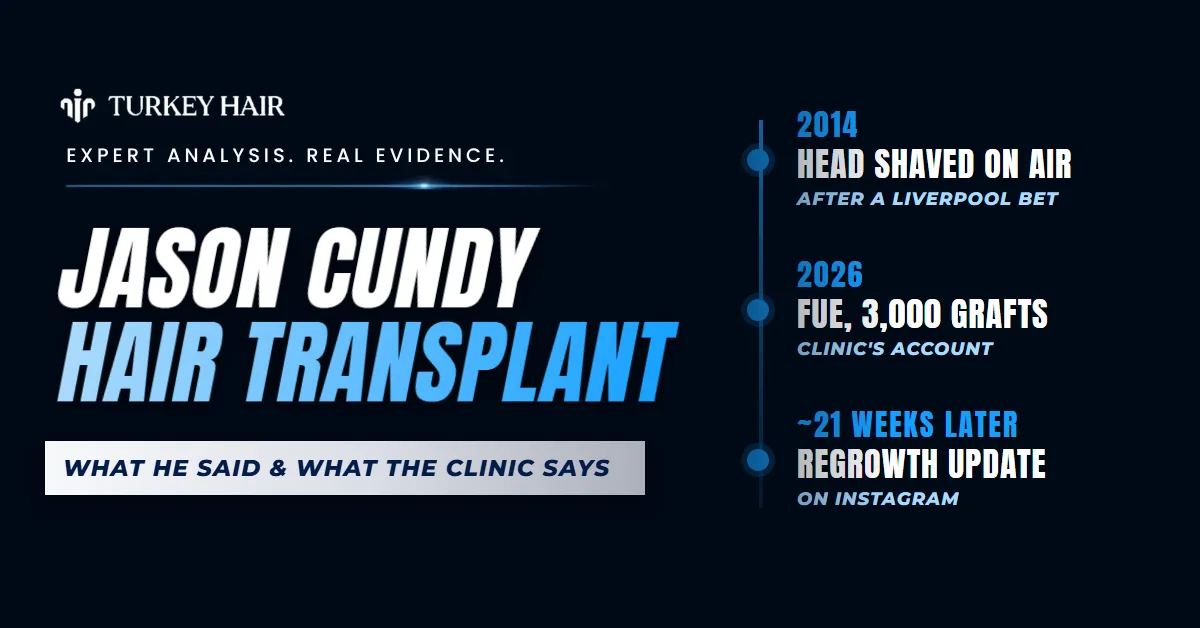
Jason Cundy, the former Chelsea and Tottenham defender who now co-hosts The Sports Bar on talkSPORT, had a hair transplant on 26.03.2026. He talked about it on air and then took part in a feature on the clinic's own website. This page collects what he said, what the clinic reported, what happened when his head was shaved live on radio in 2014, and what the numbers mean for anyone thinking about the same operation.
Quick answer: Yes. Cundy had a hair transplant in March 2026 at the Wimpole Clinic on Harley Street, London. The clinic reports an FUE procedure with 3,000 grafts to the hairline, temples and mid-scalp, performed by Dr Ahmad Moussa. Cundy has not given a graft count or a price himself.
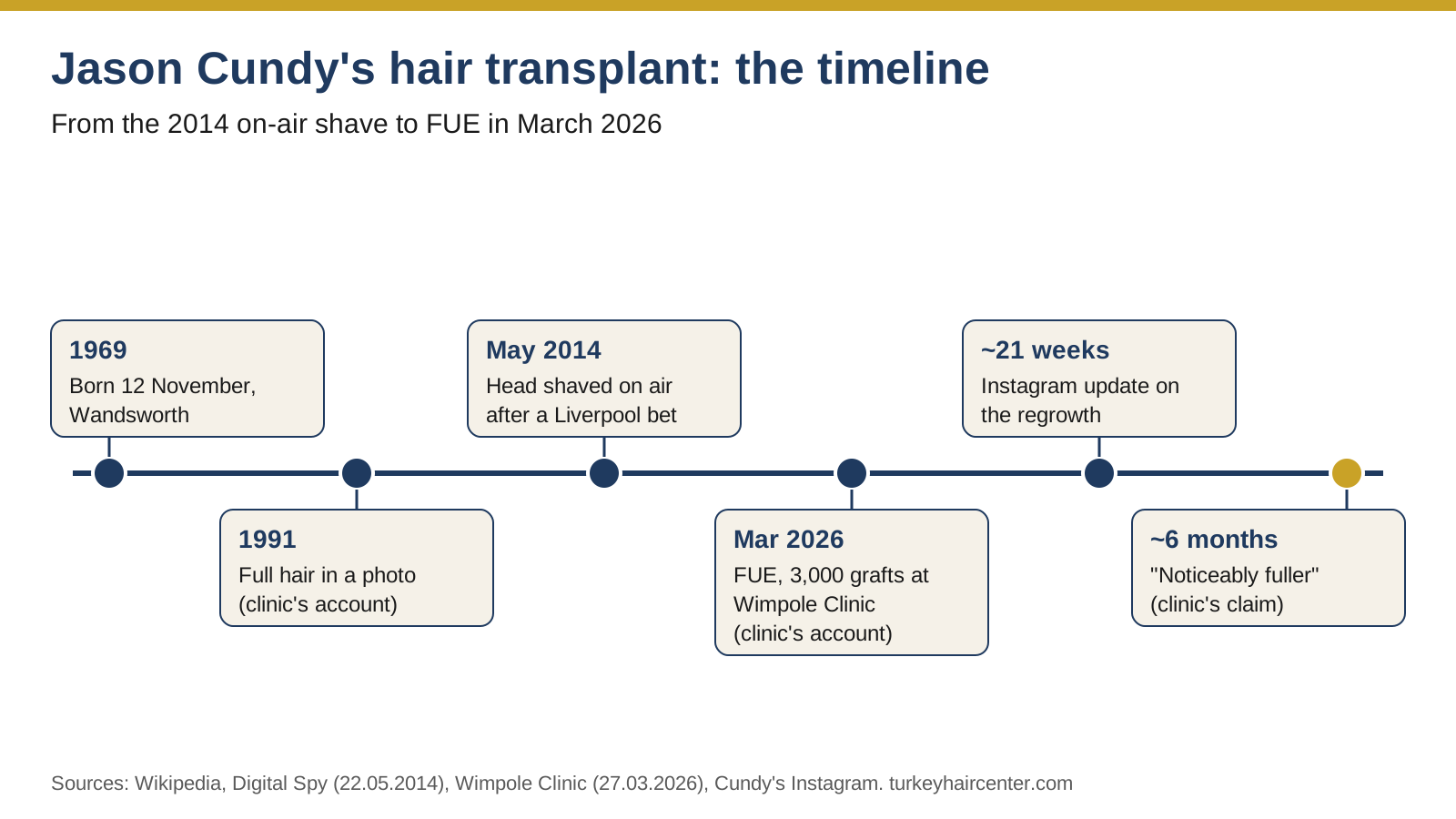
Jason Cundy Hair Transplant Timeline
Most of the detail comes from the clinic's own page, so the table marks each row as a clinic claim, a report from an independent outlet, or a reference fact. Treat clinic claims as one side of the story.
When
What happened
Source
Status
12.11.1969
Born in Wandsworth, London
Wikipedia
Reference
1991
Photo posted by a Chelsea fan account shows him with a full head of hair, aged about 22 to 23 by the clinic's reckoning
Wimpole Clinic
Clinic's account
22.05.2014
Head shaved live on air after a Liverpool bet; he says he is "losing it as it is"
Digital Spy
His own words, independent outlet
26.03.2026
Hair transplant, FUE, 3,000 grafts, Dr Ahmad Moussa
Wimpole Clinic
Clinic's account
27.03.2026
Clinic publishes its page about the operation
Wimpole Clinic
Clinic's account
About 21 weeks later
Growth update video on his Instagram account
Wimpole Clinic
Clinic's account
About six months later
Clinic describes the hairline as "noticeably fuller, lower, and straighter"
Wimpole Clinic
Clinic's claim
Who Jason Cundy Is
According to Wikipedia, Cundy was born on 12.11.1969 in Wandsworth. He played as a centre-back for Chelsea, Tottenham Hotspur, Crystal Palace, Bristol City, Ipswich Town and Portsmouth, and won three England under-21 caps. A knee injury ended his career in 2000.
He is still well known from a goal he scored for Tottenham against Ipswich in the 1992 to 1993 season, which Wikipedia describes as a freak goal. He was diagnosed with testicular cancer in February 1997. Today he co-hosts The Sports Bar with Jamie O'Hara on talkSPORT and presents Jason Cundy Kicks Off on London Live and Chelsea TV.
The broadcasting career matters here because it is why a haircut becomes news. He works on radio and on camera, and he has been a public figure for more than thirty years. Listeners of The Sports Bar have heard him joke about his hair for a long time, which is partly why he chose to announce the operation to them directly.
What He Told The Sports Bar Listeners
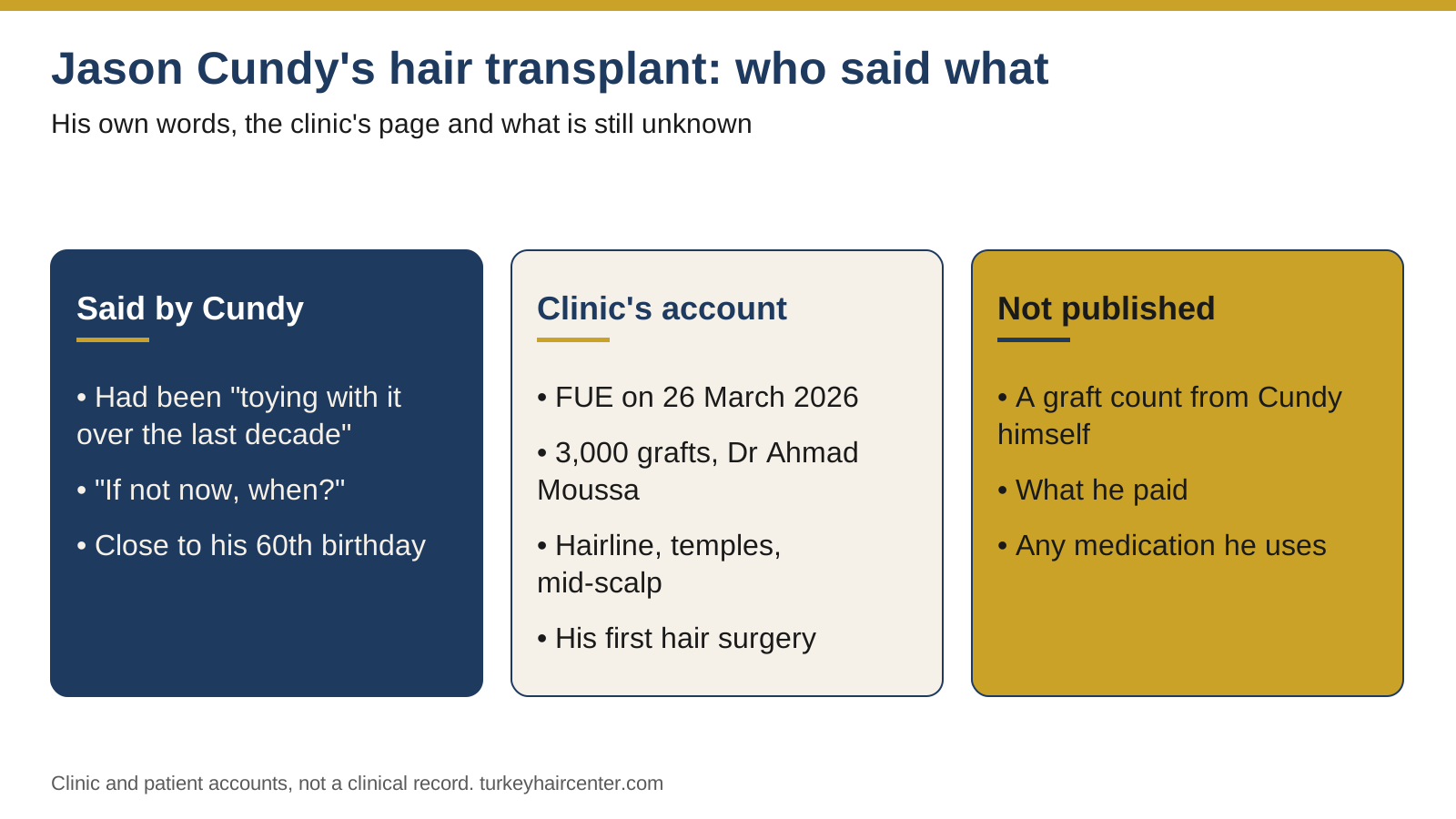
The clinic's page reports that Cundy spoke about the operation on The Sports Bar and said he had been "toying with it over the last decade". His reason for acting now, quoted by the clinic: "I'm not a million miles away from my 60th birthday. If not now, when?"
That is a familiar pattern. Plenty of men think about a transplant for years before they act, and a milestone birthday often tips the decision. Cundy was 56 when he had the procedure, by the birth date Wikipedia gives, so his words describe a man a few years short of 60 rather than someone at the milestone itself.
The clinic says this was his first surgical procedure of any kind for his hair. Before it, the clinic suggests, his hair loss thinned through his twenties and then mostly stabilised, whether through finasteride, minoxidil or simply age. That is the clinic's speculation. Cundy has not said which, if any, treatment he used.
The Operation: 3,000 Grafts and Who Did It
The Wimpole Clinic page says the surgery took place on 26.03.2026 and was carried out by Dr Ahmad Moussa using follicular unit extraction (FUE). The clinic reports 3,000 grafts placed along the hairline, temples and mid-scalp. It calls that "around the maximum number of grafts we'll normally extract in a single session".
That last phrase is the clinic's own working limit, not a universal rule. Other surgeons set different limits depending on donor density, the method and the plan for later sessions. The useful point for patients is that a surgeon should explain what limit they work to and why.
Cundy shaved his head for the procedure, the clinic says, and mentions that FUE can also be done without shaving. In March 2026 this was a talking point on air as much as a medical detail.
Date of surgery: 26.03.2026, as reported by the clinic.
Method: FUE, according to the clinic.
Grafts: 3,000, according to the clinic. Cundy has not confirmed a number.
Areas: hairline, temples and mid-scalp.
Surgeon: Dr Ahmad Moussa, according to the clinic.
His Hair in 1991 and Before the Operation
The clinic's page includes a 1991 photograph posted by a Chelsea fan account, @chelsearewind, run by Chris Wright. It shows Cundy with a full head of hair. The clinic says he was 22 or 23 at the time. By Wikipedia's birth date he turned 22 in November 1991, so that is close, though not exact. We report both and do not try to settle a gap of about a year.
For his hair before surgery, the clinic uses a photograph taken in 2026 and estimates his loss at stage 3 to 4 on the Norwood scale. That is an estimate from a photograph, made by the company that treated him. It is a rough guide to how much hair he had lost, not a diagnosis, and the Norwood stages are only a shorthand. You can read more about the pattern in our guide to male pattern baldness.
The comparison between a 1991 photo and a 2026 photo says something about how slowly this kind of loss can move. Thirty-five years separate the two images. Hair loss is rarely a sudden event, and most men notice it long before they act.
Shaved on Air in 2014 After a Liverpool Bet
The earliest independent record of Cundy and his hair is a Digital Spy feature by Adam Silverstein, published on 22.05.2014. Cundy and his co-host Andy Goldstein had bet their hair that Liverpool would not finish in the Premier League's top four. Liverpool finished second, two points behind Manchester City, according to Wikipedia's season page, so the pair lost.
Both had their heads shaved live on air by Joanne Beckham, sister of David Beckham, with Liverpool manager Brendan Rodgers joining in. Goldstein had presented with Cundy since Euro 2008. The Sports Bar was on air Monday to Friday from 10pm to 1am at the time.
What the 2014 Shave Tells Us About His Hair
Cundy told Digital Spy: "Ideally, I wouldn't have this on top of my head. I'm losing it as it is, so every little hair I have I treasure! But if there's one time of year to have this haircut, it's the summer."
Three things follow from that quote. First, in 2014 he was already aware of thinning, twelve years before the operation. Second, he treated it with humour rather than concern. Third, nothing in the interview says he planned a transplant then. The clinic's version, that he was "toying with it" for a decade, is consistent with that, but the 2014 interview does not prove it.
The other lesson is about interpretation. A man who shaves his head for a bet and jokes about it is not necessarily comfortable with his hair loss. Public humour often covers private concern. Equally, a man who jokes about it is not necessarily distressed. The honest position is that the source shows he knew he was thinning in 2014 and nothing more.
Why He Shaved His Head for the Transplant
Cundy shaved his head for the 2026 operation, the clinic says. The standard FUE approach is to cut the donor hair short so the surgeon can see each follicular unit clearly. Hair grows in natural groups of one to four hairs, and modern transplants move those groups intact, as the Wikipedia overview of hair transplantation explains.
There are choices here. A full shave gives access to the whole donor area and is common for larger sessions. A partial shave limits the visible change. Some surgeons offer unshaven FUE, which the Wimpole page mentions. Each option involves trade-offs in how many grafts can be taken and how quickly you look normal afterwards.
Decide how much of your life needs to look normal in the first two weeks.
Ask which shaving option suits the planned graft count.
Ask what the donor area will look like after harvesting.
Check whether the chosen approach changes the price.
The honest answer is that no independent outlet has published a measured before and after. What exists is the clinic's own account. It says that at six months his hairline looked "noticeably fuller, lower, and straighter". The clinic page also embeds a video in which Cundy talks about his hair growth at 21 weeks, and the video is on his Instagram account, @jason_cundy05.
That is a claim by the company that performed the surgery. It is not unreasonable, and nothing contradicts it, but it is not a neutral review either. We could not check it against photographs we are licensed to use. The same applies to the success rate of more than 97 per cent that the clinic quotes, which we do not repeat as a fact.
If you are weighing up a clinic, a useful habit is to separate three kinds of evidence: what the patient says in his own words, what the clinic says about itself, and what an independent source has measured. For Cundy, the first two exist. The third does not yet.
What the First Year Usually Looks Like
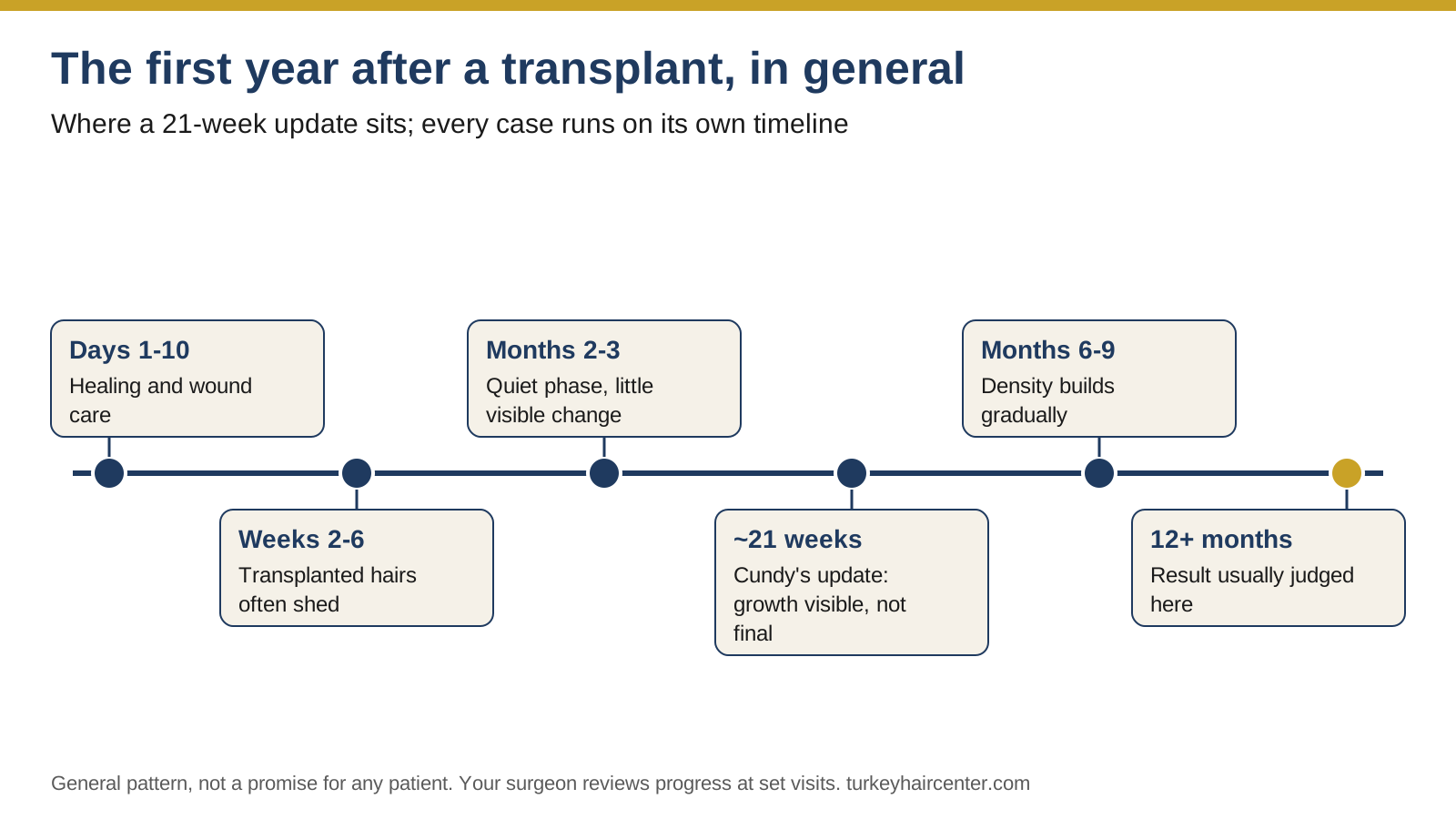
Every case runs on its own timeline. The general pattern is that the scalp heals first, transplanted hairs often shed, and new growth shows later. A review in Dermatologic Surgery, "Hair Transplantation: State of the Art" (Queen and Avram, 2025), covers patient selection, technical considerations and postoperative care, and concludes that advances in devices and techniques lead to long-lasting, natural results and high patient satisfaction in many cases.
A 21-week update is still an early check. By that point new hair is usually visible but not at its full density. Our recovery timeline goes through the stages month by month, and the guide to how long results last covers what happens beyond the first year.
The first days are about wound care and rest.
Transplanted hairs often shed before new growth starts.
New growth is gradual, which is why early updates are not final.
Your surgeon reviews progress at set visits.
Choosing a Hair Transplant Close to 60
Cundy's reason for waiting is on record, and so is the clinic's note that a mature hairline is naturally higher and more uneven than a young one. That affects planning. A mature hairline is usually designed with the donor supply in mind, not copied from a teenage photograph. Our guide to the mature hairline explains how to set realistic expectations.
The "Hair transplantation: Basic overview" review in the Journal of the American Academy of Dermatology (Jimenez, Alam, Vogel and Avram, 2021) notes that not all hair disorders suit transplantation, and gives guidelines for good and bad candidates. Candidacy is a medical judgement based on the type of loss, the donor area and the pattern over time, and not just on age.
Questions worth asking at any consultation:
How many grafts does my donor area safely support?
How low will the hairline sit at my age?
How will the plan cover later thinning?
Is my hair loss still progressing?
Medication and Maintenance After a Transplant
The clinic speculates that Cundy's hair loss slowed in his later years through finasteride, minoxidil or age. Cundy has not said what he used. The general facts, from public medical sources, are straightforward.
The NHS page on finasteride says it is also used to treat hair loss in men, but this is not available on the NHS and needs a private prescription. It also says you usually take it for 3 to 6 months before symptoms improve. A 2022 review in the Journal of Dermatological Treatment, comparing oral minoxidil, finasteride and dutasteride (Gupta, Talukder and Williams), ranks their likely efficacy and lists different side effects for each.
For minoxidil applied to the scalp, the MedlinePlus drug page says it "has no effect on receding hairlines", must be used for at least 4 months before any effect shows, and that most new hair is lost within a few months after it is stopped. That is worth knowing when the main concern is the hairline and temples, the areas named in Cundy's case.
The NHS hair loss page adds that male and female pattern baldness is permanent and runs in families, and it recommends seeing a GP before thinking about going to a commercial hair clinic. The US National Library of Medicine's MedlinePlus says treatment depends on the cause and can include medicines and hair restoration.
None of this is advice. Medicines for hair loss have side effects, and the decision belongs to you and a doctor.
What 3,000 Grafts Can and Cannot Cover
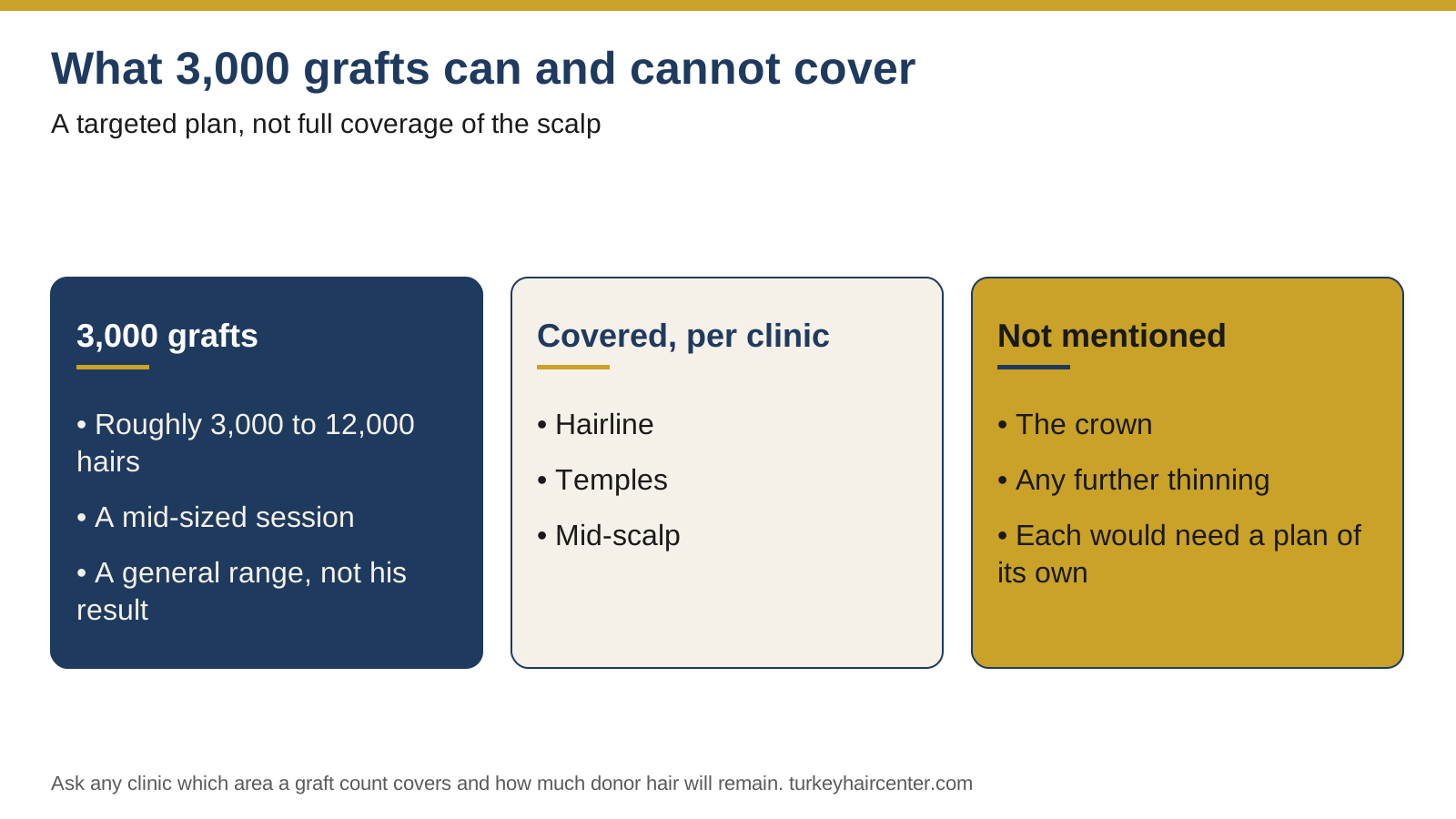
A graft usually holds one to four hairs, so 3,000 grafts means somewhere between 3,000 and 12,000 hairs. That is a general range, not a measurement of Cundy's surgery. A count of 3,000 grafts is a mid-sized session. It can rebuild a hairline and temples, but it will not thicken a whole scalp at once.
Item
What it means
Graft
A natural cluster of one to four hairs, moved as a unit
3,000 grafts
Somewhere between 3,000 and 12,000 hairs, depending on the individual
Hairline, temples, mid-scalp
The areas the clinic says were covered in Cundy's session
Crown and further thinning
Not mentioned in the clinic's account, and would need a plan of their own
That is why the clinic's wording is worth reading closely. It describes a targeted plan rather than full coverage. Ask any clinic what area a quoted graft count will cover, and how much donor hair will remain for a future session. Our guide on how many grafts you need explains how the count follows your pattern of loss.
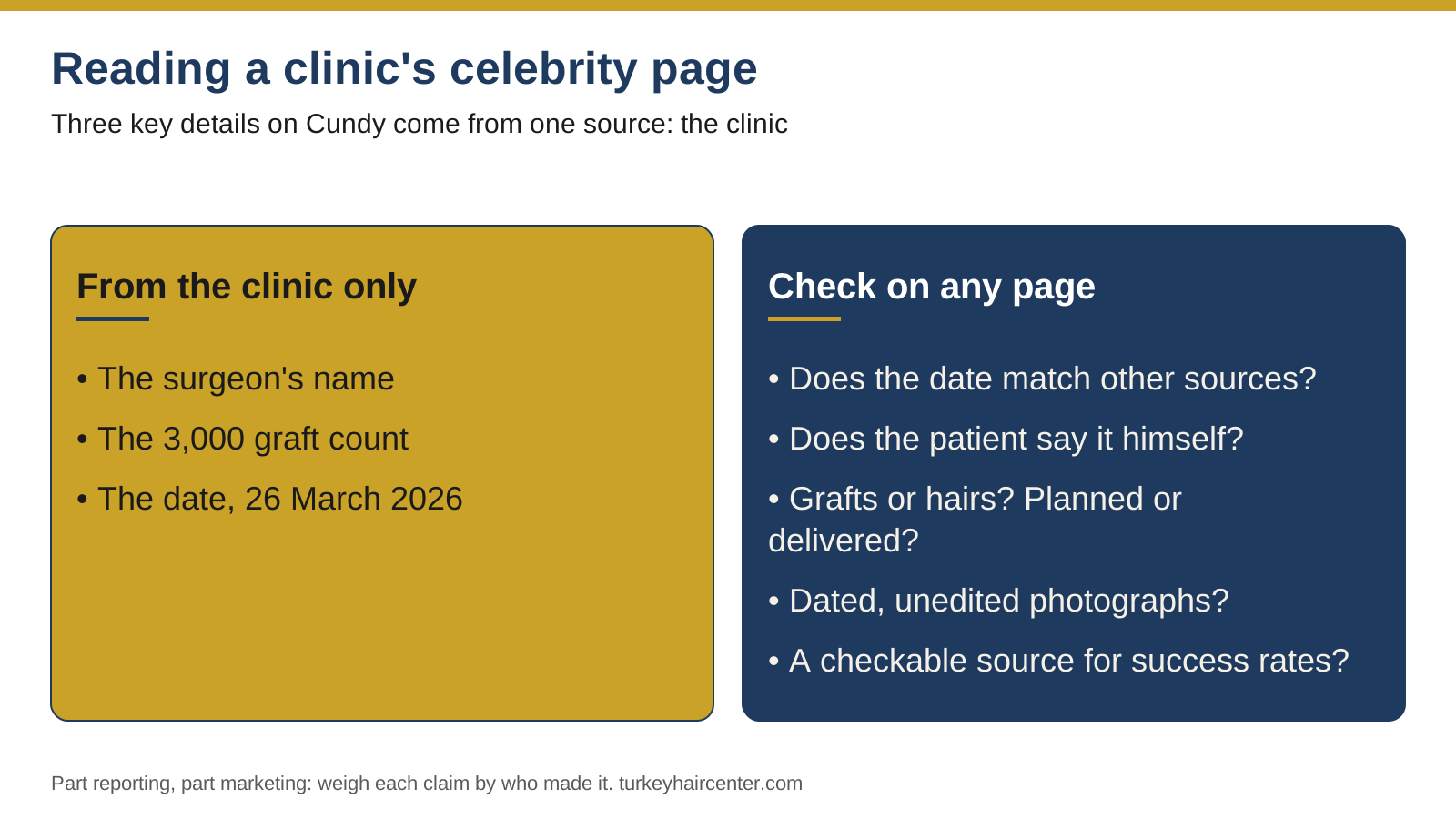
One more point on reading the evidence. Three of the key treatment details in this article, the surgeon, the graft count and the date, come from a single source, the clinic. That is normal for celebrity transplants, because patients rarely publish operative notes. It does mean a careful reader should hold those numbers loosely until a second source repeats them, and it is the reason we flag each one as the clinic's account throughout this page.
FUE or FUT: Choosing a Method
Cundy had FUE, according to the clinic. The other main method is strip harvesting (FUT), which removes a strip of scalp from the back of the head and leaves a thin linear scar. A review by Memon and Avram in the Journal of Cosmetic and Laser Therapy, "The pros and cons of follicular unit extraction (FUE) versus elliptical donor harvesting (FUT)" (2022), concludes that each option has benefits and consequences that must be examined patient by patient.
A review of androgenetic alopecia in the Nigerian Postgraduate Medical Journal, "Androgenetic Alopecia: A Review" (Oiwoh, 2024), is a useful general reference on the condition behind most cases of male hair loss.
Reactions From Colleagues and Friends
The clinic's page records two reactions. Gabby Agbonlahor said a clinic had once told him "you've got more chance of getting hair out of a bald egg". Ally McCoist replied with "Go for it mate", followed by a joke about the penalty spot.
These are jokes between friends in sport, not clinical comments, but they show how openly the subject was treated. The tone is a long way from the secrecy that surrounded transplants a generation ago.
How to Read a Clinic's Celebrity Page
A page like the one on Cundy is part reporting and part marketing. That does not make it false, but it affects how much weight each claim deserves. When reading any clinic's celebrity feature, look for these points.
Is the date of surgery stated, and does it match other sources?
Does the patient say the same thing in his own words elsewhere?
Are the numbers grafts or hairs, and are they planned or delivered?
Are the results shown with dated, unedited photographs?
Does the clinic attribute success rates to a named, checkable source?
The International Society of Hair Restoration Surgery describes itself as a global non-profit medical association with more than 1,000 members in 70 countries, founded in 1993. Its patient pages are a reasonable place to start when checking what a surgeon should tell you.
Cost
Cundy has not said what he paid, and we do not guess. Turkey Hair Center's own team performs procedures at contracted hospitals and polyclinics in Istanbul, and the package price range is $2,550 to $4,500. The price depends on the package, not only on the graft count. For a price comparison read our guide to a 3,000 graft transplant in Turkey, the comparison of the UK and Turkey and the general cost guide.
Jason Cundy Hair Transplant FAQs
What has Jason Cundy done to his hair?
He had a hair transplant in March 2026 and talked about it on talkSPORT.
Where did Jason Cundy get his hair transplant?
At the Wimpole Clinic on Harley Street in London, according to the clinic's page.
How many grafts did Jason Cundy have?
The clinic reports 3,000 grafts. Cundy has not given a number.
When did Jason Cundy get a hair transplant?
The clinic reports 26.03.2026.
Does Jason Cundy wear a wig?
No source we read says so. They describe a transplant.
Who performed Jason Cundy's hair transplant?
The clinic says Dr Ahmad Moussa performed it.
Was his head shaved on air before?
Yes. In May 2014 he and co-host Andy Goldstein had their heads shaved live on air after losing a bet on Liverpool's league finish, according to Digital Spy.
Has he said what it cost?
No. We do not estimate it.
Considering Hair Restoration for Your Own Hairline?
Turkey Hair Center's own team performs procedures at contracted hospitals and polyclinics in Istanbul; the package price range is $2,550 to $4,500. Read about other public figures on the celebrity hair transplant page, or send photos on the contact page for an assessment.
Send three photos: front, top and sides. You get a technique recommendation, a graft range and a straight answer about what is achievable, before anyone talks about price.
Your details are with the team
A patient coordinator will get back to you shortly. If you would like to send your photos now, WhatsApp is the fastest way to do it.
Real People Real Support
Send your photos on WhatsApp
Front, top and both sides, reviewed by the medical team.