Beard Transplant in Turkey: Cost, Who It Suits & Recovery
How a beard transplant works, who it suits, how many grafts a partial or full beard takes and how recovery goes, with published sources and a free photo assessment.
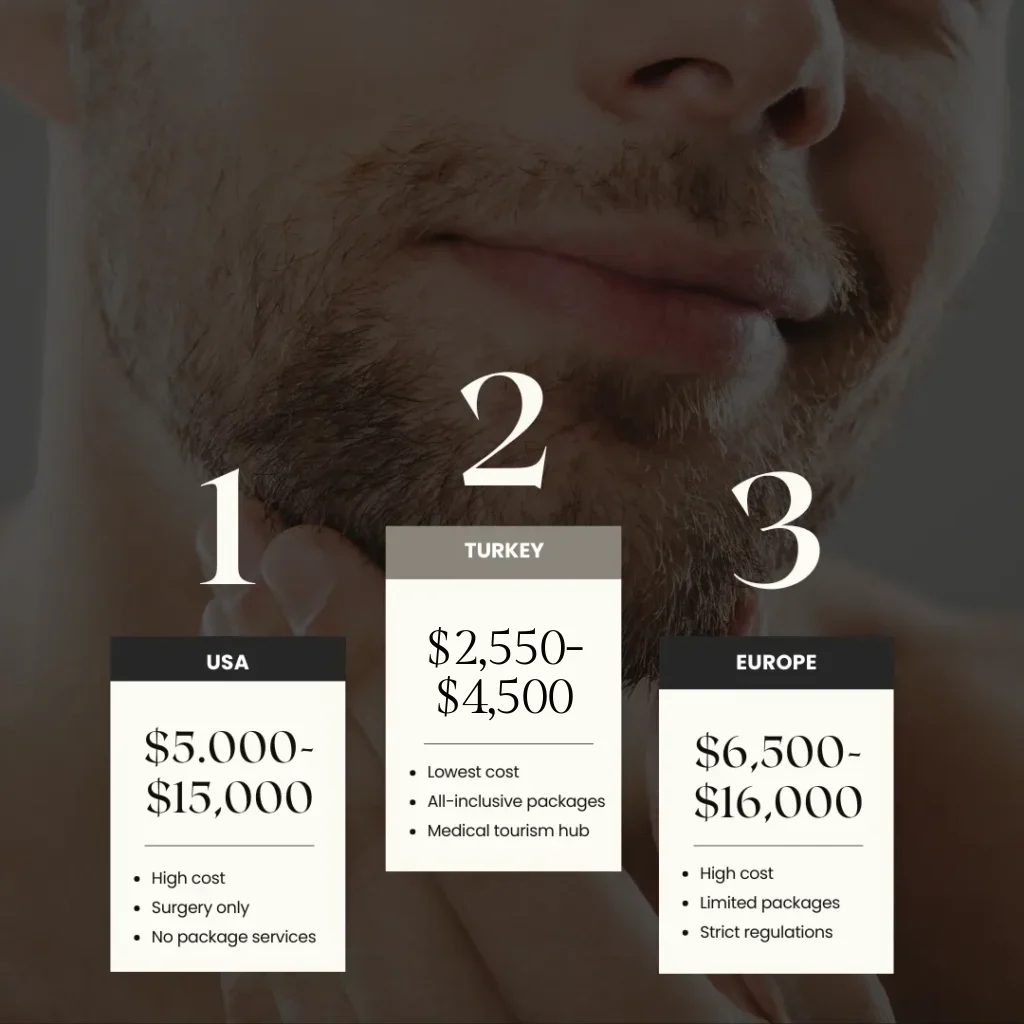
A beard transplant moves hair follicles, mostly single hairs, from the back of your scalp to thin, patchy or scarred parts of your beard, where they keep growing. A beard transplant in Turkey with our team takes one day under local anaesthetic: the hairs are taken with FUE and set almost flat, in the direction beard hair grows. Our price is $2,550 to $4,500.
A beard is seen up close and from the side, so a hair that points the wrong way shows. That is why we agree the beard line and the angle of each graft with you before the work starts.
Short answer
Your own scalp hair is moved to a patchy, thin or scarred beard in a one-day procedure. Crusts clear in about 10 days, new hairs grow from around month 3 to 4, and the result is mostly in place at about 12 months. A partial beard needs far fewer grafts than a full one. Our price: $2,550 to $4,500.
Beard transplant at a glance
Method
FUE extraction, placement into fine slits or with a DHI pen
Angle
Almost flat to the skin, direction set zone by zone
Operation
One day, several hours, local anaesthetic with sedation support
Price
$2,550 to $4,500
Number of grafts
Set at your assessment, partial or full beard
Time off work
Plan for 1 to 2 weeks
First trim
After about 10 to 14 days
Visible growth
From about month 3 to 4
Final result
About 12 months
What Is a Beard Transplant?
A beard transplant is a hair transplant planned around a face: hairs are moved one by one from where they grow thickly to where the beard is thin or missing. They are your own follicles, so they grow, can be trimmed and shaved, and keep growing for years.[1]
Demand for facial hair transplants has grown fast.[2] In the 2020 practice census of the ISHRS, beard and moustache procedures made up about 5% of hair restoration surgery in men.[3] The same single-hair work is used in an eyebrow transplant and a moustache transplant.
Scalp to Beard and Beard to Scalp
Most beard transplants use scalp hair, because the back of the head usually has hair to spare. Hair from under the chin can fill the beard too and matches its colour and thickness exactly, but most men have little of it to give.[1]
The term is also used the other way round: beard hair can be moved to the scalp when the scalp donor area runs short.[1] Our body hair transplant page explains when that helps.
Who Is a Good Candidate for a Beard Transplant?
You are a good candidate if your beard is patchy, thin or missing in places, the cause has settled, and the back of your head has healthy hair to spare. Typical reasons include:
A beard that never filled in, often on the cheeks, because of your genes.
Scars from burns, acne, injuries or surgery, once they have matured.[4]
Loss from traction, or alopecia areata that has been stable for a long time.[3]
A beard you want denser or reshaped, such as a stronger goatee or cheek line.
Facial hair keeps developing into the late twenties, so one US guide suggests waiting until you are at least 25.[5]
When to Wait
A transplant is the wrong first step while the cause of beard loss is still active or your donor area is weak. We advise waiting, or another option, in these cases:
Active alopecia areata or a scarring condition, until a doctor, sometimes with a biopsy, confirms it has settled.[3]
A hormone problem that has not yet been checked by a doctor.
Scalp hair loss that will need most of your donor hair later.[1]
Afro-Textured and Other Hair Types
The technique is the same for every hair type. Curly hair also curves under the skin, so it is extracted with extra care, and donor hair with a matching curl looks most natural.
Hair type can change the result. In one series of ten FUE beard transplants, brown or red hair and medium or fine hair were linked with better coverage, and men with straight hair were more satisfied.[6] Our Afro beard transplant page covers curly and coily hair in detail.
FUE or DHI for a Beard Transplant?
Both start the same way: the hairs are taken one by one with FUE. They differ in how each graft goes into the face. With FUE, the doctor first opens fine metal or sapphire slits and sets a graft into each with forceps; with DHI, a pen-shaped implanter places each graft in one movement.
Beard surgeons use both, as well as "stick and place", where each slit is made and filled at once. On loose facial skin, slits made in advance can close before they are filled, while implanters and stick and place cut down bleeding.[3] A strip method (FUT) is possible, but FUE is the usual choice for beards because it is more precise and leaves less scarring.[5] See our FUE hair transplant and DHI hair transplant pages.
Sapphire FUE for the Beard
Sapphire FUE is FUE in which the slits are opened with a sapphire tip instead of a metal one. For a beard, what matters most is that each slit is as small as possible and points the right way. One surgeon with more than 700 beard transplants lists the smallest possible recipient sites among the key steps.[7] Read more on our Sapphire FUE page.
Robotic, Stem Cell and PRP Add-ons
Our team does every step by hand; we do not use a robot. Our beard packages are the same as our hair transplant packages: all four include PRP, Sapphire Advanced Regrowth, DHI Comfort and Exosapphire Microflow Elite add exosome therapy, and stem cell therapy is part of our packages too. These are add-ons to the transplant, not a replacement for it; our PRP guide explains how PRP is used.
Designing a Natural Beard: Lines, Angle and Direction
A natural beard comes from three decisions made before any graft is taken: where the lines run, how flat each hair lies and which way it points. Researchers in Istanbul measured facial landmarks in 32 men to define ideal upper and lower beard lines, so the design can follow your face rather than a template.[8]
A review on beard reconstruction places the highest point of the cheek beard where two lines cross: one from between the eyebrows to the angle of the jaw, the other from the corner of the mouth to the front of the ear. Single hairs at lower density keep the edges soft, while the body of the cheek carries the most density.[3]
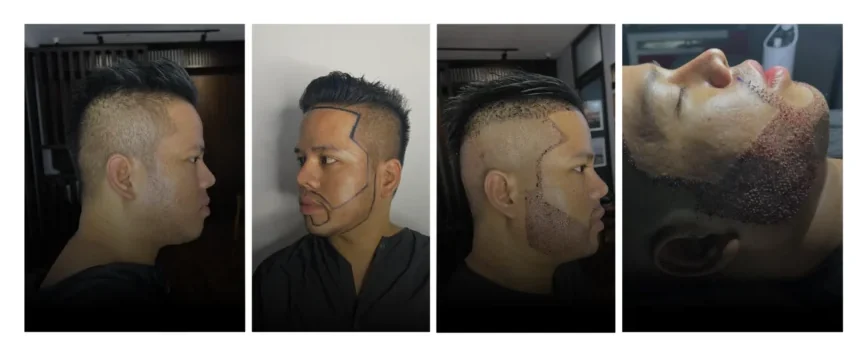
The beard line is drawn and agreed before any graft is taken.
Why Beard Grafts Lie Almost Flat
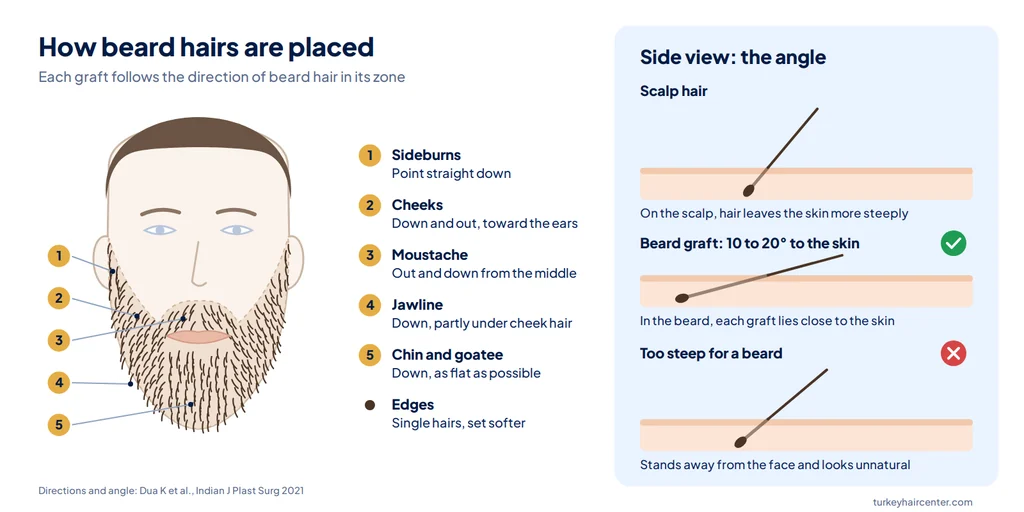
Beard hair leaves the skin at a much lower angle than scalp hair, so every graft goes in almost flat. One review gives 10 to 20 degrees to the skin for the slits,[3] and grafts set too steeply stand away from the face; the ISHRS lists wrong exit angles among the side effects of beard transplants.[1] Direction changes across the face:
Sideburns: hairs point down.
Cheeks: down and out toward the ears, in a slanted pattern.
Moustache: out and down from the middle of the upper lip.
Jawline: down, and partly covered by longer cheek hair.
Neck: whorls and changing directions, so it is rarely rebuilt unless you ask.
Which way each hair points, zone by zone, and why beard grafts go in almost flat.
How Is a Beard Transplant Performed?
A beard transplant is done in one day, with no overnight hospital stay. It takes several hours, more for a full beard, and one review asks surgeons to tell patients about the long hours in advance.[3] This is how the day runs with our team:
Photo assessment. Before you travel, you send photos of your beard and the back of your head, and the medical team tells you whether a transplant suits you.
Tests and design. Blood tests and a medical check come first. The beard lines are then drawn on your face, checked in the mirror and agreed with you before any anaesthetic.
Local anaesthetic. The donor area and the face are numbed, and you stay awake; sedation support is available if you want to feel calmer.
Extraction. Single and two-hair grafts are taken one by one from the back of the scalp with a micromotor device and punches about 0.7 to 1.2 mm wide, and kept cool until they are used.
Placement. Each graft goes into a fine slit or is placed with a DHI pen, almost flat and in the direction of beard hair in that zone, with single hairs at the edges.[7]
Next-day check. The team checks the grafts and shows you how to clean the area; this check-up is part of every package.
Is a Beard Transplant Painful?
The anaesthetic injections are the painful part; once the skin is numb, you feel pressure and movement rather than pain. Injections into the face can be quite painful, so one review describes nerve blocks and a vibration device to ease them.[3]
For the rest of the day your lips may stay numb and chewing can be awkward, so soft food or drinks are easier.[3] Afterwards the pain is usually mild and settles with simple painkillers.[5] If you are anxious about the injections, read about sedated hair transplants.
How Many Grafts Do You Need for a Full Beard?
Your graft number is set at your assessment, from the beard you want, your face and the donor hair you have; no single number fits everyone. These are the ranges we usually plan with:
Your goal
Typical range with us
Cheek gaps or patchy areas
Typical range with us
500 to 1,000 grafts
Goatee and moustache
Typical range with us
1,000 to 1,500 grafts
Jawline and sideburns
Typical range with us
1,200 to 2,000 grafts
Light or patchy full beard
Typical range with us
1,800 to 2,200 grafts
Medium-density full beard
Typical range with us
2,200 to 2,800 grafts
High-density beard
Typical range with us
2,800 to 3,500 grafts
Published figures differ, because authors count different areas and different faces:
About 300 to 400 grafts per side of the moustache, 600 to 700 for the goatee, around 200 per sideburn, and 2,000 to 2,500 for a beard that never grew in properly.[3]
On average 250 per sideburn, 350 to 600 per cheek and 550 to 650 for moustache and chin together, in another review.[4]
From a few hundred to more than 2,000, depending on the work needed, according to the ISHRS.[1]
A graft is a natural group of 1 to 4 hairs.[9] In the beard most grafts carry one or two hairs, so the hair count stays close to the graft count.[7]
Where the Grafts Come From
Your grafts come from the back of your head, chosen to match your beard as closely as possible. The middle of the back of the scalp is preferred, because its hair is closest to beard hair in thickness and texture.[3] Beard hairs are still much thicker, by 70 to 100% in cross-section in one comparison, so the donor hairs are chosen with care.[4]
Scalp FUE leaves tiny white dots that show only if you shave your head, and every graft used on the beard is one fewer for a later scalp transplant.[1] Our guide to how many grafts you need explains donor capacity.
Free assessment
Want a specialist's view on your case?
WhatsApp is opening. Send your front, top and side photos in the chat and the medical team will reply.
Our beard transplant price is $2,550 to $4,500, set by the package you choose, and the team confirms it after your free photo assessment. A partial beard needs fewer grafts and a shorter day than a full one, and scarred skin may need a planned second session for density.[4]
Our all-inclusive packages cover the operation, blood tests, PRP, two hotel nights, VIP transfers between airport, hotel and hospital, a personal medical assistant and interpreter, the next-day check-up and two years of aftercare consultation. Budget separately for flights, food, travel insurance and any extra nights; see all treatments and packages.
Our four all-inclusive packages cost $2,550 to $4,500.
Beard Transplant Cost in the USA and UK
A full beard costs much more than a partial one wherever you have it done. Behind the US averages above, a patient finance guide gives ranges of $3,311 to $8,126 for a partial and $7,607 to $19,870 for a full beard transplant.[5]
The NHS gives £1,000 to £30,000 for a hair transplant in the UK in general and does not offer one, as it is cosmetic surgery.[9] Insurance rarely pays, with possible exceptions after burns or injuries.[5] Our US vs Turkey and UK vs Turkey comparisons include travel costs, and our hair transplant cost guide explains how pricing works.
Beard Transplant Recovery Week by Week
The face looks healed within about two weeks; the beard itself takes about a year. This is what you can expect, stage by stage; our recovery timeline covers the scalp side.
When
What you see
What you do
Day 1
What you see
Swelling, redness and a tiny crust at each graft; lips numb for some hours
What you do
Soft food; sleep on your back with your head raised; do not touch the grafts[3]
The first days: a small crust at each graft, gone in about 10 days.
When Can I Shave After a Beard Transplant?
Not until the crusts have gone and the grafts are secure: plan for at least 10 days before a first light trim, and ask the team before you take a razor to the transplanted area. Published advice varies. One review allows shaving from day 8,[3] a US guide says to wait at least 10 days,[5] and the ISHRS notes that instructions differ between surgeons.[1]
Once the new hair grows from month 3 or 4, you trim and shave it like the rest of your beard. Let crusts fall away with gentle washing instead of picking them; our guide to scabs explains why.
Washing, Work and Exercise
Wash your face only the way the team shows you at the next-day check, and pat it dry without rubbing. Advice on water differs: two reviews ask patients to keep the grafts moist in the first days, one with saline,[3][4] while a US guide says some surgeons ask you not to wet your face for a week.[5]
Plan for one to two weeks off work, the range the NHS gives for hair transplants;[9] desk work can start sooner if you do not mind the redness showing. Short walks are fine after a few days, the gym after weeks 2 to 4, and swimming or the sauna after about a month. Our guide to going back to work after a hair transplant has more detail.
Beard Transplant Results Month by Month
A good result is a beard that looks as if it always grew there, with soft edges and hairs that lie the right way. Growth usually starts around month 3 or 4 and goes on for up to a year,[4] and a US guide gives 12 to 15 months for the full effect.[5]
Published series are small. In 20 men treated for burn scars, acne scars or a missing beard, 19 were satisfied after a year, and scarred skin needed more sessions for density.[4] In another series of ten men followed for a median of 39 months, eight were satisfied or very satisfied, with an average of 53% of the bare area covered.[6] The two studies measured different things, so their figures cannot be compared directly.
Do Beard Transplants Look Natural?
They can, when the lines, the angle and the direction of each hair are right. Most poor results trace back to these: the ISHRS names poor growth, wrong exit angles and a border that is too straight.[1]
Reading Beard Before-and-After Photos
Check when and how each photo was taken before you judge the result:
The after photo is at least 12 months after the procedure; photos from the first weeks show healing, not results.
Both photos show the same side of the face, the same light and the same beard length, since a longer beard hides gaps.
Several cases at your density tell you more than one best case.
Transplanted beard hairs usually keep growing for life, because they come from the back of the scalp, which keeps its hair in most men. The ISHRS describes the hairs as permanent once recovery is complete.[1] Not every graft grows, though, and a condition such as alopecia areata can still affect the beard later.
Are Beard Transplants Risky? Side Effects and Scars
Serious complications are uncommon; the real risks are about how the hairs look. Mild redness and swelling for a few days are common.[3] Other side effects to plan for:
A small crust at each graft and some itching while they heal.
Shedding of the new hairs in the first weeks, before regrowth.
Tenderness at the back of the scalp for a few days.
Bumpy, uneven skin known as cobblestoning, mostly around the chin and moustache.[3]
Hairs growing at the wrong angle, or a beard line that looks too straight.[1]
Contact the team at once if you notice yellow crusts, discharge, spreading redness or pain that gets worse instead of better. Infection and ingrown cysts are rare.[1] Our page on hair transplant side effects covers the donor side in more detail.
Two common myths
"More grafts make a fuller beard." Placement creates much of the density: a layered moustache can look full with fewer grafts.[3]
"Scalp hair grows exactly like beard hair." Transplanted hairs keep some traits of the scalp, so the donor hairs are matched to your beard.[4]
Does a Beard Transplant Leave Scars?
Not a line: FUE leaves tiny dot scars in the donor area, and the slits in the beard heal as small crusts. Around those dots, the scalp can lose a little colour in any skin type, which shows mainly on a very short haircut.[1] Tell the team about any keloid or thick scars first; one review asks surgeons to check scarring tendencies before planning.[3]
Can a Beard Transplant Be Reversed?
Not easily: transplanted hairs are meant to stay, so a wrong line or angle is much harder to fix than to avoid. Repairs do exist; one surgeon reports tens of repair procedures alongside more than 700 primary beard transplants.[7] Badly placed hairs can be removed or treated with laser hair removal, which is why your beard line is agreed before any graft is taken.
Beard Transplant vs Minoxidil and Other Options
Minoxidil can only wake follicles you still have; a transplant adds follicles where none grow. The ISHRS calls minoxidil the only medicine that helps beard fullness, but adds that its results are unpredictable, usually weaker than a transplant, and fade if you stop.[1]
Beard transplant
Minoxidil
What it does
Beard transplant
Adds follicles from the scalp
Minoxidil
Stimulates follicles you already have
Where it helps
Beard transplant
Empty patches and scars
Minoxidil
Areas that still grow some hair
Result
Beard transplant
New hairs from month 3 to 4, mostly in place at about 12 months
Minoxidil
Hard to predict
When you stop
Beard transplant
The hairs stay
Minoxidil
The gain fades
Surgery
Beard transplant
Yes, one day
Minoxidil
No
Where follicles are missing, as in a scar, only new follicles add hair; see our scar hair transplant page. A hormone problem needs a doctor first. Our minoxidil guide covers the forms, how to use them and side effects.
How to Choose a Beard Transplant Provider
Choose the team, not the city: a beard shows every decision they make. Facial hair transplantation is a subspecialty within hair restoration,[10] so ask about beard work in particular:
Who designs your beard, who extracts the grafts and who places them.[1]
Whether single hairs go at the edges and the angle follows each zone.
How your graft number was worked out from your photos.
A written package: price, what is included and what is not.
Beard cases at 12 months, in the same light and from the same angle.
Aftercare once you are home; ours includes two years of aftercare consultation.
Beard Transplant Reviews
The most useful reviews show the beard at least a year later, on platforms the provider does not control. Our patients review us on Google, Trustpilot, Bookimed and ProvenExpert (links on our review page), and we do not pay for reviews. The Trustpilot reviews below cover our service in general, not beard procedures.
TrustScore 4.1 out of 5 on Trustpilot, based on 5 reviews (checked 11.10.2026).
★★★★★
Turkey hair center was an amazing experience. They took care of me from the moment I landed all the way until my flight back home. They do top tier work and I would highly recommend them to anyone looking for this service!
★★★★★
I had my hair transplant about a month ago and so far the progress/recovery is going super well and ahead of schedule. The doctor and nurses from the clinic were super friendly and knowledgeable. They made me feel comfortable and confident i made the right decision to go with them. Also the food that they serve me half way through the procedure was amazinggggg.
★★★★★
This experience was great the Doctor and Staff were very professional and the BEST! Highly recommend if you want to goto the best hair transplant center to get your hair transplant! This is me after little before 3 months!
★★★★★
my experience at turkey hair transplant centre was really good and the doctors made me feel vert welcome, i am happy with my results at the moment and would definitely recommend it to others
Our medical team performs the procedure at partner hospitals and polyclinics in Istanbul. Turkey Hair Center® is a UK-headquartered global hair restoration company; read more about us.
Beard Transplant: Frequently Asked Questions
How much does a beard transplant cost in Turkey?
Our price is $2,550 to $4,500, confirmed after a free photo assessment. A US guide gives national averages of $4,734 for a partial and $11,461 for a full beard transplant, before travel.
How many grafts do I need for a full beard?
It is set at your assessment; there is no fixed number. Published figures run to about 2,000 to 2,500 grafts for a beard that never grew in properly. See our graft ranges.
Does a beard transplant hurt?
The anaesthetic injections hurt for a moment; after that you feel pressure, not pain, and soreness afterwards is usually mild. Our packages include sedation support.
When can I shave after a beard transplant?
Plan for at least 10 days before a first light trim, once the crusts have gone, and ask the team before using a razor on the grafts.
Is a beard transplant worth it?
Yes, if you want real hair where none grows and can wait about a year for the result. If you are under 25 or your beard is still filling in, wait first.
How long do beard transplants last?
Usually for life: the hairs come from the back of the scalp, which keeps its hair in most men. Not every graft grows, though.
Does a beard transplant leave scars?
Not a line: FUE leaves tiny dots at the back of the head, and the slits in the beard heal as small crusts within about ten days.
Can a beard transplant be reversed?
Not easily. Badly placed hairs can be removed or treated with laser hair removal, which is why your beard line is agreed before any graft is taken.
Why do so many people go to Turkey for a beard transplant?
Mostly cost: our all-inclusive packages cost $2,550 to $4,500 with hotel and transfers, while a US guide puts the average full beard transplant at $11,461 before travel. Check who designs your beard and who does each step.
Is beard transplant halal or haram?
Turkey Hair Center does not give religious rulings; please ask a scholar you trust. Medically, a beard transplant moves your own hair from the scalp to the face under local anaesthetic to restore patchy, thin or missing beard areas.
Free Beard Transplant Assessment
Every beard plan with us starts with a free photo review. Pick the goal closest to yours below for a first graft range:
1
What is your beard goal?Pick the closest; the photo review confirms it.
Typical graft range500 to 1,000grafts
An estimate from the ranges on this page, not a treatment plan. Your graft count is set after the medical team reviews your photos and donor area.
Then send photos of your beard from the front and both sides, plus one of the back of your head. The medical team will tell you whether a beard transplant suits you and roughly how many grafts you would need, free and without obligation: get your free assessment or ask us on WhatsApp.
Sources and medical review
The clinical statements on this page draw on the following published literature and professional guidance:
This page was drafted with the help of AI writing tools and edited by our team, then medically reviewed by Dr. Teuku Adifitrian, Sp.BP-RE (Dr. Tompi) on 1 November 2026. If you spot an error, write to info@turkeyhaircenter.com.
Talk to our hair team on a free video call, in your language. You receive a written plan with your technique, estimated grafts and all-inclusive price. If a hair transplant isn't right for you, we tell you honestly.