How platelet-rich plasma is prepared, what the meta-analyses found in men and women, why it cannot switch off genetic hair loss, how many sessions guidance suggests and what it adds to a hair transplant.
12sources
12in PubMed
12min read
Written by Nazmi Güldeş, Certified Trichologist · Medically reviewed by Dr. Teuku Adifitrian, Sp.BP-RE (Dr. Tompi), Plastic, Reconstructive and Aesthetic Surgeon · Last reviewed 31 October 2026
Reading level
PRP for hair loss means drawing a little of your own blood, spinning it to concentrate the platelets and injecting that plasma into thinning areas of the scalp. It can add some density to pattern hair loss, but the gain is modest, it fades without top-ups and the trials behind it are mostly low in quality.
That makes PRP a support act rather than a main treatment. The useful questions are who it suits, how many sessions it takes and what it can't do, and we answer each below.
1Quick answerThe short answer, in a few sentences
What Is PRP for Hair Loss?
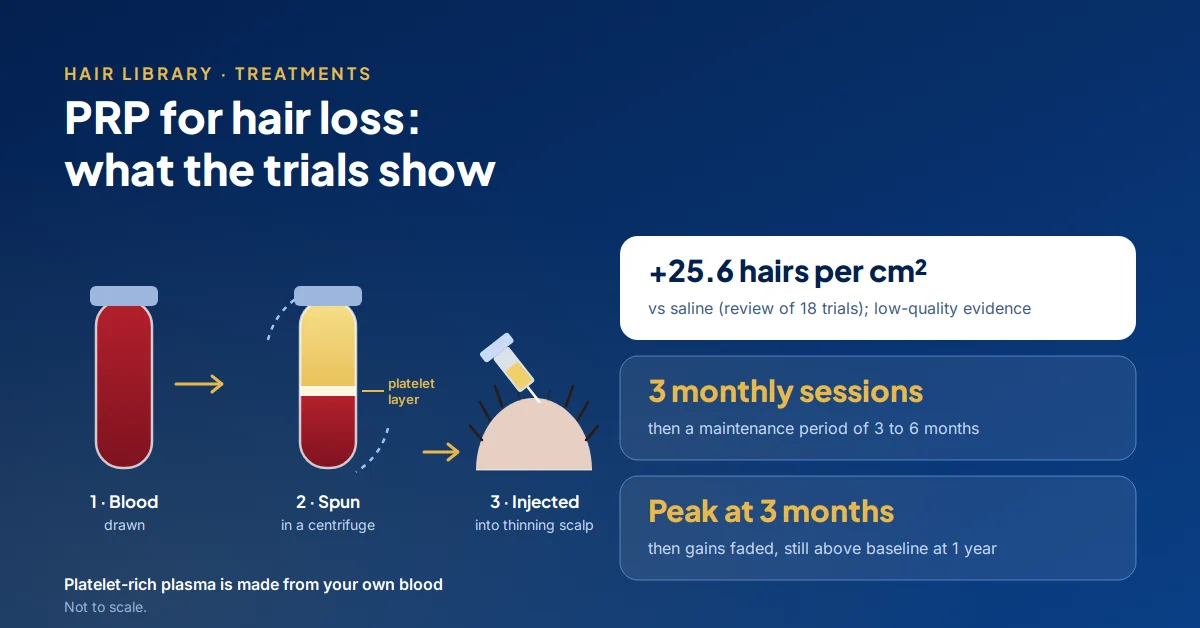
PRP, or platelet-rich plasma, is your own plasma with more platelets than normal blood. Injected into thinning scalp, it raised hair density over saline in controlled trials of pattern hair lossGlossaryAndrogenetic alopecia, or pattern baldness, is the pattern hair loss behind most male and female thinning. It is primarily driven by genetic predisposition and sensitivity to androgen hormones. Open in the glossary →, by about 25.6 hairs per cm², though that evidence is rated low quality.[1] The FDA has not approved it for this use.
In 2025 a Canadian expert panel reviewed 45 treatments for pattern hair loss and recommended seven, PRP among them.[2] So the sources pull apart: a panel that recommends it, and reviewers who rate the evidence low. We'd call it promising but unproven, and best used alongside a medicine.
2Complete guideFrom how it is made to trials, safety and surgery
How PRP Works and What the Trials Found
How PRP Is Made
Blood is drawn into tubes with an anticoagulant and spun at low speed. The plasma then goes into fresh tubes for a faster spin, so the platelets settle and can be collected in less plasma. The Indian dermatology task force recommends this double-spin method, at 0.05 to 0.1 mL of PRP per cm² of scalp.[3]
Platelets release growth factors, and PRP's effect on hair is thought to depend on them.[4] PRP may encourage hair growth by helping cells mature, differentiate and multiply[5], and recipes differ widely from study to study.
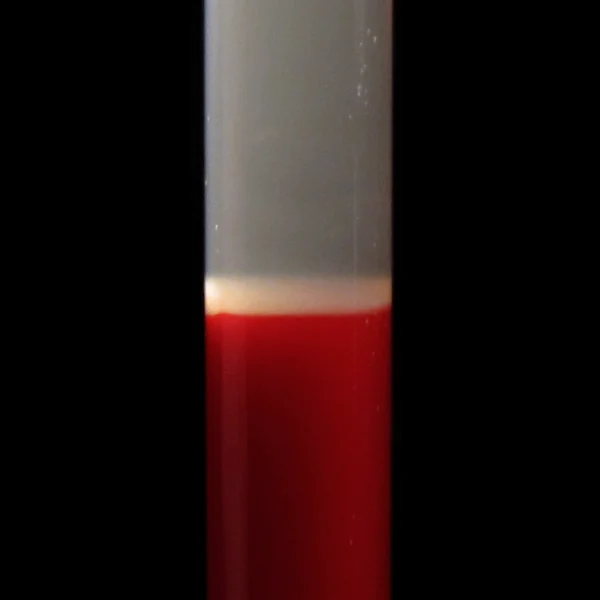
Blood after gentle centrifugation. The thin pale band between plasma and red cells is the layer of platelets and white cells. Photo: Lajoswinkler, CC BY-SA 4.0, via Wikimedia Commons, cropped.
Does PRP Work? What the Meta-Analyses Show
On average, modestly. The table sorts what the reviews found by outcome; the last column is our plain-words reading.
Outcome
What pooled studies found
Our reading
Hair density
More than saline injections, by about 25.6 hairs per cm²
A modest gain that seems real
Hair thickness
Thicker hair in a review of trials in women
Promising; the pooled data here come from women
Shedding
Fewer hairs on a pull test in women and against minoxidil
Seen in several studies on this page
Against minoxidil
Nearly comparable overall
Not a replacement for a proven drug
Quality of evidence
Mostly low, with varied recipes and schedules
Treat any single result with care
For the round patches of alopecia areata, it is unclear whether PRP does better than steroid injections, and that evidence is rated very low in quality.[1] The rest of this entry covers pattern hair loss.
Can PRP Stop Genetic Hair Loss?
Pattern hair loss comes from inherited sensitivity plus androgens, mainly DHTGlossaryDihydrotestosterone (DHT) is a potent androgen that the body makes from testosterone using an enzyme called 5-alpha reductase. In people who are genetically sensitive to it, DHT makes hair follicles shrink. Open in the glossary →, which shrink the follicles over time. Finasteride and dutasteride target that cause by lowering DHT in the follicles, while minoxidil and PRP act by other routes.[6] We found no study showing that PRP lowers DHT, so it isn't a substitute for a DHT blocker such as finasteride.
What PRP can do is slow shedding and add density for a while. In a one-year study of 20 patients, shedding returned to normal and density peaked at 3 months, then slipped at 6 and 12 months while staying above baseline, with a booster session at 6 months.[4] For the cause itself, read our guide to DHT and hair loss.
PRP for Men and for Women
Men. The best case is early to moderate loss, as the box above sets out. Against minoxidil, PRP did about as well overall: minoxidil did better on terminal hair counts, PRP on density and the pull test.[7]
Women. A meta-analysis of 21 randomized trials in 628 women found more density and thicker hair, with mild, short-lived side effects.[8] The results varied with dose, schedule and ethnicity, so there is no single proven protocol yet. For women, PRP fits best as an add-on to the treatments in our female pattern hair loss guide.
PRP Sessions, Results Timeline and Side Effects
How Many PRP Sessions Do You Need?
Guidance starts with a course, not a single shot. A 2019 meta-analysis by a hair restoration society committee recommended three monthly sessions followed by a maintenance period of 3 to 6 months.[5] The Indian task force asks for at least three to five sessions, a month apart.
After that, expect top-ups. In the one-year study, more hairs came out on the pull test again by month 6, which is why a booster session was given then.
PRP Results Timeline, Month by Month
The middle column comes from the studies on this page; the right-hand column is our advice.
Time
What the studies recorded
What you can do
Months 0 to 2
At least three monthly sessions in the guidance
Take start photos; keep your medicine going
Month 3
Shedding back to normal and density at its peak in a one-year study
Compare your photos with month 0
Months 3 to 6
Maintenance period; pull tests crept up again by month 6
Plan a booster with your doctor
Month 12
Density still above baseline after a booster at 6 months
Decide whether the gain is worth the upkeep
Side Effects, Safety and Who Should Avoid PRP
The injections hurt. In the one-year study, every patient felt mild pain despite local anaesthesia, a quarter had mild pain afterwards that faded within 4 hours, and 60% found the scalp sensitive at the first wash.[4] Pooled reviews found no serious treatment-related events.
That study left out people with any of the following, so mention them before treatment:
Blood disorders or platelet dysfunction
Anticoagulant treatment
A weakened immune system, from cancer, chemotherapy or steroids
A tendency to keloid scars, or a skin disease of the scalp
Aspirin or other anti-inflammatory painkillers, which were stopped 7 days before treatment
Ask, too, whether your blood is handled in sterile, single-use tubes, as in the method the Indian guideline describes.
Common Myths About PRP
"PRP blocks DHT." We found no study showing that it does.
"One session is enough." Guidance starts with at least three, a month apart.
"PRP is FDA approved for hair loss." It isn't.
"It works on bald skin." The best candidates are Norwood II to V, and results are weaker in stages VI and VII.
PRP vs Minoxidil, Exosomes and a Hair Transplant
How PRP Compares With Other Options
Here is how PRP sits next to the alternatives on what you would live with. The last column is our own summary of the evidence.
What it does
Time and effort
If you stop
Evidence, in short
PRP
Growth factors from your own platelets
Clinic visits and a blood draw each session
Gains fade without top-ups
Modest, low certainty
Minoxidil
A drug that doesn't target androgens
A topical or low-dose tablet, used long term
Relies on long-term use
FDA approved; recommended by the Canadian panel
Finasteride
Lowers DHT in the follicles
A tablet, or newer topical forms, used long term
Relies on long-term use
Recommended by the Canadian panel
Exosomes
Cell-derived products, mostly tested in the lab
No standard product or schedule
Unknown
Very limited
Hair transplant
Moves follicles that keep their genetic traits
A minimally invasive procedure
Moved hair stays; native hair needs medicine
Established surgery
PRP vs Minoxidil and Finasteride
Head to head, minoxidil and PRP come out close. A review of six trials found PRP nearly comparable to minoxidil, and called it a valuable add-on to minoxidil or a second-line option.[7] The FDA has approved minoxidil for pattern hair loss, but not PRP.
Finasteride lowers DHT, which PRP has not been shown to do. All three were among the seven treatments the Canadian panel recommended, along with microneedling, and we'd see PRP as something to add to a medicine rather than a reason to stop one.
PRP vs Exosomes
Exosome products are newer and less tested. In lab studies they stimulate the cells that drive hair growth, but a 2025 review found only nine clinical studies with 125 hair loss patients, and at least 10 serious adverse events reported across dermatology.[9] We found no trial comparing them with PRP in hair loss.
PRP With a Hair Transplant: What the Studies Show
The Indian guideline gives PRP an adjunct role in hair transplant surgery, and the only systematic review on the question found three controlled studies with 217 participants.[10] All reported better density, follicle survival or earlier growth, but their methods varied, none used standardized assessment, and long-term trials are missing.
So the signal is positive but thin. For shock lossGlossaryShock loss is a temporary shedding phase after a hair transplant, triggered by surgical stress to the scalp and typically starting 2 to 4 weeks after the procedure. The follicles remain healthy beneath the skin, and new growth resumes within 4 to 6 months. Open in the glossary → of native hair, we found no trial that used it as the main outcome. Our guide to shock loss after a hair transplant explains what is normal.
When a Transplant Is the Better Answer
A transplant moves follicles from the donor areaGlossaryThe donor area is the back and sides of the head, where follicles resist DHT. An extracted follicle does not grow back in that spot, so extractions are spread out, and the donor supply is the limit of every plan. Open in the glossary →, and they keep their genetic traits in the new spot.[11] If your hairline or crown has gone smooth, a transplant is the option that adds hair there; how many grafts a stage needs is set out in how many grafts do I need.
If you are still losing hair fast across the top, start with medicine: modern transplant care pairs surgery with medical therapy to maintain density.
Frequently Asked Questions
Does PRP for hair really work?
For density, modestly and on average: pooled trials found about 25.6 more hairs per cm² than saline. The evidence is rated low quality.
Is PRP for hair loss permanent?
No. In a one-year study, density peaked at 3 months and slipped afterwards, so a booster was given at 6 months.
How long does PRP for hair take to work?
Shedding settled and density peaked at about 3 months in a one-year study. Guidance starts with three monthly sessions, so judge it after that course.
Does PRP for hair hurt?
Yes, mildly, even with local anaesthesia. In trials in women, pain was no more common than in the comparison groups.
Is PRP better than a hair transplant?
They do different jobs. A transplant moves follicles that keep their genetic traits, while PRP is used to add density to thinning hair.
Is PRP for hair FDA approved?
No. The FDA has not approved PRP as a treatment for pattern hair loss.
Can PRP for hair cause cancer?
There is no direct evidence that it does. A 2026 review saw a theoretical concern for sun-damaged, thinning scalps, judged PRP safe on current evidence and advised scalp checks and sun protection.[12]
Is PRF better than PRP for hair?
It's too early to say. The Indian task force found injectable platelet-rich fibrin useful in pattern hair loss, but says more studies are needed to establish its role.
Who PRP Suits, and Who Should Skip It
This split is our reading of the studies above.
PRP may suit you if
Skip it, or wait, if
You have early to moderate pattern thinning
Your hairline or crown has already gone smooth
You already use a medicine and want an add-on
You want PRP to replace a proven medicine
You can commit to a course and top-ups
You can't return for repeat sessions
Your blood clots normally and you take no blood thinners
You have a blood or platelet disorder, take anticoagulants or have a scalp skin disease
If your hairline or crown is already smooth, a transplant is the option that adds hair there. Send us three photos for a free hair analysis, and the medical team will tell you whether your pattern suits medication, surgery or both. You can also message us on WhatsApp.
About the Author
Written by: Nazmi Güldeş, Certified Trichologist. Nazmi Güldeş focuses on patient education around androgenetic alopecia, evaluating miniaturization through dermoscopy, and assessing candidates for medical treatments and hair transplants.
Editorial Policy & Trust
This entry was drafted with the help of AI writing tools and edited by our team, then medically reviewed by Dr. Teuku Adifitrian, Sp.BP-RE (Dr. Tompi) on 31 October 2026. AI is never used as a source: every study cited here was checked against PubMed on 31 October 2026. Key figures are marked with their source, and every source is listed at the end of this entry. Read how we work in our editorial policy.
3 questions
Test yourself
Check what you remember from this entry. Each answer links back to the section that explains it.
How did reviewers rate the evidence for PRP in pattern hair loss?
Pooled trials found more hair density than saline injections, but the evidence was rated low quality. Read the section
What happened to hair density after PRP in the one-year study?
Density peaked at 3 months and was lower at 6 and 12 months, while still above baseline. Read the section
What did the only systematic review of PRP with hair transplants call for?
Its three studies reported benefits, but methods varied and long-term follow-up was missing. Read the section
3Scientific evidenceStudy types, references and how to cite this entry
12sources
Evidence behind this entry: 12 publications indexed in PubMed (2014 to 2026): 5 systematic reviews, 4 reviews, 2 guidelines and 1 clinical study. 7 sources have free full text.
Reviewsummarises many studies
Clinical studya study in people without random groups
Guideline or labela professional body, or the official drug label
Cruciani M, Masiello F, Pati I, et al. Platelet-rich plasma for the treatment of alopecia: a systematic review and meta-analysis. Blood Transfusion = Trasfusione Del Sangue. 2023;21(1):24-36.Systematic reviewPubMedDOIFree full text
Landells I, Chow E, Gupta AK, et al. A Canadian Consensus on Androgenetic Alopecia: Approach and Management. Journal of Cutaneous Medicine and Surgery. 2025;29(5_suppl):5S-14S.GuidelinePubMedDOI
Sharma A, Chouhan K, Bhatia S, et al. Platelet-Rich Plasma in Androgenetic Alopecia. Indian Dermatology Online Journal. 2021;12(Suppl 1):S31-S40.GuidelinePubMedDOIFree full text
Gkini MA, Kouskoukis AE, Tripsianis G, et al. Study of platelet-rich plasma injections in the treatment of androgenetic alopecia through an one-year period. Journal of Cutaneous and Aesthetic Surgery. 2014;7(4):213-219.Clinical studyPubMedDOIFree full text
Gupta AK, Cole J, Deutsch DP, et al. Platelet-Rich Plasma as a Treatment for Androgenetic Alopecia. Dermatologic Surgery. 2019;45(10):1262-1273.Systematic reviewPubMedDOI
Shin JW, Huh CH. Updates in Treatment for Androgenetic Alopecia. Annals of Dermatology. 2025;37(6):327-335.ReviewPubMedDOIFree full text
Abid A, Fazal F, Mumtaz H, et al. Comparison of the efficacy of platelet-rich plasma with topical minoxidil in treating patients with androgenetic alopecia: a systematic review of clinical trials. Skin Health and Disease. 2025;5(5):311-318.Systematic reviewPubMedDOIFree full text
Yuan J, He Y, Wan H, et al. Effectiveness of platelet-rich plasma in treating female hair loss: A systematic review and meta-analysis of randomized controlled trials. Skin Research and Technology. 2024;30(8):e70004.Systematic reviewPubMedDOIFree full text
Queen D, Avram MR. Exosomes for Treating Hair Loss: A Review of Clinical Studies. Dermatologic Surgery. 2025;51(4):409-415.ReviewPubMedDOI
Sindhusen S, Tawanwongsri W, Eden C. Efficacy of Platelet-Rich Plasma as an Adjunct to Hair Transplantation: A Systematic Review. Cureus. 2025;17(10):e94116.Systematic reviewPubMedDOIFree full text
Queen D, Avram MR. Hair Transplantation: State of the Art. Dermatologic Surgery. 2025;51(9):874-881.ReviewPubMedDOI
Spindler A, Maas D, Zappi I, et al. Platelet-Rich Plasma Injections and Scalp Cutaneous Malignancies: Clinical Implications and Knowledge Gaps. International Journal of Dermatology. 2026;65(11):2222-2223.ReviewPubMedDOI
Güldeş, N. (2026, October 31). PRP for hair loss: Does it really work?. Turkey Hair Center Hair Library. https://turkeyhaircenter.com/prp-for-hair-loss/
@misc{guldes2026prpforhairloss,
  author       = {Güldeş, Nazmi},
  title        = {PRP for hair loss: Does it really work?},
  howpublished = {Turkey Hair Center Hair Library},
  year         = {2026},
  month        = oct,
  url          = {https://turkeyhaircenter.com/prp-for-hair-loss/},
  note         = {Last updated 31 October 2026}
}
TY  - ELEC
AU  - Güldeş, Nazmi
TI  - PRP for hair loss: Does it really work?
T2  - Turkey Hair Center Hair Library
PY  - 2026
DA  - 2026/10/31
UR  - https://turkeyhaircenter.com/prp-for-hair-loss/
N1  - Last updated 31 October 2026
ER  -
Send three photos: front, top and sides. You get a technique recommendation, a graft range and a straight answer about what is achievable, before anyone talks about price.
Your details are with the team
A patient coordinator will get back to you shortly. If you would like to send your photos now, WhatsApp is the fastest way to do it.