Jack P Shepherd Hair Transplant, Three Procedures by Year
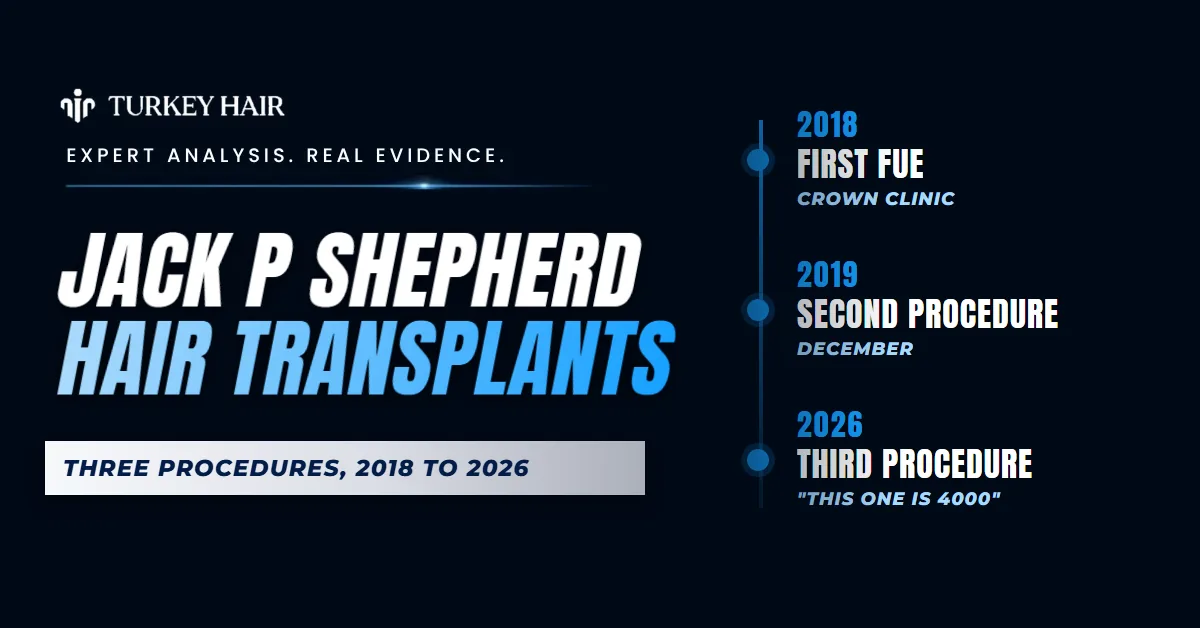
Jack P Shepherd hair transplant timeline: three procedures in 2018, 2019 and 2026, the shaved head he revealed in June 2026 and his hair growth, in his words.
Jack P Shepherd has had three hair transplants, by his own account: one in 2018, one in 2019 and a third in June 2026. The Coronation Street actor said the third was the first one he had with a shaved head, and that it used more hairs than the two before it. This page puts every dated claim in one place, says who made it, and explains what the numbers mean for anyone weighing up a transplant of their own.
Quick answer: Yes. On the On the Sofa podcast, reported on 09.06.2026, he said: "This is my third one." He has not named the clinic, the method or the cost of the third procedure. He thanked Crown Clinic in Manchester for the first.
Who Jack P Shepherd Is and Why His Hairline Gets Noticed
Jack Peter Shepherd was born on 14.01.1988. He is best known for playing David Platt on the ITV soap Coronation Street, a role he has held since 2000, according to his Wikipedia biography. The same page lists awards for the part, including the British Soap Award for Villain of the Year in 2008.
That history explains why a change in his hair is visible to viewers in a way it is not for most men. He has been on screen since he was a child. A hairline that moves back over twenty years shows up in the archive footage, the publicity photos and every new episode. He said as much in 2019, and he repeated it in 2026. He has called his hair vital for his work and has talked about hurtful comments on social media, as the Manchester Evening News reported.
Jack P Shepherd Hair Transplant Timeline
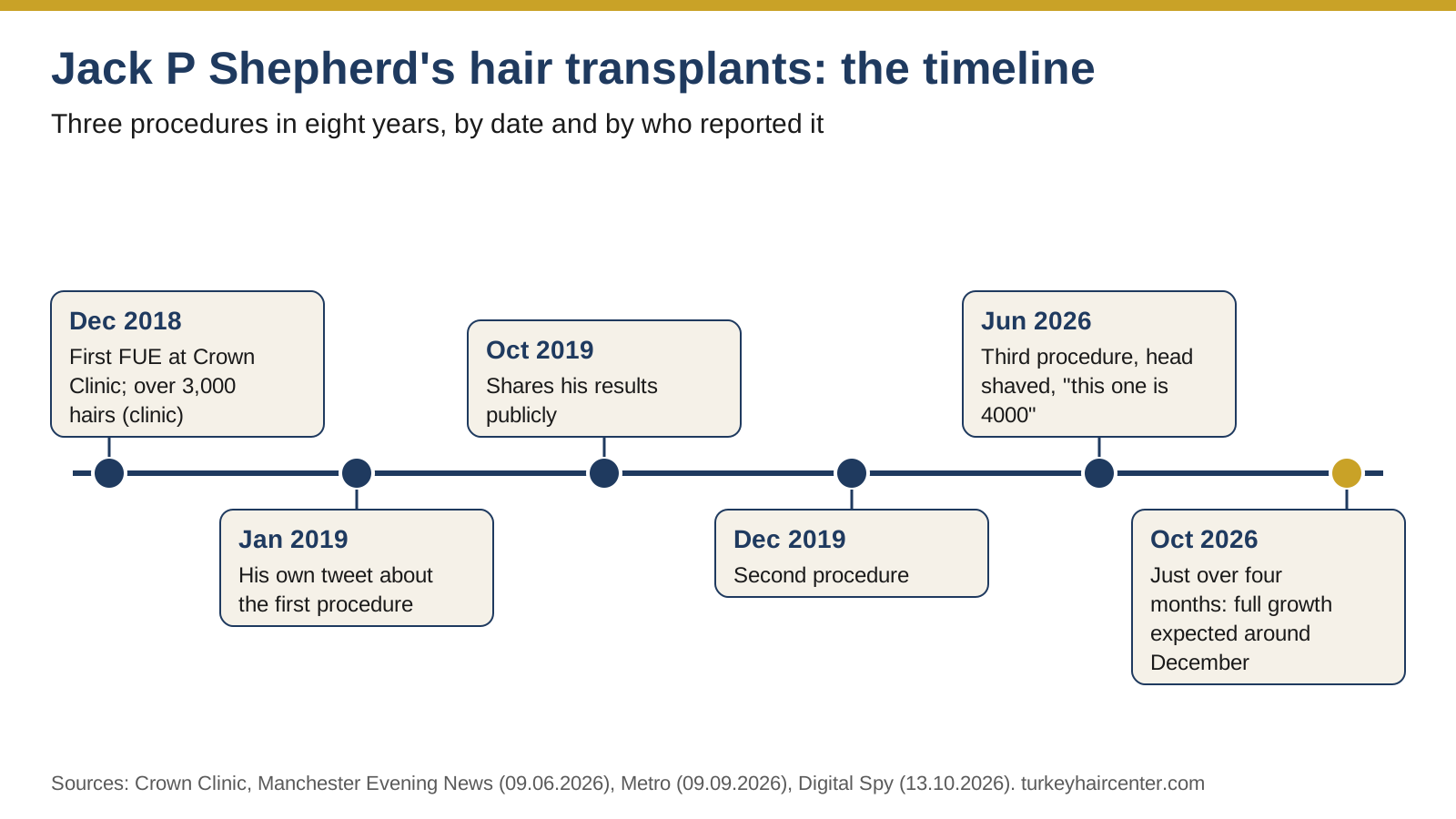
The table lists each claim with its date and the outlet that carried it. Where two sources word the timing differently, both are shown instead of being forced into one version.
When
What was said or reported
Source
Status
December 2018
FUE procedure with Dr Asim Shahmalak during the show's two-week Christmas break; more than 3,000 hairs into the temples and frontal hairline
Crown Clinic case study (undated page)
Clinic's account
25.01.2019
Thanked Dr Shahmalak and Crown Clinic in a tweet; said hair loss had "really escalated in the last year"
Yahoo UK
His own post
02.10.2019
Shared his results; said he began the process "at the beginning of the year"
Digital Spy
His own words
December 2019
Second procedure, "exactly a year after his first"
Manchester Evening News, 09.06.2026
Reported
09.06.2026
Said on a podcast it was his third: "I had one in 2018, 2019 and now"
Manchester Evening News
His own words
Mid 2026
Update on Facebook: hairs "starting to fall out now" and the back scar "growing nicely", just over two weeks after surgery
Manchester Evening News (second article)
His own post
09.09.2026
Daughter Constance, born in June, and the on-screen explanation of David's absence
Metro
Reported
13.10.2026
"Just over four months" on; full growth expected around six months, in December
Digital Spy
His own words
One discrepancy deserves a note. Crown Clinic dates the first operation to December 2018, which fits the Manchester Evening News line that the second came "exactly a year" later in December 2019. Digital Spy's 2019 piece quotes him saying he began "at the beginning of the year". The two can both be true if the process started with a consultation or planning early in 2018 or 2019, but no source says so, and this page does not guess.
The First Procedure in 2018 at Crown Clinic
The clinic's case study says Shepherd had experienced hair loss for around a decade, and that it had become considerably more noticeable in the year before his procedure. Working in front of the camera made the change hard to ignore. The page quotes him: "I remember seeing myself on screen and thinking: 'Oh my God, it is really falling out.'"
According to the clinic, he had follicular unit extraction (FUE) with Dr Asim Shahmalak during the programme's two-week Christmas break in 2018. It reports more than 3,000 hairs moved into the temples and frontal hairline, and says only a small area at the back of the scalp was shaved, so he could be back at work the following month. These are the clinic's statements about its own patient, not an independent audit, and they are worded as marketing. The facts that line up with other sources are the clinic, the surgeon and the time of year.
In his own words, quoted by the clinic, he wanted "to get my hair back to what it was like before so that I could style it at the front in any way that I like". After the operation he said: "You want your hair to look right and the transplant completely natural. Dr. Shahmalak was recommended to me and, so far, I have been delighted with the results."
What He Said in January and October 2019
On 25.01.2019, when he was 31, he posted a tweet thanking Dr Shahmalak and Crown Clinic, according to Yahoo UK. The report quotes him saying his hair loss had "really escalated in the last year, particularly at the front of my scalp". He said a friend's transplant had influenced him, and he described the operation as "like a male version of the boob job", a joke about a cosmetic choice people tend to keep quiet.
In October 2019, Digital Spy reported that he shared his results and linked the hair loss to stress and insomnia. He told the outlet he had felt "depressed" through his twenties. He said that as an actor his hair and looks were "crucial to my success", and he rated the new hairline "1000% better". He also joked about an "Elvis quiff".
Two things stand out. He framed the operation around his mental health as much as his looks. And he made it public within weeks, at a time when many men with a transplant say nothing at all.
The Second Procedure in December 2019
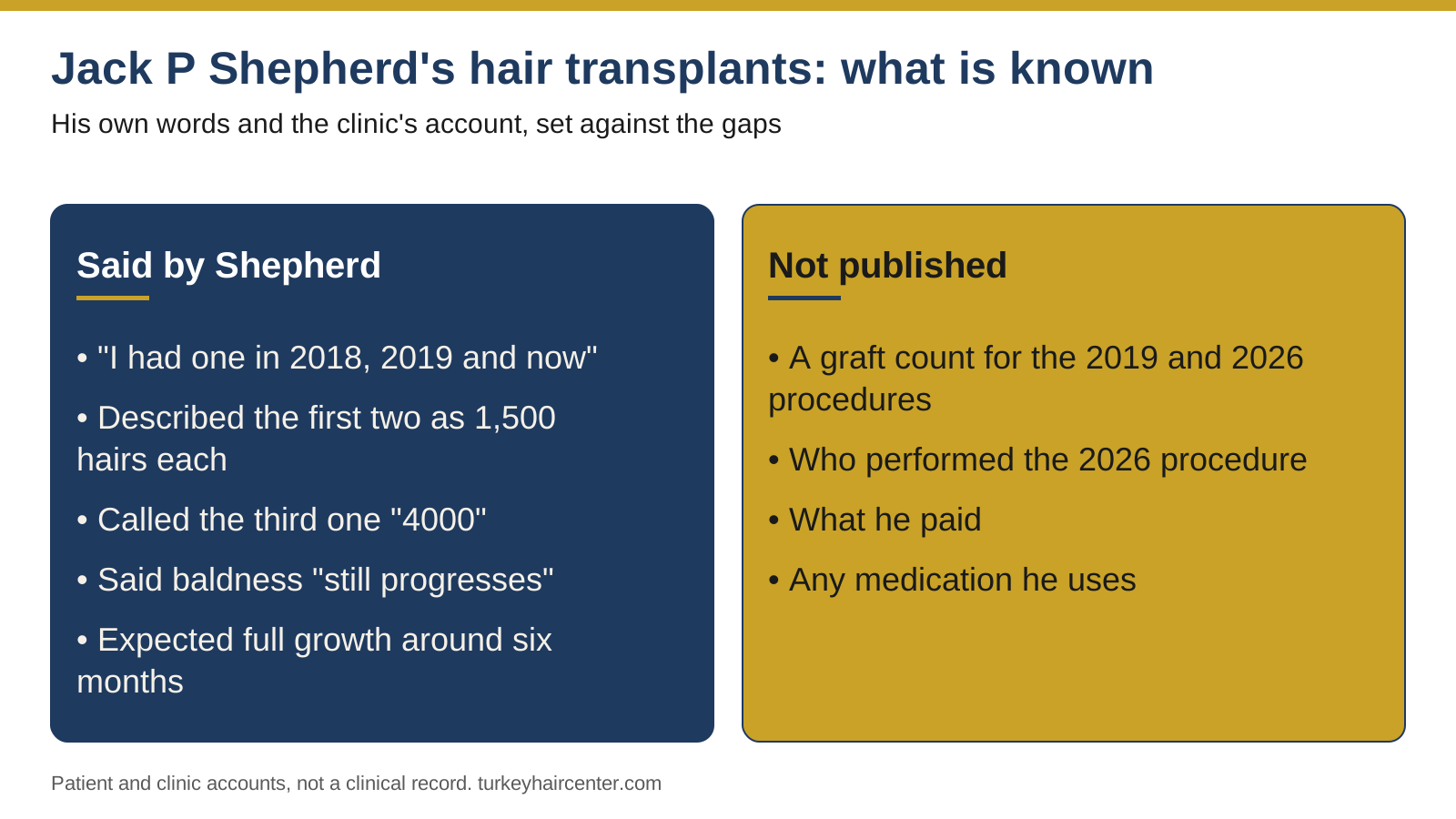
The second operation is the least documented of the three. The only source is the Manchester Evening News, which wrote in 2026 that it took place in December 2019, "exactly a year after his first". Shepherd's own words on the podcast confirm the year: "I had one in 2018, 2019 and now." No clinic, graft count or surgeon has been named for it.
He did say the first two sessions were about the front and sections of the scalp, and that "the two times before, I only had 1500 hairs put in, so 3000". Read next to Crown Clinic's "more than 3,000 hairs" for the first operation alone, the figures do not match. The likely reason is that clinics and patients count differently: some count grafts, some count hairs, and a casual podcast figure is not a surgical record. This page reports both numbers and does not choose between them.
The Third Procedure in 2026 and the 4,000 Figure
The Manchester Evening News published the podcast story on 09.06.2026, written by Jessica Sansome. Shepherd said: "This is my third one... I had one in 2018, 2019 and now. So I've had it all done mainly on the front and sections." He added that this time "this one is 4000".
He explained why he went again. Baldness, he said, "still progresses as time goes on". Later, to Metro, he said he could see his hairline further back in the middle and decided to "act now while I could", adding that he had a bit of time off for the baby. His daughter Constance was born in June, at home, Metro reported. His wife Hanni had been worried about photos around the birth, according to the podcast report.
The podcast is On the Sofa, hosted by Ben Price and Colson Smith. Smith had a transplant of his own in 2024 and said of the shaved look: "I think it's a look... I actually quite like it." Reactions from colleagues were friendly. Jane Danson said she thought it suits him and Danny Miller said "Looking good brother."
Why He Shaved His Head This Time
The third operation was the first time he shaved his whole head for the procedure. His reason, as quoted: "you get a lot more hair follicles if you shave the head. If you're having to go in between hairs, it's more difficult."
That matches how the technique is described in general terms. Hair transplantation moves follicles from a donor site to a thinning area, and modern surgery works with natural groupings of one to four hairs, as Wikipedia's overview sets out. In follicular unit extraction, the surgeon needs to see each unit clearly. Short hair across the whole donor zone gives a wider area to harvest from.
The trade-off is visible on the day. In 2018 only a small patch at the back was shaved, and the clinic highlights that he could work again soon after. A full shave gives the surgeon more to work with, and it also announces the procedure. Which approach suits you depends on the planned graft count, your job and how fast you need your hair to look normal again. A reliable surgeon will explain both options before you decide.
Shaving the whole donor zone: more follicles available in one session, a visible change on day one.
Shaving only a small patch: a discreet recovery, but a smaller harvest area.
No shave at all: possible with some surgeons and cases, but the plan has to fit the donor area.
Your timing: a planned break from work or public life helps, as it did for him in 2018 and 2026.
Recovery: What He Reported Week by Week
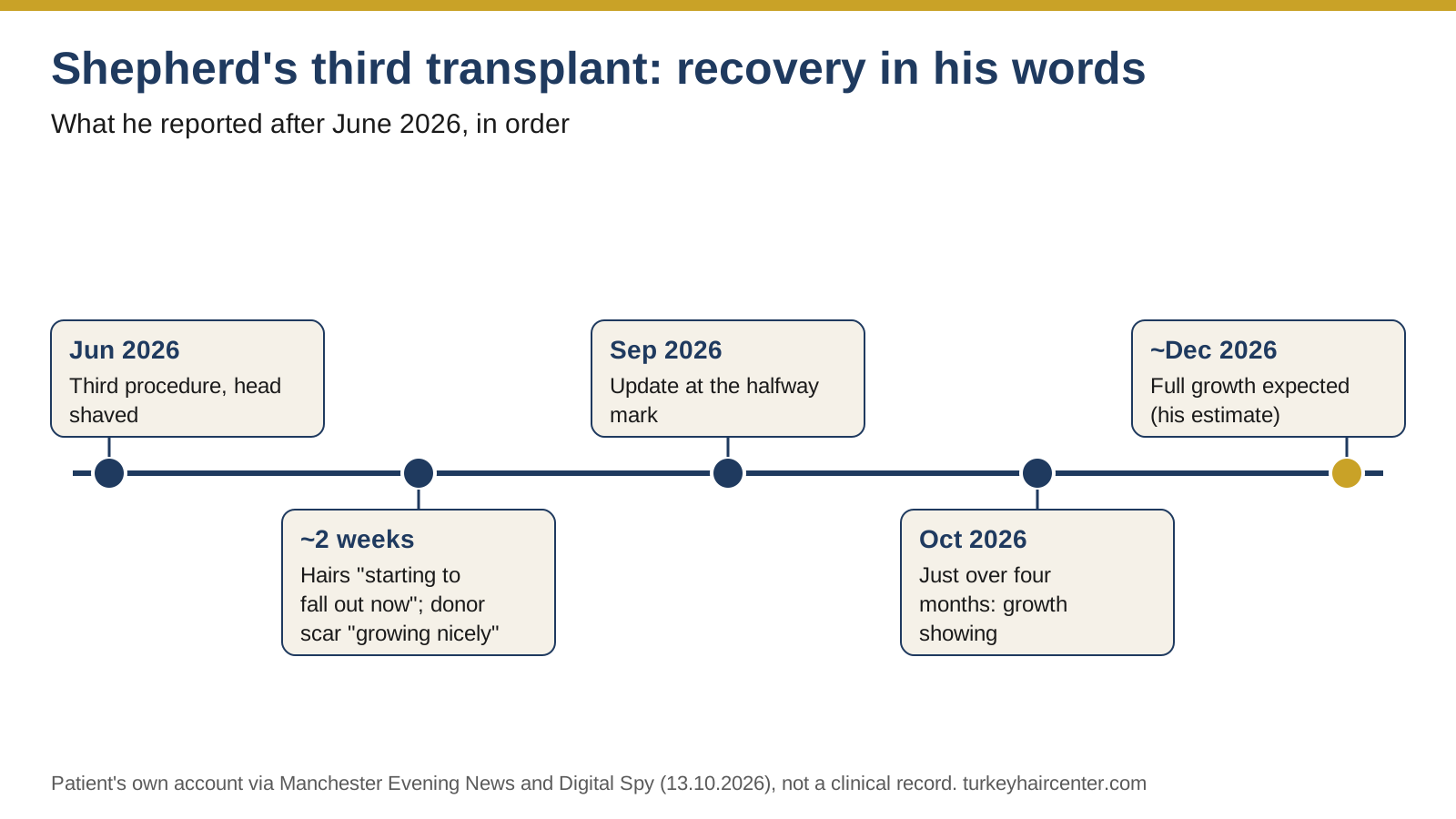
The picture from his own updates is typical of the first months. In the Facebook update covered by the Manchester Evening News, just over two weeks after the third procedure, he said the transplanted hairs were "starting to fall out now", that he was "kind of used to it" by his third time, and that the scar at the back was "growing nicely".
By 13.10.2026, Digital Spy quoted him at just over four months. He expected full growth by about six months, which would be around December, and joked that he looked like "Elvis" or "Cousin Itt" at that stage. The same article says his previous update came in September, at the halfway mark.
Each point is the patient's own account, not a clinical record. The useful reading is the order of events: an early shed, a quiet phase, then visible growth in the months that follow. Our hair transplant recovery timeline goes through those stages in more detail.
First days: wound care, rest and a scalp that looks red and sore.
Around two weeks: transplanted hairs begin to fall out, as he described.
Months two and three: little visible change, which worries many patients unnecessarily.
Around four months: new hair becomes noticeable.
Around six months: fuller growth, in his case expected by December.
Why One Transplant Was Not the End of It
Three operations in eight years raises an obvious question: did something fail? Nothing in the sources says so. What Shepherd described is the normal course of pattern hair loss. The NHS states that male and female pattern baldness is permanent and runs in families, and that people lose 50 to 100 hairs a day as part of normal shedding. A transplant moves hair that resists loss. It does not stop the hair around it from thinning.
The published literature says the same. A review in the Journal of the American Academy of Dermatology, "Hair transplantation: Basic overview" (Jimenez, Alam, Vogel and Avram, 2021), notes that not all hair disorders suit transplantation and gives guidelines for good and bad candidates. A newer review in Dermatologic Surgery, "Hair Transplantation: State of the Art" (Queen and Avram, 2025), says thoughtful hairline design and concurrent medical management have improved results.
The practical message: a transplant is one part of a long plan. If you are in your twenties or thirties, the surgeon should talk about where the hairline will sit in ten and twenty years, and how much donor hair to keep in reserve. Read our guide to how long a hair transplant lasts before you commit.
Medication Alongside Surgery
Nothing in the coverage says whether Shepherd uses hair-loss medication. That is worth stating, because the question comes up whenever someone has repeat surgery. The general picture, from public medical sources, is this.
The NHS page on finasteride says it is also used to treat hair loss in men, but this is not available on the NHS and needs a private prescription.
The same page says you usually need to take it for 3 to 6 months before symptoms improve.
A 2022 review in the Journal of Dermatological Treatment, comparing oral minoxidil, finasteride and dutasteride (Gupta, Talukder and Williams), ranks the likely efficacy of the options and lists different side effects for each.
According to that review, oral minoxidil and oral dutasteride were not approved for hair loss in most places, so clinicians use them off-label, although Japan and South Korea have approved oral dutasteride for male pattern hair loss.
None of this is advice. Medicines for hair loss have side effects and interactions, and the decision belongs to you and a doctor. The NHS also suggests seeing a GP before going to a commercial hair clinic, which is sound advice for anyone unsure whether their hair loss has a treatable cause.
Hairs, Grafts and the Numbers Behind 1,500, 3,000 and 4,000
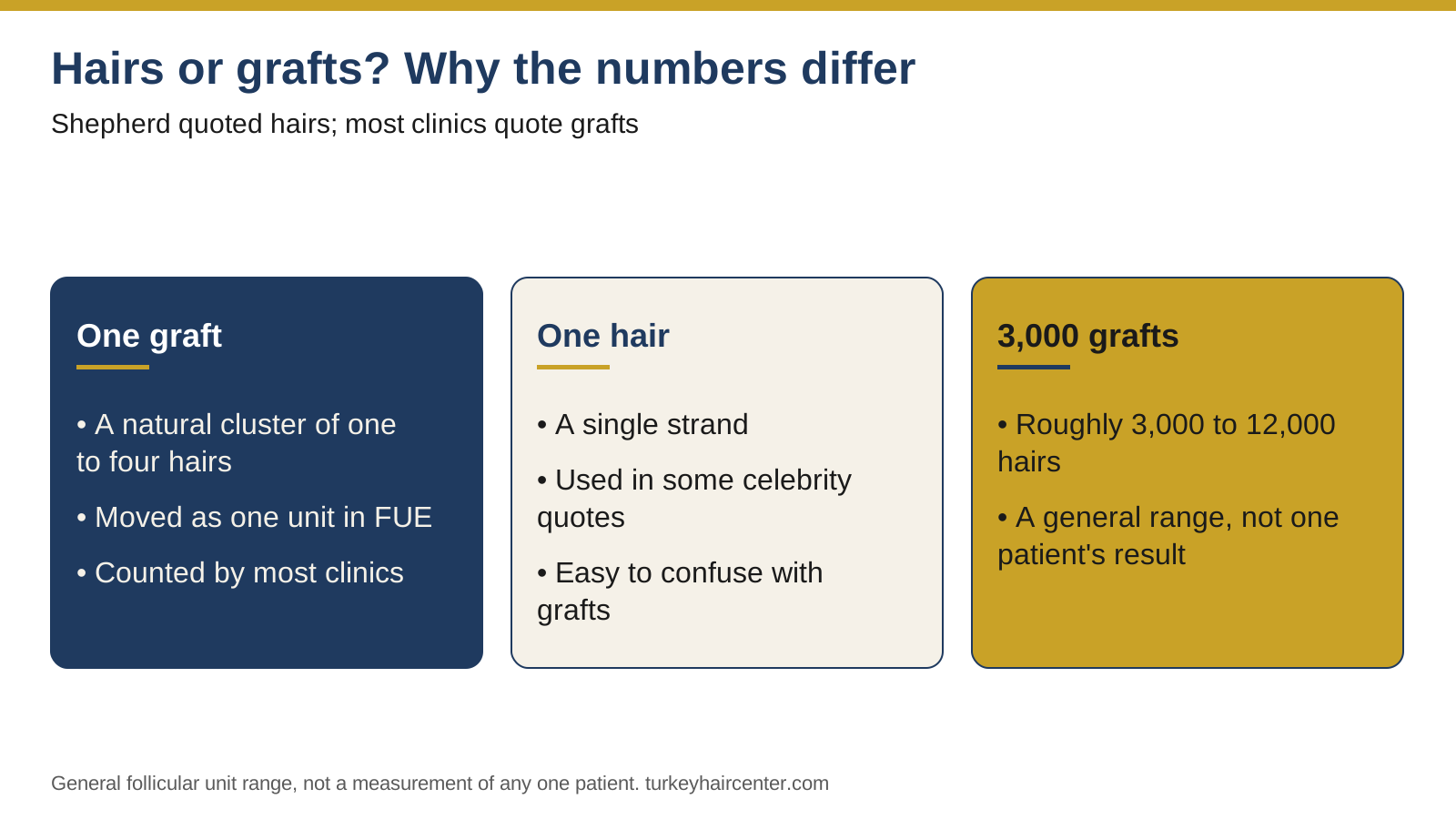
Shepherd's counts are in hairs, and clinics often talk in grafts. A graft is a natural cluster of one to four hairs, so a hair count and a graft count are different numbers. A session of 3,000 grafts could mean something between 3,000 and 12,000 hairs. That is a general range, not a measurement of any one patient.
Number quoted
Who said it
What it describes
More than 3,000 hairs
Crown Clinic
First operation, temples and frontal hairline, December 2018
1,500 hairs each, so 3,000
Shepherd, on the podcast
His description of the first two operations
4,000
Shepherd, on the podcast
His description of the third operation, shaved
The mismatch between the first two rows is a lesson in itself. If you collect quotes from different clinics, make sure you compare like with like. Ask whether the figure is grafts or hairs, whether it is the planned or the delivered number, and which areas it covers. Our guide on how many grafts you need explains how the count follows your hair loss pattern and donor density.
FUE, FUT and Choosing a Method
Crown Clinic describes Shepherd's first operation as FUE, where follicles are taken one by one from the donor area. The other main method, strip harvesting (FUT), removes a strip of scalp from the back and leaves a thin linear scar, which is usually covered by the surrounding hair, according to the Wikipedia overview cited above. Shepherd has not said which method he used in 2019 or 2026, and the sources do not either.
Few men have their hairline recorded in front of millions for twenty years. Shepherd's story is a useful case study anyway, because the choices he described are common.
He acted early, in his early thirties, rather than waiting until the loss was advanced.
He planned around work, using a break in filming in 2018 and time off for the baby in 2026.
He accepted that more than one session might be needed.
He talked about it openly, which gave other men permission to ask questions.
Colson Smith's comment is telling. A colleague with his own transplant said he quite liked the shaved look, and no one in the coverage treats the procedure as a secret. The tone has changed since the 2019 coverage, when Shepherd himself joked about it as the male equivalent of a cosmetic operation people hide.
How Coronation Street Handled the Change on Screen
In September 2026 the show addressed the new look in the story. According to Metro, David Platt's absence was put down to a visit to his mother Gail in France, and a character asked about his shaved head. The report does not say the programme gave any medical explanation. It was a one-off scene, not a storyline about hair loss.
For viewers this bridged the gap between a real shaved head and a character who had been on screen with a full head of hair weeks earlier. For anyone planning a transplant it is a reminder that the early phase of recovery is visible, and that work and social plans need to allow for it.
Questions to Ask Before You Book a Transplant
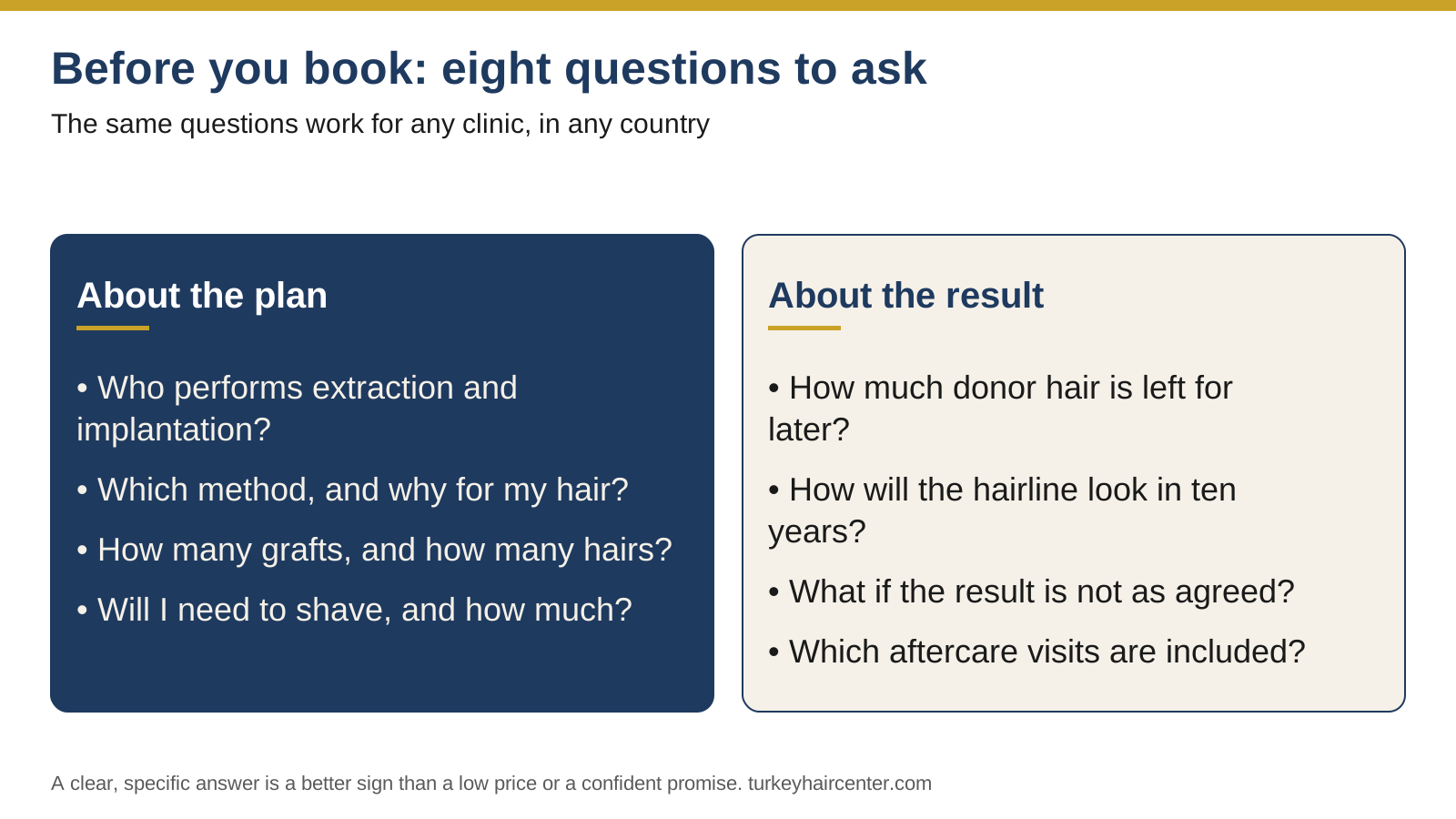
The International Society of Hair Restoration Surgery describes itself as a global non-profit medical association with more than 1,000 members in 70 countries, founded in 1993. Its patient pages are a reasonable place to start when checking what a surgeon should tell you. Use the list below in any consultation.
Who will perform the extraction and implantation, and who will be in the room?
Which method is planned, and why does it suit my hair?
How many grafts are planned, and how many hairs does that mean for me?
How much donor hair will be left for any future session?
What will the hairline look like at my age in ten years?
What happens if the result is not what we agreed?
Will I need to shave, and how much?
What aftercare and follow-up visits are included?
You can ask the same questions of any clinic, in any country. A clear, specific answer is a better sign than a low price or a confident promise.
Jack P Shepherd Hair Transplant FAQs
Has Jack P Shepherd had a hair transplant?
Yes. He said in June 2026 that he has had three, in 2018, 2019 and 2026.
Where did Jack P Shepherd have his hair transplant?
He thanked Crown Clinic in Manchester for the first one, performed by Dr Asim Shahmalak. The clinic for the second and third procedures has not been named in any source we found.
Why did Jack P Shepherd shave his head?
He said a shaved scalp gives the surgeon more follicles to work with: "you get a lot more hair follicles if you shave the head."
How many hairs did he have transplanted in 2026?
He said "this one is 4000", after saying the two earlier sessions placed 1,500 each. These are his own figures from a podcast, and they are counted in hairs, not necessarily grafts.
When did he first show his results?
He shared photos of his first transplant on 25.01.2019 and talked about the results to Digital Spy on 02.10.2019.
Did Coronation Street explain his shaved head?
Yes, in a scene in September 2026, according to Metro. David Platt's absence was put down to a visit to his mother in France.
Has he said what the transplants cost?
No source we read gives a price for any of the three. We do not estimate it.
Considering Hair Restoration for Your Own Hairline?
Turkey Hair Center's own team performs procedures at contracted hospitals and polyclinics in Istanbul; the package price range is $2,550 to $4,500. See the cost guide, read about other public figures on the celebrity hair transplant page, or send photos on the contact page for an assessment.
Send three photos: front, top and sides. You get a technique recommendation, a graft range and a straight answer about what is achievable, before anyone talks about price.
Your details are with the team
A patient coordinator will get back to you shortly. If you would like to send your photos now, WhatsApp is the fastest way to do it.
Real People Real Support
Send your photos on WhatsApp
Front, top and both sides, reviewed by the medical team.