Vellus Hair vs Terminal Hair: Differences, Changes and Hair Loss
How fine vellus hair and thick terminal hair differ, how puberty and pattern hair loss switch one into the other, what baby hairs at the hairline mean, and why a transplant moves terminal hair.
12sources
12in PubMed
8min read
Written by Nazmi Güldeş, Certified Trichologist · Medically reviewed by Dr. Teuku Adifitrian, Sp.BP-RE (Dr. Tompi), Plastic, Reconstructive and Aesthetic Surgeon · Last reviewed 31 October 2026
Reading level
Vellus hair vs terminal hair is a difference in size. Vellus hair is the soft, pale fuzz on much of your face and body; terminal hair is the thick, pigmented hair of your scalp and, after puberty, your armpits, groin and, in men, the beard. The same follicle can switch from one type to the other, in both directions.
That switch explains puberty and, run backwards, pattern hair loss.
1Quick answerThe short answer, in a few sentences
Vellus Hair vs Terminal Hair: The Difference
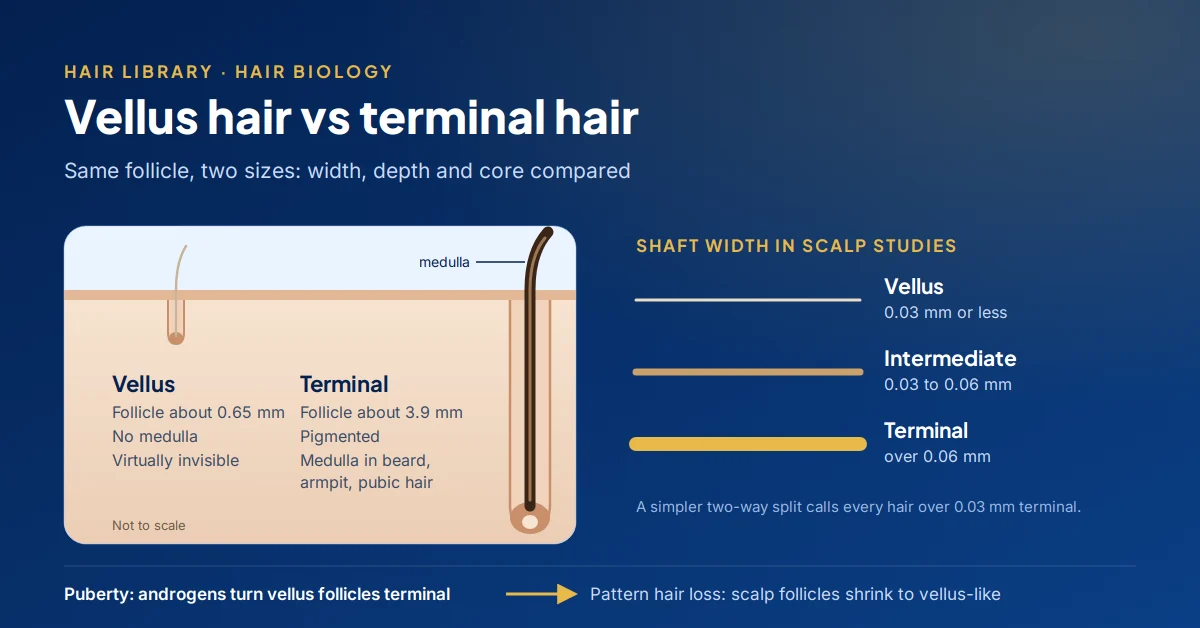
Vellus hairGlossaryVellus hair is the fine, short, pale hair that covers most of the body. It is under 30 micrometres wide and under 2 millimetres long. Open in the glossary → is short, fine and nearly invisible, with no central core, or medulla. Terminal hairGlossaryTerminal hair is thick and pigmented, over 60 micrometres wide and longer than 2 centimetres. It grows on the scalp, eyebrows, armpits, beard and pubic region. Open in the glossary → is thicker and pigmented. On the scalp, a hair 0.03 mm wide or thinner counts as vellus.[1] Androgens turn vellus follicles terminal at puberty, and in pattern hair loss scalp follicles shrink back toward vellus.
2Complete guideFrom peach fuzz and puberty to miniaturization and surgery
How Vellus and Terminal Hair Compare
Vellus hair
Terminal hair
Shaft width
Vellus hair
0.03 mm or less
Terminal hair
Over 0.03 mm, or over 0.06 mm when intermediate hairs are split off
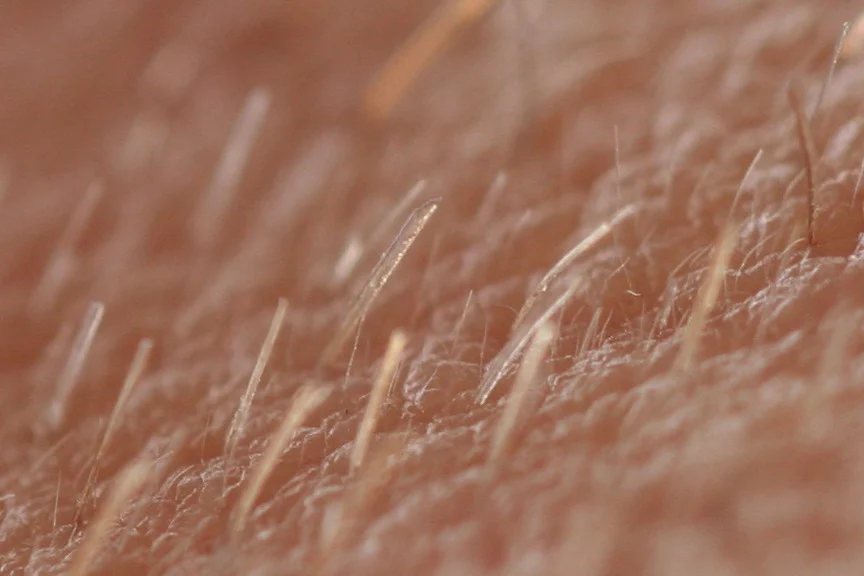
Peach fuzz is vellus hair, and your face carries a lot of it: about 439 hairs per cm² on the forehead, against 85 on the back.[4] Your chest and back carry it too, more sparsely.
In women, excess hair growth is called hirsutism, another sign of androgens at work. Here is how we'd read the fine hairs you notice:
What you notice
What it probably is
A sensible next step
Fine hairs at the hairline that were always there
What it probably is
Normal vellus "baby hairs"
A sensible next step
Compare with old photos
Hairs at the front, mid-scalp or crown getting finer
What it probably is
Terminal hairs miniaturizing
A sensible next step
Have it assessed early
Thinning at the back as well as on top
What it probably is
Pattern loss can reach the back, though less than the front[5]
A sensible next step
A scalp exam before any surgery
New coarse, dark hairs on a woman's face or body
What it probably is
Vellus follicles turning terminal
A sensible next step
See a doctor about the cause
How Hair Switches Between Vellus and Terminal
Vellus to Terminal at Puberty
Androgens are the main switch. Around puberty they turn vellus follicles in the armpits and groin terminal in both sexes, and the beard in men, by changing how long the hair grows, the size of the dermal papilla and the activity of pigment cells.[6] The new hairs also gain a medulla. The growth phase is explained in our hair growth cycle entry.
The response varies by body site because it is specific to the follicle itself, so the same androgens that stimulate a beard can later inhibit scalp hair.[6]
Terminal to Vellus-Like in Pattern Hair Loss
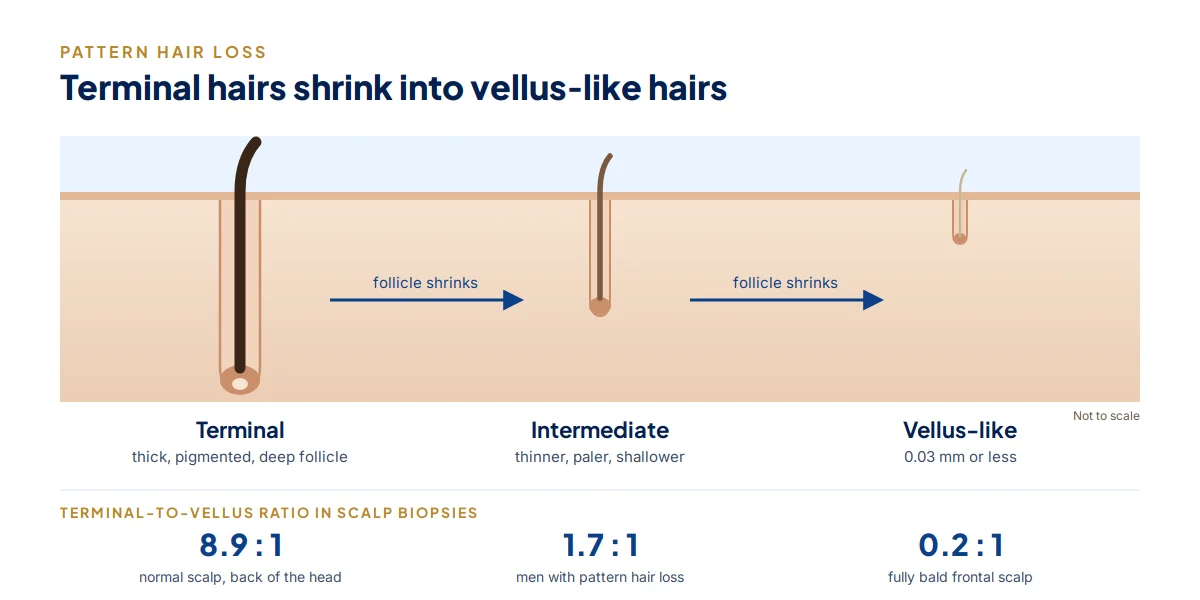
In pattern hair loss the switch runs backwards: terminal scalp follicles shrink into miniaturized, vellus-like ones.[7] Biopsies track this as the ratio of terminal to vellus hairs: about 8.9 to 1 at the back of a normal scalp[8], 1.7 to 1 on average in men with pattern hair loss[9] and 0.2 to 1 on fully bald frontal scalp.[5]
Terminal-to-vellus ratios in scalp biopsies. Diagram: Turkey Hair Center, not to scale.
One study of women used a terminal-to-vellus ratio of 3 to 1 or lower as its diagnostic cut-off.[1] Why some follicles react to DHTGlossaryDihydrotestosterone (DHT) is a potent androgen that the body makes from testosterone using an enzyme called 5-alpha reductase. In people who are genetically sensitive to it, DHT makes hair follicles shrink. Open in the glossary → is covered in DHT and hair loss. The female pattern is covered in our female pattern hair loss entry.
Baby Hairs on the Hairline: Vellus or Miniaturized?
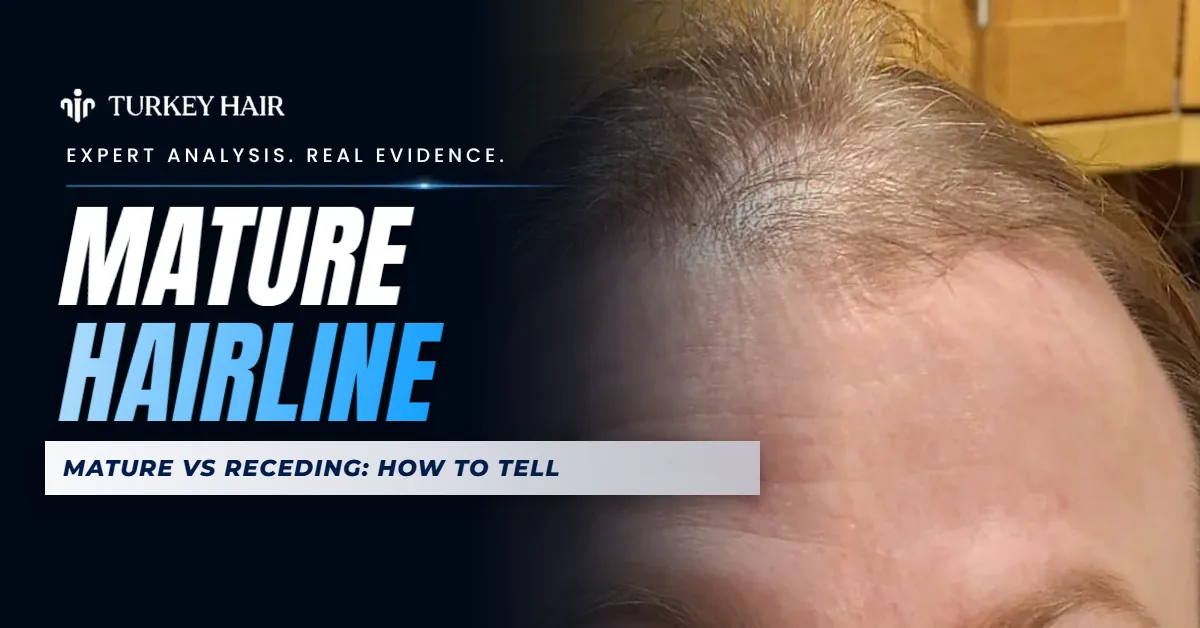
Some fine hair along the hairline is normal. Under magnification, about 6% of hairs at the front of healthy women's scalps were thinner than 0.03 mm, against about 21% in women with pattern hair loss.[10]
What matters is change: edges that used to be thicker and now look wispy suggest miniaturizing hairs. Our mature hairline guide shows how to check.
Is Vellus Hair a Sign of Regrowth?
It can be, if the fine hairs are thickening. In one trial, sublingual minoxidil at 1.35 mg and 4.05 mg a day widened hairs over 24 weeks, intermediate ones most of all, while hairs on placebo got thinner.[7]
What is left matters: in one biopsy study, men with fewer than 2 follicular structures per mm² regrew nothing on topical minoxidil.[9] Oral finasteride and topical minoxidil are the effective medicines, though not everyone responds.
Vellus Hair, Terminal Hair and Hair Transplants
A transplant moves terminal follicles from the donor areaGlossaryThe donor area is the back and sides of the head, where follicles resist DHT. An extracted follicle does not grow back in that spot, so extractions are spread out, and the donor supply is the limit of every plan. Open in the glossary → at the back of the scalp, which resist androgens.[11] Even in men with fully progressed pattern loss, the back still had about 3.5 terminal hairs for every vellus hair.[5]
A transplant can make sense when:
the thinning area has few follicles left
the back of the scalp still carries terminal hair
you will keep treating the native hair around the grafts
It is the wrong answer when:
the fine hairs are normal vellus, such as lifelong baby hairs
your hairs are miniaturizing but still there, and medicine may widen them first
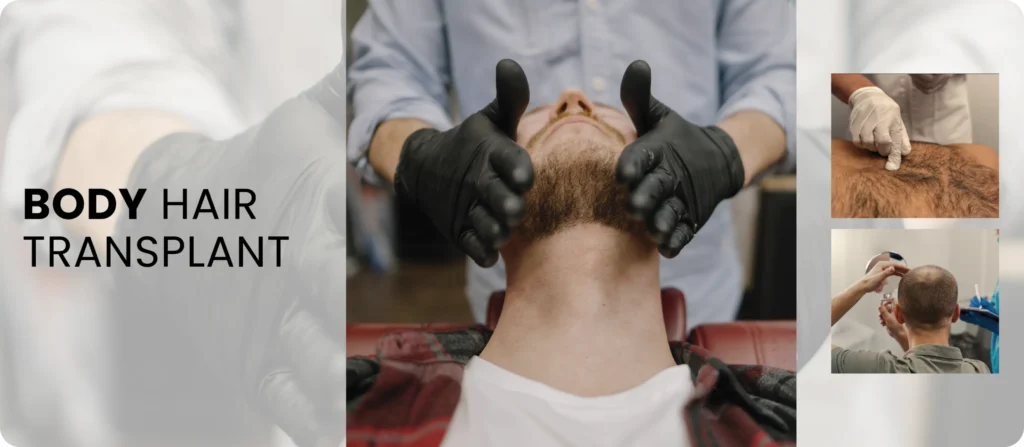
When scalp donor hair is short, our body hair transplant page explains the beard and body options.
Frequently Asked Questions
Can vellus hair turn into terminal hair?
Yes. Androgens do it at puberty, and miniaturized scalp hairs can widen again on treatment.
How long does it take vellus hair to turn terminal?
No study we found timed a single hair. The trial cited here measured hair width at 24 weeks, so think in months.
Can vellus hairs become terminal with minoxidil?
Some can. Topical minoxidil trials did not show wider hairs, but higher sublingual doses did, and minoxidil turned vellus follicles back to terminal in a humanized mouse model.
Can you grow more baby hairs along the hairline?
Only in part. We found no study of a treatment that thickens hairs that were always vellus. If your edges used to be fuller, those hairs may be miniaturizing, which is worth checking early.
Is peach fuzz vellus hair?
Yes. Peach fuzz is facial vellus hair, far denser than on your back.
What is the difference between vellus hair and lanugo?
Lanugo is the fine hair a fetus grows, first appearing on the back of the trunk around the 17th week of fetal life.[12] Vellus hair is the fine hair on much of an adult's face and body.
Does vellus hair have a medulla?
No. Vellus hairs have no medulla; beard, armpit and pubic hairs gain one at puberty under androgens.
Should You Worry About Fine Hair on Your Scalp?
Fine hair on your face and body is normal, and so are a few soft hairs at the hairline. Fine scalp hair is worth checking when it replaces thicker hair over time, because miniaturized hairs can still widen on treatment.
Send us three photos for a free hair analysis, and the medical team will tell you whether your fine hairs look miniaturized and whether medication, a transplant or both fit. You can also message us on WhatsApp.
About the Author
Written by: Nazmi Güldeş, Certified Trichologist. Nazmi Güldeş focuses on patient education around androgenetic alopecia, evaluating miniaturization through dermoscopy, and assessing candidates for medical treatments and hair transplants.
Editorial Policy & Trust
This entry was medically reviewed by Dr. Teuku Adifitrian, Sp.BP-RE (Dr. Tompi) on 31 October 2026. Every study cited here was checked against PubMed on 31 October 2026. Key figures are marked with their source, and every source is listed at the end of this entry. Read how we work in our editorial policy.
3 questions
Test yourself
Check what you remember from this entry. Each answer links back to the section that explains it.
In scalp biopsy studies, how wide is a hair that counts as vellus?
A hair 0.03 mm wide or thinner counts as vellus. Some studies also split off intermediate hairs between 0.03 and 0.06 mm. Read the section
What turns vellus follicles in the armpits, pubic area and beard into terminal ones at puberty?
Androgens change how long the hair grows, the size of the dermal papilla and pigment-cell activity, and the new hairs gain a medulla. Read the section
Why does a hair transplant take grafts from the back of the scalp?
Follicles at the back of the scalp resist androgens, so they keep making terminal hair: even in men with fully progressed pattern loss, the back still had about 3.5 terminal hairs for every vellus hair. Read the section
3Scientific evidenceStudy types, references and how to cite this entry
12sources
Evidence behind this entry: 12 publications indexed in PubMed (1991 to 2026): 5 clinical studies, 4 lab studies, 2 reviews and 1 randomized trial. 2 sources have free full text. 1 article has a published correction, shown in the references.
Randomized trialpeople assigned to treatments by chance
Reviewsummarises many studies
Clinical studya study in people without random groups
Lab studytested on cells or hair follicles in the lab
Kakizaki P, Rocha VB, Machado CJ, et al. Diagnostic Performance of the Trichogram Compared to Histopathology of Scalp Biopsy in Horizontal Sections in Female Androgenetic Alopecia: A Retrospective Study. Skin Appendage Disorders. 2026;12(4):260-265.Clinical studyPubMedDOIFree full text
Jave-Suarez LF, Langbein L, Winter H, et al. Androgen regulation of the human hair follicle: the type I hair keratin hHa7 is a direct target gene in trichocytes. The Journal of Investigative Dermatology. 2004;122(3):555-564.Lab studyPubMedDOI
Vogt A, Hadam S, Heiderhoff M, et al. Morphometry of human terminal and vellus hair follicles. Experimental Dermatology. 2007;16(11):946-950.Lab studyPubMedDOI
Blume U, Ferracin J, Verschoore M, et al. Physiology of the vellus hair follicle: hair growth and sebum excretion. The British Journal of Dermatology. 1991;124(1):21-28.Clinical studyPubMedDOI
Kim JN, Lee JY, Shin KJ, et al. Morphological and morphometric study of the androgenetic alopecic scalp using two- and three-dimensional analysis comparing regional differences. The British Journal of Dermatology. 2014;170(6):1313-1318.Lab studyPubMedDOI
Randall VA. Androgens and hair growth. Dermatologic Therapy. 2008;21(5):314-328.ReviewPubMedDOI
Sinclair R, Sicinska J, Bokhari L, et al. Sublingual minoxidil increases fibre diameter in male androgenetic alopecia: a proxy for reversal of hair follicle miniaturization. Clinical and Experimental Dermatology. 2025;50(7):1362-1365.Randomized trialPubMedDOI
Visessiri Y, Pakornphadungsit K, Leerunyakul K, et al. The study of hair follicle counts from scalp histopathology in the Thai population. International Journal of Dermatology. 2020;59(8):978-981.Clinical studyPubMedDOI
Whiting DA. Diagnostic and predictive value of horizontal sections of scalp biopsy specimens in male pattern androgenetic alopecia. Journal of the American Academy of Dermatology. 1993;28(5 Pt 1):755-763.Clinical studyPubMedDOIA correction to this article was published: J Am Acad Dermatol 1993 Oct;29(4):554.
Rakowska A, Slowinska M, Kowalska-Oledzka E, et al. Dermoscopy in female androgenic alopecia: method standardization and diagnostic criteria. International Journal of Trichology. 2009;1(2):123-130.Clinical studyPubMedDOIFree full text
Liu Y, Tosti A, Wang ECE, et al. Androgenetic alopecia. Nature Reviews Disease Primers. 2025;11(1):73.ReviewPubMedDOI
Domagała Z, Dąbrowski P, Kurlej W, et al. The sequence of lanugo pattern development on the trunk wall in human fetuses. Advances in Clinical and Experimental Medicine. 2017;26(6):967-972.Lab studyPubMedDOI
Güldeş, N. (2026, October 31). Vellus hair vs terminal hair: Differences, changes and hair loss. Turkey Hair Center Hair Library. https://turkeyhaircenter.com/vellus-hair-vs-terminal-hair/
@misc{guldes2026vellushairvsterminalhair,
  author       = {Güldeş, Nazmi},
  title        = {Vellus hair vs terminal hair: Differences, changes and hair loss},
  howpublished = {Turkey Hair Center Hair Library},
  year         = {2026},
  month        = oct,
  url          = {https://turkeyhaircenter.com/vellus-hair-vs-terminal-hair/},
  note         = {Last updated 31 October 2026}
}
TY  - ELEC
AU  - Güldeş, Nazmi
TI  - Vellus hair vs terminal hair: Differences, changes and hair loss
T2  - Turkey Hair Center Hair Library
PY  - 2026
DA  - 2026/10/31
UR  - https://turkeyhaircenter.com/vellus-hair-vs-terminal-hair/
N1  - Last updated 31 October 2026
ER  -
Talk to our hair team on a free video call, in your language. You receive a written plan with your technique, estimated grafts and all-inclusive price. If a hair transplant isn't right for you, we tell you honestly.
Your information is 100% confidential.
Real People Real Support
Send your photos on WhatsApp
Front, top and both sides, reviewed by the medical team.