Hairline Lowering in Turkey: Hair Transplant or Forehead Reduction?
Performed at authorized partner hospitals Turkey Hair Center is a Ministry of Health authorized health-tourism intermediary, not a clinic.
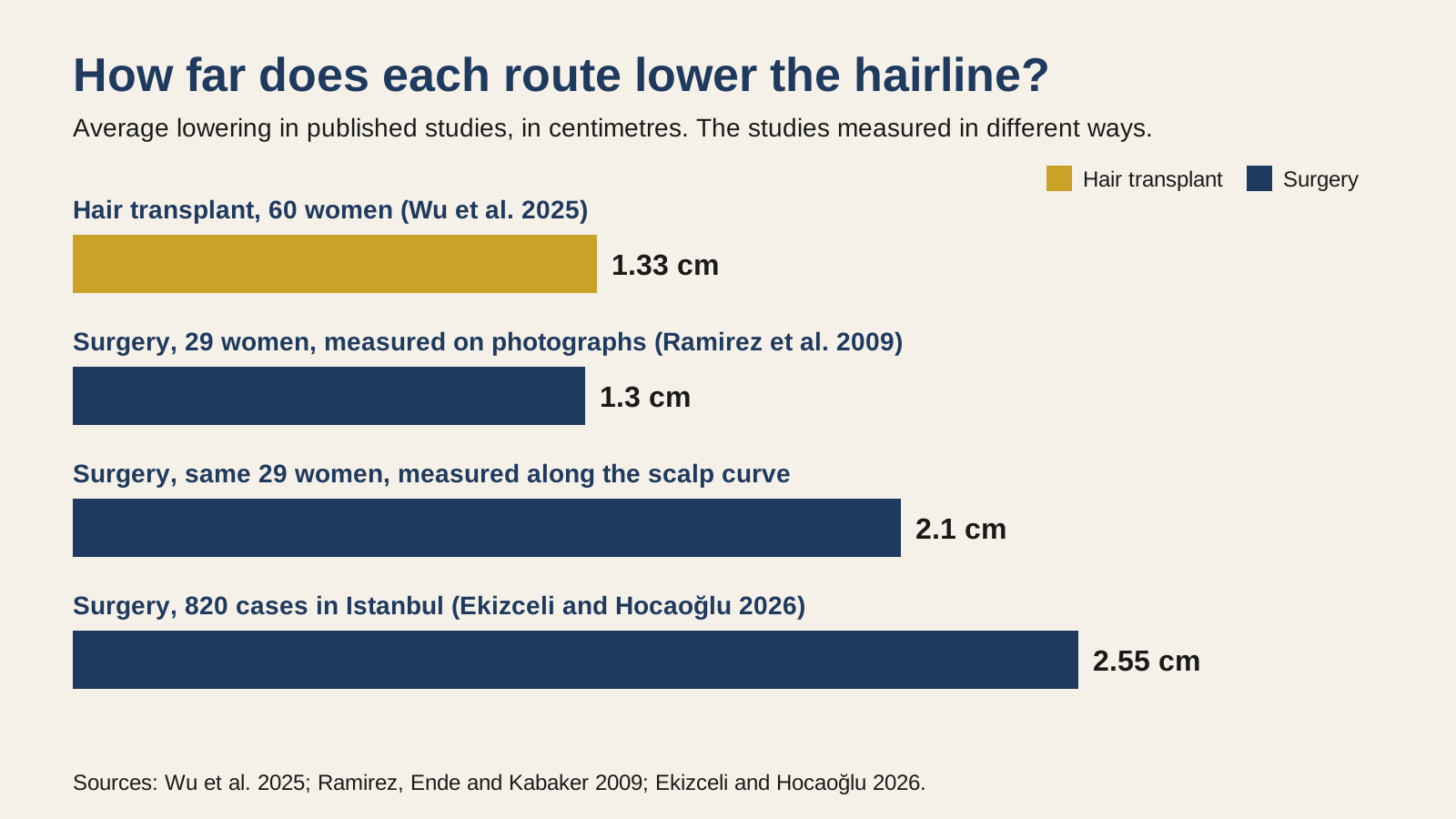
You can lower a hairline in two ways: with a hair transplant that adds hair in front of the current line, or with forehead reduction surgery that removes a strip of forehead skin and moves the scalp forward. In published studies, a hair transplant lowered the middle of the hairline by an average of 1.33 cm in 60 women, and also narrowed the temples. Forehead reduction surgery gave an average of 2.1 cm in one American series and 2.55 cm in 820 cases from Istanbul, in a single operation.
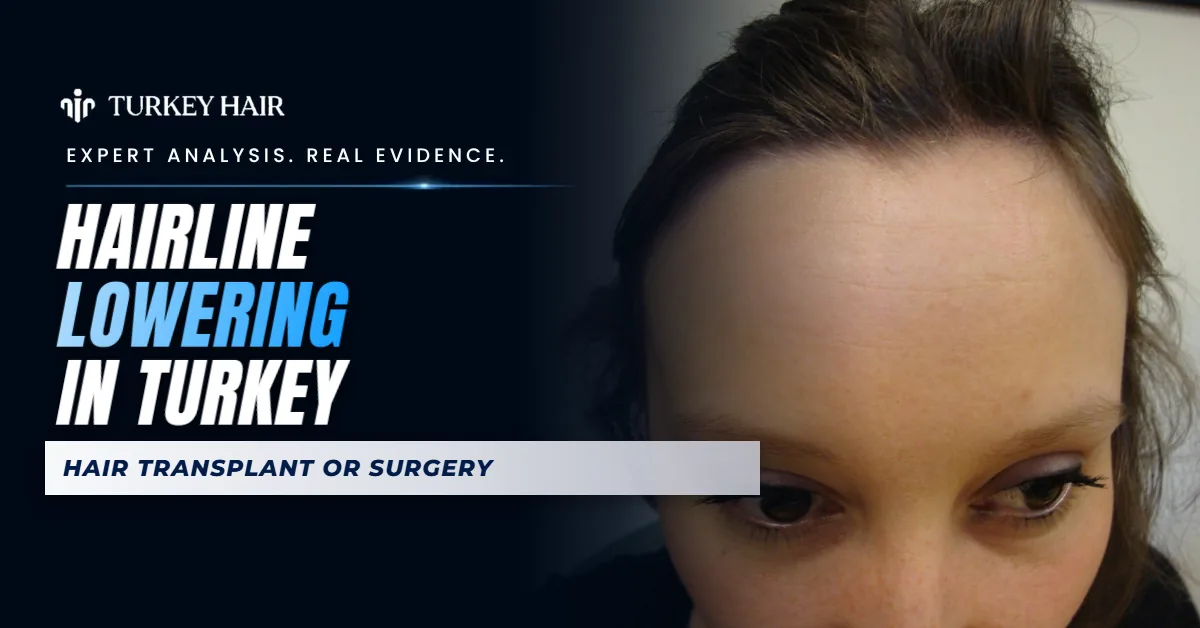
Cover built on a close view of a woman's forehead and hairline. Photo: Faceofwiki, public domain, via Wikimedia Commons, cropped, text and logo added.
The surgery is suited mainly to people with a stable hairline and a mobile scalp, which, as one review puts it, excludes most men. A hair transplant suits a wider group, including men whose hairline is receding.
Here are the short answers to the questions people ask most:
Can a hair transplant lower my hairline? Yes. Three studies of 60 to 89 women used grafts to bring the hairline down and reported high satisfaction.
Which route lowers it more? Surgery, on average, in one day. A transplant usually lowers less but can reshape the corners and temples.
Which leaves a scar on the forehead? Surgery leaves a line along the new hairline. FUE grafts leave small dot scars in the donor area at the back.
Is forehead reduction surgery risky? A 2026 meta-analysis of 3,213 patients found an overall complication rate of 5.9 percent, but almost everyone had temporary numbness.
What does a hair transplant cost in Turkey? Our packages are $2,550 to $4,500 per procedure.
The woman in the cover is not one of our patients, and the picture is not a transplant or surgery result. It shows a natural hairline with the hair pulled back, which is the line both routes below try to move down. Forehead height is measured from this line to the eyebrows.
Average lowering reported in four measurements from three studies. The studies measured in different ways, so the bars show scale, not a contest. Chart: Turkey Hair Center, from Wu et al. 2025, Ramirez et al. 2009 and Ekizceli and Hocaoğlu 2026.
The two middle bars come from the same 29 operations. Measured straight down on photographs, the hairline moved 1.3 cm; measured along the curve of the scalp, the same advancement was 2.1 cm. That is why a single number from a clinic tells you little until you know how it was measured.
Can a Hair Transplant Lower Your Hairline?
Yes. Instead of moving the scalp, a transplant places new hairs in front of the existing hairline, so the forehead looks shorter. The grafts come from the back and sides of the head, where hair is resistant to pattern loss.
Three studies have looked at this in women with high foreheads:
Study
Patients
What they measured
Result
Park, You and Kim 2019
89 women with a high forehead
Satisfaction on a 5 point scale
4.2 from patients, 4.3 from the surgeon; no folliculitis, cysts or asymmetry
Park and Suh 2023
83 women with a long face
Satisfaction on a 5 point scale
4.5 from patients, 4.9 from the surgeon; no adverse events; 3 touch ups for density
Wu et al. 2025
60 women, average age 33
Forehead height and width
Height down 1.33 cm, width between the temples down 1.47 cm
The width figure is the part most comparisons miss. In the Wu study, the forehead started at an average of 7.48 cm high and 14.66 cm wide. The authors write that, compared with forehead reduction surgery, a transplant not only reduces forehead height but also narrows the forehead by adjusting the side hairline, without a linear scar. If your forehead looks wide as well as high, that matters.
A transplant is also the usual route for men. A man's hairline often recedes at the temples over the years, so moving the whole scalp forward does not stop the corners from thinning later. Our guide to the mature hairline explains how a receding male hairline is planned, and widow's peak hair transplant covers the shape of the middle point.
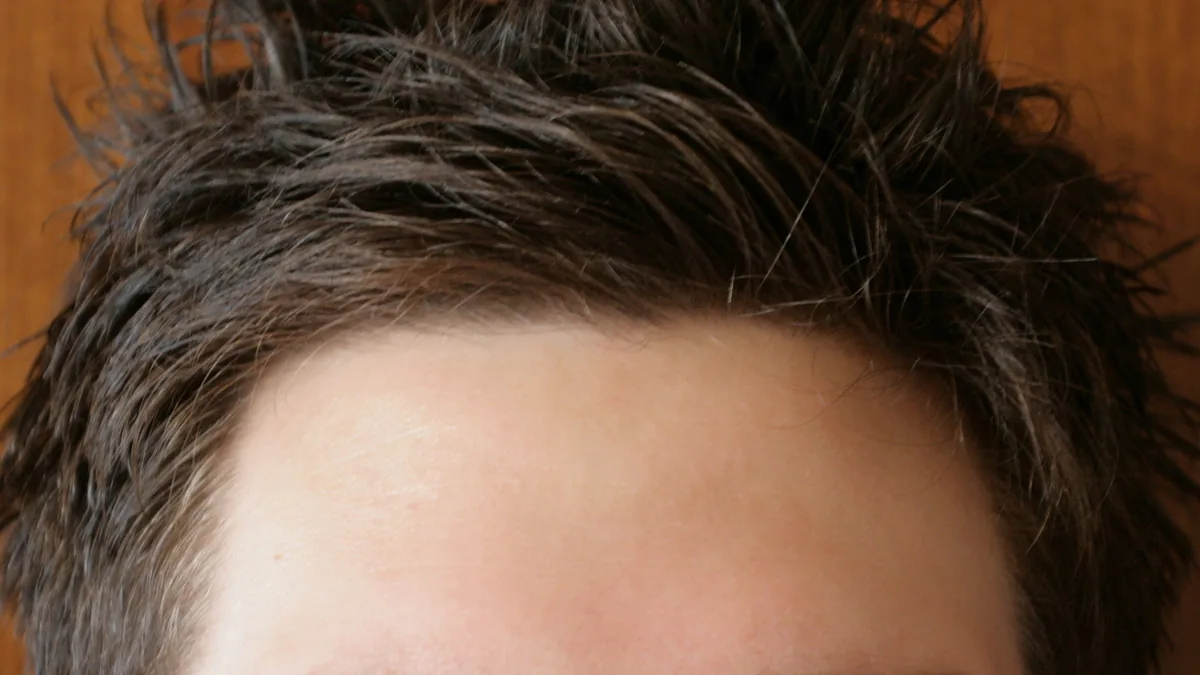
This man is not one of our patients and the picture is not a transplant result. Look at the corners on each side: in men, this is where the hairline usually starts to recede first, which is why a plan for a male hairline looks at the temples and not only at the middle.
How Does Forehead Reduction Surgery Work?
Forehead reduction surgery, also called hairline lowering surgery or scalp advancement, removes a strip of skin between the eyebrows and the hairline. The hair bearing scalp behind it is loosened and pulled forward, then fixed in its new place.
The main steps described in the studies are:
Marking the new hairline. The surgeon plans how much skin can come out, depending on how far the scalp can stretch.
A trichophytic incision. Ramirez and colleagues describe an irregular cut along the hairline, made so that hair can later grow through and in front of the scar.
Freeing the scalp. The scalp is lifted so that it can slide forward. This is the scalp advancement flap.
Fixing the flap. Ekizceli and Hocaoğlu describe methods for fixing the advanced scalp to the bone so that it holds its new place.
Closing. The forehead skin is removed and the wound is sutured.
The amount of lowering depends on how mobile the scalp is. Epstein and Epstein, who described more than 90 of these operations, say candidates need a fairly to very mobile scalp to gain enough advancement. In a 2026 cadaver study of five heads, Bran and colleagues found that adding short extensions at both ends of the incision increased the forward movement by 21 percent in the middle and 24 to 28 percent above the pupils.
Hair Transplant vs Forehead Reduction: Side by Side
The two routes solve the same problem in opposite ways. One adds hair, the other removes forehead skin.
Hair transplant (FUE)
Forehead reduction surgery
How it works
Grafts placed in front of the hairline
Forehead skin removed, scalp moved forward
Average lowering in studies
1.33 cm (Wu et al. 2025)
2.1 cm (Ramirez et al. 2009); 2.55 cm, range 1 to 5 cm (Ekizceli and Hocaoğlu 2026)
Shapes the temples and corners
Yes; width narrowed 1.47 cm in Wu et al.
Mainly moves the hairline forward
Scar
Small dots in the donor area at the back
A line along the new hairline
When the result shows
Grows in over 10 to 18 months
Immediately, once healed
Density
Depends on how many grafts are placed
The person's own scalp density
Most suitable for
Women and men, including receding hairlines
Mainly women with a stable hairline and a mobile scalp
Operation length
About 4 to 8 hours under local anaesthetic (AAD)
Not given in the sources we used
Surgery's advantage is speed and density. Epstein and Epstein call the density "unsurpassed" and the results immediate, and Arnaoutakis's 2026 review lists the same advantages. A transplant's advantage is flexibility: it can draw a new shape, fill the corners and avoid a scar at the front.
How Far Can Each Route Lower the Hairline?
In the 820 Istanbul operations reported by Ekizceli and Hocaoğlu, the forehead was shortened by 25.5 mm on average, ranging from 10 to 50 mm. Their follow-up lasted up to 71 months.
With a transplant, the limit is not the scalp but the donor supply and how dense the new zone must look. In the Wu study, women received an average of 3,243 grafts, with a spread of plus or minus 1,038, placed at 50 to 60 grafts per square centimetre. At 1.8 to 2.3 hairs per graft, as used in our graft guide, 3,243 grafts are about 5,800 to 7,500 hairs.
The studies on transplants for high foreheads do not give a maximum lowering. In practice, the further down a new hairline sits, the more grafts it needs, because every square centimetre of new forehead coverage has to be filled. Our page on how much a hairline transplant costs explains how the size of the area changes the plan.
Risks and Complications Compared
Both routes are reported as safe in the studies, but the risks differ in kind.
Forehead reduction surgery
Hair transplant to lower the hairline
Evidence
Meta-analysis of 14 studies, 3,213 patients
Three case series of 60, 83 and 89 women
Overall complications
5.9 percent pooled
No adverse events in 83 women (Park and Suh); only minor events in 60 (Wu)
Temporary numbness
97.3 percent
Not reported as a complication in these studies
Folliculitis
25.1 percent pooled
7 of 60 (Wu); none in 89 (Park 2019)
Scarring
5.5 percent reported scarring problems
No linear scar at the front
Hair loss along the incision
0.7 percent
Not applicable
Further treatment
Revision 1.3 percent; later hair transplant 1.2 percent
Touch up for density in 3 of 83
The surgery figures come from the 2026 meta-analysis by Alabdulkarim and colleagues. Most of the included studies were retrospective case series, the evidence level was IV, and patient satisfaction was 99.9 percent. Their pooled numbers mix very different studies, so treat them as a guide to what happens, not a precise forecast.
In the Wu transplant study, the reported events were itching in 4 women, swelling in 1, pain in 1 and folliculitis in 7, with no severe complications. The authors note that the topic still lacks large prospective studies from several centres.
Temporary shedding can follow either route. Ramirez and colleagues recorded one major and one minor effluvium, a temporary loss of hair, among 29 operations. Our guide to shock loss after a hair transplant explains what that looks like after grafts, and hair transplant side effects covers the rest.
Who Suits Which Route?
The choice depends on your hairline's history, your scalp and the shape you want.
A hair transplant is usually the route when:
Your hairline is receding. Pattern hair loss can keep moving the hairline, and grafts from the safe donor band keep their resistance to it.
Your forehead is wide as well as high. Grafts can bring the corners and temples in.
You want no scar at the front. FUE leaves small dots at the back, not a line on the forehead.
Your scalp is tight. A transplant does not depend on how far the scalp can stretch.
Forehead reduction surgery is usually discussed when:
Your hairline has always been high and has not moved. Epstein and Epstein say a stable frontal hairline is required, which excludes most men.
Your scalp is fairly to very mobile. That allows enough advancement.
You want the full change at once. The result is immediate rather than growing in over a year.
If you have any history of thinning at the front, a family pattern of hair loss or a hairline that has moved in recent years, tell the medical team. Moving a hairline that will keep receding can leave the new line, or its scar, exposed later.
Women have their own considerations, such as diffuse thinning that can affect the donor area. Our guide to hair transplant for women covers them.
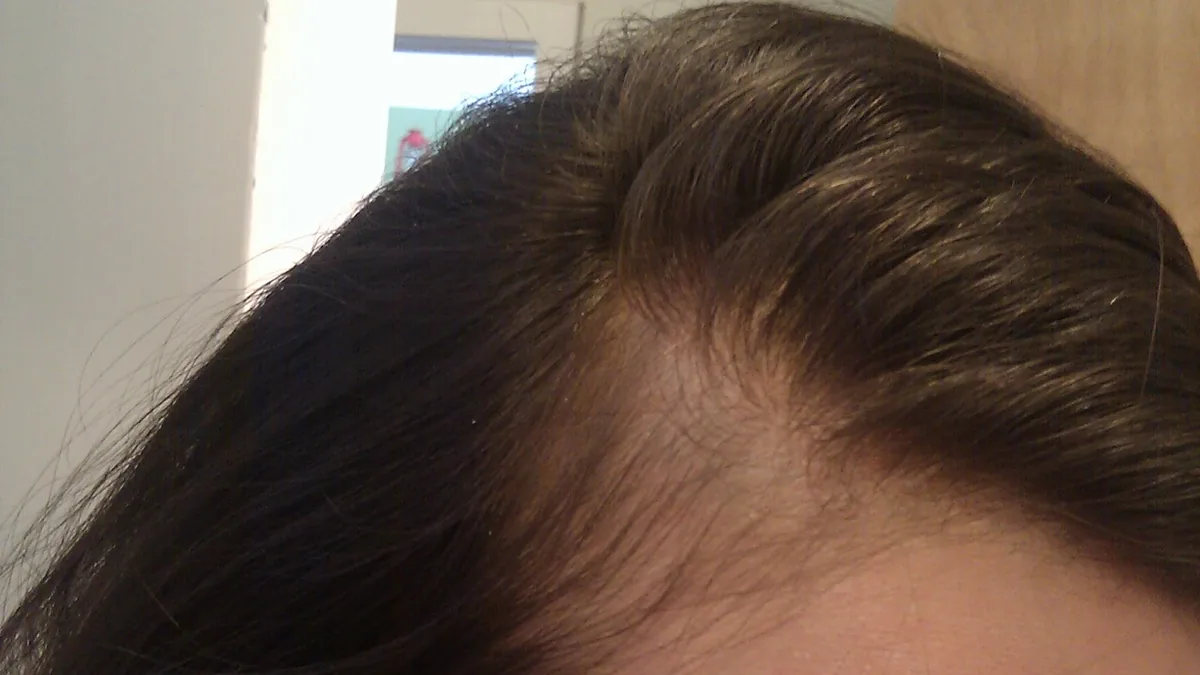
A woman's frontal hairline with thinning after shedding that followed childbirth. Photo: Mvolz, CC0, via Wikimedia Commons, cropped.
This is not one of our patients and not a transplant result. It shows why a team asks about recent shedding first: thin, short hairs along the front can come from a temporary shedding phase, and a hairline that is still changing is not the right starting point for either route.
How Much Does Hairline Lowering Cost in Turkey?
For the hair transplant route, we do not set prices by the graft. Our packages are fixed prices per procedure, from $2,550 to $4,500, and the medical team decides how many grafts your donor area can safely give.
Package
Price per procedure
Sapphire Prime
$2,550
Sapphire Advanced Regrowth
$3,000
DHI Comfort
$3,350
Exosapphire Microflow Elite
$4,500
What every package covers:
Hotel: 2 nights in Istanbul.
Transfers: VIP transfer between the airport, the hotel and the hospital.
Aftercare: 2 years of care consultation.
Not covered: flights, which you book yourself.
Our hair transplant cost page explains what moves the price between packages. We do not quote a price for forehead reduction surgery here; ask any surgeon who offers it for a written quote that states how far they expect to lower the hairline and how they measure it.
How Long Is Recovery After Each Route?
For a hair transplant, the NHS says you may need 1 to 2 weeks off work and may be told to cut down on exercise in the first month. The American Academy of Dermatology says the operation usually lasts 4 to 8 hours, with most people awake and only the scalp numbed. In the Wu study, sessions lasted about 7 hours on average.
Step after a hair transplant
Typical timing
Source
Swelling on the forehead and around the eyes
Settles in about 5 to 7 days
Romera de Blas et al. 2026
Time off work
1 to 2 weeks
NHS
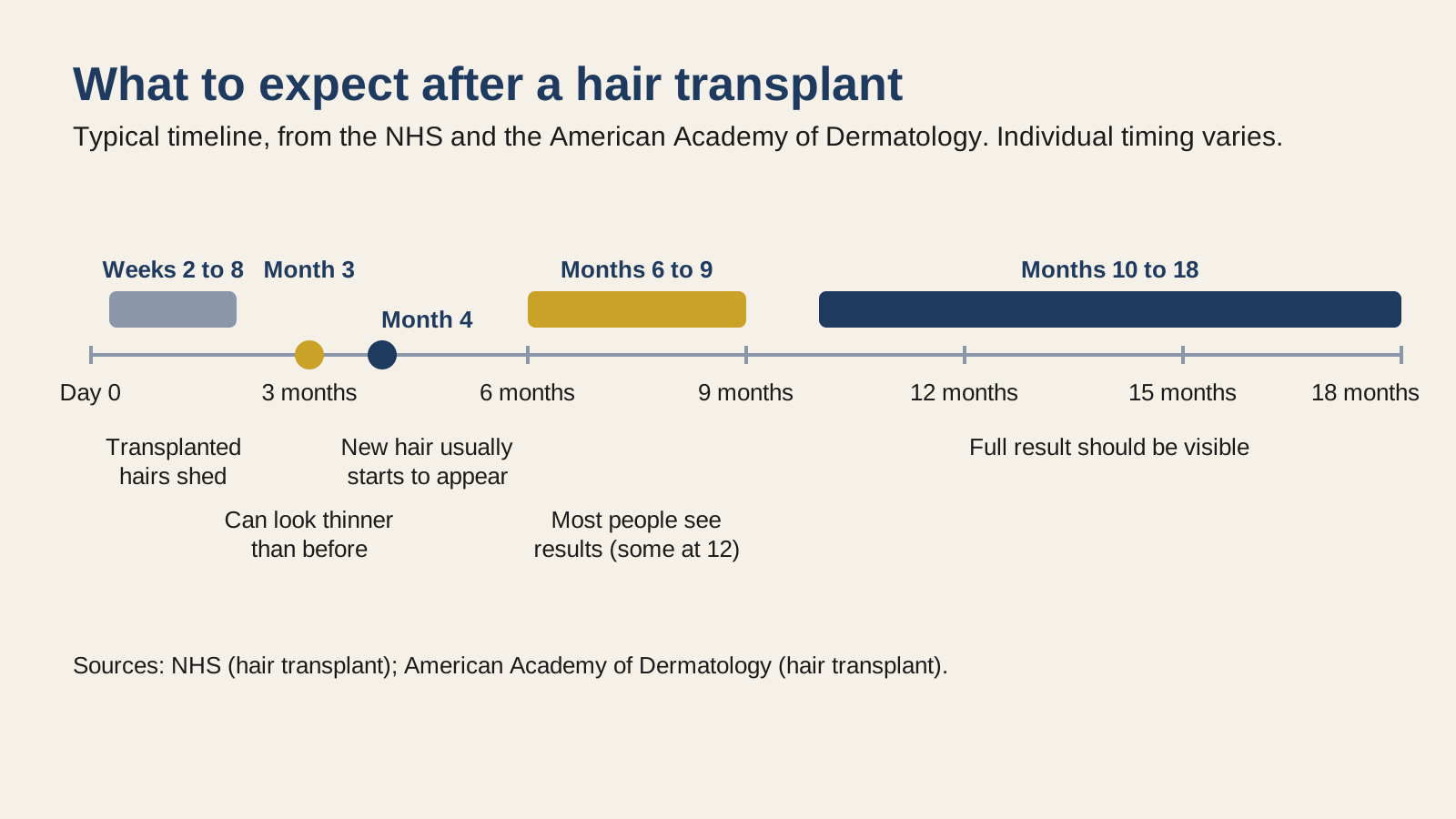
Shedding of transplanted hair
2 to 8 weeks
American Academy of Dermatology
Visible results
6 to 9 months, sometimes 12
American Academy of Dermatology
Full result
10 to 18 months
NHS
Typical growth timeline after a hair transplant, from NHS and American Academy of Dermatology information.
The sources we used for forehead reduction surgery do not give a standard recovery time, so we do not quote one. What they do report is that temporary numbness of the scalp behind the incision is almost universal, at 97.3 percent in the meta-analysis. Our recovery timeline covers the weeks after a transplant in detail, and can I go to work after a hair transplant looks at different jobs.
Can You Lower the Hairline Without Surgery?
Not in a lasting way that moves the hairline itself. Medicines such as minoxidil and finasteride treat pattern hair loss and can help keep the hair you have, but the studies on high foreheads treated a feature that is often congenital, using grafts or surgery. Hairstyles, fringes and cosmetic fibres can hide a high forehead without changing it.
If your frontal hairline has thinned rather than always been high, regrowing it is a hair loss question first. The 2021 hair transplant practice guidelines say every patient should be taught why medical treatment should continue after surgery, because pattern hair loss is progressive and untreated hair can keep thinning around the grafts.
Frequently Asked Questions
Is it possible to make the forehead smaller?
Yes. Surgery shortens it by removing forehead skin, by 25.5 mm on average in 820 Istanbul cases. A hair transplant makes it look smaller by adding hair at the front and sides, by 1.33 cm in height and 1.47 cm in width in one study of 60 women.
Is hairline lowering permanent?
Grafts taken from the safe donor band keep their resistance to pattern loss, so they are expected to last. Ekizceli and Hocaoğlu present surgery as a permanent solution, with follow-up up to 71 months. With either route, hair that was not treated can still thin. Read how long hair transplants last for more.
Is a hairline transplant painful?
The NHS says it is usually done under local anaesthetic and sedation, so you are awake but should not feel pain during it. Wu and colleagues recorded pain as an event in 1 of 60 women. Contact your team if pain is severe after surgery.
How painful is forehead reduction surgery?
The sources we used do not give a pain score for it. The meta-analysis found temporary numbness of the scalp behind the incision in 97.3 percent of patients.
How risky is hairline lowering surgery?
The 2026 meta-analysis pooled an overall complication rate of 5.9 percent, with folliculitis in 25.1 percent, scarring problems in 5.5 percent and revision in 1.3 percent. Patient satisfaction was 99.9 percent.
Can men have forehead reduction surgery?
Most men are not candidates. Epstein and Epstein say the surgery needs a stable frontal hairline, which excludes most men, because a male hairline often keeps receding. A hair transplant is the usual route.
Is 25 too early for a hairline transplant?
Not always, but the hair transplant practice guidelines advise waiting until at least 23 to 25 and do not recommend surgery under 21. The concern is that pattern hair loss may still be developing in younger patients.
Can I have a hairline transplant if my hair is thin?
It depends on the donor area, not only on the hair at the front. Fine hair covers less scalp per graft, so it can take more grafts for the same look. The free analysis checks the density and thickness of your donor hair.
Does a transplanted hairline look natural with every hair type?
The aim is a natural line for each hair type. In the Wu study the hairline design was tailored to each woman's facial proportions, with a buffer zone about 2 cm wide behind the leading edge of the hairline. Curly or coarse hair needs a different placement plan from straight, fine hair.
How is aftercare handled if I travel home after the transplant?
Every package includes 2 years of care consultation, so the team follows your recovery from abroad using dated pictures. The Romera de Blas review links delaying the first wash beyond 3 days to a higher risk of folliculitis. Our post-operative hair wash guide shows how to wash safely in the first weeks.
Find Out Which Route Suits Your Hairline
The right route depends on whether your hairline has always been high or is moving back, how wide your forehead is and what your donor area can give. Send clear pictures of the front, top, both sides and back in daylight, with your hair pulled back from the forehead, for a free hair analysis. The medical team will tell you whether a hair transplant can give the hairline you want, how many grafts it would take and whether another approach should be discussed.
Medical disclaimer: This article is for informational purposes only and is not medical advice. Individual results and recovery vary from person to person. Always follow the written aftercare plan from your own medical team.
Wu W, Liu C, Zhang P, Zhang S, et al. Enhancing mid-upper facial contours: hairline transplant solutions for East Asian women with high and wide foreheads. Journal of Cosmetic Dermatology, 2025;24(8):e70374
Park JH, Suh BS. Hairline correction by hair transplantation for reducing apparent face length in long-face women. Plastic and Reconstructive Surgery, 2023;151(3):511-519
Park JH, You SH, Kim N. Frontal hairline lowering with hair transplantation in Asian women with high foreheads. International Journal of Dermatology, 2019;58(3):360-364
Epstein J, Epstein GK. Hairline-lowering surgery. Facial Plastic Surgery Clinics of North America, 2020;28(2):197-203
Arnaoutakis D. Hairline-lowering surgery. Facial Plastic Surgery Clinics of North America, 2026;34(1):97-102
Send three photos: front, top and sides. You get a technique recommendation, a graft range and a straight answer about what is achievable, before anyone talks about price.
Your details are with the team
A patient coordinator will get back to you shortly. If you would like to send your photos now, WhatsApp is the fastest way to do it.
We respond quickly, day or night, in your language.
Multilingual team, no obligation
Data protectedKVKK and GDPR compliant, 100% confidential
Authorized Health Tourism Intermediary
Turkey Hair Center is the hair-restoration brand of Healthy Way Tourism, an authorized international health-tourism intermediary. All medical procedures are performed by licensed medical professionals at authorized healthcare facilities in Turkiye, in accordance with the regulations of the Ministry of Health.