How Fast Does Hair Grow: Daily, Weekly and Monthly Timeline
Performed at authorized partner hospitals Turkey Hair Center is a Ministry of Health authorized health-tourism intermediary, not a clinic.
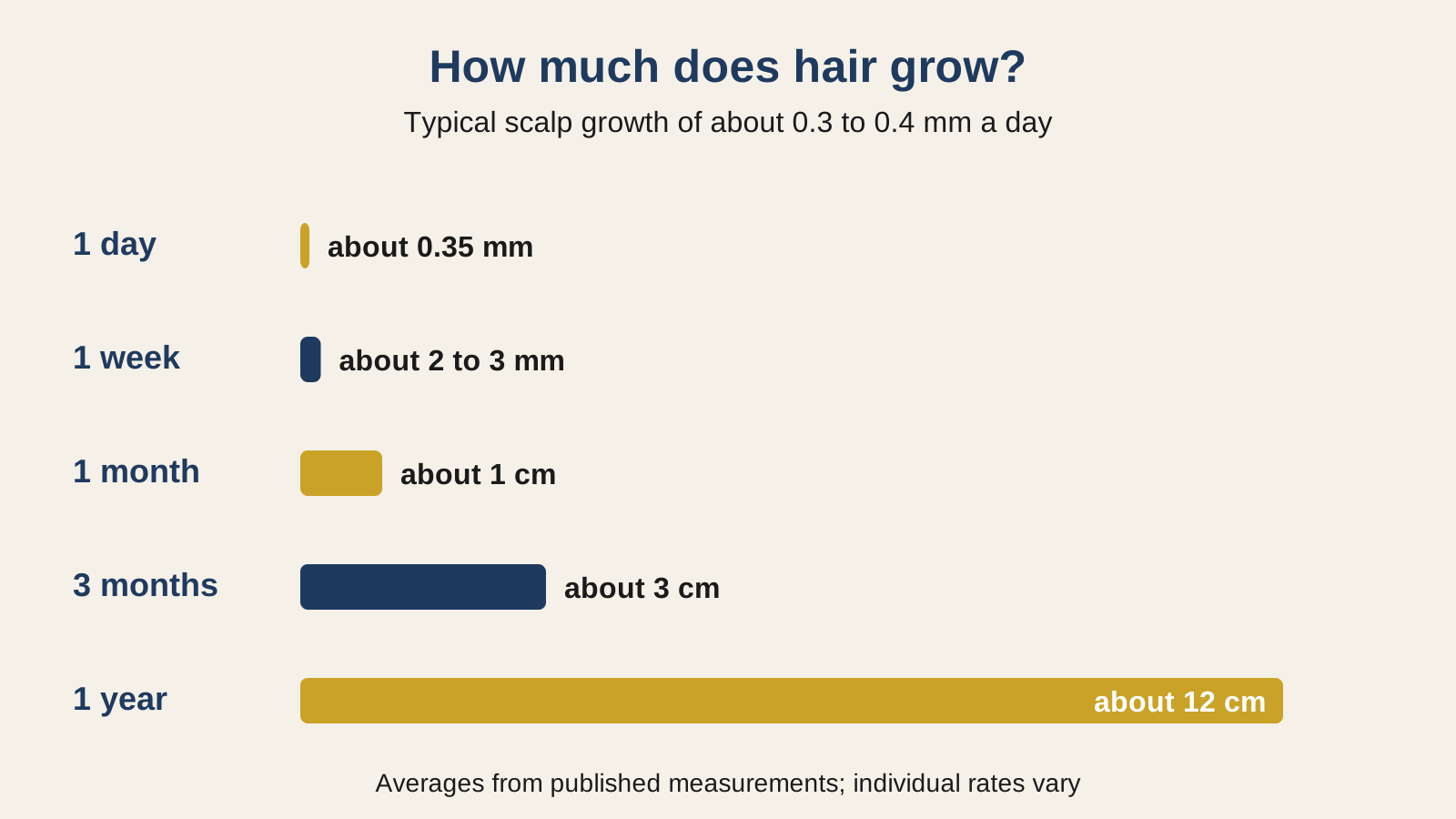
Scalp hair grows about 0.3 to 0.4 mm a day, which adds up to roughly 1 cm a month and about 12 cm a year. The exact speed varies with age, ancestry and hair colour, and each follicle only adds length during its active growth phase.
Those averages hide a lot of variation. One person's hair can grow noticeably faster than another's, and the same scalp grows at slightly different speeds in different areas. This guide covers:
the measured growth rates, by day, week and month
what changes the speed from one person to the next
the three phases of the hair growth cycle
when slow growth or heavy shedding is worth a medical check
Hair Growth Stages
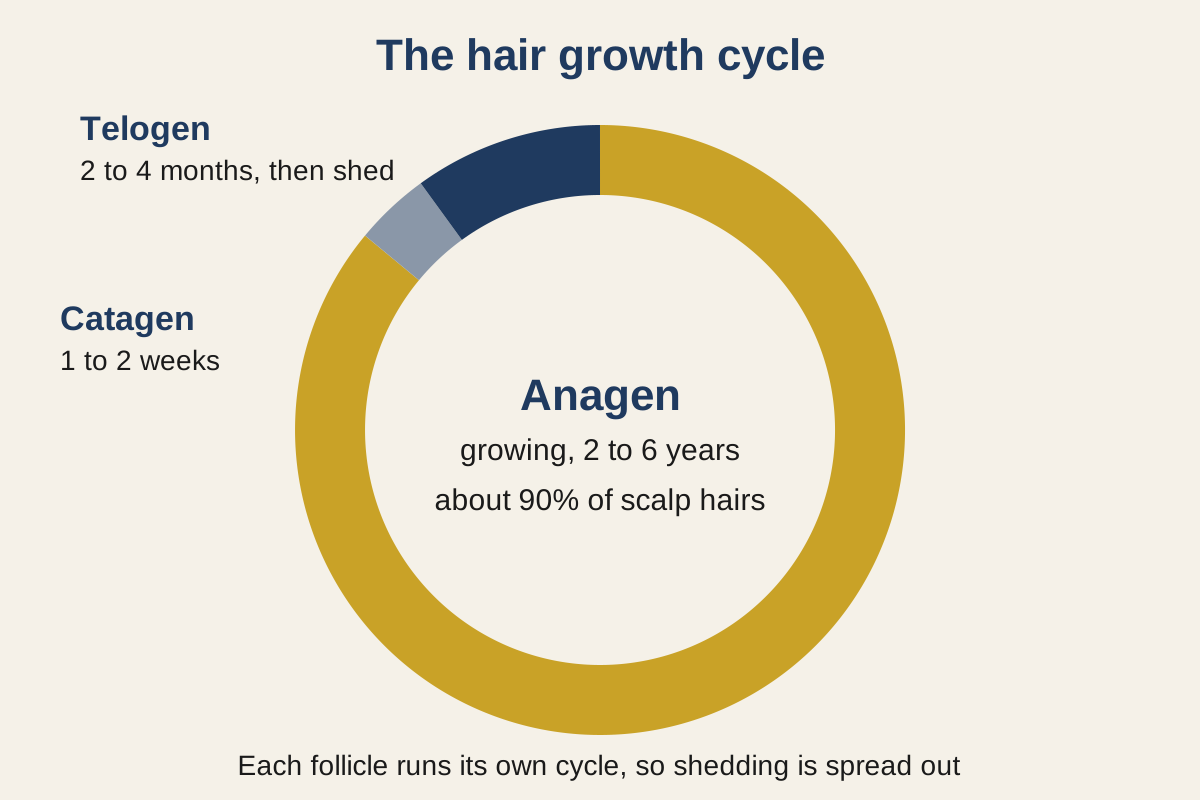
Not every hair on your head is growing at the same time. Each follicle runs through its own cycle of growth, regression and rest, and the cycles are not in step with each other. That is why you never lose all your hair at once, and why the scalp keeps a fairly even look.
At any one moment, most scalp hairs are in the growing stage. Two sources give similar shares:
Phase
Share of scalp hairs (Zhang et al., 2024)
Share of scalp hairs (Park et al., 2020)
Anagen, growing
About 90%
About 86%
Catagen, regression
About 1%
About 1%
Telogen, resting
About 9%
About 13%
Only the anagen hairs add length. So when people ask how fast hair grows, the honest answer is: the growing ones lengthen by about 0.3 mm a day, while one hair in ten or so is resting and not growing at all. The details of each phase are set out further down, in the section on the hair growth cycle.
How Fast Does Hair Grow?
A review in Deutsches Ärzteblatt International gives the standard clinical figure: scalp hair grows about 0.3 mm a day, or about 1 cm a month. Cleveland Clinic gives the same 1 cm a month. Studies that measure growth directly show how much the figure moves between groups.
Group studied
Mean growth per day
Source
Adults, clinical average
About 0.3 mm
Wolff et al., 2016
White adults
0.396 mm
Loussouarn, 2001
African adults
0.256 mm
Loussouarn, 2001
Dark-haired children aged 9 months to 6 years
0.352 mm
Ruiz et al., 2024
Light-haired children aged 9 months to 6 years
0.325 mm
Ruiz et al., 2024
Infants under 1 year
0.288 mm
Ruiz et al., 2024
Even inside one group, the spread is wide. In the African volunteers, individual rates ranged from 0.150 to 0.363 mm a day. A larger study by Loussouarn and colleagues, covering 2,249 young adults from 24 ethnic groups, found that African hair grew more slowly on average and Asian hair grew faster.
Most adult figures on this page come from a phototrichogram. A 2022 study in Clinical, Cosmetic and Investigational Dermatology describes it as a noninvasive technique that pairs a digital video microscope with image analysis. The African study used it to record density, the share of resting hairs and growth rate in three areas of the scalp.
When to See a Healthcare Provider?
Slow growth on its own is rarely a medical problem. The bigger signals are changes in how much hair you lose and where. The American Academy of Dermatology says shedding 50 to 100 hairs a day is normal and lists situations that can trigger heavier shedding:
losing 20 pounds or more
giving birth
a lot of ongoing stress
a high fever, an operation or recovery from illness
stopping birth control pills
The academy notes that this type of shedding often shows up a few months after the event and usually settles, with hair tending to regain its fullness within six to nine months. Hair loss is different: something stops the hair from growing, as in hereditary hair loss, and it does not return until the cause is treated.
See a dermatologist if shedding is clearly heavier than usual, if it goes on for months, if you see patches or a widening part, or if you think a medicine might be involved. The academy advises not stopping a prescribed treatment on your own, and says the sooner treatment begins, the better the outlook.
How Much Does Hair Grow in a Week?
At 0.3 to 0.4 mm a day, scalp hair grows about 2 to 3 mm in a week. A week of growth is hard to see on long hair but easy to see on a very short cut.
Using the measured averages, a week of growth looks like this:
White adults, 0.396 mm a day: about 2.8 mm
Clinical average, 0.3 mm a day: about 2.1 mm
African adults, 0.256 mm a day: about 1.8 mm
For someone with a 3 mm buzz cut, one week can nearly double the length. For someone with shoulder-length hair, the same 2 mm disappears into the length. Our guide to how many hairs are on the human head explains why density, not length, decides how full hair looks.
How Much Does Hair Grow Every Day?
Every day, each growing hair adds about 0.3 to 0.4 mm. Researchers usually express this in micrometres, where 1 mm equals 1,000 micrometres, so the studies above report figures such as 396 or 256 micrometres a day.
The growth happens deep in the skin, not at the tip. New cells are made in the hair bulb at the base of the follicle and push the older part of the hair upward. A review by Tobin in the International Journal of Trichology notes that almost all of the keratin-making cells in a growing bulb are dividing at any one time, at a rate second only to bone marrow and the lining of the gut. Our page on the hair bulb explains that part of the follicle.
Because growth starts at the base, the hair nearest the scalp is always the newest. The ends are the oldest part, which is why they look drier and more worn, as our hair shaft anatomy guide explains.
Daily Hair Growth: What Changes the Rate
Several factors are linked to faster or slower daily growth in the studies we reviewed:
Age: infants under 1 year grew hair more slowly than children aged 2 to 5 in the 2024 study of 266 preschool children.
Hair colour: dark-haired children grew hair faster than light-haired children in the same study.
Ancestry: African hair grew more slowly and Asian hair faster in the 24-group study.
Scalp area and sex: the 24-group study linked differences to both, while the smaller African study found no difference by sex or scalp area.
In the children's study, the factors that predicted growth rate were age, height, hair pigment and the protein content of the hair. Sex was not among them. For adult men and women, the large study reported some differences by sex, but the abstract does not give a single figure for each, so we do not quote one.
What does not appear in these studies is just as useful. None of them shows that cutting hair makes it grow faster. Trimming removes worn ends from the oldest part of the hair; it does not change what the follicle does.
Hair Growth Per Day in Inches
For readers who think in inches, 1 inch is 25.4 mm. The daily figure is tiny:
0.3 mm a day is about 0.012 inch
0.4 mm a day is about 0.016 inch
1 cm a month is about 0.4 inch
12 cm a year is about 4.7 inches
So the common rule of thumb of about half an inch a month is a little generous for the average adult. It fits the faster end of the measured range, such as the white adults in the 2001 study, better than the slower end.
How Much Does Hair Grow in 3 Months?
In three months, scalp hair grows about 3 cm, or a little over 1 inch. That is enough to grow out a short haircut or to see clear new length at the roots after colouring.
Three months is also an important point after a hair transplant, and the timeline there is different. The American Academy of Dermatology explains that transplanted hairs usually fall out within two to eight weeks, that the area can look thinner around the third month, and that most people see new growth between six and nine months, with some waiting 12 months. Our hair transplant recovery timeline walks through each stage.
The reason is the growth cycle again. The transplanted hairs are shed first, the follicles then start a new growing phase, and only after that does length build at the usual 1 cm or so a month.
How Much Does Hair Grow in 2 Days?
In two days, hair grows about 0.6 to 0.8 mm. That is less than one millimetre, so on most people it cannot be seen without measuring.
Short timeframes like this are why studies measure growth with magnified images rather than by eye. On a full head of hair, a change of under a millimetre is lost in the length, the curl and the way hair falls.
How Much Does Hair Grow in 4 Days?
In four days, hair grows about 1.2 to 1.6 mm. On a freshly shaved or closely clipped scalp, that is the point where new stubble becomes easy to see and feel.
If you want to check your own rate, a rough home method is simple:
clip or shave a small patch somewhere discreet
photograph it next to a ruler on day one
photograph it again under the same light on day four or seven
compare the length, then divide by the number of days
The result will be rougher than a clinical measurement, but it shows whether your hair sits near the averages above.
Hair Growth Cycle
The growth cycle explains why hair length has a natural limit and why shedding is normal. The 2016 review in Deutsches Ärzteblatt International and Cleveland Clinic give slightly different ranges for each phase, and both are shown below.
Anagen
Anagen is the growing phase. The Deutsches Ärzteblatt review gives 2 to 6 years for scalp hair, and Cleveland Clinic gives 2 to 7 years. Tobin's review describes a usual length of 3 to 5 years.
The length of anagen sets how long hair can get. At about 1 cm a month, a 3 year anagen phase allows roughly 36 cm of growth before the hair stops, and a 6 year phase allows roughly 72 cm. This helps explain why some people can grow very long hair while others find it stops at a shorter length.
Catagen
Catagen is a short transition. The Deutsches Ärzteblatt review gives 1 to 2 weeks, and Cleveland Clinic about 2 weeks. A 2020 study in the Annals of Dermatology notes that protein and pigment production stop in this phase, and the review in Biology describes about two thirds of the lower follicle breaking down while the dermal papilla stays intact.
Telogen
Telogen is the resting phase. The Deutsches Ärzteblatt review gives 2 to 4 months, and Cleveland Clinic up to 4 months. The 2020 study adds that a resting hair does not fall out at once but stays in the follicle for a while before it is shed, and the follicle then starts a new growth phase.
The Deutsches Ärzteblatt review also notes that a share of telogen hairs above 20% points to increased shedding. That is one of the measures a dermatologist can use when shedding seems heavy.
Frequently Asked Questions
How Fast Does Hair Grow at 14?
We did not find a study that measures scalp growth in teenagers separately. The large adult study covered ages 18 to 35, and the children's study covered ages 9 months to 6 years. So we cannot give a measured figure for that age, and a single number would be a guess.
How Fast Does Hair Grow in Cm?
About 1 cm a month, according to both the Deutsches Ärzteblatt review and Cleveland Clinic. Per day, that is about 0.03 to 0.04 cm.
How Fast Does Facial Hair Grow?
The sources we reviewed measure scalp hair, not facial hair, so we do not quote a rate. Facial hair follicles do differ in size: one study found the dermal papilla of beard follicles was almost 40 times larger in volume than that of fine facial hair follicles in women.
How Fast Does Beard Hair Grow?
We found no verified published figure for beard growth per day, so we do not give one. Beard growth also varies a lot between men. Our beard transplant page covers options when beard hair is patchy.
How Fast Does Hair Grow on Your Head?
About 0.3 to 0.4 mm a day on average, or about 1 cm a month. Measured adult averages range from about 0.26 mm a day in African volunteers to about 0.40 mm a day in white volunteers.
How Fast Does Hair Grow in Inches for Men?
About 0.4 inch a month, or a little under 5 inches a year, based on the 1 cm a month average. The studies we reviewed do not give a separate inch figure for men.
How Fast Does Hair Grow in Men?
Men's scalp hair grows at roughly the same 0.3 to 0.4 mm a day as women's. The African study found no significant difference between the sexes, while the large multi-ethnic study reported some differences linked to sex without giving one simple figure.
How Fast Does Hair Grow in 1 Day?
About 0.3 to 0.4 mm, which is around 0.012 to 0.016 inch. That is too small to see, but over a month it adds up to about 1 cm.
Want to Know What Your Hair Is Doing?
If your hair seems to grow but the scalp still looks thinner each year, the issue is usually not speed. It is how many follicles are still producing hair. A photo review can show where density has dropped. Send:
Medical disclaimer: This article is for informational purposes only and is not medical advice. Individual results and recovery vary from person to person. Always follow the written aftercare plan from your own medical team.
Sources and medical review
Wolff H, Fischer TW, Blume-Peytavi U. The Diagnosis and Treatment of Hair and Scalp Diseases. Deutsches Ärzteblatt International, 2016;113(21):377-386
Cleveland Clinic. Hair Follicle: Function, Structure and Associated Conditions. Cleveland Clinic health library
Loussouarn G. African hair growth parameters. British Journal of Dermatology, 2001;145(2):294-297
Loussouarn G, Lozano I, Panhard S, Collaudin C, El Rawadi C, Genain G. Diversity in human hair growth, diameter, colour and shape. An in vivo study on young adults from 24 different ethnic groups observed in the five continents. European Journal of Dermatology, 2016;26(2):144-154
Zhang HL, Qiu XX, Liao XH. Dermal Papilla Cells: From Basic Research to Translational Applications. Biology (Basel), 2024;13(10):842
Park SH, Seol JE, Kim DH, Kim H. Analysis of Microscopic Examination of Pulled Out Hair in Telogen Effluvium Patients. Annals of Dermatology, 2020;32(2):141-145
Tobin DJ. Aging of the hair follicle pigmentation system. International Journal of Trichology, 2009;1(2):83-93
Alsharif SH, AlGhamdi KM. Evaluation of Scalp Hair Density and Diameter in the Arab Population: Clinical Office-Based Phototrichogram Analysis. Clinical, Cosmetic and Investigational Dermatology, 2022;15:2737-2743
Elliott K, Stephenson TJ, Messenger AG. Differences in hair follicle dermal papilla volume are due to extracellular matrix volume and cell number: implications for the control of hair follicle size and androgen responses. Journal of Investigative Dermatology, 1999;113(6):873-877
Send three photos: front, top and sides. You get a technique recommendation, a graft range and a straight answer about what is achievable, before anyone talks about price.
Your details are with the team
A patient coordinator will get back to you shortly. If you would like to send your photos now, WhatsApp is the fastest way to do it.
We respond quickly, day or night, in your language.
Multilingual team, no obligation
Data protectedKVKK and GDPR compliant, 100% confidential
Authorized Health Tourism Intermediary
Turkey Hair Center is the hair-restoration brand of Healthy Way Tourism, an authorized international health-tourism intermediary. All medical procedures are performed by licensed medical professionals at authorized healthcare facilities in Turkiye, in accordance with the regulations of the Ministry of Health.