How Much Hair Loss Is Normal? Hairs Per Day, Shower Shedding and Clumps
If you're finding hair in the shower, on your pillow or in your brush, here's the short answer: losing 50 to 100 hairs a day is normal, and most of what you see is the normal end of a hair's life. How much hair loss is normal for you depends less on one number than on the pattern behind it.
A count on its own can fool you. Three clues tell normal shedding from a real problem: when you last washed, what the root looks like and where your hair is getting thinner. We'll work through them the way a doctor would.
How Much Hair Loss Is Normal Per Day?
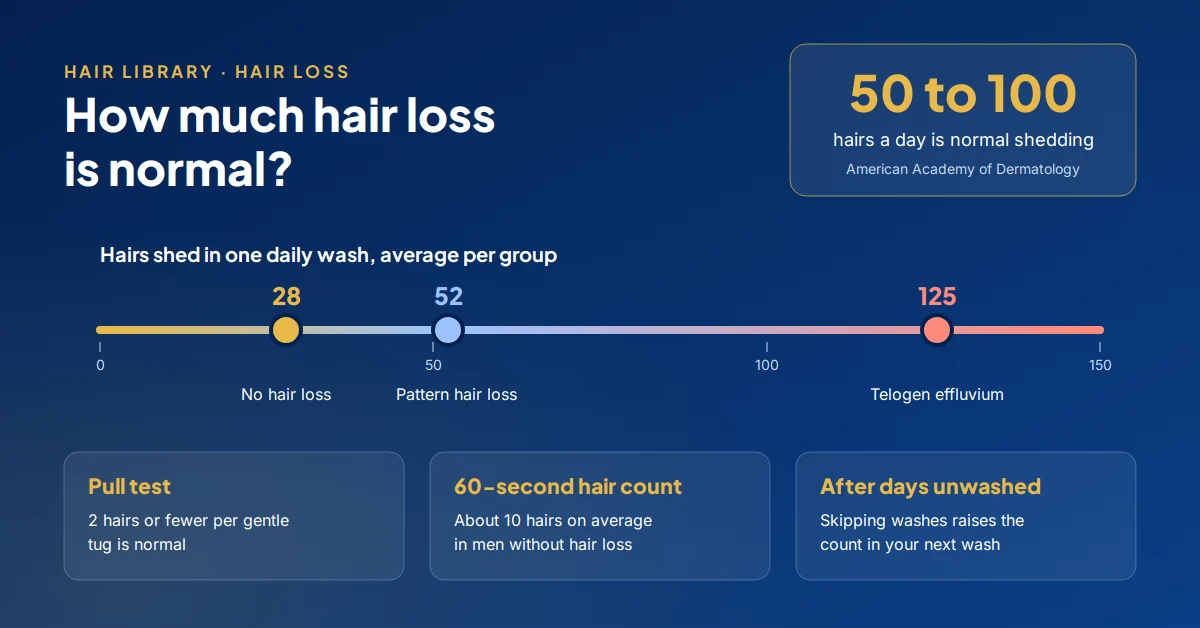
Shedding 50 to 100 hairs a day is normal, according to the American Academy of Dermatology. What matters more is the pattern. Even shedding with no bare spots is typical, while sudden heavy shedding, a widening part, receding temples or bald patches need a closer look.
Most of those hairs are resting hairs that have finished their cycle. The follicle stays in the skin and, in time, starts a new hair.
Where the Number Comes From and Why Your Count Changes
Where 50 to 100 Hairs a Day Comes From
The 50 to 100 figure is a general guide. Careful counts in healthy people sit inside that range or below it, and they shift with your wash routine and the season, so one heavy day tells you little.
Why hairs fall a few at a time and never all together is explained in our entry on the hair growth cycle. Our page on how many hairs are on the head sets the daily figure against the total.
Shower and Brush Shedding
Washing collects hairs that were already loose, so the shower is often where you notice shedding. In a careful wash test, people without hair loss shed about 28 hairs per daily wash, people with pattern hair loss about 52 and people with telogen effluvium about 125.
To see whether the hairs in your brush are whole shed hairs, use the root check further down. For a washing schedule by scalp type, see our entry on how often to wash hair.
Why More Falls After Days Without Washing
Here's the first clue, and it explains a lot of panic. If you wash less often because you're scared of losing hair, the next wash brings out more, and that feeds the fear of going bald.
Say about 30 hairs come loose each day and you wash every fourth day. That one wash can carry four days' worth, so the drain looks alarming while your daily shedding hasn't changed at all.
Compare like with like: count after the same number of days since your last wash each time, so a longer gap doesn't look like heavier shedding.
Long, Curly, Afro-Textured and Braided Hair
Long, curly and braided hair can change how much shedding you see at one time. Long hairs make a bigger pile in the drain, and a longer gap between washes adds up, as the first clue above shows.
The pull test gives similar results in Caucasian, Asian and Afro-textured hair, and tight hairstyles don't change it, so the normal limit below applies whatever your hair type.
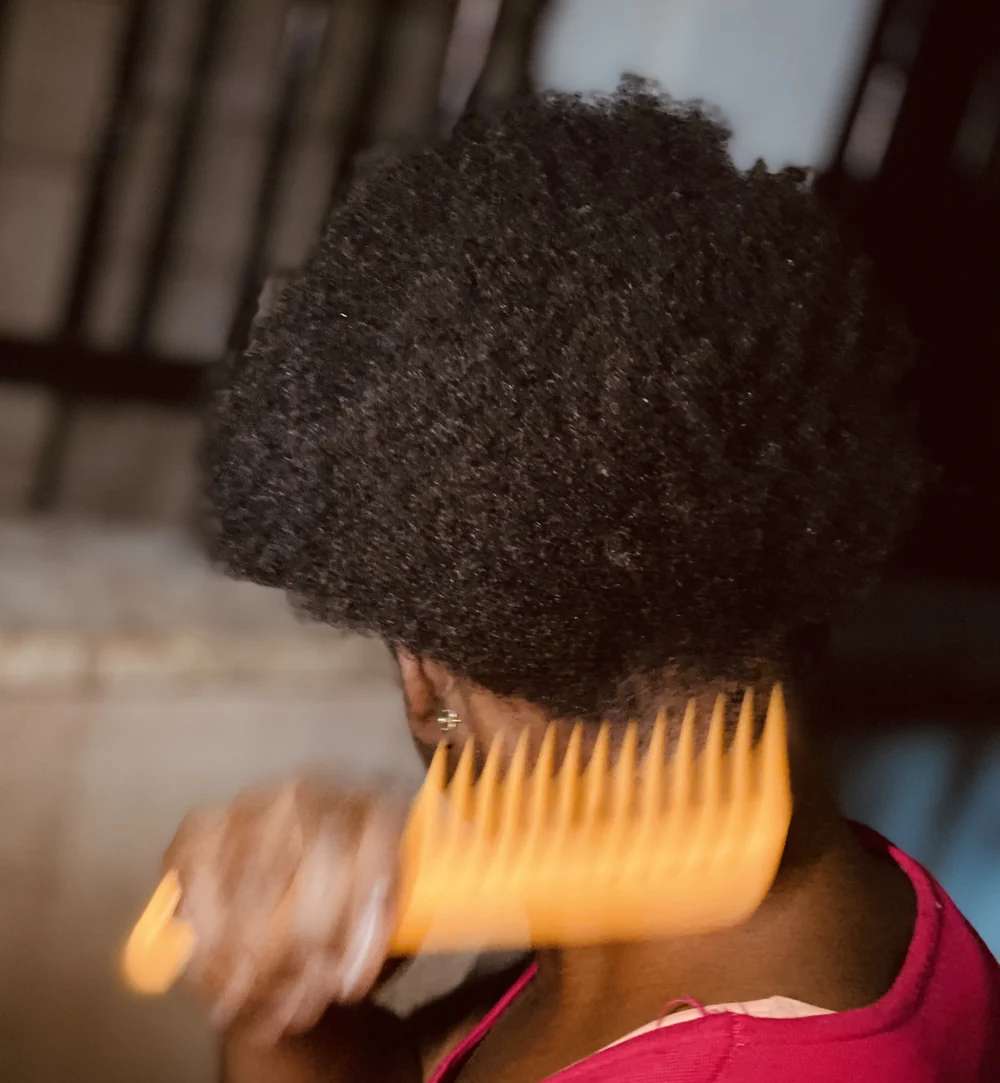
Detangling Afro-textured hair with a wide-tooth comb. Photo: Adesolive, CC BY-SA 4.0, via Wikimedia Commons, cropped.
Tension is a separate problem. Braids, rollers and ponytails that pull on the roots can cause hair loss, and the outlook is excellent once you stop the style.
Shedding has a yearly rhythm. In healthy men followed for 18 months, shed hairs peaked at about 60 a day in August and September, when the fewest follicles were growing, more than double the winter level.
So a heavier few weeks in late summer isn't a warning sign on its own. Count again in a month before you worry.
Postpartum Shedding
Shedding after a birth is normal and temporary, and it runs to a predictable timetable:
About month 2 after the birth: heavier shedding starts.
Around month 4: it usually peaks.
Within 6 to 9 months: hair tends to regain its normal fullness.
As your body readjusts, the extra shedding stops. Our postpartum hair loss guide covers what helps in the meantime.
Shedding Myths, Checked
"Washing less will save my hair." It won't. The hairs come out in the next wash instead.
"A white bulb on the end means the root was ripped out." That bulb is the normal club end of a resting hair, and the follicle stays in the skin.
"Heavy shedding means I'm going bald." Shedding after a trigger doesn't lead to baldness, and it usually settles.
"Shedding is worst in winter." In the study above, it peaked in late summer.
How to Check Your Hair Shedding at Home
Counting beats guessing, and it gives a doctor something real to work with. Here are three checks, from the quickest to the most thorough.
Check
How it works
Normal result
Best for
Pull test
One gentle pull on a small bunch of hair at the crown
2 hairs or fewer
A quick check for active shedding
60-second count
A timed 60-second hair count, repeated on several days
About 10 hairs on average in men without hair loss
Tracking your own trend
Wash count
Collect every hair from one wash on a cloth over the drain
About 28 hairs per daily wash without hair loss
Telling heavy shedding from normal
The Pull Test
A gentle pull on hair at the crown normally removes 2 hairs or fewer; in the study that set this limit, the average was 0.44 hairs per pull. When you last washed or brushed made no difference to the result, so you don't need to plan around it.
The 60-Second Count and the Wash Count
In men without hair loss, a standardised 60-second count averaged about 10 hairs, with a wide range, and stayed steady from day to day and six months later. That steadiness is what makes it useful: a jump in your own count matters more than how you compare with anyone else.
For a wash count, copy the researchers' method. Wash 24 hours before, then wash over a sink covered with a fine cloth and collect every hair it catches, three days in a row.
Expert note: Count on three days in a row, at the same time and after the same gap since your last wash, and write the numbers down with the date. Repeat a month later. Two sets of numbers show a doctor whether your shedding is rising, steady or settling, which one alarming morning can't.
Shed, Broken or Thinning?
Here's the second clue: look at the end of the hair. A normal shed hair has an even shaft and a small bulb at the root with no colour in it, the white tip you can see. That bulb is the club end of a resting hair, and the follicle it came from stays in the skin.
Hairs without that white bulb are worth a closer look, because they may be pieces that broke off rather than whole shed hairs. Lots of short, fine hairs in your count is a different clue: fine vellus hairs made up about 8% of shed hairs in pattern hair loss, against about 1% without hair loss. Our hair breakage entry shows how to tell the two apart.
When Hair Shedding is a Sign of a Problem
The third clue is where and how your hair is thinning. Match what you see to the closest row. The last two columns are our own summary of the sources cited below.
What you notice
Most likely cause
Your first move
What to expect
Even shedding, no bare spots, steady counts
Normal shedding
Nothing; count again in a month if you're worried
Ups and downs with washing and the seasons
Sudden heavy shedding all over, 2 to 3 months after a birth, fever, surgery or crash diet
Telogen effluvium
Find the trigger and deal with it
Usually settles within 3 to 6 months
Heavy shedding with no clear cause, while your hair still looks full
Chronic telogen effluvium
See a doctor for blood tests
May take 3 to 10 years to settle, but doesn't cause baldness
Gradual thinning, a widening part, receding temples or a thinning crown
Pattern hair loss
See a doctor early
Tends to continue without treatment
Round bald patches on the scalp, beard or eyebrows
Alopecia areata
See a dermatologist
Reversible in principle, but hard to treat
Hair Falling Out in Clumps
Sudden, heavy shedding all over the scalp 2 to 3 months after a trigger such as childbirth, a high fever or major surgery points to telogen effluvium, and it usually settles within 3 to 6 months once the trigger is dealt with. That delay is the timing clue: look back three months, not three days.
The American Academy of Dermatology's list of triggers also includes losing 20 pounds or more, a lot of stress and stopping birth-control pills. If the stress carries on, the shedding can too. Our telogen effluvium entry lists the triggers and the month-by-month course.
Clumps that leave bare patches are a different matter. Alopecia areata causes patchy hair loss that appears over a short time, on the scalp and sometimes the eyebrows or beard. See our alopecia areata entry for its types and treatment.
Thinning Without Heavy Shedding
Pattern hair loss can thin your hair without dramatic shedding, which is why a count alone can miss it. In women it usually shows as thinning over the top of the scalp, often with a widening part, and in men as receding temples and thinning at the crown.
Hereditary hair loss tends to keep going without treatment, and the sooner treatment starts, the better the outlook. Read more on female pattern hair loss.
When to See a Doctor
Shedding that lasts beyond the 3 to 6 months telogen effluvium usually takes once its trigger is gone
Bare patches on the scalp, beard or eyebrows
A widening part or receding temples
Heavy shedding with no trigger you can find
For shedding with no clear cause, doctors check a full blood count, ferritin (your iron stores) and thyroid hormones, because iron deficiency and thyroid problems often cause no other signs. If you think a medicine is behind it, don't stop it on your own; talk to your doctor first.
Expert note: Before the appointment, lay one day's shed hairs on a sheet of white paper, photograph them next to a coin for scale and note how many days it was since your last wash. With your dated counts, that shows a doctor in seconds whether the hairs have a white bulb, how long and fine they are, and whether the amount is rising.
A transplant moves follicles that keep their genetic traits into thinning areas, and it's used mainly for pattern hair loss.
For telogen effluvium a transplant isn't needed: that shedding doesn't lead to baldness, and the hair comes back once the cause is dealt with. Shedding in the weeks after surgery is a separate story, explained in our guide to shock loss after a hair transplant.
Frequently Asked Questions
What is normal hair loss per day for women?
The same 50 to 100 hairs a day. Long hair makes the same number look like more, and shedding after a birth is a common, temporary spike.
What is normal hair loss in the shower?
About 28 hairs per daily wash in people without hair loss, in a refined wash test study. Counts around 125 were typical of telogen effluvium.
What is normal hair loss after 3 days without washing?
More than after a daily wash, because the hairs shed over the gap come out together. We found no published normal value for a 3-day gap, so compare counts taken after the same number of days.
Does normal hair loss include the root?
Yes. A normally shed hair ends in a small white bulb, the club end of a resting hair, while the follicle stays in the skin to grow a new one.
What is normal hair loss for long hair?
The number is the same; long hairs just make a bigger pile. Judge by your count and the pattern of thinning, not by the size of the clump.
Is hair loss a sign of new hair growth?
Not exactly. A shed hair is a resting hair, and its follicle waits for a signal to start a new one, so normal shedding is part of a healthy cycle. Shedding by itself doesn't prove new growth is on the way.
Normal Shedding or Not: Who Should Get a Closer Look
If your shedding is steady, rises in late summer or looks heavy only after a long gap between washes, it's most likely normal. Get checked if it lasts beyond the usual 3 to 6 months after a trigger, leaves bare patches, or comes with a widening part or receding temples.
Your checklist:
Count for three days in a row, after the same gap since your last wash.
Check the roots for white bulbs, snapped pieces or short, fine hairs.
Look three months back for a trigger such as a birth, an illness, surgery or major stress.
Check the mirror for a widening part, receding temples or bare patches.
Count again a month later, and see a doctor if the number is rising or the pattern is changing.
If you'd like a second opinion, send us three photos for a free hair analysis. The medical team will tell you whether it looks like normal shedding, a temporary shed or pattern hair loss, with no obligation. You can also message us on WhatsApp.
Sperling LC. Hair anatomy for the clinician. Journal of the American Academy of Dermatology, 1991;25(1 Pt 1):1-17
Li X, Wang X, Wang C, et al. Hair Shedding Evaluation for Alopecia: A Refined Wash Test. Clinical, Cosmetic and Investigational Dermatology, 2022;15:117-126
Rushton DH. Nutritional factors and hair loss. Clinical and Experimental Dermatology, 2002;27(5):396-404
Steck WD. Telogen effluvium: a clinically useful concept, with traction alopecia as an example. Cutis, 1978;21(4):543-548
Randall VA, Ebling FJ. Seasonal changes in human hair growth. The British Journal of Dermatology, 1991;124(2):146-151
Shrivastava SB. Diffuse hair loss in an adult female: approach to diagnosis and management. Indian Journal of Dermatology, Venereology and Leprology, 2009;75(1):20-27; quiz 27-8
Wolff H, Fischer TW, Blume-Peytavi U. The Diagnosis and Treatment of Hair and Scalp Diseases. Deutsches Arzteblatt International, 2016;113(21):377-386
Queen D, Avram MR. Hair Transplantation: State of the Art. Dermatologic Surgery, 2025;51(9):874-881
Adesolive Detangling Afro-textured hair with a wide-tooth comb (cropped), CC BY-SA 4.0 Wikimedia Commons
Send three photos: front, top and sides. You get a technique recommendation, a graft range and a straight answer about what is achievable, before anyone talks about price.
Your details are with the team
A patient coordinator will get back to you shortly. If you would like to send your photos now, WhatsApp is the fastest way to do it.