Hair Growth Cycle: Anagen, Catagen, Telogen and Exogen Explained
How long anagen, catagen, telogen and exogen last on the scalp, where the sources disagree, how pattern hair loss changes the cycle and why transplanted hair sheds before it grows.
11sources
11in PubMed
10min read
Written by Nazmi Güldeş, Certified Trichologist · Medically reviewed by Dr. Teuku Adifitrian, Sp.BP-RE (Dr. Tompi), Plastic, Reconstructive and Aesthetic Surgeon · Last reviewed 31 October 2026
Reading level
The hair growth cycle is the loop every hair follicle repeats: years of growth, a brief shutdown, a few months of rest, then the old hair is let go and a new one starts. Each of the roughly 100,000 hairs on your head runs it on its own schedule, so you lose some hair every day but not all at once.
Many kinds of hair loss change this timing, while the scarring types destroy follicles for good. Once you know which phase is affected, the delays that make shedding so confusing make sense.
1Quick answerThe short answer, in a few sentences
What Is the Hair Growth Cycle?
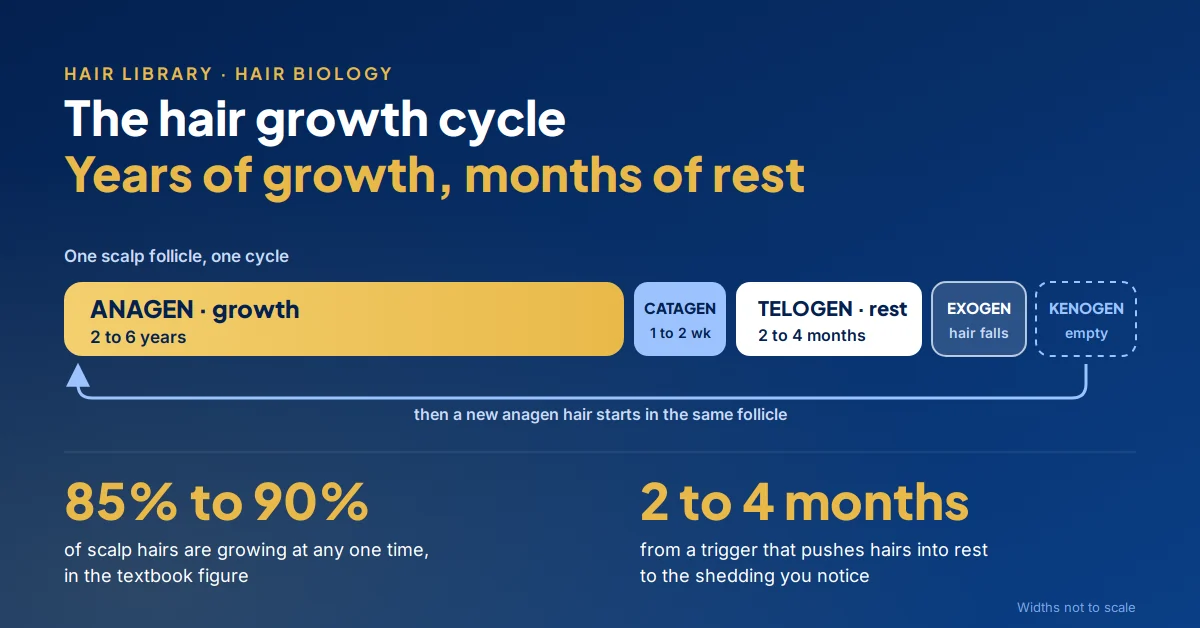
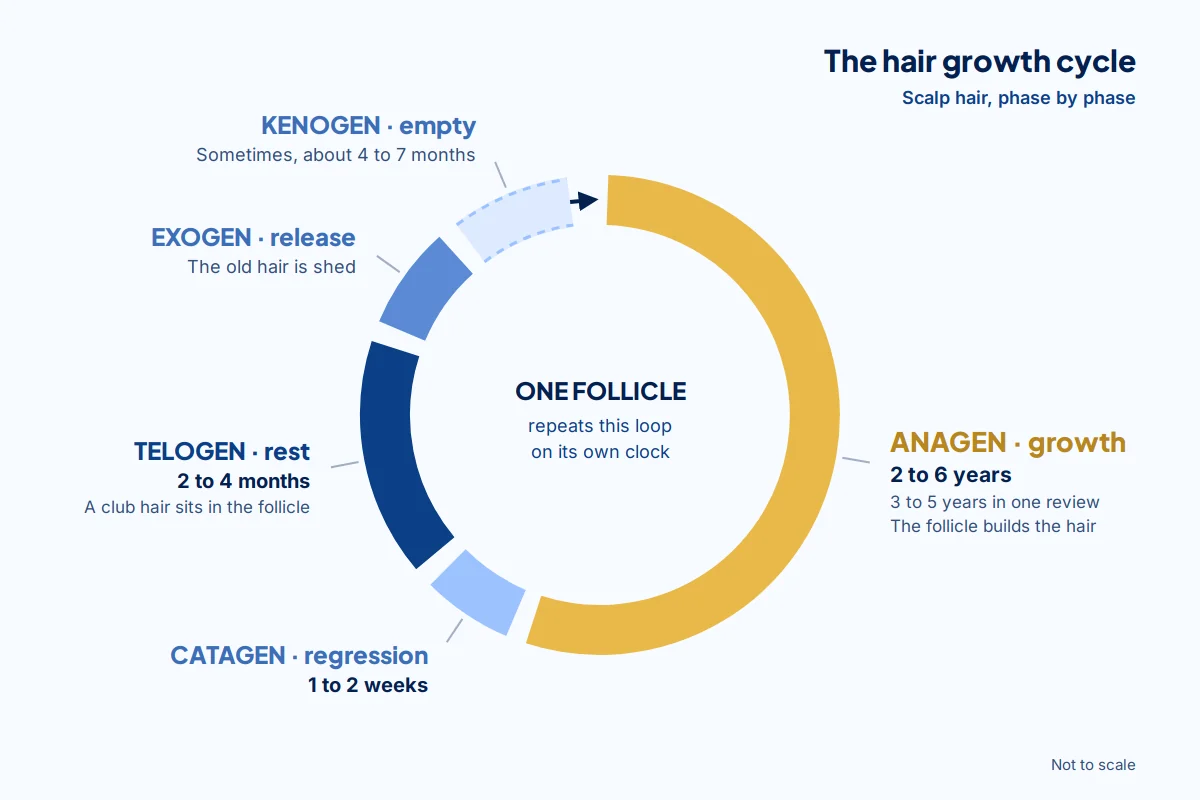
The hair growth cycle has three classic phases: anagen, when the hair grows, catagen, a short transition, and telogen, a rest before the hair falls out. On the scalp, anagen lasts 2 to 6 years, catagen 1 to 2 weeks and telogen 2 to 4 months.[1] Newer work adds exogen, the release of the old hair, as a fourth phase.
Anagen is the phase to watch: its length sets how long your hair can grow, and many kinds of hair loss cut it short or delay the next one.
2Complete guideFrom the phases to pattern loss and surgery
AnagenGlossaryAnagen is the growing phase of the hair cycle. For scalp hair it lasts 2 to 6 years according to a Deutsches Ärzteblatt review, and 2 to 7 years according to Cleveland Clinic. Open in the glossary → is when the follicle is busiest, building the hair shaft at about 1 cm a month. How long it lasts sets the longest your hair can grow. Monthly growth is covered in how fast hair grows.
Catagen, Telogen, Exogen and Kenogen
In catagenGlossaryCatagen is the short transition phase of the hair cycle, lasting about 1 to 2 weeks. Cell division stops and about two thirds of the lower follicle breaks down, while the dermal papilla stays intact and moves upward. Open in the glossary → the follicle stops growing and shrinks back. In telogenGlossaryTelogen is the resting phase of the hair cycle. It lasts 2 to 4 months according to a Deutsches Ärzteblatt review, and up to 4 months according to Cleveland Clinic. Open in the glossary → it rests, holding the finished hair, called a club hair. Exogen is the release: the club hair's anchor weakens until the hair falls out.[5]
Exogen is the stage you see: shed hairs are club hairs released at the end of their cycle, and losing up to 100 a day is normal.[1] Our normal hair loss guide covers the daily numbers.
Kenogen is an empty gap after the old hair falls and before a new one appears. It doesn't happen in every cycle, and in pattern hair loss it lasts longer and comes more often.
The scalp hair growth cycle, with phase lengths from the sources cited here. Diagram: Turkey Hair Center. Not to scale.
Why Your Hairs Do Not All Shed at Once
Each follicle changes phase on its own schedule, so at any moment only a small share of your hair is resting. Trouble starts when something pushes many growing follicles into rest together. Known triggers include:[6]
Inflammation
Hormones and stress
Nutritional deficiency or poor sleep
Medicines that block cell division
Those hairs then rest for a few months before they fall, so the shedding shows 2 to 4 months after the trigger, late enough that the link is easy to miss.[1] Our telogen effluvium entry covers that shedding.
Scalp vs Body Hair: Why the Stages Differ
Every hair on your body cycles, fine vellus and coarse terminal hair alike, but the phase lengths vary greatly from site to site.[7]
The stage also matters for hair removal, because only growing hairs are particularly sensitive to physical injury.
How Hair Loss Changes the Hair Growth Cycle
Hair Loss Types and the Stage They Affect
Different kinds of hair loss disturb different stages. Match what you notice to the closest row; the last two columns are our summary.
What you notice
What happens in the cycle
What to expect
A sensible first move
Even shedding all over, months after stress or a new medicine
Immune cells reversibly stall the follicles: alopecia areata
What to expect
Regrowth possible; the course varies
A sensible first move
See a dermatologist
Shedding 2 to 4 months after a birth
What happens in the cycle
The stress of delivery and hormonal changes push many follicles into rest
What to expect
Normal and temporary
A sensible first move
Give it time
Shorter Growth, Longer Empty Spells
In pattern hair lossGlossaryAndrogenetic alopecia, or pattern baldness, is the pattern hair loss behind most male and female thinning. It is primarily driven by genetic predisposition and sensitivity to androgen hormones. Open in the glossary →, a growing share of hairs get a shorter anagen, grow thinner and leave the follicle empty for longer before the next hair appears. That picture comes from almost 10,000 hair cycles followed in 10 men over 15 years.[8]
The empty gaps add to the thinning, because fewer hairs are on the scalp at any one time. Why some follicles react is covered in DHT and hair loss.
Can You Extend or Restart the Hair Growth Cycle?
Two medicines act on the cycle itself. In animal studies, minoxidil shortens telogen so resting follicles start growing early, and it may also lengthen anagen.[9]Finasteride works on the hormone side: in a four-year study, two years of it restarted growth faster and lengthened anagen in follicles that still made thick hair.[5]
The catch is timing: follicles already making very thin hair kept shrinking on finasteride. In that study, there was no clear sign that shrunken hairs turned back into thick ones.
How to Support a Healthy Hair Growth Cycle
Outside these medicines, we found no study of a routine that makes a healthy anagen last longer. Supporting the cycle means removing what cuts it short: the triggers above, and any medical cause behind extra shedding.
If your shedding rises, ask about blood tests: iron deficiency and thyroid problems are among the causes to rule out when the reason isn't clear. See thyroid and hair loss and vitamins for hair loss.
After a one-off trigger, this is the timeline we'd expect:
The trigger: stress, a birth or a new medicine pushes many hairs into rest.
Months 2 to 4: the resting hairs fall out, and the shedding shows.
As each follicle restarts: a new hair begins and grows about 1 cm a month, so length comes back slowly.
The Hair Growth Cycle After a Hair Transplant
Why Transplanted Hair Sheds, Then Regrows
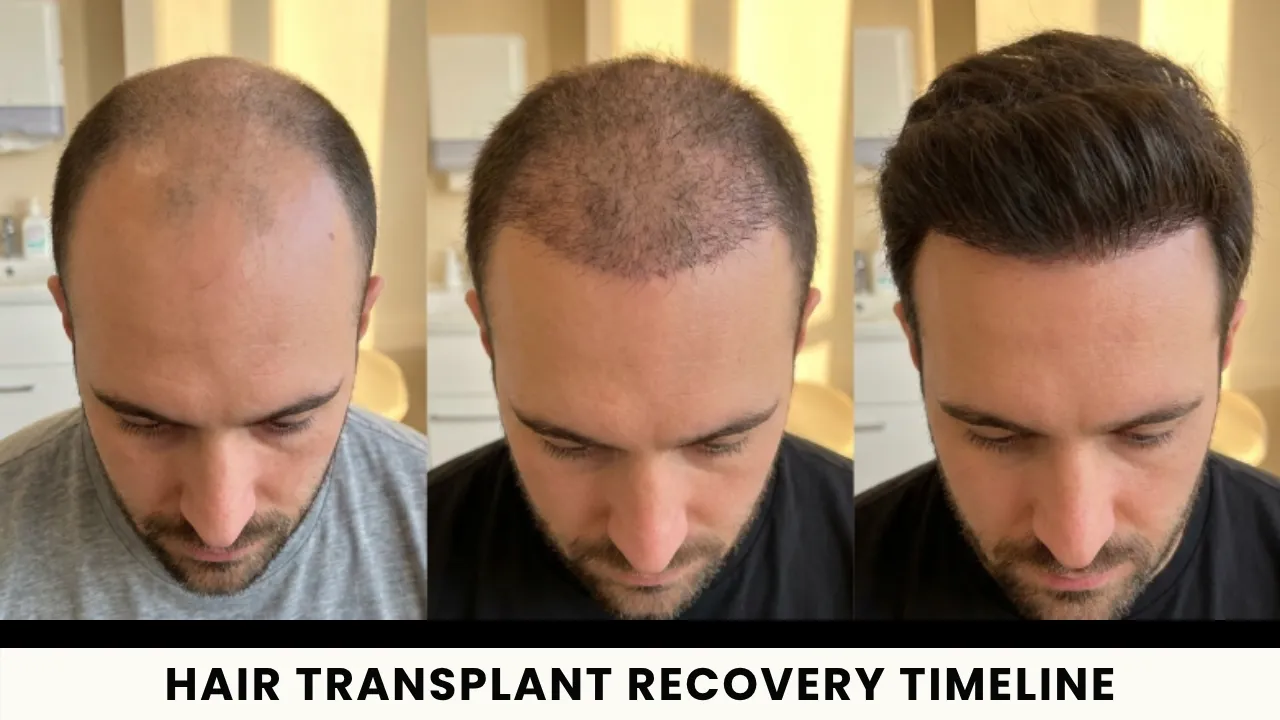
Moving a follicle doesn't change its genes: transplanted hair keeps the traits of its donor site, a principle called donor dominance.[10] The move does disturb its cycle. The hairs usually shed 2 to 4 weeks after surgery, and regrowth begins 3 to 5 months after the operation.[11]
A transplant is the wrong move during a sudden shed: those follicles have been pushed into rest, not destroyed, and the cycle repeats. When a transplant does fit, medical treatment alongside it has improved results and helps maintain density.
Frequently Asked Questions
How long does the hair growth cycle last?
On the scalp, years: 2 to 6 of growth, 1 to 2 weeks of transition and 2 to 4 months of rest. Elsewhere on the body, phase lengths vary greatly from site to site.
How many phases does the hair growth cycle have?
Three in the classic model, four with exogen and five with kenogen. In order: anagen, catagen, telogen and exogen, with kenogen as an empty gap that can come before the next anagen.
Does the hair growth cycle repeat?
Yes. After shedding, the same follicle returns to anagen and makes a new hair, though in pattern hair loss each new hair tends to be finer and the wait longer.
Is the hair growth cycle different for women?
The phases are the same. After childbirth, many follicles rest together, so a normal shed appears 2 to 4 months later, as our postpartum hair loss guide explains. Empty follicles have also been documented in women with progressing female pattern hair loss.
Do you shed more hair in certain seasons?
The evidence is limited. One review lists the seasons among the factors that can push many follicles into rest together, with the shed showing 2 to 4 months later.[1] It names no season and no size of effect, and none of our sources measured one.
Does shaving affect the hair growth cycle?
Shaving cuts the hair at the skin surface, while the follicle, where the cycle runs, reaches down into the dermis. We found no study showing that shaving changes the cycle.
How long is the eyebrow hair growth cycle?
It differs from the scalp's, because phase lengths vary greatly from one body site to another; see do eyebrows grow back for the figures. Scalp hair transplanted into the brows keeps the traits of its donor site.
When a Changing Cycle Needs a Closer Look
Steady daily shedding is the cycle at work, and a shed after a trigger such as a birth can be normal and temporary. Finer, shorter hairs in a pattern point to a cycle that keeps shortening, and in one finasteride study the follicles that responded were those still making thick hair.
A transplant fits only the second case, once areas have thinned, with medical treatment alongside it. Send us three photos for a free hair analysis: the medical team will tell you whether this looks like normal cycling, a temporary shed or progressive loss, and whether a transplant fits. Or message us on WhatsApp.
About the Author
Written by: Nazmi Güldeş, Certified Trichologist. Nazmi Güldeş focuses on patient education around androgenetic alopecia, evaluating miniaturization through dermoscopy, and assessing candidates for medical treatments and hair transplants.
Editorial Policy & Trust
This entry was medically reviewed by Dr. Teuku Adifitrian, Sp.BP-RE (Dr. Tompi) on 31 October 2026. Every study cited here was checked against PubMed on 31 October 2026. Key figures are marked with their source, and every source is listed at the end of this entry. Read how we work in our editorial policy.
3 questions
Test yourself
Check what you remember from this entry. Each answer links back to the section that explains it.
How long does anagen, the growth phase, last on the scalp?
Anagen lasts 2 to 6 years on the scalp, and one review gives 3 to 5. Catagen takes 1 to 2 weeks and telogen 2 to 4 months. Read the section
When do transplanted hairs usually shed?
They usually shed 2 to 4 weeks after surgery, and regrowth begins 3 to 5 months after the operation. Read the section
What happens to the cycle in pattern hair loss?
More and more hairs get a shorter anagen, grow finer and wait longer before regrowing. Read the section
3Scientific evidenceStudy types, references and how to cite this entry
11sources
Evidence behind this entry: 11 publications indexed in PubMed (1987 to 2025): 7 reviews, 3 clinical studies and 1 lab study. 2 sources have free full text.
Reviewsummarises many studies
Clinical studya study in people without random groups
Lab studytested on cells or hair follicles in the lab
Wolff H, Fischer TW, Blume-Peytavi U. The Diagnosis and Treatment of Hair and Scalp Diseases. Deutsches Arzteblatt International. 2016;113(21):377-386.ReviewPubMedDOIFree full text
Stene JJ. [Hair physiology]. Revue Medicale de Bruxelles. 2004;25(4):A263-5.ReviewPubMed
Jimenez F, Alam M. The Proportion of Catagen and Telogen Hair Follicles in Occipital Scalp of Male Androgenetic Alopecia Patients: Challenging the Established Dogma. Experimental Dermatology. 2024;33(10):e70001.Lab studyPubMedDOI
Rebora A, Guarrera M. Kenogen. A new phase of the hair cycle?. Dermatology (Basel, Switzerland). 2002;205(2):108-110.ReviewPubMedDOI
Van Neste D. Natural scalp hair regression in preclinical stages of male androgenetic alopecia and its reversal by finasteride. Skin Pharmacology and Physiology. 2006;19(3):168-176.Clinical studyPubMedDOI
Natarelli N, Gahoonia N, Sivamani RK. Integrative and Mechanistic Approach to the Hair Growth Cycle and Hair Loss. Journal of Clinical Medicine. 2023;12(3).ReviewPubMedDOIFree full text
Mandt N, Troilius A, Drosner M. Epilation today: physiology of the hair follicle and clinical photo-epilation. The Journal of Investigative Dermatology Symposium Proceedings. 2005;10(3):271-274.ReviewPubMedDOI
Courtois M, Loussouarn G, Hourseau C, et al. Hair cycle and alopecia. Skin Pharmacology. 1994;7(1-2):84-89.Clinical studyPubMedDOI
Messenger AG, Rundegren J. Minoxidil: mechanisms of action on hair growth. The British Journal of Dermatology. 2004;150(2):186-194.ReviewPubMedDOI
Queen D, Avram MR. Hair Transplantation: State of the Art. Dermatologic Surgery. 2025;51(9):874-881.ReviewPubMedDOI
Kassimir JJ. Use of topical minoxidil as a possible adjunct to hair transplant surgery. A pilot study. Journal of the American Academy of Dermatology. 1987;16(3 Pt 2):685-687.Clinical studyPubMedDOI
Güldeş, N. (2026, October 31). Hair growth cycle: Anagen, catagen, telogen and exogen explained. Turkey Hair Center Hair Library. https://turkeyhaircenter.com/hair-growth-cycle/
@misc{guldes2026hairgrowthcycle,
  author       = {Güldeş, Nazmi},
  title        = {Hair growth cycle: Anagen, catagen, telogen and exogen explained},
  howpublished = {Turkey Hair Center Hair Library},
  year         = {2026},
  month        = oct,
  url          = {https://turkeyhaircenter.com/hair-growth-cycle/},
  note         = {Last updated 31 October 2026}
}
TY  - ELEC
AU  - Güldeş, Nazmi
TI  - Hair growth cycle: Anagen, catagen, telogen and exogen explained
T2  - Turkey Hair Center Hair Library
PY  - 2026
DA  - 2026/10/31
UR  - https://turkeyhaircenter.com/hair-growth-cycle/
N1  - Last updated 31 October 2026
ER  -
Talk to our hair team on a free video call, in your language. You receive a written plan with your technique, estimated grafts and all-inclusive price. If a hair transplant isn't right for you, we tell you honestly.
Your information is 100% confidential.
Real People Real Support
Send your photos on WhatsApp
Front, top and both sides, reviewed by the medical team.