Performed at authorized partner hospitals Turkey Hair Center is a Ministry of Health authorized health-tourism intermediary, not a clinic.
Scalp pain and hair loss often turn up together because the same event can upset both the follicle and the nerves around it. The most common pairing is a burning or tender scalp during a spell of heavy shedding, a symptom doctors call trichodynia, which usually settles once the shedding calms down.
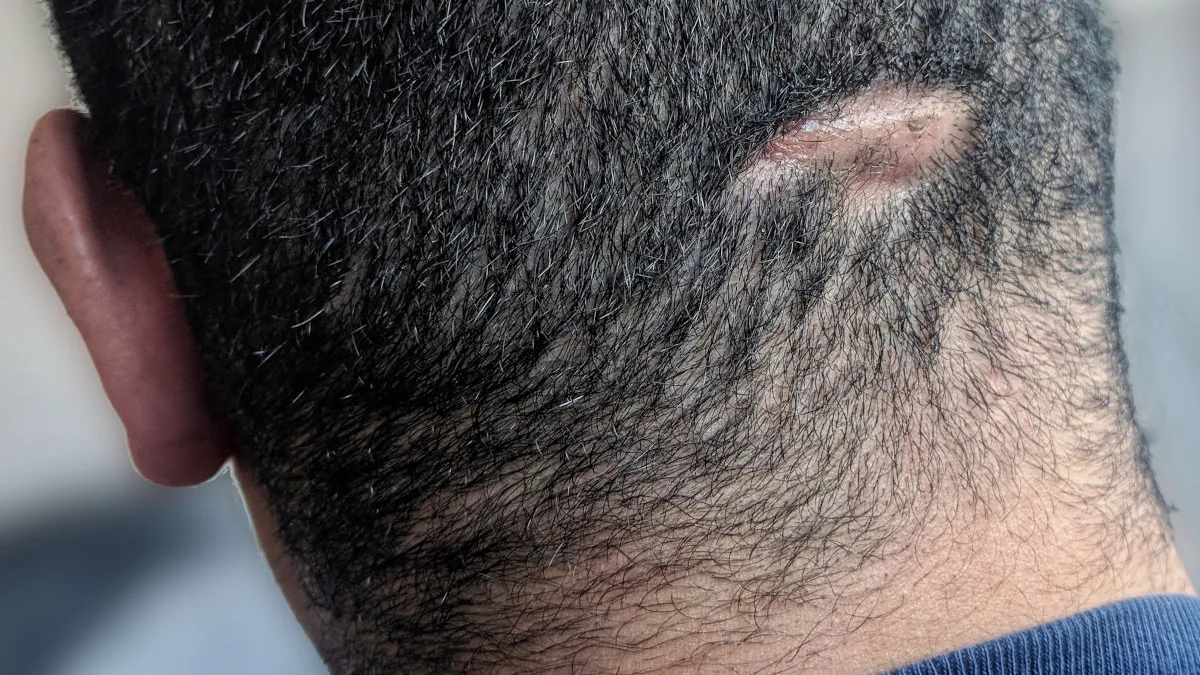
Dissecting cellulitis of the scalp: a pus-filled nodule with patchy hair loss. Photo: PhilipPirrip, CC BY-SA 4.0, via Wikimedia Commons, cropped.
Less often, pain in the scalp and hair loss point to inflammation, infection or a scarring condition that needs a diagnosis. This guide sorts the usual causes of hair loss and scalp pain, explains which ones are harmless and which are urgent, and covers the treatments that have evidence behind them.
The photo shows a soft, pus-filled lump in a patch where hair has been lost, on the back of the head of a 40-year-old man. Dissecting cellulitis is a rare inflammatory scalp condition that can leave scarring, so a sore lump with hair loss in the same place needs a dermatologist. Appearance alone is not a diagnosis.
What Is Aching Scalp Hair Loss?
Aching scalp hair loss is the everyday name for trichodynia: pain, burning, tingling or soreness of the scalp reported by people who are losing hair. A 2021 review in Skin Appendage Disorders describes it as a painful sensation of the scalp related to the complaint of hair loss.
It was first linked mainly to telogen effluvium, the sudden diffuse shedding that follows illness, childbirth or stress. Later studies found it just as often in androgenetic alopecia, the pattern hair loss behind most male and female thinning. The same review notes that studies failed to show a link between how much the scalp hurts and how much hair is actually falling out.
Why Am I Losing Hair and My Scalp Hurts?
The scalp pain and hair loss causes fall into three groups: shedding that brings nerve sensitivity with it, inflammation of the skin or follicles, and less common conditions where pain is the main warning sign.
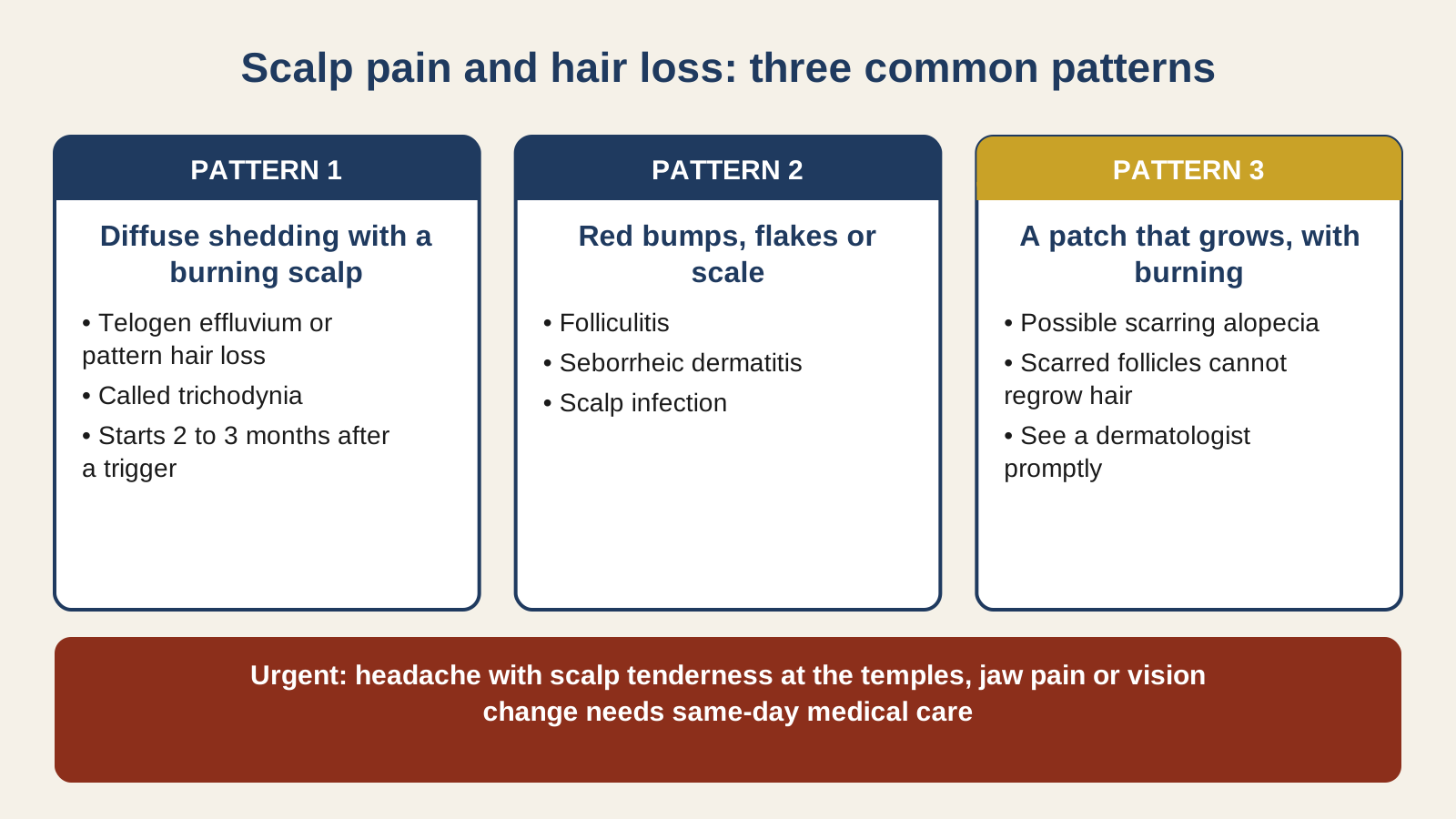
The diagram puts those groups side by side: diffuse shedding with a tender scalp, red bumps or scale, and a single patch that spreads with burning. The red box marks the one pattern that needs same-day medical care.
A clinic survey from Istanbul University put numbers on it. Of 249 patients seen in a hair disease unit, 89 (35.7%) had trichodynia. It was more common in women than in men, and more common in people with cicatricial (scarring) alopecia than in any other diagnosis group.
Inflammation of the Scalp (Scalp Folliculitis or Dermatitis)
Folliculitis is inflammation of the hair follicles. The American Academy of Dermatology (AAD) says it often looks like a sudden acne breakout, each spot may have a red ring, and the skin can itch or feel painful. Seborrheic dermatitis causes an itchy, flaky, scaly rash on oily areas such as the scalp.
Is It Always Inflammation?
No. In telogen effluvium the scalp can hurt with no visible redness at all. A 2020 review in Cureus lists trichodynia as a key symptom of telogen effluvium and describes it as tenderness, pain, burning, itching or stinging. Pattern hair loss can bring the same sensations.
Other Causes of Scalp Tenderness
Tight hairstyles: the AAD warns that hair pulled tightly back over long periods can lead to permanent loss (traction alopecia).
Scalp infection: scaly, sometimes inflamed areas, at times with small black dots where hairs have broken off.
Scarring alopecia: pain or burning with a patch that slowly widens.
Giant cell arteritis: headache with scalp tenderness, covered further down.
Scalp Pain and Hair Loss: Recommended Solutions
The right scalp pain and hair loss treatment depends on the cause, so the first step is a proper look at the scalp rather than a new product. A dermatologist can tell diffuse shedding from patchy loss, inspect the follicles with a dermatoscope and check for scale, pustules or scarring.
Bring a short history to the appointment: when the shedding started, what happened two to three months before it (fever, surgery, a new medicine, a crash diet), and where on the scalp it hurts. That timeline is often what separates a temporary shed from a condition that needs ongoing treatment.
Trichology Scalp and Hair Care
A 2023 review of sensitive scalp and trichodynia organises management in three steps: scalp care first, then topical treatment, then systemic treatment when needed. Scalp care means gentle, fragrance-free products and fewer triggers such as hot styling and tight ties.
Natural and Medical Treatments for Scalp Inflammation
For flaking and itch, medicated shampoos are the usual starting point, and a dermatologist can suggest which active ingredient suits the scalp. There is some trial evidence for a natural scalp pain and hair loss treatment: in a 4-week randomised study of 126 people with mild to moderate dandruff, a 5% tea tree oil shampoo improved the severity score by 41%, against 11% with placebo.
That study measured dandruff, not hair loss, so it supports tea tree oil for scaling and itch only. Scalp pain hair loss home remedies with no trial data behind them, such as undiluted essential oils, can irritate an already sensitive scalp.
Medicated shampoo: for seborrheic dermatitis and dandruff-type scaling.
Prescription creams or lotions: for confirmed inflammation, chosen by a doctor.
Treatment of the shedding cause: for example iron or thyroid problems found on blood tests.
No new actives on a sore scalp: see the minoxidil warning below.
The US label for women's 2% minoxidil solution says not to use it if your scalp is red, inflamed, infected, irritated or painful. Get the pain diagnosed first, then decide on regrowth treatment with your doctor.
Scalp Sore Hair Thinning
Scalp sore hair thinning is common in pattern hair loss, not only in sudden shedding. The 2021 review in Skin Appendage Disorders reports that trichodynia occurs in androgenetic alopecia too, and that it often coexists with anxiety or low mood about the hair loss.
That is a useful point for anyone with hair loss and a sore scalp that has lasted for months. The soreness does not mean the thinning is speeding up. Gradual thinning at the crown or temples is better judged with a pattern scale such as the Norwood scale than by how the scalp feels on a given day.
Tender Scalp and Hair Loss
A tender scalp and hair loss along the hairline, the parting or around a bun point towards pulling. Many people notice soreness after taking down a tight ponytail, braids or extensions, and that tenderness is the early sign to act on.
The AAD warns that continual pulling can lead to permanent hair loss. Looser styles, rotating the parting and shorter wear times for extensions reduce the strain. If the edges are already thinning, a dermatologist can check whether the follicles are still active before the damage becomes permanent.
Hair Loss Scalp Hurts
If your hair loss scalp hurts enough to disturb sleep or daily life, note where and how it hurts. Burning across the whole scalp during a shed fits trichodynia. Pain in one spot, a patch with no hairs, pus, crusting or a lump points to a local problem that should be examined.
In the Istanbul survey, the share of patients with trichodynia was highest in the scarring alopecia group. Scarring conditions are rare, but pain in a spot where hair is disappearing is one of the reasons to book a dermatology appointment rather than wait.
Sore Scalp Alopecia
Sore scalp alopecia is worth taking seriously because some forms of hair loss leave scars that stop regrowth. The AAD explains, in its page on frontal fibrosing alopecia, that once a hair follicle scars it can no longer grow hair, and that treatment tends to work better the earlier it starts.
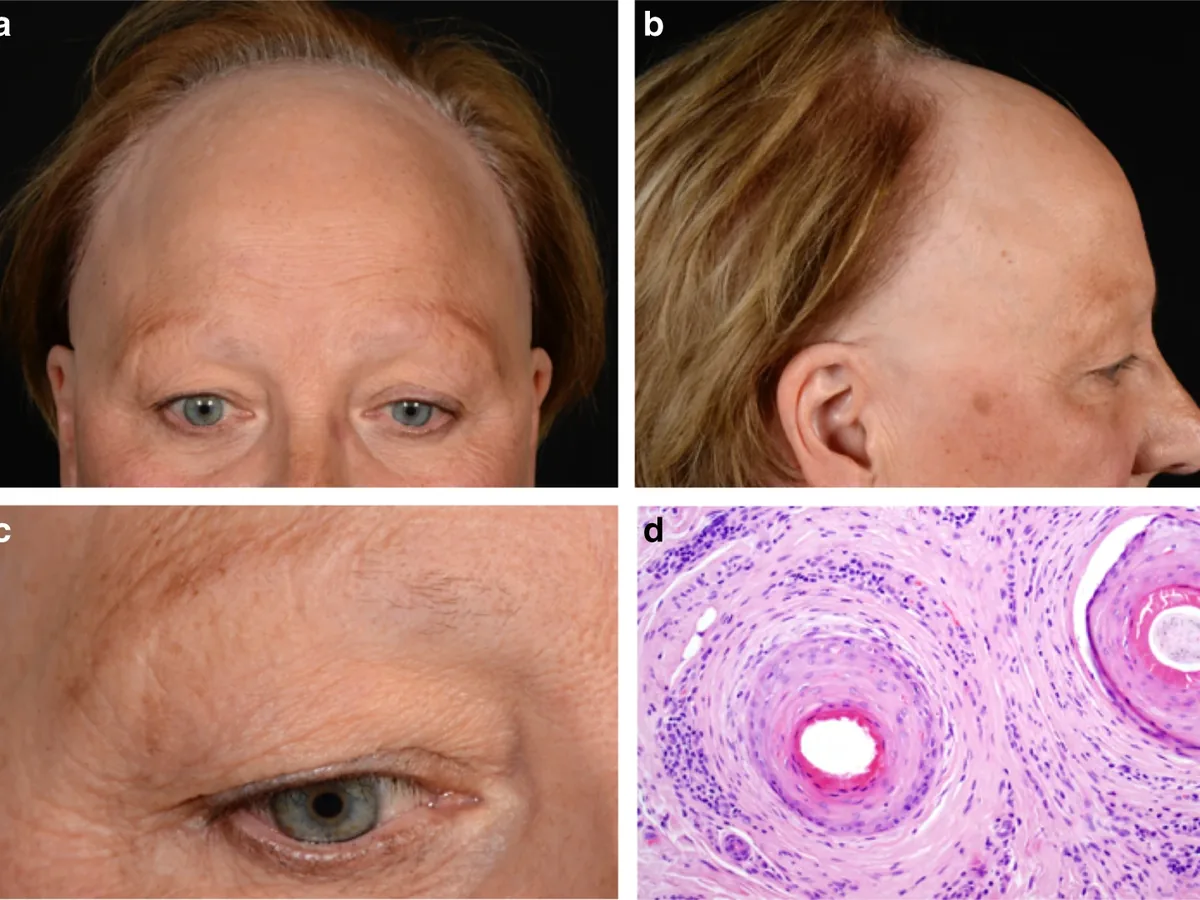
Frontal fibrosing alopecia: receded hairline (a), both temples (b), eyebrows (c), biopsy view (d). Photo: Tziotzios, C., Petridis, C., Dand, N. et al., CC BY 4.0, via Wikimedia Commons, cropped.
In these photos the hairline has moved back in a band, the skin where hair was lost looks smooth and pale, and the eyebrows are thin. A biopsy, shown in the last panel, is often how a dermatologist confirms a scarring alopecia; appearance alone is not a diagnosis.
Warning signs that need a dermatologist:
A bald patch that keeps getting bigger.
Shiny skin with no visible follicle openings.
Redness or scale around the hair roots at the edge of a patch.
Burning or itching in the same place, week after week.
Headache with Hair Loss
Headache with hair loss is usually two separate things at once, for example a tension headache during a stressful period that also triggered shedding. One combination needs urgent care. The NHS lists the main symptoms of giant cell arteritis (temporal arteritis) as frequent, severe headaches, pain or tenderness at the temples or on the scalp, jaw pain while eating or talking, and vision problems.
The NHS advises asking for an urgent GP appointment or contacting NHS 111 if you think you might have it, because it can lead to stroke and blindness. If your scalp is suddenly tender to touch and you also have jaw pain or blurred vision, do not wait for a hair appointment.
Sensitive Scalp and Hair Loss
Sensitive scalp and hair loss often go together. The 2023 review describes sensitive scalp as sensitive skin on the scalp, with itch, burning, pain or pricking and sometimes visible redness, set off by internal or external triggers.
There are no specific trichoscopic features for it yet, so the diagnosis rests on the history and on ruling out other scalp diseases. The review names postherpetic neuralgia and trigeminal trophic syndrome as the main conditions to exclude. In practice, a sensitive scalp and hair loss treatment starts with fewer products, milder cleansers and patch-testing anything new.
Hair Falling Out and Scalp Hurts
Hair falling out and scalp hurts a few weeks or months after an illness is a well documented pattern. In an international survey of hair specialists, 128 people with past COVID-19 who came to hair clinics were assessed: 66.3% had telogen effluvium and 58.4% had trichodynia.
In most of them, hair and scalp symptoms began within the first month after the diagnosis, and in about half they started after 12 weeks or more. The same delay applies to other triggers. Telogen effluvium usually shows two to three months after the event, and acute shedding lasts less than six months. Hair falling out scalp hurts during that window is usually part of the same shed.
Hair Fall and Scalp Pain
Hair fall and scalp pain at the same time do not have to mean a serious disease, but they do change what you should put on your scalp. The table below matches common combinations with a sensible next step.
What you notice
Likely group
Next step
Diffuse shedding, burning scalp, no redness
Telogen effluvium with trichodynia
Look back 2 to 3 months for a trigger; blood tests if no clear cause
Gradual thinning with soreness
Pattern hair loss with trichodynia
Dermatology review of the pattern
Red bumps or pustules
Folliculitis
Dermatologist to confirm and treat
Flakes, itch, greasy scale
Seborrheic dermatitis
Medicated shampoo, dermatologist if it persists
Sore edges after tight styles
Traction alopecia
Loosen styles now
Growing bald patch with burning
Possible scarring alopecia
Prompt dermatology appointment
Temple pain, jaw pain, vision change
Possible giant cell arteritis
Urgent medical care the same day
For a wider list of triggers, our reasons for hair loss guide covers genetics, stress and nutrition. If blood tests come back low in iron or vitamin D, the guide to vitamins for hair loss explains which deficiencies are linked to shedding.
Frequently Asked Questions
Does Your Scalp Hurt When Losing Hair?
It can. Trichodynia, a painful or burning scalp, is reported by a large share of people with hair loss: 35.7% in one survey of 249 hair clinic patients. It is common in telogen effluvium and pattern hair loss, and it does not mean the hair loss is worse than it looks.
Is Scalp Pain Related to Hair Loss?
Often, yes. The same triggers that push follicles into shedding, such as illness, stress or childbirth, can make the scalp feel sore. Scalp pain can also come from folliculitis, dermatitis, tight hairstyles or rare conditions, so persistent or one-sided pain should be checked by a doctor.
Why Is My Scalp Sore and Tender to Touch?
Common reasons are a recent shed, tight hairstyles, inflamed follicles or a flaky dermatitis. Tenderness at the temples with headache, jaw pain or vision problems is different and needs urgent care, because the NHS lists these as symptoms of giant cell arteritis.
Why Is My Hair Sore at the Roots?
Hair has no nerves, but the skin around each follicle does. Soreness at the roots usually comes from pulling (ponytails, braids, extensions), from inflamed follicles, or from the nerve sensitivity of trichodynia during shedding. Loosening styles is the first thing to try.
Why Is My Scalp Tender in One Spot with Hair Loss?
A single tender spot with hair loss needs an examination. Possible causes include folliculitis, a scalp infection, or a scarring alopecia, where early treatment matters because scarred follicles cannot regrow hair. A dermatologist can usually tell these apart with a scalp exam and, if needed, a biopsy.
What Is Trichodynia?
Trichodynia is pain, burning, tingling or soreness of the scalp in people who are losing hair. A 2021 review in Skin Appendage Disorders describes it as a painful sensation of the scalp related to the complaint of hair loss. It is common in telogen effluvium and pattern hair loss, and studies have not shown that more pain means more hair is falling out.
Can Stress Cause a Sore Scalp and Hair Loss?
It can contribute to both. A 2023 review lists emotional stress among the main internal triggers of a sensitive scalp, and notes that anxiety and depression can be either triggers or results of scalp discomfort. Stress is also a known trigger of telogen effluvium, the shedding that often comes with trichodynia. Symptoms that persist still need a medical check.
Can I Use Minoxidil If My Scalp Hurts?
Not without medical advice. The US drug label for women's 2% minoxidil solution says not to use it if your scalp is red, inflamed, infected, irritated or painful, and to stop and ask a doctor if scalp irritation or redness occurs. Get the cause of the pain diagnosed first, then discuss regrowth treatment with your doctor.
How Is Ongoing Scalp Pain Treated?
It depends on the cause. A 2023 review describes three steps: gentle scalp care, then topical treatment, then medicines by mouth when needed. For persistent trichodynia, doctors sometimes prescribe medicines also used for nerve pain, such as certain antidepressants or gabapentin. These are prescription decisions, so they should be started and monitored only by a doctor.
Get a Second Opinion on Your Hair Loss
Once the scalp is calm and the cause is clear, the remaining question is often how much hair has been lost for good. Send clear photos of your scalp for a free hair analysis and the medical team will tell you whether you are looking at temporary shedding or a pattern that may need longer-term treatment. Turkey Hair Center is a Ministry of Health authorized health-tourism intermediary; procedures take place at authorized partner hospitals.
Medical disclaimer: This article is for informational purposes only and is not medical advice. Individual results and recovery vary from person to person. Always follow the written aftercare plan from your own medical team.
Starace M, Iorizzo M, Sechi A, et al. Trichodynia and telogen effluvium in COVID-19 patients: results of an international expert opinion survey on diagnosis and management. JAAD International, 2021;5:11-18
Send three photos: front, top and sides. You get a technique recommendation, a graft range and a straight answer about what is achievable, before anyone talks about price.
Your details are with the team
A patient coordinator will get back to you shortly. If you would like to send your photos now, WhatsApp is the fastest way to do it.
We respond quickly, day or night, in your language.
Multilingual team, no obligation
Data protectedKVKK and GDPR compliant, 100% confidential
Authorized Health Tourism Intermediary
Turkey Hair Center is the hair-restoration brand of Healthy Way Tourism, an authorized international health-tourism intermediary. All medical procedures are performed by licensed medical professionals at authorized healthcare facilities in Turkiye, in accordance with the regulations of the Ministry of Health.