Telogen Effluvium: Why Hair Sheds Suddenly and When It Grows Back
Why hair sheds all at once a few months after an illness, an operation, childbirth or a crash diet, how long the shedding lasts, and what helps it grow back.
12sources
11in PubMed
14min read
Written by Nazmi Güldeş, Certified Trichologist · Medically reviewed by Dr. Teuku Adifitrian, Sp.BP-RE (Dr. Tompi), Plastic, Reconstructive and Aesthetic Surgeon · Last reviewed 31 October 2026
Reading level
Telogen effluvium is sudden, even shedding all over your scalp that starts a few months after a shock to your body: a high fever, an operation, a birth, major weight loss or a hard stretch of stress. It looks alarming, but the follicles aren't damaged, and for most people the hair grows back.
The trick is the delay. By the time hair comes out in handfuls, the cause is months behind you, so most people look in the wrong place. Below is where to look, what to expect month by month and when it's time to see a doctor.
1Quick answerThe short answer, in a few sentences
What Is Telogen Effluvium?
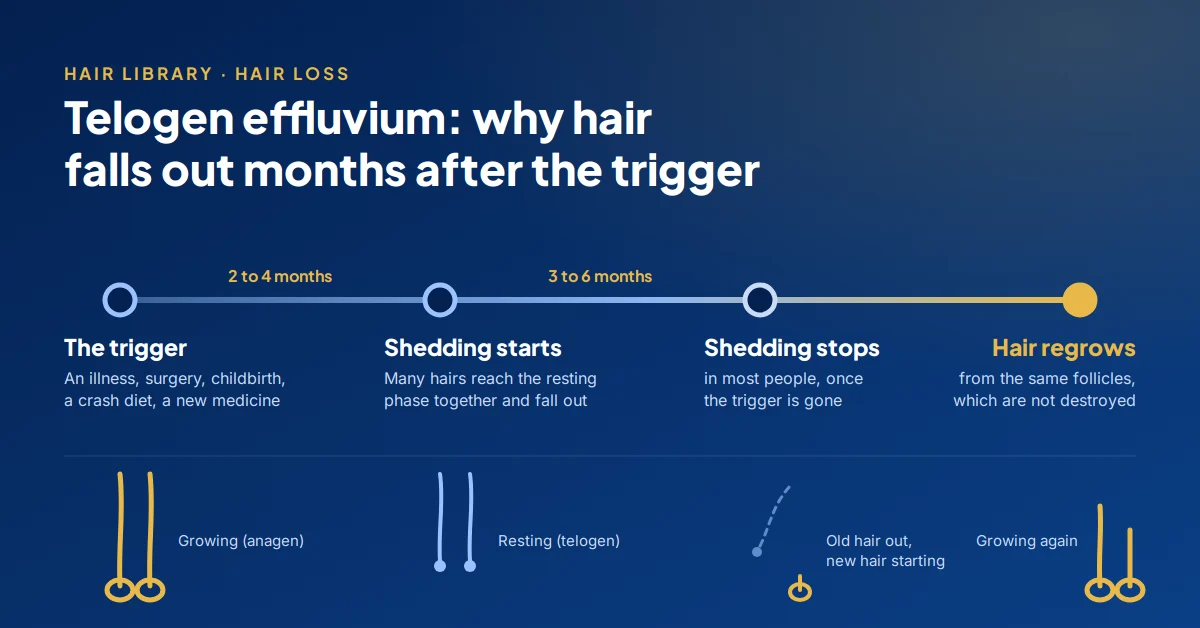
Telogen effluvium is temporary, non-scarring hair loss. After a physical or emotional stress, many follicles switch from growing to resting at once, and those hairs fall out together a few months later. The hair thins evenly, with no bare patches. Treatment means finding and correcting the trigger, and the shedding usually stops 3 to 6 months after it starts.[1]
Shedding is not the same as going bald. Telogen effluvium is non-scarring, so the follicles are not destroyed, which is why the hair usually comes back once the trigger has passed.[2]
2Complete guideFrom triggers and timeline to treatment and surgery
Symptoms, Causes and Timeline of Telogen Effluvium
Symptoms of Telogen Effluvium: What the Shedding Looks Like
The first sign is more hair than usual on your pillow, in your brush and in the shower drain. Losing 50 to 100 hairs a day is normal; telogen effluvium means losing clearly more than that.[3] The loss comes from the whole scalp at once, so your hair feels thinner and your ponytail lighter, yet no bare patch appears.
What to look for:
A sudden change: shedding that was normal one month and heavy the next.
Thinning everywhere at once, rather than only at the crown, the temples or the part.
A positive pull test: a gentle tug on a small bunch of hairs normally removes 2 or fewer.[4]
A sore or itchy scalp: some people feel it while they shed, as the questions below explain.
Our hair breakage entry shows how to tell a shed hair from a broken one.
How the Hair Cycle Explains the Delay
Each scalp hair grows in a phase called anagenGlossaryAnagen is the growing phase of the hair cycle. For scalp hair it lasts 2 to 6 years according to a Deutsches Ärzteblatt review, and 2 to 7 years according to Cleveland Clinic. Open in the glossary →, then rests in a phase called telogenGlossaryTelogen is the resting phase of the hair cycle. It lasts 2 to 4 months according to a Deutsches Ärzteblatt review, and up to 4 months according to Cleveland Clinic. Open in the glossary → before it falls out and a new hair starts in the same follicle. Normally the follicles take turns, so only some are resting at any one time.
A trigger pushes a large share of growing follicles into the resting phase together. They don't let go straight away: the shed usually comes 3 to 4 months after the trigger, which is why so many people blame the wrong thing.[5]
Common Triggers
Think back two to four months, not two weeks. Most of the triggers below are on the American Academy of Dermatology's list[3]; the last column is our practical advice.
Trigger
Examples
What you can do
Illness with fever
Examples
COVID-19 or any illness with a high fever
What you can do
Wait it out; the shed usually comes after you have recovered
An operation
Examples
Any surgery
What you can do
Expect a shed a few months later, and don't panic when it comes
Weight loss
Examples
Losing 20 pounds (9 kg) or more
What you can do
Expect a shed a few months later; for weight-loss injections, see Mounjaro hair loss
A birth
Examples
Shedding often starts about 2 months after the birth and peaks at around 4
The timeline is the most useful thing to know, because it tells you whether to wait or to act. The last column is our advice.
When
What usually happens
What you should do
Month 0
What usually happens
The trigger
What you should do
Note the date and what happened
2 to 4 months later
What usually happens
Shedding starts
What you should do
Look back for the trigger rather than buying products
3 to 6 months after it starts
What usually happens
Shedding stops, once the trigger is gone
What you should do
Take a monthly photo of your part and temples
Within 6 to 9 months
What usually happens
Hair tends to regain its normal fullness
What you should do
Judge fullness first; length returns as the hair grows
Over 6 months of shedding
What usually happens
It is called chronic
What you should do
See a dermatologist
After COVID-19, the numbers were a little shorter: shedding began a median of 2 months after the infection, recovery took a median of 5 months, and 95% of cases resolved.[6] Short regrowing hairs often appear while the shedding is still going on. How soon your length returns depends on how fast hair grows.
Acute vs Chronic Telogen Effluvium
Acute shedding has a clear start and settles within months. Shedding that lasts more than six months is called chronic.[7]
Whether chronic telogen effluvium is a separate disease is disputed. A 2023 systematic review found no agreed definition, and suggests many cases are early female pattern hair loss, a trigger nobody found, or worry about normal shedding in anxious people with long hair.[8]
Telogen Effluvium vs Androgenetic Alopecia and Other Look-Alikes
Telogen Effluvium or Pattern Hair Loss?
Androgenetic alopeciaGlossaryAndrogenetic alopecia, or pattern baldness, is the pattern hair loss behind most male and female thinning. It is primarily driven by genetic predisposition and sensitivity to androgen hormones. Open in the glossary →, or pattern hair loss, is the main condition to tell apart from telogen effluvium, and some people have both. Pattern loss is inherited and tends to keep going without treatment, while a shed settles.
Telogen effluvium
Pattern hair loss
Where it shows
Telogen effluvium
Evenly over the scalp, no bare patches
Pattern hair loss
Women: gradual thinning on top. Men: a receding hairline or a bald patch in the centre of the scalp
How it starts
Telogen effluvium
Suddenly, months after a trigger
Pattern hair loss
Gradually, over years
What drives it
Telogen effluvium
A trigger
Pattern hair loss
Inherited genes
Without treatment
Telogen effluvium
Usually settles
Pattern hair loss
Usually keeps going
First step
Telogen effluvium
Find and stop the cause
Pattern hair loss
A pattern-loss treatment such as minoxidil
Alopecia areataGlossaryAlopecia areata is an autoimmune condition that can cause round patches of hair loss in the eyebrows, beard or scalp. Hair often regrows within a few months and may look white or grey at first before the natural colour returns. Open in the glossary → is the other lookalike. It usually causes round bald patches, but it can also thin hair all over, so patches or a fast, unexplained loss need a dermatologist. Our alopecia areata entry covers the patchy form.
How Doctors Confirm It
History: what happened in the months before the shedding started. A detailed history is where the search for the cause begins.
Pull test: the gentle tug from the symptoms list, done at the visit.
Wash test: counting the hairs shed in one wash, which is also a simple way to track whether the shed is easing.
Trichoscopy: a scalp magnifier often shows empty follicles and short regrowing hairs.
Blood tests: aimed at metabolic problems and nutritional deficiencies that could be keeping the shed going.
Biopsy: kept for long-running, unclear cases. It shows whether follicles are shrinking, which would point to pattern hair loss.
Iron, Vitamin D and Supplements: Where the Studies Disagree
The studies pull in different directions. A 2026 meta-analysis found lower ferritin, the body's iron store, and lower vitamin D in people with telogen effluvium than in healthy controls, although the studies varied a lot.[10]
A 2024 study of 90 women with chronic shedding found ferritin and vitamin D no different from controls, only lower zinc, and concluded that deficiencies are less common in telogen effluvium than people think.[11] Our reading: test rather than guess, and treat a deficiency the blood test confirms. See our guide to vitamins for hair loss.
Telogen Effluvium in Women
Women seek help for telogen effluvium more often, and the shedding tends to weigh on them more.[2] In the review of chronic cases, almost all were women.
Before you worry, compare today's shed with your own usual amount rather than a number on the internet, and count it the same way each time.
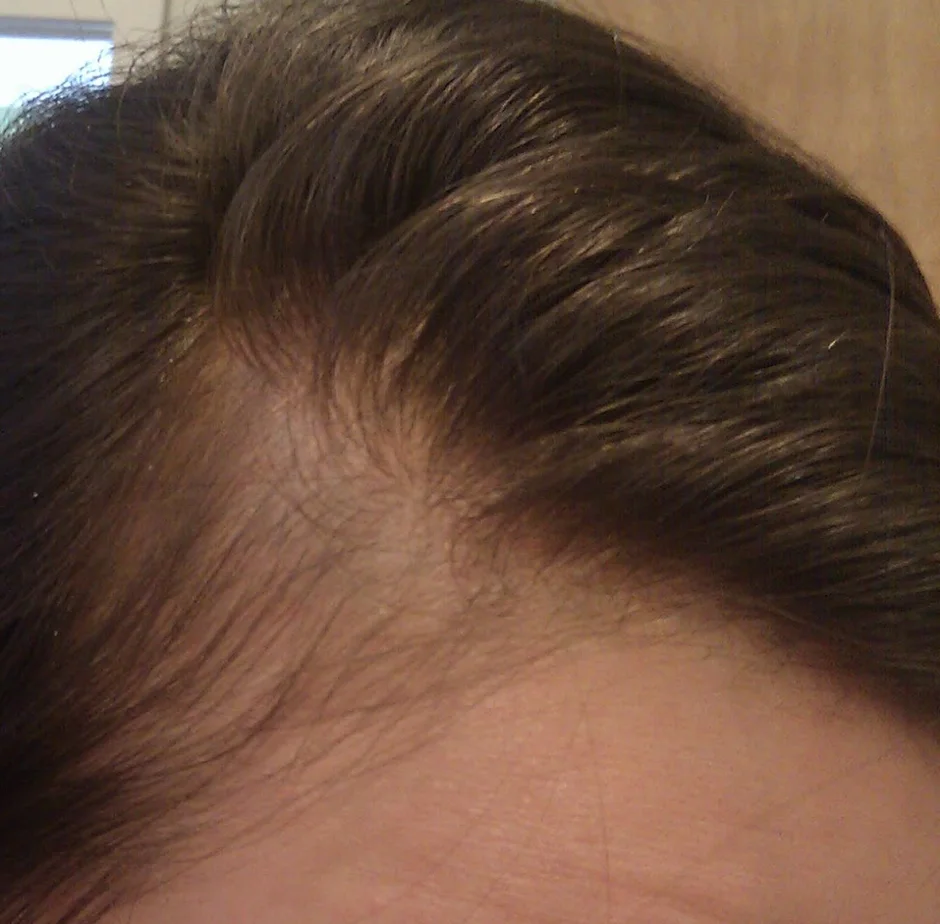
Thinning at the temple, described by the photographer as postpartum telogen effluvium. Photo: Mvolz, CC0 1.0, via Wikimedia Commons, cropped.
If your part keeps widening after the shedding settles, read our entry on female pattern hair loss.
Telogen Effluvium in Men
Men get it too. The usual question is whether it is a shed or early male pattern baldness. Shedding from all over, with no receding hairline and no thin spot on top, points to telogen effluvium; a hairline moving back or a bald patch on top points to pattern loss, covered in DHT hair loss.
Treatment, Prevention and the Hair Transplant Question
What Helps Telogen Effluvium
Finding and correcting the trigger is the treatment, and there is still no evidence-based drug for telogen effluvium.[1] A 2025 Canadian expert algorithm puts weight on explaining the condition to patients, and suggests offering a safe topical product while you wait.[2]
Minoxidil is the drug people ask about, and the evidence for it here is thin:
Topical 5% minoxidil: in a small trial with no placebo group, terminal hairs rose within 4 weeks. The authors note that natural recovery limits what this proves, and that the use is off-label.[1]
Low-dose oral minoxidil: in 36 women with chronic shedding, shedding scores fell at 6 and 12 months, and 13 developed unwanted facial hair.[7]
Our view: an acute shed is expected to stop on its own once the trigger is gone, so minoxidil earns its place mainly in chronic shedding, prescribed and followed by a doctor. Our minoxidil entry explains the forms, doses and side effects.
Can You Prevent Telogen Effluvium?
Only in part. A high fever, an operation or a birth can't always be avoided, but you can expect the shed and know that it passes.
Where you do have a say:
Diet: losing 20 pounds or more is a known trigger, which is worth knowing before you start a big diet.
Medicines: if you suspect a new drug, ask the prescriber before stopping it, because stopping some treatments suddenly can cause serious side effects.[3]
Ongoing stress: a stressor that stays with you can keep the shedding going.
Nutrition: test before you supplement, as the iron and vitamin D section explains.
Three myths make the waiting harder:
"Washing makes it worse." The hairs in the shower are resting hairs that the trigger pushed out of the growth phase months ago. In a pull-test study, when people had last washed or brushed made no difference to how many hairs came out.[4]
"It must be something from last week." The trigger is usually two to four months back.
"It means I'm going bald." It is non-scarring, so the follicles survive.
Shedding After Surgery and After a Hair Transplant
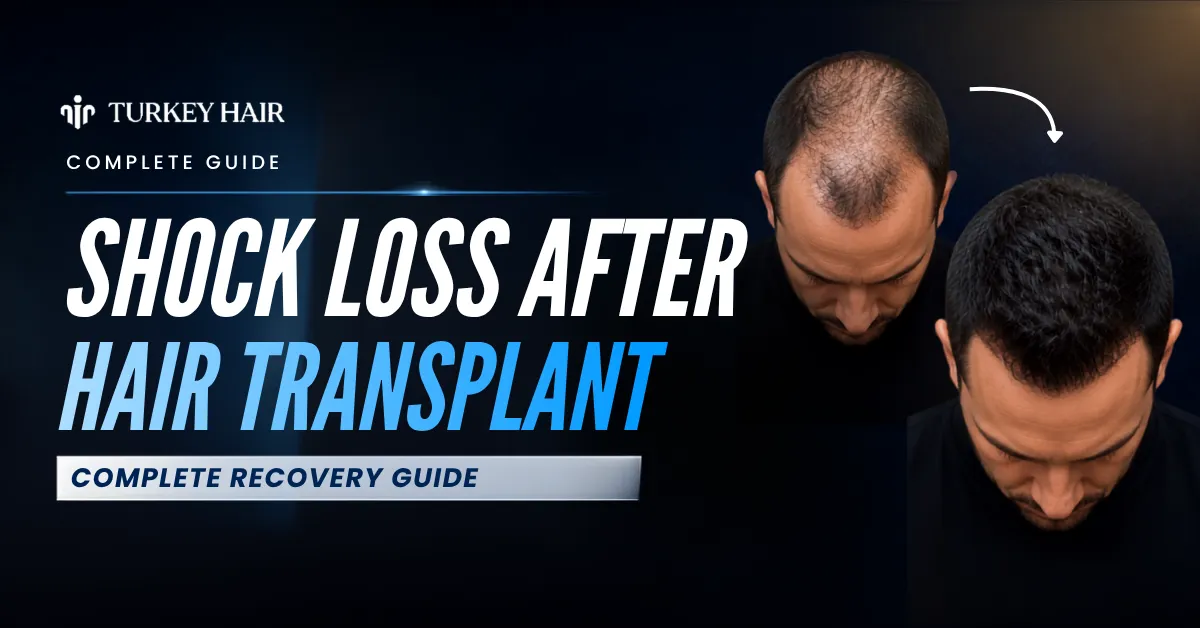
Any operation can set off telogen effluvium a few months later. A hair transplant can also cause a local shed, called shock lossGlossaryShock loss is a temporary shedding phase after a hair transplant, triggered by surgical stress to the scalp and typically starting 2 to 4 weeks after the procedure. The follicles remain healthy beneath the skin, and new growth resumes within 4 to 6 months. Open in the glossary →, at the recipient site or around the donor area. A 2025 review of transplant complications put effluvium at up to 6.5% at the recipient site and 4.1% at the donor site.[12]
When Shedding Doesn't Stop: Is a Transplant the Answer?
For telogen effluvium alone, no. In the seven-year follow-up above, the four women who kept shedding lost no visible density and their follicles did not shrink, so there was no bald area for grafts to fill.
The answer changes when the shed uncovers pattern hair loss. One woman in that study developed it within 18 months, and the 2023 review suggests many cases labelled chronic telogen effluvium are early pattern loss. Treatment then follows that diagnosis (for men, see our finasteride entry), and a transplant can be weighed for areas that stay thin after the shedding stops.
Frequently Asked Questions
How long does telogen effluvium last?
Acute shedding usually stops 3 to 6 months after it starts, once the trigger is gone. Shedding that goes on past six months is called chronic and can come and go for years.
Can telogen effluvium make you bald?
No. It is a non-scarring hair loss, so the follicles survive. Bare patches point to something else, such as alopecia areata.
Does hair grow back after telogen effluvium?
Yes, in most people. Hair tends to regain its normal fullness within 6 to 9 months, and 95% of published post-COVID cases resolved.
Does telogen effluvium affect the hairline?
It thins the whole scalp, temples included, so your hairline can look thinner along with the rest. If the hairline keeps moving back after the shedding settles, have it checked for pattern hair loss.
Can telogen effluvium come back?
Yes. A new trigger can start a new shed, and ongoing stress can keep one going. COVID-19 may also set off a relapse of chronic shedding.
Does telogen effluvium cause an itchy or sore scalp?
It can. Scalp soreness, called trichodyniaGlossaryTrichodynia is pain, burning, tingling or soreness of the scalp in people who are losing hair. It is common in telogen effluvium and pattern hair loss. Open in the glossary →, and itching were common complaints in people shedding after COVID-19. See scalp pain and hair loss.
Is telogen effluvium an autoimmune disease?
No. It is the hair cycle reacting to a trigger: many follicles switch to the resting phase at once and shed together later. If you see round bald patches, have alopecia areata ruled out.
Who Needs Patience, and Who Needs a Closer Look
Patience is the right plan if the shedding is even, began two to four months after a clear event, and is starting to ease.
Get a closer look if:
the shedding has lasted more than six months;
your part keeps widening or your hairline keeps moving back;
you see round bald patches;
the shed started after a new medicine, or you feel unwell in other ways.
A transplant only makes sense once pattern hair loss is confirmed and the shedding has settled. If you are not sure which you have, send us three photos for a free hair analysis. The medical team will tell you whether it looks like a temporary shed or pattern hair loss underneath. You can also message us on WhatsApp.
About the Author
Written by: Nazmi Güldeş, Certified Trichologist. Nazmi Güldeş focuses on patient education around androgenetic alopecia, evaluating miniaturization through dermoscopy, and assessing candidates for medical treatments and hair transplants.
Editorial Policy & Trust
This entry was medically reviewed by Dr. Teuku Adifitrian, Sp.BP-RE (Dr. Tompi) on 31 October 2026. Every study cited here was checked against PubMed on 31 October 2026. Key figures are marked with their source, and every source is listed at the end of this entry. Read how we work in our editorial policy.
3 questions
Test yourself
Check what you remember from this entry. Each answer links back to the section that explains it.
When does telogen effluvium shedding usually begin?
Classic descriptions put it 3 to 4 months after the trigger; after COVID-19 the median was 2 months. Read the section
What is the upper limit of a normal hair pull test?
In 181 volunteers a pull removed 0.44 hairs on average, and the authors set the normal limit at 2 or fewer. Read the section
Is a hair transplant a treatment for telogen effluvium alone?
In a seven-year follow-up of chronic shedding, density held and follicles did not shrink. A transplant is weighed only if pattern hair loss is found. Read the section
3Scientific evidenceStudy types, references and how to cite this entry
12sources
Evidence behind this entry: 11 publications indexed in PubMed (2005 to 2026): 5 clinical studies, 4 systematic reviews, 1 clinical trial and 1 review. Plus . 6 sources have free full text. 1 article has a published correction, shown in the references.
Randomized trialpeople assigned to treatments by chance
Reviewsummarises many studies
Clinical studya study in people without random groups
Guideline or labela professional body, or the official drug label
Ohyama M, Irisawa R, Uchiyama M, et al. Use of 5% Topical Minoxidil Application for Telogen Effluvium: An Open-Label Single-Arm Clinical Trial. The Journal of Dermatology. 2025;52(9):1351-1359.Clinical trialPubMedDOIFree full text
Landells I, Gupta AK, Jasso Olivares JC, et al. A Canadian Algorithm on the Management of Telogen Effluvium. Journal of Cutaneous Medicine and Surgery. 2025;29(5_suppl):15S-19S.ReviewPubMedDOIA correction to this article was published: J Cutan Med Surg. 2026 Jan-Feb;30(1):100. doi: 10.1177/12034754251380403. (PubMed).
American Academy of Dermatology. Do you have hair loss or hair shedding? AAD public information.GuidelineSource page
McDonald KA, Shelley AJ, Colantonio S, et al. Hair pull test: Evidence-based update and revision of guidelines. Journal of the American Academy of Dermatology. 2017;76(3):472-477.Clinical studyPubMedDOI
Chhabra N, George CA, Ganguly S. Telogen Effluvium Following Coronavirus Disease-2019 Infection: A Retrospective Study of 113 Cases. International Journal of Trichology. 2025;17(1):32-35.Clinical studyPubMedDOIFree full text
Czech T, Sugihara S, Nishimura Y. Characteristics of hair loss after COVID-19: A systematic scoping review. Journal of Cosmetic Dermatology. 2022;21(9):3655-3662.Systematic reviewPubMedDOIFree full text
Perera E, Sinclair R. Treatment of chronic telogen effluvium with oral minoxidil: A retrospective study. F1000Research. 2017;6:1650.Clinical studyPubMedDOIFree full text
Daunton A, Harries M, Sinclair R, et al. Chronic Telogen Effluvium: Is it a Distinct Condition? A Systematic Review. American Journal of Clinical Dermatology. 2023;24(4):513-520.Systematic reviewPubMedDOI
Sinclair R. Chronic telogen effluvium: a study of 5 patients over 7 years. Journal of the American Academy of Dermatology. 2005;52(2 Suppl 1):12-16.Clinical studyPubMedDOI
Ahmed A, Alali A, Alahmadi M, et al. Association between Serum Trace Elements and Telogen Effluvium: A Systematic Review and Meta-Analysis. Skin Appendage Disorders. 2026.Systematic reviewPubMedDOIFree full text
Durusu Turkoglu IN, Turkoglu AK, Soylu S, et al. A comprehensive investigation of biochemical status in patients with telogen effluvium: Analysis of Hb, ferritin, vitamin B12, vitamin D, thyroid function tests, zinc, copper, biotin, and selenium levels. Journal of Cosmetic Dermatology. 2024;23(12):4277-4284.Clinical studyPubMedDOIFree full text
Liu RH, Xu LJ, McCarty JC, et al. A Scoping Review on Complications in Modern Hair Transplantation: More than Just Splitting Hairs. Aesthetic Plastic Surgery. 2025;49(3):585-595.Systematic reviewPubMedDOI
Güldeş, N. (2026, October 31). Telogen effluvium: Why hair sheds suddenly and when it grows back. Turkey Hair Center Hair Library. https://turkeyhaircenter.com/telogen-effluvium/
@misc{guldes2026telogeneffluvium,
  author       = {Güldeş, Nazmi},
  title        = {Telogen effluvium: Why hair sheds suddenly and when it grows back},
  howpublished = {Turkey Hair Center Hair Library},
  year         = {2026},
  month        = oct,
  url          = {https://turkeyhaircenter.com/telogen-effluvium/},
  note         = {Last updated 31 October 2026}
}
TY  - ELEC
AU  - Güldeş, Nazmi
TI  - Telogen effluvium: Why hair sheds suddenly and when it grows back
T2  - Turkey Hair Center Hair Library
PY  - 2026
DA  - 2026/10/31
UR  - https://turkeyhaircenter.com/telogen-effluvium/
N1  - Last updated 31 October 2026
ER  -
Talk to our hair team on a free video call, in your language. You receive a written plan with your technique, estimated grafts and all-inclusive price. If a hair transplant isn't right for you, we tell you honestly.
Your information is 100% confidential.
Real People Real Support
Send your photos on WhatsApp
Front, top and both sides, reviewed by the medical team.