Traction Alopecia: Causes, Stages and When It Becomes Permanent
Why tight hairstyles thin the hairline, how to spot the first signs, when the damage becomes permanent, and what treatment and a hair transplant can and cannot do.
8sources
7in PubMed
13min read
Written by Nazmi Güldeş, Certified Trichologist · Medically reviewed by Dr. Teuku Adifitrian, Sp.BP-RE (Dr. Tompi), Plastic, Reconstructive and Aesthetic Surgeon · Last reviewed 31 October 2026
Reading level
Traction alopecia is hair loss caused by hairstyles or headwear that pull on the roots, month after month, most often at the front hairline and temples. The cause is the way you wear your hair, so it is one you can change. Loosen the style early and the hair usually grows back; keep the pull going and the follicles can scar for good.
The hard part is knowing which side of that line you are on.
1Quick answerThe short answer, in a few sentences
What Is Traction Alopecia?
Traction alopecia is hair loss from styles or headwear that pull on the hair for a long time. It usually thins the front and temple hairline, and it affects up to one in three adult women of African descent.[1] Caught early, it grows back once the pulling stops. Left too long, the follicles scar for good.
The cause is mechanical: constant pulling injures the follicle and sets off inflammation. It is seen in every ethnic group, but it is most common in women of African descent, because of tight styling practices and the curved shape of the follicle.
2Complete guideFrom the first signs to treatment and surgery
Causes and Who Gets Traction Alopecia
Hairstyles That Pull Hardest
The risk rises with how hard the hair is pulled and for how long, and chemically treated hair may stand up to it less well. The styles most often linked to it:
Tight buns, ponytails and pigtails
Weaves and extensions, especially on relaxed hair
Tight braids and cornrows, with extra pull from beads and clips
Locs and sisterlocks, which get heavier as they grow
Headwear over hair pulled back tight, such as a turban, a pinned cap or a scarf
The worst combination is traction on relaxed hair. In a study of 574 African schoolgirls and 604 women, it carried 3.47 times the odds of traction alopecia seen with natural hair.[2] Natural hair, loose styles and wigs carry the least risk.
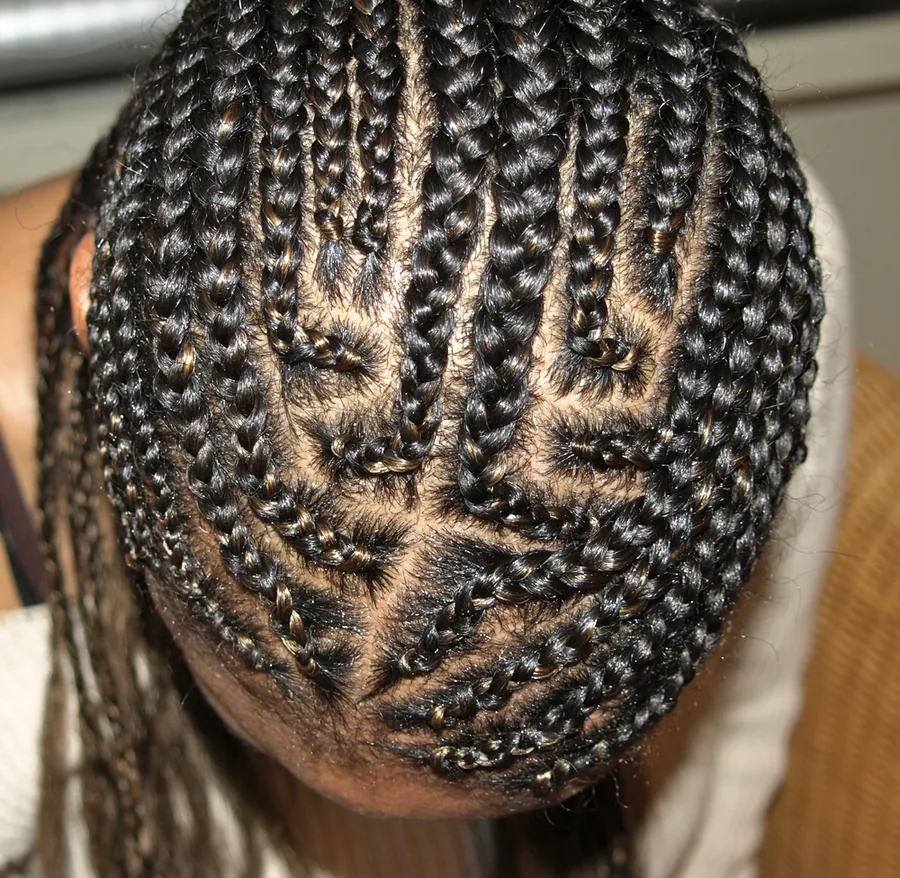
Cornrows with added synthetic hair, one of the higher-risk styles. Photo: Joanita Hafermalz, CC BY-SA 2.0, via Wikimedia Commons, cropped.
Traction Alopecia in Women
Most people diagnosed with it are women, and braids are only part of the story. Ballet dancers are at risk too: one lost hair at both temples after 13 years of a tight bun.
It can also occur alongside another type of hair loss, which is one reason a dermatologist sometimes takes a biopsy. Female pattern hair loss looks different: it thins the crown and top and keeps the front hairline.
Afro-Textured Hair: Braids, Locs and Relaxers
Afro-textured hair grows from a curved follicle, and its spiral shape creates weak points, so it breaks more easily under combing and tight styles. Relaxers weaken it further by breaking the disulfide bonds in the shaft.
You do not have to give up braids or locs. Thicker braids, shorter lengths, edges left out and breaks between installs all cut the pull, as the prevention table below shows.
Traction Alopecia in Men
Men get it much less often. One reported group is Sikh men, who twist their uncut hair into a knot on the front of the scalp under a tight turban; band-like scarring along the front hairline has been described. Military personnel and anyone who must pull their hair back for work are also at higher risk.
Traction Alopecia in Children
It starts young and builds with years of styling. In one South African school, 8.6% of girls in the first year had it, against 21.7% in the last.[3] Tight cornrows, pigtails and rubber bands are among the childhood styles that raise the risk. Early signs are common in children, and at that stage the loss can still reverse.
Myths About Traction Alopecia
"Only braids cause it." Ponytails, buns, weaves, locs and tight headwear can all cause it.
"If it doesn't hurt, it's safe." Pain is an early warning, but many people with traction alopecia have no symptoms.
"Natural hair can't get it." Relaxers raise the risk, but pulling alone is enough.
"Once the edges go, they're gone." Early loss usually grows back. Hair cannot return once the skin has turned smooth, shiny and bald.
Signs, Stages and When Traction Alopecia Becomes Permanent
Early Signs on the Hairline and Temples
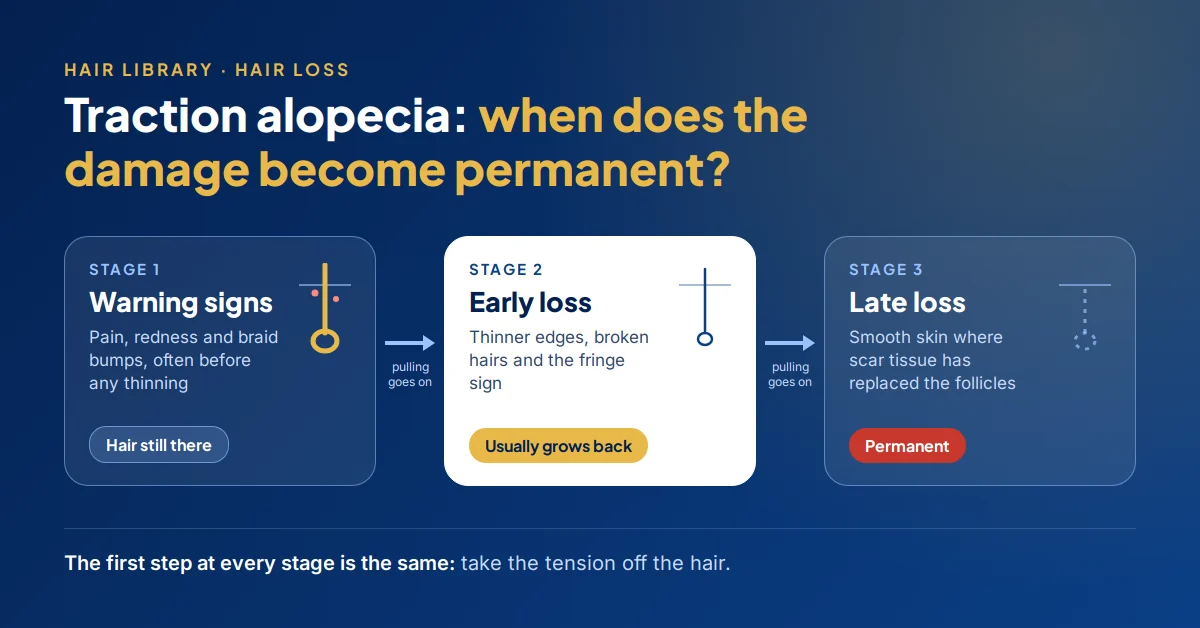
Pain after styling is one of the earliest warnings, and it is easy to dismiss because many people expect tight styles to hurt. Redness, crusts and small pus bumps called folliculitisGlossaryFolliculitis is inflammation of the hair follicles. It often looks like a sudden acne breakout; each spot may have a red ring, and the skin can itch or feel painful. Open in the glossary → can also appear before any thinning.
Then the edges thin. A strip of fine hairs often survives at the very front, called the fringe sign. It is a useful clue, because frontal fibrosing alopecia, a scarring condition of the hairline, usually loses it.
The Three Stages of Traction Alopecia
The loss starts out reversible and turns into permanent scarring if the pulling goes on. Use the table as a guide to your next step; the last two columns are our own summary of what the reviews describe.
What you see
Stage
Your first move
What to expect
Pain, redness, bumps or crusts after styling; no thinning yet
Stage
Warning signs
Your first move
Take the style out or loosen it now
What to expect
The hair is still there
Thinner edges, broken hairs, a fringe of fine hairs
Stage
Early traction alopecia
Your first move
Stop the pull and see a dermatologist
What to expect
Usually grows back
Smooth, shiny skin with no follicle openings
Stage
Late traction alopecia
Your first move
Ask a dermatologist whether a transplant fits
What to expect
Usually permanent
A receding edge with thinning eyebrows and no fine hairs
Stage
Possibly frontal fibrosing alopecia
Your first move
See a dermatologist; a biopsy may be needed
What to expect
No transplant while it is active
How Long Does Hair Take to Grow Back?
No trial has timed it, and the evidence for scalp treatments is anecdotal at best.[4] Based on the case reports, this is the timeline we suggest:
Today: take the tension off. It is the key step at every stage.
First weeks: see a dermatologist if there are bumps or crusts, because inflammation is treated first.
Around month 3: regrowth was reported at this point in two women with late-stage loss using 2% minoxidil.[3]
Months 6 to 9: the same women had significant regrowth.
Later: if the edges stay smooth even with the tension off and with treatment, ask a dermatologist whether a transplant fits.
Is the Point of No Return Clear?
Not entirely. Reviews call early loss reversible and late loss permanent, yet in a Bronx study of 216 patients, how long people had been losing hair did not predict who improved.[5] The two women who regrew on minoxidil had seen no change after 1 to 2 years without tight styles.
So a long-thinned hairline deserves a fair trial first. Smooth, shiny skin is the exception: the AAD says hair cannot grow back at that stage.
Traction Alopecia vs Other Hairline Loss
Early patches with broken hairs can look like trichotillomania or alopecia areata, and late scarring can look like other scarring alopecias.
Condition
Where it starts
Clues
Scarring?
Traction alopecia
Where it starts
Front and temple edges, or wherever a style pulls
Clues
Fringe sign, hair casts, tight styles
Scarring?
Only late
Frontal fibrosing alopecia
Where it starts
The front and side hairline, often the eyebrows
Clues
No fringe sign, no fine hairs, eyebrow loss
Scarring?
Yes
Female pattern hair loss
Where it starts
Crown and top, front hairline kept
Clues
Hereditary and androgen-related
Scarring?
No
Central centrifugal cicatricial alopecia
Where it starts
The crown, spreading outward
Clues
Lost follicle openings, inflammation
Scarring?
Yes
Alopecia areata
Where it starts
Patches that appear suddenly
Clues
Exclamation mark hairs, nail pitting
Scarring?
No
How Traction Alopecia Is Diagnosed
Diagnosis rests on where the hair is lost and on your hairstyle history. A dermatoscope can show fine vellus hairsGlossaryVellus hair is the fine, short, pale hair that covers most of the body. It is under 30 micrometres wide and under 2 millimetres long. Open in the glossary →, broken hairs and hair casts, tubes of root sheath that slide along the shaft. Hair casts mean the pulling is still going on.
Clinical detail: what a biopsy shows
In late traction alopecia, terminal follicles drop out and are replaced by fibrous tracts, while vellus hairs and sebaceous glands remain, with no inflammation around the follicles. That pattern separates it from other scarring alopecias.
When to See a Doctor About Traction Alopecia
See a dermatologist once your edges start to thin, because the longer traction alopecia goes untreated, the more likely it is to be permanent.[6] Go without delay if:
the thinning continues after you have loosened your styles
painful bumps or pus spots appear along the hairline
the skin at the edge has turned smooth and shiny
your eyebrows are thinning too, which points to frontal fibrosing alopecia
Prevention, Treatment and Hair Transplant for Traction Alopecia
How to Prevent Traction Alopecia
Prevention and treatment start with the same step: take the tension off. You can keep the styles you like if you wear them looser, for shorter spells, with breaks in between.
Style
A safer way to wear it
Braids and cornrows
A safer way to wear it
Loosen at the hairline, choose thicker braids, keep them shorter, leave the edges out
Weaves and extensions
A safer way to wear it
Sewn-in rather than glued, less volume and length, out at once if it hurts
Locs and sisterlocks
A safer way to wear it
Keep them shorter; loosen the front locs once styled
Ponytails and buns
A safer way to wear it
Tie loosely with covered ties without metal; for a sleek look, use alcohol-free gel instead of pulling tight
Hats, scarves and turbans
A safer way to wear it
Pull hair back loosely underneath; choose silk or satin
Wigs
A safer way to wear it
Wear a satin wig cap so the edge does not rub
Children's braids and pigtails
A safer way to wear it
Braid gently, use covered bands, take styles out within 2 to 4 weeks (up to 2 months for older children)
How long to keep braids in is where the advice differs. The AAD says no longer than 6 to 8 weeks[6], while a 2021 review allows 2 to 3 months for adults.[1] We would go with the shorter limit, then give your hair a few months loose or natural, and avoid braids and weaves on relaxed hair if you can.
Steroids, Antibiotics and Minoxidil
If changing your styles is not enough, a dermatologist can add medicine. The inflamed early stage is treated with steroid creams or injections and with antibiotics, used for their anti-inflammatory effect. Minoxidil is the third option, though its best evidence is still case reports. Our minoxidil entry covers doses and side effects.
When a Hair Transplant Helps
Once follicles have scarred, a transplant may be the only effective treatment.[4] It moves follicles from the donor areaGlossaryThe donor area is the back and sides of the head, where follicles resist DHT. An extracted follicle does not grow back in that spot, so extractions are spread out, and the donor supply is the limit of every plan. Open in the glossary → at the back of the scalp into the bare hairline.
In one reported case, a woman whose temples had scarred from a tight daily ponytail had 90% to 95% of the transplanted hair surviving at one year.[3] More than one session may be needed.
When a Hair Transplant Is the Wrong Answer
The hair can still come back. Most early cases reverse once the pulling stops.
The pulling has not stopped. Relieving the tension is the key step at every stage, late scarring included.
It is really frontal fibrosing alopecia. In lichen planopilaris, including its frontal fibrosing form, graft survival in most reports fell below 41% after the second year.[7]
You form keloids. Keloid scarring is a reason not to operate, and a small test session first is suggested.[8]
Hair Transplants With Afro-Textured Hair
Afro-textured hair makes the surgery more demanding, because the curved follicle is easy to cut through by accident when grafts are taken. On the plus side, the curl and the lower contrast between hair and scalp can make a transplant look fuller.
Yes, in the early stage, once the pulling stops. Once the follicles have scarred, a transplant may be the only option.
How long does it take for hair to grow back after traction alopecia?
No trials have timed it. In two reported cases on minoxidil, regrowth started at about 3 months and was significant by 6 to 9 months.
Is traction alopecia scarring?
Not at first. It becomes scarring when the pulling goes on for a long time.
Can braids or locs cause traction alopecia?
Yes, when they are tight or heavy, and more so on relaxed hair. Thicker, looser braids that come out on time pull less.
Does traction alopecia spread?
It can widen if the pulling continues. Women who had worn a tight head covering for over 10 years had loss reaching further back than those with fewer years.
Is traction alopecia genetic?
Not in the usual sense: it is caused by pulling. Afro-textured hair is more vulnerable because of its follicle shape, and the role of genes is still being studied.
Does traction alopecia hurt or itch?
It can cause tenderness, itching and headache, but the hair loss itself is often painless. In the Bronx study, most patients' hair loss caused no symptoms.
Can Your Hairline Recover, or Is It Time for a Transplant?
If your edges are thinning but the skin is not yet smooth and shiny, you may still have hair to save. Change the style, treat any inflammation and give regrowth a fair trial before you think about surgery.
If the hairline has scarred and frontal fibrosing alopecia has been ruled out, a transplant may be the only effective way to rebuild it. Keep the tension off, now and after surgery.
Send us three photos of your hairline for a free hair analysis. The medical team will tell you whether it looks recoverable or suits a transplant. You can also message us on WhatsApp.
About the Author
Written by: Nazmi Güldeş, Certified Trichologist. Nazmi Güldeş focuses on patient education around androgenetic alopecia, evaluating miniaturization through dermoscopy, and assessing candidates for medical treatments and hair transplants.
Editorial Policy & Trust
This entry was medically reviewed by Dr. Teuku Adifitrian, Sp.BP-RE (Dr. Tompi) on 31 October 2026. Every study cited here was checked against PubMed on 31 October 2026. Key figures are marked with their source, and every source is listed at the end of this entry. Read how we work in our editorial policy.
3 questions
Test yourself
Check what you remember from this entry. Each answer links back to the section that explains it.
What is the fringe sign?
It is a clue to traction alopecia at the hairline. Frontal fibrosing alopecia, which also attacks the hairline, usually loses it. Read the section
Which combination carried the highest risk in a study of 574 African schoolgirls and 604 women?
Adding traction to relaxed hair gave 3.47 times the odds seen with natural hair. Read the section
Why is a hair transplant usually the wrong answer for early traction alopecia?
Most early cases reverse once the pulling stops, so surgery would come too soon. Read the section
3Scientific evidenceStudy types, references and how to cite this entry
8sources
Evidence behind this entry: 7 publications indexed in PubMed (2008 to 2026): 4 reviews, 2 clinical studies and 1 systematic review. Plus . 4 sources have free full text.
Reviewsummarises many studies
Clinical studya study in people without random groups
Guideline or labela professional body, or the official drug label
Mayo TT, Callender VD. The art of prevention: It's too tight-Loosen up and let your hair down. International Journal of Women's Dermatology. 2021;7(2):174-179.ReviewPubMedDOIFree full text
Khumalo NP, Jessop S, Gumedze F, et al. Determinants of marginal traction alopecia in African girls and women. Journal of the American Academy of Dermatology. 2008;59(3):432-438.Clinical studyPubMedDOI
Billero V, Miteva M. Traction alopecia: the root of the problem. Clinical, Cosmetic and Investigational Dermatology. 2018;11:149-159.ReviewPubMedDOIFree full text
Akingbola CO, Vyas J. Traction alopecia: A neglected entity in 2017. Indian Journal of Dermatology, Venereology and Leprology. 2017;83(6):644-649.ReviewPubMedDOI
Balazic E, Hawkins K, Choi J, et al. Traction alopecia: assessing the presentation, management and outcomes in a diverse urban population. Clinical and Experimental Dermatology. 2023;48(9):1030-1031.Clinical studyPubMedDOI
American Academy of Dermatology. Hairstyles that pull can lead to hair loss. AAD public information.GuidelineSource page
Palacios-Diaz RD, Lasheras-Pérez MA. Systematic review of efficacy of hair transplantation in patients with classic lichen planopilaris and frontal fibrosing alopecia: revisiting the current evidence. Anais Brasileiros de Dermatologia. 2026;101(5):501426.Systematic reviewPubMedDOIFree full text
Okereke UR, Simmons A, Callender VD. Current and emerging treatment strategies for hair loss in women of color. International Journal of Women's Dermatology. 2019;5(1):37-45.ReviewPubMedDOIFree full text
Güldeş, N. (2026, October 31). Traction alopecia: Causes, stages and when it becomes permanent. Turkey Hair Center Hair Library. https://turkeyhaircenter.com/traction-alopecia/
@misc{guldes2026tractionalopecia,
  author       = {Güldeş, Nazmi},
  title        = {Traction alopecia: Causes, stages and when it becomes permanent},
  howpublished = {Turkey Hair Center Hair Library},
  year         = {2026},
  month        = oct,
  url          = {https://turkeyhaircenter.com/traction-alopecia/},
  note         = {Last updated 31 October 2026}
}
TY  - ELEC
AU  - Güldeş, Nazmi
TI  - Traction alopecia: Causes, stages and when it becomes permanent
T2  - Turkey Hair Center Hair Library
PY  - 2026
DA  - 2026/10/31
UR  - https://turkeyhaircenter.com/traction-alopecia/
N1  - Last updated 31 October 2026
ER  -
Talk to our hair team on a free video call, in your language. You receive a written plan with your technique, estimated grafts and all-inclusive price. If a hair transplant isn't right for you, we tell you honestly.
Your information is 100% confidential.
Real People Real Support
Send your photos on WhatsApp
Front, top and both sides, reviewed by the medical team.