Performed at authorized partner hospitals Turkey Hair Center is a Ministry of Health authorized health-tourism intermediary, not a clinic.
PP405 is an experimental topical gel for hair loss from Pelage Pharmaceuticals, and it is not approved anywhere. As of 04.11.2026 it is in a Phase 2/3 trial in men, and no approval or release date has been made public.
Cover built on a stained tissue section showing hair follicles. Photo: Angelina Koch, CC BY-SA 4.0, via Wikimedia Commons, cropped, text and logo added.
The only human efficacy data so far is a Phase 2a study that the company reported itself. In it, 31% of men with more advanced loss on PP405 had a hair density gain above 20% at week 8, against 0% on placebo. That result has not been published in a peer-reviewed journal. This guide explains what PP405 is, how it is meant to work, what the trials show, and how it compares with minoxidil, finasteride and a hair transplant.
Most people searching for it want three answers: does it work, is it real, and when can they get it. The honest answers are "early signs, but not proven", "yes, it is a real drug candidate in registered trials", and "nobody outside the company can say".
What Is PP405?
PP405 is a topical drug candidate developed by Pelage Pharmaceuticals, a company that licensed the underlying science from the University of California, Los Angeles (UCLA) in 2018. The company describes it as a potent topical mitochondrial pyruvate carrier (MPC) inhibitor. It is applied to the scalp, not swallowed or injected.
The idea behind it is different from the main treatments in use today. Instead of blocking a hormone or widening blood vessels, it aims to wake up hair follicle stem cells that have gone dormant. Those stem cells are still present in many thinning areas, but they stay inactive, so the follicle does not restart its growth cycle.
Three points are worth keeping straight:
It is investigational. No regulator has approved PP405 for sale.
It is not the same as a supplement or a "growth serum". It is a drug candidate in registered clinical trials.
It is only a code name for now. PP405 is the company's development code, so a product name has not been announced.
How Does PP405 Work?
The science traces back to a 2017 paper in Nature Cell Biology from the UCLA group of William Lowry. Flores and colleagues found that hair follicle stem cells depend on a particular energy route. They rely on glycolysis and on lactate production, rather than sending all their fuel into the mitochondria. When the researchers blocked the mitochondrial pyruvate carrier, the cells made more lactate, and the stem cells activated sooner, which sped up the hair cycle in mice.
In plain terms, the follicle stem cell behaves like an engine with a switch. Push it toward lactate production and it fires. PP405 is designed to apply that push from the surface of the scalp.
Pelage's own materials say the drug acts to raise lactate dehydrogenase (LDH) activity in the follicle. In the company's 2024 conference data, a seven-day Phase 1 study reported a statistically significant rise in Ki67, a marker of cells that are dividing, compared with baseline. That is a signal that cells were being stimulated. It is not a measure of new hair.
Mouse findings and cell markers do not prove that a drug regrows hair in people. The step that matters is a controlled human trial with hair counts that are measured the same way for the treated and placebo groups.
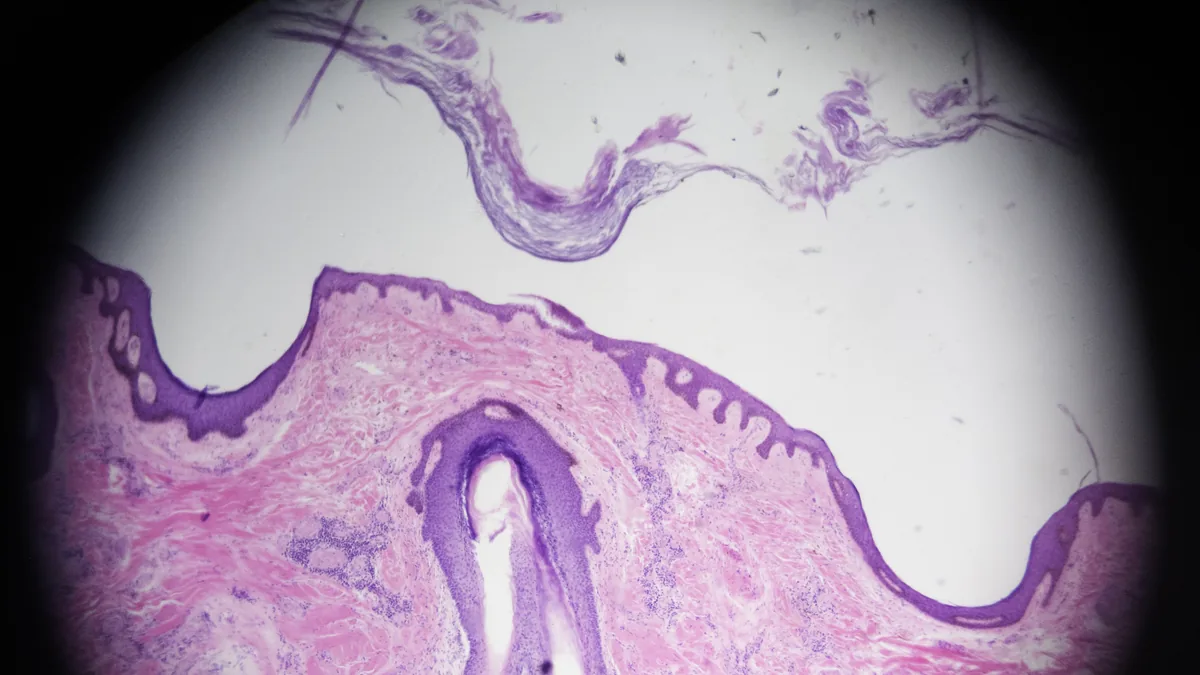
A stained section of scalp skin. A hair follicle and its oil glands sit just below the surface. Photo: Lazar.zenit, CC BY-SA 4.0, via Wikimedia Commons, cropped.
The follicle has to be alive for any of this to apply. A drug that wakes dormant stem cells cannot restore follicles that have been lost for good. Our guide to dead hair follicles explains how to tell a sleeping follicle from a scarred one.
What Do the PP405 Trials Show?
Three registered trials give the clearest picture. All of them are listed on ClinicalTrials.
Trial
Phase
Who
Status on 04.11.2026
NCT06393452
Phase 2
78 adults with androgenetic alopecia
Completed
NCT07819435 (AWAKEN)
Phase 2/3
About 600 adult men
Recruiting
NCT07907783
Phase 2
About 200 adult women
Not yet recruiting
The Phase 2a Result
The completed Phase 2 study enrolled 78 men and women. It was randomized and placebo controlled, with PP405 applied once a day for 4 weeks and follow-up to 12 weeks. Its main goal was safety, and hair growth was an exploratory measure, so it was never designed to prove that the drug works.
Here is what Pelage reported in June 2025:
Safety: PP405 was well tolerated, and no systemic absorption was detected.
Efficacy signal: At week 8, in men with more advanced hair loss, 31% of those on PP405 had a hair density increase above 20%, versus 0% on placebo.
Source of the numbers: the company press release, not a peer-reviewed paper. The release gives no p-value.
An independent trade report in Dermatology Times (March 2026) said that treated groups showed more follicular units and terminal hairs than placebo, where gains were limited to fine vellus hairs. It gave no numeric values, and it noted that the study was not powered for efficacy.
The AWAKEN Trial
AWAKEN is the study that should answer the real question. Pelage announced in October 2026 that the first patient had been dosed, after a positive end-of-Phase-2 meeting with the US Food and Drug Administration. The details released so far:
Participants: about 600 adult men in the US and Canada with Norwood-Hamilton stage IV or V hair loss
Measures: non-vellus target area hair count, a patient-reported outcome and follicular reactivation
Registry dates: primary completion is estimated for December 2027 and full completion for June 2028
A trial that started in September 2026 and runs for 12 months cannot report in 2026. Any article claiming Phase 3 results today is not describing real data.
When Will PP405 Be Available?
No release date has been published. A trial that finishes in mid-2028 has to be analysed, submitted to regulators and reviewed before a product can be sold. Pelage has not announced a filing date, a price or a launch market.
It helps to separate what is known from what is not:
Public: trial phases, patient numbers, registry dates and the company's Phase 2a headline results
Not public: approval date, price, launch countries, final strength and instructions for use
Not tested yet: long-term safety beyond the short Phase 2 exposure, and results in women
Any website that sells "PP405" today is not selling an approved product. Do not buy it, and do not accept a pharmacy or online shop offering it.
Will PP405 Cure Baldness?
No result so far supports the word "cure". Pattern hair loss is a lifelong tendency, and the NHS notes that some types of hair loss, including male and female pattern baldness, are permanent. A drug that restarts follicles would more likely be a treatment that needs to be kept up, like the ones in use now, though that is unknown for PP405 until the trials report.
The realistic hopes for PP405, if the Phase 2/3 data hold up, are narrower:
Thicker, more terminal hairs in areas where follicles are thin but alive
A topical option that may act mainly on the scalp, since no systemic absorption was detected in Phase 2a
A new option for people who cannot tolerate or do not respond to current treatments
None of these is proven. The 31% figure also means most men on PP405 did not reach that 20% density threshold in that analysis.
PP405 vs Minoxidil, Finasteride and Hair Transplant
The table compares what each option does, not who wins, because PP405 has no head-to-head data against anything.
PP405
Minoxidil
Finasteride
Hair transplant
Status
Investigational
Approved
Approved for men
Established procedure
Aim
Wake dormant follicle stem cells
Prolong growth phase, widen follicles
Lower DHT
Move living follicles to thin areas
Form
Topical, once daily in trials
Topical
Tablet
Surgery
Evidence
One small Phase 2a, company reported
Decades of use
Decades of use
Decades of use
Proven in a Phase 3 trial
Not yet
Yes
Yes
Not applicable
A few practical points follow from this comparison:
Minoxidil and finasteride work today. They are the treatments with long track records, and they need to be used consistently to keep their effect.
PP405 is not a replacement for them yet. No study has tested PP405 alongside either one, so there is no data on whether they combine well. That is unknown.
A transplant moves hair; a drug changes the hair you have. Transplanted follicles are taken from the donor area, which is resistant to the hormone behind DHT hair loss, so they tend to keep growing in the new area.
If you have male pattern baldness now, waiting for an unapproved drug has a cost. A drug that only works on living follicles has less to work with the more hair is lost, so an early assessment is useful. Decisions like this belong with a doctor who has examined your scalp.
Should You Wait for PP405?
For most people the practical answer is not to put decisions on hold. The earliest possible approval is years away, based on the registry dates, and the outcome of AWAKEN is unknown.
This is general information, not medical advice. Do not start, stop or combine hair loss treatments on your own. Ask a doctor who has examined your scalp, especially if you are taking other medicines.
Questions worth bringing to a consultation:
Is my hair loss a pattern type, or a shed from another cause such as illness, stress or medicine?
How much of the thin area still has living follicles?
Which proven option fits my age, health and goals today?
Would a transplant make sense now, and how would a future drug fit around it?
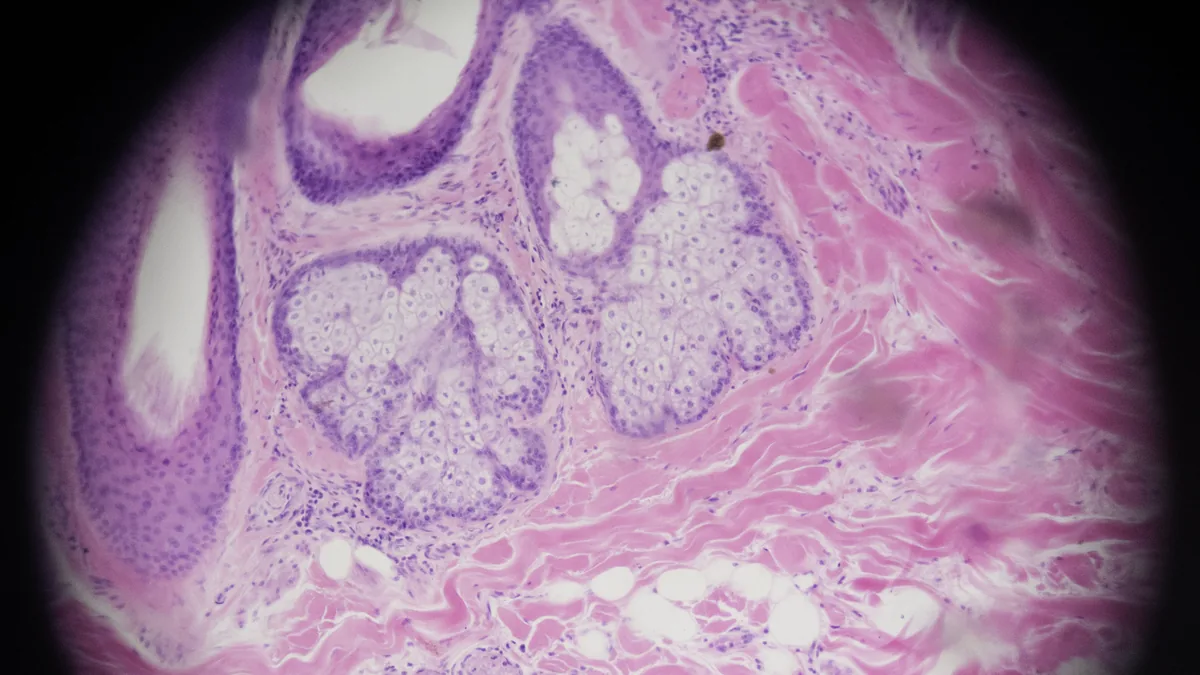
Sebaceous glands next to hair follicles in a stained scalp section. Photo: Lazar.zenit, CC BY-SA 4.0, via Wikimedia Commons, cropped.
Frequently Asked Questions
What Is PP405 for Hair Loss?
PP405 is an experimental topical gel from Pelage Pharmaceuticals that aims to reactivate dormant hair follicle stem cells. It is a mitochondrial pyruvate carrier inhibitor, and it is in clinical trials, not on sale.
Is PP405 Real or Fake?
It is a real drug candidate with registered trials on ClinicalTrials.gov (NCT06393452, NCT07819435 and NCT07907783). It is not an approved product, so any shop selling it should be treated as unreliable.
When Will PP405 Be Available?
Unknown. No approval or launch date has been published. The AWAKEN trial is estimated to finish in 2028, and regulators would have to review the results afterwards.
Does PP405 Work?
There are early signs. In the company's Phase 2a study, 31% of men with more advanced loss on PP405 had a density gain above 20% at week 8, against 0% on placebo. The study was small and the result is not peer reviewed, so the larger AWAKEN trial is needed to confirm it.
Will PP405 Cure Baldness?
No evidence supports a cure. Pattern hair loss is long term, and a treatment that works would probably need to be continued. What PP405 can do beyond the trial period is not yet known.
Is PP405 Better Than Minoxidil?
Nobody knows. No study has compared the two directly, and minoxidil has decades of data behind it while PP405 has one small Phase 2a result.
Will PP405 Work for Women?
Not yet known. The Phase 2a study included men and women, but the efficacy signal Pelage highlighted was in men. A separate Phase 2 trial in women is listed as not yet recruiting.
Thinning Hair Now? Get a Clear Picture First
Whatever happens with PP405, the first step is the same: find out what kind of loss you have and how much living hair is left. Send clear photos of your hairline and crown for a free hair analysis, and the medical team will tell you whether treatment, a transplant or watchful waiting fits your case. Turkey Hair Center is a Ministry of Health authorized health-tourism intermediary; procedures take place at authorized partner hospitals.
Medical disclaimer: This article is for informational purposes only and is not medical advice. Individual results and recovery vary from person to person. Always follow the written aftercare plan from your own medical team.
Sources and medical review
Pelage Pharmaceuticals. Pelage Pharmaceuticals announces positive Phase 2a clinical trial results for PP405 in regenerative hair loss therapy, 17.06.2025. Company press release
Pelage Pharmaceuticals. PP405 AWAKEN trial first patient dosed, 14.10.2026. Company press release
Pelage Pharmaceuticals. PP405 impact on follicular regeneration at AAD 2026, 18.03.2026. Company press release
Pelage Pharmaceuticals. Pelage presents late-breaking data at AAD 2024 demonstrating PP405 activates human hair follicle stem cells ex vivo and in Phase 1 clinical study, 09.03.2024. Company press release
ClinicalTrials.gov. NCT06393452: Safety, pharmacokinetics and efficacy of PP405 in adults with androgenetic alopecia. US National Library of Medicine trial registry
ClinicalTrials.gov. NCT07819435: Phase 2/3 efficacy and safety of PP405 in adult males. US National Library of Medicine trial registry
ClinicalTrials.gov. NCT07907783: PP405 Phase 2 study in adult females. US National Library of Medicine trial registry
Weng C, Gil D, Bosslett M. Reactivating the follicle: PP405 moves toward late-stage trials for alopecia. Dermatology Times, 28.03.2026
Send three photos: front, top and sides. You get a technique recommendation, a graft range and a straight answer about what is achievable, before anyone talks about price.
Your details are with the team
A patient coordinator will get back to you shortly. If you would like to send your photos now, WhatsApp is the fastest way to do it.