Does Hair Growth Serum Work? Timeline & How to Use
Performed at authorized partner hospitals Turkey Hair Center is a Ministry of Health authorized health-tourism intermediary, not a clinic.
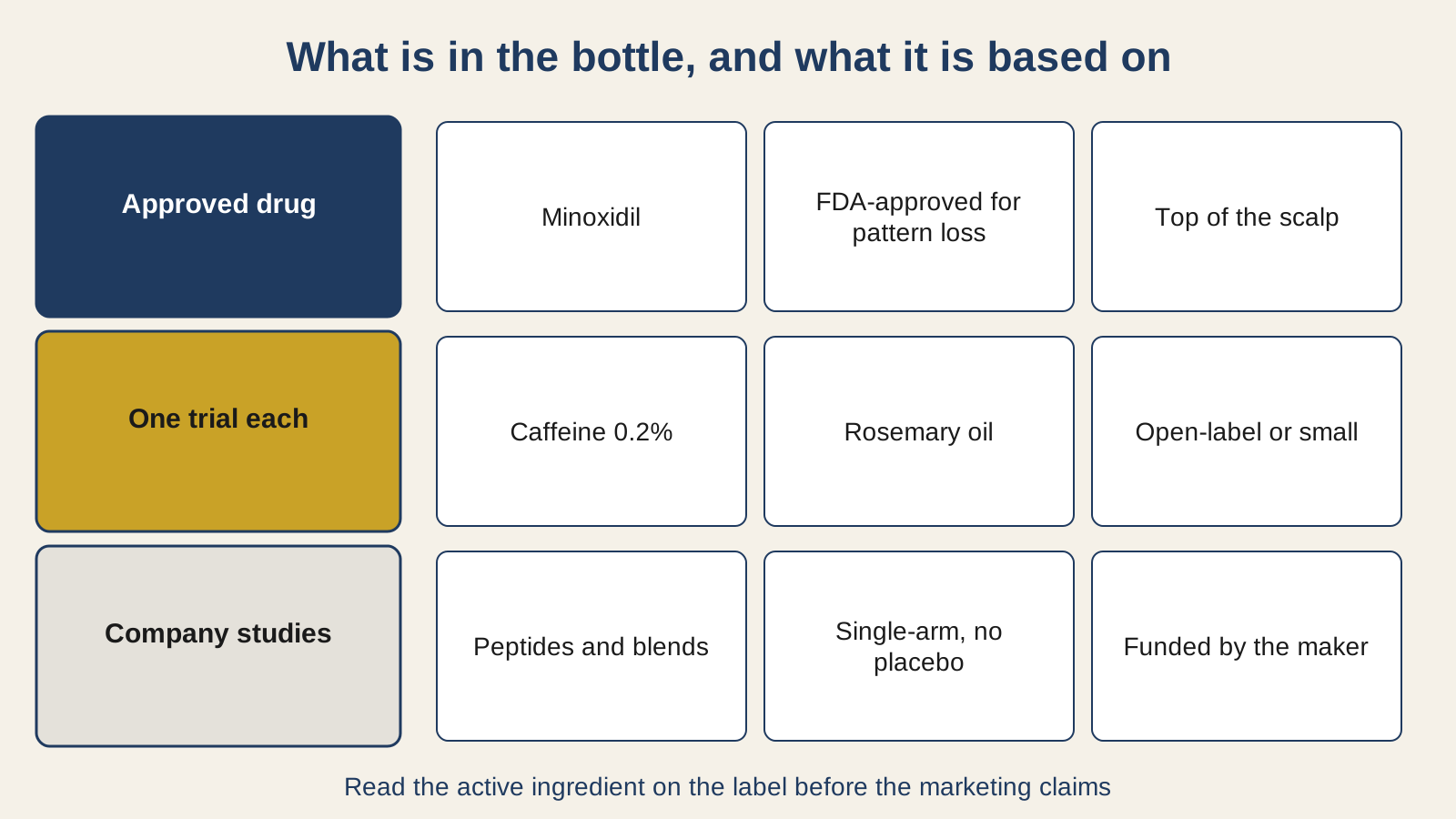
A hair growth serum works only if it contains an ingredient that has been tested, and for most people that means minoxidil, the one FDA-approved topical drug for pattern hair loss. Serums built on caffeine or rosemary have one trial each, while peptide and botanical blends rest mostly on small studies paid for by the brand.
So, does hair growth serum work? Some do, slowly and only while you keep using them, on the type of hair loss they were tested for. This guide explains how long a serum takes, how to apply it, which ingredients have evidence, what the side effects are, and when a serum is the wrong tool for your hair loss.
When to Apply Hair Growth Serum?
Follow the timing on the product label. For minoxidil, the label sets how many times a day to apply it and warns that using more, or using it more often, will not improve results. For cosmetic serums, the brand's directions are the only guide, because most have not been tested with different schedules.
A few habits help whatever the product:
Apply it at the same times each day so you do not skip doses.
Use it on the area of hair loss, as the minoxidil label directs.
Keep it away from the eyes, and rinse with water if it gets in.
Wash your hands after applying so it does not spread to your face.
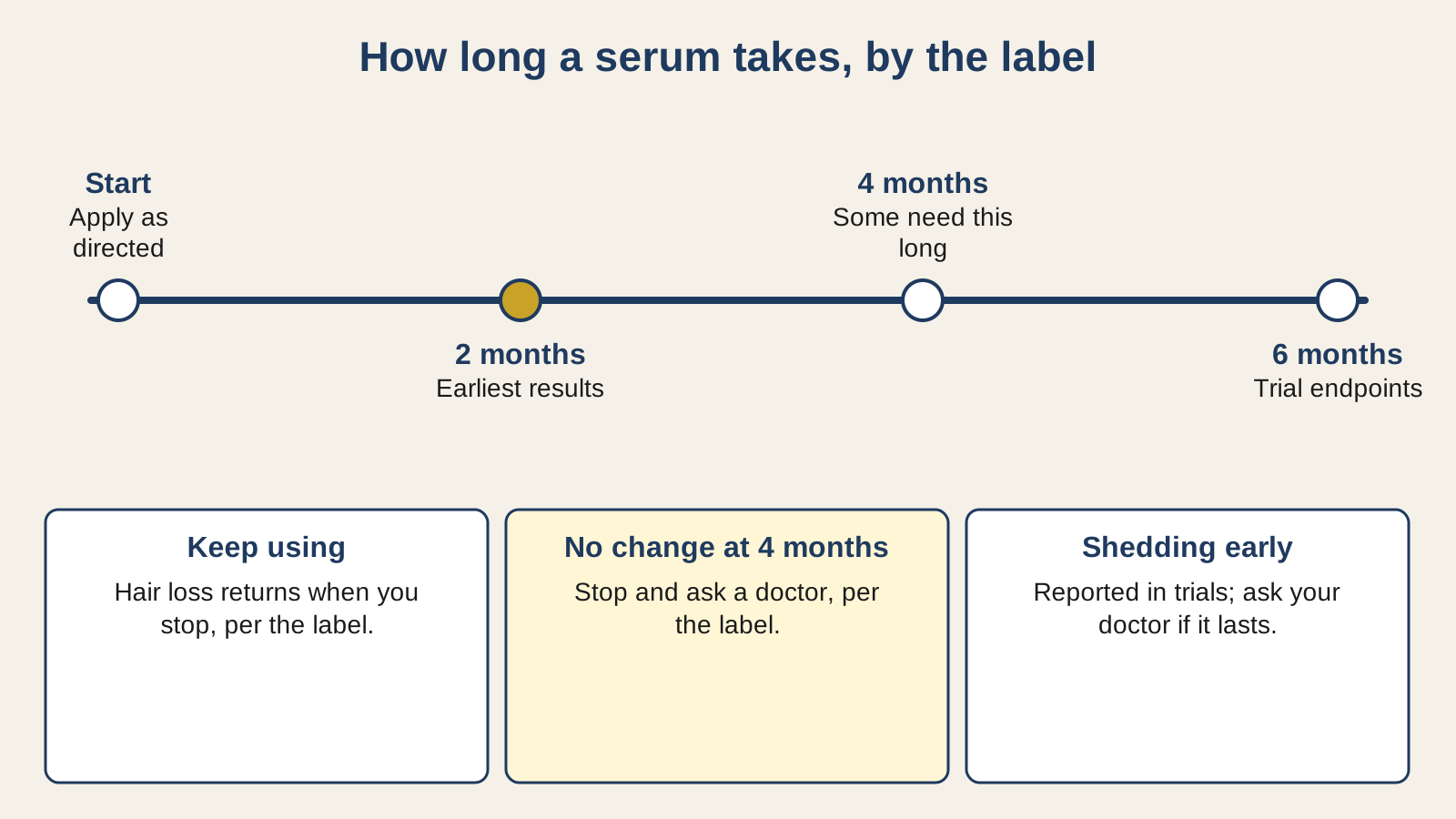
Consistency matters more than the time of day. The minoxidil label says continued use is needed to keep any regrowth, and that hair loss will begin again if you stop.
Apply to the Scalp, Not the Hair Lengths
The minoxidil label directs you to apply it directly onto the scalp in the hair loss area. A serum spread along the hair lengths does not reach the follicles where hair grows. In the company trial of one rosemary serum, it was sprayed onto a clean scalp and massaged in. Part your hair into rows so the product touches skin, not just hair.
What Is the Most Effective Hair Growth Serum?
Among topical products, minoxidil has the strongest evidence and is FDA-approved for pattern hair loss. Pattern loss is driven by the hormone DHT, explained in our DHT and hair loss guide. A 2024 review notes that only finasteride and minoxidil are FDA-approved treatments for it, and finasteride is a tablet, not a serum.
Two other ingredients have a trial each. In 2017, a caffeine 0.2% liquid was compared with minoxidil 5% in 210 men for 6 months and was judged no worse; the trial was open-label, so participants knew what they used. A 2015 trial compared rosemary oil with minoxidil 2% in 100 people and found similar gains at 6 months.
Supports Hair Growth Cycle
Hair grows in cycles: a long growing phase called anagen, a short transition and a resting phase. DHT shortens anagen in pattern loss. Minoxidil is thought to help keep follicles in anagen, and a lab study found caffeine counteracted the effect of testosterone on hair follicles.
Hair Growth Serums: Side Effects and Safety
Most side effects of serums are on the scalp. In a 2002 study of people with allergic reactions to minoxidil solution, patch tests showed that propylene glycol, an ingredient used to dissolve the drug, was the cause in most cases, not minoxidil itself. Irritation from this ingredient led to foam versions made without it.
The minoxidil label lists reasons to stop and ask a doctor:
Chest pain, a fast heartbeat, faintness or dizziness.
Sudden, unexplained weight gain or swollen hands or feet.
Scalp irritation or redness.
Unwanted facial hair growth.
No regrowth after 4 months.
Can Hair Growth Serums Cause Shedding?
Yes, for minoxidil. A 2019 review of minoxidil lists a trial in women where hair shedding was reported by 12.5% of foam users and 17.5% of solution users. The same review notes that stopping treatment leads to shedding within 3 to 4 months. If shedding is heavy or lasts, ask your doctor.
Who Should Avoid Using These Serums?
The men's 5% minoxidil label says not to use it if you are a woman, if your hair loss is on the front of the scalp, or if it is sudden or patchy. It warns that it may be harmful during pregnancy or breastfeeding. Anyone with a red, sore or broken scalp should see a doctor before applying any serum.
How Long Does Hair Growth Serum Take to Work?
According to the minoxidil label, results may appear at 2 months with twice-daily use, but some men need at least 4 months. The caffeine and rosemary trials measured results at 6 months, and the rosemary trial saw no change at 3 months in either group.
Hair is slow because it follows its cycle. Scalp hair grows about 0.35 mm a day, so even a working serum shows little in the first weeks. Judge any product over months, take photos in the same light, and stop and see a doctor if nothing changes by the point the label gives.
How Do Serums Help with Hair Growth?
Serums work in different ways depending on the active ingredient:
Ingredient
How it is thought to work
Best evidence
Minoxidil
Keeps follicles in the growing phase longer
FDA-approved for pattern loss
Caffeine
Counters testosterone's effect on follicles in the lab
One open-label trial vs minoxidil 5%
Rosemary oil
Unclear
One trial vs minoxidil 2%
Peptides and plant blends
Claimed follicle support
Company-funded, mostly without placebo
Peptide serums are often marketed as a gentle alternative. In one 2025 study of a rosemary and peptide serum, 32 women used the product for 120 days with no placebo group, and the study was funded by the company that sells it. Single-arm studies cannot show how much change would have happened anyway.
Before buying, find the active ingredient and its strength on the label. If the label lists only botanical names and branded complexes, the product has not been held to drug-level testing.
Nutrafol Hair Serum
Nutrafol sells a topical serum, but the clinical trials behind the brand are of its oral capsules, not the serum. A 2025 trial in men with thinning hair found more participants rated as improved with the capsules than with placebo; it was funded by the company, and company staff were among the authors.
So the trial results cannot be transferred to the serum. If you want to try it, treat it like any cosmetic serum: check the ingredient list, patch test it, and judge it over months.
See a dermatologist before using any serum if your hair loss is sudden, patchy or spreading quickly, or if your scalp is red, scaly or sore. These can be signs of alopecia areata, infection or another condition that a serum will not treat.
Frequently Asked Questions
Does Hair Growth Serum Work on Facial Hair?
Minoxidil is used off-label for facial hair, and a 2025 review of 19 trials found it can enhance facial hair, though many trials had a risk of bias. The men's scalp product label says not to apply it to other parts of the body, so talk to a doctor first.
Does Hair Growth Serum Work on Eyebrows?
In a 2023 trial of 60 people with sparse eyebrows, minoxidil 2% gel and bimatoprost gel both improved eyebrow scores, with no significant difference between them. This is off-label use near the eyes, so it should be supervised by a doctor.
Does Hair Growth Serum Work on Beards?
Beard enhancement is an off-label use of minoxidil described in medical reviews. Results vary, and the scalp product label does not cover the face. A doctor can tell you whether it is suitable and which side effects to watch for.
Does Hair Growth Serum Work on Receding Hairline?
The men's 5% minoxidil label states that it is not intended for frontal baldness or a receding hairline; it is labelled for the top of the scalp. A receding hairline is often pattern loss, which you can stage on the Norwood scale.
Does Hair Growth Serum Work on Eyelashes?
Scalp serums are not meant for the eyes. Bimatoprost solution is FDA-approved for sparse eyelashes. Its label warns of eye itching, redness, skin darkening and brown iris colour changes that are likely to be permanent. Ask an eye doctor before using any lash product.
Does Hair Growth Serum Work on Bald Head?
The trials we cite enrolled people with mild to moderate hair loss, and the minoxidil label refers to moderate hair loss on the top of the scalp. We found no trial showing regrowth on a fully bald scalp. For advanced loss, a doctor can discuss other options.
Does Hair Growth Serum Work for Alopecia?
Minoxidil is approved for pattern hair loss and is used off-label in alopecia areata, according to a 2019 review. Alopecia areata is an autoimmune condition, so a dermatologist should diagnose and treat it. Cosmetic serums have not been shown to help.
Does Hair Growth Serum Work on Dandruff Scalp?
Dandruff is a separate problem. The NHS recommends anti-dandruff shampoos with ingredients such as ketoconazole, coal tar or salicylic acid. If the scalp is red or swollen, or dandruff lasts beyond 4 weeks of treatment, see a GP before adding a serum.
Is Your Hair Still Thinning?
If you have used a serum for months and still see thinning, the cause may need a different approach. Our guide to the reasons for hair loss covers the common ones. Send clear photos for a free hair analysis, and the medical team will tell you what they see. You can also compare oils for hair growth and what each one has been tested for.
Medical disclaimer: This article is for informational purposes only and is not medical advice. Individual results and recovery vary from person to person. Always follow the written aftercare plan from your own medical team.
Bin Rubaian NF, Alzamami HFA, Amir BA. An overview of commonly used natural alternatives for the treatment of androgenetic alopecia, with special emphasis on rosemary oil. Clinical, Cosmetic and Investigational Dermatology, 2024;17:2495-2503
Dhurat R, Chitallia J, May TW, et al. An open-label randomized multicenter study assessing the noninferiority of a caffeine-based topical liquid 0.2% versus minoxidil 5% solution in male androgenetic alopecia. Skin Pharmacology and Physiology, 2017;30(6):298-305
Fischer TW, Hipler UC, Elsner P. Effect of caffeine and testosterone on the proliferation of human hair follicles in vitro. International Journal of Dermatology, 2007;46(1):27-35
Friedman ES, Friedman PM, Cohen DE, Washenik K. Allergic contact dermatitis to topical minoxidil solution: etiology and treatment. Journal of the American Academy of Dermatology, 2002;46(2):309-312
Patel M, Tuli N, Patel N, Merja A. A clinical evaluation of the safety, efficacy, and tolerability of the Soulflower Rosemary Redensyl Hair Growth Serum, Tetragain, in healthy female subjects for the treatment of alopecia. Cureus, 2025;17(1):e77066
Bhatia N, Ablon G, Farris PK, Hazan A, Raymond I. A randomized, double-blind, placebo-controlled study to evaluate the safety and efficacy of a nutraceutical supplement with standardized botanicals in males with thinning hair. Journal of Cosmetic Dermatology, 2025;24(1):e16778
Almutairi AG, Shadid A, AlAkrash L. Topical minoxidil effectiveness in enhancing facial aesthetics: a systematic review and meta-analysis. Journal of Family Medicine and Primary Care, 2025;14(11):4446-4456
Zaky MS, Hashem OA, Mahfouz SM, Elsaie ML. Comparative study of the efficacy and safety of topical minoxidil 2% versus topical bimatoprost 0.01% versus topical bimatoprost 0.03% in treatment of eyebrow hypotrichosis: a randomized controlled trial. Archives of Dermatological Research, 2023;315(9):2635-2641
Natarelli N, Gahoonia N, Sivamani RK. Integrative and mechanistic approach to the hair growth cycle and hair loss. Journal of Clinical Medicine, 2023;12(3):893
Van Neste D. Thickness, medullation and growth rate of female scalp hair are subject to significant variation according to pigmentation and scalp location during ageing. European Journal of Dermatology, 2004;14(1):28-32
Send three photos: front, top and sides. You get a technique recommendation, a graft range and a straight answer about what is achievable, before anyone talks about price.
Your details are with the team
A patient coordinator will get back to you shortly. If you would like to send your photos now, WhatsApp is the fastest way to do it.
We respond quickly, day or night, in your language.
Multilingual team, no obligation
Data protectedKVKK and GDPR compliant, 100% confidential
Authorized Health Tourism Intermediary
Turkey Hair Center is the hair-restoration brand of Healthy Way Tourism, an authorized international health-tourism intermediary. All medical procedures are performed by licensed medical professionals at authorized healthcare facilities in Turkiye, in accordance with the regulations of the Ministry of Health.