How dead, dormant and miniaturized follicles differ, which kinds of hair loss destroy follicles for good, how a doctor tells them apart and when only a transplant can restore hair.
12sources
12in PubMed
10min read
Written by Nazmi Güldeş, Certified Trichologist · Medically reviewed by Dr. Teuku Adifitrian, Sp.BP-RE (Dr. Tompi), Plastic, Reconstructive and Aesthetic Surgeon · Last reviewed 31 October 2026
Reading level
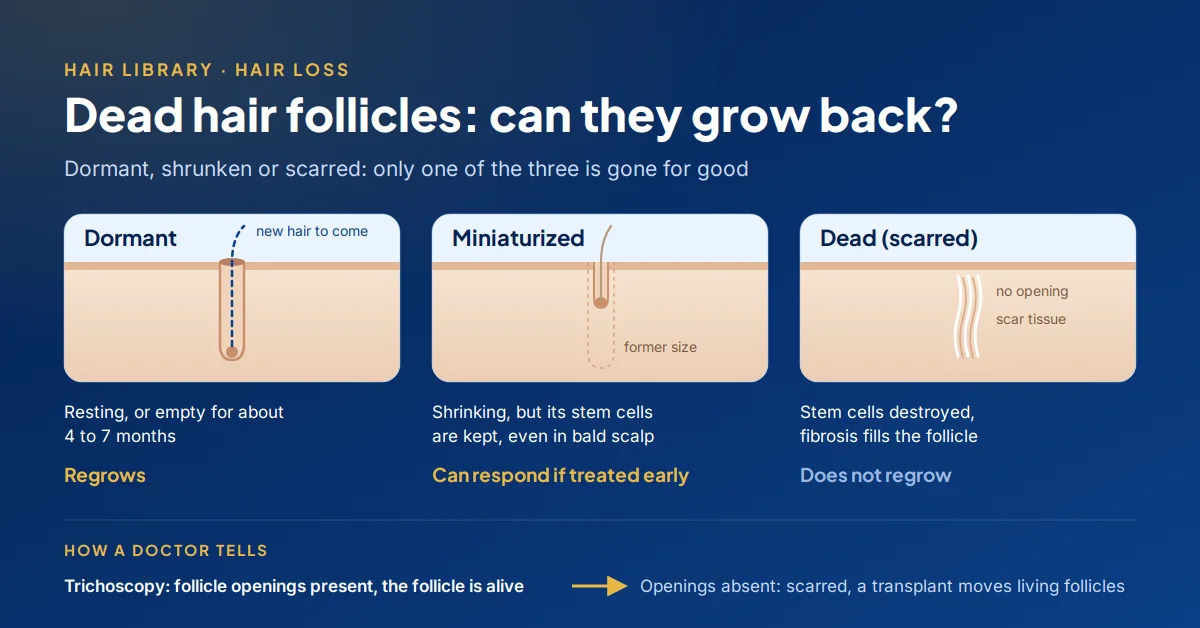
Dead hair follicles don't grow back, but many follicles that look dead are not. A follicle is dead when its stem cells are lost and scar tissue takes its place. Resting and shrinking follicles can leave the skin looking just as bare, yet they are alive, and many can make hair again.
So the real question is which of the three you have, and a magnified look at the skin often answers it.
1Quick answerThe short answer, in a few sentences
Can Dead Hair Follicles Grow Back?
No. When scarring alopecia destroys a follicle's stem cells, fibrous tissue takes its place and the loss is permanent.[1] Dormant and miniaturized follicles are a different story: they are alive, and many can grow hair again, on their own or with treatment. Where follicles have died, a transplant can move living ones into the bare skin.
Bare skin alone doesn't tell you which kind you have, so don't write an area off before it has been examined.
2Complete guideFrom resting follicles to scarring and surgery
Dead, Dormant or Miniaturized: What Each Means
This is our guide to reading a bare or thinning area; the first-move column is our advice.
What you see
Likely follicle state
First move
What to expect
Sudden shedding all over, months after an illness or stress
Follicles are preserved; loss is often temporary[3]
Slow, patterned thinning
Miniaturized: shrinking but alive
Start treatment while hairs are still fairly thick
Follicles still making thick hair responded to finasteride; very thin ones did not[4]
Thinning at the hairline with tight styles
Traction: reversible early, scarred late
Loosen your styles now
Early loss is reversible; late loss may need a transplant[5]
Bare patch with no follicle openings
Dead: scarred
Dermatologist, trichoscopy, sometimes a biopsy
Treatment aims to prevent further loss; regrowth isn't expected[6]
Dormant Follicles: Resting, Not Dead
A dormant follicle is resting, or sits empty after shedding its old hair until a new one starts. That empty gap, called kenogen, lasts about 4 months and can stretch to about 7.[8] Our hair growth cycle entry explains the phases.
Telogen effluvium, the shedding of resting (telogen) hairs that can follow an illness or a stressful event, is non-scarring. In alopecia areata, immune cells gather around the bulb, but the follicle itself is preserved.
Miniaturized Follicles: Shrunken but Alive
In pattern hair lossGlossaryAndrogenetic alopecia, or pattern baldness, is the pattern hair loss behind most male and female thinning. It is primarily driven by genetic predisposition and sensitivity to androgen hormones. Open in the glossary →, sensitive follicles shrink over time and make ever finer hair. They are alive, and their stem cells stay in place even where the scalp looks bald; what appears to fail is the step from stem cells to progenitor cells.
Why some follicles react to DHTGlossaryDihydrotestosterone (DHT) is a potent androgen that the body makes from testosterone using an enzyme called 5-alpha reductase. In people who are genetically sensitive to it, DHT makes hair follicles shrink. Open in the glossary → is covered in DHT and hair loss. Our vellus vs terminal hair entry shows the shrinking. The stages in men are in male pattern baldness.
Dead Follicles: Scarring Alopecias
In scarring alopecias, the follicle loses the stem cells in its bulge, through inflammation or because they turn into scar-forming cells. Without them the follicle can no longer make hair, and fibrous tissue takes its place.[1]
Several diseases do this, and folliculitis decalvans is the most common neutrophilic form. Traction alopecia is linked to tightly pulled styles: it begins as reversible loss and later scars, and stopping those styles is the main treatment.
Can Long-Standing Pattern Hair Loss Kill Follicles?
Usually not in the scarring sense: in men, even bald scalp keeps its stem cells, though a subset of women develop a permanent form (below). The catch is that the most shrunken follicles may stop responding. In a four-year study, follicles already making hair under 40 micrometres kept shrinking during two years on finasteride.[4] So a follicle can be alive yet too small to respond to finasteride.
Dead Hair Follicles in Women
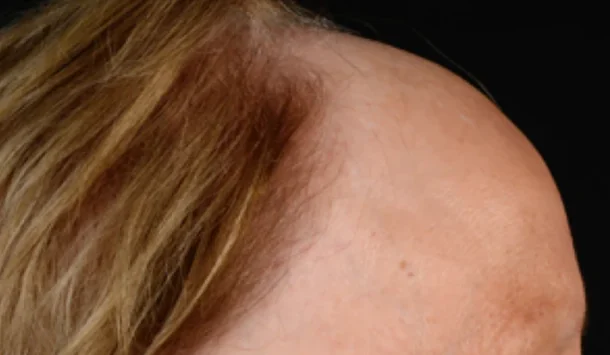
Female pattern hair loss is generally considered potentially reversible, but in a subset of women it turns permanent, with follicles dropping out in a scarring form.[9] Frontal fibrosing alopecia, shown below, and central centrifugal cicatricial alopecia are two other permanent types seen mainly in women.
Tight styles are another route: traction alopecia still scars hairlines in young women worldwide, most often at the front and temples.
Frontal fibrosing alopecia: the hairline has receded at the temple. Photo: Tziotzios C, Petridis C, Dand N, et al., Nature Communications 2019, CC BY 4.0, via Wikimedia Commons, cropped.
How to Tell If Hair Follicles Are Dead or Dormant
Three checks help tell them apart:
Pull test. In acute telogen effluvium, a gentle pull frees many hairs, and the test is used to confirm the diagnosis and its severity.[2]
Trichoscopy. Under magnification, visible follicle openings mean non-scarring loss, and missing openings mean scarring.[10] In 1,102 people with scarring alopecia, absent openings were the most consistent sign.[11]
Biopsy. A small skin sample examined under the microscope remains the gold standard for diagnosis. Trichoscopy helps choose the best spot to take it.
What Can Regrow, and When Only a Transplant Restores Hair
How to Stimulate Dormant and Miniaturized Follicles
A follicle can only be stimulated while it is alive, and what works depends on why it stopped. Shedding after a trigger usually settles by itself, and alopecia areata has its own treatments.
For miniaturized follicles, timing matters. Finasteride made follicles that still produced thick hair regrow sooner and grow for longer, while those already making very fine hair kept shrinking. The practical rule is to start while the thinning area still has thick hairs in it, not after they have all turned fine.
How to Regrow Hair on a Bald Spot
The cause decides whether hair can come back. One trichoscopy method first sorts hair loss into patchy, patterned or diffuse, then looks for follicle openings.
A well-defined bald patch can be alopecia areata, whose follicles are preserved and whose loss is often temporary.
Patterned thinning with ever finer hairs suggests pattern hair loss. Those follicles are alive, and the ones still making thick hair respond to finasteride. Our minoxidil entry covers that treatment in detail.
A patch with no follicle openings has scarred. Treatment aims to control inflammation and prevent further loss, not to regrow hair, and the transplant section below covers the options.
Where regrowth is possible, expect months rather than weeks: in one long study, an emptied follicle rested for about 4 to 7 months before a new hair appeared.[8]
When Follicles Are Gone: Hair Transplant
Scarred follicles don't come back. In folliculitis decalvans, for example, treatment aims to control inflammation, and regrowth cannot be expected.[6]
A transplant moves living follicles from the donor areaGlossaryThe donor area is the back and sides of the head, where follicles resist DHT. An extracted follicle does not grow back in that spot, so extractions are spread out, and the donor supply is the limit of every plan. Open in the glossary →, and they keep their traits in the new site.[12] It is used mainly for pattern hair loss, and also in end-stage scarring alopecia.
A transplant can make sense when:
pattern loss has left areas bare
a scarring alopecia has become inactive
traction alopecia has reached the scarred stage, where a transplant may be the only effective treatment[5]
It is the wrong answer when:
your follicles are only resting, since shedding after a trigger usually ends within 6 months
scarring disease is still active, since guidance on folliculitis decalvans considers a transplant only once it is inactive
your thinning hairs could still respond to medicine
Cloning and Camouflage
A 2025 review of hair transplantation lists follicle cloning among future directions, not current treatments, so hair on scarred skin comes from follicles moved in by a transplant. Our hair cloning entry follows that research. For covering bare skin instead, our scalp micropigmentation entry explains the cosmetic tattoo option.
Frequently Asked Questions
Can dead hair follicles be revived?
No. Scarring destroys the follicle irreversibly, its stem cells are gone, and expert guidance on folliculitis decalvans says regrowth cannot be expected.
Are my hair follicles dead or dormant?
If a doctor sees follicle openings under trichoscopy, the loss is non-scarring and the follicles are alive. Missing openings suggest scarring, which a biopsy can confirm.
How can you tell if hair loss is temporary or permanent?
Temporary loss usually has a trigger and an end: shedding that starts about 3 months after an illness or stress typically lasts up to 6 months. In pattern thinning, untreated follicles kept regressing in one long study, and skin without follicle openings means permanent scarring.
What do dead hair follicles look like on the scalp?
Under magnification, a scarred area shows no follicle openings. Active folliculitis decalvans can also show redness and scaling around the hairs, and pustules or crusts when it is more active.[6]
Can dead hair follicles be replaced?
Only with living follicles moved by a transplant. Our hair cloning entry covers the lab work on growing new ones.
Are damaged hair follicles permanent?
Not always. Damage that destroys the stem cells is permanent, but non-scarring loss leaves them in place, even in bald pattern-loss scalp. Traction shows the line clearly: it reverses early and scars late.
Does laser hair removal kill hair follicles?
We found no study we could cite that settles whether laser hair removal destroys follicles for good, so we make no claim either way.
What causes dead hair follicles?
Scarring alopecias such as folliculitis decalvans, frontal fibrosing alopecia and central centrifugal cicatricial alopecia, and traction that goes on too long. Our reasons for hair loss guide covers the wider list.
Is Your Hair Loss Permanent? Who Should Act Now
If a thinning area still shows fine hairs and follicle openings, the follicles are alive, so act early. A bare patch with no openings, especially a red or scaly one, needs a dermatologist's trichoscopy, and possibly a biopsy, before any other decision.
A transplant suits bare areas of pattern loss, and scarred areas once the disease is inactive; resting follicles usually recover on their own.
Send us three photos for a free hair analysis: the medical team will say whether your thinning looks like resting, shrinking or scarred follicles, whether to see a dermatologist first, and whether a transplant fits. You can also message us on WhatsApp.
About the Author
Written by: Nazmi Güldeş, Certified Trichologist. Nazmi Güldeş focuses on patient education around androgenetic alopecia, evaluating miniaturization through dermoscopy, and assessing candidates for medical treatments and hair transplants.
Editorial Policy & Trust
This entry was drafted with the help of AI writing tools and edited by our team, then medically reviewed by Dr. Teuku Adifitrian, Sp.BP-RE (Dr. Tompi) on 31 October 2026. AI is never used as a source: every study cited here was checked against PubMed on 31 October 2026. Key figures are marked with their source, and every source is listed at the end of this entry. Read how we work in our editorial policy.
3 questions
Test yourself
Check what you remember from this entry. Each answer links back to the section that explains it.
Under trichoscopy, what is the most consistent sign of scarred, dead follicles?
In 1,102 people with scarring alopecia, absent follicle openings were the most consistent sign. Visible openings point to non-scarring loss. Read the section
What did fully bald scalp in men with pattern hair loss still contain?
Bald scalp kept its hair follicle stem cells but lacked the progenitor cells that stem cells turn into on the way to new hair. Read the section
When is a hair transplant the wrong answer?
Guidance on folliculitis decalvans considers a transplant only in inactive disease. In late traction alopecia, a transplant may be the only effective treatment. Read the section
3Scientific evidenceStudy types, references and how to cite this entry
12sources
Evidence behind this entry: 12 publications indexed in PubMed (2002 to 2026): 7 reviews, 3 clinical studies, 1 guideline and 1 lab study. 4 sources have free full text.
Reviewsummarises many studies
Clinical studya study in people without random groups
Lab studytested on cells or hair follicles in the lab
Guideline or labela professional body, or the official drug label
Halley-Stott RP, Adeola HA, Khumalo NP. Destruction of the stem cell Niche, Pathogenesis and Promising Treatment Targets for Primary Scarring Alopecias. Stem Cell Reviews and Reports. 2020;16(6):1105-1120.ReviewPubMedDOI
Sharquie KE, Jabbar RI. COVID-19 infection is a major cause of acute telogen effluvium. Irish Journal of Medical Science. 2022;191(4):1677-1681.Clinical studyPubMedDOIFree full text
Pratt CH, King LE Jr, Messenger AG, et al. Alopecia areata. Nature Reviews Disease Primers. 2017;3:17011.ReviewPubMedDOIFree full text
Van Neste D. Natural scalp hair regression in preclinical stages of male androgenetic alopecia and its reversal by finasteride. Skin Pharmacology and Physiology. 2006;19(3):168-176.Clinical studyPubMedDOI
Akingbola CO, Vyas J. Traction alopecia: A neglected entity in 2017. Indian Journal of Dermatology, Venereology and Leprology. 2017;83(6):644-649.ReviewPubMedDOI
Waśkiel-Burnat A, Starace M, Iorizzo M, et al. Management of folliculitis decalvans: The EADV task force on hair diseases position statement. Journal of the European Academy of Dermatology and Venereology. 2025;39(8):1385-1394.GuidelinePubMedDOI
Garza LA, Yang CC, Zhao T, et al. Bald scalp in men with androgenetic alopecia retains hair follicle stem cells but lacks CD200-rich and CD34-positive hair follicle progenitor cells. The Journal of Clinical Investigation. 2011;121(2):613-622.Lab studyPubMedDOIFree full text
Rebora A, Guarrera M. Kenogen. A new phase of the hair cycle?. Dermatology (Basel, Switzerland). 2002;205(2):108-110.ReviewPubMedDOI
Olsen EA. Female pattern hair loss and its relationship to permanent/cicatricial alopecia: a new perspective. The Journal of Investigative Dermatology Symposium Proceedings. 2005;10(3):217-221.ReviewPubMedDOI
Katoulis AC, Pappa G, Sgouros D, et al. A Three-Step Diagnostic Algorithm for Alopecia: Pattern Analysis in Trichoscopy. Journal of Clinical Medicine. 2025;14(4).ReviewPubMedDOIFree full text
Kelati A, Waśkiel-Burnat A, Apalla Z, et al. Trichoscopy of Cicatricial Alopecia in Fair and Dark Skin: A Multicenter International Study of the EADV Task Force on Hair Diseases and the IDS Task Force on Trichoscopy. International Journal of Dermatology. 2026;65(8):1647-1667.Clinical studyPubMedDOI
Queen D, Avram MR. Hair Transplantation: State of the Art. Dermatologic Surgery. 2025;51(9):874-881.ReviewPubMedDOI
Güldeş, N. (2026, October 31). Dead hair follicles: Can they grow back?. Turkey Hair Center Hair Library. https://turkeyhaircenter.com/dead-hair-follicles/
@misc{guldes2026deadhairfollicles,
  author       = {Güldeş, Nazmi},
  title        = {Dead hair follicles: Can they grow back?},
  howpublished = {Turkey Hair Center Hair Library},
  year         = {2026},
  month        = oct,
  url          = {https://turkeyhaircenter.com/dead-hair-follicles/},
  note         = {Last updated 31 October 2026}
}
TY  - ELEC
AU  - Güldeş, Nazmi
TI  - Dead hair follicles: Can they grow back?
T2  - Turkey Hair Center Hair Library
PY  - 2026
DA  - 2026/10/31
UR  - https://turkeyhaircenter.com/dead-hair-follicles/
N1  - Last updated 31 October 2026
ER  -
Send three photos: front, top and sides. You get a technique recommendation, a graft range and a straight answer about what is achievable, before anyone talks about price.
Your details are with the team
A patient coordinator will get back to you shortly. If you would like to send your photos now, WhatsApp is the fastest way to do it.